PCB manufacturing PCB manufacturing
Home > Blog

PCB Supplier

PCB Quality Agreement Checklist for Fabrication and PCBA
Monday, August 17th, 2026
OEM and PCB supplier teams reviewing quality agreement responsibilities and board samples
A PCB quality agreement should convert expectations into named responsibilities, controlled evidence and clear release decisions before the first purchase order.

This PCB quality agreement checklist defines how a customer and PCB/PCBA supplier control specifications, acceptance, traceability, changes, nonconformance and performance. The agreement supplements the drawing, purchase order and commercial contract by assigning who must do what, which records prove it, and when customer approval is required.

This checklist is for engineering, supplier quality and purchasing teams preparing a new supplier, new product or higher-risk production program. It is not legal advice; liability, warranty, confidentiality, governing law and other legal terms should be reviewed by qualified counsel.

If a shipped board fails, can both parties point to the same approved file, acceptance rule, affected lot and corrective-action owner?

If the answer depends on assumptions scattered across quotations and emails, the quality agreement is incomplete.

EBest Circuit can review project-specific fabrication, PCBA, inspection, test and documentation requirements before quotation.

Send Gerber/ODB++, drawings, stackup, BOM/CPL when applicable, quantity, acceptance criteria, traceability depth, required records, change-control rules and target delivery. Final scope is confirmed from the released project package.

The 12 PCB Quality Agreement Clauses to Set Before a PO

Clause Required decision Observable evidence
1. Scope and roles Products, sites, processes and responsible contacts Approved responsibility matrix
2. Document authority Which file/revision governs conflicts Released package and acknowledgement
3. Engineering review DFM/EQ ownership and design authority Closed questions and approved deviations
4. Materials/sub-tier control Approved sources, substitutions and outsourced steps Source/lot/process records
5. Acceptance Inspection, test, sampling, limits and reports Job-linked results
6. Traceability/records Lot/panel/unit depth, retention and retrieval Retrievable history
7. Change notification Triggers, notice, approval and effectivity Approved PCN
8. Deviations/nonconformance Containment, authority and disposition NCR/deviation record
9. CAPA/complaints Response, root cause and effectiveness Closed corrective action
10. Audit/access Audit rights, confidentiality and record access Audit plan/findings
11. Performance Quality, delivery and escalation metrics Scorecard/review minutes
12. Continuity/exit Disaster, obsolescence, inventory and transfer Continuity/transition plan

Define Scope, Sites and Responsibility Owners

Name the legal entities, manufacturing sites, product families, bare PCB/PCBA scope, component sourcing, testing, packaging and any special process. Identify engineering, quality, purchasing and account contacts plus an escalation path. If different factories or subcontractors perform parts of the work, state who remains accountable for the finished result.

Set the Document Hierarchy and Design Authority

List the controlled inputs: purchase order, Gerber/ODB++ or IPC-2581, drill data, fabrication drawing, stackup, BOM, CPL, assembly drawing, test specification and approved engineering queries. Define which record wins when they conflict and how both parties confirm the released revision.

The supplier may propose manufacturability changes, but design authority must be explicit. Use the PCB engineering change order checklist when an approved design changes after release.

Agree on Materials, Sources and Sub-Tier Processes

Define approved laminate/material families, copper, finish, solder mask, components and any customer-controlled sources. State substitution rules, counterfeit/traceability expectations, storage/shelf-life controls and customer-supplied material responsibilities. Require control of outside finish, special processes, bare-board sources or test labs that can affect acceptance.

Write Inspection, Test and Shipment Acceptance Rules

A quality agreement should name applicable specifications, drawing requirements, sample or 100% checks, test methods, acceptance limits, required reports and shipment-release authority. Separate bare-board electrical/visual/dimensional evidence from PCBA AOI/X-ray/ICT/functional evidence. Do not use “standard inspection” when the buyer expects a specific record.

The PCB testing guide helps choose evidence matched to the build and risk.

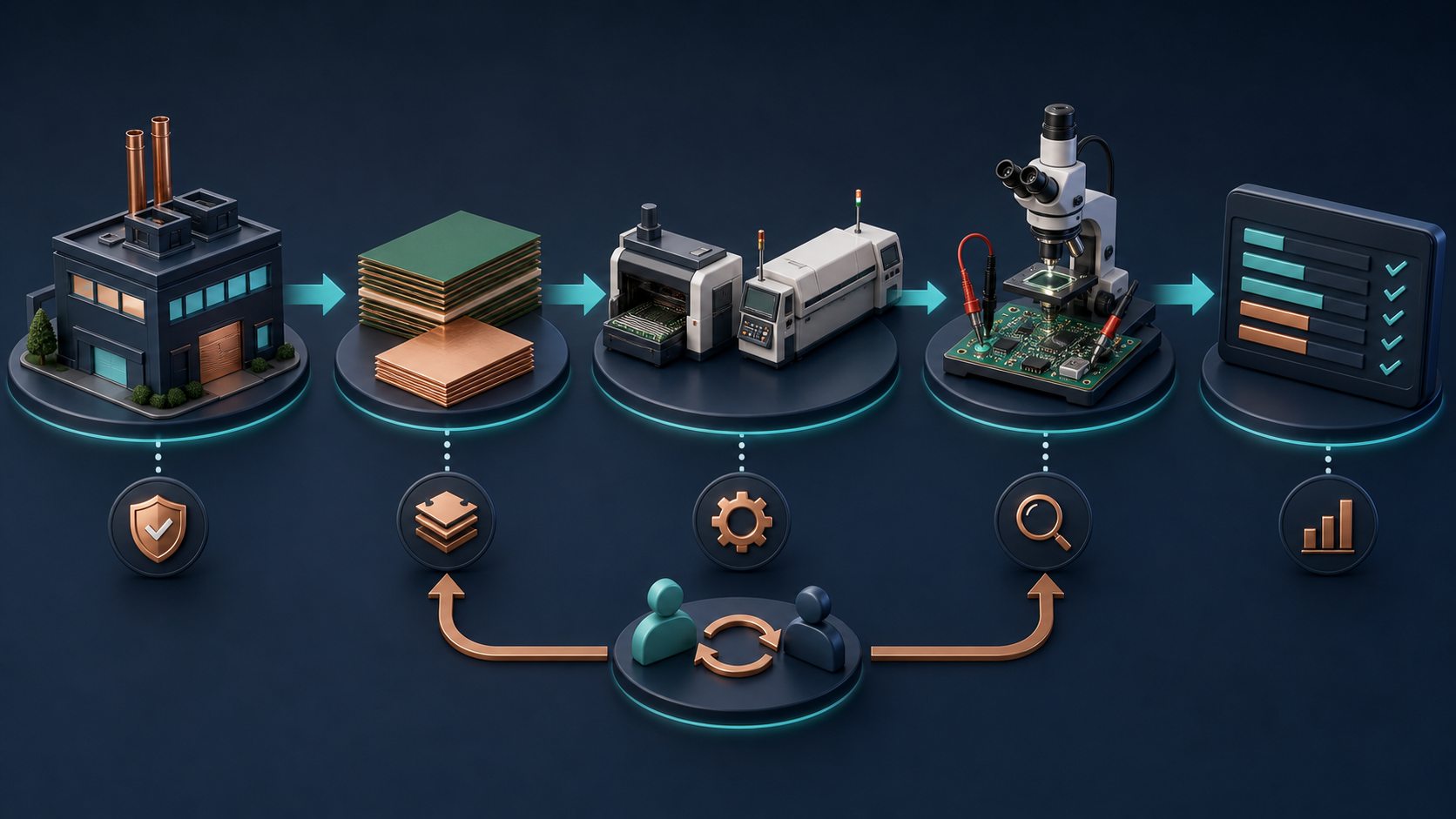
PCB quality agreement control loop for files materials inspection testing changes records and performance
Quality responsibilities form one loop: controlled inputs, qualified materials/processes, inspection, test, change control, records, corrective action and ongoing performance.

Specify Traceability Depth, Record Retention and Retrieval

Choose shipment, lot, panel or unit traceability based on risk and customer need. Define links to material/component lots, manufacturing order, revision, process/inspection/test records, rework and shipment. State retention period, format, access, backup and expected retrieval time. Avoid promising unit-level history if the agreed process only controls lots.

Control Supplier Changes, Deviations and Nonconformance

List material, process, site, equipment, subcontractor, design/configuration and supply-status changes that require notice and approval. The PCB supplier change notification checklist provides the PCN fields and effectivity gates.

Separately define temporary deviations and nonconforming product: containment, segregation, customer notification, material-review authority, use-as-is/rework/scrap/return decisions and traceability. The supplier should never treat shipment pressure as approval.

Define Complaint, CAPA and Effectiveness Requirements

Set who acknowledges a complaint, contains affected lots, provides interim status and submits root-cause/corrective-action evidence. Do not measure closure only by report date. Require verification that the cause was removed, related products/processes were reviewed and later production confirms effectiveness. Define how repeat or major issues escalate.

Set Audit Rights, Confidentiality and Record Access

Define planned and cause-based audit rights, notice, sites/processes in scope, remote/on-site access, customer/end-customer participation, confidentiality and corrective-action follow-up. Audit access should respect sensitive supplier information while still proving control. Use the PCB supplier audit checklist to connect clauses with evidence sampling.

Measure Supplier Performance and Escalation

Agree on a small set of defined metrics: accepted/defective quantity, escapes/returns, delivery, response time, CAPA aging and repeat findings. Define data source, calculation period, review frequency and escalation thresholds. A scorecard should trigger decisions—improvement plan, controlled new business, re-audit or disqualification—not exist as decoration.

Plan Business Continuity, Obsolescence and Supplier Exit

Address disaster recovery, capacity interruption, material/component obsolescence, EOL notice, last-time buy, customer-owned inventory/tooling, unfinished WIP and controlled transfer to another site or supplier. Define what records and approved data must be returned or transferred at termination. Legal ownership and liability terms belong with qualified contract review.

What to Send EBest Circuit Before Finalizing the Quality Scope

Use this PCB quality agreement checklist when sending the PCB/PCBA part and revision, released manufacturing files, application/risk context, quantity, acceptance criteria, test/report needs, traceability depth, record requirements, change-notification rules and target delivery. For assembly, include BOM/CPL, source restrictions, programming and functional-test inputs.

EBest Circuit can review the manufacturable quality scope and quotation assumptions for the project. The final agreement should identify what is feasible, which evidence will be delivered and which customer approvals remain required.

FAQ About PCB Quality Agreements

What is a PCB quality agreement?

It is an operational agreement assigning customer and supplier responsibilities for specifications, acceptance, traceability, changes, nonconformance, records and performance.

Is a quality agreement the same as a purchase order?

No. The PO places the order; the quality agreement defines continuing quality responsibilities and evidence.

Who should approve it?

Engineering, quality and purchasing should approve their responsibilities; legal counsel should review legal/commercial terms where appropriate.

Should prototypes need the same agreement as production?

Not always. Scale controls to risk, but even prototypes need clear files, acceptance, change authority and nonconformance handling.

What traceability level should be required?

Select shipment, lot, panel or unit depth from product risk and customer/regulatory needs, then confirm the supplier can execute it.

How are supplier changes controlled?

Define PCN triggers, notice, evidence, customer approval and the first affected lot/date/PO boundary.

What happens when quality performance declines?

Use agreed metrics and escalation: containment, corrective action, improvement plan, re-audit, restricted business or disqualification.

You may also like

PCB Supplier Change Notification Checklist for Process Changes
Monday, August 17th, 2026
Supplier and customer engineers reviewing PCB process change notification samples
A useful PCB supplier change notification gives the customer enough time and evidence to assess risk before the changed product enters a shipment.

A PCB supplier change notification (PCN) is the controlled notice a PCB or PCBA supplier sends before changing an approved material, process, site, equipment route, subcontractor or product configuration. It should describe the current and proposed states, affected items, reason, risk, qualification evidence, implementation boundary and requested customer decision.

The goal is not to generate more paperwork. It is to prevent an apparently minor supplier change from altering impedance, solderability, reliability, compliance, traceability, assembly behavior or long-term availability without the customer knowing which lots are affected.

Would your team learn about a material, factory or process change before the first changed PCB lot ships—or only after a quality problem?

If the purchase order and quality agreement do not define notification triggers, timing and approval authority, both customer and supplier may assume the other party owns the decision.

EBest Circuit can review project-specific PCB/PCBA change requirements and affected manufacturing data.

Send the controlled Gerber/ODB++, drawing, stackup, BOM/CPL if applicable, approved material/process requirements, quantity, validation needs and required notice/approval rules. Final feasibility and evidence depend on the released construction and change scope.

What a PCB Supplier Must Notify Before Making a Change

A supplier should notify changes that can affect the approved definition, manufacturing route, product performance, acceptance evidence or continuity of supply. The exact trigger list belongs in the purchase agreement, drawing, specification or supplier-quality agreement; it should not depend on one salesperson deciding whether a change seems important.

Notification does not automatically mean rejection. It creates a review gate so engineering, quality and purchasing can decide whether the change is equivalent, needs evidence, requires a limited qualification build or cannot be accepted.

PCB Change Triggers That Require Customer Review

Change area PCB/PCBA examples Customer question
Material Laminate, prepreg, copper foil, solder mask, surface finish chemistry, adhesive or approved component source Does form, fit, function, reliability or compliance change?
Process or equipment Lamination route, drilling/plating method, imaging, cleaning, soldering, rework, test or inspection method Is the output still controlled to the approved requirement?
Site or ownership Factory move, new line, merger, tooling transfer or different manufacturing entity Does qualification and traceability remain valid?
Subcontractor New outside finish, special process, bare-board source or assembly partner Who controls the external process and its records?
Design/configuration Stackup, panel, marking, BOM alternate, firmware or test limit proposed by the supplier Who has design authority to approve it?
Supply status Discontinuance, allocation, EOL material or emergency substitution What inventory and transition plan protects continuity?

PCN, ECO, Deviation and SCAR: Do Not Mix the Records

A PCN starts with the supplier and asks the customer to review a proposed product or process change. An engineering change order usually authorizes a customer-controlled design change. A deviation requests temporary permission to depart from an approved requirement. A supplier corrective action request (SCAR) addresses a failure and asks for root cause and corrective action.

One issue may require several linked records, but each has a different decision. The PCB engineering change order checklist covers customer-originated design release; this page controls supplier-originated change notice and approval.

Set Notice Timing by Contract and Risk, Not One Universal Number

There is no single notice period that fits every PCB program. Define the required advance notice in the contract or quality agreement and align it with qualification time, inventory exposure, regulatory/customer approval and supply continuity. A high-reliability material or site change may need more review than a documentation correction.

Emergency changes caused by obsolescence, disaster or sudden material unavailability still require prompt disclosure, containment and an agreed interim plan. “Emergency” should not silently turn a proposed substitution into an approved change.

Required Fields in a PCB Supplier PCN Template

PCN field Minimum useful content Approval value
Identity PCN number, supplier site, customer, affected part numbers/revisions and contacts Creates traceability
Current vs proposed state Specific before/after material, process, site, source or configuration Shows the real difference
Reason and risk Driver, urgency, known effects and potential failure modes Supports priority and depth
Affected scope Orders, inventory, WIP, finished lots and related products Defines containment
Qualification Test plan, comparison data, samples and acceptance criteria Makes equivalence observable
Effectivity Proposed date, PO, lot, date code or serial boundary Prevents mixed shipments
Decision Approve, reject, request evidence, limited approval or deviation Records authority and conditions

Assess Form, Fit, Function, Reliability and Supply Impact

Review the change against the released requirement, not only the supplier’s statement that it is “equivalent.” Check physical dimensions and interfaces, electrical behavior, thermal/mechanical performance, process compatibility, solderability, impedance, environmental/compliance documentation, inspection/test coverage, marking, traceability and service interchangeability.

Also review business impact: new tooling, MOQ, price, lead time, lifecycle, remaining old stock and the risk of splitting production between old and new states. A technically acceptable change can still create an uncontrolled supply transition.

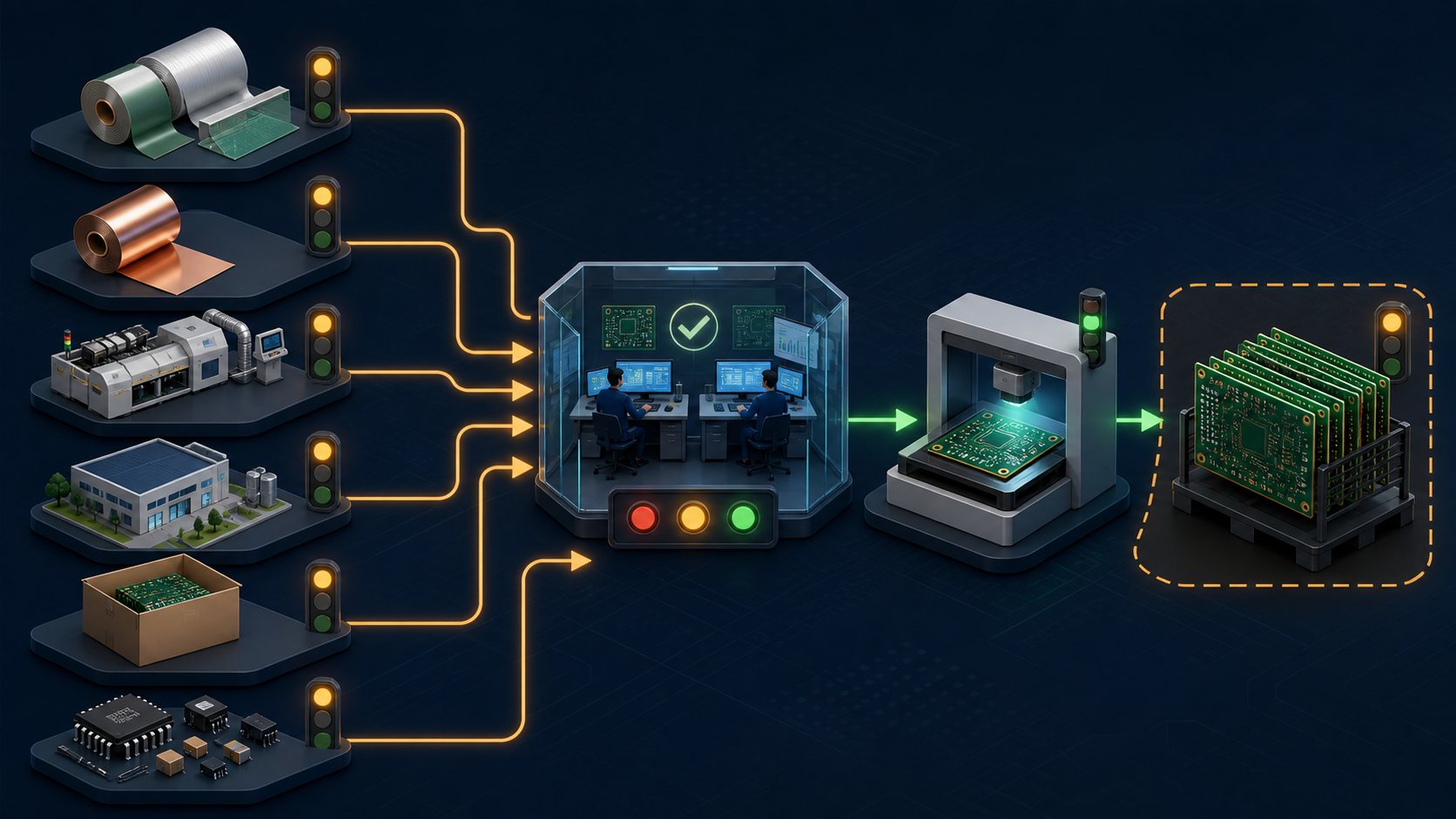
PCB supplier material process site and component changes routed through approval and validation
Material, process, site, subcontractor and component changes should converge at one controlled impact review before qualification and the first changed lot.

Route the PCN Through Engineering, Quality and Purchasing Approval

Engineering assesses design and performance impact. Quality defines qualification, traceability and acceptance evidence. Purchasing assesses price, inventory, continuity and contract terms. Regulatory or customer-program owners join when their requirements are affected. Assign one coordinator and one final authority rather than collecting disconnected email opinions.

Record open questions, owner, due date and disposition. The supplier should not implement the changed state until the required decision is issued, unless a documented emergency/deviation path explicitly authorizes it.

Define Qualification Evidence Before Approving the Change

Evidence should target the changed risk. A material/stackup change may require updated construction, impedance or reliability review. A finish or soldering-process change may require solderability, microsection, profile or assembly evidence. A site/equipment transfer may require first-article comparison and process capability evidence. A component-source change may need authenticity, package, electrical, lifecycle and functional review.

Define sample size, method, limits and records before testing. Use the PCB testing guide to distinguish bare-board from assembly evidence, and use the PCB supplier audit checklist when the change also affects site or process qualification.

Control Effectivity, Existing Inventory and the First Changed Lot

Approval should state which lot, date code, PO or serial number first uses the change. Identify old material, WIP and finished inventory, then decide whether it may be used, segregated, returned, reworked or exhausted under a controlled boundary. Require the first changed lot to carry the agreed identification and evidence package.

After approval, update drawings, specifications, approved-source records, incoming inspection and supplier records. Monitor early lots for the failure modes considered in the impact assessment.

Put Change-Notification Rules Into the PCB Quality Agreement

  • define product/material/process/site/subsupplier and supply-status triggers;
  • state the required advance notice or emergency escalation path;
  • name customer and supplier contacts plus approval authority;
  • prohibit implementation before required approval;
  • define PCN fields, evidence, sample and document format;
  • set effectivity, inventory, traceability and first-lot rules;
  • define what happens when a change is implemented without notice;
  • require flow-down to relevant sub-tier suppliers.

The custom PCB supplier guide helps connect these controls to RFQ and supplier selection.

What to Send EBest Circuit for a Controlled PCB Change Review

Send the affected PCB/PCBA part and revision, current and proposed state, reason, target timing, open orders, inventory/WIP status and required approval process. Include Gerber/ODB++, fabrication drawing, stackup and material/finish requirements; add BOM, CPL, assembly drawing, test and programming data for PCBA.

State the validation evidence you require and whether any customer, regulatory or service approval is involved. EBest Circuit can review project-specific feasibility, manufacturing impact and quotation, but the released files and agreed acceptance plan remain the basis of approval.

FAQ About PCB Supplier Change Notifications

What does PCN mean in PCB manufacturing?

PCN commonly means product or process change notification: a supplier’s controlled notice of a proposed change affecting an approved PCB or PCBA.

Which PCB changes require a PCN?

Define triggers contractually; typical areas include material, process, site, equipment route, subcontractor, source, product configuration, test and supply status.

Is a PCN the same as an ECO?

No. A PCN usually originates with a supplier; an ECO authorizes a controlled engineering design change.

How much advance notice is required?

Use the purchase/quality agreement and applicable customer or regulatory requirement. Do not assume one universal period.

Can a supplier implement a change before approval?

Only if the governing agreement allows it or a documented emergency/deviation approval authorizes it.

What should be checked in the first changed lot?

Confirm identification, approved effectivity, targeted qualification evidence, traceability and any enhanced inspection or test.

What if a supplier changed a process without notice?

Contain affected lots, identify the implementation boundary, assess risk, request records and decide disposition plus corrective action.

You may also like

PCB Supplier Audit Checklist for Fabrication and PCBA
Monday, August 17th, 2026
Quality engineers auditing PCB factory process evidence and board quality
A supplier audit should connect claimed capability to controlled processes, sampled records and closed corrective actions.

A PCB supplier audit checklist helps buyers verify whether a fabrication or PCBA supplier can repeatedly build the actual product—not whether its presentation looks impressive. The audit should test factory ownership, process control, traceability, inspection, change management, subcontracting and corrective action with current evidence.

Use it before awarding a high-risk program, after a major process/site change, when performance deteriorates, or when the product moves from prototype to production. Scale depth to board and application risk.

Can the supplier trace one shipped lot backward from test result to materials, process records, approved data and operators?

If not, certificates and equipment lists cannot prove control of your order.

EBest Circuit can support project-specific manufacturing review and evidence requests.

Send Gerber/ODB++, drawing, stackup, quantity, test/document needs and supplier-audit questions. Add BOM, CPL and acceptance criteria for PCBA. Exact capability remains subject to the released construction.

Decide Audit Scope From Product Risk

Define site, product family, processes and evidence period before scheduling. Consider technology complexity, safety/reliability consequence, volume, prior escapes, new equipment, special processes and subcontractors. A remote document audit may screen a supplier; critical work may require process observation and record sampling.

Request Evidence Before the Audit

  • legal entity, site address, organization and manufacturing/subcontracting map;
  • quality certificates with site, scope, issuer and validity;
  • process flow, control plan, inspection/test plan and sample traveler;
  • equipment, calibration, maintenance and capability evidence relevant to the proposed build;
  • material approval, storage, shelf-life and lot-trace procedures;
  • document/change control, nonconformance, CAPA and complaint procedures;
  • recent delivery, quality and corrective-action performance;
  • data security, business continuity and disaster-recovery controls.

Verify Factory Ownership and Subcontractors

Match the quotation to the physical site that performs each step. Identify who controls CAM, imaging, lamination, drilling, plating, solder mask, finish, routing, electrical test, SMT/THT, cleaning, programming and functional test. For every outsourced special process, verify approval criteria, incoming acceptance, traceability and change notification.

A trading office can provide useful service, but the buyer must know who owns product quality and who can retrieve original process evidence.

Audit QMS, Document Control and Change Authority

Sample one current job. Confirm the operator used the approved revision, traveler, stackup, work instructions and inspection limits. Check obsolete-file removal, access control, backup, retention and customer approval for material, stackup, process, site or subcontractor changes. The PCB CAM guide explains why front-end edits need visible authority.

Trace Materials From Receiving to Shipment

Select a finished lot and walk backward. Verify laminate/copper or component identity, supplier, receipt, inspection, lot/date code, storage condition, shelf-life controls, issue-to-job record and remaining inventory. Check how substitutions and customer-supplied material are segregated and approved. Do not accept a generic certificate that cannot be tied to the audited lot.

Review PCB Fabrication Process Controls

Process Audit evidence Failure to challenge
Imaging/etching Artwork revision, setup, inspection and trend records Width/spacing or registration drift
Drilling/plating Tool life, bath control, coupon/microsection and acceptance Hole quality and interconnect risk
Lamination Approved stackup, material lot, press cycle and verification Thickness, registration or reliability variation
Finish/profile/test Process control, dimensions, electrical test and final records Solderability, fit or escaped opens/shorts

Audit only the processes relevant to the proposed construction; confirm capability from evidence, not a universal marketing maximum. Use the DFM checklist to connect design risks to factory controls.

PCB supplier audit control loop covering factory materials process inspection and performance
Qualification is a loop: verify site, material, process and inspection, then monitor performance and corrective action.

Review PCBA Controls When Assembly Is Included

Check BOM/CPL/program revision control, approved component sources, moisture sensitivity, ESD, solder paste and stencil control, feeder setup, first-article approval, reflow profile, selective/manual soldering, AOI/X-ray rules, rework authorization, cleaning, programming and functional test. Confirm defect data can be traced to line, lot, machine/program and disposition.

Sample Inspection, Test and Calibration Records

Choose records yourself rather than accepting a prepared example. Confirm equipment ID, calibration status, method, limits, result, sample size, failure handling and job/lot link. Review the PCB testing guide when deciding which evidence fits bare boards versus assemblies.

Test Nonconformance and CAPA With a Real Example

Follow one defect from detection through segregation, material review, customer notification, root cause, containment, corrective action, effectiveness check and recurrence prevention. Weak systems close actions when a report is issued; strong systems prove the cause was removed and related products/processes were reviewed.

Turn Findings Into Approval, Conditions or Rejection

Classify findings by product risk and systemic weakness. Record requirement, objective evidence, affected process, owner and due date. Approval options should be explicit: approved; conditionally approved with limited scope/quantity and CAPA; development supplier requiring verification; or rejected. Do not average a critical traceability failure away with high scores for housekeeping.

Monitor the Supplier After Approval

An audit is a baseline, not permanent approval. Review incoming defects, escapes, returns, delivery, responsiveness, deviations, change notifications, CAPA aging and repeat findings. Define re-audit triggers and require renewed evidence after site/process/ownership changes. The custom PCB supplier guide helps connect qualification to project RFQs.

FAQ About PCB Supplier Audits

What should a PCB supplier audit cover?

Factory identity, QMS, documents, materials, fabrication/assembly controls, inspection/test, calibration, traceability, subcontractors, changes, CAPA and performance.

Can a remote audit replace an onsite audit?

It can screen documents and records, but observation and independent sampling may be needed for high-risk processes.

How often should a PCB supplier be audited?

Set frequency from risk and performance; re-audit after major changes, repeated defects or serious escapes.

Are certificates enough?

No. Verify site/scope/validity, then sample how the system controls real jobs.

How do I verify traceability?

Select a finished lot and trace it backward to data revision, materials, operations, inspections and dispositions.

What is a critical audit finding?

A failure that threatens product safety, legality, identity, traceability, design authority or reliable process control.

What should I send EBest for qualification?

Send Gerber/ODB++, drawing, stackup, quantity, test/report needs and your supplier-quality questions; add BOM/CPL for PCBA.

You may also like

PCB Manufacturing NZ: How to Compare Local and Overseas Suppliers
Monday, August 17th, 2026
PCB manufacturing inspection setup for a New Zealand electronics project
New Zealand PCB sourcing decisions work best when design risk, supplier scope, evidence and total delivered cost are compared before location alone.

PCB manufacturing NZ searches usually come from teams that need a practical supply decision, not simply a list of company names. A New Zealand project may use a local fabricator, a local engineering or assembly partner that manages offshore fabrication, or a direct overseas PCB factory. Each model can work, but the comparison changes with board complexity, quantity, response time, inspection evidence, freight and the cost of a failed build.

The right question is not “Which country is cheapest?” It is “Which supply path gives this released design the clearest technical ownership, most credible evidence and lowest total project risk?”

Can every supplier quote the same controlled revision and explain what is included in the delivered price?

If one quote assumes standard material, another changes the stackup and a third omits testing or freight, the lowest number is not a comparable offer.

EBest Circuit can review PCB fabrication files for New Zealand projects before quotation.

Send Gerber or ODB++, NC drill and route files, fabrication drawing, stackup, material and copper requirements, impedance notes, quantity, panel preference, surface finish, test and documentation requirements, delivery destination and target date. Assembly projects should also include BOM and CPL/centroid data.

What “PCB Manufacturing NZ” Can Mean in a Real RFQ

Supplier location and manufacturing location are not always the same. A company serving New Zealand may own a local fabrication line, manage offshore factories, provide only design and assembly, or act as a commercial channel for another manufacturer. Ask each bidder to identify the legal supplier, manufacturing site, CAM/DFM owner, quality owner, assembly site, test site and shipment origin.

This matters when a nonconformance appears. Your team should know who can review the source data, approve a deviation, reproduce the build record and issue corrective action. A responsive local contact is valuable, but it does not replace visibility into the factory that actually controls lamination, drilling, plating, imaging, surface finish and electrical test.

Local New Zealand Supply or Overseas Fabrication?

Choose the supply model that matches the cost of delay and the technical uncertainty.

Decision factor Local or locally managed supply may fit Direct overseas fabrication may fit Question to resolve
Engineering interaction Frequent live discussion, evolving requirements or close design support Released data is stable and issues can be handled through a controlled portal/email loop Who owns DFM decisions and response time?
Quantity and price pressure Very small runs where coordination dominates unit cost Repeat batches where factory scale and process breadth matter What is the delivered cost at prototype, pilot and forecast volume?
Board complexity A capable local specialist is demonstrably qualified The overseas factory has verified experience and evidence for the construction Can the supplier prove the actual process, not merely advertise it?
Schedule Local transport and communication reduce recovery time Factory lead time is predictable and freight buffer is accepted Is the promised date ex-works, shipped or delivered?
Recovery risk Fast physical access or local rework is important Replacement capacity, spare quantity and controlled escalation are planned What happens if the first lot fails inspection?
New Zealand buyer comparing local PCB supply with overseas fabrication and freight
Compare the whole supply path: engineering access, factory evidence, production scale, freight, recovery options and ownership of manufacturing decisions.

Start With the Board Risk, Not the Supplier Location

A low-risk two-layer board and a dense controlled-impedance multilayer should not use the same qualification depth. Before shortlisting suppliers, classify:

  • layer count, finished thickness, copper distribution and stackup sensitivity;
  • minimum finished conductor/space, holes, slots, annular features and copper-to-edge constraints;
  • controlled impedance, RF behavior, reference planes and required coupons;
  • HDI, blind/buried vias, microvias, sequential lamination or via filling;
  • flex or rigid-flex zones, bend requirements, coverlay and stiffeners;
  • thermal demands, heavy copper, metal-core or special substrate needs;
  • surface finish, solderability, cleanliness, marking and cosmetic requirements;
  • electrical test, inspection reports, microsections, certificates and traceability;
  • application reliability, regulatory evidence and change-control expectations.

For a repeatable internal review, use the PCB DFM checklist before asking factories for price.

Build a Quote Package That Suppliers Can Price the Same Way

A comparable quote starts with one frozen RFQ package. Include Gerber or ODB++, NC drill and route data, a readable PCB fabrication drawing, stackup or construction request, materials and properties, finished copper, surface finish, impedance table, tolerances, panel/delivery format, quantity breaks, forecast, test scope, reports, packaging, revision and target delivery location/date.

Mark every requirement as fixed, preferred or open to supplier proposal. If the factory proposes an alternative material or stackup, request a documented comparison and approval step. Do not let a substitution disappear into a quote note that never reaches the design owner.

Assembly quotes need the controlled BOM, manufacturer part numbers, approved alternates, do-not-substitute parts, CPL/centroid, assembly drawing, polarity notes, programming/test instructions, consigned-material details and expected yield or acceptance criteria.

Compare Landed Cost Instead of Board Price

Landed project cost includes much more than the fabrication line item. Normalize tooling/NRE, boards, coupons, electrical test, reports, certificates, special packaging, overage, payment/transfer cost, freight, insurance, import handling, taxes or duties where applicable, customs/broker charges, local delivery and currency exposure. Confirm current import treatment with the responsible broker or adviser rather than assuming it from an old shipment.

Add the engineering cost of DFM clarification, sample approval, incoming inspection, travel/time-zone coordination, rejected lots, replacement freight and schedule disruption. A higher board price can be the lower project cost if it prevents a missed field trial; a scalable overseas factory can be the better choice when a stable design moves into predictable repeat volume.

Ask bidders to state Incoterm, shipment origin, package assumptions, quote currency, validity, minimum order, production lead time, transit estimate and what event starts the clock.

Verify Manufacturing Evidence Before Award

Marketing claims are not qualification evidence. Request evidence proportional to the board risk:

Claim Useful evidence What to verify
Factory capability Reviewed stackup, DFM response, sample/coupon, process route The exact construction and production conditions
Quality system Current certificate scope, audit response, control plan Correct site, activity and validity
Electrical performance Test method, impedance/coupon result, netlist comparison Limits, units, sample size and lot trace
Material and finish Certificate of conformance or requested material/finish records Part/revision/lot match and agreed alternates
Corrective action Example 8D/CAPA workflow with confidential data removed Containment, root cause, verification and recurrence control

For a broader supplier screen, the custom PCB supplier guide explains how to separate service coverage from verified manufacturing ownership.

Prototype, Pilot and Repeat Orders Need Different Controls

Use staged release gates instead of treating the prototype supplier as automatically approved for production.

  1. Prototype: prove manufacturability, basic function, fit and the first controlled build record.
  2. Pilot: lock stackup/materials, test fixtures, panel, inspection plan, yield review and change approvals.
  3. Production qualification: confirm capacity, repeatability, lot traceability, packaging, reports, escalation and forecast handling.
  4. Repeat order: compare revision, approved deviations, supplier process changes, incoming results and field feedback before release.

If a different factory or process is used between stages, treat it as a controlled transfer. Request first-article evidence rather than assuming the earlier result carries over.

Plan Freight, Customs and Schedule Buffers for NZ Delivery

Quote dates must be translated into a New Zealand receiving date. Build the schedule from data freeze, DFM response, customer disposition, material readiness, production, inspection/report release, booking, export handoff, transit, import clearance and domestic delivery. Add buffer around holidays, first builds and any shipment that is critical to an external test window.

Define who is the importer, who supplies customs documents, who pays each charge, whether batteries/components or unusual materials affect the shipment, and how loss or damage is handled. Split shipments may protect a prototype milestone, but only if both lots keep clear revision and lot traceability.

For urgent work, compare the cost of a small early lot by fast freight with a larger follow-on lot by the normal route. Do not compress DFM or approval gates merely to create an earlier ex-works date.

How EBest Circuit Supports New Zealand PCB Projects

EBest Circuit can support a direct factory quotation path for bare PCB fabrication and, when required, assembly coordination. The engineering review is based on the actual released data. Capability, material, stackup, controlled features, surface finish, test, reports, panel, quantity and schedule are confirmed for the specific combination rather than presented as an unconditional limit.

New Zealand buyers can request a DFM question list, quote assumptions, proposed construction, inspection/test scope, production status and shipment details. If a requirement is uncertain or needs a special process, it should remain a project confirmation item until the factory review is complete.

Teams planning assembly can also review the prototype PCB assembly service and include BOM, CPL, test and programming information with the board data.

FAQ About PCB Manufacturing in New Zealand

Are PCBs manufactured in New Zealand?

Yes, local providers exist, but supplier scope varies. Confirm whether the bidder owns local fabrication equipment, manages an offshore factory, supplies design/assembly only, or combines these services.

Should a New Zealand company buy PCBs locally or overseas?

Use local or locally managed supply when interaction and recovery access dominate. Consider direct overseas fabrication when the design is controlled, scale matters and factory evidence plus freight risk are acceptable.

What files are needed for a PCB manufacturing quote?

Provide Gerber or ODB++, drills/routes, fabrication drawing, stackup/material/copper/finish requirements, impedance notes, quantities, panel format, tests, reports, revision, destination and target date.

How should I compare PCB manufacturing quotes?

Normalize construction, tests, reports, tooling, quantity, overage, freight, shipment terms, currency, production lead time, delivery date and exclusions. Do not compare headline unit prices with different assumptions.

How can I verify an overseas PCB manufacturer?

Review the actual DFM response and stackup, certificate scope, sample/coupon evidence, test records, traceability and corrective-action process. Evidence should match the manufacturing site and construction.

What should be checked before a repeat PCB order?

Confirm revision, stackup, materials, approved deviations, panel, test program, supplier process/site changes, prior nonconformance actions and required delivery date.

Can EBest Circuit ship PCB orders to New Zealand?

Project delivery can be quoted to the requested New Zealand destination. Confirm shipment terms, freight method, import responsibilities and schedule in the project-specific quotation.

You may also like