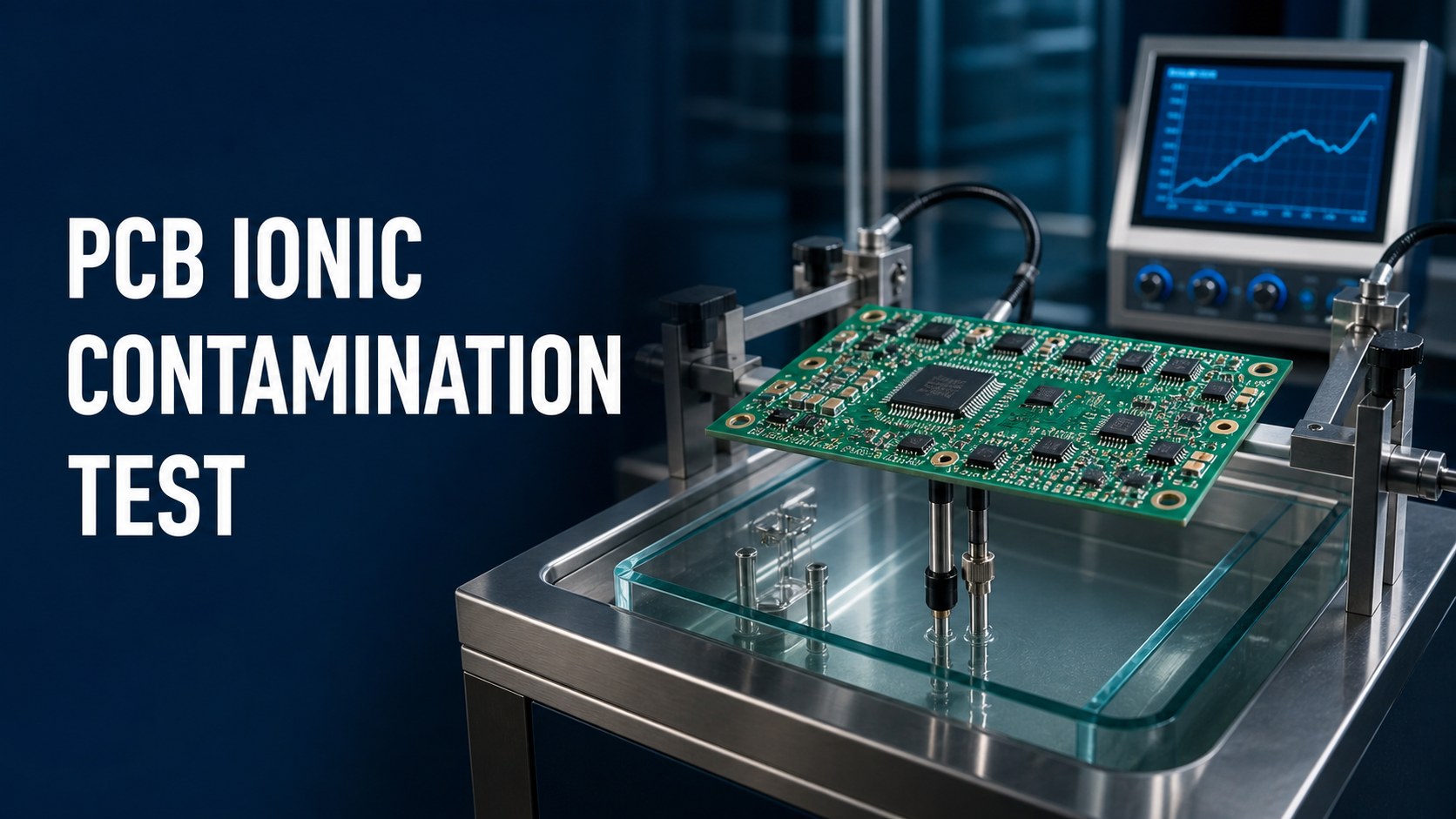
A PCB ionic contamination test measures ionizable residues that may remain after board fabrication, soldering, cleaning or handling. These residues can dissolve in moisture and contribute to leakage, corrosion or electrochemical migration. The test is not one universal machine reading: ROSE, ion chromatography and surface insulation resistance answer different questions.
Use ROSE for fast bulk process monitoring, ion chromatography when you need to identify and quantify specific ions, and SIR when the decision depends on electrical insulation behavior under controlled humidity and bias. The purchase specification must define the sample condition, method revision, extraction area, reporting units and acceptance source. A number without those details cannot support a reliable quality decision.
What Does a PCB Ionic Contamination Test Detect?
It detects or evaluates ionic material that can become electrically conductive when moisture is present. Potential sources include plating chemistry, handling salts, flux activators, cleaning residues and environmental exposure. The measured result depends on what the selected solvent can extract and what the analytical method can detect.
ROSE reports a bulk conductivity response as sodium-chloride-equivalent contamination over a stated area. Ion chromatography separates selected anions and cations so the report can show individual species. SIR testing does not identify an ion; it measures how a test pattern’s insulation resistance behaves during defined environmental and electrical stress.
This distinction prevents a common error: treating “ionic cleanliness” as a single material property. It is a method-dependent observation of a specific sample under specific conditions.
Why Ionic Residues Become a Reliability Risk
Ionic residue becomes dangerous when moisture, voltage, time and geometry create a conductive or electrochemical path. A dry assembly can initially pass electrical test and still become vulnerable during condensation, humidity cycling or contaminated field service.
- Hygroscopic residue can attract or retain moisture.
- Dissolved ions can increase surface conductivity between adjacent conductors.
- Voltage bias can drive electrochemical migration and dendritic growth.
- Corrosive species can attack metal finishes, component terminations or exposed copper.
- Residue trapped beneath low-standoff packages can be harder to remove and inspect.
- Conformal coating over a contaminated surface can trap the problem rather than eliminate it.
Risk is therefore application-specific. Fine spacing, high impedance nodes, elevated voltage, humid service and long required life usually justify a more deliberate cleanliness validation plan than a simple low-risk prototype.
When Should a Bare PCB or PCBA Be Tested?
Test when cleanliness is a controlled product or process requirement, when a process changes, or when failures suggest residue-related leakage or corrosion. The test point should isolate the process you are trying to understand.
- Qualifying a new bare-board fabrication or surface-finish process.
- Validating a solder paste, flux, wash chemistry or no-clean assembly process.
- Reviewing a new component whose body or termination may introduce residue.
- Confirming cleaning after rework or hand soldering.
- Investigating intermittent leakage, corrosion, dendrites or coating adhesion concerns.
- Establishing a production baseline and watching for trend changes.
- Meeting a customer drawing, quality agreement or controlled standard.
Do not wait until final inspection to decide the sample. A finished assembly result combines bare board, components, soldering, cleaning and handling; that may be correct for product acceptance but weak for locating the source of a process shift.
Bare PCB Testing vs Assembled PCBA Testing
The sample stage determines which processes the result represents. A useful plan often separates incoming bare boards, process coupons and finished assemblies.
| Sample | What it can represent | Limitation |
| Bare PCB | Fabrication chemistry, rinsing, handling and final-finish process | Does not include assembly flux, components or rework |
| Process coupon | Controlled comparison among flux, cleaning and thermal profiles | May not reproduce the real board’s shadowed geometry |
| Finished PCBA | Combined production route and delivered-product condition | Source attribution can be difficult |
| Localized extract | Focused review beneath a package or in a suspect zone | Requires a documented extraction and area calculation |
Link the sample to part number, revision, lot, process date and route. For a wider test strategy, see the PCB board testing checklist.
How the ROSE Test Works—and What It Cannot Tell You
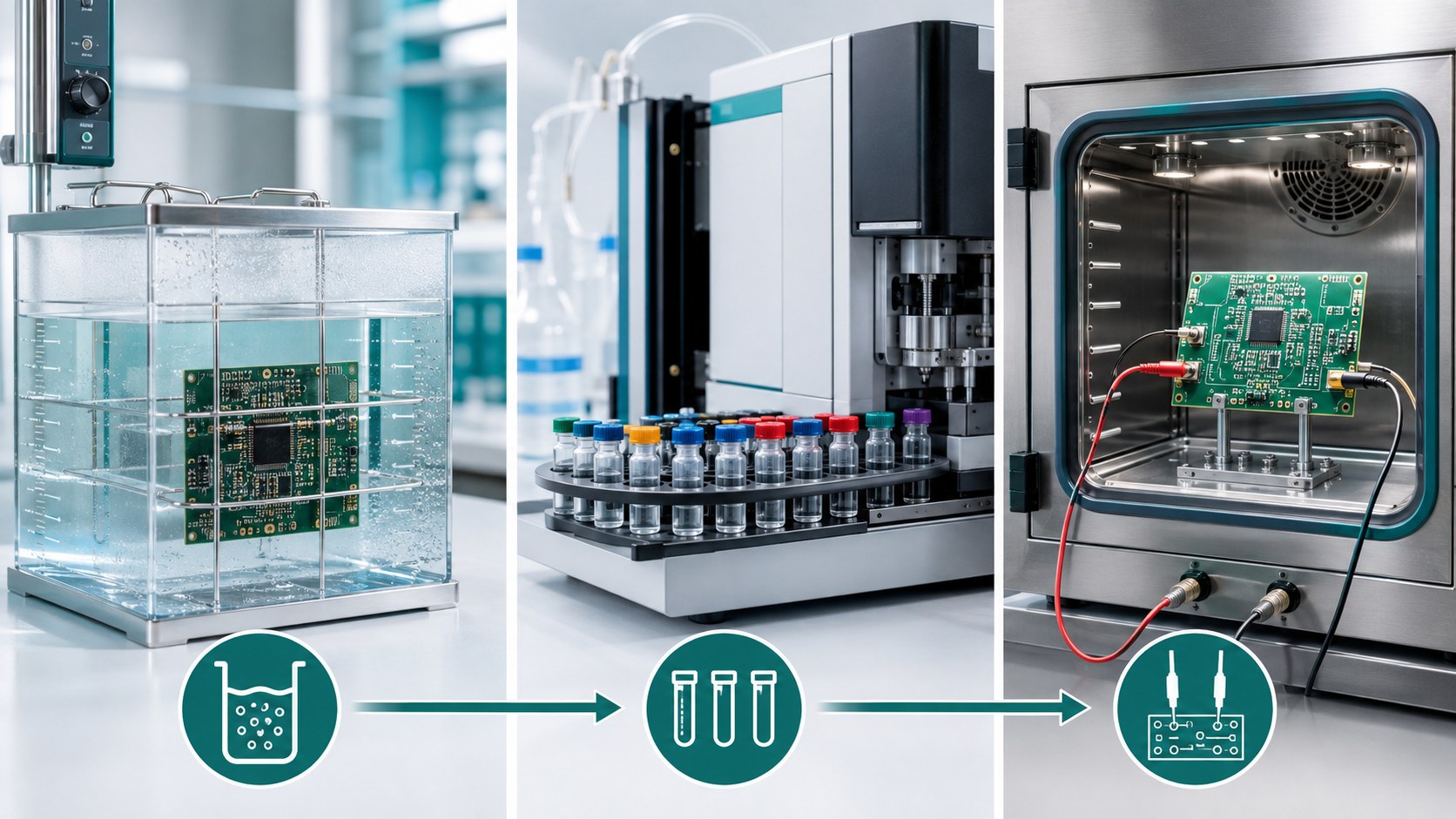
ROSE extracts ionizable surface material into a controlled solvent and monitors the solution’s resistivity or conductivity. IPC-TM-650 2.3.25D describes the method for detection and measurement of ionizable surface contamination by resistivity of solvent extract.
- Define the sample and calculate the tested surface area using the specified convention.
- Prepare or verify the extraction solution and equipment condition.
- Calibrate or verify the instrument at the controlled solution temperature.
- Expose the sample using the selected static or dynamic extraction route.
- Measure the change in the test solution and calculate the reported equivalent contamination per area.
- Record the method, solvent composition, temperature, extraction time, area and result.
ROSE is fast and useful for process monitoring, but it is non-specific. It does not identify which ions are present, prove where they came from, detect every weak organic acid residue equally or directly reproduce long-term powered service. A passing bulk reading can also hide a severe localized deposit if it is diluted across a large calculated area.
When Ion Chromatography Is the Better Choice
Choose ion chromatography when the decision requires ion-specific evidence or source investigation. IPC’s test-method listing includes IPC-TM-650 2.3.28 for ionic analysis of circuit boards and 2.3.28.2 for bare-board cleanliness by ion chromatography.
After controlled extraction, the laboratory separates and measures selected ionic species. This can help distinguish chloride, bromide, sulfate, weak organic acids or other analytes included in the laboratory method. The pattern can support root-cause work: for example, comparing an incoming board, a post-reflow coupon and a cleaned assembly.
Ion chromatography costs more and requires a qualified analytical method, blank control, standards and careful interpretation. Its strength is specificity, not automatic product acceptance. Agree on the analyte list, reporting basis, detection limits and acceptance source before submitting samples.
When SIR Testing Adds Electrical Evidence
Use SIR testing when you need evidence of insulation performance under defined temperature, humidity and electrical bias. It is especially useful for validating flux residues and cleaning processes where the main concern is leakage or electrochemical migration rather than only extract conductivity.
SIR normally uses controlled test patterns or coupons, environmental exposure and resistance monitoring over time. The test vehicle, conductor spacing, bias, environment, duration and measurement intervals all affect the result. It is therefore not interchangeable with a finished-board ROSE reading.
SIR may better represent electrical risk, but a coupon does not reproduce every component shadow, board material or local residue trap. Use production-representative materials and processes, then connect the qualification evidence to ongoing process controls.
ROSE vs IC vs SIR: Which Method Should You Specify?
Select the method from the question you need answered. No single cleanliness test is best for every production and reliability decision.
| Question | Preferred evidence | Important caution |
| Is bulk extractable ionic residue stable from lot to lot? | ROSE process monitoring | Non-specific and sensitive to area/extraction conventions |
| Which ions are present and how much of each? | Ion chromatography | Analyte list and reporting method must be defined |
| Does the assembly process maintain insulation under bias and humidity? | SIR qualification | Coupon and exposure must represent the process risk |
| Where did a contamination shift enter the route? | Staged ROSE and/or IC samples | One finished sample cannot isolate every source |
| Is the delivered product acceptable? | Customer-approved combination | Method alone does not create the acceptance criterion |
How Sample Area, Extraction and Calibration Change Results
Two laboratories can produce different numbers if they use different area calculations, extraction conditions or calibration controls. A defensible report makes those variables visible.
- State whether area includes one face, both faces, board edges or component surfaces.
- Record whether the sample is a bare board, coupon, partially built assembly or final PCBA.
- Define solution composition, volume, temperature and extraction time.
- Identify dynamic or static extraction and any localized extraction fixture.
- Record instrument model, calibration/verification status and blank result.
- Use the same controlled method when establishing a production trend.
- Do not compare unlike units or convert results without the required basis.
Packaging and handling matter too. An open sample bag, fingerprints or a contaminated fixture can change the result after manufacturing. Define clean sample handling and time from production to test.
Why One Universal Cleanliness Limit Is Unsafe
A familiar historical number should not be copied into every PCBA purchase specification. IPC’s official release for J-STD-001H states that the former 1.56 micrograms sodium-chloride-equivalent per square centimeter ROSE value is no longer an acceptable basis for qualifying a manufacturing process.
This does not make ROSE useless. It changes how the evidence should be used: establish and validate a process-specific cleanliness approach, define the applicable controlled requirement, and use the measurement consistently for the intended purpose. Other controlled programs may still prescribe their own limits and methods, so the contract document and revision must be named.
Ask four questions before accepting any limit: Which standard or customer document? Which revision? Which test method and sample? Is the number for process qualification, ongoing control or product acceptance? The broad IPC-TM-650 PCB test methods guide explains why the method and acceptance source are separate decisions.
What a PCB Cleanliness Test Report Must Include
A useful report lets another engineer understand what was tested, reproduce the method and trace the result to production. “Pass” alone is not enough.
- Customer, part number, PCB revision and production lot.
- Sample stage, quantity and any coupon or location details.
- Test method number, revision and documented deviations.
- Extraction solution, volume, temperature, time and area calculation.
- Instrument identification and calibration/verification status.
- Blank/control result and measured values with units.
- For IC, the individual ions, reporting limits and chromatographic method.
- For SIR, coupon, material, flux, bias, environment, duration and resistance trend.
- Acceptance requirement and its controlled source.
- Result, conclusion, test date and authorized reviewer.
How to Investigate a Failed or Trending Result
Do not respond to one high reading by changing the cleaning process blindly. First confirm the result, then isolate where the residue entered the route.
- Verify sample identity, area calculation, instrument check, blank and method execution.
- Retest a retained sample or controlled comparison where the quality plan permits.
- Split the route into incoming PCB, components, post-print/reflow, post-clean and final handling stages.
- Use ion chromatography when the specific ionic pattern can help identify the source.
- Review flux volume, reflow activation, cleaner concentration, wash energy, rinse water, drying and fixtures.
- Inspect shadowed areas beneath low-standoff packages and around connectors.
- Implement corrective action, then verify the process with the same controlled method and trend several lots.
Keep the original result and investigation trail. A corrected retest without traceability can hide an unstable process.
How Cleaning, Handling and Conformal Coating Affect the Plan
Cleanliness testing should follow the actual process route and occur before a coating or encapsulant makes residues harder to investigate. “No-clean” describes a flux process category; it does not guarantee suitability for every high-impedance, humid or coated application.
Cleaning must remove the target residues without leaving cleaner, rinse or handling contamination. Drying must prevent trapped moisture. Gloves, fixtures, trays, wash baskets and packaging are part of the cleanliness system, not administrative details.
If conformal coating is planned, validate surface cleanliness and coating compatibility together. The conformal coating inspection guide covers masking, coverage, cure and release evidence. For practical residue-removal context, see how to clean a PCB board safely.
What Changes Test Cost and Lead Time?
Cost is driven by method, sample quantity, extraction scope, analyte list, environmental duration and reporting depth. A routine ROSE check is normally simpler than ion chromatography with a wide analyte panel or a multi-day SIR qualification.
Lead time also increases when samples require controlled shipping, localized extraction, destructive preparation, subcontract laboratory scheduling or failure investigation. Define whether the request is a one-time qualification, lot acceptance or recurring trend program. Ask the quote to separate setup, sample testing, analytical work and engineering interpretation.
What to Send in an Ionic Cleanliness Test RFQ
A quote-ready request connects the cleanliness evidence to the real product and process. Send:
- Gerber/ODB++, assembly drawing, BOM and CPL where applicable.
- Part number, revision, board dimensions, sample stage and quantity.
- Bare-board finish, solder paste, flux, cleaning chemistry and coating route.
- Target test method, revision and any permitted deviation.
- ROSE extraction/area convention, IC analyte list or SIR coupon/conditions.
- Applicable customer specification, quality agreement or controlled standard.
- Required raw results, photos, chromatograms, trend data and sign-off.
- Lot traceability, sample retention and retest rules.
- Product environment and the failure risk the test is intended to control.
- Target delivery date and whether an accredited external laboratory is required.
If a field is not yet decided, mark it for engineering confirmation rather than inserting a copied default. A clear RFQ lets the manufacturer and laboratory quote the same scope.
FAQ About PCB Ionic Contamination Testing
What is the ROSE test full form?
ROSE means Resistivity of Solvent Extract. It measures the conductivity change caused by ionizable material extracted from a sample into a controlled test solution.
Does ROSE identify which ions are present?
No. It provides a bulk sodium-chloride-equivalent result. Use an ion-specific method such as ion chromatography when the identity and quantity of individual ions matter.
Is 1.56 µg NaCl equivalent/cm² a universal pass limit?
No. IPC has stated that this historical ROSE value is no longer an acceptable universal basis for qualifying a manufacturing process under J-STD-001H. Use the controlled project requirement and revision.
Can a board pass ROSE and still have a reliability problem?
Yes. Local residue can be diluted in a bulk extraction, and ROSE does not reproduce every powered humidity condition. Method selection must match the risk.
What is ion chromatography used for on PCB assemblies?
It separates and quantifies selected ionic species in an extract, helping with source investigation and more detailed cleanliness characterization.
What is the difference between ionic contamination and SIR?
Ionic contamination methods analyze extractable residue. SIR measures electrical insulation resistance over time under controlled environmental and bias conditions.
Should no-clean assemblies be tested?
They may need testing when the product environment, geometry, voltage, coating process or customer requirement makes residue risk important. “No-clean” is not a universal acceptance result.
Should bare PCBs and final assemblies use the same limit?
Not automatically. They represent different process stages and surface geometries. Define the method, sample and acceptance source for each intended decision.
What information is essential in a cleanliness report?
At minimum: sample identity, lot, method/revision, area and extraction conditions, instrument control, result with units, acceptance source and reviewer.
Can ionic testing locate the contamination source?
A single result rarely proves the source. Staged samples plus ion-specific analysis and process records can narrow where contamination entered the route.
Need PCB or PCBA cleanliness evidence in your quotation?
Send EBest Circuit your manufacturing files, board/assembly stage, flux and cleaning route, required ROSE/IC/SIR method, sample quantity, acceptance source and report format. We will review the available project data and confirm the applicable manufacturing and test route before quotation.
You may also like
Tags: PCB Assembly, PCB testing, Quality Control