An MCB symbol looks simple, but reading it correctly requires more than recognizing a breaker-shaped graphic. A drawing may use IEC conventions, ANSI/IEEE-style symbols, manufacturer-specific CAD libraries, or a simplified symbol created for a single-line diagram. The same protective function can therefore appear differently from one project to another.
The practical approach is to treat the symbol as one piece of information. Pole count, device tag, current rating, trip characteristic, breaking capacity, and the project legend complete the picture. This becomes especially important when distinguishing 1P, 2P, 3P, 4P, MCB, MCCB, and other protective devices.
Key Takeaways
An MCB circuit breaker symbol represents a miniature circuit breaker used mainly for overload and short-circuit protection, but the exact graphic can vary by drawing standard and diagram type.
There is no single MCB symbol that appears identically on every schematic. IEC, ANSI/IEEE-style drawings, CAD libraries, and project legends may use different representations.
1P, 2P, 3P, and 4P MCB symbols mainly indicate how many conductors are switched together. 1P+N and 3P+N configurations need additional attention because the neutral pole may be switched without having the same protective function as the phase poles.
A three-phase MCB may appear as three mechanically linked contacts on a detailed schematic, but a single-line diagram can represent the same three-pole breaker with one compact symbol.
The symbol alone usually does not tell you the current rating, trip curve, breaking capacity, AC/DC suitability, or exact product type.
MCB and MCCB symbols can look similar on simplified diagrams. Device tags, ratings, schedules, and specifications are often needed to tell them apart.
When reading an electrical drawing, always use the project legend, pole annotation, breaker tag, and ratings together rather than identifying the device from shape alone.
What Does MCB Mean and What Does an MCB Do?
MCB stands forMiniature Circuit Breaker. It is an automatically operated protective switching device commonly used to interrupt a circuit when an overload or short circuit exceeds the breaker’s operating limits.
Unlike a fuse, an MCB can normally be reset after the fault has been cleared. It also provides manual switching, although its primary role in the circuit is protection rather than routine control.
Typical MCB applications include:
Residential distribution boards
Commercial branch circuits
Lighting circuits
Small motors
Control panels
Industrial auxiliary circuits
Equipment power distribution
The exact protection characteristics depend on the device. Rated current, trip curve, breaking capacity, voltage rating, and pole configuration must therefore be checked separately from the schematic symbol.
What Does an MCB Circuit Breaker Symbol Mean?
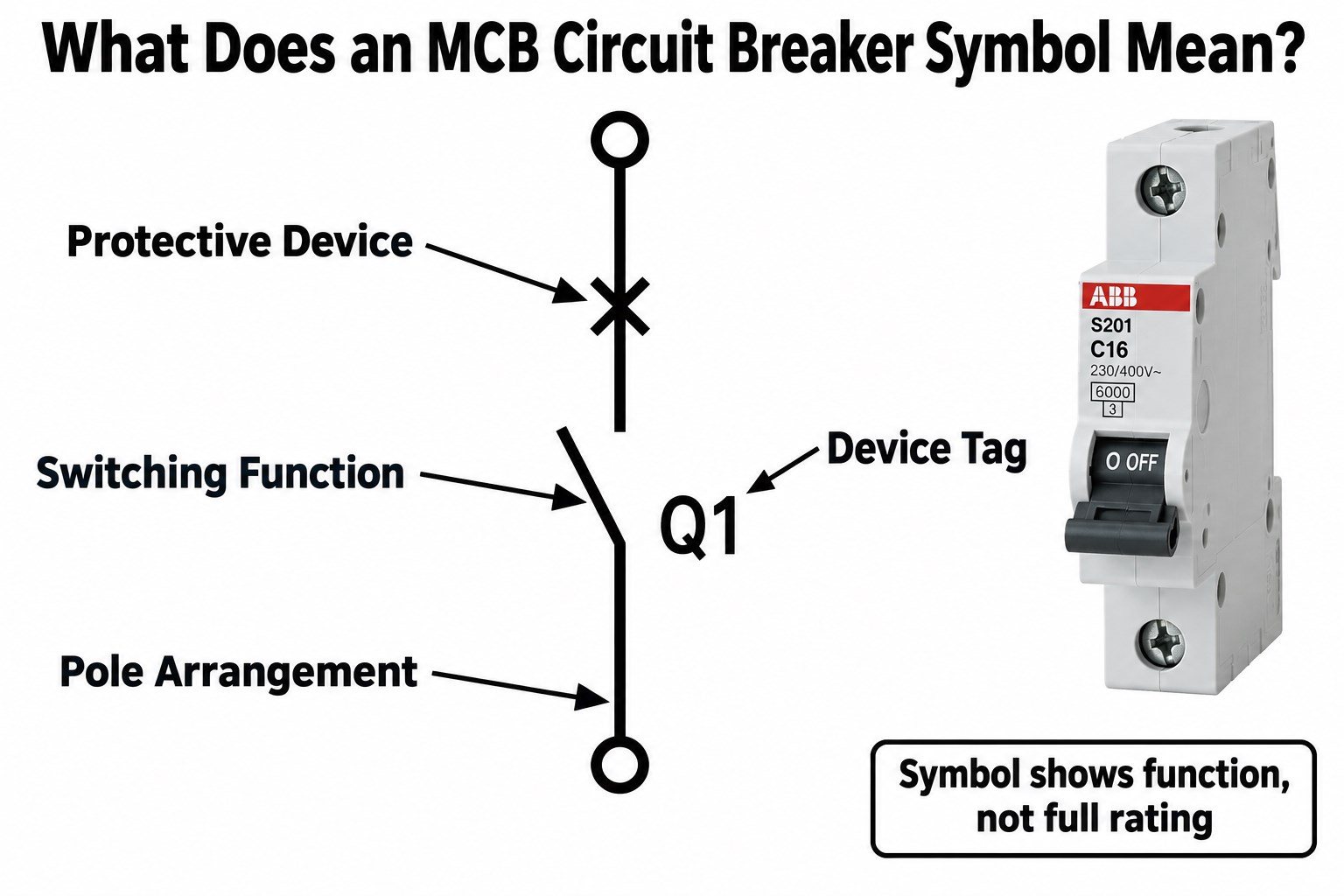
The MCB symbol meaning is that the circuit contains a protective switching device capable of automatically interrupting fault current.
Depending on the drawing style, the symbol may show a switching contact, a break in the conductor path, a protective-device qualifier, multiple mechanically linked poles, or a device tag such as CB1, QF1, or MCB1.
The graphic can help identify the function and sometimes the pole arrangement, but it usually does not provide the complete device specification. Rated current, trip curve, breaking capacity, voltage, AC/DC suitability, manufacturer, product series, and terminal arrangement normally come from annotations, schedules, or the component specification.
Is There One Standard MCB Symbol?
No. There is no single MCB graphic that appears identically in every electrical schematic, single-line diagram, and CAD library.
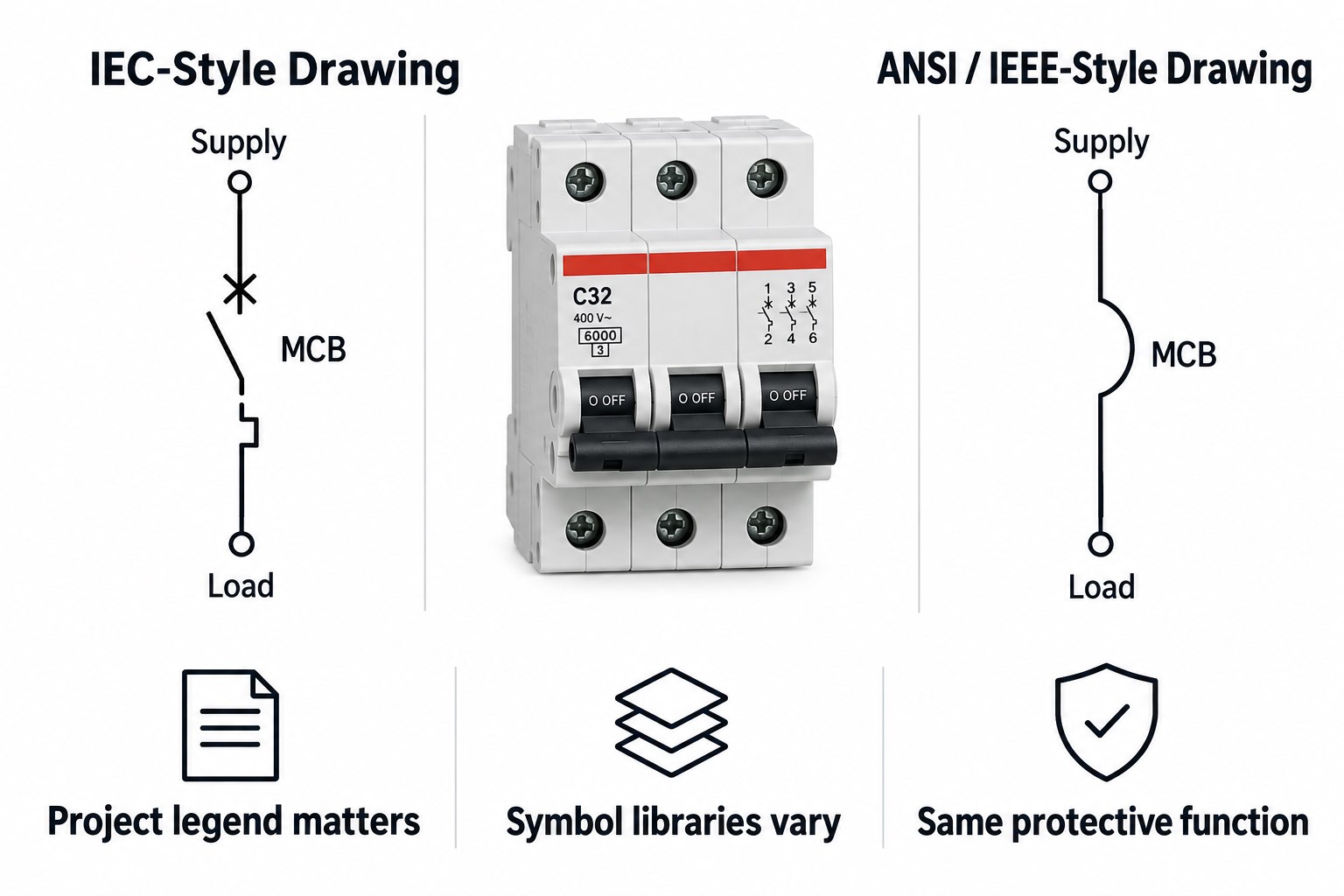
IEC 60617 provides standardized graphical symbols for electrical diagrams, including switching and protective functions. However, the symbol actually shown in a project can vary depending on how the standard is applied and how much detail the drawing needs.
Variation can come from IEC-based symbol libraries, ANSI/IEEE-style drawings, single-line diagrams, detailed control schematics, CAD software libraries, company drafting standards, and manufacturer documentation.
The correct method is therefore to check the drawing legend and project drafting standard first. A symbol should be interpreted in the context of the drawing in which it appears.
IEC vs ANSI/IEEE MCB Symbols: What Is the Difference?
IEC and ANSI/IEEE-style drawings can represent circuit-breaker functions differently, although both communicate the same basic idea: a protective device that can open the electrical path.
North American symbol conventions and device numbering
Single-line diagram
Simplified representation of multiphase circuits
Detailed schematic
Individual contacts, coils, mechanical links, and terminals may be shown
Neither system changes what the MCB physically does. The main risk is assuming a symbol copied from one standard must look exactly the same in another drawing. In real engineering documentation, the project legend remains the safest reference.
1P vs 2P vs 3P vs 4P MCB Symbols: What Changes?
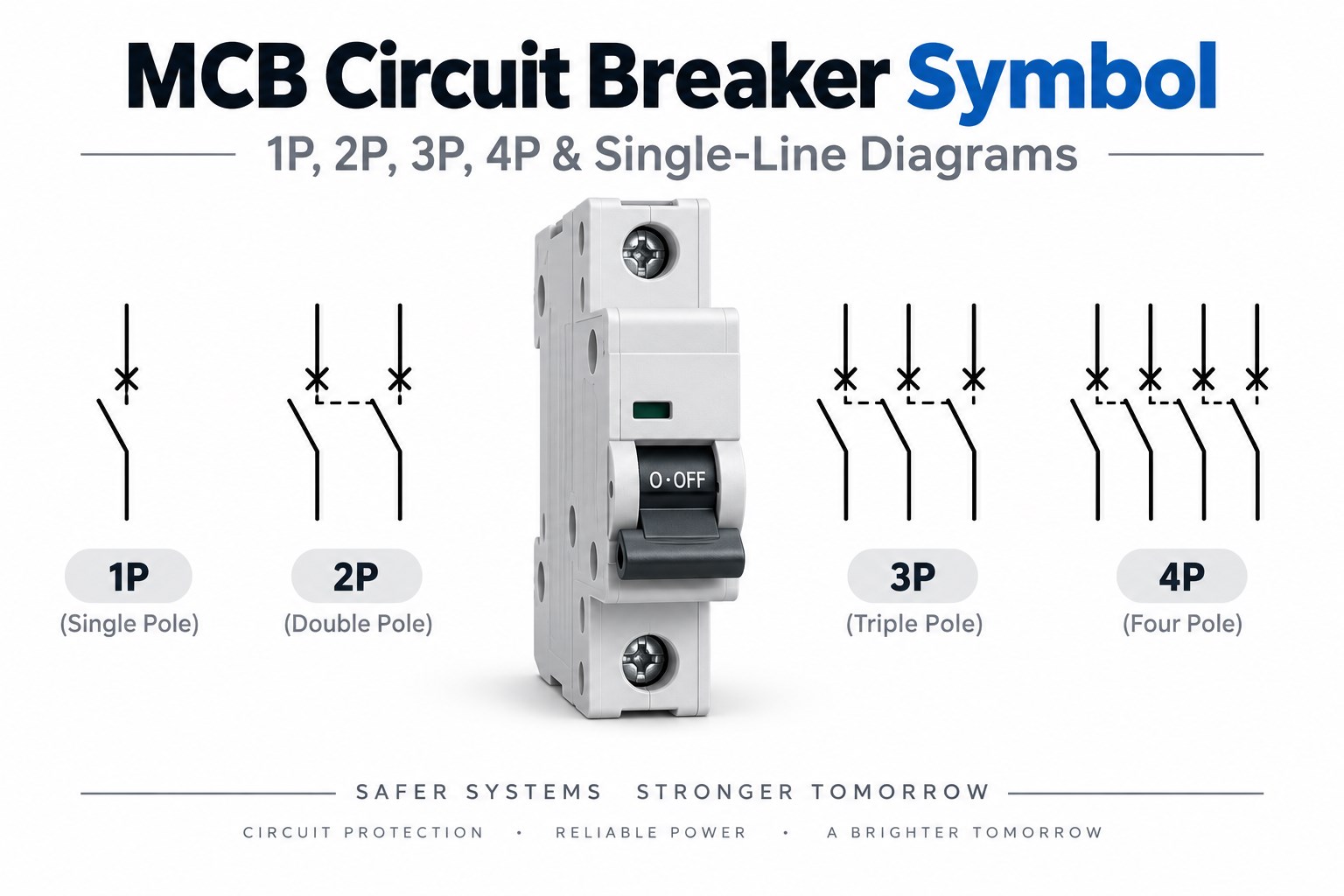
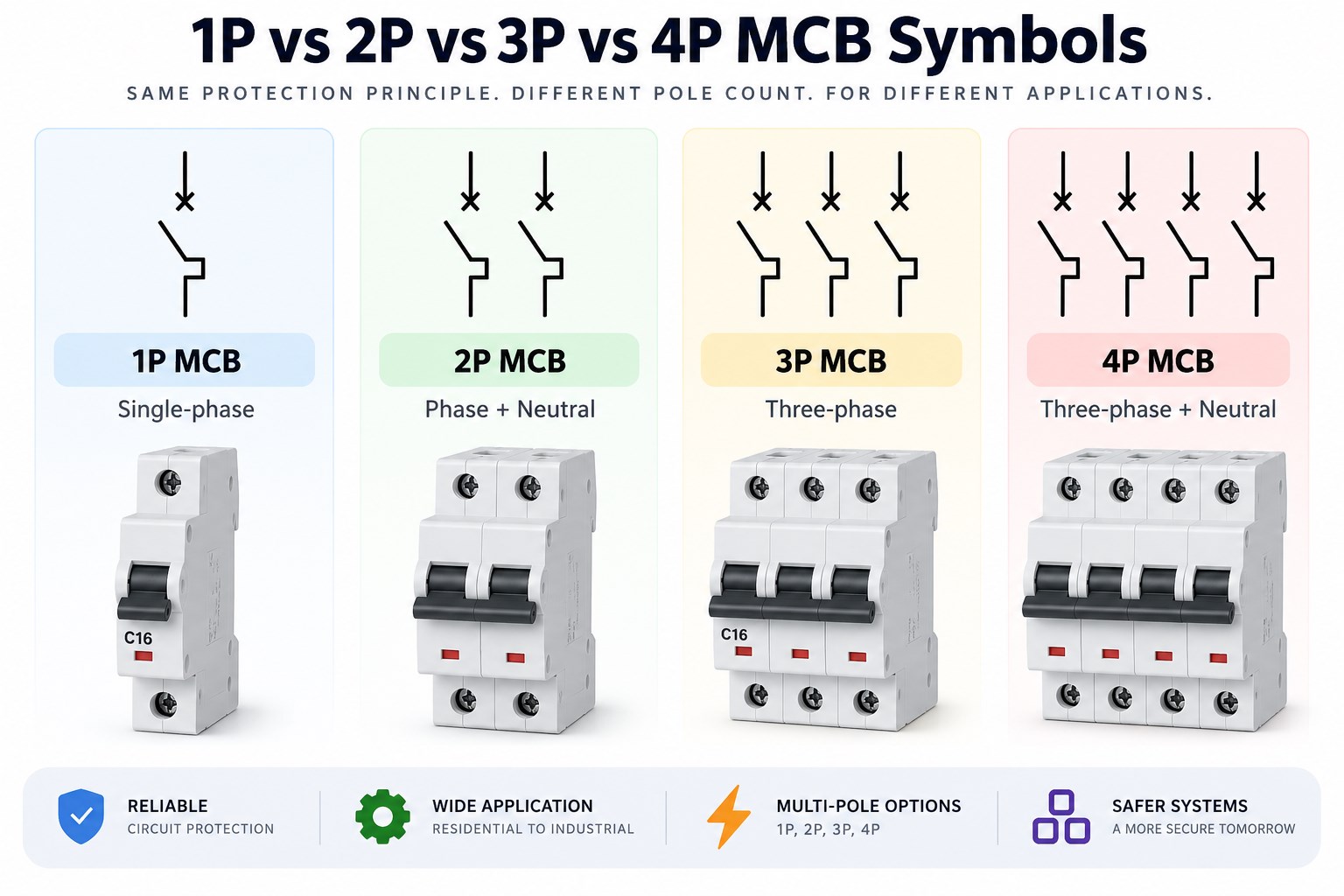
The main difference between 1P, 2P, 3P, and 4P MCB symbols is the number of conductors operated together by the breaker.
MCB Configuration
Conductors Switched
Typical Application
1P
1
Single-phase branch circuit
2P
2
Phase + neutral or two-line circuit
3P
3
Three-phase circuit
4P
4
Three-phase + neutral
1P+N
2
Single-phase with switched neutral
3P+N
4
Three-phase with switched neutral
A 1P MCB normally interrupts one live conductor. A 2 pole MCB symbol represents two mechanically linked poles operating together, while a 3P MCB mechanically links three poles for a three-phase system. A 4 pole MCB symbol adds a fourth switched path, commonly used when the neutral must also be disconnected.
However, 1P+N and 3P+N should not automatically be treated as identical to 2P and 4P protective devices. In some constructions, the neutral pole is switched but does not provide the same overcurrent protection as the phase pole.
What Does a 3-Phase Circuit Breaker Symbol Show?
A 3 phase circuit breaker symbol represents one breaker operating across all three phase conductors together.
In a detailed schematic, the drawing may show three separate contacts with a mechanical linkage between them. That linkage indicates that the poles operate together as one device.
In a single-line diagram, however, the entire three-phase circuit is represented by one line. The breaker may therefore appear as one compact symbol with annotations such as 3P, 3Ø, CB1, QF1, C32, or 10 kA.
A single line in an SLD does not mean the breaker has only one pole. Mechanical linkage shows simultaneous operation; it is not another current-carrying wire.
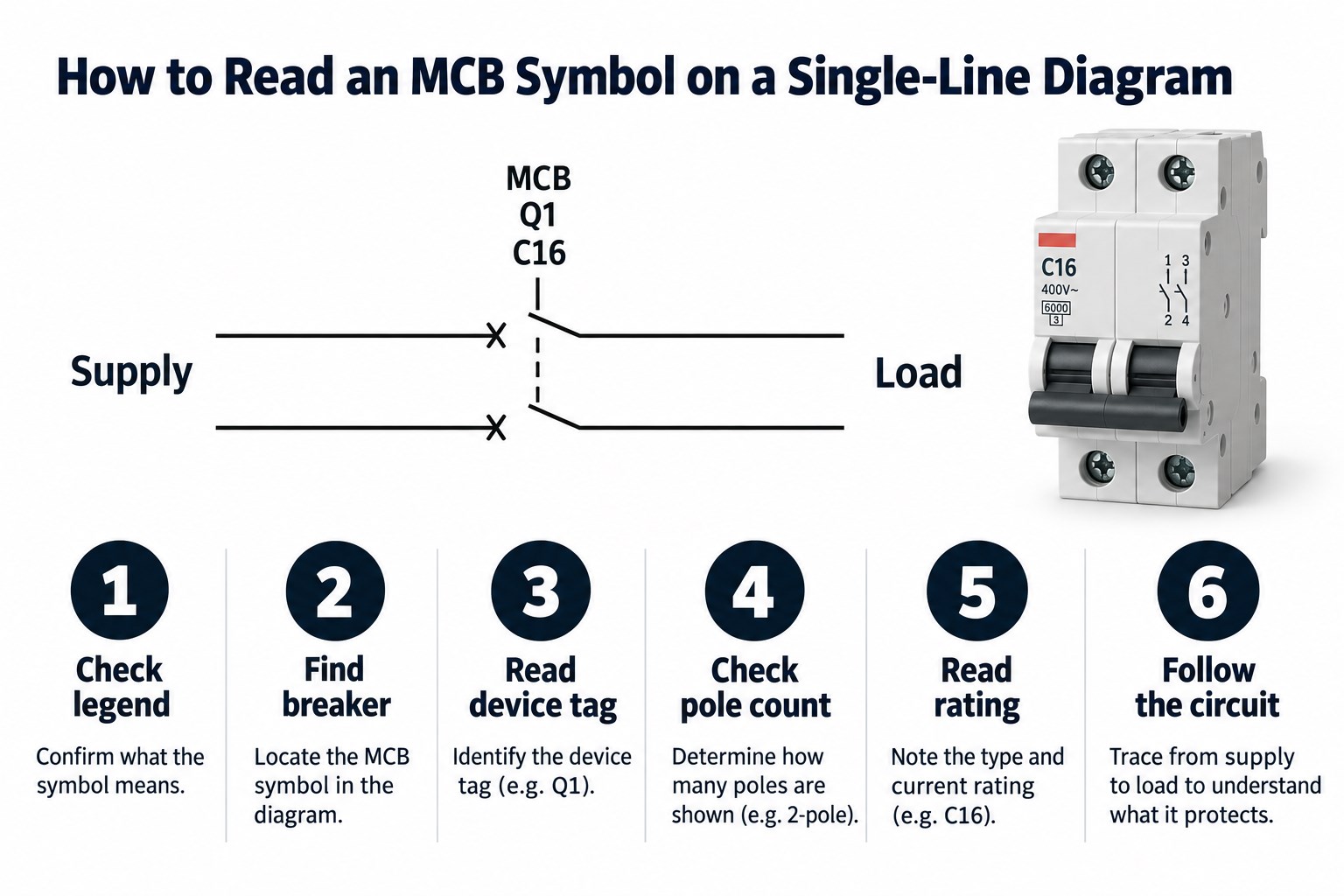
How Do You Read an MCB Symbol on a Single-Line Diagram?
Reading an MCB on a single-line diagram is easier when you follow the information in a fixed order instead of relying on the symbol shape alone.
Check the drawing legend. Confirm what the project uses for MCBs, MCCBs, isolators, fuses, and switches.
Locate the breaker symbol. Follow the incoming supply or feeder until you reach the protective switching device.
Read the device tag. Common tags include MCB1, CB1, QF1, or Q1.
Check the pole configuration. Look for 1P, 2P, 3P, 4P, 1P+N, or 3P+N.
Read the current and trip information. A label such as C16 commonly indicates a C-characteristic 16 A MCB.
Check breaking capacity and voltage. Values such as 6 kA or 10 kA describe short-circuit interruption capability under the applicable rating conditions.
Follow the circuit upstream and downstream. Confirm where the breaker receives power and which load, bus, or subcircuit it protects.
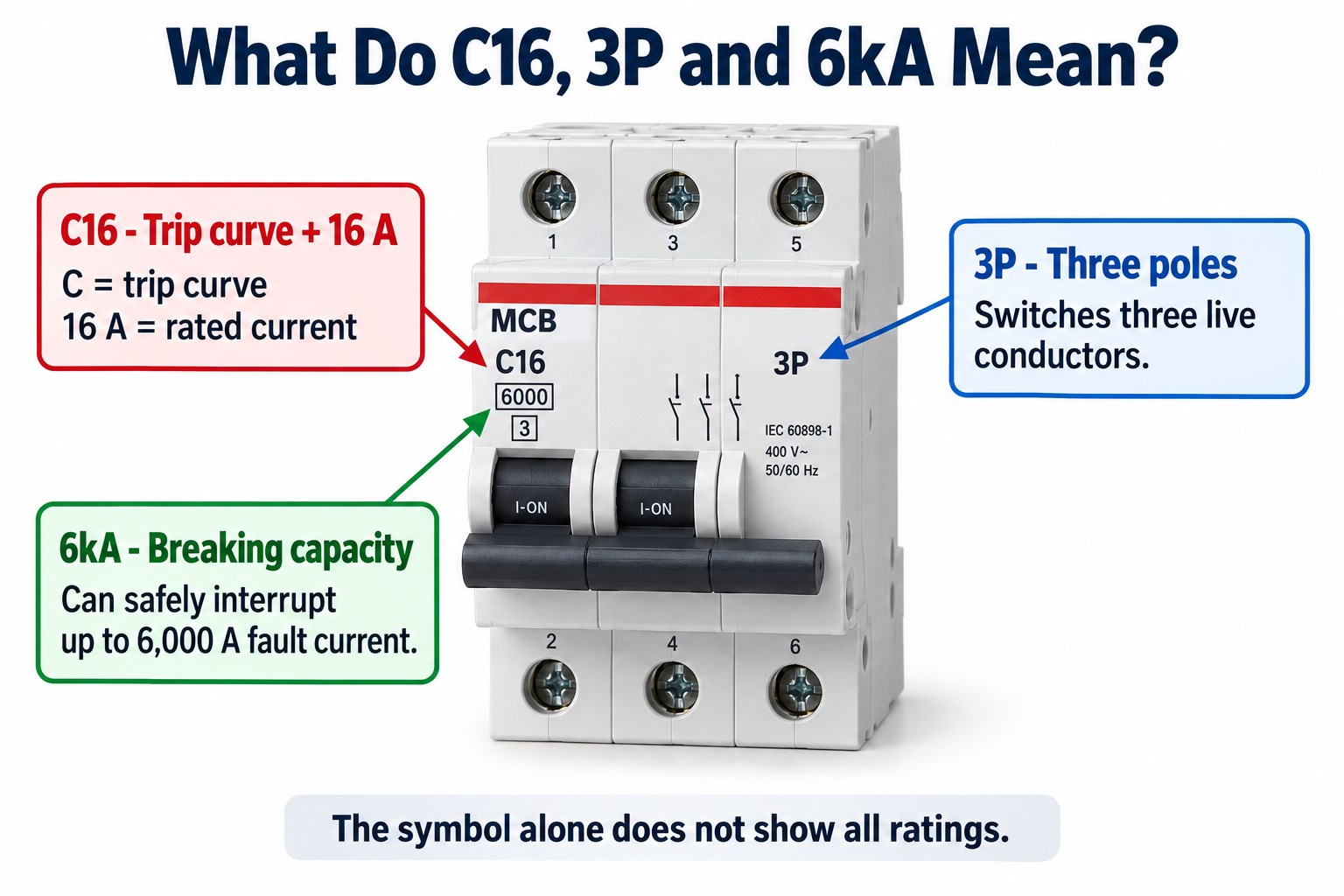
What Do MCB Labels Such as C16, 3P and 6kA Mean?
MCB labels provide electrical information that the schematic symbol itself usually cannot communicate.
Marking
Typical Meaning
C
C-type tripping characteristic
16
16 A rated current
3P
Three-pole device
6 kA
Rated short-circuit breaking capacity under the applicable rating standard
A B, C, or D designation normally relates to the magnetic trip characteristic rather than the number of poles. Similarly, 6 kA does not mean the breaker is intended to carry 6,000 A continuously. It describes the short-circuit current the device is rated to interrupt under specified test conditions.
MCB vs MCCB Symbols: Can You Tell Them Apart by Shape?
Not always. An MCB and an MCCB can share a generic circuit-breaker symbol in simplified drawings because both perform the same basic protective switching function.
The difference may only become clear from surrounding information. Check the device tag, MCB/MCCB annotation, rated current, frame size, breaking capacity, adjustable trip settings, electronic or thermal-magnetic trip unit, equipment schedule, and manufacturer part number.
An MCCB is generally used for higher current levels and more demanding distribution applications, while an MCB is typically used for lower-current final or branch circuits. However, symbol shape alone should not be used to determine the product category.
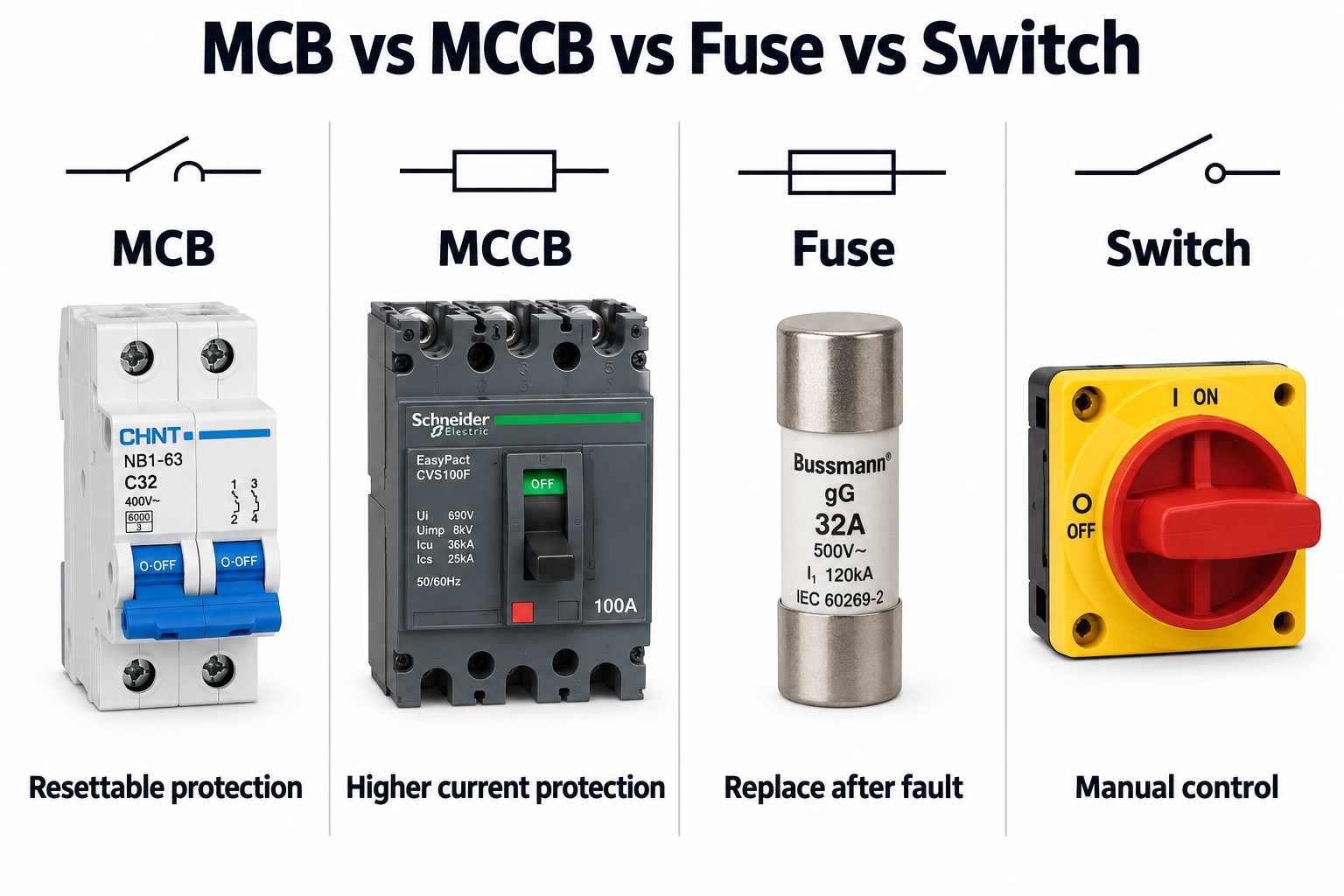
MCB vs Fuse vs Switch Symbol: How Do You Avoid Misreading Them?
MCBs, fuses, and switches can all interrupt a circuit, but their functions are different.
Device
Automatic Fault Protection
Resettable
Main Purpose
MCB
Yes
Yes
Overload / short-circuit protection
MCCB
Yes
Yes
Higher-current protective switching
Fuse
Yes
No
Overcurrent protection
Switch
Not necessarily
Yes
Manual switching
An MCB combines switching with automatic overcurrent protection. A fuse also provides automatic protection, but once its element melts, the fuse must be replaced. A normal switch can open the circuit manually but should not be assumed to provide overload or short-circuit protection unless it is part of a protective device.
What Information Should Be Checked Beyond the MCB Symbol?
The MCB symbol identifies the device function, but selecting or verifying the physical breaker requires more information.
Engineers should check:
Rated current
Pole count
Rated voltage
AC or DC operation
Trip characteristic
Breaking capacity
Frequency
Installation category
Terminal arrangement
Applicable standard
Manufacturer and part number
The same distinction matters when an MCB connects to a PCB-based control system. The schematic symbol is not the physical footprint.
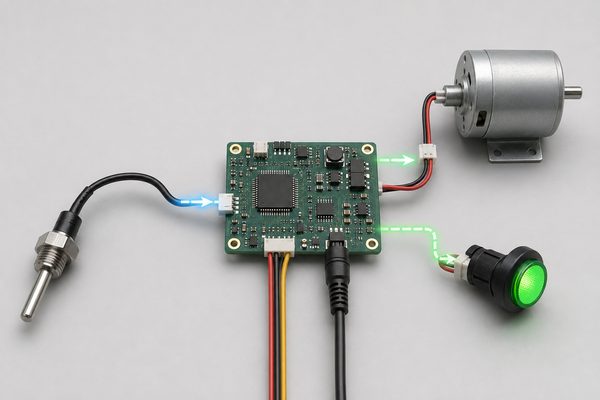
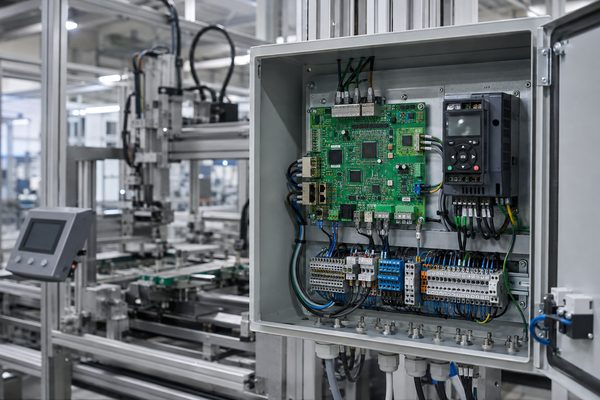
A control PCB may interface with auxiliary contacts, shunt-trip coils, undervoltage release, remote actuators, current sensors, status inputs, or DIN-rail terminal blocks. Connector pitch, terminal current, creepage, clearance, relay ratings, and isolation barriers must therefore be designed from the actual hardware specification rather than from the MCB symbol shown in the system schematic.
FAQ About MCB Circuit Breaker Symbols
1. What is the full form of MCB? MCB stands for Miniature Circuit Breaker. It is mainly used for automatic overload and short-circuit protection in lower-current electrical circuits.
2. What is the symbol of an MCB? The exact symbol depends on the drawing standard and diagram type. IEC-based schematics, ANSI/IEEE-style drawings, and single-line diagrams may represent the breaker differently, so the project legend should be checked.
3. What is the difference between a 1P and 2P MCB symbol? A 1P MCB operates one conductor, while a 2P MCB operates two mechanically linked conductors together.
4. What is the symbol for a 3-phase MCB? A detailed schematic may show three mechanically linked breaker contacts. In a single-line diagram, one breaker symbol marked 3P may represent the complete three-phase device.
5. Is the MCB symbol different from the MCCB symbol? Not necessarily. Simplified electrical drawings can use the same basic circuit-breaker symbol for both, with annotations or schedules identifying whether the device is an MCB or MCCB.
6. Can an MCB symbol tell me whether the breaker is AC or DC? Usually not. AC/DC suitability should be confirmed from the rating annotation, project specification, and manufacturer datasheet rather than inferred from the symbol shape.
Reading an MCB Symbol on a PCB-Based Control System?
An MCB symbol can identify the protective device on the electrical schematic, but PCB design requires the actual breaker interface to be reviewed separately. Auxiliary contacts, control voltages, terminal spacing, isolation, relay outputs, and sensing circuits all affect the final board.
EBest Circuit supports industrial control PCB fabrication, DFM review, component sourcing, PCBA, and functional testing. If your control-board project interfaces with breakers, relays, contactors, or other power devices, send your Gerber files, BOM, schematic, and electrical requirements to sales@bestpcbs.com for engineering review.
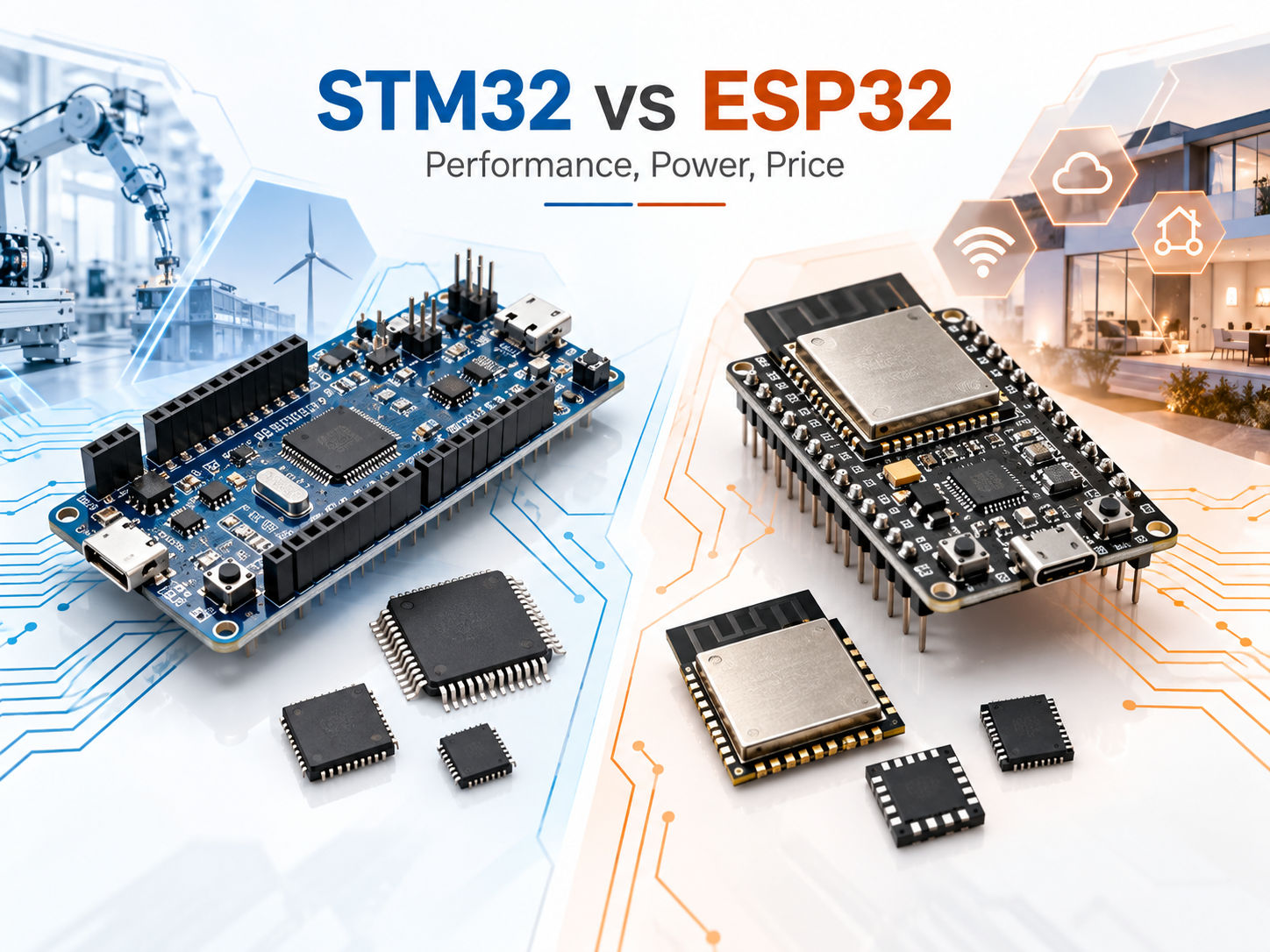
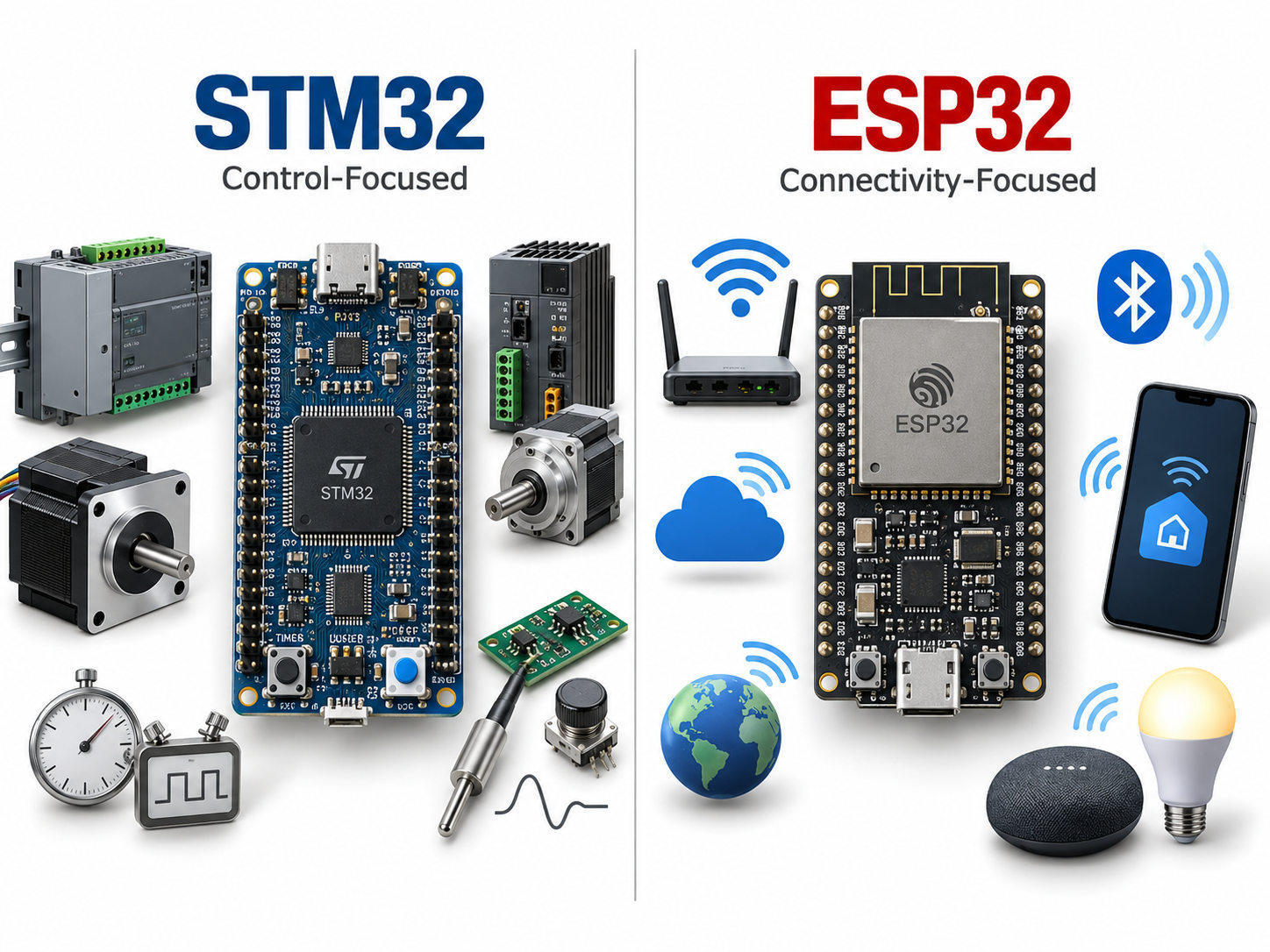
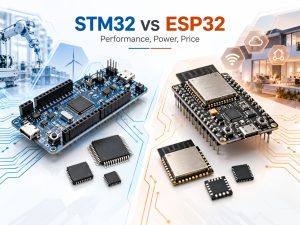
STM32 vs ESP32 is not a comparison between two individual chips. STM32 is a large Arm Cortex-M microcontroller family covering entry-level control through high-performance embedded processing, while ESP32 is a family of connected MCUs and SoCs designed around integrated wireless capability, general-purpose processing, and rapid IoT development.
This STM32 vs ESP32 microcontroller comparison focuses on production decisions rather than development-board popularity.
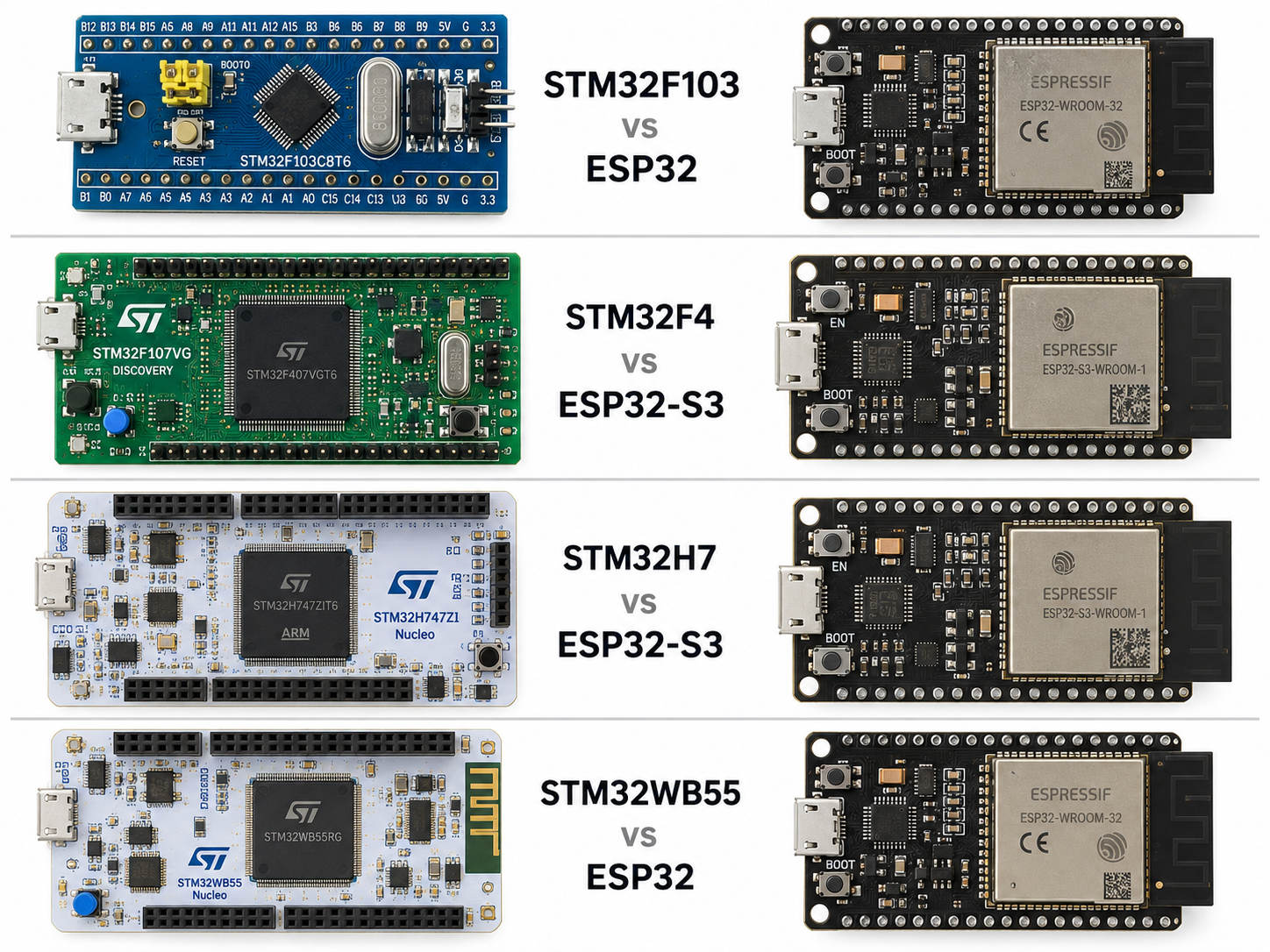
The better choice depends on the actual workload. CPU performance, peripherals, wireless requirements, power budget, unit cost, software ecosystem, PCB design, and production volume can all change the decision. Comparing representative devices such as STM32F103, STM32F4, STM32H7, classic ESP32, and ESP32-S3 gives a more useful picture than comparing the two brand families as if each contained only one MCU.
Key Takeaways
STM32 is usually a stronger starting point for deterministic control, motor control, industrial interfaces, and applications that need a wide MCU selection.
ESP32 is attractive for Wi-Fi, Bluetooth, IoT, and connected products because wireless connectivity is integrated into many ESP32 variants.
Performance depends on the exact devices being compared. STM32F103, STM32F4, STM32H7, classic ESP32, and ESP32-S3 belong to very different performance levels.
STM32 often fits low-power control applications well, while ESP32 power consumption depends heavily on radio activity, sleep strategy, and communication duty cycle.
ESP32 can reduce total BOM cost in wireless products by eliminating a separate Wi-Fi or Bluetooth module.
Robotics and drones do not have one universal winner. Real-time control and wireless communication place different demands on the MCU.
STM32 and ESP32 can also work together, with one handling deterministic control and the other handling wireless connectivity.
STM32 vs ESP32: What Is the Main Difference?
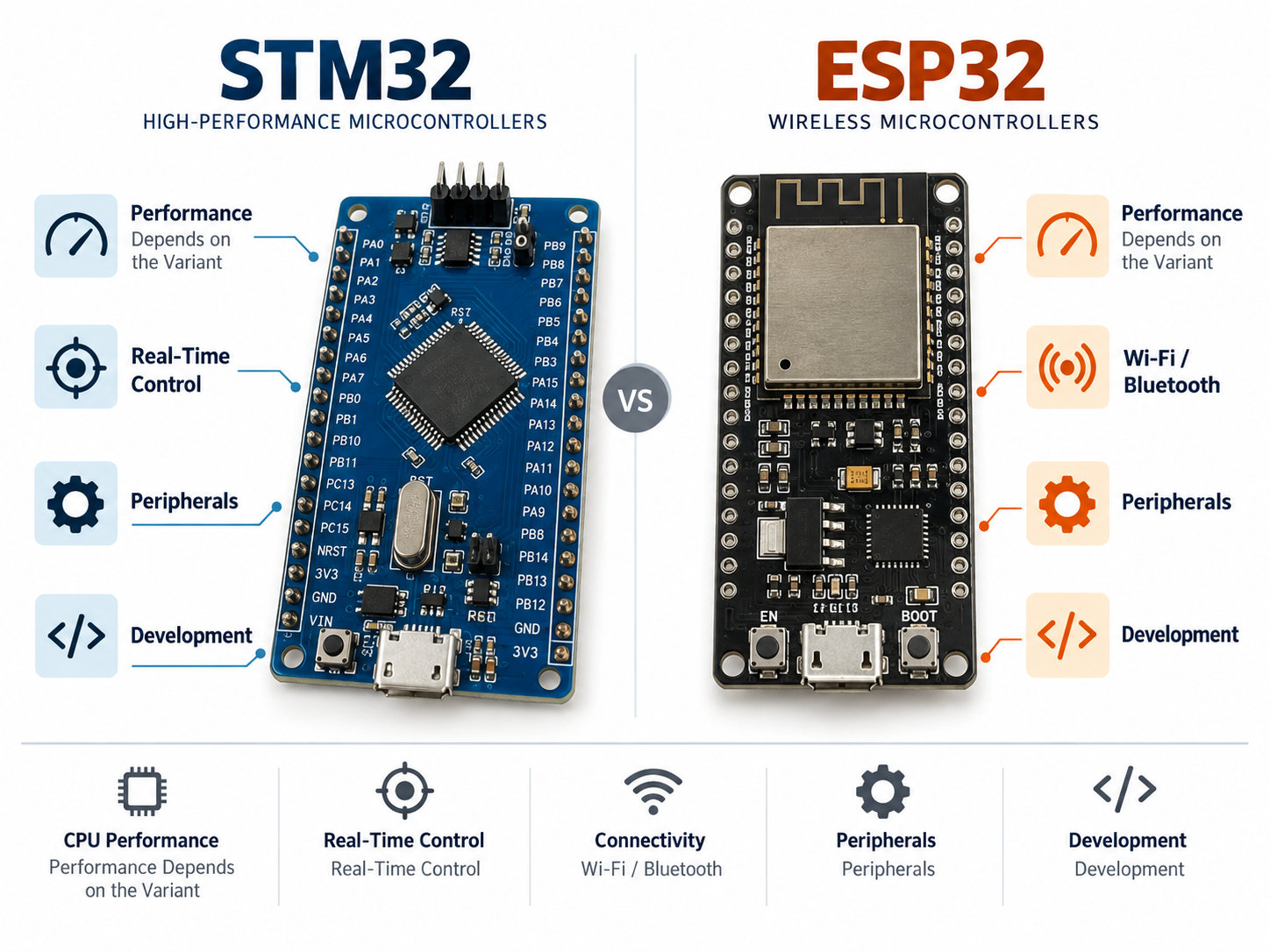
The main difference is positioning: STM32 is primarily a broad embedded-control MCU family, while ESP32 is strongly oriented toward connected embedded systems with integrated Wi-Fi and Bluetooth on many variants.
STM32 devices span many performance and application classes. Depending on the series, designers can choose different CPU cores, clock speeds, memory sizes, timers, ADCs, communication peripherals, security features, and low-power modes.
ESP32 devices combine MCU processing with wireless functionality in a compact platform. Typical strengths include:
Wi-Fi and Bluetooth integration
Large developer ecosystem
FreeRTOS support
Flexible GPIO
SPI, UART, I²C, ADC, PWM, and other common interfaces
Module options with flash and antenna already integrated
For products centered on motor control, precise timing, industrial I/O, or tightly managed low-power operation, STM32 is often a natural starting point. For connected sensors, gateways, smart devices, and Wi-Fi/Bluetooth products, ESP32 can simplify the architecture.
Which STM32 and ESP32 Models Should You Actually Compare?
A useful STM32 vs ESP32 comparison needs representative devices from similar application levels. Comparing STM32H7 directly with an older ESP32 while ignoring the intended workload can create misleading conclusions.
STM32 Family
ESP32 Family
Useful Comparison
STM32F103
Classic ESP32
Entry-level and older mainstream embedded designs
STM32F4
ESP32 / ESP32-S3
General embedded processing
STM32H7
ESP32-S3
Higher-performance applications
STM32WB55
ESP32 family
Wireless embedded designs
STM32F103 is widely associated with low-cost development boards such as the Blue Pill, while STM32F4 is a common step up for DSP, control, and higher-performance applications.
STM32H7 moves into a much higher performance class with faster Cortex-M7 devices and stronger memory and peripheral architectures. ESP32-S3, meanwhile, improves processing and AI-oriented instruction support while keeping Wi-Fi and Bluetooth integration.
The right comparison should therefore start from application requirements, not family names.
STM32 vs ESP32 Performance: Which Is Faster?
Neither platform is always faster because CPU performance depends on the exact STM32 and ESP32 devices being compared.
For an STM32 vs ESP32 speed comparison, benchmark the exact parts under the real workload. An STM32 vs ESP32 clock speed figure alone does not predict interrupt latency, peripheral throughput, or control-loop behavior.
Important factors include:
CPU architecture
Clock frequency
Number of cores
FPU and DSP support
Cache architecture
Internal RAM
External-memory support
DMA capability
Hardware accelerators
Interrupt and real-time behavior
An STM32F103 and STM32H7 are both STM32 devices, yet their performance levels are far apart. The same issue appears within the ESP32 family, where classic ESP32, ESP32-S3, C-series, and other variants use different architectures and peripheral sets.
ESP32 can perform well when parallel tasks, networking, or connected applications are important. Higher-end STM32 devices can offer stronger deterministic processing for control loops, signal processing, and demanding embedded workloads.
Clock speed alone should not decide the comparison. A 240 MHz processor does not automatically outperform a lower-clocked MCU in every real-time or peripheral-heavy application.
STM32 vs ESP32 Connectivity and Peripherals: What Changes the Design?
ESP32 generally offers an advantage when Wi-Fi or Bluetooth must be integrated directly into the product, while STM32 provides a broader range of specialized embedded-control peripherals across its product families.
Feature
STM32
ESP32
Wi-Fi
Usually external
Integrated on many variants
Bluetooth
Available on selected wireless series
Integrated on many variants
CAN / FDCAN
Broad device support
Depends on variant
Motor-control timers
Strong on many series
Available, but product focus differs
ADC
Wide model-dependent range
Integrated, variant dependent
USB
Available on selected devices
Available on selected variants
Ethernet
Available on selected STM32 devices
Usually requires external PHY and suitable variant
Wireless networking
External or wireless STM32 family
Core strength
STM32WB, STM32WL, and other wireless STM32 families mean it is inaccurate to say STM32 has no wireless capability. The difference is that wireless connectivity is central to the ESP32 ecosystem, while STM32 offers a broader family structure covering many embedded-control niches.
STM32 vs ESP32 Power Consumption: Which Uses Less Power?
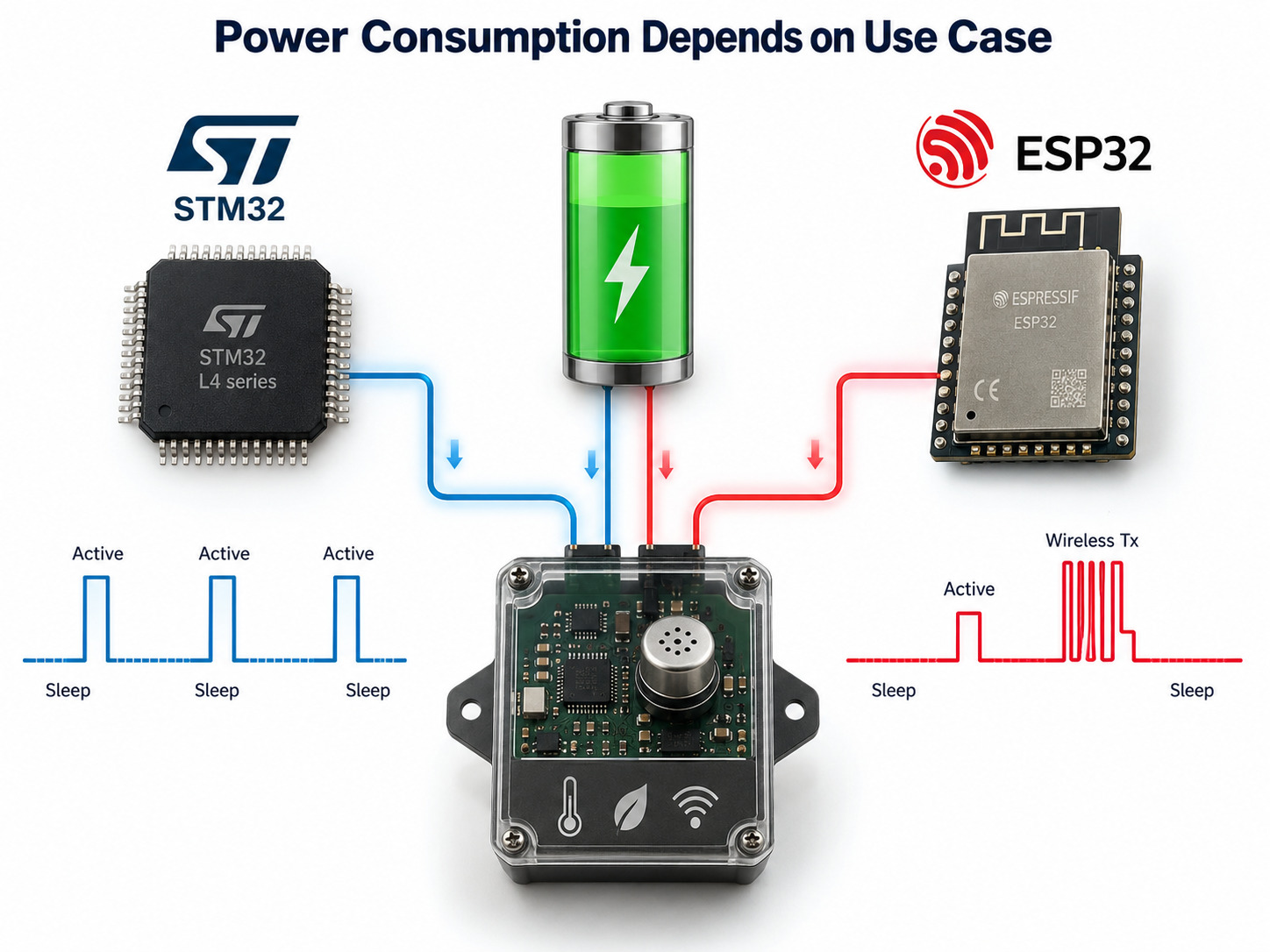
STM32 often provides more low-power choices for battery-operated control systems, but a fair comparison depends on the exact MCU, radio state, clock configuration, and duty cycle.
Power should be evaluated under several operating conditions:
Active processing
Idle mode
Stop or light-sleep mode
Deep sleep
Wi-Fi active
Bluetooth active
Periodic radio wake-up
Bare MCU versus development board
ESP32 designs can achieve low sleep current, but wireless transmission creates short periods of much higher consumption. A sensor that wakes every few minutes, transmits data, and returns to sleep may still have excellent battery life if the duty cycle is carefully controlled.
STM32 families include devices designed specifically for low-power operation, making them attractive for metering, battery instrumentation, remote sensing, and long-life embedded devices.
For production hardware, regulator quiescent current, LEDs, USB bridges, sensors, and external radios can matter as much as the MCU specification itself.
STM32 vs ESP32 Price: Which Costs Less in a Real Product?
ESP32 can have a lower total system cost when the product needs Wi-Fi or Bluetooth, while STM32 can be more economical when wireless connectivity is unnecessary.
The MCU price alone does not show the full cost. A production comparison should include:
MCU or module cost
External Wi-Fi/Bluetooth module
Flash and external memory
RF matching components
Antenna
Crystal and clock components
PCB area
Assembly cost
Programming and testing
Wireless certification requirements
An ESP32 module can combine the MCU, flash, RF circuitry, and antenna into one certified package. That can reduce design time and BOM complexity compared with adding an external wireless module to a conventional MCU.
A non-wireless STM32 design may require fewer RF-related parts and less PCB space reserved for antenna performance. The lower-cost architecture therefore depends on the final product, not the MCU unit price alone.
STM32 vs ESP32 Development: Which Is Easier to Program and Debug?
ESP32 often provides a faster learning path for connected prototypes, while STM32 offers a deeper professional embedded-development environment for projects that require detailed peripheral and hardware control.
Common STM32 tools include:
STM32CubeIDE
STM32CubeMX
HAL and LL libraries
ST-Link
SWD debugging
FreeRTOS
Common ESP32 tools include:
ESP-IDF
Arduino Core for ESP32
PlatformIO
FreeRTOS
JTAG debugging
Large open-source library ecosystem
ESP32 is popular among makers and IoT developers because Wi-Fi, Bluetooth, networking stacks, and Arduino-compatible libraries are easy to access.
STM32CubeMX can generate initialization code for clocks, GPIO, timers, ADCs, communication interfaces, and other peripherals. This can be especially useful when the application uses many hardware resources.
Arduino should not be treated as a third MCU family in this comparison. It is primarily a development platform and ecosystem that can run on different microcontroller architectures.
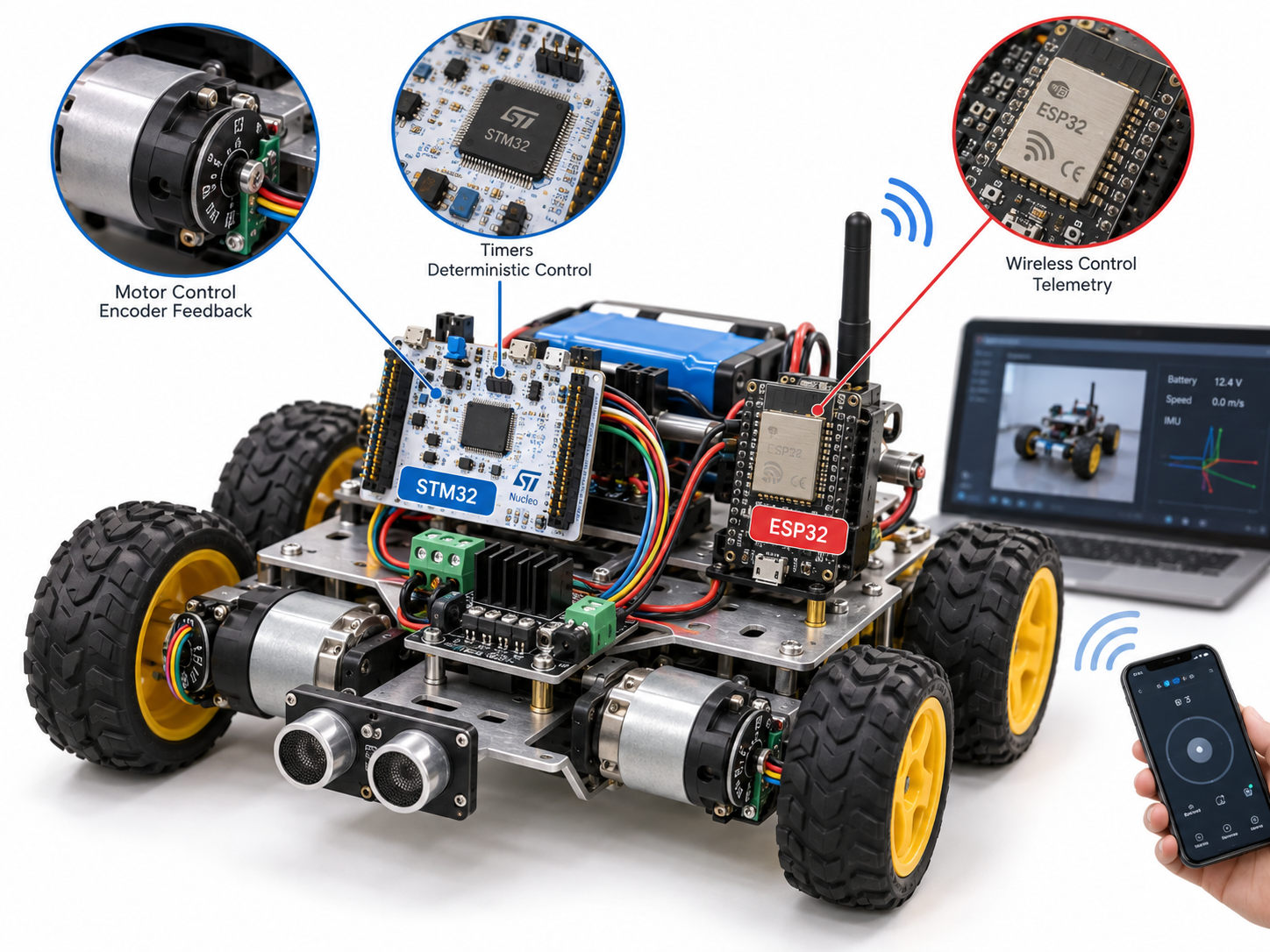
STM32 vs ESP32 for Robotics: Which Fits the Project Better?
STM32 is often preferred for deterministic motor and motion control, while ESP32 is attractive when the robot needs wireless communication, remote control, telemetry, or cloud connectivity.
Robotics commonly involves:
Motor PWM
Encoders
PID or FOC control
IMUs
Distance sensors
Servo control
Communication buses
Wireless control
Telemetry
A mobile robot with several motors and encoders may benefit from STM32 timer, DMA, ADC, and motor-control capabilities.
An ESP32 can work well for simpler robots where Wi-Fi or Bluetooth control is important. It can also manage sensors, web interfaces, telemetry, and communication with another controller.
For more demanding systems, separating responsibilities can improve architecture. One MCU can handle hard real-time control while another manages networking and user communication.
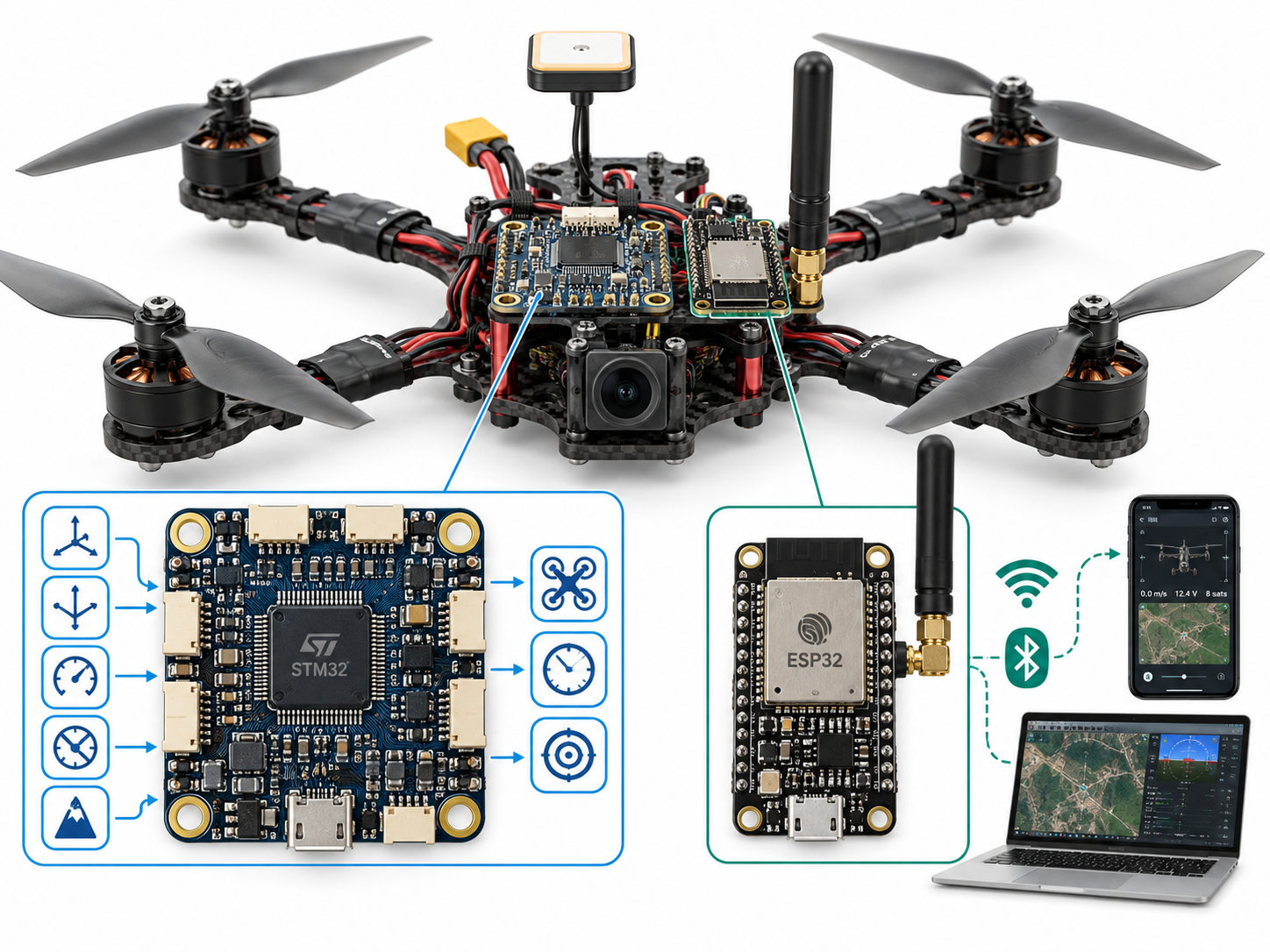
STM32 vs ESP32 for Drones: Which Fits Flight Control and Connectivity?
STM32 is commonly suited to the flight-control side of a drone, while ESP32 can be useful for wireless communication and secondary connected functions.
A flight controller needs predictable handling of:
IMU sampling
Sensor fusion
PWM or DShot outputs
Control loops
DMA
Interrupt timing
Barometer and compass data
These requirements favor deterministic MCU behavior and strong timer/peripheral support.
ESP32 can fit other parts of the drone architecture, including Wi-Fi communication, Bluetooth setup, telemetry, configuration interfaces, and camera or peripheral control.
A simple experimental drone may run entirely on one MCU, but more advanced designs often divide time-critical control and communication functions.
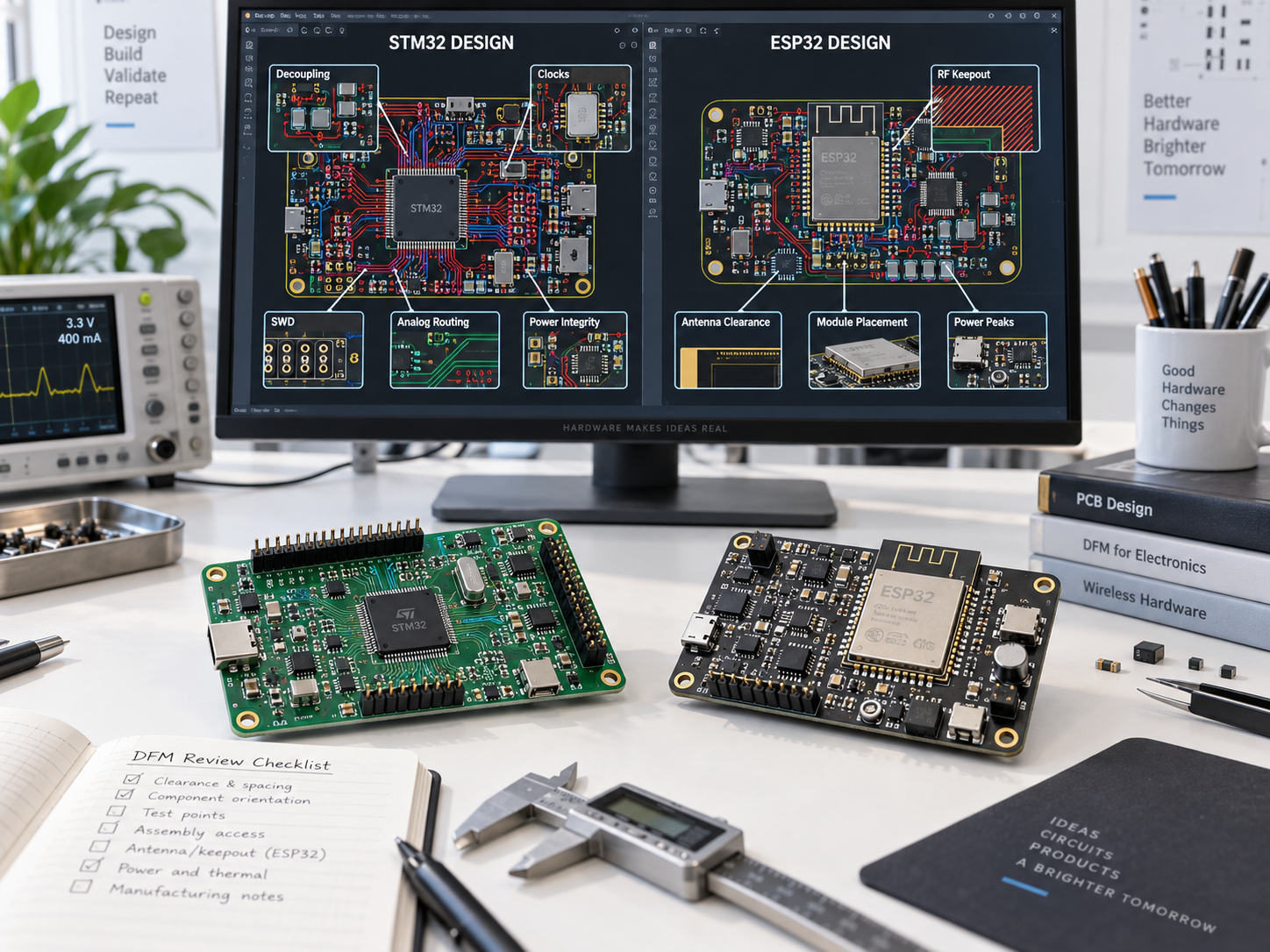
STM32 vs ESP32 PCB Design: What Changes at Hardware Level?
STM32 and ESP32 create different PCB design priorities. STM32 designs often focus on power integrity, clocks, analog performance, programming interfaces, and peripheral routing, while ESP32 designs also need careful RF and antenna planning.
For STM32 hardware, review:
Decoupling capacitor placement
VDDA and analog grounding
Clock source and crystal layout
BOOT configuration
SWD programming interface
USB or CAN transceivers
External wireless modules where required
For ESP32 hardware, additional checks may include:
Module versus bare SoC
Antenna placement
RF keepout
Ground-plane geometry
Flash and PSRAM configuration
USB interface
Power-supply peak-current capability
Using an ESP32 module can simplify RF design, but the antenna area still needs proper PCB clearance and enclosure consideration.
At EBest Circuit, MCU placement, power integrity, RF keepout, controlled-impedance interfaces, component footprints, and PCBA requirements can be reviewed during DFM before prototype fabrication.
Can STM32 and ESP32 Be Used Together?
Yes. STM32 and ESP32 are often complementary rather than direct competitors in systems that need both deterministic control and wireless connectivity.
A typical architecture might use:
STM32
Motor control
ADC sampling
Real-time sensors
Industrial communication
Safety-related control
UART or SPI link
ESP32
Wi-Fi
Bluetooth
Mobile-app communication
MQTT or cloud connection
Web configuration
This separation lets each controller handle the workload it is naturally suited to.
For example, an industrial robot may use STM32 for servo timing and encoder processing while ESP32 handles wireless diagnostics. A smart instrument can use STM32 for measurement accuracy and ESP32 for cloud connectivity.
The extra MCU adds BOM cost and firmware complexity, so this architecture is most useful when one device alone creates compromises in timing, connectivity, or certification.
STM32 vs ESP32: Which Should You Choose?
Choose according to the project requirement rather than the brand name. The most natural starting point changes with the workload.
Requirement
More Natural Starting Point
Wi-Fi IoT device
ESP32
Bluetooth-connected prototype
ESP32
Motor control
STM32
Industrial peripheral control
STM32
Battery-powered control system
Selected STM32 series
Wireless sensor node
ESP32 or wireless STM32
High-performance real-time processing
Higher-end STM32
Low-cost connected product
ESP32
Wireless + deterministic control
STM32 + ESP32
General maker prototype
ESP32
Industrial production platform
Compare exact STM32 and ESP32 variants
The final decision should consider MCU availability, software maturity, peripheral requirements, power budget, wireless needs, PCB complexity, and long-term production requirements.
A project that needs integrated Wi-Fi and rapid development may favor ESP32, while precise motor control or demanding industrial interfaces may point toward STM32. For many commercial products, comparing exact part numbers is more useful than deciding between the two families in general.
FAQ About STM32 vs ESP32
1. Is STM32 more powerful than ESP32?
It depends on the exact variants. Entry-level STM32 devices can be less powerful than some ESP32 models, while STM32H7 devices occupy a much higher embedded-performance class.
2. Is ESP32 faster than STM32F103?
In raw CPU clock and many general processing workloads, ESP32 typically has more processing headroom than STM32F103. Real-time peripheral performance still depends on the application.
3. STM32F4 vs ESP32: which is better?
STM32F4 is often attractive for real-time control, DSP, timers, and industrial peripherals. ESP32 is usually more convenient when integrated Wi-Fi or Bluetooth is a major requirement.
4. STM32H7 vs ESP32-S3: what is the main difference?
STM32H7 focuses on high-performance embedded control and processing, while ESP32-S3 combines general-purpose processing with integrated Wi-Fi and Bluetooth connectivity.
5. STM32 Blue Pill or Black Pill vs ESP32: which should beginners use?
ESP32 is often easier for wireless and IoT projects. Blue Pill and Black Pill boards are useful for learning STM32 peripherals, embedded debugging, timers, and lower-level MCU development.
6. STM32 vs ESP32 vs Arduino vs RP2040 vs Raspberry Pi: are they direct alternatives?
Not exactly. STM32, ESP32, and RP2040 are MCU platforms, Arduino is primarily a development ecosystem and board family, while most Raspberry Pi products are Linux-capable single-board computers. Raspberry Pi Pico is an MCU board based on RP2040 or newer RP-series devices.
Planning an STM32 or ESP32 PCB?
MCU selection affects more than firmware. Power architecture, clocks, RF layout, antenna clearance, analog routing, programming interfaces, connectors, and assembly requirements can all change with the selected device.
EBest Circuit supports STM32 and ESP32 PCB fabrication, DFM review, fine-pitch SMT assembly, component sourcing, programming, and functional testing. For a new embedded project, send your Gerber files, BOM, schematic, and assembly requirements to sales@bestpcbs.com for engineering review.
A locker control board is the electronic link between a smart locker’s host system and its individual doors. It receives an unlock command, drives the correct electronic lock, reads the resulting door or compartment status, and reports the result to the host. In a multi-door cabinet, these actions must remain reliable across every channel—not only on the first working prototype.
That makes the board more than a simple relay module. Its architecture must match the number and type of locks, the communication network, the available power supply, the sensing method, and the required test coverage. EBest Circuit supports prototype and production PCBA for customer-released locker controller designs. To discuss a project, send the PCB files, BOM and functional requirements to sales@bestpcbs.com.
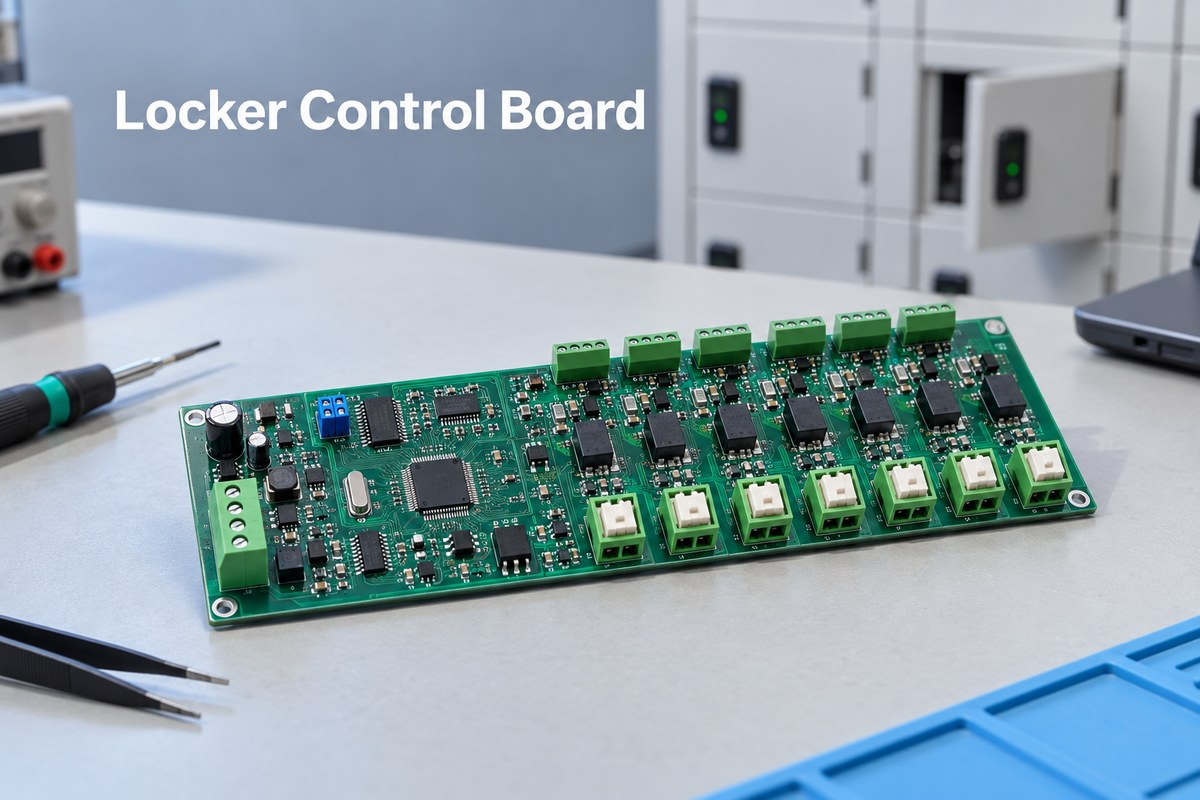
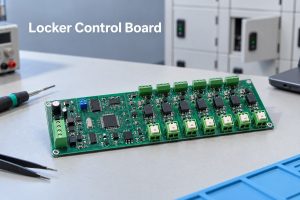
Multi-channel locker control board for electronic locks, communication and status feedback.
What Is a Locker Control Board?
A locker control board controls the electronic hardware inside parcel lockers, vending lockers, school lockers, pharmaceutical cabinets and other multi-compartment systems. It may operate as the main controller or as a lower-level unit connected to a separate computer or gateway.
Its role can be separated clearly:
On the board: select a compartment, drive its lock, read door or occupancy signals, and control local indicators.
Usually elsewhere: user interface, payment, cloud connection, access rules and management software.
This boundary prevents unnecessary functions from being added to the PCB and clarifies what the locker control board must exchange with the host system.
How Is a Smart Locker Control Board System Structured?
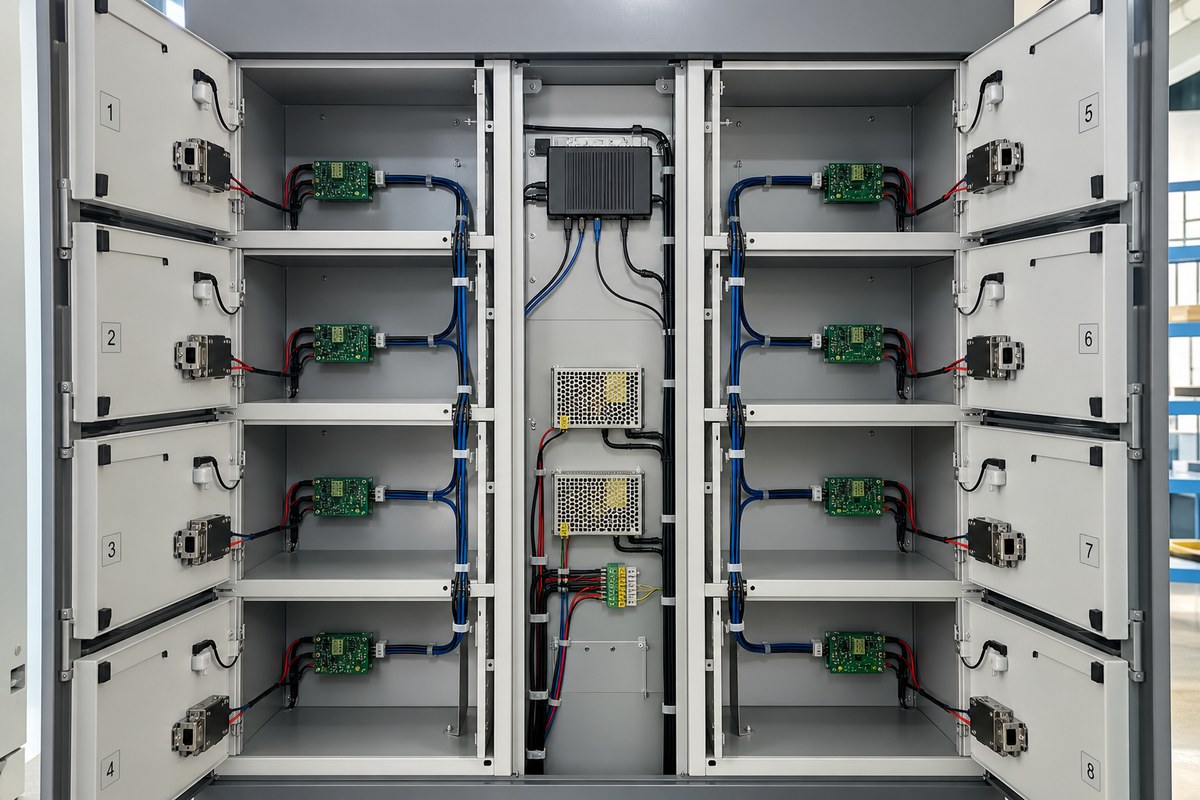
Many multi-door locker systems use a modular structure rather than putting every function on one large PCB.
Host or main controller: Runs the user interface, access rules, network connection and application software.
Communication or bus unit: Converts commands from Ethernet, USB or another host interface into a field bus such as RS485.
Lock control unit: Provides multiple lock outputs and reads the corresponding feedback or sensor inputs.
Locks and sensors: Perform the physical action and return door, latch or occupancy information.
Placing lock units near the compartments shortens high-current wiring. Additional addressed units can add more doors without redesigning the host controller.
Typical choice: combine the host interface and lock drivers for a compact locker; use one gateway plus several addressed lock boards for a large cabinet.
Distributed control boards connect a locker gateway to individual electronic locks and sensors.
How Many Locks Can One Locker Control Board Manage?
Commercial locker boards commonly provide 8, 16 or 24 lock channels. Start with the compartment count: each door needs a lock output and the corresponding feedback and indicator connections. If the product family uses several cabinet sizes, a few spare channels can keep one controller platform usable across more than one model.
Then apply the electrical limit. The combined pulse current of every lock that may open together must remain within the PCB power path, connectors and external supply. For example, a 48-door cabinet can use two uniquely addressed 24-channel boards instead of concentrating 48 high-current outputs on one PCB. The “24-channel” label is meaningful only when the feedback I/O, power budget and bus architecture also support 24 doors.
How Do RS485 and TCP/IP Connect a Locker Control Board to the Host System?
TCP/IP and RS485 normally serve different links in the same system:
Interface
Typical link
Main reason to use it
TCP/IP
Network or server to locker gateway
Connects management software and remote services
RS485
Gateway to distributed lock boards
Supports addressed boards over longer cabinet wiring
RS485 still requires the correct termination and biasing arrangement, transient protection where needed, controlled connector pinouts and a clear grounding strategy. The firmware protocol must define addresses, commands, acknowledgements and fault behavior. Adding a transceiver alone does not make the bus reliable.
How Does a Locker Control Board Monitor Doors and Compartments?
A locker control board monitors each compartment through separate inputs tied to the same channel number as its lock output. After the host commands channel 12, latch feedback can show that the lock released, a door switch can show whether door 12 actually opened, and an occupancy sensor can show whether the item was removed. The controller reports these events separately instead of returning one vague “success” status.
This separation lets the host distinguish an electrical release from a completed pickup. It can also identify cases such as “lock released but door stayed closed” or “door closed but latch not engaged.” The status LED is an output that communicates the resulting state to the user; it is not a substitute for the feedback inputs. Long sensor wiring may require filtering and protection so that noise does not create a false door event.
How Does a Locker Control Board Drive Solenoid and Motor Locks?
The two lock types need different drive behavior:
Lock type
Typical drive action
Main PCB consequence
Solenoid lock
Apply a defined release pulse
Size the switching path for pulse current and suppress the inductive transient
Motor lock
Run for a controlled interval, sometimes with polarity reversal
Provide direction control and stop the drive at the correct time
MOSFETs are commonly used for compact, efficient DC switching. Relays are more appropriate when the design needs isolated or flexible contacts, but they consume more board space and have a finite mechanical life. Whichever device is selected, the PCB power path, connectors and external supply must carry the worst-case current when multiple doors are released—not merely the current of one lock.
Does a Locker Control Board Need a 2-Layer or 4-Layer FR-4 PCB?
The common choice is 2-layer or 4-layer FR-4:
PCB structure
Better suited to
2-layer FR-4
A roomy expansion board with modest channel count, low-speed communication and simple sensor inputs
4-layer FR-4
A compact controller combining an MCU, dense connectors, communication, many outputs and multiple inputs
Four layers provide clearer ground and power planes and reduce routing congestion, but more layers do not automatically make a better controller. A roomy 8-channel board may work well in two layers, while a compact 24-channel controller may justify four. Freeze the stackup before final placement because a late layer change affects grounding, vias, routing and PCBA cost.
When Does a Locker Control Board Need HDI, Heavy Copper or BGA Assembly?
Most locker control boards need none of these three technologies. A conventional 2-layer or 4-layer FR-4 PCB with plated through holes and standard SMT packages is normally sufficient for a multi-channel lock controller.
HDI becomes justified only when the permitted board area and fine-pitch routing cannot be resolved with conventional through vias. Heavy copper becomes justified only when the simultaneous lock current cannot be carried practically with wider standard-copper pours and shorter power paths. In many locker designs, staged lock operation avoids that current concentration.
BGA assembly depends mainly on the selected processor rather than the locker application itself. A conventional MCU in QFP or QFN normally avoids BGA. A compact Linux controller that integrates processing, memory and networking is more likely to require BGA placement, X-ray inspection and escape routing. The design should add HDI, heavy copper or BGA only after a real space, routing or current limit rules out the conventional construction.
What Makes Multi-Channel Locker Control Board Assembly and Testing Difficult?
The challenge is repetition. A solder defect, incorrect connector, reversed driver device or wrong component value can affect only one of many otherwise identical channels. A board may power up and communicate normally while one locker door still fails in service.
Mixed assembly can add another difficulty. Locker controllers often combine fine-pitch SMT control electronics with relays, terminal blocks, pin headers or other through-hole parts. The assembly process must keep polarity and orientation correct while protecting tall connectors and mechanically loaded joints.
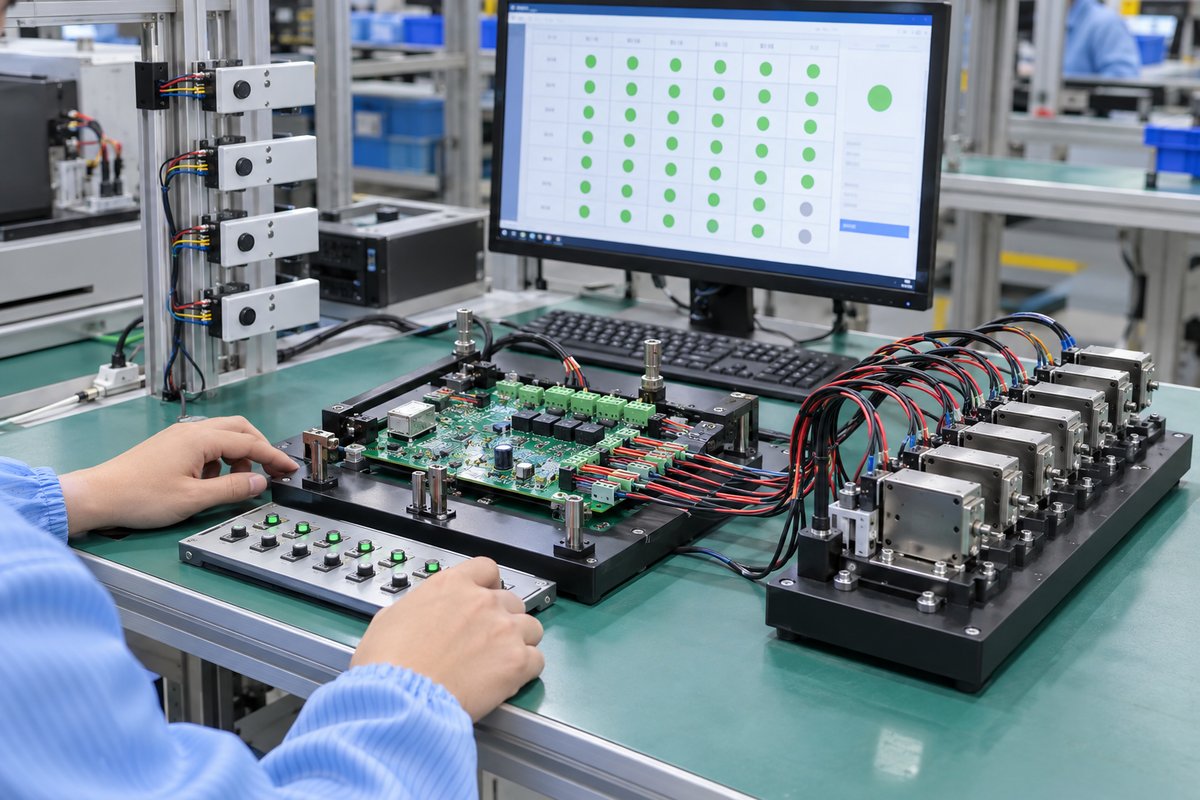
Visual inspection and continuity testing cannot demonstrate full operation. A production fixture should repeat one closed-loop sequence for every populated channel:
Send a command to channel 1.
Apply a representative lock load and confirm the output.
Switch the paired door or occupancy input.
Verify that the host reports channel 1.
Repeat for every remaining channel.
Firmware revision and total supply current can be checked once for the complete board.
The fixture does not need dozens of physical locker doors. Electrical loads and switch simulation can test every channel efficiently, while a first article fitted with the actual lock confirms that the simulated current and feedback conditions represent the application.
A functional fixture verifies each locker output and its paired feedback channel.
How Does EBest Circuit Build and Test Multi-Channel Locker Control Board Assemblies?
The greatest manufacturing risk on a multi-channel locker board is that one repeated error can appear 8, 16 or 24 times. EBest Circuit reviews the repeated driver circuits, connector numbering, polarity and test-point access before assembly, helping prevent a mirrored connector or incorrect protection device from being copied across the complete board.
The prototype is built as a usable assembly rather than a bare PCB alone. PCB fabrication, sourcing through a network of more than 1,000 supply-chain partners, SMT and through-hole assembly can cover the MCU, communication devices, MOSFETs or relays, terminal blocks and cabinet connectors in one project. This allows the customer to connect the first articles to the intended locks and wiring before releasing the next quantity.
For production, the functional fixture follows the actual channel map. It verifies that each command activates the matching output and that the paired door or occupancy input returns to the correct address. Firmware revision, material batch and production progress can be linked through EBest Circuit’s digital workshop, where material and product batch information can be traced within five seconds.
With more than 20 years of PCB and PCBA experience, EBest Circuit supports prototypes, small batches and repeat orders under ISO 9001, ISO 13485, IATF 16949 and AS9100D quality systems. The practical benefit is a locker control board that arrives assembled, channel-tested and traceable, ready for the customer’s cabinet-level validation.
FAQs About Locker Control Board
Can one locker control board operate different types of electronic locks?
Yes, if the output circuit and firmware match the voltage, current, pulse duration and feedback method of each lock. A board designed for a low-current solenoid should not be assumed to support a motor lock without checking the driver and power architecture.
Is RS485 necessary for every smart locker?
No. A compact locker may connect its controller directly to the host. RS485 becomes especially useful when multiple lock boards are distributed through a larger cabinet or when the communication cable must cover a longer distance in a noisy environment.
Does a 24-channel board open all 24 locks at the same time?
Not necessarily. Channel count describes how many locks the board can address, not how many it can energize simultaneously. The permitted simultaneous operation depends on the output devices, copper distribution, connectors and external power supply.
Does a locker control board require a 4-layer PCB?
Not always. A simple expansion board may use two layers. Four layers are more appropriate when processing, communication, sensor inputs and many lock outputs create dense routing or demanding power and grounding needs.
What information is most useful for a locker control board PCBA quotation?
The PCB data, BOM, placement file and required quantity are enough to begin a manufacturing review. It also helps to identify the lock voltage and current, number of channels, programmed components, through-hole parts and expected functional test. EBest Circuit can review the available package first and identify any missing production details without asking the customer to prepare an unnecessary document set.
A reliable locker control board must do more than switch an electronic lock. It must control the correct channel, communicate consistently, read meaningful feedback and pass the same functional checks across every assembled board. For a locker controller PCB or PCBA review, contact EBest Circuit at sales@bestpcbs.com.
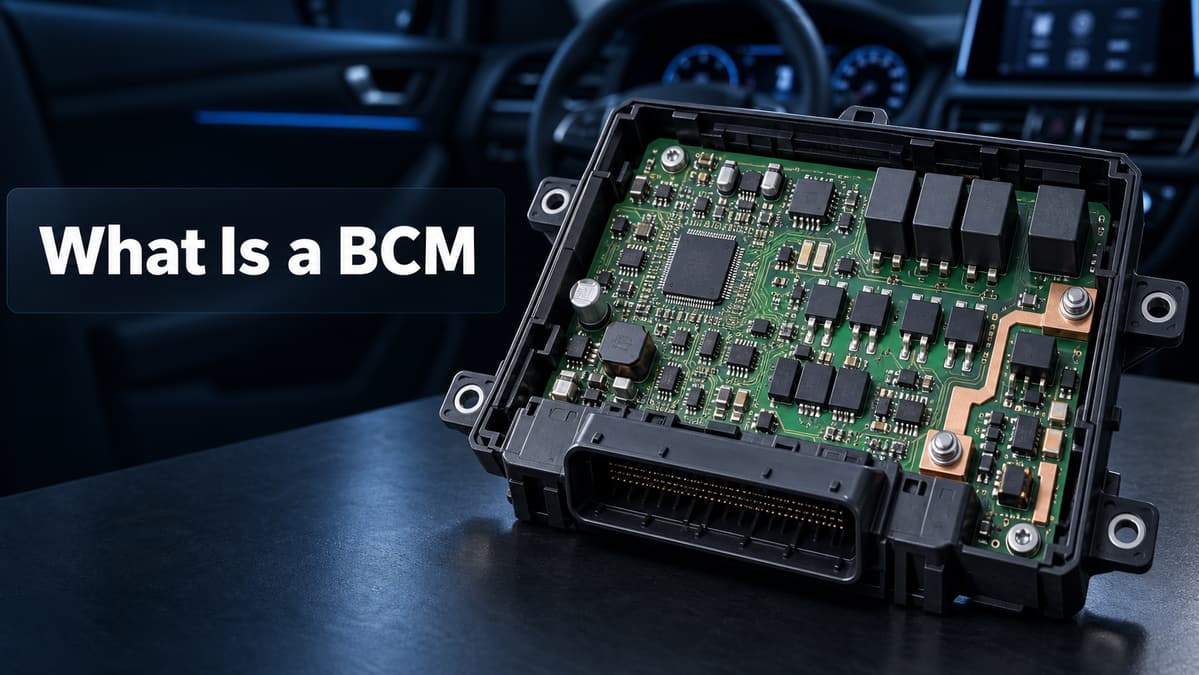
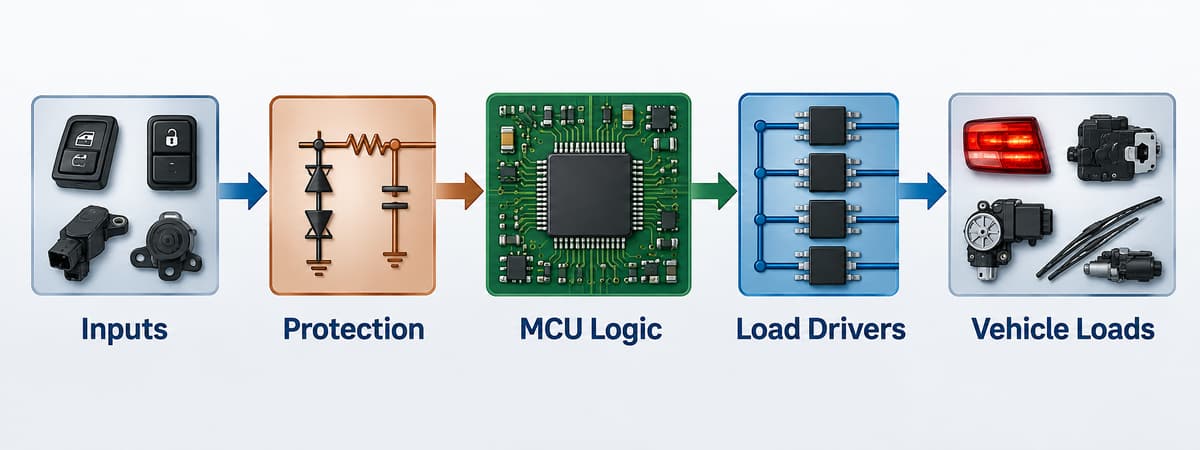
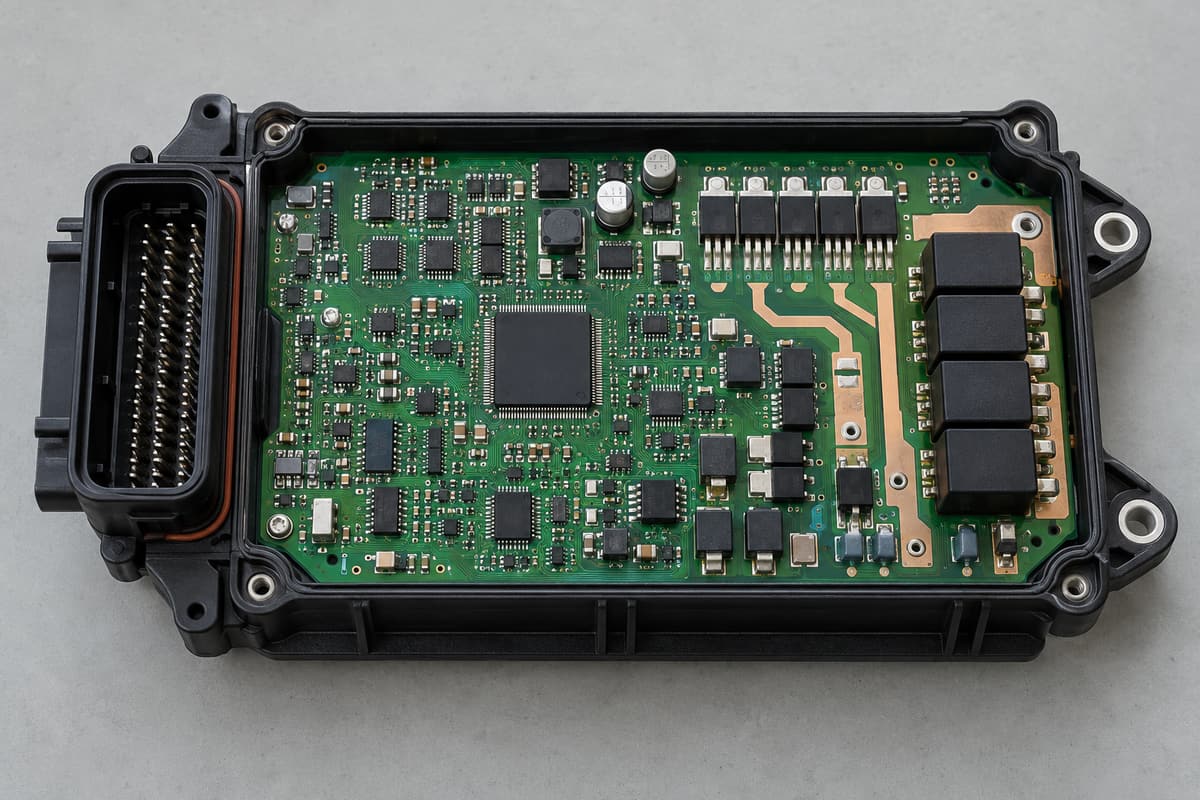
BCM most often means Body Control Module in an automotive context. It is an electronic control unit that reads switches, sensors, and vehicle-network messages, runs body-control logic, and drives loads such as lamps, door locks, windows, mirrors, wipers, and interior convenience systems.
A BCM is not just a processor board. Its PCB must place low-voltage logic, vehicle communications, protected power inputs, and higher-current load drivers in one compact assembly while handling electrical transients, heat, electromagnetic interference, vibration, and long service life. This guide opens the module and follows the signal path from an input to a physical vehicle function.
What Is a BCM on a Car?
A BCM on a car is the electronic control unit responsible for body and convenience functions rather than combustion, traction, or transmission control. The exact boundary varies by vehicle: one platform may use a central BCM, while another divides the same work among front, rear, door, or zone controllers.
The search phrase what is a bcm module usually refers to the same device. “Module” describes the complete unit: the populated PCB, connector interface, housing, firmware, and calibration data. Replacing only the circuit board may not restore operation if the vehicle also requires coding, key matching, or configuration.
Module
Primary responsibility
Typical inputs and outputs
BCM
Body, access, lighting, and cabin convenience functions
Door switches, locks, lamps, windows, mirrors, wipers, network messages
Powertrain control; on some vehicles it combines engine and transmission control
Engine and transmission sensors, injectors, ignition, shift control
BCM, ECM, and PCM names are not perfectly standardized across automakers. The vehicle service information and electrical architecture remain the authority for a specific model.
What Does a BCM Control in a Car?
A BCM commonly controls exterior and interior lights, central locking, power windows, mirrors, wipers, washers, retained accessory power, and selected heaters or motors. It also coordinates these functions with door modules, gateways, and other ECUs when the vehicle architecture distributes the load control.
Access: central locking, keyless-entry requests, trunk or tailgate release, and anti-theft status exchange.
Doors and glass: window motors, mirror fold or heating, door-ajar inputs, and child-lock functions.
Wipers and washers: stalk requests, intermittent timing, rain-sensor messages, and pump or motor control.
Cabin functions: interior lamps, retained accessory power, seat or steering-wheel heaters, and wake/sleep coordination.
Not every vehicle assigns every function to the BCM. Some loads are driven by door or zone modules after receiving BCM commands over CAN or LIN; the model-specific wiring diagram identifies the responsible controller and output stage.
How Does a BCM Work?
A BCM works through five blocks: it receives an input, protects and conditions the signal, evaluates the request in a microcontroller, commands a driver, and monitors the resulting load. For example, a door-switch transition can be debounced by the input circuit, interpreted by firmware, transmitted to another ECU if required, and used to switch a courtesy lamp through a protected high-side output.
The complete path normally includes:
Input acquisition: switches, Hall sensors, analog sensors, and messages from CAN or LIN nodes.
Protection and conditioning: filtering, voltage clamping, reverse-polarity protection, level shifting, and transient-tolerant interfaces.
Decision logic: an MCU applies timing, state-machine, safety, diagnostic, and energy-management rules.
Load actuation: smart high-side switches, low-side drivers, half bridges, full bridges, or relays operate lamps, heaters, solenoids, and motors.
Feedback: current sense, fault flags, temperature status, position signals, and bus messages confirm whether the command succeeded.
Sleep behavior is another core function. When the vehicle is parked, the BCM must reduce its own current and coordinate network sleep without missing legitimate wake events such as a key request or door opening.
What Is Inside a BCM Module?
Inside a BCM module are a microcontroller, regulated power rails, CAN or LIN transceivers, protected input circuits, load drivers, nonvolatile memory, clocks, connectors, and thermal paths. Exact parts depend on the vehicle architecture, but real automotive reference designs make the functional split concrete.
Circuit function
Representative automotive device
Role in a BCM-class design
Microcontroller
TI AM263P4-Q1
Runs control logic, diagnostics, timing, and network software in a recent zone-controller reference design
Power-management IC
TI TPS65386x-Q1 family
Generates and supervises regulated rails for the processor and peripheral circuits
CAN/CAN FD transceiver
TI TCAN1043A-Q1
Converts MCU logic-level data to the differential vehicle bus and supports wake/sleep behavior
LIN transceiver
TI TLIN1021A-Q1
Connects lower-cost local nodes such as switches, small actuators, or door electronics
Smart high-side switch
TI TPS1HC30-Q1
Switches a protected body load and provides diagnostic feedback
Motor driver
TI DRV8245S-Q1
Controls bidirectional DC loads such as selected window, latch, or seat mechanisms
These are examples, not a universal BCM bill of materials. A more integrated approach is also possible: Infineon’s TLE9560-3QX system basis chip combines a 5 V regulator, CAN FD and LIN communication, two half-bridge drivers, high-side outputs, and SPI control in one device. The final choice depends on current, channel count, diagnostic coverage, thermal limits, software architecture, and the automaker’s component requirements.
How Does a BCM Communicate With Other ECUs?
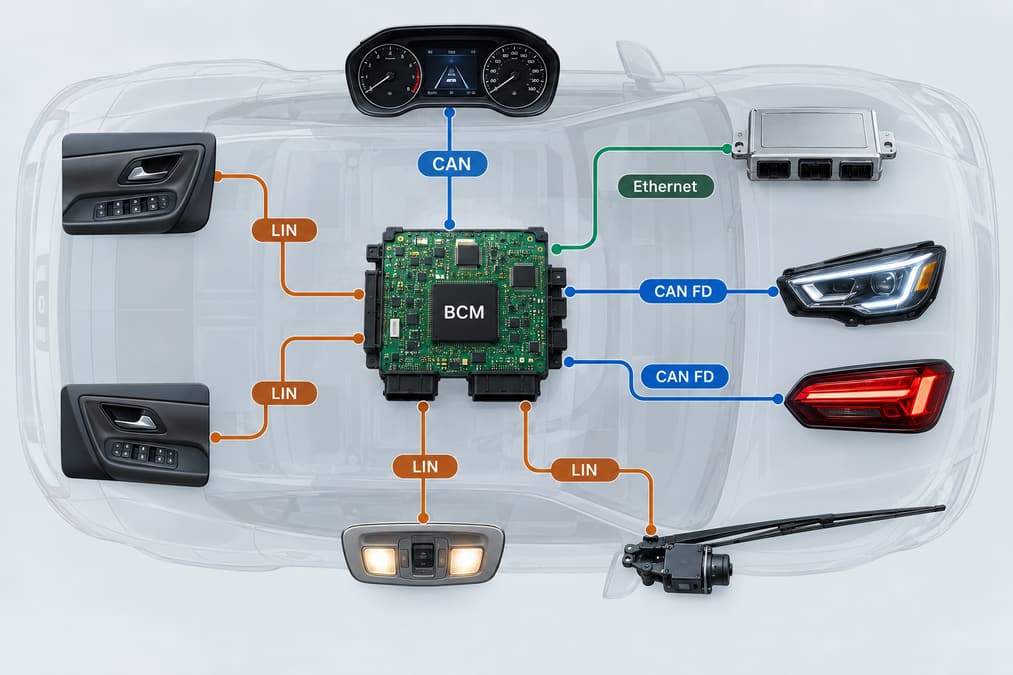
A BCM communicates with other ECUs through vehicle networks, most commonly CAN or CAN FD for coordinated control and LIN for lower-cost local devices. Some newer centralized or zonal architectures also use automotive Ethernet for higher-bandwidth links, but not every BCM includes every interface.
CAN: robust multi-node communication for status, commands, diagnostics, and coordination among body, gateway, powertrain, and instrument modules.
CAN FD: retains CAN arbitration while allowing a larger payload and faster data phase when the network and transceivers support it.
LIN: a lower-cost single-master network suited to local switches, small motors, lighting nodes, and door electronics.
Automotive Ethernet: a higher-bandwidth link increasingly associated with gateways and zone controllers rather than a universal requirement for conventional BCMs.
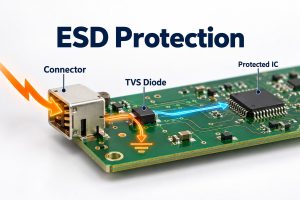
The PCB must keep these communication paths away from noisy switching nodes, preserve their return paths, and implement the termination, common-mode filtering, ESD protection, and connector pinout required by the actual interface design.
What Makes a BCM PCB Different From a General Control Board?
A BCM PCB differs from a general control board because it combines battery-connected power, sensitive digital logic, network interfaces, and multiple switched loads in a harsh electrical and mechanical environment. A circuit that works on a bench can still fail in a vehicle if the layout cannot handle a load dump, inductive switching, reverse battery, ground offset, thermal cycling, or conducted and radiated noise.
Power partitioning: battery inputs, regulators, high-current outputs, logic rails, and communication grounds require a deliberate placement and return-path strategy.
Current and heat: copper width, copper weight, via arrays, thermal spreading, connector pins, and driver packages must be checked against actual current and ambient temperature.
Transient protection: suppressors, filters, reverse-polarity circuits, and protected drivers must be placed so surge current does not flow through the logic-ground path.
EMC control: fast driver edges, motor currents, and DC/DC converters must not corrupt CAN, LIN, crystal, reset, or sensor signals.
Mechanical reliability: connector insertion force, mounting points, enclosure support, vibration, moisture exposure, and coating keep-outs affect the PCB layout and assembly process.
Standard FR-4 PCB manufacturing may suit many body-control designs, but “FR-4” alone does not define a finished material system. The laminate grade, glass-transition temperature, CAF performance, copper construction, solder mask, coating, and validation plan should be matched to the specified environment rather than chosen from a generic layer-count rule.
Which PCB and PCBA Checks Matter for BCM Hardware?
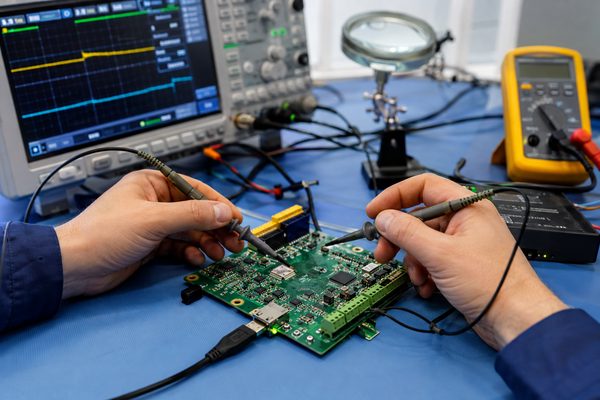
The most important checks are power-path verification, network-layout review, assembly inspection, programming control, and functional testing under representative loads. They should be agreed before the design is released because a fixture, connector breakout, firmware image, or diagnostic interface may affect both PCB layout and production cost.
PCB review: confirm stackup, copper weight, high-current trace temperature rise, thermal vias, creepage and clearance, test-point access, connector support, and coating keep-outs.
Signal-integrity and EMC review: examine CAN/CAN FD differential routing, LIN protection, clock and reset nets, switching loops, power-plane discontinuities, and return-current paths.
Assembly controls: use solder paste inspection where applicable, AOI for visible joints, and X-ray for hidden-pad packages or thermal-pad voiding when required by the design.
Programming and traceability: control firmware version, calibration data, serial or lot records, approved component alternatives, and the relationship between each assembly and its test result.
Functional testing: exercise wake/sleep behavior, CAN and LIN communication, input thresholds, load outputs, current sensing, fault reporting, and quiescent current with defined limits.
A capable PCB assembly process should connect inspection records to the released BOM, placement data, firmware, and test procedure. Our quality and inspection overview explains the broader controls available for PCB and PCBA projects; the exact automotive test matrix still needs to be defined by the customer’s product requirements.
FAQ About BCM Hardware
Is a BCM the same as an ECU?
A BCM is one type of ECU. “ECU” is the broad category for electronic control units; “BCM” identifies the unit assigned to body and convenience functions.
Can one car have more than one BCM?
Yes. A vehicle can distribute body functions across a central BCM, door modules, a smart junction box, gateway, or front and rear zone controllers. The physical module count depends on the electrical architecture.
Does every BCM use CAN and LIN?
No. CAN is common, and LIN is widely used for local low-cost nodes, but the actual mix can include CAN FD, Ethernet, direct hardwired inputs, or proprietary interfaces.
Can a BCM switch loads without mechanical relays?
Yes. Smart high-side or low-side semiconductor switches can replace some relays and add current sensing, short-circuit protection, and diagnostic feedback. Relays may remain where load, isolation, cost, or fail-safe requirements favor them.
Why does a BCM need low sleep current?
The BCM remains connected to the vehicle battery while parked. Excess quiescent current can discharge the battery, so the design must place the MCU, transceivers, regulators, and output drivers into defined low-power states while preserving valid wake sources.
Where can I find BCM failure and reset information?
For symptoms, test methods, common failure causes, reset considerations, and repair-oriented questions, read our separate guide to Body Control Module testing and failure symptoms. Keeping that troubleshooting topic separate avoids mixing service procedures with this hardware-architecture guide.
How Can We Support Your BCM PCB and PCBA Project?
We can manufacture and assemble customer-released BCM and automotive control-board designs, with engineering review focused on manufacturability, stackup, materials, component availability, assembly, inspection, and test preparation. At EBest Circuit, our listed quality certifications include ISO 9001:2015 and IATF 16949; we confirm the applicable facility, process scope, and project requirements before quotation.
Our support can combine PCB fabrication, component sourcing, SMT and through-hole assembly, AOI, X-ray inspection where applicable, and functional-test coordination. Send your Gerber files, BOM, pick-and-place data, stackup or copper requirements, quantities, coating specification, firmware instructions, and test limits to sales@bestpcbs.com. We will review the package against the required automotive environment instead of treating it as a generic control board.
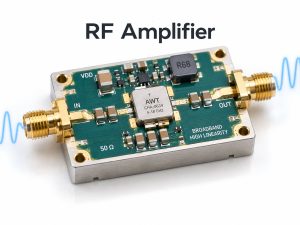
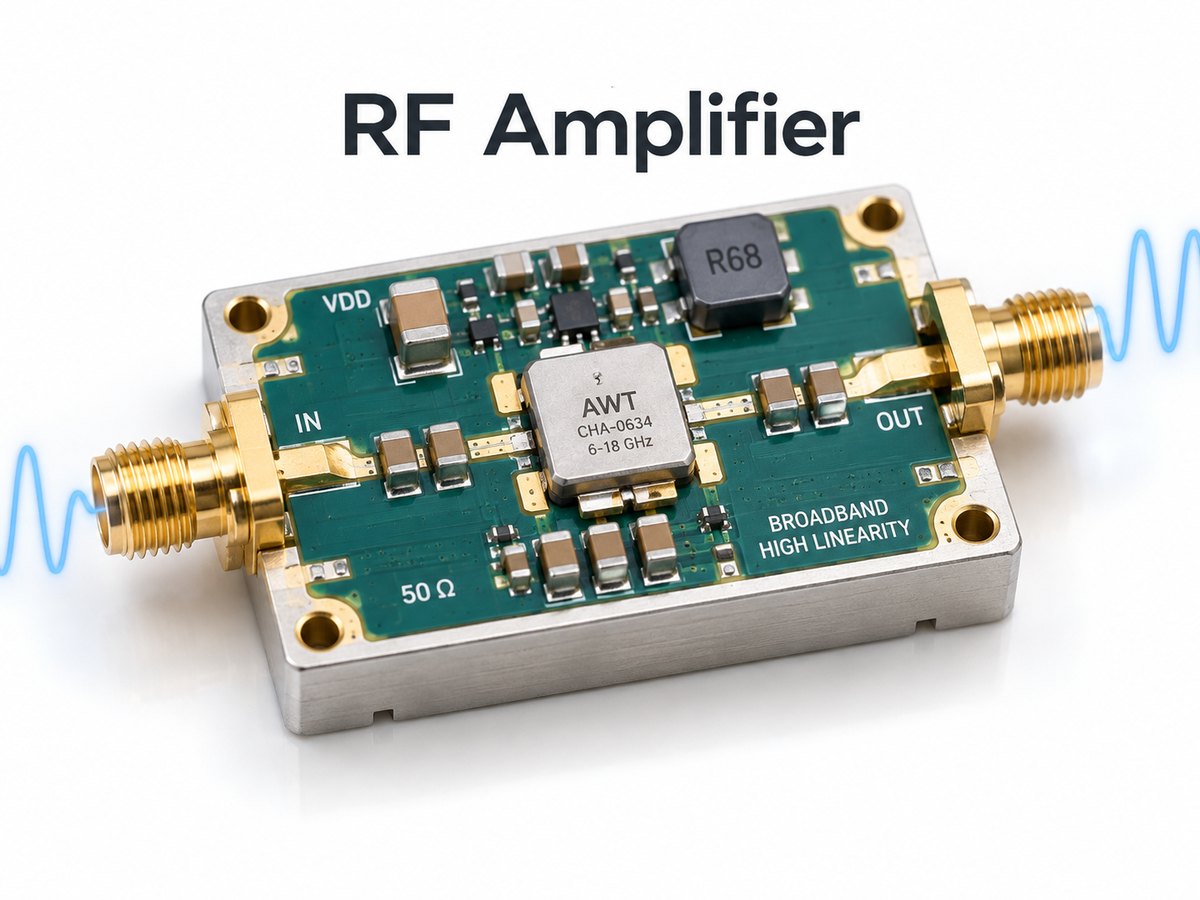
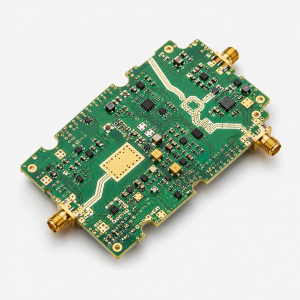
An RF amplifier, or radio frequency amplifier, increases the amplitude or power of an RF signal within a specified frequency range. Depending on where it sits in the signal chain, it may amplify a weak received signal, drive another RF stage, or provide enough output power for transmission. Gain, noise figure, bandwidth, linearity, output power, efficiency, and impedance matching are the main parameters that define its performance.
RF amplifiers are used in wireless communication, radar, satellite systems, test equipment, IoT hardware, MRI equipment, and many other RF products. Their real performance depends not only on the amplifier IC or transistor, but also on the matching network, bias circuit, PCB layout, grounding, stackup, and thermal design.
What Is an RF Amplifier?
An RF amplifier is a circuit that strengthens a radio-frequency signal without changing its intended information content.
The term covers several amplifier functions. A receiver may use a low-noise amplifier to raise a weak antenna signal. A transmitter may use a driver amplifier followed by an RF power amplifier to increase signal power before the antenna.
Typical RF amplifier roles include:
Low-noise amplification in receiver front ends
Signal gain between RF stages
High-linearity amplification for modulated signals
Wideband amplification across multiple frequencies
Power amplification before transmission
Adjustable gain for automatic gain control
An RF amplifier is therefore broader than an RF power amplifier. A power amplifier is only one category within the RF amplifier family.
At radio and microwave frequencies, parasitic capacitance, inductance, trace impedance, return-current paths, and electromagnetic coupling become part of the circuit behavior. That is why RF amplifiers require more careful physical implementation than ordinary low-frequency amplifiers.
How Does an RF Amplifier Work?
An RF amplifier uses energy from a DC power supply to increase the level of an incoming RF signal.
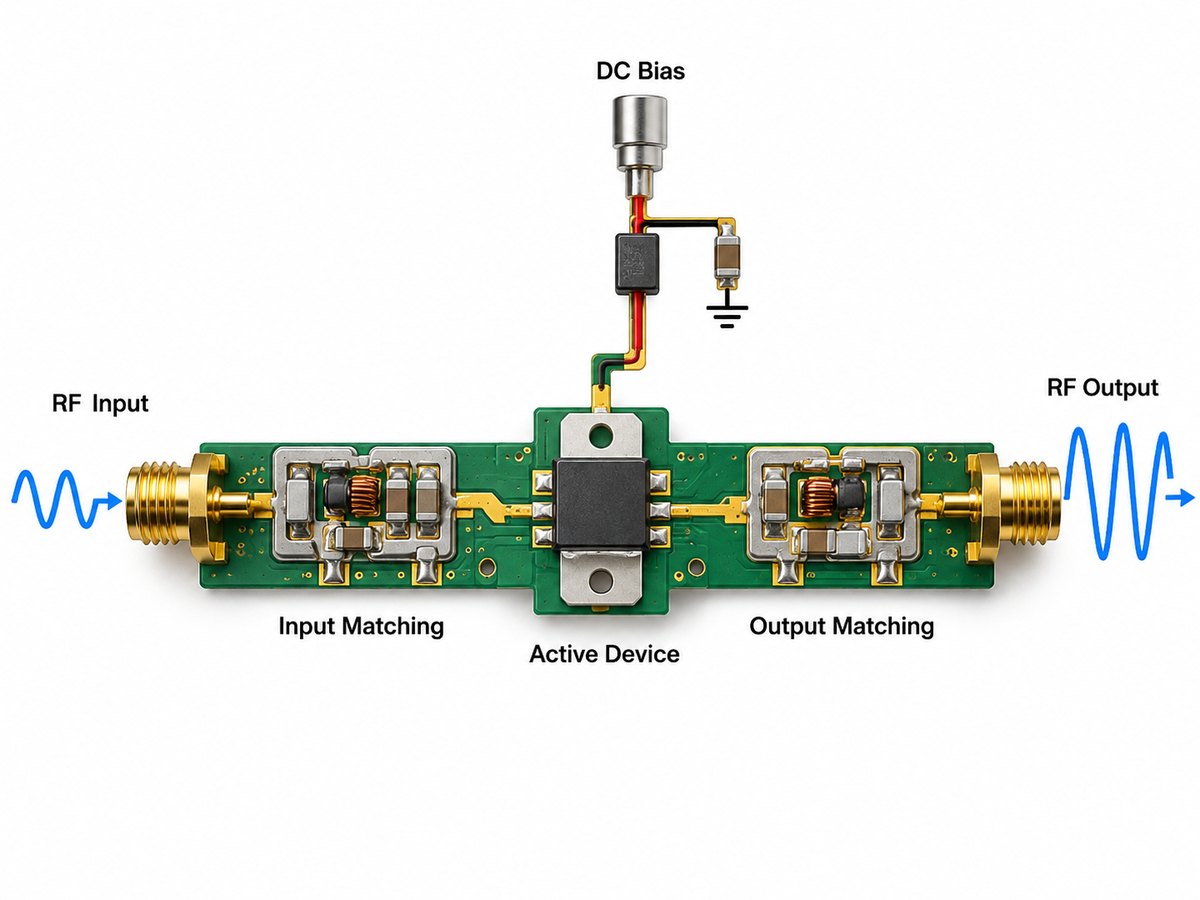
The active device may be a transistor, MMIC, or integrated RF amplifier IC. The surrounding network allows that device to operate at the required frequency and bias point.
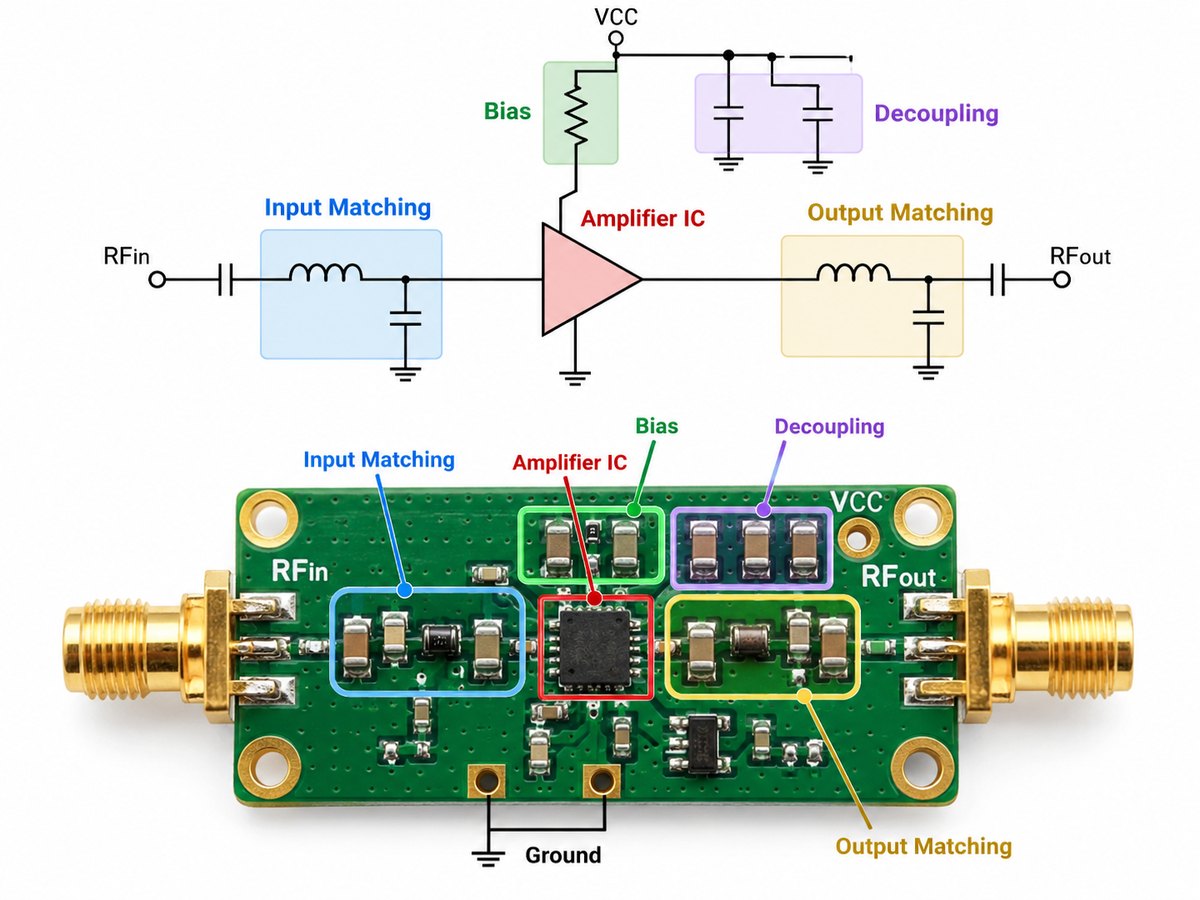
A typical circuit includes:
Input matching network to interface the source with the amplifier
Active device to provide gain
Bias circuit to set the correct DC operating condition
Output matching network to transfer power to the next stage
Decoupling components to keep RF energy out of the power rail
DC blocking capacitors where RF and DC paths must be separated
At low input levels, the amplifier normally operates in its linear region. As input power rises, the output eventually stops increasing proportionally. This is the beginning of gain compression, which is why RF designers check parameters such as P1dB when defining the usable signal range.
What Are the Main Types and Classes of RF Amplifiers?
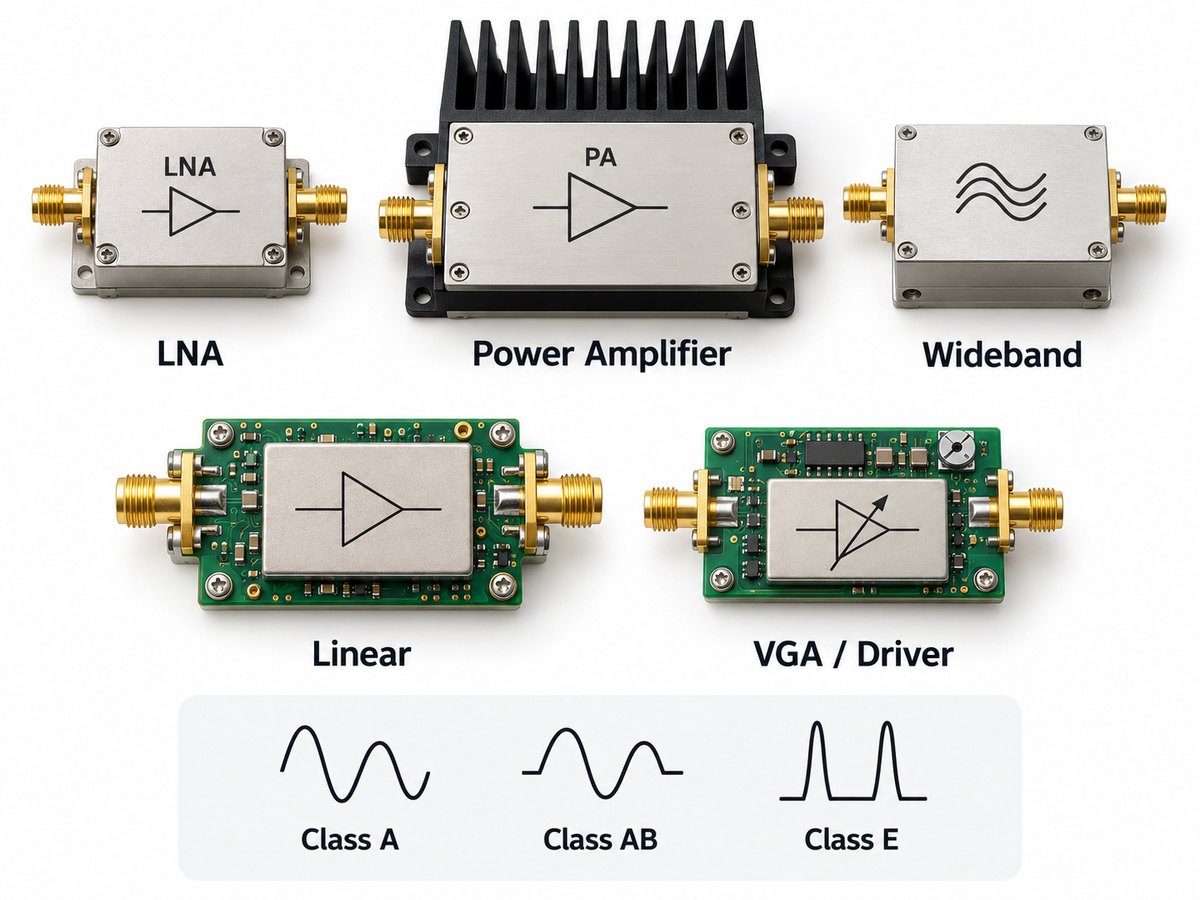
RF amplifiers are usually classified first by what they do in the RF signal chain.
Low-noise amplifier
A low-noise RF amplifier, or LNA, is used near the receiver input. Its main job is to amplify weak signals while adding as little noise as possible.
RF power amplifier
An RF power amplifier increases signal power before transmission. Output power, efficiency, linearity, and thermal performance are usually the main concerns.
Wideband RF amplifier
A wideband amplifier provides useful gain across a broad frequency range. It is common in test equipment, broadband communication, radar, and multi-band RF systems.
RF linear amplifier
A linear RF amplifier is designed to preserve the amplitude and phase characteristics of the input waveform. This matters for modulation schemes that are sensitive to distortion.
Variable gain amplifier
A VGA allows gain to be changed electronically. It is often used in automatic gain control and systems with a wide input signal range.
Gain block and driver amplifier
A gain block provides convenient fixed gain. A driver amplifier raises the signal level before another stage, often before the final PA.
RF power amplifiers may also be described as Class A, AB, B, C, D, or E. These classes describe how the active device operates.
In simple terms:
Class A favors linearity
Class AB balances linearity and efficiency
Class B and C increase efficiency but reduce linear operation
Class D and E use switching behavior for higher efficiency in suitable RF designs
Function and operating class are different classifications, so a power amplifier can still be described separately as Class AB, Class E, or another class.
What Does an RF Amplifier Circuit and Schematic Include?
An RF amplifier circuit normally combines an active device with matching, bias, decoupling, and filtering networks.
The main parts shown in an RF amplifier schematic are typically:
Transistor, MMIC, or RF amplifier IC
Input matching components
Output matching components
Bias resistors, inductors, or RF chokes
DC blocking capacitors
Power-supply bypass capacitors
Ground connections
Optional filtering or stability components
The schematic shows the electrical connections, but the physical PCB implementation strongly affects the final RF behavior.
For example, a capacitor connected directly to ground on the schematic still has pad, trace, and via inductance on the real board. At microwave frequencies, even a short connection can change the response of the matching or decoupling network.
RF amplifier circuits may be implemented in three common forms:
Discrete circuit: transistor plus external bias and matching components
RF amplifier IC or MMIC: more RF functions integrated into one device
RF amplifier module: amplifier plus additional matching, shielding, connectors, filtering, or thermal structure
The best form depends on frequency, power, board area, development effort, and performance requirements.
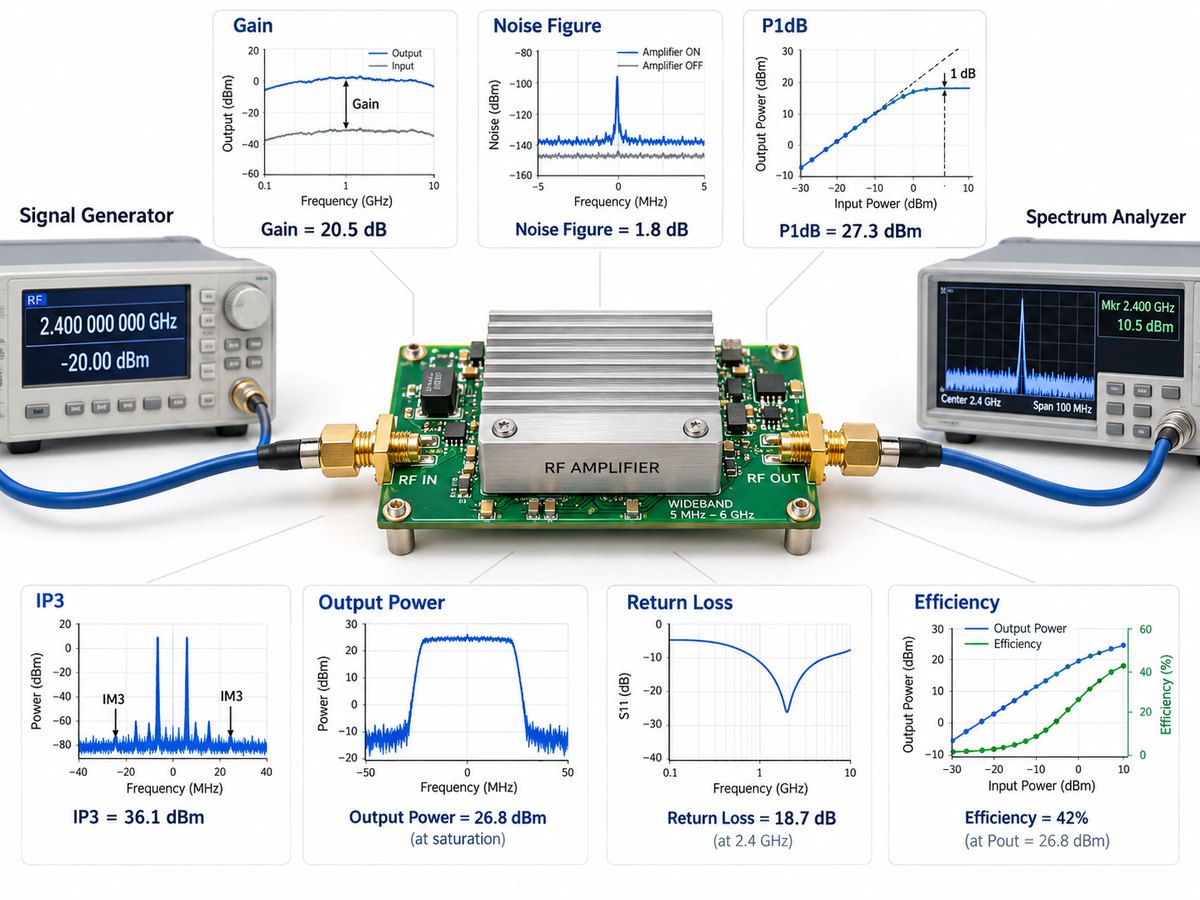
Which RF Amplifier Specifications Matter Most?
The most important RF amplifier specifications are frequency range, gain, noise figure, linearity, output power, matching, and efficiency.
Specification
What It Indicates
Typical Importance
Frequency range
Supported RF band
All RF amplifiers
Gain
Signal amplification
All signal chains
Gain flatness
Gain variation across bandwidth
Wideband systems
Noise figure
Noise added by the amplifier
Receiver LNAs
P1dB
Beginning of meaningful gain compression
Large-signal operation
IP3
Intermodulation linearity
Multi-signal environments
Output power
Available RF power
Driver and power amplifiers
Return loss / VSWR
Input and output matching
RF interfaces
Efficiency
DC-to-RF power conversion
Power amplifiers
Supply voltage/current
Electrical power requirement
Power and thermal design
No single specification tells the whole story.
A high-gain amplifier may still be unsuitable if its output compresses too early. A low-noise device may not provide enough linearity in the presence of strong nearby signals. A power amplifier may meet its output-power target but create excessive heat if efficiency is poor.
For wideband designs, these specifications should be checked across the complete operating frequency range rather than only at the center frequency.
How Do Gain, Noise Figure, and Linearity Affect RF Amplifier Performance?
Gain, noise figure, and linearity determine how strongly an RF amplifier boosts the signal, how much noise it adds, and how well it handles larger or multiple signals.
Gain determines how much the signal level rises through the amplifier. Too little gain may leave the next stage with insufficient signal. Too much gain can reduce available headroom.
Noise figure measures how much the amplifier degrades the signal-to-noise ratio. It matters most in the early stages of a receiver, where added noise can directly affect sensitivity.
Linearity describes how well the amplifier avoids distortion as signal level rises. P1dB and IP3 are commonly used to judge this behavior.
These parameters often interact.
For example, increasing front-end gain can reduce the relative noise contribution of later receiver stages. However, the same higher gain may cause the receiver to reach compression sooner when a strong signal enters the system.
The priority depends on amplifier position:
LNA: noise figure, gain, linearity
Driver amplifier: gain, IP3, P1dB
Power amplifier: output power, efficiency, linearity, thermal performance
The correct target is therefore not simply maximum gain or minimum noise, but enough margin for the full signal environment.
How Do You Choose the Right RF Amplifier for an Application?
Choose an RF amplifier by matching its operating limits to the actual frequency, signal level, bandwidth, and system role.
Start with these requirements:
Operating frequency or frequency range
Required gain
Minimum and maximum input level
Required output power
Bandwidth
Noise figure limit
P1dB and IP3 targets
Modulation and linearity requirements
Supply voltage and current
Efficiency target
Operating temperature
Package or module size
Input and output impedance
For a receiver front end, noise figure and linearity are usually more important than maximum output power.
For a transmitter, output power, efficiency, linearity, compression, and thermal performance move higher on the list.
For a wideband RF amplifier, check that gain flatness, return loss, noise figure, and output performance stay acceptable across the full band.
It is also useful to check whether the manufacturer provides a validated evaluation-board layout. RF amplifier performance can change noticeably when the matching network or PCB geometry differs from the reference design.
What Causes RF Amplifier Instability and Oscillation?
RF amplifier instability is usually caused by unintended feedback, poor grounding, incorrect matching, or parasitic coupling.
Common causes include:
Coupling between RF input and output
Long or poorly controlled RF traces
Weak ground connections
Insufficient power-supply decoupling
Bias network problems
Incorrect matching components
Parasitic capacitance and inductance
Coupling through power or ground networks
Layout changes from the reference design
Poor isolation from digital or switching circuits
Oscillation may occur inside or outside the intended RF band. It can raise current consumption, increase noise, distort gain, or produce unexpected spectral components.
Several layout practices help reduce the risk:
Keep input and output networks physically separated
Place decoupling components close to the device pins
Use short ground paths
Add ground vias where needed
Keep switching power circuits away from sensitive RF sections
Preserve the intended matching-network geometry
For discrete RF amplifier design, stability should also be checked in simulation over a frequency range wider than the required operating band.
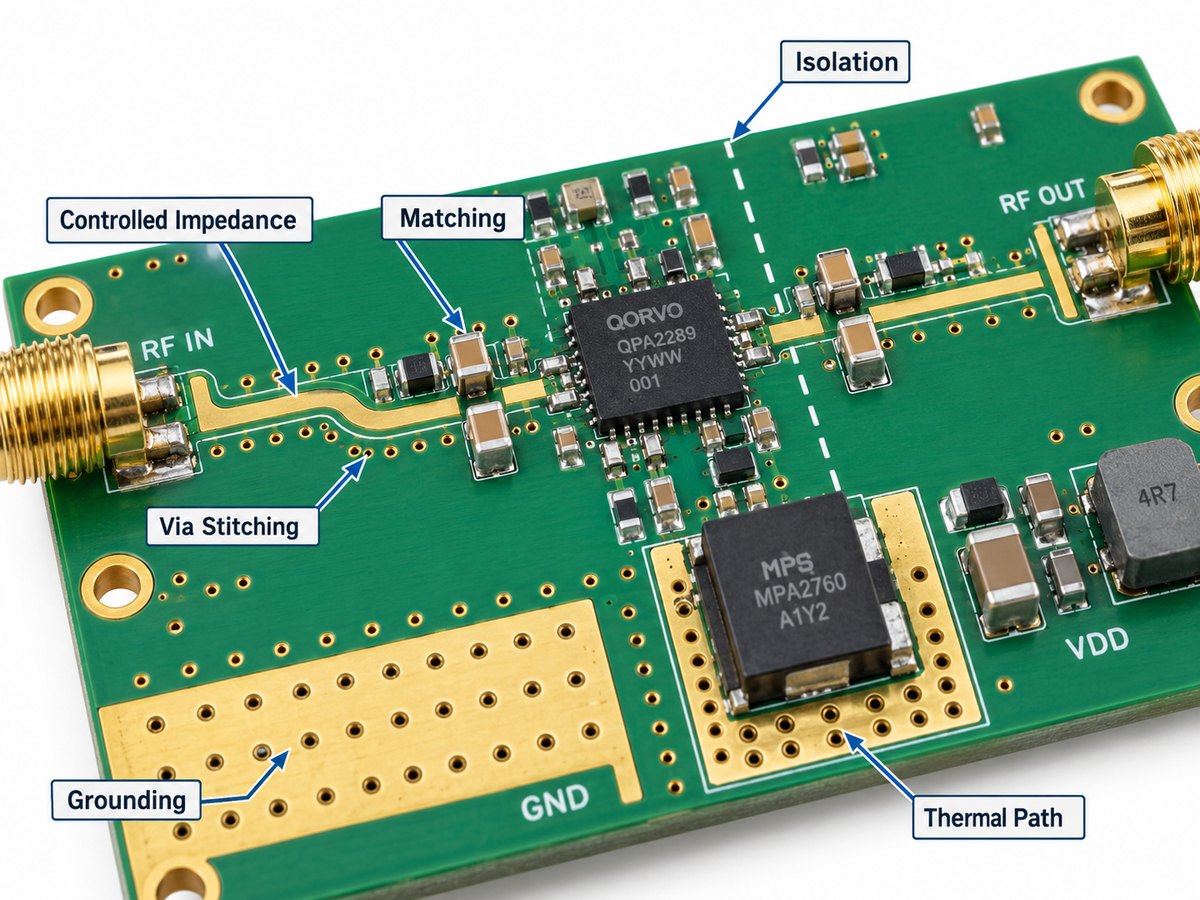
What PCB Design Factors Affect RF Amplifier Performance?
RF amplifier PCB performance depends heavily on controlled impedance, grounding, component placement, isolation, dielectric properties, and thermal design.
Controlled impedance
RF traces are commonly designed as microstrip, stripline, or grounded coplanar waveguide. Their impedance depends on trace width, copper thickness, dielectric thickness, Dk, and nearby reference conductors.
RF trace routing
Critical RF paths should remain compact and free from unnecessary bends or discontinuities. The production routing should stay close to the geometry used during simulation or reference-board validation.
Grounding
A continuous ground reference helps maintain a predictable RF return path. Ground-plane gaps or long ground connections add unwanted inductance.
Matching-network placement
Matching capacitors and inductors should be positioned close to the RF device and in the intended order. At higher frequencies, moving these components can alter the matching response.
Via stitching
Ground stitching vias can help maintain plane continuity and reduce field spreading around RF structures.
Isolation
Keep RF inputs away from high-power RF outputs, clocks, DC/DC converters, and fast digital signals to reduce unwanted coupling.
PCB material
Higher-frequency or lower-loss designs may require RF laminates with more stable Dk and lower dissipation loss than standard FR-4. Material selection should match the loss budget, frequency, stackup, and cost target.
Thermal path
Power amplifiers may require:
Exposed thermal pads
Thermal vias
Heavy local copper
Heat spreaders
Metal chassis contact
Dedicated heatsinks
The fabricated PCB stackup should match the stackup used for impedance calculation and RF simulation. Changes to dielectric thickness, copper weight, or laminate grade can alter the final RF transmission-line geometry.
If your project is already moving from amplifier selection to board layout, our RF amplifier PCB guide explains the PCB-level checks that should be reviewed before fabrication and assembly.
Where Are RF Amplifiers Used?
RF amplifiers are used in receivers, transmitters, measurement equipment, medical systems, radar, wireless hardware, and microwave electronics.
Common applications include:
Cellular base stations
Wi-Fi and 2.4 GHz wireless devices
Bluetooth and IoT products
Satellite communication
Radar
GNSS receivers
Software-defined radio
RF test instruments
Microwave communication links
Radio transmitters
MRI systems
Industrial RF equipment
RF distribution systems
Aerospace and defense electronics
The amplifier type depends on the position in the system.
A receiver may use an LNA to raise a weak antenna signal. A transmitter may use a driver amplifier followed by a power amplifier. Test equipment may use wideband or variable gain amplifiers to support multiple frequency ranges and signal levels.
A 2.4 GHz RF amplifier, for example, can be used in either the receive or transmit chain. The required gain, noise figure, power, and linearity will differ depending on that role.
FAQ About RF Amplifiers
1. What does RF amplifier stand for?
RF amplifier stands for radio frequency amplifier. It amplifies RF signals used in wireless, radio, radar, satellite, and other high-frequency electronic systems.
2. What is the difference between an RF amplifier and an RF power amplifier?
An RF amplifier is the general category. An RF power amplifier is a specific type designed to deliver higher RF output power, usually near the transmitter output.
3. What is the difference between an LNA and a power amplifier?
An LNA amplifies weak received signals while adding very little noise. A power amplifier increases RF power for transmission or for driving another high-power stage.
4. What does gain mean in an RF amplifier?
Gain is the increase in signal level from the amplifier input to its output. RF power gain is usually expressed in decibels, or dB.
5. Why are RF amplifiers usually designed for 50 ohms?
Many RF cables, connectors, instruments, antennas, and components use 50 Ω interfaces, so 50 Ω has become a common system standard. Matching networks may still be required because the amplifier device itself may not have a native 50 Ω impedance.
6. Can an RF amplifier work at 2.4 GHz?
Yes. Many RF amplifiers are designed for the 2.4 GHz band. The device must support the required frequency while meeting the target gain, noise figure, output power, linearity, and matching requirements.
Ready to Move Your RF Amplifier Design Into PCB Production?
RF amplifier performance can change when the production PCB does not reproduce the intended stackup, impedance, grounding, matching geometry, component placement, or thermal path.
EBest Circuit supports RF and microwave PCB and PCBA projects using controlled impedance, Rogers materials, Rogers/FR-4 hybrid stackups, low-loss multilayer construction, HDI, fine-pitch assembly, impedance verification, and engineering DFM review. Send your Gerber files, stackup, BOM, target impedance, operating frequency, assembly requirements, and quantity to sales@bestpcbs.com for review and quotation.
High-frequency PCB manufacturers in China range from large industrial groups to RF specialists, custom PCB/PCBA partners, and online prototype platforms. Their production scale, material systems, engineering access, assembly scope, and order models differ substantially, so the right candidate depends on the released board and expected production route.
A useful comparison starts with manufacturing location, RF process capability, material and inspection control, lead-time basis, and the benefit each supplier brings to the order. The table below provides that overview before the individual company profiles explain where each manufacturer fits.
How Do the Top High-Frequency PCB Manufacturers in China Compare?
Material-specific engineering support for custom RF and microwave boards
Victory Giant Technology
Huizhou
High-layer and HDI PCB; high-frequency and high-speed signal-integrity production
Program-specific quotation
Scalable manufacturing for mature communications, computing, and automotive programs
Aoshikang
Hunan and other sites
RF and microwave mixed-pressure PCB; HDI; embedded copper; blind and through holes
Confirm hybrid stackup schedule
Strong fit for integrated antenna, radar, interconnect, and thermal requirements
Bomin Electronics
Shenzhen, Meizhou, and Jiangsu
Microwave and high-frequency PCB; HDI; high-layer production across multiple sites
Confirm by producing site
Multi-site route for projects moving from development into recurring production
Delton Technology
Guangzhou and other sites
High-speed and high-frequency multilayer PCB for data, 5G, AI, and automotive systems
Program-specific quotation
Production network suited to complex infrastructure boards and planned volume
Fastprint
Shenzhen and other sites
High-mix and quick-turn PCB; 5G transceiver and microwave-board experience
Quick-turn focus; confirm RF build date
Responsive engineering-lot route with a path to repeat production
AKM Meadville
Xiamen and other sites
Advanced HDI, substrate-like PCB, rigid-flex, and high-speed/RF engineering
Confirm by site and construction
Supports compact products combining RF performance with fine interconnection
Viasion
Shenzhen
Rogers, Arlon, Isola, and Taconic; controlled impedance; HDI; inspection and turnkey PCBA
Confirmed after engineering review
Flexible low-to-medium-volume fabrication and assembly coordination
PCBWay
Hangzhou
High-frequency and mixed-material PCB; Rogers, Taconic, Arlon, and PTFE; HDI and assembly
Live estimate for supported configurations
Accessible online ordering for prototypes and small production runs
JLCPCB
China production network
Standardized Rogers and PTFE options; supported high-frequency PCB and assembly
Displayed in the live ordering platform
Fast sourcing route for designs that fit published platform rules
LZJPCB
Shenzhen
RO4003C, RO4350B, Taconic, and Isola; multilayer PCB; prototype-to-volume PCBA
Confirm material and plant schedule
Custom export supply combining named laminates, fabrication, and assembly
Use the table to identify two or three manufacturers whose location, process scope, lead-time basis, and advantages fit the same released board. The profiles below explain the differences behind those initial matches.
1. EBest Circuit
EBest Circuit is a Shenzhen-based custom PCB and PCBA manufacturer founded in 2006. It supports engineering prototypes, repeat production, component sourcing, assembly, and testing coordination for overseas customers. This gives product teams one technical interface from bare-board review through assembled hardware instead of requiring separate fabrication and assembly vendors.
Its high-frequency scope includes RF boards, controlled-impedance multilayers, Rogers and Taconic materials, HDI, rigid-flex, and mixed PCB/PCBA programs. Customers can submit fabrication files with the BOM, placement data, assembly drawing, and test requirements for a free DFM review before quotation. That review can identify material, stackup, drill, impedance, panelization, component, and assembly conflicts while design changes are still manageable.
The service model is built around custom orders rather than a fixed online menu. This gives customers room to coordinate bare-board requirements with sourcing, soldering, programming, or functional-test needs, while retaining a single project contact. Order-specific capability, material availability, inspection, and final acceptance criteria are confirmed during quotation and engineering review.
Suitable projects: Custom RF and microwave products that need direct engineering communication and a coordinated prototype-to-production route. EBest is especially relevant to overseas teams that want controlled-impedance fabrication, component sourcing, assembly, and order documentation managed through one supplier.
2. Shennan Circuits
Shenzhen-headquartered Shennan Circuits combines printed circuit boards, packaging substrates, and electronic assembly within a large industrial group. Its public PCB portfolio includes RF and microwave products as well as high-speed and high-capacity boards, making it relevant to infrastructure programs that need several advanced technologies under one corporate supplier.
The company publicly lists Rogers RO3003, RO3006, RO4350B, RO4360G2, and RO4835, together with CLTE, GenClad, RF-35, and FastRise 27. This breadth supports designs that specify a precise low-loss laminate rather than a generic material brand. Its wider PCB and assembly operations also suit programs that combine RF sections with complex digital, power, or system-level requirements and need capacity beyond a development batch.
Shennan’s corporate scale is a meaningful advantage for programs that require formal qualification, production ramp, and long-term capacity planning. The same scale can bring a more structured onboarding process, so it fits mature specifications and forecasted demand better than informal, rapidly changing prototype work.
Suitable projects: Large or technically demanding communications, data, server, and industrial programs that can support formal supplier qualification and need scalable PCB or PCBA capacity over a long product lifecycle.
3. Kinwong Electronics
Shenzhen-headquartered Kinwong Electronics gives RF and microwave PCBs a distinct place in its product portfolio rather than treating them as a minor extension of standard multilayer production. Its public RF information covers PTFE, hydrocarbon, and ceramic-filled material families, plus pure high-frequency and hybrid constructions.
The same portfolio includes blind and buried vias, microvias, and multilayer structures. That combination matters when an antenna, radar, or RF front end must share a compact board with dense digital control circuitry. Kinwong’s differentiation is the ability to bring material processing and interconnect density into one manufacturing platform, which can reduce the need to split an integrated RF module across several PCB suppliers.
This combination also makes Kinwong relevant when a project must move from a pure RF section to a compact mixed-technology product. Its public evidence supports evaluating the company for advanced board construction, while the exact laminate, layer count, via span, copper, and tolerance combination still belongs in the order-level capability review.
Suitable projects: Automotive, communications, industrial, and mixed RF/digital products that need high-frequency material processing together with multilayer or HDI integration. It is more relevant to integrated boards than to simple two-layer microwave circuits.
4. Suntak Technology
Shenzhen-headquartered Suntak Technology publicly connects its PCB capability to high-frequency antennas, high-speed and high-layer boards, optical modules, communications equipment, and impedance-controlled products. Its 5G-related material also describes RF and high-speed boards used in active antenna units.
Its product range is most relevant when antenna or RF paths must coexist with high-speed digital interfaces or optical networking hardware. Suntak’s multi-product manufacturing base offers a broader production route than a small RF-only shop for mature communications programs, particularly when impedance-controlled multilayers, recurring volume, and experience across several electronics markets matter together.
For international buyers, the practical attraction is not a single laminate name but the overlap between antenna, high-speed, optical, and multilayer production. That overlap can simplify supplier selection for equipment containing several signal domains and complex product lifecycles, provided the assigned factory and current material construction are confirmed for the released board and planned production volume.
Suitable projects: Communications, optical networking, automotive, and industrial programs that need an established multilayer producer with both high-frequency and high-speed product coverage. It is a stronger candidate for repeat programs and long-term volume support than for a one-off experimental coupon.
5. Sunking PCB
Sunking PCB operates manufacturing in Huizhou and Ji’an and presents high-frequency PCB fabrication as a dedicated service. Its public material coverage names Rogers, Taconic, Isola, and PTFE families, giving RF buyers more useful starting information than a general claim that the factory supports special materials.
The company also describes mixed-dielectric constructions, multilayer boards, HDI, prototype-to-volume manufacturing, and optional PCB assembly. This combination can support antenna, microwave, communications, and control products that place RF and digital functions on the same board. The assembly option is useful when fabrication and component placement must be coordinated, while the named laminate families make early material screening easier.
Compared with a large diversified group, Sunking presents a more specialized RF-facing offer. That can help small and mid-sized teams reach the relevant engineering service faster, particularly when a hybrid stackup or named laminate requires discussion before pricing. The trade-off is that program scale and plant allocation should be matched to the order.
Suitable projects: Custom RF and microwave boards that need a specified high-frequency laminate, hybrid construction, or integrated assembly service. Sunking is a closer fit for buyers seeking material-specific engineering support than for orders selected only through an instant online quote.
6. Victory Giant Technology
Victory Giant Technology is based in Huizhou and is oriented toward high-volume, high-layer, and HDI production for data, communications, automotive, and other electronics markets. Its public material and product information connects high-frequency and high-speed signal integrity with complex multilayer manufacturing.
This production model suits boards in which an RF function is part of a larger high-density system, such as communications infrastructure or computing hardware, rather than a stand-alone microwave circuit. The company’s strength is scalable multilayer and HDI capacity for mature programs with stable forecasts. Its scale can support long product lifecycles, although onboarding and production ramp are likely to be more formal than on a prototype platform.
Victory Giant is oriented toward production scale and complex board integration rather than a catalogue of small RF prototype options. Buyers with stable designs can benefit from that orientation, while projects still changing materials or layer structures may need a supplier with a more flexible engineering-lot model.
Suitable projects: Forecasted communications, computing, and automotive programs that need high-layer or HDI production at scale, controlled signal-integrity features, and a supplier structured for recurring volume rather than one-off development boards.
7. Aoshikang
Hunan-based Aoshikang, also known as ASKPCB, presents RF and microwave mixed-pressure boards alongside HDI, embedded-copper, blind-hole, and through-hole technologies. Its market information connects these products to communications, antenna systems, 77 GHz automotive radar, servers, and other high-frequency or high-speed applications.
The mixed-pressure capability is relevant when a design uses low-loss material only on critical RF layers and another laminate elsewhere for mechanical, density, or cost reasons. Aoshikang’s combination of hybrid material processing, embedded copper, and advanced vias gives it a broader role than a conventional RF board shop. It can address products in which antenna or radar performance, thermal paths, and high-density interconnection must share one construction.
This gives Aoshikang a distinct position among volume-oriented manufacturers: its public examples connect advanced process combinations to concrete antenna and radar uses. A buyer evaluating an integrated radar or communications board can compare one supplier’s ability to handle RF material, dense interconnection, and thermal features together.
Suitable projects: Hybrid-material RF boards, radar and antenna electronics, or dense products that need advanced vias and a route from sample production to higher volume. The public application evidence is particularly relevant to automotive radar and communications hardware.
8. Bomin Electronics
Bomin Electronics was founded in 1994 and operates PCB production bases in Shenzhen, Meizhou, and Jiangsu. Its public product scope includes microwave and high-frequency boards, HDI, and high-layer PCBs, while the wider group also covers electronic components and related system services.
The multi-site footprint gives Bomin capacity options across several board technologies and stages of a product lifecycle. Microwave or RF requirements can be combined with HDI or high-layer construction for industrial, communications, and automotive electronics. Its wider group structure may also help customers planning supply continuity or services beyond a single bare-board prototype, although plant and service scope remain specific to the quoted order.
Bomin’s main advantage is its breadth across facilities and PCB categories. It may suit customers that expect a project to grow or diversify, because the group can be evaluated for several construction types under one corporate relationship. That same multi-site model makes the actual producing factory an important part of the quotation.
Suitable projects: Buyers seeking an established multi-site Chinese manufacturer for microwave, high-frequency, HDI, or multilayer production, with room to expand from development quantities into repeat manufacturing.
9. Delton Technology
Guangzhou-based Delton Technology was founded in 2002 and publicly identifies high-speed and high-frequency PCB manufacturing as a central business. Its production network includes sites in Guangzhou, Dongguan, Huangshi, and Thailand, and its application focus spans data centers, cloud computing, artificial intelligence, 5G communications, and automotive electronics.
Delton is aligned with complex infrastructure and computing boards that combine controlled signal paths, high layer counts, demanding drilling, and recurring production volume. Its production network also gives international programs options for capacity and supply-chain planning. This differs from a small online prototype service: the main value lies in a manufacturing platform built around demanding data and communications applications.
The application mix is useful for buyers whose definition of high frequency overlaps with high-speed digital performance. Rather than approaching Delton as a general prototype source, procurement teams can evaluate it for complex system boards, production ramp, and multi-site capacity where signal integrity and manufacturing scale are closely linked.
Suitable projects: Data infrastructure, 5G, AI computing, and automotive programs that need high-speed/high-frequency multilayer capability and planned production scale. It is most relevant when the RF requirement is one part of a complex system board.
10. Fastprint
Fastprint began in Shenzhen in 1999 with a quick-turn and high-mix focus, then expanded into broader PCB, substrate, flexible-circuit, and test-board production. Its public product examples include 5G transceiver and microwave stepped-slot boards, creating a clearer RF connection than a generic advanced-PCB claim.
The company is differentiated by its engineering-lot and high-mix orientation. It can serve teams that expect several design revisions, test-board variants, or lower volumes before a stable release. This profile is useful in communications and measurement programs where learning speed and responsive engineering matter more than the lowest recurring unit price. Its broader portfolio also provides a path from specialized samples to repeat builds after the design matures.
Fastprint sits between mass-production groups and self-service quote platforms. Its prototype heritage with broader manufacturing resources lets teams retain engineering interaction during early builds, preserve a consistent set of fabrication assumptions through design revisions, and keep a qualified route into repeat production after the construction stabilizes.
Suitable projects: Engineering prototypes, high-mix programs, test hardware, and 5G or microwave boards that benefit from responsive sample production and a later volume path.
11. AKM Meadville
AKM Meadville is headquartered in Xiamen and operates production facilities in Guangzhou, Shanghai, Suzhou, Xiamen, and Thailand. Its product portfolio emphasizes advanced HDI, substrate-like PCB, rigid-flex, packaging substrates, and boards for 5G communications, artificial intelligence, and cloud infrastructure.
The company also publishes engineering roles connected to RF and high-speed/high-frequency test methods, indicating a technical focus that extends beyond fabrication alone. Its main distinction is advanced system integration: dense interconnects, fine features, rigid-flex structures, or substrate-like construction can be combined with high-speed and RF functions for compact advanced electronic products.
This portfolio gives AKM Meadville a stronger fit for advanced electronics platforms than for commodity RF boards. A buyer may shortlist it when packaging density, flex integration, fine interconnects, and system performance all influence the PCB choice, especially when the program needs access to several production sites and broader engineering depth across multiple product generations.
Suitable projects: Global programs that combine dense interconnects, rigid-flex or substrate-like structures, and high-speed or RF functions under a large multi-site supplier. It is more relevant to integrated devices than to uncomplicated two-layer microwave circuits.
12. Viasion
Shenzhen-based Viasion focuses on custom, low-to-medium-volume PCB manufacturing and assembly. Its high-frequency service publicly references Rogers, Arlon, Isola, and Taconic materials, controlled impedance, HDI features, electrical test, automated optical inspection, and turnkey assembly.
The company differs from a large listed group because it is aimed at buyers who need a flexible project interface and coordinated fabrication and PCBA. Its named material families, impedance support, board inspection, and turnkey scope are useful for lower-volume industrial or communications products whose stackup, connectors, or assembly test still need active engineering discussion. For such orders, access to a responsive project team can matter more than total corporate scale.
Viasion’s service breadth lets a customer keep prototype fabrication, component purchasing, assembly, and inspection within one managed order. That can reduce handoff work for a small engineering team, while its low-to-medium-volume positioning distinguishes it from companies optimized primarily for large and stable production forecasts.
Suitable projects: Low-to-medium-volume industrial, communications, and RF products requiring a custom board plus assembly and export support. Viasion is a practical option when the project remains too specialized for a standardized ordering platform.
13. PCBWay
Hangzhou-based PCBWay provides an online ordering route for prototypes and small production runs while also publishing advanced-board capabilities. Its platform supports high-frequency and mixed-material work using Rogers, Taconic, Arlon, and Chinese PTFE families, alongside HDI and other special PCB options.
The online workflow is convenient for early engineering builds, especially when the design fits selectable materials and published process rules. The platform also offers assembly, reducing logistics for evaluation hardware. PCBWay is more accessible than a large volume supplier for small teams and one-off development, while covering a broader range of special materials and board structures than a basic low-cost prototype service.
Its practical value comes from the combination of online access and an unusually broad published special-process menu. This makes initial sourcing easier for startups, laboratories, and engineering groups that want to compare materials or order evaluation quantities before committing to a formal volume-manufacturer onboarding process.
Suitable projects:Fast prototypes and small batches with defined requirements that fit the platform’s current material and process options. It is useful for teams that value online access and transparent ordering more than a highly customized supplier-qualification program.
14. JLCPCB
China-based JLCPCB is known for a standardized online PCB ordering system and large prototype ecosystem. Its current quotation options include Rogers and PTFE high-frequency boards, allowing engineers to price and order supported constructions without a traditional supplier-onboarding cycle.
This model is efficient for evaluation boards and straightforward RF prototypes because supported material and construction options are visible during ordering. JLCPCB also offers assembly within its broader platform. Its advantage is speed and accessibility for standardized designs; custom hybrid stackups, specialized coupons, unusual RF testing, or tightly controlled production changes may require a more consultative supplier model.
JLCPCB differs from the large industrial groups through its self-service workflow and from custom shops through its standardized rules. That clarity can shorten sourcing for a supported board, but the buyer has less reason to choose it when the design depends on a highly tailored material stack, documentation package, or product-specific RF test plan.
Suitable projects: Cost-sensitive prototypes and small runs that match the platform’s selectable high-frequency process options. It is best considered when the board can stay within standardized rules and does not need an extensive custom qualification package.
15. LZJPCB
LZJPCB is a Shenzhen supplier founded in 2006 with PCB and PCBA services and production resources in China and Indonesia. Its public manufacturing information names Rogers RO4003C and RO4350B, Taconic, Isola, high-frequency boards, multilayer fabrication, and prototype-to-volume service.
The combined fabrication and assembly scope can simplify sourcing for an RF product when the customer prefers one commercial contact. Its named Rogers grades and additional laminate brands make it relevant to common low-loss board requirements, while the China and Indonesia resources may support export-oriented production planning. Compared with a standardized online platform, LZJPCB offers a more conventional custom-supplier relationship across prototype, production, and PCBA.
That model places LZJPCB between a specialist RF fabricator and a turnkey export supplier. It can be useful when the customer’s priorities include named laminate support, assembly coordination, international shipment handling, and a recurring production route, but do not require the scale and formal onboarding of China’s largest listed PCB groups.
Suitable projects: Export-oriented custom PCB and PCBA orders that use established Rogers or comparable high-frequency materials and need a prototype-to-production path with international support for overseas customers through one supplier relationship.
What Should You Look for in a High-Frequency PCB Manufacturer in China?
Look for a factory that can build the complete RF construction, verify its critical characteristics, and support the order quantity you actually need. A material brand or generic multilayer claim is insufficient because laminate grade, copper, geometry, via structure, inspection, and production scale interact in the same board.
Material and stackup fit: Confirm the exact laminate grade, dielectric thickness, bonding system, copper type, layer order, and permitted substitutions. The returned stackup should match the electrical model and identify the producing factory.
Combined process capability: Check the hardest combination rather than isolated maxima: controlled impedance, fine geometry, HDI or blind vias, hybrid pressing, board thickness, copper, surface finish, and assembly must coexist in one approved process window.
Inspection and RF evidence: Specify electrical test, impedance coupons or TDR, microsection, dimensional inspection, material traceability, and any product-specific RF test before quotation. The supplier should state which records accompany prototypes and production lots.
Production and service model: Match prototype flexibility, engineering communication, PCBA support, volume capacity, and change control to the program. A self-service platform, specialist factory, and large group solve different sourcing problems.
Realistic lead-time basis: Ask whether the quoted date starts after engineering approval, whether the laminate is in stock, which plant will build the board, and whether inspection, assembly, freight, and customs are included. The useful output is a dated route from release to delivery.
These checks turn the manufacturer profiles into a practical qualification list. The FAQs below address the remaining questions buyers commonly face about materials, prototypes, assembly, cost, lead time, verification, and quotation inputs.
FAQs About High-Frequency PCB Manufacturers in China
Q1: Who are the major high-frequency PCB manufacturers in China?
A1: China’s major high-frequency PCB candidates span large advanced-PCB groups, specialist factories, custom PCB/PCBA suppliers, and online prototype platforms. Shennan Circuits, Kinwong, Victory Giant, Suntak, Aoshikang, Bomin, Delton, Fastprint, and AKM Meadville focus on different advanced or scaled production needs. Sunking, EBest Circuit, Viasion, PCBWay, JLCPCB, and LZJPCB provide different custom, export, prototype, or integrated PCB/PCBA routes.
Q2: Which Chinese PCB manufacturers work with Rogers materials?
A2: Shennan Circuits, Sunking PCB, EBest Circuit, Viasion, PCBWay, JLCPCB, and LZJPCB publicly identify Rogers materials or selectable Rogers options. Confirm the exact grade, thickness, copper type, bonding system, and assigned factory in the current quotation because brand-level support does not approve every construction.
Q3: Can Chinese manufacturers produce high-frequency PCB prototypes?
A3: Yes, Chinese suppliers can produce high-frequency PCB prototypes through custom engineering services or standardized online platforms. Confirm that the prototype uses the planned laminate, stackup, process route, impedance coupon, and inspection method so the result can support a later production decision.
Q4: Can one supplier provide both high-frequency PCB fabrication and assembly?
A4: Several suppliers can combine high-frequency PCB fabrication with component sourcing and assembly. Keep separate acceptance points for the bare board and the assembled product, including impedance evidence, soldering quality, connector launches, shielding, programming, and functional testing where the design requires them.
Q5: How much does a high-frequency PCB cost in China?
A5: High-frequency PCB cost depends on the released construction, so a universal China price is not useful. Laminate grade and minimum purchase, layer count, board area, copper, hybrid pressing, geometry, holes, surface finish, panel yield, quantity, testing, reports, assembly, and freight all change the quotation. Compare suppliers with the same files, quantity, and acceptance requirements.
Q6: What is the typical lead time for a high-frequency PCB from China?
A6: Lead time depends most on material availability, engineering approval, process complexity, testing, assembly, and shipping. Ask when the supplier’s clock starts and request separate dates for engineering release, material readiness, fabrication completion, inspection, assembly, and delivery rather than relying on one unsupported day count.
Q7: How can I verify a Chinese high-frequency PCB manufacturer?
A7: Verify the legal company, the actual producing factory, and a stackup-specific capability response before approving a supplier. Then review relevant certificate scope, prototype results, inspection records, electrical and impedance evidence, material traceability, and change-control terms against the same acceptance criteria.
Q8: What should I send for a high-frequency PCB quotation?
A8: Send fabrication data, drill files, the fabrication drawing, approved or proposed stackup, exact laminate and copper requirements, and the impedance table. Add critical tolerances, surface finish, prototype and forecast quantities, delivery location, required date, inspection records, plus BOM, assembly, programming, and test files when PCBA is included.
Conclusion
Your final supplier should match the laminate, stackup, impedance, inspection, volume, and delivery requirements of the released design. Once those points are aligned, the quotation becomes easier to compare and approve.
Planning a high-frequency PCB or PCBA project? Send EBest Circuit your Gerber or ODB++ files, stackup, laminate grade, impedance requirements, quantities, delivery destination, and any BOM, assembly, or test files. Our engineering team will provide a free DFM review, identify issues that could affect fabrication or assembly, and prepare a quotation for your actual build. Email sales@bestpcbs.com to discuss your requirements and request a quote.
What are embedded systems? They are purpose-built computers integrated into products or machines to monitor inputs, make decisions, and control specific functions. An embedded system combines electronic hardware with firmware or software, and it is normally designed around limits such as response time, power, size, operating environment, and cost.
A simple thermostat and a multi-board industrial controller can both be embedded systems. Their complexity differs, but the design question is the same: can the hardware and software perform the required function predictably inside the finished product?
What Is an Embedded System?
An embedded system is a computer built into a larger product to perform a defined function or a limited group of related functions. It may be nearly invisible to the user, yet it can control sensing, communication, motion, power conversion, safety monitoring, or a user interface.
The word “embedded” describes the system’s role, not a particular processor or board size. A design may use an 8-bit microcontroller, a 32-bit MCU, a microprocessor running embedded Linux, an FPGA, or a system-on-chip. What makes it embedded is that its computing resources are selected and programmed for the product rather than for unrestricted general-purpose use.
How Does an Embedded System Work?
Most embedded systems follow an input-process-output loop. Sensors, switches, or communication interfaces provide input; the processor runs control logic; outputs then operate a display, relay, motor, valve, radio, or another subsystem.
Input: A sensor, user control, or data interface supplies information.
Signal conditioning: Analog front ends, filters, level shifters, or protection circuits prepare the signal.
Processing: Firmware reads the input, applies rules or algorithms, and decides what should happen.
Output: Driver circuits translate the processor’s low-power signal into a usable electrical or mechanical action.
Feedback: The system checks the result and corrects its next action when closed-loop control is required.
What Are the Main Components of an Embedded System?
An embedded system needs more than a processor. The complete hardware platform must provide stable power, memory, timing, interfaces, protection, and a physical PCB that connects every function.
Processor: An MCU, MPU, DSP, FPGA, or SoC executes the application.
Memory: Flash or other nonvolatile memory stores code; RAM holds temporary data.
Power circuitry: Regulators, filters, supervisors, and protection devices create stable supply rails.
Clock and reset: Oscillators, crystals, reset circuits, and watchdogs control startup and timing.
Inputs and outputs: GPIO, ADC, DAC, sensor interfaces, drivers, displays, and actuators connect computation to the physical world.
Communication: UART, SPI, I2C, CAN, USB, Ethernet, and wireless modules exchange data where the application requires them.
PCB and connectors: The board provides electrical interconnection, grounding, mechanical support, test access, and thermal paths.
An MCU often integrates the processor, memory, timers, ADCs, and common peripherals into one device. An MPU usually depends on external memory and may support a richer operating system. For a practical selection comparison, see our guide to microcontrollers versus microprocessors.
What Are Some Examples of Embedded Systems?
Embedded systems appear anywhere a product must sense, decide, communicate, or control without acting like a conventional desktop computer.
System Example
Typical Input
Processing Task
Typical Output
Washing machine controller
Door, water-level, and temperature sensors
Run the selected cycle and safety interlocks
Valves, heater, pump, and motor
Industrial motor controller
Speed command and current feedback
Control speed, torque, and fault response
Gate-driver or inverter commands
Smart sensor node
Temperature, pressure, motion, or light
Filter readings and package data
Local alarm or network message
Portable monitor
Sensor and user-button inputs
Calculate and record measurements
Display, storage, and alerts
Vehicle control module
Network messages and local sensors
Apply control and diagnostic logic
Actuator commands and status data
The exact architecture depends on consequences of failure, response time, environmental exposure, power budget, service life, and the interfaces shared with the rest of the product.
What Types of Embedded Systems Are Common?
Embedded systems can be grouped by how they operate, but the categories often overlap. A battery-powered IoT sensor, for example, is both portable and networked.
Standalone systems perform their function locally without a continuous network connection.
Networked systems exchange data with other controllers, gateways, servers, or cloud services.
Real-time systems must produce a correct response within a defined timing window; missing the deadline can be as serious as producing the wrong value.
Portable and battery-powered systems prioritize low-power states, efficient conversion, compact packaging, and controlled wake-up behavior.
Safety- or mission-related systems add requirements for fault detection, redundancy, diagnostics, controlled changes, and documented verification according to the application’s governing requirements.
“Real-time” does not simply mean fast. It means the timing behavior is bounded and appropriate for the task. Likewise, not every embedded system needs an operating system; simple controllers can run a loop, state machine, and interrupt handlers directly on the hardware.
How Do Embedded Systems Differ from General-Purpose Computers?
An embedded system is optimized for a defined product function, while a general-purpose computer is built to run many user-selected applications. That difference changes the hardware, software, interfaces, and validation plan.
Design Area
Embedded System
General-Purpose Computer
Primary role
Dedicated product or control function
Broad user-selected computing tasks
Hardware
Selected for a defined workload and environment
Standardized for flexibility and expansion
Software
Firmware, RTOS, or embedded OS tied closely to hardware
Full operating system and replaceable applications
User interface
May be minimal or absent
Usually includes rich user input and display
Validation
Checks the complete product function and interfaces
Emphasizes platform and application compatibility
The boundary is not always sharp. A single-board computer can be used as a general development platform, then become part of an embedded product when its hardware and software are fixed around a specific application.
What Is the Difference Between Embedded Systems and IoT?
An embedded system performs local computing inside a device; an IoT device adds connectivity and normally participates in a wider data or service architecture. Every IoT endpoint contains embedded computing, but many embedded systems are not connected to the Internet.
A motor controller that regulates speed over a local feedback loop is an embedded system. Add a network interface, device identity, secure update path, gateway or cloud connection, and remote data service, and the product may become part of an IoT system. The extra connectivity changes power demand, memory use, cybersecurity planning, radio or Ethernet layout, regulatory work, and lifecycle support.
How Does Embedded Software Control the Hardware?
Embedded software configures the processor and peripherals, reads inputs, schedules work, handles faults, and drives outputs. It is usually closer to the hardware than desktop application software because register settings, interrupts, timing, memory limits, and electrical interfaces directly affect behavior.
A small controller may use bare-metal firmware with a main loop and interrupt service routines. A more complex design may use a real-time operating system to schedule tasks and manage communication, or embedded Linux when the product needs extensive networking, storage, graphics, or application frameworks. The most suitable option depends on timing, memory, boot time, update strategy, security, maintainability, and available engineering resources.
Which PCB Design Decisions Matter in Embedded Hardware?
PCB layout turns the system architecture into physical hardware, so electrical, thermal, mechanical, and test requirements must be resolved together rather than after routing.
Power integrity: Place regulators, bulk capacitance, and high-frequency decoupling around the actual load and current path.
Ground and return paths: Give clocks, buses, converters, radios, and analog signals continuous, controlled return paths.
Signal integrity: Treat fast edge rates, not only clock frequency, as the trigger for impedance, termination, crosstalk, and via-stub review.
Analog and digital interaction: Control noisy switching currents before separating areas mechanically or cutting ground planes.
Protection and interfaces: Put ESD, surge, filtering, isolation, and level translation where the external connection enters the board.
Thermal behavior: Estimate loss in processors, regulators, drivers, and power devices, then provide copper area, thermal vias, airflow, or a heatsink path as needed.
Debug and production access: Reserve programming headers or pads, test points, boot controls, and serial diagnostics before the enclosure removes access.
Manufacturability: Review package geometry, component spacing, assembly side, panelization, fiducials, inspection access, and component lifecycle before release.
A control board article can help translate these system requirements into board functions, while our embedded boards guide covers the board-level platform in more detail.
How Should an Embedded System Be Tested?
Testing should prove both that the PCB was assembled correctly and that the complete hardware-software system performs its intended function. A visually perfect board can still fail because of power sequencing, firmware, timing, communication, sensor calibration, or interaction with the enclosure.
Pre-power checks: Inspect polarity, orientation, soldering, resistance to ground, and expected rail isolation.
Controlled power-up: Use current limits and verify each rail, reset state, clock, and boot condition.
Programming and interface checks: Confirm the debug path, firmware image, memory, communication ports, and peripheral identification.
Functional tests: Apply representative inputs and confirm outputs, timing, fault handling, and recovery behavior.
Production coverage: Combine appropriate inspection and electrical methods, which may include AOI, X-ray for hidden joints, in-circuit or flying-probe checks, and a product-specific functional fixture.
System validation: Verify the assembled product under the environmental, electrical, mechanical, safety, EMC, and cybersecurity requirements that apply to its market and use case.
For a closer look at choosing coverage rather than relying on a single inspection step, see our guide to PCB assembly testing services.
FAQ About Embedded Systems
What are embedded systems examples? Common examples include appliance controllers, smart sensors, motor drives, vehicle control modules, printers, cameras, access-control devices, routers, portable instruments, and industrial monitoring equipment. The embedded computer is usually one subsystem inside the finished product.
What are embedded systems and why are they important? Embedded systems give products local sensing, decision-making, communication, and control. They can respond without sending every action to a remote computer, and their hardware can be tailored to the product’s power, size, cost, and environmental limits.
What are embedded systems in IoT? In an IoT product, the embedded system reads sensors, controls local functions, manages a communication interface, and prepares data for a gateway or cloud service. Secure identity, updates, data protection, and loss-of-network behavior become part of the design.
What are embedded systems in electronics? They are electronic assemblies that combine processing, memory, power, I/O, and firmware to perform a defined function. The processor may be a microcontroller, microprocessor, SoC, DSP, or FPGA, depending on the workload.
Do all embedded systems use an RTOS? No. A simple controller can run a loop, state machine, and interrupts without an operating system. An RTOS becomes useful when several time-sensitive tasks, communication stacks, resource sharing, or maintainable scheduling justify the added software layer.
Is a Raspberry Pi an embedded system? It can be. The board is a general development platform, but it becomes part of an embedded system when it is integrated into a product with a fixed function, controlled software image, defined interfaces, and a product-level validation plan.
How Can EBest Circuit Help Turn an Embedded Design into Hardware?
The practical answer to what are embedded systems is that hardware and software must work as one product. At EBest Circuit, we support PCB design review, prototyping, PCB fabrication, component sourcing, PCBA assembly, and testing for teams turning embedded designs into physical assemblies.
For an engineering review or quotation, send your Gerber files, BOM, quantity, assembly drawings, and available programming or functional-test requirements to sales@bestpcbs.com. We can review the manufacturing package and help identify PCB or assembly details that should be resolved before production.
Finding the right industrial control PCB manufacturer Australia buyers can rely on is not simply a matter of choosing the nearest factory or the lowest unit price. A control board may operate pumps, motors, relays, sensors, safety circuits, or communication modules for years in an electrical cabinet. One weak solder joint, unsuitable laminate choice, undocumented component substitution, or incomplete functional test can stop the equipment that depends on it.
Australian OEMs therefore need to compare manufacturers by project fit: bare-board capability, component sourcing, assembly, inspection, testing, traceability, engineering response, and repeat-order control. EBest Circuit (Best Technology) supports this complete path through its own PCB and PCBA factories, a supply network of more than 1,000 partners, 20 years of PCBA experience, and quality systems including ISO 9001, ISO 13485, IATF 16949, and AS9100D. To discuss an industrial control PCB or PCBA requirement, contact sales@bestpcbs.com.
Industrial control PCBA inspection for an Australian OEM manufacturing project.
Industrial Control PCB Manufacturer Australia: 10 Companies to Compare in 2026
The following manufacturers represent different sourcing models available to Australian industrial-control buyers, including local PCB fabrication, contract electronics manufacturing, and Australian-managed supply routes.
Alfatron – A Victoria-based manufacturer offering onshore PCB fabrication and assembly. Its published services include prototype assembly, AOI, ICT, X-ray inspection, conformal coating, and electromechanical assembly. It is a relevant candidate when sovereign Australian production is a firm requirement.
Circuitwise Electronics Manufacturing – A Sydney-based contract electronics manufacturer serving high-reliability industrial and regulated applications. Its published scope includes SMT and through-hole assembly, FAI, 3D AOI, X-ray, box build, functional testing, and component-level traceability.
Precision Electronic Technologies – An Australian engineering and manufacturing provider supporting PCB development, sourcing, assembly, and production. Its manufacturing network can suit buyers comparing local engineering access with a broader supply footprint.
Elemental Electronics – A Victorian electronics developer and manufacturer focused on prototype and low-to-medium-volume production. It provides PCB assembly, product integration, test-fixture development, functional testing, and enclosure work.
Hetech – A Brisbane electronics manufacturing provider offering prototyping, PCB assembly, inspection, testing, coating, and product integration. Its published industry coverage includes industrial automation and other high-reliability applications.
Advanced Technology and Manufacturing (AT&M) – A Perth-based assembly provider supporting low- and higher-volume PCBA. Its published production capabilities include SMT, through-hole assembly, reflow, wave soldering, and workmanship aligned with IPC/J-STD requirements.
OurPCB Australia – A PCB and PCBA supplier serving Australian customers through an overseas manufacturing model. It may fit buyers who want local communication while sourcing boards or assemblies from Asia.
Rush PCB Australia – A supplier covering PCB prototypes, fabrication, and assembly for the Australian market. Buyers should confirm the production location, applicable capabilities, quality records, and test scope for their exact control-board build.
QualiEco Circuits – An Australian supplier of PCB fabrication and contract assembly services. It can be considered for prototype, urgent, and repeat-order needs where an Asia-linked supply route is acceptable.
Crystalaid – An Australian-owned and operated electronics manufacturer based in Queensland. Its published capabilities include SMT and through-hole PCB assembly, cable and harness assembly, testing, and box build for industrial and other high-reliability applications.
Shortlisting tip: Choose three or four candidates whose production model matches the project. Send each supplier the same controlled RFQ package and compare the resulting assumptions, exclusions, technical questions, test plan, evidence package, and delivery commitment – not only the quoted price.
Australia-Based vs China Industrial Control PCB Manufacturers
The better manufacturing location depends on what the project must protect. A local Australian supplier may be attractive when face-to-face engineering access, sovereign production, small local runs, or regulated procurement rules are decisive. A qualified China-based supplier can be competitive when the buyer needs a broader PCB process range, coordinated component sourcing, scalable assembly capacity, or cost control across repeat orders.
Decision
Australia-based supplier
China-based supplier
Communication
Local time zone and easier site access
Confirm response owner and engineering handoff
Production
Useful when onshore manufacture is mandatory
Broader capacity and supply-chain options may be available
Cost
Can suit low-volume or locally controlled work
Often competitive for integrated and repeat production
Logistics
Short domestic transport route
Requires freight, customs, and buffer planning
The country alone does not determine risk. Before nomination, compare revision control, approved-vendor handling, first-article approval, nonconformance response, test ownership, traceability, and the supplier’s ability to reproduce the same build months later.
Australian buyers can also use a hybrid sourcing strategy. Early engineering builds or sensitive programs may stay local, while a qualified China partner supports cost-controlled repeat production. The key is to release the same approved files, BOM, test limits, and change-control rules to every manufacturing route.
Industrial Control PCB Capabilities for Australian Automation Projects
EBest Circuit manufactures FR-4, heavy-copper, rigid-flex, metal-core, and ceramic boards for industrial controllers, power interfaces, motor-control units, and monitoring equipment.
Industrial-control requirement
EBest Circuit capability
FR-4 layers and materials
1–10 layers standard Up to 32 layers after review Low-, mid-, and high-Tg FR-4
Copper and geometry
Copper up to 5 oz 4/4 mil line and space 0.20 mm finished holes
Special processes
Heavy copper up to 20 oz 3/3 mil line and space 0.15 mm finished holes after review
Thickness and finish
Common thickness: 0.4–3.5 mm HASL, OSP, ENIG, immersion silver/tin, ENEPIG, and hard gold
Other board types
Rigid-flex: up to 20 layers MCPCB: up to 10 layers Thin-film, DBC, DPC, and AMB ceramic boards
Dimensional inspection of multilayer industrial control PCBs before assembly.
Special-process limits require project review. Send the Gerbers, drill files, fabrication drawing, stack-up, impedance requirements, IPC class, and critical tolerances. EBest Circuit can then confirm the production route and return DFM questions before release.
Industrial Control PCB Assembly for Australian Orders
EBest Circuit provides SMT, through-hole, and mixed-technology assembly for Australian industrial-control orders. This is useful for boards that combine fine-pitch ICs with relays, terminal blocks, transformers, large connectors, heat sinks, or other through-hole components.
PCBA item
EBest Circuit capability
Placement capacity
Company capability data lists up to 13,200,000 component placements per day
Board size
From 0.2 × 0.2 inches to 20 × 20 inches; boards up to 22 × 47.5 inches require project review
Small components
Down to 01005 packages
Fine-pitch packages
BGA pitch down to 0.25 mm
Assembly processes
SMT, THT, and mixed assembly
Component packaging
Reels, cut tape, tubes, trays, and loose parts
Assembly production time
Capability data lists 1–5 days, subject to BOM readiness, process complexity, inspection, and testing
Mixed-technology industrial control PCB assemblies moving through production.
EBest Circuit can manage turnkey, consigned, or partial-turnkey builds. The service can combine BOM review, approved component procurement, stencil preparation, solder-paste printing, placement, reflow, through-hole insertion, wave or manual soldering, programming, cleaning, coating, testing, and final packaging according to the released order scope.
Before purchasing components, the team reviews manufacturer names, part numbers, packages, quantities, lifecycle risks, and approved-substitution rules. When a part is obsolete or has an unsuitable lead time, EBest Circuit can prepare a BOM optimisation or alternative-parts list for customer approval. No substitute is released merely because stock is available.
To receive a complete PCBA quotation, provide the BOM, centroid data, assembly drawings, Gerbers, approved-vendor requirements, soldering standard, programming files, test procedure, first-article quantity, production quantity, and repeat-order forecast.
Testing Evidence for Industrial Control PCB Orders to Australia
EBest Circuit can provide a project-specific inspection and test evidence package for Australian industrial-control orders. The exact records are agreed before production so that the delivered documentation matches the customer’s acceptance plan.
Available production and quality evidence includes:
incoming-material and component verification records;
solder-paste inspection records when SPI is included in the process plan;
X-ray images or records for BGA, QFN, and other bottom-terminated packages when required;
bare-PCB open-and-short electrical-test results;
ICT or flying-probe results where the board design and agreed test route permit them;
programming confirmation and functional-test results measured against customer-approved limits;
first-article inspection and approved-deviation records; and
final inspection, serial-number, batch, material, and process-traceability records.
Functional and electrical verification of an industrial control PCBA.
EBest Circuit’s digital workshop records material and product batches, production stages, and manufacturing progress. This helps the team retrieve the corresponding production information quickly when a customer reviews a batch, repeat order, or quality issue.
For functional testing, the customer should provide the procedure, firmware version, expected inputs and outputs, pass/fail limits, connector pinout, fixture interface, golden sample, and any required load or communication simulator. EBest Circuit can then implement the approved test at PCBA level and return the agreed results with the shipment.
Quality Certifications for Industrial Control PCB Manufacturing in Australia
A certificate is useful only when its scope and controls match the project. Buyers should request the current certificate, issuing body, covered site, expiry date, and manufacturing scope rather than relying on a logo displayed on a website.
Match the evidence to the application:
ISO 9001 supports a general quality-management framework.
ISO 13485 may be relevant when the control assembly forms part of a medical-device supply chain.
IATF 16949 is relevant to automotive production controls when the project and manufacturing site fall within scope.
AS9100D supports aerospace and defence quality-system requirements when applicable.
IPC-A-600, IPC-A-610, IPC/WHMA-A-620, and J-STD-001 can define board, assembly, cable, and workmanship expectations when specified in the purchase package.
Beyond certificates, audit how the manufacturer controls incoming material, shelf life, calibration, ESD, nonconforming product, rework, corrective action, approved suppliers, engineering changes, and production records. The purchase order should state the required IPC class and any customer-specific acceptance criteria.
Lead Times for Industrial Control PCB Prototypes and Repeat Orders to Australia
EBest Circuit offers normal and expedited production for industrial-control prototypes. The published FR-4 times below apply to standard-specification prototype orders below one square metre. The PCBA figures cover assembly production and still depend on component readiness, fixture requirements, programming, coating, and the approved inspection plan.
Product
Normal service
Fastest service
1-layer FR-4 prototype
7 days
24 hours
2-layer FR-4 prototype
8 days
24 hours
4-layer FR-4 prototype
10 days
48 hours
6-layer FR-4 prototype
10 days
72 hours
8-layer FR-4 prototype
12 days
72 hours
PCBA
1 week
2 days
The standard FR-4 reference covers normal FR-4 material from 0.4–1.6 mm, 0.5 or 1 oz copper, lead-free HASL, green solder mask, white silkscreen, line width and spacing above 8 mil, minimum hole above 0.3 mm, and minimum annular ring above 10 mil. A control board with heavy copper, fine lines, controlled impedance, special laminate, blind vias, coating, or unusual testing needs a project-specific schedule.
For an Australian shipment, EBest Circuit confirms the manufacturing schedule after reviewing PCB complexity, BOM availability, first-article approval, testing, documentation, and freight requirements. Repeat orders can move faster when the approved Gerbers, BOM revision, placement program, stencil, fixture, test limits, golden sample, and deviations remain under the same controlled revision.
Why Australian OEMs Choose EBest Circuit for Industrial Control PCB Projects
EBest Circuit supports Australian buyers who want one accountable manufacturing path from bare PCB through tested assembly. The business value is strongest when the project involves several technical handoffs that would otherwise be divided among unrelated suppliers.
Project support can include:
in-house PCB and PCBA production coordinated under one order;
DFM pre-review and a BOM optimisation list before release;
PCB, component, assembly, and testing engineers supporting the customer’s commercial contact;
prototype and small-batch builds for engineering validation before repeat production;
sourcing support through more than 1,000 supply-chain partners;
ISO 9001, ISO 13485, IATF 16949, and AS9100D quality systems, subject to project applicability; and
digital batch and material tracking designed to retrieve production information within seconds.
The company has 20 years of PCBA experience and reports service to more than 10,000 engineers and 1,800 customers. Australian buyers may also arrange a factory visit to review the PCB and PCBA lines, inspection equipment, traceability controls, and the proposed production route before supplier approval.
Send sales@bestpcbs.com your controlled files, target quantity, application, testing requirements, and requested delivery date. The engineering team can then return project-specific questions and a quotation instead of a price based on incomplete assumptions.
Case Study: Industrial Control PCB for an Australian Automation System
An Australian customer ordered a 600-piece batch of four-layer FR-4 control boards for a battery-powered equipment system. The released specification called for a finished thickness of 1.6 mm, Tg of at least 170 degrees C, 35-micrometre internal and base outer-layer copper, ENIG with 3 microinches of gold, UL 94V-0 material, and RoHS-compliant production.
The board also carried manufacturing requirements that directly affected supplier selection:
minimum plated-through-hole copper of 20 micrometres;
minimum annular ring of 0.15 mm;
solder-mask registration tolerance of +/-0.10 mm;
automatic open-and-short electrical testing at 250 V;
AOI and X-ray inspection after assembly;
board cleaning after SMT with defined cosmetic acceptance requirements; and
COC, electrical-test, copper-thickness, and final inspection reports.
EBest Circuit reviewed the fabrication package and assembly requirements before production, confirmed the panelisation and test expectations, and coordinated PCB fabrication with the following SMT build. One additional sample accompanied the 600 production boards for approval and quality reference.
This project shows why an industrial-control buyer should include measurable acceptance criteria in the RFQ. Board material, copper, plating, solder-mask tolerance, electrical-test voltage, cleaning, inspection method, and required reports were defined before manufacturing rather than left to general factory practice.
For a comparable Australian control-board project, send the Gerber files, fabrication drawing, BOM, placement data, assembly drawing, test limits, inspection requirements, production quantity, sample requirement, and delivery target to sales@bestpcbs.com. EBest Circuit can review the complete package and identify any manufacturing or documentation question before quotation and production release.
FAQs About Industrial Control PCB Manufacturer Australia
1. Should an Australian industrial-control OEM choose a local or overseas PCB manufacturer?
Choose according to the project’s procurement rules, engineering access, production volume, process requirements, cost target, and supply-chain risk. Local manufacture may be important for sovereign or highly sensitive work. A qualified overseas partner may be suitable when broader PCB capability, integrated sourcing, assembly capacity, or repeat-production cost is more important.
2. What files are required for an accurate industrial control PCB quotation?
Send Gerber and drill files, fabrication drawing, stack-up and impedance requirements, BOM, centroid data, assembly drawings, approved-substitute rules, firmware, test procedure, acceptance limits, quantity, and delivery target. Add enclosure or cable information if mechanical assembly is included.
3. Which tests should be specified for an industrial control PCB assembly?
The plan may combine bare-board electrical test, solder-paste inspection, AOI, X-ray, in-circuit testing, programming, and functional testing. Select methods according to component packages, circuit access, safety risk, expected failures, production volume, and the functions that must be verified before shipment.
4. Can EBest Circuit support prototypes and repeat industrial-control production?
Yes. EBest Circuit supports prototypes and small batches for design validation, then repeat PCBA production using the approved files, BOM, process settings, inspection requirements, and test limits. Lead time remains dependent on board complexity, component availability, fixture readiness, and production loading.
5. How should buyers audit an industrial control PCB manufacturer serving Australia?
Review the applicable certificates, factory scope, process capability, approved-supplier controls, ESD and calibration systems, material traceability, inspection equipment, test records, change control, nonconformance handling, and repeat-order controls. To evaluate EBest Circuit for an industrial control PCB manufacturer Australia project, arrange a factory visit or send the controlled RFQ package to sales@bestpcbs.com.
A medical LED MCPCB must do more than hold LEDs in position. It has to move heat away from the LED array, maintain the mechanical relationship between the LEDs and optics, and give the medical-equipment manufacturer a repeatable platform for electrical and optical validation.
EBest Circuit supports medical-lighting projects from substrate review and PCB fabrication through component sourcing, SMT assembly and customer-defined testing. This gives buyers one manufacturing workflow for the bare board and assembled LED module, with the approved revision, materials and production records linked to the order. Send your Gerber files, BOM, CPL, drawings, operating conditions and required tests to sales@bestpcbs.com for a project-specific review.
How Does LED Junction Temperature Affect Medical Lighting?
LED junction temperature affects light output, color stability and service life. In a surgical light, examination lamp or diagnostic light source, heat that remains around the LED junction can make optical performance less stable during extended operation.
The PCB is one part of the complete thermal path:
LED package to solder joint: Pad design, solder coverage and voiding influence how effectively heat leaves the LED package.
Circuit layer to dielectric: The dielectric must provide the specified electrical isolation without creating unnecessary thermal resistance.
Metal or ceramic substrate: The substrate spreads heat away from localized LED hot spots.
Board to heat sink: Board flatness, mounting pressure and the thermal-interface material affect contact with the heat sink.
Heat sink to operating environment: Enclosure design, airflow and duty cycle determine whether the complete assembly can release the heat.
This is why selecting a material by thermal-conductivity value alone is not enough. Before quotation, the manufacturer should review the LED power, board outline, copper distribution, dielectric requirement, mounting method, heat sink, ambient temperature and operating cycle. Thermal acceptance limits should then be defined for the assembled equipment under the customer’s intended test conditions.
Which Substrate Should You Choose for a Medical LED MCPCB?
The right substrate depends on heat density, electrical-isolation requirements, board geometry, weight, budget and the way the board connects to the heat sink.
Substrate
Best fit
Buyer benefit
Aluminum MCPCB
Surgical, examination and general medical-lighting boards with moderate-to-high heat loads
Practical thermal performance with competitive cost and weight
Copper-base PCB
Compact, high-power LED arrays with concentrated heat
Faster heat spreading from local hot spots
Ceramic PCB
Compact modules requiring high thermal stability and electrical insulation
Direct thermal and insulation performance without a metal-core dielectric stack
Aluminum MCPCB is often the practical starting point for medical LED lighting. Copper base may be justified where the LED array creates concentrated heat that aluminum cannot spread effectively within the available space. Ceramic substrates can suit compact light sources or assemblies where thermal stability, insulation and dimensional control outweigh material cost.
The final choice should be made against the released design. EBest can compare the required board thickness, copper weight, dielectric construction, isolation voltage, surface finish, flatness and mounting details before confirming the build.
How Can Medical LED PCB Assembly Maintain Brightness and Color Consistency?
Consistent illumination starts with controlled components and repeatable assembly. The PCB manufacturer cannot correct an unspecified LED binning strategy after the LEDs have been purchased and mounted.
Medical-lighting buyers should control:
Approved LED part number and bin: Specify the permitted luminous-flux, color-temperature, wavelength or forward-voltage bin in the BOM or purchasing specification.
Lot consistency: Define whether one LED lot or matched bins are required within each board, lamp head or production order.
Polarity and placement: Use clear polarity marks and machine-readable placement data so every LED follows the approved optical layout.
Solder-paste deposition:SPI can check solder-paste volume, area and height before component placement.
Placement accuracy: AOI can verify presence, position, orientation and visible solder-joint conditions after reflow.
Reflow control: A controlled profile helps reduce solder variation and thermal stress on LEDs and nearby components.
Board-level operation: Powering the LEDs before shipment identifies open circuits, polarity errors and non-operating devices before system installation.
If brightness or color uniformity is an acceptance requirement, the RFQ should also define the measurement equipment, test distance, drive current, warm-up time, sampling plan and pass/fail limits. That turns “consistent light” into a result both parties can verify.
Which White Solder Mask Is Suitable for Medical LED PCBs?
White solder mask can improve reflectance around an LED array, but color alone does not define its suitability. Buyers should consider initial reflectance, resistance to yellowing, adhesion, surface appearance and compatibility with the assembly temperature profile.
The manufacturing package should state:
the approved white solder-mask type or agreed equivalent;
required color and appearance standard;
areas where mask thickness or clearance is critical;
acceptable discoloration after the specified thermal exposure;
inspection method and cosmetic acceptance limits.
A highly reflective surface can support optical efficiency, while a mask that discolors during reflow or long-term operation can affect appearance and light distribution. For this reason, the solder mask should be evaluated with the actual LED wavelength, operating temperature and optical structure—not selected from a catalog description alone.
Some medical LED assemblies use black or another dark solder mask to manage stray light or match the optical design. The correct choice follows the equipment’s optical requirement; white should not be treated as a universal rule.
What Testing Should Medical LED MCPCB Manufacturing Include?
Testing should verify the requirements that determine whether the assembled board can move into the customer’s lighting system. The required scope depends on the board design and the medical-equipment manufacturer’s validation plan.
Test or inspection
What it helps verify
Bare-board electrical test
Opens and shorts against the released PCB data
Dimensional inspection
Outline, thickness, mounting holes and critical positions
SPI and AOI
Solder-paste deposition, placement, polarity and visible assembly defects
X-ray when applicable
Hidden joints, thermal pads or voiding that cannot be judged visually
Dielectric or Hi-Pot test
Customer-defined electrical-isolation requirement
LED operation test
Correct polarity and operation before installation
Thermal test
Temperature at agreed locations under defined power and ambient conditions
Optical test
Customer-defined brightness, color temperature, wavelength or uniformity limits
Functional test
Board-level input, control, dimming or communication functions
The RFQ should identify which tests are required, who supplies the fixture and procedure, how many units are tested, and which records must accompany the shipment. EBest can review the proposed test points, power conditions, fixtures and acceptance limits before production so that the quotation reflects the actual verification work.
How Should Medical LED PCB Materials and Production Lots Be Traced?
Traceability helps a buyer connect a delivered LED assembly to the correct files, materials, components and inspection records. It is especially useful when the product moves from prototype approval to repeat production.
The required record set may include:
Released revision: Gerber files, BOM, CPL, assembly drawings and approved engineering changes.
PCB materials: Core or base material, dielectric construction, solder mask and surface finish.
LED identity: Manufacturer, part number, date or lot code, and approved bin where required.
Other critical components: Supplier and production-lot information defined by the customer.
Production batch: Work order, assembly lot and relevant process dates.
Inspection and testing: Bare-board test, SPI, AOI, X-ray, electrical, functional, thermal or optical records included in the agreed quality plan.
Change history: Approved substitutions or process changes linked to the applicable production lot.
The customer should define the required traceability level and record-retention period before ordering. EBest operates under ISO 9001 and ISO 13485 quality systems and can align the order records and inspection deliverables with the agreed medical-lighting project requirements.
Case Study: Medical LED MCPCB Production at EBest
A surgical-lighting customer needed a completed LED assembly that could proceed to installation, rather than a bare metal-core board from one supplier and assembly from another. EBest coordinated the aluminum PCB, component procurement and SMT assembly under one order.
Item
Project detail
Application
Surgical-lighting LED board
Construction
Single-sided aluminum-core PCB
Thickness
1.6 mm ±10%
Copper
1 oz
Surface finish
Lead-free HASL
Mask / legend
Black solder mask / gray legend
Scope
PCB, component sourcing and SMT assembly
Completion
Within 1.5 weeks
The production requirements focused on details that affected the customer’s next assembly step:
LED positions followed the approved optical layout: Placement-offset requirements kept assembly aligned with the released design.
Mounting holes were measured before shipment: Optical measurement checked the critical hole positions needed for installation.
Every LED was checked for operation: The customer received assembled boards with a board-level operation check completed before integration.
Boards were cleaned for delivery: Solder balls, rosin and other visible residues were controlled before shipment.
The customer received the fabricated board, sourced components and completed SMT assembly in one coordinated delivery. The 1.5-week completion time applies to this project; schedules for other medical LED assemblies depend on material availability, board construction, quantity and required testing.
Illustrative view of medical LED MCPCB production and inspection.
Why Choose EBest for Medical LED MCPCB Manufacturing?
EBest helps medical-lighting buyers convert released product requirements into a controlled PCB and assembly order.
A thermal structure matched to your LED assembly: Aluminum, copper-base and ceramic options can be reviewed against the heat load, insulation requirement and mechanical interface.
Fewer supplier handoffs: PCB fabrication, component sourcing and SMT assembly can be coordinated through one manufacturing workflow.
Earlier detection of production risks: DFM and BOM review can identify unclear materials, footprints, polarity, mounting details and test requirements before the build.
Inspection matched to your board: Electrical testing, SPI, AOI, X-ray and customer-defined functional testing can be assigned according to the actual assembly.
Traceable repeat orders: Approved files, specified materials, LED information, production lots and agreed inspection records can remain linked to the order.
Quality systems relevant to medical projects: EBest holds ISO 9001 and ISO 13485 certifications, with IATF 16949 and AS9100D supporting additional controlled manufacturing requirements where applicable.
A clear delivery plan: Lead time is confirmed after reviewing board complexity, component availability, quantity and test scope; the surgical-lighting project above was completed within 1.5 weeks.
To receive a useful quotation, send the Gerber files, BOM, CPL, assembly drawings, LED bin requirements, board quantity, heat-sink details and required test plan. EBest will review what can be manufactured, which details need confirmation and what evidence can be delivered with the order.
FAQs About Medical LED MCPCB
Is every medical LED PCB an MCPCB?
No. Aluminum and copper-core MCPCBs are common when the LED array needs an efficient thermal path, but FR4, ceramic and other constructions may be appropriate for different power, insulation, space and cost requirements.
Is copper always better than aluminum for medical LED lighting?
Copper spreads heat more effectively, but it is heavier and more expensive. Aluminum is often sufficient when the thermal load and heat-sink design are compatible. The choice should follow the actual thermal and mechanical requirements.
Should a medical LED PCB always use white solder mask?
No. White solder mask is useful when reflectance supports the optical design. Black or another color may be required to control stray light or meet the equipment’s appearance requirements.
Can EBest source LEDs by a specified brightness or color bin?
EBest can source components against the approved manufacturer part number and customer-defined bin requirement. Permitted bins, lot-matching rules and substitution restrictions should be stated in the BOM or purchasing specification.
Which files are needed for a medical LED PCBA quotation?
Provide the Gerber files, BOM, CPL, assembly drawings, quantities, LED specifications, operating conditions, critical dimensions and required electrical, thermal, optical or functional tests.
Can the MCPCB manufacturer guarantee the finished medical light’s performance?
The manufacturer can verify agreed board and assembly requirements. Finished-equipment optical performance, thermal performance and service life must be validated in the complete lighting system under its intended operating conditions.
Ready to move your medical-lighting board from files to an assembled, testable unit? Send your project package to sales@bestpcbs.com for a manufacturing review and quotation for your medical LED MCPCB.
Medical PCB manufacturer Germany options give OEM buyers access to domestic engineering support, short logistics routes, and suppliers familiar with European medical-device expectations. The right choice, however, depends on more than location. Buyers need a PCB partner that can hold the required stackup and tolerances, provide the agreed inspection records, protect approved materials, and support the project from prototypes through repeat production.
This guide compares German supplier options and shows when an integrated China PCB and PCBA route may be a better fit for cost, capacity, or process coverage.
Top 10 Medical PCB Manufacturers in Germany for OEM Projects
The following companies are practical candidates for a German medical PCB supplier shortlist. This is not a quality ranking. Buyers should confirm the production site, technology, ISO 13485 scope, PCBA coverage, traceability, and regulatory documentation for the specific project before placing an order.
Supplier
Useful starting point for comparison
KSG GmbH
Medical PCB programs, HDI, rigid-flex, documented traceability
Schweizer Electronic AG
High-reliability and custom PCB technologies
Würth Elektronik CBT
German production, HDI, flex-rigid, prototype-to-series support
PRECOPLAT GmbH (formerly MicroCirtec)
German PCB production, IPC Class 2/3, medical addendum on request
CONTAG AG
Quick-turn, high-technology prototypes and HDI
Leiton GmbH
German prototypes, CAM review, specialty PCB options
Beta LAYOUT GmbH
Rapid prototypes, PCB-POOL, and assembly options
Multi-Circuit Boards Ltd.
Multilayer, HDI, impedance-controlled, and special PCBs
Aisler B.V. Germany service
Online PCB and assembly ordering for development teams
ANDUS Electronic GmbH
Prototype and small-series PCB manufacturing
KSG specifically presents medical applications, traceability, HDI, and rigid or semi-flexible PCB capability. Schweizer identifies industrial and medical applications among its target markets. Würth Elektronik offers German production across basic, HDI, and rigid-flex technologies and has supplied PCBs for medical ventilators. PRECOPLAT, CONTAG, Leiton, and Beta LAYOUT are relevant when prototype speed, German CAM support, or smaller quantities are important. MicroCirtec was fully merged into PRECOPLAT effective August 1, 2025, so buyers should now qualify and contract with the PRECOPLAT entity.
A supplier name alone is not enough. A buyer sourcing an implant-related HDI board, a diagnostic sensor PCB, and a laboratory controller may need three different capability profiles.
Medical PCB Supplier Selection for German OEM Projects
Choose the supplier by the evidence required at release and repeat-order stages.
Copper weight, thermal path, temperature rise limits
Regulated production
Certificate scope, lot traceability, change control
Complete PCBA
BOM ownership, SMT/THT, inspection, functional test
Send the same controlled RFQ package to every candidate: Gerber or ODB++, fabrication drawing, stackup, IPC class, BOM, CPL, assembly drawing, test requirements, quantity, target date, and required records. Comparable inputs produce more meaningful quotations and expose missing assumptions before supplier selection.
PCB Manufacturing Capabilities for Medical Devices in Germany
For Germany medical PCB projects, capability should be checked against the released design rather than a generic equipment list. At EBest Circuit, we compare the PCB structure, smallest features, materials, thermal requirements, component packages, and inspection scope with our actual process limits before confirming manufacturability.
Our relevant PCB and PCBA capabilities include:
Capability
EBest Circuit capability
PCB structures
Multilayer up to 32 layers; FPC up to 8; rigid-flex up to 12
Fine features
3/3 mil line/space; 0.15 mm finished holes; 0.10 mm laser vias
Aluminum, copper, insulated metal, and thermoelectric separation
Thermal conductivity
1–3 W/m·K standard; 3–8 W/m·K requires material confirmation
Metal-core build
0.8–3.0 mm standard; inner 0.5–3 oz and outer 1–3 oz copper
Assembly and inspection
±0.025 mm SMT placement; 3D SPI, 3D AOI, and X-ray
The metal-core options are useful when a medical product must move heat away from LEDs, power devices, drivers, or compact control electronics. Standard metal-core thickness is 0.8–3.0 mm; 4.0/5.0 mm material and 0.4–1.0 mm bendable aluminum require project review. Available finishes include HASL, OSP, ENIG, immersion silver, immersion tin, and plated gold fingers. The buyer should specify thermal conductivity, dielectric thickness, base metal, copper weight, finished thickness, insulation voltage, and mechanical envelope; “aluminum PCB” alone is not enough to select a construction.
When reviewing a medical PCB RFQ, we match the table above directly with the released files:
PCB structure, stackup, finished thickness, and minimum features.
Material, impedance, copper, current, and thermal requirements.
Smallest component package and required inspection or testing.
Prototype quantity and expected repeat-production volume.
The buyer receives a project-specific feasibility response before production: which requirements fit the standard process, which need special material or engineering review, and which data must be clarified before quotation. This reduces the risk of discovering a stackup, thermal, drilling, or assembly conflict after the first medical PCB build has already started.
Medical PCB Assembly and Testing for Germany Projects
Medical PCBA buyers should define what must be checked, what record must be retained, and who approves any deviation.
Production stage
Practical control
Component receiving
MPN, quantity, packaging, date code, moisture status
Solder paste
SPI for deposit volume and alignment
First assembled board
First-article verification before the batch continues
Visible solder joints
AOI plus visual inspection where required
BGA or hidden joints
X-ray inspection
Electrical performance
ICT, flying probe, or functional test as specified
Final release
Inspection record, serial or lot identity, packaging check
The inspection plan should follow the board. X-ray is valuable for hidden joints but does not replace functional testing. AOI can identify visible placement and soldering defects but cannot prove that firmware, sensors, communications, or power functions operate correctly. If the OEM supplies a test fixture and procedure, the manufacturer can quote the actual functional-test coverage rather than a generic “100% tested” claim.
PCB Certifications for Medical Device Projects in Germany
For a German medical project, verify the certificate that covers the work being purchased, not just the logos on a supplier page.
Requirement
What the buyer should verify
ISO 13485
Legal entity, site, scope, validity, PCB or PCBA activity covered
ISO 9001
General quality-management scope and site
IPC-A-600 / IPC-6012
Bare-board acceptance class stated on the drawing
IPC-A-610 / J-STD-001
Assembly workmanship class and process requirement
IPC-6012EM
Whether the medical addendum is contractually required
RoHS / REACH
Material declarations required for the project
UL
Applicable material system and marking requirement
ISO 13485 supports a medical-device quality-management system, but it does not by itself approve the finished medical device or replace the OEM’s regulatory responsibilities. German and EU buyers should place the required records, change-notification rules, approved materials, retention period, and traceability level directly in the purchase specification or quality agreement.
German Medical PCB Manufacturer vs China PCB Partner
Neither route is automatically better. The right route depends on regulatory constraints, product maturity, volume, and the work that must stay under one supplier.
Project priority
German manufacturer
China PCB partner
Domestic-source requirement
Strong fit
Not suitable
Face-to-face engineering
Easier
Usually remote
Urgent local prototype
Often advantageous
Shipping must be included
Broad PCB plus PCBA scope
Supplier-dependent
Often available together
Cost-sensitive repeat volume
May cost more
Often more competitive
Component sourcing
Supplier-dependent
Can be integrated with PCBA
Complex capacity scaling
Confirm available lines
Often broader capacity options
Use a German supplier when domestic production, local communication, or a short physical supply chain is mandatory. Consider a China PCB partner when the project needs integrated fabrication, component sourcing, assembly, testing, and repeat-volume pricing. The comparison should use landed cost, approved process scope, records, yield ownership, and delivery date rather than PCB unit price alone.
Medical PCB Manufacturing Lead Time for Germany Buyers
For Germany projects quoted by EBest Circuit, the following ranges can be used as an initial planning reference. The delivery date becomes reliable only after we have reviewed the PCB data, BOM, materials, tests, approvals, and shipping method.
Stage
EBest Circuit planning reference
Engineering and DFM review
1–2 working days
Standard prototype PCB
About 3–7 working days
Complex HDI or rigid-flex PCB
About 1.5–3 weeks
Standard PCBA after material readiness
About 1 week
Urgent PCBA
1–5 days when the build qualifies
Express delivery to Germany
Commonly 3–7 days
These are EBest Circuit planning ranges, not an automatic commitment or an average of the ten German suppliers listed above. Missing stackup details, unavailable components, special laminates, impedance reports, test fixtures, coating, programming, or customer approval can extend the schedule. Our quotation separates PCB fabrication, component preparation, assembly, testing, and transport so the buyer can see the true critical path.
Medical PCB Manufacturing Case Study for Germany Buyers
A medical sensor-control PCBA entered review with Gerber files, BOM, CPL, assembly drawings, and buyer-approved critical components. Before SMT release, two issues needed resolution: passive-component alternatives were not clearly authorized, and a connector footprint needed confirmation against the selected part.
Problem
Starting production with unclear substitutions could have placed an unapproved component on the board. A connector-package mismatch could have stopped assembly or created a nonfunctional first article.
Action
The BOM notes and approved alternatives were clarified before purchasing. The connector package and placement data were checked before SMT. Critical ICs were verified, and the assembly plan included first-article inspection, SPI, AOI, and X-ray for hidden joints.
Result
The build entered production with the BOM, package data, and inspection points aligned. The buyer avoided approving substitutions during assembly and received inspection records that could support repeat-order review.
This is a manufacturing reference for German buyers; it is not presented as a claim that the customer was located in Germany.
How EBest Circuit Supports Medical PCB Projects for Germany
Germany buyers can use EBest Circuit when their project is open to overseas production and they want fewer handoffs between PCB fabrication and PCBA.
One release package: PCB data, BOM, CPL, drawings, and test requirements are reviewed together before production.
More PCB options: HDI, flex, rigid-flex, high-frequency, heavy-copper, metal-core, and multilayer requirements can be assessed within one supplier route.
Controlled sourcing: Turnkey, partial-turnkey, and consigned-component models let the buyer retain control of strategic parts.
Visible approvals: Material changes, substitutions, and unresolved engineering questions can be held for customer approval before use.
Assembly evidence: SPI, first-article inspection, AOI, X-ray, functional testing, and traceability records can be defined according to the build.
Repeat-order continuity: Released files, component status, process records, and approved changes remain connected to the production order.
The practical benefit is a clearer route from quotation to repeat production: fewer supplier interfaces, fewer uncontrolled substitutions, and one team responsible for coordinating PCB, parts, assembly, and inspection.
FAQs About Medical PCB Manufacturer Germany
Is a German production site mandatory for every medical PCB?
No. It is mandatory only when the OEM, customer contract, regulatory strategy, funding condition, or security requirement specifies domestic or regional production. Otherwise, an audited overseas supplier may also be considered.
Does a medical PCB manufacturer need ISO 13485?
It depends on the supplier’s role and the OEM’s quality plan. If ISO 13485 is required, verify the legal entity, manufacturing site, certificate scope, and purchased activity rather than accepting a logo alone.
What should I send for a medical PCB quotation?
Send Gerber or ODB++, fabrication drawing, stackup, BOM, CPL, assembly drawings, quantities, target date, test procedure, programming files, acceptance class, traceability needs, and required quality documents.
Can one supplier provide both PCB fabrication and medical PCBA?
Yes, if its approved scope covers both. This can reduce handoffs involving panelization, surface finish, component land patterns, fixtures, sourcing, soldering, and defect ownership.
How should component substitutions be controlled?
Define approved alternatives and substitution authority before ordering. Any unapproved change should be supported by manufacturer data and submitted to the buyer for written approval before use.
How can a Germany buyer start an EBest Circuit review?
Send the PCB files, BOM, CPL, assembly drawings, quantity, required certifications, inspection records, and target delivery date to sales@bestpcbs.com. The returned review should identify missing inputs, manufacturability questions, component risks, test needs, and the quoted production schedule before the order is released.
Use this medical PCB manufacturer Germany guide to compare the supplier route against your released files, quality requirements, and production plan.
This website uses cookies to enhance your experience, remember your preferences, and help us understand how visitors use our site. You can accept all cookies, reject non-essential cookies, or manage your settings.
This website uses cookies to improve your experience while you navigate through the website. Out of these cookies, the cookies that are categorized as necessary are stored on your browser as they are essential for the working of basic functionalities of the website. We also use third-party cookies that help us analyze and understand how you use this website. These cookies will be stored in your browser only with your consent. You also have the option to opt-out of these cookies. But opting out of some of these cookies may have an effect on your browsing experience.
Necessary cookies are absolutely essential for the website to function properly. These cookies ensure basic functionalities and security features of the website, anonymously.
Cookie
Duration
Description
cookielawinfo-checkbox-analytics
11 months
This cookie is set by GDPR Cookie Consent plugin. The cookie is used to store the user consent for the cookies in the category "Analytics".
cookielawinfo-checkbox-functional
11 months
The cookie is set by GDPR cookie consent to record the user consent for the cookies in the category "Functional".
cookielawinfo-checkbox-necessary
11 months
This cookie is set by GDPR Cookie Consent plugin. The cookies is used to store the user consent for the cookies in the category "Necessary".
cookielawinfo-checkbox-others
11 months
This cookie is set by GDPR Cookie Consent plugin. The cookie is used to store the user consent for the cookies in the category "Other.
cookielawinfo-checkbox-performance
11 months
This cookie is set by GDPR Cookie Consent plugin. The cookie is used to store the user consent for the cookies in the category "Performance".
viewed_cookie_policy
11 months
The cookie is set by the GDPR Cookie Consent plugin and is used to store whether or not user has consented to the use of cookies. It does not store any personal data.
Functional cookies help to perform certain functionalities like sharing the content of the website on social media platforms, collect feedbacks, and other third-party features.
Performance cookies are used to understand and analyze the key performance indexes of the website which helps in delivering a better user experience for the visitors.
Analytical cookies are used to understand how visitors interact with the website. These cookies help provide information on metrics the number of visitors, bounce rate, traffic source, etc.
Advertisement cookies are used to provide visitors with relevant ads and marketing campaigns. These cookies track visitors across websites and collect information to provide customized ads.