PCB manufacturing PCB manufacturing
Home > Blog

aerospace PCB

Aerospace PCB Testing Requirements: Standards, Tests and Documents
Monday, June 15th, 2026

Aerospace PCB testing requirements are the inspection, verification, documentation, and traceability rules used to confirm that an aerospace printed circuit board can meet high-reliability expectations before it is accepted for use. This article explains the key standards, bare board tests, electrical testing rules, microsection and TDR requirements, aerospace PCB assembly tests, and supplier deliverables that buyers should understand before placing an order.

For many buyers, the difficult part is not knowing that aerospace PCBs should be “high reliability.†The difficult part is turning that idea into clear purchase requirements. If the RFQ only says “IPC Class 3†or “aerospace quality,†suppliers may quote differently, test differently, and deliver different levels of evidence.

Common problems usually start like this:

  • The supplier says “Class 3,†but the required standard stack is not clear.
  • The buyer asks for testing, but does not define 100% test or sampling.
  • Microsection, impedance, and X-ray requirements are discussed too late.
  • The PCBA supplier and bare board factory treat responsibilities differently.
  • The buyer receives only a CoC, with limited test data or traceability.
  • Environmental testing is assumed, but no one defines who owns it.
  • A material or process change happens without proper approval.

A better approach is to define aerospace PCB testing requirements as a complete acceptance package. It should include applicable standards, required tests, sampling rules, deliverable documents, traceability depth, change control, and nonconformance handling.

Aerospace PCB Testing Requirements

What Are Aerospace PCB Testing Requirements?

Aerospace PCB testing requirements are the rules used to verify whether a PCB is acceptable for aerospace, aviation, space, or defense-related electronics. They cover more than one test. They include design review, material verification, bare board inspection, electrical testing, assembly inspection, functional testing, environmental validation, and documentation.

In practical sourcing, aerospace PCB testing requirements usually answer these questions:

  • Which standards apply?
  • What class level is required?
  • What tests are mandatory?
  • Which tests can be risk-based?
  • Is electrical testing 100% or sampling?
  • Are microsection and impedance reports required?
  • Does the project need PCBA testing or system-level validation?
  • What documents must the supplier deliver?
  • How deep should traceability go?
  • What happens if a nonconformance is found?

This matters because aerospace PCBs are often used in products where failure is expensive, difficult to repair, or safety-related. These boards may work in vibration, thermal cycling, altitude change, humidity, long service life, and strict maintenance environments.

Aerospace PCB testing requirements should be clear enough that a supplier can quote, manufacture, test, document, and ship the product without guessing. If a requirement is important, it should be written into the RFQ, drawing notes, purchase order, inspection plan, or quality agreement.

A useful principle is simple: do not ask only for “aerospace quality.†Ask for measurable standards, test methods, report formats, and acceptance rules.

Why Do Aerospace PCBs Need Stricter Testing?

Aerospace PCBs need stricter testing because their working environment is more demanding than many commercial electronic products. A standard PCB may pass basic manufacturing inspection, but that does not automatically make it suitable for aerospace PCB applications.

Aerospace and defense PCB assemblies may face:

  • Wide temperature changes
  • Thermal cycling and thermal stress
  • Vibration and mechanical shock
  • Humidity and contamination risk
  • High altitude or low-pressure conditions
  • Long operating life
  • Dense routing and controlled impedance
  • High current or high-frequency signals
  • Limited repair access after installation
  • Strict audit and documentation requirements

The risk is not always visible. A board can look good on the surface but still have hidden defects such as weak hole-wall plating, microvia cracks, resin voids, poor solder joints, insufficient annular ring, poor impedance control, or unverified material substitution.

For buyers, the key point is this: aerospace PCB testing is not only about finding defects. It is about proving that the board was built, inspected, and documented under controlled conditions.

That is why aerospace printed circuit boards often require more than a final electrical pass. They may need material certificates, process records, cross-section data, impedance coupon results, X-ray evidence, first article inspection, and controlled change records.

A high reliability PCB for aerospace is not defined by one inspection step. It is defined by the full control chain from material selection to final test report.

Which Standards Apply to Aerospace PCBs?

Several standards may apply to aerospace PCBs, depending on whether the project is a bare board, an assembled PCBA, a space-grade board, a defense program, or part of certified airborne electronic hardware.

The buyer should avoid writing one vague sentence such as “must meet aerospace standards.†Instead, the required standards should be separated by scope.

Common standard areas include:

ScopeCommonly Used Standard or Requirement
Bare rigid PCB performanceIPC-6012, project class requirement
Space or military avionics rigid PCBIPC-6012ES / IPC-6012FS if required
Bare board visual acceptabilityIPC-A-600
PCBA workmanshipIPC-A-610 Class 3
Soldering processJ-STD-001 Class 3
Aerospace quality systemAS9100D
First article inspectionAS9102 when required
Environmental qualificationDO-160, MIL-STD-810, or project test plan
Military QML programMIL-PRF-31032 when required
Airborne electronic hardware evidenceDO-254 / AC 20-152A context when applicable

Not every aerospace PCB project needs every standard. A ground support device, an aircraft cabin control board, a UAV power module, a space-grade PCB, and a defense radar assembly may have different requirements.

For buyers, the practical rule is:

  • Use IPC standards to define PCB and PCBA workmanship and acceptance.
  • Use AS9100D to evaluate the supplier’s aerospace quality management system.
  • Use AS9102 if first article inspection documentation is required.
  • Use DO-160 or MIL-STD-810 when environmental qualification is required.
  • Use MIL-PRF-31032 only when the program or customer specification requires that military QML framework.
  • Use DO-254 / AC 20-152A when the PCB or PCBA evidence must support airborne electronic hardware certification and configuration control.

DO-254 and AC 20-152A are not normal PCB fabrication standards. They become relevant when the board-level manufacturing evidence supports hardware verification, configuration baseline, and certification records for airborne systems.

A clear standard stack reduces confusion. It also helps suppliers quote correctly instead of assuming a lower test or documentation level.

IPC Class 3, Class 3A or IPC-6012ES?

IPC Class 3, Class 3A, and IPC-6012ES are often discussed together, but they are not the same thing. Buyers should not treat them as interchangeable labels.

A simple way to understand them is:

  • IPC Class 3
    Used for high-performance electronic products where continued performance or performance-on-demand is critical.
  • IPC Class 3A / Class 3/A
    Used when the customer or project requires a higher avionics or mission-critical expectation beyond normal Class 3 wording. It should be clearly defined by the applicable IPC document and procurement specification.
  • IPC-6012ES / IPC-6012FS
    Addendum requirements for rigid printed boards used in space and military avionics applications. These add requirements or exceptions beyond normal IPC-6012 Class 3 requirements.
  • MIL-PRF-31032
    A military performance specification tied to qualified printed board manufacturing programs when the contract requires it.

For a buyer, the safest wording is not “Class 3 only.†A better requirement should define:

  • The IPC standard revision
  • The product class
  • Any applicable addendum
  • Required tests
  • Required reports
  • Sampling or 100% inspection rules
  • Traceability and change control
  • Customer approval for deviations

A simple example of clearer wording is:

“Bare printed boards shall be manufactured and inspected to IPC-6012 Class 3 and IPC-A-600 Class 3, unless otherwise specified on the drawing. If the program requires space or military avionics requirements, IPC-6012ES or the applicable current addendum shall apply. Electrical testing, microsection, impedance verification, and deliverable reports shall follow the approved inspection plan.â€

This wording is only a template. The final version should match the customer drawing, contract, program specification, and regulatory context.

The main point is simple: IPC Class 3 is often a starting point, not a complete aerospace PCB testing requirement by itself.

What Tests Are Required for Bare Boards?

Bare board testing focuses on the printed circuit board before component assembly. This is where the supplier verifies that the aerospace printed circuit board was fabricated correctly.

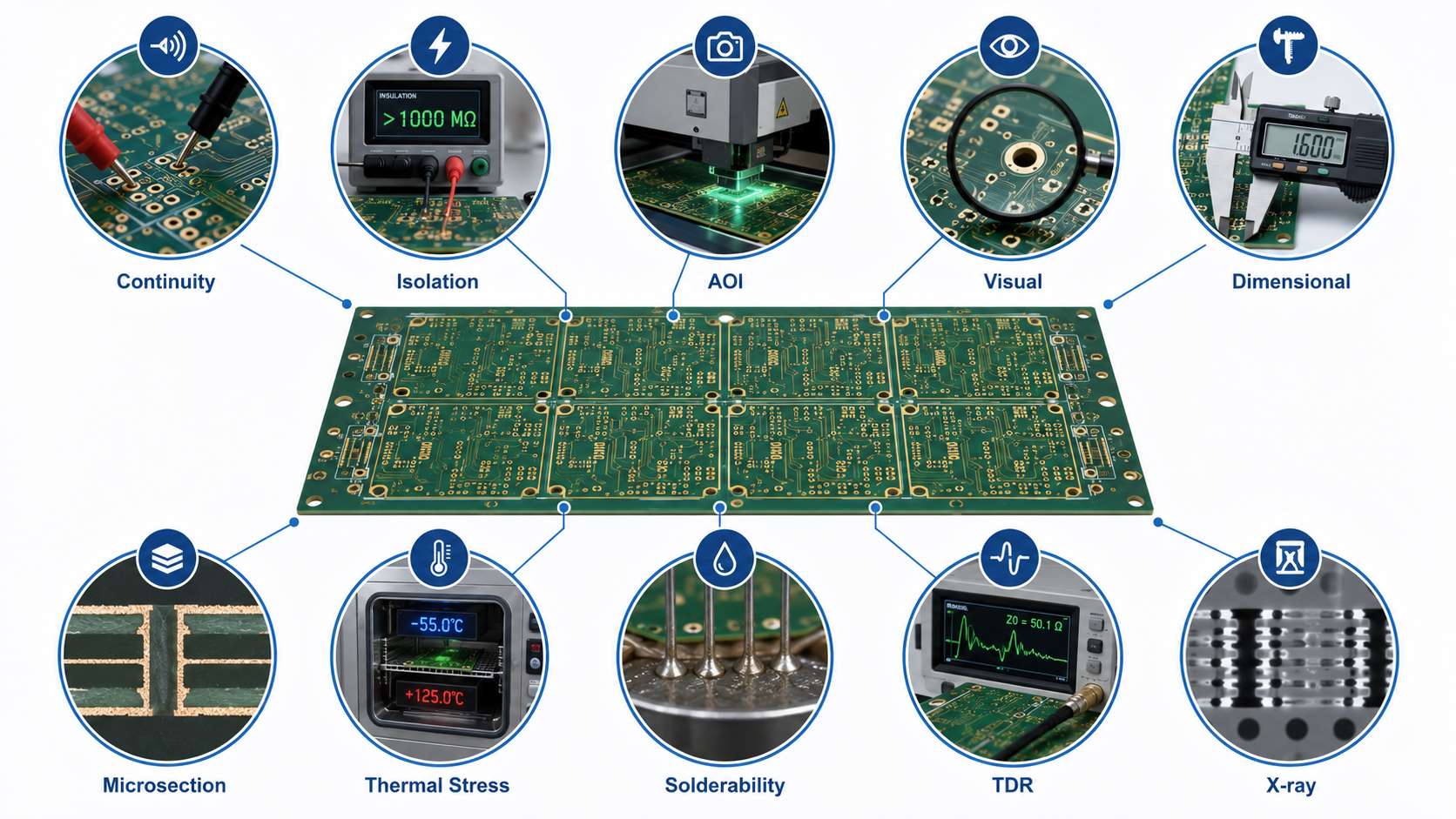
Common bare board tests include:

  • Continuity test
    Confirms that connected nets are electrically continuous.
  • Isolation test
    Confirms that separated nets are not shorted.
  • AOI inspection
    Checks opens, shorts, trace defects, annular ring issues, etching defects, and pattern errors.
  • Visual inspection
    Reviews solder mask, surface finish, legend, edge quality, holes, scratches, contamination, and workmanship.
  • Dimensional inspection
    Confirms board outline, hole size, slot size, thickness, registration, and critical tolerances.
  • Microsection inspection
    Checks plated-through holes, via structure, copper thickness, lamination quality, resin recession, cracks, and voids.
  • Thermal stress test
    Evaluates how plated holes and laminate structures survive soldering-related thermal stress.
  • Solderability test
    Confirms that the surface finish can accept solder properly.
  • Impedance test
    Uses coupons and TDR data to verify controlled impedance traces.
  • X-ray inspection
    May be used for hidden structures such as blind vias, buried vias, HDI features, or internal alignment concerns.

For aerospace PCBs, the key question is not only “Can you test it?†The better question is:

“How will each test be performed, recorded, sampled, and delivered?â€

For example, continuity and isolation may need 100% testing. Microsection may be performed by lot or coupon. Impedance may be verified through coupon testing. X-ray may be defined for specific hidden structures or high-risk areas.

If the inspection plan is not defined before production, the buyer may receive a board that technically passed the supplier’s internal process but does not meet the buyer’s acceptance expectations.

Aerospace PCB Testing Requirements

Is 100% Electrical Testing Required?

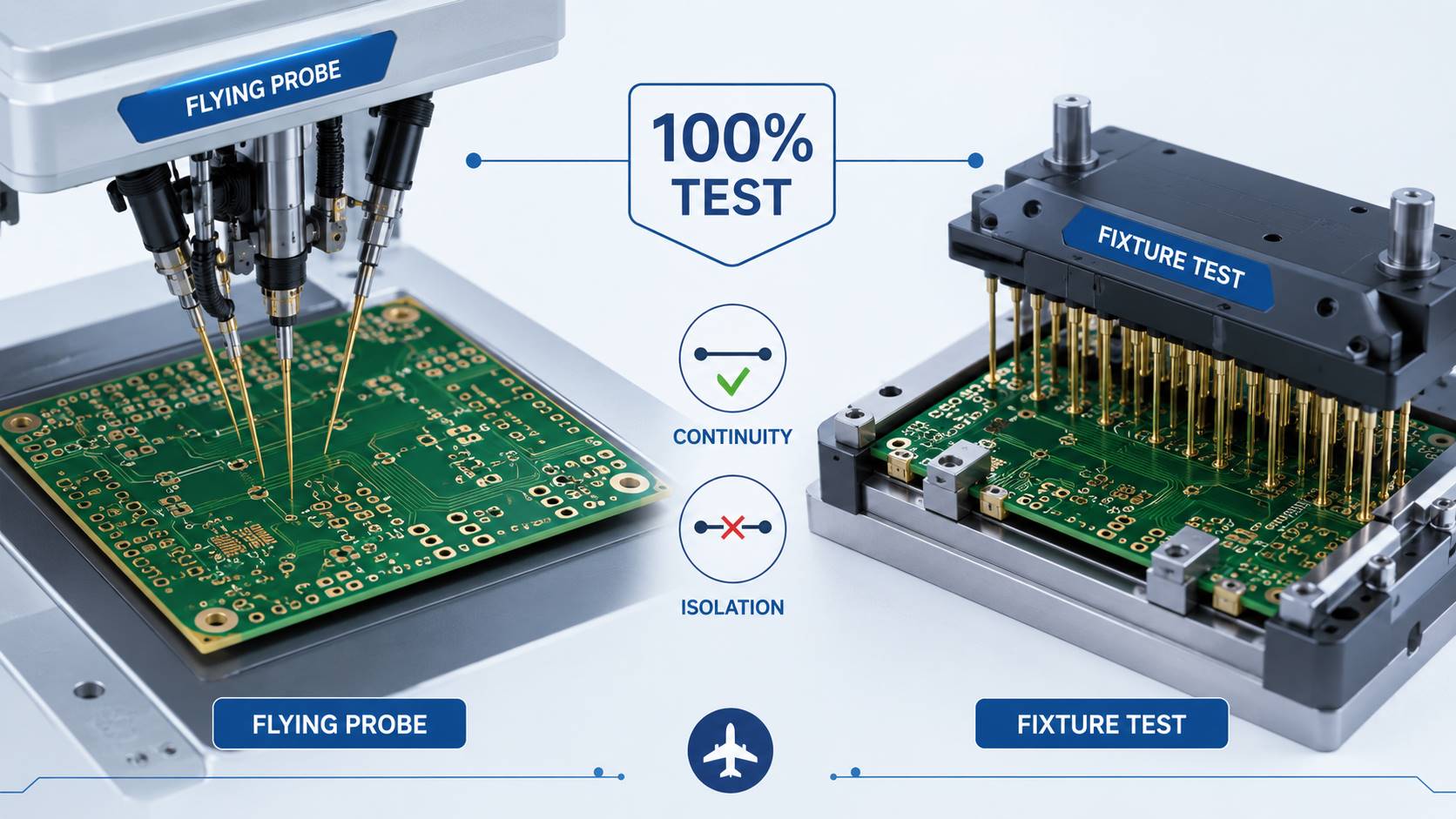
For aerospace PCBs, 100% electrical testing is commonly expected for bare board continuity and isolation. This is because an open or short circuit can create immediate functional failure, and sampling only a few boards may miss a critical defect.

Electrical testing usually checks:

  • Net continuity
  • Net isolation
  • Opens
  • Shorts
  • Incorrect connections
  • High-resistance defects when detectable by the test method

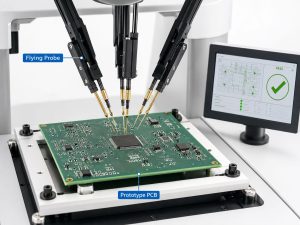
Both flying probe and fixture-based testing can be used. The correct method depends on volume, board complexity, lead time, cost, and test coverage.

A simple comparison is:

Test MethodBest ForBuyer Concern
Flying probePrototype, small batch, complex low-volume boardsSlower for high volume
Bed-of-nails fixtureMedium to high volumeFixture cost and setup time
Universal grid / fixture testRepeat productionCoverage and fixture control

The important point is not whether the supplier uses flying probe or bed-of-nails. The important point is whether the test covers the required netlist and whether every production board is tested when required.

Buyers should avoid vague wording such as:

“Supplier shall perform electrical test.â€

A stronger requirement is:

“Supplier shall perform 100% netlist-based electrical testing for continuity and isolation on all delivered bare boards. Test records shall be retained and made available upon request. Sampling-only electrical testing is not acceptable unless approved in writing.â€

This is the kind of wording that prevents later disputes.

For aerospace PCB assembly, electrical testing becomes broader. It may include ICT, flying probe assembly test, functional test, programming, boundary scan, or system-level test depending on the product.

Aerospace PCB Testing Requirements

When Are Microsection and TDR Tests Needed?

Microsection and TDR tests are needed when hidden manufacturing quality or controlled impedance must be verified. These tests are especially important for high reliability PCB for aerospace projects because many critical defects are not visible from the surface.

Microsection Testing

Microsection, also called cross-section analysis, cuts through a board or coupon to inspect internal structures under magnification.

It can verify:

  • Hole-wall copper thickness
  • Plating quality
  • Barrel cracks
  • Via fill quality
  • Lamination defects
  • Resin voids
  • Inner layer registration
  • Copper wrap
  • Interconnect integrity
  • Microvia structure

Microsection is usually not performed on every production board because it is destructive. Instead, it is commonly performed on test coupons, production panels, selected samples, first article lots, or lots defined by the inspection plan.

Buyers should define:

  • When microsection is required
  • Which coupon or sample is used
  • What features must be measured
  • What photos must be delivered
  • What acceptance criteria applies
  • What happens if the result fails

TDR and Impedance Testing

TDR testing is used to verify controlled impedance. It is common for aerospace printed circuit boards used in high-speed digital, RF, radar, communication, sensor, avionics, or defense electronics.

TDR testing can confirm:

  • Single-ended impedance
  • Differential impedance
  • Coupon performance
  • Stack-up consistency
  • Transmission line control

A useful requirement may say:

“Controlled impedance shall be verified by TDR test on approved impedance coupons. Test data shall include target impedance, measured impedance, tolerance, coupon ID, lot number, and test date.â€

TDR is not needed for every aerospace PCB. It is needed when the design includes controlled impedance requirements. If the drawing calls out 50Ω, 90Ω, 100Ω differential, or other controlled impedance values, the inspection plan should define how those values are verified.

In short, microsection proves hidden manufacturing quality. TDR proves controlled impedance performance. Both should be planned before production, not requested after boards are finished.

What Tests Apply to Aerospace PCB Assembly?

Aerospace PCB assembly testing applies after components are mounted. It is different from bare board testing. A PCB can pass fabrication inspection but still fail after soldering, cleaning, coating, programming, or functional operation.

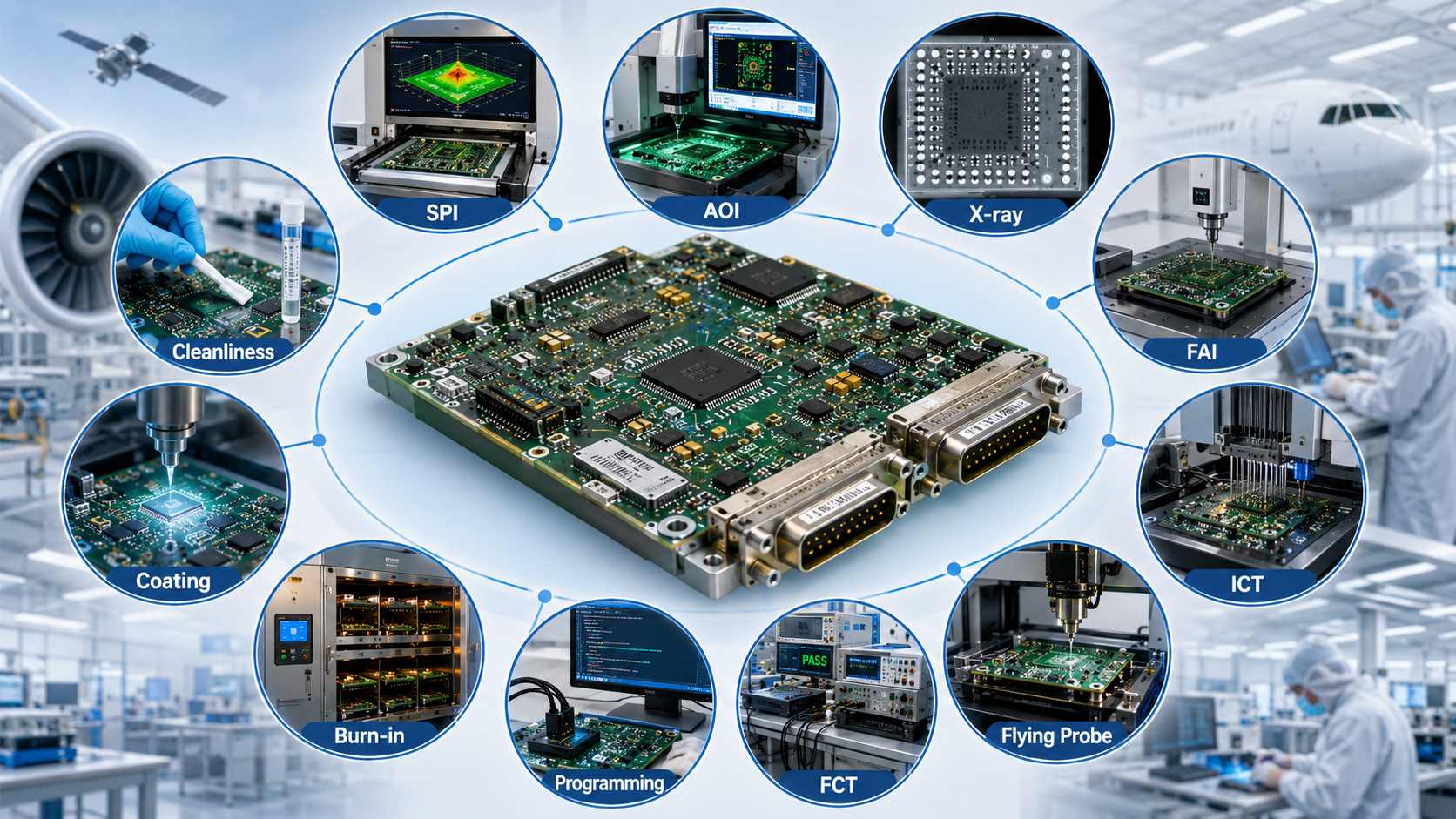
Common aerospace PCB assembly tests and inspections include:

  • SPI
    Checks solder paste volume, area, height, and alignment before reflow.
  • AOI
    Checks component presence, polarity, solder joints, tombstoning, bridges, missing parts, and placement issues.
  • X-ray inspection
    Used for BGA, QFN, bottom-terminated components, hidden joints, voids, and some high-reliability solder joints.
  • First article inspection
    Confirms that the first assembled unit matches the approved BOM, drawing, placement, polarity, and workmanship requirements.
  • ICT
    Checks assembled circuit electrical characteristics when test access is available.
  • Flying probe assembly test
    Useful for low-volume or prototype aerospace PCB assembly where fixtures are not practical.
  • Functional test
    Confirms that the PCBA performs the required electrical functions.
  • Programming and firmware verification
    Applies when the assembly includes programmable devices.
  • Burn-in or aging test
    May be used to screen early failures in selected projects.
  • Conformal coating inspection
    Checks coverage, thickness, bubbles, masking, and contamination risk when coating is required.
  • Cleanliness or contamination testing
    May be required for high-reliability or sensitive assemblies.

Aerospace & defense PCB assemblies often require tighter control of BOM, component sourcing, soldering profile, rework limits, operator training, and process records.

The buyer should define whether the supplier is responsible only for PCB manufacturing, or for full PCB assembly and manufacturing for defense and aerospace applications. This boundary changes the test plan, price, lead time, and deliverable documents.

For PCBA projects, “tested†should not be a general word. It should mean a defined test flow with clear acceptance criteria.

Aerospace PCB Testing Requirements

What Documents Should Suppliers Provide?

Documentation is what closes the loop in aerospace PCB testing requirements. Without documents, the buyer may know that the boards passed, but not how, when, by whom, under which lot, and against which acceptance rule.

A proper aerospace PCB delivery package may include:

  • Certificate of Conformance
  • Material certificates
  • Laminate, prepreg, copper, solder mask, and surface finish batch records
  • Surface finish certificate if required
  • Electrical test report
  • AOI inspection summary
  • Dimensional inspection report
  • Microsection photos and measured values
  • Thermal stress or solderability test record
  • Impedance coupon and TDR report
  • X-ray report if applicable
  • PCBA inspection report
  • ICT or FCT report if applicable
  • First Article Inspection report when required
  • NCR record if any nonconformance occurred
  • CAPA or SCAR response if required
  • Approved deviation or concession record if any
  • Change notification record
  • Lot traceability or board serial number traceability
  • Packing and handling records if specified

A stamped CoC alone is not enough for many aerospace PCB projects. It may be part of the package, but it does not replace test data, material traceability, or inspection evidence.

Buyers should decide the required traceability depth before ordering.

Common traceability levels include:

  • Lot-level traceability
    Links boards to a production lot and material batch records.
  • Panel-level traceability
    Links a panel or production set to process records.
  • Board-level serial traceability
    Links each delivered board or assembly to inspection, test, and production records.

Board-level traceability costs more, but it may be necessary for mission-critical or defense-related projects.

Change control is also important. The supplier should not change laminate, prepreg, copper foil, solder mask, surface finish, approved process, outside process, or critical component substitution without approval when the project requires controlled configuration.

A good document package protects both sides. It helps the buyer pass internal review, supplier audit, incoming inspection, and failure analysis if a field issue occurs.

FAQs About Aerospace PCB Testing Requirements

Are IPC Class 3 Requirements Enough for Aerospace PCBs?

IPC Class 3 is often a starting point, but it may not be enough by itself. Aerospace PCB projects may also require IPC-6012 addendums, AS9100D quality controls, first article inspection, traceability, environmental testing, and project-specific acceptance rules.

What Is the Difference Between IPC Class 3 and Class 3A?

IPC Class 3 is used for high-performance electronic products. Class 3A, often written in some contexts as Class 3/A, is associated with higher-reliability avionics or mission-critical expectations when specified by the applicable procurement document or IPC requirement. Buyers should not use the term casually. It should be tied to the correct standard and contract requirement.

Is IPC-6012ES Required for All Aerospace PCBs?

No. IPC-6012ES is not automatically required for every aerospace PCB. It is used when the program, drawing, contract, or customer specification requires space or military avionics addendum requirements. For many aerospace electronics, IPC Class 3 with additional project-specific testing may be used instead.

Does AS9100D Certify the PCB Itself?

No. AS9100D is a quality management system standard for aerospace organizations. It does not automatically certify that every PCB meets a specific technical requirement. Buyers still need to define the PCB standard, test plan, inspection reports, and acceptance criteria.

Should Aerospace PCBs Be 100% Electrically Tested?

For bare boards, 100% continuity and isolation testing is commonly expected for aerospace PCB projects. Sampling-only testing should not be used for critical electrical acceptance unless the buyer has formally approved it.

Is Flying Probe Testing Acceptable for Aerospace PCBs?

Flying probe testing can be acceptable when it provides the required netlist coverage and documented test results. The issue is not the machine type alone. The buyer should confirm test coverage, test limits, records, and whether every delivered board is tested.

When Is Microsection Required?

Microsection is needed when plated holes, vias, lamination quality, copper thickness, or hidden structures must be verified. It is commonly performed on coupons, production panels, first articles, or lots defined by the inspection plan.

When Is TDR Testing Required?

TDR testing is required when the PCB has controlled impedance requirements. It verifies that impedance coupons meet the target values and tolerances defined by the design.

Are Environmental Tests Part of PCB Testing?

Sometimes, but not always. Bare board factories usually handle fabrication-level tests. Environmental tests such as thermal cycling, vibration, shock, humidity, altitude, or DO-160 testing are often PCBA-level, box-level, or system-level requirements. Responsibility and cost should be defined in the RFQ or test plan.

What Documents Should I Request From an Aerospace PCB Supplier?

At minimum, request CoC, material certificates, electrical test evidence, inspection records, and traceability information. For high-reliability projects, also request microsection data, impedance reports, X-ray reports, FAI records, NCR/CAPA records, and change-control documentation when applicable.

How Can I Verify an AS9100 Certificate?

Buyers should verify AS9100 certification through the IAQG OASIS database instead of relying only on a PDF certificate sent by email. The certificate scope, site address, expiration date, and certification body should match the supplier being used.

Why Do Aerospace PCB Testing and Documentation Increase Cost?

The cost is higher because the supplier must perform more verification, maintain traceability, control materials, prepare records, manage audits, and sometimes support first article inspection or special process controls. The extra cost is mainly risk control, not only board fabrication.

To wrap up, Aerospace PCB testing requirements define the standards, inspections, test reports, traceability, and acceptance rules needed before aerospace printed circuit boards enter high-reliability applications.

For buyers, the key is to define the required tests clearly, including bare board electrical testing, microsection, impedance verification, aerospace PCB assembly inspection, and supplier documentation.

If you need aerospace PCB manufacturing, PCBA assembly, or DFM review, please feel free to send your Gerber files, BOM, stack-up, and project requirements to EBest Circuit (Best Technology) at sales@bestpcbs.com. As one of the experienced aerospace PCB manufacturers, we can help you review technical requirements, testing expectations, and production feasibility before manufacturing starts.

You may also like

Aerospace PCB Manufacturer
Monday, June 15th, 2026

Aerospace PCB are built for environments where reliability matters from the first design review to final field operation. A circuit board used in aviation, satellite communication, radar, navigation, UAV control, aerospace testing equipment, or other mission-critical systems cannot be treated like a standard commercial PCB. It requires stable materials, controlled processes, strict inspection, and clear documentation.

Aerospace PCB Manufacturer

That is why choosing the right aerospace PCB manufacturer is not only a purchasing decision. It is also a risk-control decision.

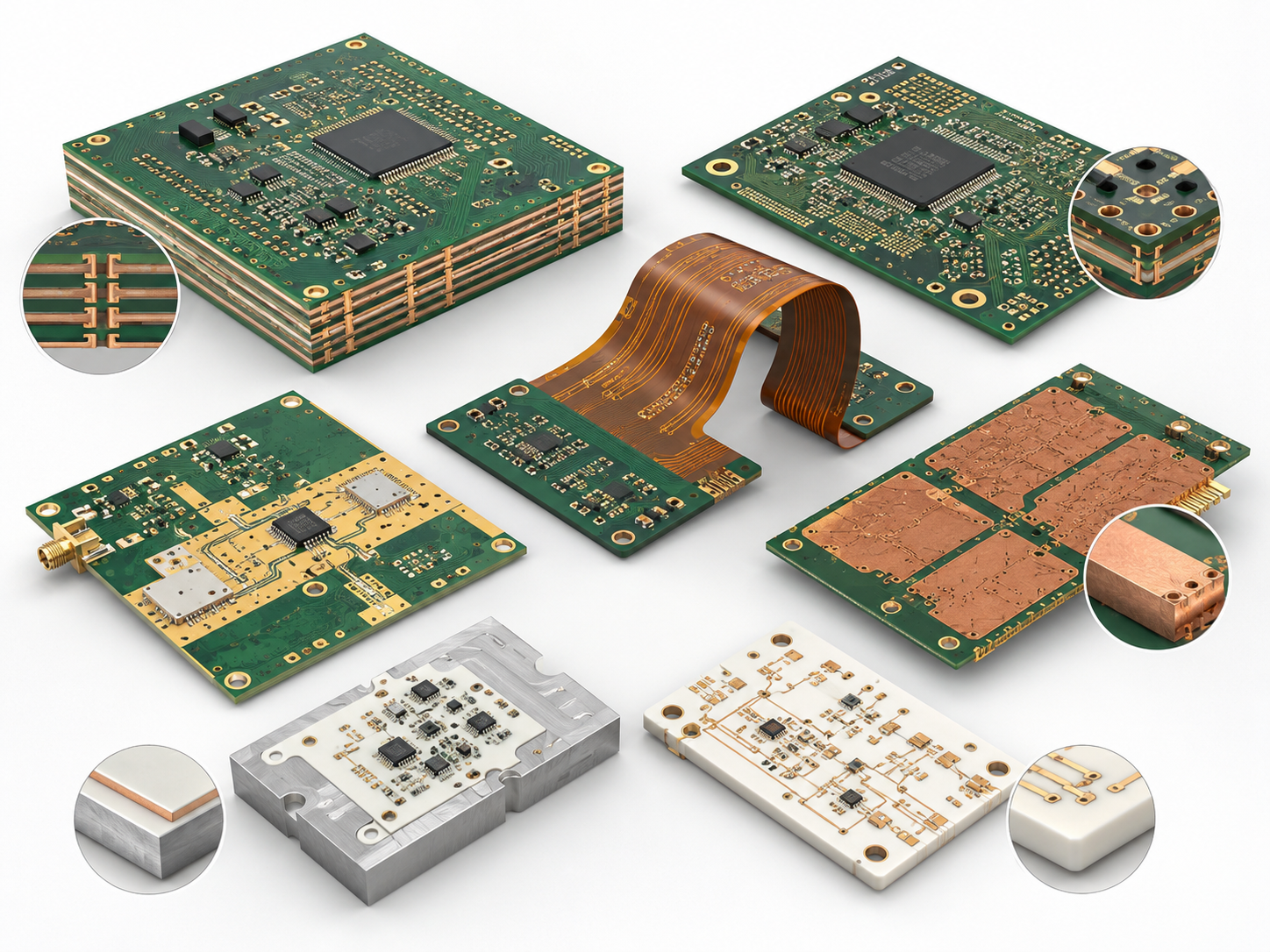
At EBest Circuit, we support aerospace-related PCB projects that require high reliability, engineering communication, controlled materials, precision manufacturing, and PCB assembly support. Our capabilities include high-Tg PCB, HDI PCB, rigid-flex PCB, RF PCB, heavy copper PCB, metal core PCB, ceramic PCB, multilayer PCB, and PCBA services. From prototype verification to small-batch production and repeat orders, our engineering and manufacturing teams help customers turn demanding designs into reliable circuit boards.

Why Aerospace PCB Projects Need More Than Standard PCB Manufacturing?

An aerospace PCB is a printed circuit board designed for aerospace-related electronic systems. These systems may be used in aircraft, satellites, avionics, radar modules, navigation equipment, unmanned aerial vehicles, defense electronics, power control units, sensors, and ground support equipment.

The difference between an aerospace PCB and a standard PCB is not only the application name. The real difference lies in reliability requirements, material selection, process control, testing, and traceability.

A standard commercial PCB may mainly focus on cost, basic function, and delivery time. Aerospace PCB projects usually require more attention to thermal stability, vibration resistance, signal integrity, mechanical strength, long-term operation, and production consistency. In many cases, failure can be expensive, difficult to repair, or unacceptable.

This is why aerospace PCB manufacturing requires more than a low-cost PCB supplier. It needs a manufacturer that understands engineering risk, manufacturing tolerance, inspection discipline, and documentation control.

For customers, the key question is not simply, “Can you make this board?†A better question is, “Can you help us make this board stable, repeatable, and suitable for a high-reliability application?â€

That is the value we aim to provide.

What Makes Aerospace PCBs Difficult to Manufacture?

Aerospace PCB projects are challenging because the working environment is often harsher than that of common industrial or consumer electronics. The board may need to handle temperature changes, vibration, shock, high-frequency signals, dense layouts, power loads, or limited installation space.

Aerospace PCB Manufacturer

Several design and manufacturing factors can directly affect reliability.

  • Temperature cycling can create stress between copper, dielectric materials, solder joints, vias, and component pads. If the material is not selected properly, the board may face expansion mismatch, delamination risk, or unstable electrical performance.
  • Vibration and mechanical shock can affect solder joints, connectors, plated through holes, and flexible sections. For aircraft, UAVs, and aerospace control systems, mechanical reliability is a serious concern.
  • High-frequency communication and radar systems require controlled impedance, stable dielectric properties, smooth signal paths, and careful stack-up design. Even a small material or process variation may affect signal performance.
  • Power control and high-current modules need proper copper thickness, thermal path design, and sometimes heavy copper, metal core, or ceramic substrate solutions. Poor thermal design can reduce long-term reliability.
  • Space-constrained aerospace electronics may require HDI PCB or rigid-flex PCB. These boards need tighter control over drilling, plating, lamination, registration, flex bending areas, and stack-up balance.
  • Documentation is also important. Aerospace-related projects often require controlled material records, production traceability, inspection reports, test data, and clear communication during engineering review.

Because of these factors, aerospace PCB projects should be handled through a controlled manufacturing process, not a simple quote-and-build workflow.

Our Aerospace PCB Manufacturing Capabilities

EBest Circuit supports aerospace-related PCB projects with a wide range of PCB technologies. This helps customers choose the right board structure according to the application, reliability target, space limitation, thermal requirement, signal speed, and assembly needs.

Our PCB manufacturing capabilities include:

  • High-Tg PCB for applications that require better thermal stability than standard FR4
  • Multilayer PCB for complex aerospace control and communication systems
  • HDI PCB for compact and high-density electronic designs
  • Rigid-flex PCB for space-limited and vibration-sensitive equipment
  • RF and high-frequency PCB for radar, antenna, communication, and microwave-related modules
  • Heavy copper PCB for power control, current-carrying circuits, and high-load applications
  • Metal core PCB for improved heat dissipation in power and lighting modules
  • Ceramic PCB for high thermal conductivity, dimensional stability, and demanding power applications
  • PCBA service for customers who need PCB fabrication, component sourcing, SMT assembly, testing, and box-build support

This broad technology coverage allows us to support different aerospace electronic projects instead of being limited to one board type.

For example, an avionics control module may need a high-Tg multilayer PCB. A radar module may require RF laminate and impedance control. A compact UAV control board may need HDI or rigid-flex technology. A high-power aerospace lighting or power module may need metal core PCB, heavy copper PCB, or ceramic PCB. Different systems require different solutions.

Our role is to help customers evaluate the design, material, structure, and manufacturing route before production starts.

What Types of PCBs Can Be Used in Aerospace Electronics?

Aerospace electronics may use many types of circuit boards. The right choice depends on the operating environment, electrical function, mechanical layout, and reliability requirements.

Rigid PCBs are widely used in control modules, power circuits, communication equipment, test systems, and many aerospace-related electronic products. They can be made as single-layer, double-layer, or multilayer boards. For higher reliability, high-Tg materials, controlled stack-up, stable copper thickness, and stricter inspection are often required.

Many aerospace systems need multilayer PCBs because the circuit design may include power planes, ground planes, high-speed signals, control signals, and shielding layers. A stable multilayer stack-up helps improve signal integrity, EMC performance, and routing density.

HDI PCB is useful when aerospace electronics need smaller size, lighter weight, and higher component density. Microvias, blind vias, buried vias, and fine lines can help reduce board area while supporting complex routing. HDI manufacturing requires accurate drilling, plating, lamination, and registration control.

Rigid-flex PCB is valuable in aerospace electronics because it can reduce connectors, save space, and improve mechanical reliability in compact assemblies. Instead of using multiple rigid boards connected by cables, a rigid-flex structure can integrate rigid sections and flexible interconnection areas into one board.

This is especially useful for avionics modules, UAV electronics, sensor assemblies, compact control units, and devices exposed to vibration.

Radar, antenna, satellite communication, and aerospace RF modules may require PTFE or other high-frequency laminates. These materials support more stable signal performance at higher frequencies. The PCB manufacturer must control impedance, dielectric thickness, copper profile, routing geometry, and surface finish.

Heavy copper PCB is used when the circuit needs to carry higher current or manage stronger power loads. Aerospace power control units, power distribution boards, motor control systems, and high-current modules may use thicker copper to improve current capacity and thermal performance.

Metal core PCBs, especially aluminum or copper base boards, help transfer heat away from power devices. They can be used in aerospace lighting, power modules, LED systems, and thermal management applications.

Aerospace PCB Manufacturer

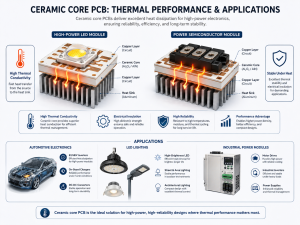
Ceramic PCB can support high thermal conductivity, good dimensional stability, and strong electrical insulation. It is suitable for high-power, high-temperature, and compact electronic modules. Aerospace-related power electronics, sensor modules, laser systems, and high-reliability thermal designs may benefit from ceramic substrates.

Materials We Support for Aerospace PCB Applications

Material selection is one of the most important decisions in aerospace PCB manufacturing. A material that works well in a simple commercial product may not be suitable for high-reliability aerospace electronics.

We support several material options for aerospace-related PCB projects.

High-Tg FR4 is often used when the PCB needs better thermal resistance and dimensional stability than standard FR4. It is suitable for multilayer PCBs, control boards, communication boards, and industrial-grade aerospace-related electronics.

Polyimide is commonly used in flexible PCB and rigid-flex PCB. It offers good flexibility and thermal resistance, making it suitable for compact, bendable, and vibration-sensitive electronic assemblies.

PTFE and other RF materials are used in high-frequency applications such as radar, antenna, satellite communication, and microwave modules. These materials help maintain more stable dielectric performance at high frequencies.

Heavy copper is selected for high-current and power control circuits. It improves current-carrying capability and can also help with heat spreading in power sections.

Metal core materials help dissipate heat from power components. Aluminum base PCB is widely used in thermal management applications, while copper base PCB can offer stronger heat transfer for more demanding designs.

Ceramic materials such as alumina and aluminum nitride can be used when the design needs high thermal conductivity, electrical insulation, and dimensional stability. Ceramic PCB is especially useful for compact power electronics and high-heat applications.

Instead of recommending one material for every project, we help customers evaluate material options based on real operating conditions. These include working temperature, current load, signal frequency, board size, component density, mechanical stress, and testing requirements.

Engineering Support Before Aerospace PCB Production

For aerospace PCB projects, engineering review before manufacturing is extremely important. A design may look complete in Gerber files, but small details can still affect yield, cost, delivery, or long-term reliability.

Our engineering team can support customers with practical design and manufacturability reviews before production.

This review may include:

  • Gerber file checking
  • Stack-up review
  • Material suggestions
  • Copper thickness review
  • Drill size and via structure review
  • Impedance control review
  • Minimum line width and spacing check
  • Annular ring and drill-to-copper clearance review
  • Solder mask bridge and pad design review
  • Surface finish recommendation
  • Thermal path review
  • Assembly feasibility review
  • Panelization suggestion
  • Special inspection and documentation review

This step helps customers identify potential manufacturing risks before the board enters production. It can also reduce unnecessary redesign, production delays, and quality uncertainty.

Aerospace PCB Manufacturer

For example, if an aerospace-related board has high-current areas, we may review whether the copper thickness, trace width, via quantity, and thermal path are suitable. If the board includes RF sections, we may check impedance requirements and material compatibility. If the project uses rigid-flex PCB, we may review bend areas, coverlay openings, stiffener design, and stack-up transitions.

Quality Control for Aerospace PCB Manufacturing

Quality control for aerospace PCB manufacturing does not begin at final inspection. It starts before production and continues through every key process.

For high-reliability PCB projects, a stable process is more important than simply checking the finished board. Material selection, stack-up confirmation, inner layer inspection, lamination, drilling, plating, solder mask, surface finish, electrical testing, and final packaging all affect the final result.

Our quality control process can include:

  • Incoming material inspection
  • Engineering file review
  • Stack-up confirmation
  • Inner layer AOI
  • Lamination process control
  • Drilling inspection
  • Plating thickness control
  • Solder mask inspection
  • Surface finish inspection
  • Electrical testing
  • Impedance testing when required
  • Microsection analysis when required
  • Final visual inspection
  • Packing inspection
  • Traceability documentation

For PCBA projects, additional quality control can include:

  • BOM review
  • Component sourcing control
  • Solder paste inspection
  • SMT placement inspection
  • Reflow process control
  • AOI inspection
  • X-ray inspection for BGA or hidden solder joints
  • DIP inspection
  • Functional testing when required
  • Conformal coating when required
  • Final assembly inspection

For aerospace-related electronics, customers often need more than a good-looking PCB. They need confidence that the board is built through a controlled and repeatable process.

If your project requires specific inspection reports, material traceability, test records, or customer-defined acceptance standards, our team can review these requirements before quotation and production.

Quality Systems and Manufacturing Discipline

Aerospace PCB projects often require strong quality management. Customers may need suppliers that understand structured documentation, process control, traceability, corrective action, and consistent production management.

EBest Circuit has long-term experience supporting high-reliability PCB and PCBA projects across industrial control, automotive electronics, medical devices, communication equipment, power electronics, and aerospace-related applications.

Our quality system support covers project requirements related to ISO9001, ISO13485, IATF16949, and AS9100D. These systems help strengthen manufacturing discipline, supplier control, documentation awareness, production consistency, and risk management.

For customers, this matters because aerospace PCB projects are not only about manufacturing capability. They are also about communication quality, process discipline, and the ability to handle engineering details carefully.

A capable aerospace PCB manufacturer should be able to discuss technical questions clearly, review project risks, follow controlled procedures, and provide useful feedback before and during production.

That is the type of support we aim to deliver.

PCB Assembly Support for Aerospace-Related Electronics

Many aerospace customers do not only need bare PCB fabrication. They also need PCB assembly, component sourcing, testing, coating, or box-build support.

We provide PCBA services to help customers reduce supply chain complexity and improve project communication. Instead of managing separate suppliers for PCB fabrication, component sourcing, assembly, testing, and final packaging, customers can work with one team for a more integrated process.

Our PCBA capabilities include:

  • SMT assembly
  • DIP assembly
  • Fine-pitch component assembly
  • BGA assembly
  • QFN and QFP assembly
  • Component sourcing support
  • BOM review
  • PCB fabrication and assembly coordination
  • SPI inspection
  • AOI inspection
  • X-ray inspection
  • Functional testing
  • Conformal coating
  • Box-build assembly

This one-stop support is especially valuable for engineering teams that need prototype builds, design verification, small-batch production, or stable repeat orders.

For aerospace-related projects, assembly quality can be just as important as PCB fabrication quality. Solder joint reliability, component placement, thermal profile control, cleaning, inspection, and functional testing all affect final performance.

By combining PCB manufacturing and PCBA support, we help customers reduce handover risks between suppliers and improve communication efficiency.

From Aerospace PCB Prototype to Batch Production

Aerospace-related electronics often start with engineering samples or small-batch verification. The design may need several rounds of testing before it enters stable production.

We support customers through different project stages:

  • Engineering prototype
  • Design verification build
  • Small-batch production
  • Pilot run
  • Batch production
  • Repeat order manufacturing
  • PCB assembly and testing
  • Box-build support when required

For prototype projects, speed and engineering feedback are important. Customers need to know whether the design can be manufactured, whether the material is suitable, whether the stack-up is practical, and whether special testing is needed.

For batch production, consistency becomes more important. Customers need stable material supply, repeatable manufacturing processes, controlled inspection, and clear documentation.

Because we support both prototype and production stages, customers can move from early design review to later production with better continuity.

This is especially useful for aerospace-related projects where design knowledge, manufacturing history, and quality records should remain consistent across development stages.

What Files Should You Send for an Aerospace PCB Quote?

A complete quotation package helps the engineering team evaluate your aerospace PCB project faster and more accurately.

For bare PCB fabrication, please prepare:

  • Gerber files
  • Drill files
  • Stack-up requirement
  • Board thickness
  • Material requirement
  • Copper thickness
  • Surface finish
  • Solder mask color
  • Silkscreen requirement
  • Controlled impedance requirement
  • Minimum line width and spacing
  • Special tolerance requirement
  • IPC class or customer acceptance standard
  • Testing requirement
  • Quantity
  • Expected lead time

For PCBA projects, please also provide:

  • BOM
  • CPL or pick-and-place file
  • Assembly drawing
  • Testing procedure if available
  • Programming requirement if needed
  • Functional test requirement
  • Conformal coating requirement if needed
  • Box-build documents if required

If you are not sure whether your files are complete, you can send the available files first. Our engineering team can help check what is missing and provide feedback before production.

Why Choose EBest Circuit for Aerospace PCB Projects?

Choosing an aerospace PCB manufacturer is about more than price. A lower quotation may not reduce project risk if the supplier cannot support engineering review, material control, reliable manufacturing, inspection, and documentation.

EBest Circuit is positioned to support demanding aerospace-related PCB and PCBA projects through manufacturing experience, broad technology coverage, engineering communication, and one-stop service.

Founded in 2006, EBest Circuit has long-term experience in PCB manufacturing and PCB assembly. We serve customers in industrial control, automotive electronics, medical devices, communication systems, power electronics, aerospace-related electronics, and other high-reliability fields.

This experience helps us understand that different industries care about different risks. For aerospace-related projects, we pay close attention to reliability, materials, thermal performance, signal quality, inspection, and traceability.

We are not limited to one PCB type. Our capabilities include high-Tg PCB, HDI PCB, rigid-flex PCB, RF PCB, heavy copper PCB, metal core PCB, ceramic PCB, multilayer PCB, and PCBA.

This gives customers more flexibility when choosing the right solution for their aerospace electronic products.

We do not only quote from Gerber files. We can help review stack-up, material selection, copper thickness, impedance requirements, via design, thermal path, and assembly feasibility.

This engineering-driven approach helps customers reduce risks before production begins.

High-reliability projects require process discipline. Our quality management approach supports controlled manufacturing, inspection, testing, and documentation. For projects with special quality system, traceability, or inspection requirements, our team can review the details before production.

We support engineering prototypes, small batches, pilot runs, and production orders. This allows customers to work with one manufacturing partner through different project stages.

We provide PCB fabrication, component sourcing support, SMT assembly, DIP assembly, inspection, functional testing, conformal coating, and box-build support. This can reduce supplier coordination work and improve project efficiency.

Aerospace-related PCB projects often involve technical questions before production. Our team can communicate with customers about manufacturing feasibility, file requirements, testing needs, delivery planning, and project risks.

Aerospace PCB Applications We Can Support

Our aerospace-related PCB and PCBA solutions can be used in many electronic systems, depending on customer design and project requirements.

Typical applications include:

  • Avionics control modules
  • Satellite communication equipment
  • Radar and RF modules
  • UAV control systems
  • Navigation electronics
  • Power control units
  • Aerospace lighting systems
  • Sensor modules
  • Ground testing equipment
  • High-reliability industrial electronics
  • Defense-related electronic assemblies
  • Communication and telemetry systems

Each application has different requirements. Some need high-frequency performance. Some need compact structures. Some need better heat dissipation. Some need high-current capability. Some need rigid-flex design to reduce cables and connectors.

Frequently Asked Questions About Aerospace PCB Manufacturing

  • What is an aerospace PCB?

An aerospace PCB is a printed circuit board used in aerospace-related electronic systems, such as avionics, satellite communication, radar, UAV control, navigation, power control, and testing equipment. It usually requires higher reliability, better material control, stricter inspection, and stronger documentation than standard commercial PCB.

  • What types of PCBs are used in aerospace electronics?

Aerospace electronics may use rigid PCB, multilayer PCB, HDI PCB, rigid-flex PCB, RF PCB, heavy copper PCB, metal core PCB, ceramic PCB, and PCBA assemblies. The right type depends on space, signal, current, thermal, and reliability requirements.

  • What materials are suitable for aerospace PCB manufacturing?

Common material options include high-Tg FR4, polyimide, PTFE or RF laminates, heavy copper, aluminum base, copper base, and ceramic substrates. The best choice depends on working temperature, frequency, mechanical stress, heat load, and project requirements.

  • Do aerospace PCBs need IPC Class 3?

Many aerospace-related PCB projects may refer to IPC Class 3 or customer-specific high-reliability standards. However, the final requirement should always follow the customer drawing, procurement specification, acceptance standard, and application level.

  • Can you manufacture rigid-flex aerospace PCBs?

Yes. We can support rigid-flex PCB projects for compact and vibration-sensitive applications. Our engineering team can review bend areas, stack-up, coverlay design, stiffeners, copper structure, and assembly requirements before production.

  • Can ceramic PCBs be used in aerospace applications?

Yes. Ceramic PCBs can be used in aerospace-related applications that require high thermal conductivity, good electrical insulation, and dimensional stability. They are suitable for high-power modules, sensors, laser systems, and demanding thermal designs.

  • Do you provide aerospace PCB assembly?

Yes. We provide PCBA services, including SMT assembly, DIP assembly, component sourcing support, BGA assembly, X-ray inspection, functional testing, conformal coating, and box-build support when required.

  • What files are needed for an aerospace PCB quotation?

For PCB quotation, please send Gerber files, drill files, stack-up requirements, material requirements, copper thickness, surface finish, impedance requirements, quantity, lead time, and testing requirements. For PCBA, please also send BOM, CPL, assembly drawings, and testing instructions if available.

Need Aerospace PCB Manufacturing Support?

If you are developing aerospace-related electronics and need reliable PCB manufacturing or assembly support, EBest Circuit can help review your project before production.

We support high-Tg PCB, HDI PCB, rigid-flex PCB, RF PCB, heavy copper PCB, metal core PCB, ceramic PCB, multilayer PCB, and PCBA projects for demanding electronic applications.

Our engineering team can review your Gerber files, stack-up, material requirements, impedance control needs, testing requirements, assembly risks, and production feasibility. Whether you need prototype verification, small-batch production, or one-stop PCB assembly, we can help you choose a practical and reliable manufacturing solution.

Send your project files and requirements to sales@bestpcbs.com. Our team will help evaluate your aerospace PCB project and provide engineering support for quotation and production.

You may also like