





Medical PCBs manufacturer refers to a specialized category of PCB and PCBA production facility that designs, fabricates, and assembles printed circuit boards specifically for use in medical devices and healthcare equipment. This article covers everything engineers and procurement teams need to know — from understanding what a medical PCB is and what materials go into it, to navigating certification requirements and selecting the right manufacturing partner.
Are your medical PCB projects being held back by supplier limitations?
Here are five pain points engineers commonly face when sourcing from a medical PCBs manufacturer:
- Suppliers lack ISO 13485 or FDA-compliant quality systems, forcing costly re-qualification mid-project.
- Inconsistent material traceability makes it impossible to meet regulatory audit requirements for PCB for medical devices.
- Poor DFM feedback results in repeated design revisions that push product launch timelines back by weeks.
- Minimum order quantities are too high for prototype and clinical trial stages, locking up budget unnecessarily.
- Limited experience with high-reliability medical PCB design requirements leads to field failures in life-critical applications.
As a professional PCBA manufacturer specializing in medical-grade production, we address these challenges directly:
- Full ISO 13485 certification and documented quality management processes aligned with medical device regulatory standards.
- End-to-end material traceability with batch records retrievable within 5 seconds via our digital manufacturing system.
- 20-year experienced engineers provide DFM analysis and process adaptation advice before fabrication begins.
- Prototype and small-batch support — no excessive MOQ requirements, enabling fast R&D iteration at clinical trial scale.
- Dedicated high reliability medical PCB assembly lines with process controls matched to IPC Class 3 standards.
EBest Circuit (Best Technology) is a one-stop PCB and PCBA manufacturer with over 20 years of industry experience, holding ISO 9001/13485, IATF 16949, and AS9100D certifications. Our in-house factory, backed by 1,000+ supply chain partners, serves 1,800+ clients and 10,000+ engineers worldwide — from early-stage prototypes to full production runs. With a digital workshop enabling real-time production tracking and 1.5-week PCBA fast delivery, we bring medical-grade quality and speed together under one roof. For inquiries, pls feel free to contact us at sales@bestpcbs.com.
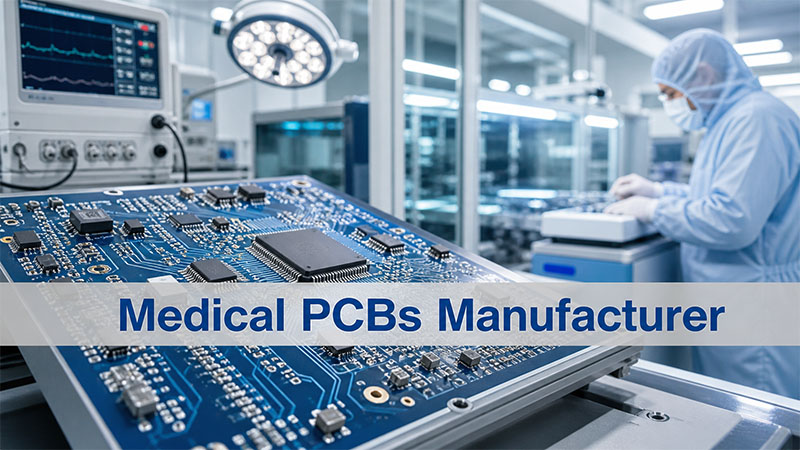
What Is A Medical PCB?
A medical PCB is a printed circuit board engineered to meet the elevated reliability, biocompatibility, and regulatory traceability standards demanded by the healthcare industry. Unlike commercial or industrial PCBs, medical grade PCB designs must perform without failure in environments where a malfunction can directly harm a patient — making every material choice, soldering parameter, and quality inspection step a matter of life safety.
Medical PCBs appear in an extraordinarily wide range of equipment: from implantable cardiac monitors and surgical robots to portable diagnostic devices and hospital imaging systems. What unites them is a shared manufacturing philosophy — zero tolerance for defects, full traceability of every component and process step, and verified compliance with international medical device standards.
From a technical standpoint, medical PCB design requirements differ from standard PCBs in several measurable ways:
| Parameter | Standard PCB | Medical Grade PCB |
|---|---|---|
| IPC Acceptability Class | Class 1 or 2 | Class 2 or 3 (life support: Class 3) |
| Cleanliness Standard | IPC-CH-65 basic | IPC-CH-65 strict; ionic contamination tested |
| Component Traceability | Batch-level | Full lot-level, lot-date code recorded |
| Solder Quality Inspection | AXI or visual | AXI + AOI + cross-section verification |
| Reliability Testing | Standard burn-in | Extended HALT/HASS, thermal cycling |
| Documentation | Standard BOM | Full DHR (Device History Record) per FDA 21 CFR Part 820 |
Understanding what sets a medical PCB apart is the foundation for making every downstream decision — material selection, manufacturer qualification, and regulatory submission — correctly the first time.
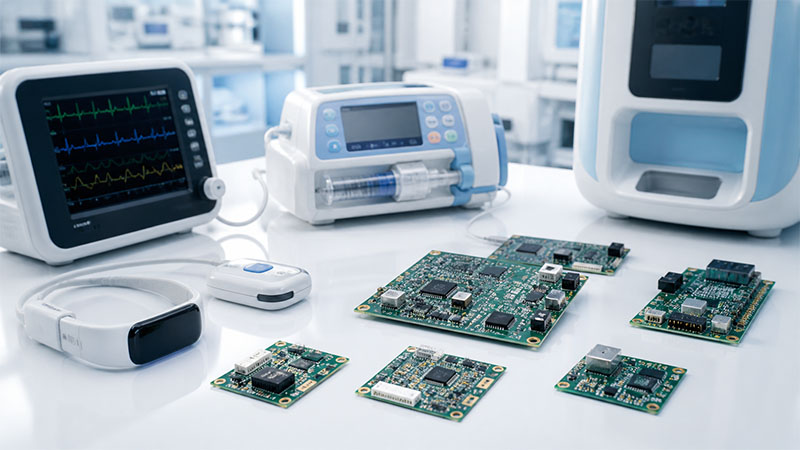
What Are The Types Of Medical PCBs?
Medical PCBs span a wide spectrum of form factors, layer counts, and substrate materials, each matched to a specific class of medical device application. Choosing the right board type is a critical early design decision that affects both performance and manufacturing cost.
The main types used in medical device PCBs manufacturing are:
1. Rigid PCBs The most common type in medical applications. Multi-layer rigid boards (typically 4–12 layers) are used in diagnostic imaging equipment, patient monitors, laboratory analyzers, and hospital network infrastructure. They offer dimensional stability, high circuit density, and mature manufacturing processes suited to IPC Class 3 assembly.
2. Flexible PCBs (Flex PCBs) Used wherever the circuit must bend, fold, or conform to a curved surface — wearable biosensors, endoscope camera assemblies, hearing aids, and implantable devices. Flex PCBs reduce connector count (a major reliability risk point), decrease assembly weight, and enable compact form factors impossible with rigid boards.
3. Rigid-Flex PCBs A hybrid construction combining rigid sections (for component mounting) with flexible sections (for dynamic interconnect). Rigid-flex is widely used in implantable devices, surgical tools, and portable diagnostic equipment where both mechanical robustness and spatial efficiency are required.
4. High-Density Interconnect (HDI) PCBs HDI technology — featuring microvias, blind vias, and buried vias — enables extremely fine trace widths (down to 3 mil / 75 µm) and component pitches. Essential for modern wearable medical devices, portable ultrasound units, and miniaturized implantables where every square millimeter of board space is constrained.
5. Metal Core PCBs (MCPCBs) For applications generating significant heat — LED surgical lighting, power supply units in imaging equipment, and high-current motor driver boards in surgical robots — metal core (typically aluminum) substrates provide thermal conductivity of 1–3 W/(m·K), compared to standard FR-4 at 0.3 W/(m·K).
6. Ceramic PCBs Alumina (Al₂O₃) and aluminum nitride (AlN) ceramic substrates offer superior thermal conductivity (up to 170 W/(m·K) for AlN), excellent biocompatibility, and outstanding chemical resistance. Used in implantable neurostimulators, cochlear implant electronics, and high-frequency RF medical devices.
The board type selection should always begin with the device’s operating environment — temperature range, mechanical stress, size envelope, and regulatory class — before moving to layer count and material specification.
What Are The Key Requirements For Medical PCB Manufacturing?
Medical PCB manufacturing is governed by a set of technical and regulatory requirements that go significantly beyond what is expected in consumer or industrial PCB production. Meeting these requirements is not optional — they are the baseline for any product destined for regulatory submission.
Reliability and Quality Standards
Medical devices are categorized by risk level, and the PCB manufacturing standard follows accordingly:
| Device Risk Class | Example Devices | IPC Assembly Class | Required Reliability Level |
|---|---|---|---|
| Class I (Low Risk) | Bandages, tongue depressors with electronics | IPC Class 2 | Standard |
| Class II (Moderate Risk) | Patient monitors, infusion pumps, diagnostic equipment | IPC Class 2–3 | High |
| Class III (High Risk) | Implantable pacemakers, defibrillators, neurostimulators | IPC Class 3 | Ultra-high |
Core manufacturing requirements include:
- Controlled processes: Every soldering profile, cleaning cycle, and inspection step must be documented, validated, and repeatable. Process deviations must trigger corrective action (CAPA) records.
- IPC Class 3 workmanship: For life-critical devices, solder joints, via fills, and copper plating thickness are held to IPC-A-610 Class 3 acceptance criteria — zero tolerance for lifted pads, cold joints, or incomplete hole fill.
- Ionic contamination control: Post-reflow cleaning must bring residual ionic contamination below 1.56 µg/cm² NaCl equivalent (per IPC-CH-65), verified by ROSE or SIR testing.
- Electrostatic Discharge (ESD) protection: Medical PCB assembly areas must maintain ESD-safe environments (< 100 V) per ANSI/ESD S20.20, as many sensitive medical ICs have ESD withstand voltages below 500 V.
- Full material traceability: Every component lot, bare board batch, and solder paste date code must be recorded in a Device History Record (DHR) that can be retrieved and submitted during FDA or CE audits.
- Change control: Any change to materials, processes, or suppliers must follow a formal change notification (PCN) process, with re-validation data before the change takes effect.
These requirements define the minimum bar any medical PCBs manufacturer must meet — not just during certification audits, but on every production lot, every day.
What Certifications Should A Medical PCBs Manufacturer Have?
Certification is the most objective way to evaluate whether a medical PCBs manufacturer operates a quality system genuinely capable of supporting regulatory submissions. The right certifications are not marketing badges — they represent audited, third-party-verified evidence of process discipline.
The essential certifications to require:
ISO 13485 — Medical Device Quality Management System This is the non-negotiable baseline. ISO 13485 is the international standard specifically designed for organizations involved in the design and manufacture of medical devices and their components. It requires documented procedures for risk management, design control, process validation, complaint handling, and CAPA. A PCB manufacturer without ISO 13485 cannot be qualified as a direct supplier for any Class II or Class III medical device.
FDA 21 CFR Part 820 — Quality System Regulation (USA) For devices sold in the US market, the manufacturing facility must comply with FDA’s Quality System Regulation. Key requirements include design controls, corrective and preventive action (CAPA) systems, and complete Device History Records (DHRs). A manufacturer supplying FDA-registered device makers is expected to be audit-ready at all times.
IPC-A-610 Class 3 Certification IPC-A-610 is the global acceptability standard for electronic assemblies. Class 3 certification means the manufacturer’s inspection operators are trained and certified to apply the most stringent acceptance criteria — the standard for high-reliability and life-support equipment.
ISO 9001 — General Quality Management System The foundational QMS standard. Most medical PCB manufacturers hold both ISO 9001 and ISO 13485; ISO 9001 alone is insufficient for medical device applications.
Additional certifications that add confidence:
| Certification | Relevance to Medical PCB |
|---|---|
| IATF 16949 | Process discipline from automotive; indicates process control maturity |
| AS9100D | Aerospace-grade quality systems; relevant for high-reliability implantables |
| UL Certification | Safety approval for specific board materials and constructions |
| RoHS Compliance | Required for CE-marked medical devices sold in the EU |
| REACH Compliance | Chemical substance compliance for EU market access |
When evaluating a biomedical PCB manufacturing partner, always request current, valid certificates — not expired documents — and verify that the scope of certification explicitly covers PCB and PCBA manufacturing, not just the company’s headquarters or administrative functions.
What Materials Are Used In Medical Device PCBs Manufacturing?
Material selection in medical device PCBs manufacturing directly determines electrical performance, thermal management, biocompatibility, and long-term reliability. Unlike commercial PCB designs where cost optimization is the primary driver, medical PCB material choices are governed first by performance and regulatory compliance, then by cost.
Substrate Materials:
| Material | Thermal Conductivity | Key Properties | Typical Medical Application |
|---|---|---|---|
| FR-4 (High-Tg) | 0.3 W/(m·K) | Stable up to 170°C Tg; cost-effective | Patient monitors, diagnostic equipment |
| Polyimide | 0.2 W/(m·K) | Flexible, wide temp range (−65°C to +260°C) | Flex PCBs, wearable biosensors, implantables |
| Alumina (Al₂O₃) | 20–30 W/(m·K) | Biocompatible, chemical resistant | Implantable devices, RF medical equipment |
| Aluminum Nitride (AlN) | 140–170 W/(m·K) | Highest thermal conductivity ceramic | High-power implantables, laser medical devices |
| PTFE / Rogers | 0.2–0.7 W/(m·K) | Low Dk/Df for high-frequency signals | Wireless medical devices, imaging systems |
| Aluminum Core (MCPCB) | 1–3 W/(m·K) | Excellent heat dissipation | LED surgical lighting, power supply boards |
Surface Finish Options:
The surface finish affects solderability, shelf life, and — critically for implantable or skin-contact devices — biocompatibility:
- ENIG (Electroless Nickel Immersion Gold): The standard choice for medical PCB assembly. Flat, solderable, and nickel barrier prevents copper migration. Shelf life: 12 months.
- ENEPIG (Electroless Nickel Electroless Palladium Immersion Gold): Preferred for wire bonding applications in implantable sensors. Palladium layer improves gold wire bond adhesion.
- OSP (Organic Solderability Preservative): Low cost, RoHS-compliant, but short shelf life (6 months). Acceptable for non-implantable disposable medical devices.
- Hard Gold: Used on edge connectors and contact fingers subject to repeated insertion cycles — common in diagnostic instrument PCB card-edge interfaces.
Solder Alloy:
For medical devices, SAC305 (Sn96.5/Ag3.0/Cu0.5) is the industry standard lead-free alloy. It offers a good balance of mechanical strength, thermal fatigue resistance, and process maturity. For implantable devices requiring even higher joint reliability, some manufacturers specify SAC405 or bismuth-modified alloys for specific joint geometries.
Material selection should always be documented in the design specification and reviewed during DFM analysis to confirm compatibility with the manufacturing process before bare board fabrication begins.
How Are Medical PCBs Manufactured?
Medical PCB manufacturing follows the same fundamental process sequence as standard PCB production, but every step is executed under tighter process controls, with mandatory documentation and inspection gates that would be optional in commercial production.
Here is the end-to-end manufacturing flow for a typical high reliability medical PCB assembly:
Step 1 — Design Review and DFM Analysis Before any material is ordered, the PCB design files (Gerber, ODB++, IPC-2581) and BOM are reviewed against medical PCB design requirements. DFM analysis checks for minimum annular rings, acid traps, copper clearance violations, and test point accessibility. A written DFM report is issued with recommended modifications.
Step 2 — Bare Board Fabrication The PCB substrate is fabricated per the design specification. For medical applications, key in-process controls include:
- Copper thickness verification (inner layers: ±10% of nominal)
- Drill registration and hole size (±0.05 mm for Class 3)
- Impedance control verification (±10% for controlled impedance designs)
- Electrical testing: 100% net continuity and isolation testing before lamination
Step 3 — Component Sourcing and Incoming Inspection Components are sourced from authorized distributors only — no gray-market or counterfeit-risk channels. Incoming inspection includes:
- Certificate of Conformance (CoC) verification for every lot
- Date code and lot code recording in the DHR
- Visual inspection and functional sampling per AQL level
Step 4 — SMT Assembly Solder paste printing, component placement, and reflow soldering are executed on calibrated SMT lines. Process controls include:
- Solder paste inspection (SPI) after printing — volume, area, and height verified on every board
- Pick-and-place accuracy: ±0.05 mm for standard components; ±0.03 mm for fine-pitch ICs
- Reflow profile validated and recorded per component manufacturer specifications
Step 5 — Post-Reflow Inspection
- AOI (Automated Optical Inspection): 100% inspection of solder joint geometry, component presence, polarity, and alignment
- AXI (Automated X-Ray Inspection): Mandatory for BGAs, QFNs, and any bottom-terminated components where solder joints are hidden
- Cross-section analysis: Performed on sample boards per lot to verify via fill quality and solder joint microstructure
Step 6 — Cleaning and Cleanliness Verification Post-reflow aqueous or semi-aqueous cleaning removes flux residues. Ionic contamination is tested per IPC-CH-65 to confirm residual contamination is below the medical-grade threshold.
Step 7 — Functional and In-Circuit Testing ICT verifies component values, solder joint continuity, and short circuits across all test points. FCT validates the board’s functional performance against the device specification — voltages, currents, signal frequencies, and communication interfaces are all exercised.
Step 8 — Final Inspection and Documentation Each board receives a final visual inspection per IPC-A-610 Class 3 criteria. The completed DHR — including all material lot records, process parameter logs, inspection results, and test data — is archived for regulatory traceability.
This disciplined, gate-driven process is what separates a genuine medical PCBs manufacturer from a general-purpose assembly house that simply claims to handle medical work.
How To Choose A Reliable Medical PCBs Manufacturer?
Selecting the right medical PCBs manufacturer is one of the highest-stakes procurement decisions in medical device development. The wrong choice can result in regulatory delays, product recalls, or — in the worst case — patient harm. The right choice accelerates your path from prototype to market while building a quality record that withstands regulatory scrutiny.
Evaluate candidates against these seven criteria:
1. Certification Scope — Not Just the Certificate Confirm that ISO 13485 certification explicitly covers the PCB fabrication and PCBA assembly operations at the specific facility you will use — not just the company’s headquarters. Request the latest audit report summary and verify there are no open major nonconformances.
2. Medical PCB Experience and References Ask for examples of completed medical device projects — device category (not necessarily the exact device), IPC class, and regulatory market (FDA, CE, PMDA). A manufacturer with 10 years of general PCB experience is very different from one with 10 years of specifically medical device PCBs manufacturing experience.
3. DFM Capability A reliable partner does not just build what you send them — they review it first. The quality of a manufacturer’s DFM feedback (depth of analysis, speed of response, clarity of the report) is a strong predictor of how they will handle process issues during production.
4. Traceability Infrastructure Ask directly: “How do you generate the Device History Record for each production lot, and how quickly can you retrieve it for an FDA audit?” The answer should describe a documented system — not a manual spreadsheet process. Digital manufacturing systems that enable 5-second batch traceability are the benchmark.
5. Test Coverage Confirm that the manufacturer operates ICT, AOI, AXI, and FCT in-house — not outsourced. For IPC Class 3 work, all four test methods are typically required. Ask for specifics on fixture capability (probe pitch, net coverage percentage) and FCT programmability.
6. Prototype and Scale Flexibility Medical device development involves multiple design iterations before a design freeze. A manufacturer that imposes high MOQs or long lead times on prototype orders will slow your development cycle. Look for a partner that supports small-batch and prototype orders with the same quality controls applied to production runs.
7. Communication and Engineering Support Responsiveness matters. A manufacturer that assigns you a dedicated application engineer — someone who understands medical PCB design requirements and can engage technically — is worth significantly more than a low-cost supplier that only communicates through a sales portal.
The best medical PCBs manufacturer is not necessarily the cheapest or the largest — it is the one whose quality system, engineering capability, and process controls are most closely matched to the specific demands of your device and its target regulatory market.
How Can EBest Circuit (Best Technology) Support Your Medical PCB Projects?
Supporting medical PCB projects from first prototype through certified production requires an integrated manufacturing capability that very few suppliers can genuinely offer. EBest Circuit (Best Technology) has built that capability over 20 years, specifically to serve engineers developing complex, high-reliability products — including medical devices.
Our medical PCB support process:
1. Pre-Production DFM and Medical PCB Design Requirements Review Our 20-year experienced PCB/PCBA engineers review your Gerber files, BOM, and design specification before a single panel is fabricated. We issue a written DFM report covering trace clearance, via design, test point accessibility, component spacing, and IPC Class compliance — with a corresponding BOM optimization list that flags long-lead or obsolete medical components before they become a production problem.
2. ISO 13485-Certified Quality Management System Our production operations are certified to ISO 13485, ISO 9001, IATF 16949, and AS9100D. Every medical PCB assembly job runs under a documented quality plan — including incoming inspection records, process parameter logs, inspection results, and a complete Device History Record (DHR) that is audit-ready from day one.
3. Full Material Traceability in 5 Seconds Our digital manufacturing workshop tracks every material lot, component date code, and production batch in real time. Any traceability query — “which lot of solder paste was used on board serial number X?” — is answerable within 5 seconds. This is the traceability infrastructure your regulatory submissions require.
4. IPC Class 3 Assembly and Inspection Our SMT lines are configured for IPC Class 3 medical PCB assembly, with 100% SPI, AOI, and AXI inspection as standard for medical projects. Our FCT stations are programmable to your device test plan, covering voltage rails, signal integrity, communication interfaces, and functional performance verification.
5. Prototype to Production — No Gap in Quality We support prototype quantities (as low as 5 pcs) and small-batch clinical trial builds with the same certified processes applied to full production. There is no “prototype mode” with relaxed controls — every medical board, at every quantity, runs under the same ISO 13485 quality system.
6. 1.5-Week PCBA Fast Delivery Our integrated in-house PCB fabrication and PCBA assembly eliminates inter-supplier hand-off delays. For qualifying medical PCB projects, we deliver completed, tested assemblies in as fast as 1.5 weeks — without compromising on the process controls your device requires.
Whether you are developing a wearable biosensor, a Class II diagnostic instrument, or a high-reliability implantable device, EBest Circuit (Best Technology) has the engineering depth, certified quality infrastructure, and manufacturing capacity to be a long-term partner in your medical device supply chain. If any questions, pls feel free to contact our team anytime at sales@bestpcbs.com.
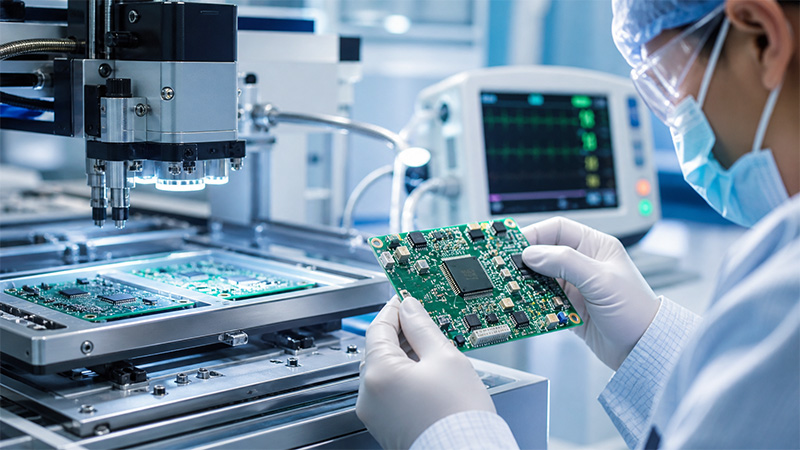
To sum up, medical PCBs manufacturer is a precise term for a highly specialized category of electronics production partner — one that combines advanced fabrication and assembly capabilities with certified quality management systems, rigorous material traceability, and deep familiarity with the regulatory requirements of the healthcare industry. This article has covered the full landscape: from understanding what a medical PCB is and which types apply to different device categories, to the materials, processes, certifications, and selection criteria that define a genuinely capable manufacturing partner.
Choosing the right medical PCBs manufacturer is not a cost decision — it is a quality and compliance decision that will define your regulatory submission timeline, your field reliability record, and your ability to scale from prototype to production without disruption.
At EBest Circuit (Best Technology), we bring 20 years of certified PCB and PCBA manufacturing expertise to every medical device project. Our ISO 13485-certified quality system, IPC Class 3 assembly capability, 5-second material traceability, and 1.5-week delivery mean your medical PCB project gets the engineering rigor it demands — and the speed your development schedule requires. From the first DFM review to the final DHR, we are built to be the manufacturing partner your medical device deserves.
Ready to start your next medical PCB project? Pls feel free to contact our team anytime at sales@bestpcbs.com.
FAQs About Medical PCBs Manufacturer
Q: What is the difference between a standard PCB manufacturer and a medical PCBs manufacturer?
A: The core difference lies in the quality system, not the equipment. A medical PCBs manufacturer operates under ISO 13485 certification, applies IPC Class 2 or Class 3 assembly standards, maintains full lot-level material traceability, and generates Device History Records (DHRs) for every production lot. Standard PCB manufacturers typically operate under ISO 9001 only, without the medical-specific documentation and process control requirements. For any PCB for medical devices that will be submitted to FDA or CE regulatory review, the manufacturer must meet medical-grade requirements.
Q: Is ISO 13485 certification mandatory for a medical PCBs manufacturer?
A: For direct suppliers to medical device companies — yes, in practice. While ISO 13485 is technically a voluntary standard, most medical device OEMs require it as a contractual supplier qualification condition, and regulatory bodies (FDA, EU MDR) expect manufacturers to demonstrate supplier control through certified QMS documentation. A medical PCBs manufacturer without ISO 13485 will almost certainly fail OEM supplier audits for Class II and Class III device programs.
Q: What IPC class applies to medical PCB assembly?
A: It depends on the device risk class. Class II medical devices (patient monitors, infusion pumps, diagnostic equipment) are typically assembled to IPC Class 2 as a minimum, with many OEMs specifying IPC Class 3 for added reliability assurance. Class III devices (implantable pacemakers, defibrillators, neurostimulators) universally require IPC Class 3, which mandates the most stringent solder joint and workmanship acceptance criteria. Confirm the required IPC class with your device risk classification and OEM specification before engaging any medical PCBs manufacturer.
Q: How do I verify that a medical PCBs manufacturer’s traceability system meets FDA requirements?
A: Request a sample Device History Record (DHR) from a previous production lot — with customer-confidential information redacted. A compliant DHR should contain: the device identification and revision, dates of manufacture, quantity manufactured and released, inspection and test records, component lot codes and date codes, and the names of personnel performing key operations. If the manufacturer cannot produce a complete sample DHR quickly and confidently, their traceability system is unlikely to survive an FDA 21 CFR Part 820 audit.
Q: Can a medical PCBs manufacturer support both prototypes and production volumes?
A: The best partners do. Early-stage medical device development requires frequent design iterations, often in quantities of 5–50 units, before a design freeze is reached. A manufacturer that imposes high MOQs or applies relaxed quality controls on small runs forces engineers to switch suppliers between development and production — which introduces re-qualification risk and delays. Look specifically for a medical PCBs manufacturer that applies the same certified quality system to prototype builds as to production lots, regardless of quantity.
Q: What certifications should I ask for when qualifying a biomedical PCB manufacturing supplier?
A: At minimum, require: ISO 13485 (current, with scope covering PCB/PCBA manufacturing), ISO 9001, and evidence of IPC-A-610 Class 3 operator certification. For devices targeting the US market, confirm familiarity with FDA 21 CFR Part 820 requirements. For EU MDR submissions, confirm RoHS and REACH compliance documentation. For high-reliability or implantable applications, AS9100D certification is an additional indicator of process control maturity. Always request current certificates — not photocopies of expired documents — and verify the certification body is accredited.
You may also like

Tags: medical device pcbs manufacturing, medical grade pcb, Medical PCBs Manufacturer