PCB manufacturing PCB manufacturing
Home > Blog

PCB Manufacturers in China

Top 15 High-Frequency PCB Manufacturers in China
Wednesday, September 9th, 2026

High-frequency PCB manufacturers in China range from large industrial groups to RF specialists, custom PCB/PCBA partners, and online prototype platforms. Their production scale, material systems, engineering access, assembly scope, and order models differ substantially, so the right candidate depends on the released board and expected production route.

A useful comparison starts with manufacturing location, RF process capability, material and inspection control, lead-time basis, and the benefit each supplier brings to the order. The table below provides that overview before the individual company profiles explain where each manufacturer fits.
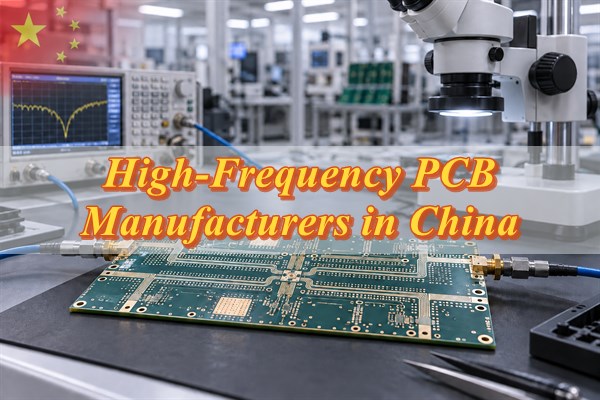
High-frequency PCB manufacturers in China, RF PCB inspection scene with a translucent Chinese flag and centered article keyword

How Do the Top High-Frequency PCB Manufacturers in China Compare?

High-frequency PCB manufacturers in China differ most in production location, process combination, scheduling model, and the customer benefit each supplier is built to deliver. Large groups suit qualified volume programs, engineering-focused factories support custom RF stackups, and online platforms work best when the board fits published options. Use all five fields together; a fast estimate has little value if the laminate, impedance, via structure, or inspection scope does not match the released design.

Manufacturer Location Process Capability Lead Time Advantages
EBest Circuit Shenzhen Custom RF and controlled-impedance PCB; Rogers and Taconic; HDI; PCB and PCBA Confirmed after DFM and material review One project interface from bare-board review through assembly and testing coordination
Shennan Circuits Shenzhen and other sites RF and microwave PCB; broad low-loss laminate support; high-layer PCB and assembly Program-specific quotation Large-scale capacity for complex communications, data, and long-lifecycle programs
Kinwong Electronics Shenzhen and other sites PTFE, hydrocarbon, and ceramic-filled RF PCB; hybrid stackups; HDI and microvias Confirm by assigned plant and stackup Combines RF material processing with dense digital interconnection
Suntak Technology Multiple China sites Antenna and 5G RF PCB; high-speed and high-layer boards; controlled impedance Confirm by assigned plant Useful for products combining RF, high-speed digital, and optical-networking functions
Sunking PCB Huizhou and Ji’an Rogers, Taconic, Isola, and PTFE; hybrid multilayer PCB; HDI; optional assembly Confirm material stock and construction Material-specific engineering support for custom RF and microwave boards
Victory Giant Technology Huizhou High-layer and HDI PCB; high-frequency and high-speed signal-integrity production Program-specific quotation Scalable manufacturing for mature communications, computing, and automotive programs
Aoshikang Hunan and other sites RF and microwave mixed-pressure PCB; HDI; embedded copper; blind and through holes Confirm hybrid stackup schedule Strong fit for integrated antenna, radar, interconnect, and thermal requirements
Bomin Electronics Shenzhen, Meizhou, and Jiangsu Microwave and high-frequency PCB; HDI; high-layer production across multiple sites Confirm by producing site Multi-site route for projects moving from development into recurring production
Delton Technology Guangzhou and other sites High-speed and high-frequency multilayer PCB for data, 5G, AI, and automotive systems Program-specific quotation Production network suited to complex infrastructure boards and planned volume
Fastprint Shenzhen and other sites High-mix and quick-turn PCB; 5G transceiver and microwave-board experience Quick-turn focus; confirm RF build date Responsive engineering-lot route with a path to repeat production
AKM Meadville Xiamen and other sites Advanced HDI, substrate-like PCB, rigid-flex, and high-speed/RF engineering Confirm by site and construction Supports compact products combining RF performance with fine interconnection
Viasion Shenzhen Rogers, Arlon, Isola, and Taconic; controlled impedance; HDI; inspection and turnkey PCBA Confirmed after engineering review Flexible low-to-medium-volume fabrication and assembly coordination
PCBWay Hangzhou High-frequency and mixed-material PCB; Rogers, Taconic, Arlon, and PTFE; HDI and assembly Live estimate for supported configurations Accessible online ordering for prototypes and small production runs
JLCPCB China production network Standardized Rogers and PTFE options; supported high-frequency PCB and assembly Displayed in the live ordering platform Fast sourcing route for designs that fit published platform rules
LZJPCB Shenzhen RO4003C, RO4350B, Taconic, and Isola; multilayer PCB; prototype-to-volume PCBA Confirm material and plant schedule Custom export supply combining named laminates, fabrication, and assembly

Use the table to identify two or three manufacturers whose location, process scope, lead-time basis, and advantages fit the same released board. The profiles below explain the differences behind those initial matches.

1. EBest Circuit

EBest Circuit is a Shenzhen-based custom PCB and PCBA manufacturer founded in 2006. It supports engineering prototypes, repeat production, component sourcing, assembly, and testing coordination for overseas customers. This gives product teams one technical interface from bare-board review through assembled hardware instead of requiring separate fabrication and assembly vendors.

Its high-frequency scope includes RF boards, controlled-impedance multilayers, Rogers and Taconic materials, HDI, rigid-flex, and mixed PCB/PCBA programs. Customers can submit fabrication files with the BOM, placement data, assembly drawing, and test requirements for a free DFM review before quotation. That review can identify material, stackup, drill, impedance, panelization, component, and assembly conflicts while design changes are still manageable.

The service model is built around custom orders rather than a fixed online menu. This gives customers room to coordinate bare-board requirements with sourcing, soldering, programming, or functional-test needs, while retaining a single project contact. Order-specific capability, material availability, inspection, and final acceptance criteria are confirmed during quotation and engineering review.

Suitable projects: Custom RF and microwave products that need direct engineering communication and a coordinated prototype-to-production route. EBest is especially relevant to overseas teams that want controlled-impedance fabrication, component sourcing, assembly, and order documentation managed through one supplier.

2. Shennan Circuits

Shenzhen-headquartered Shennan Circuits combines printed circuit boards, packaging substrates, and electronic assembly within a large industrial group. Its public PCB portfolio includes RF and microwave products as well as high-speed and high-capacity boards, making it relevant to infrastructure programs that need several advanced technologies under one corporate supplier.

The company publicly lists Rogers RO3003, RO3006, RO4350B, RO4360G2, and RO4835, together with CLTE, GenClad, RF-35, and FastRise 27. This breadth supports designs that specify a precise low-loss laminate rather than a generic material brand. Its wider PCB and assembly operations also suit programs that combine RF sections with complex digital, power, or system-level requirements and need capacity beyond a development batch.

Shennan’s corporate scale is a meaningful advantage for programs that require formal qualification, production ramp, and long-term capacity planning. The same scale can bring a more structured onboarding process, so it fits mature specifications and forecasted demand better than informal, rapidly changing prototype work.

Suitable projects: Large or technically demanding communications, data, server, and industrial programs that can support formal supplier qualification and need scalable PCB or PCBA capacity over a long product lifecycle.

3. Kinwong Electronics

Shenzhen-headquartered Kinwong Electronics gives RF and microwave PCBs a distinct place in its product portfolio rather than treating them as a minor extension of standard multilayer production. Its public RF information covers PTFE, hydrocarbon, and ceramic-filled material families, plus pure high-frequency and hybrid constructions.

The same portfolio includes blind and buried vias, microvias, and multilayer structures. That combination matters when an antenna, radar, or RF front end must share a compact board with dense digital control circuitry. Kinwong’s differentiation is the ability to bring material processing and interconnect density into one manufacturing platform, which can reduce the need to split an integrated RF module across several PCB suppliers.

This combination also makes Kinwong relevant when a project must move from a pure RF section to a compact mixed-technology product. Its public evidence supports evaluating the company for advanced board construction, while the exact laminate, layer count, via span, copper, and tolerance combination still belongs in the order-level capability review.

Suitable projects: Automotive, communications, industrial, and mixed RF/digital products that need high-frequency material processing together with multilayer or HDI integration. It is more relevant to integrated boards than to simple two-layer microwave circuits.

4. Suntak Technology

Shenzhen-headquartered Suntak Technology publicly connects its PCB capability to high-frequency antennas, high-speed and high-layer boards, optical modules, communications equipment, and impedance-controlled products. Its 5G-related material also describes RF and high-speed boards used in active antenna units.

Its product range is most relevant when antenna or RF paths must coexist with high-speed digital interfaces or optical networking hardware. Suntak’s multi-product manufacturing base offers a broader production route than a small RF-only shop for mature communications programs, particularly when impedance-controlled multilayers, recurring volume, and experience across several electronics markets matter together.

For international buyers, the practical attraction is not a single laminate name but the overlap between antenna, high-speed, optical, and multilayer production. That overlap can simplify supplier selection for equipment containing several signal domains and complex product lifecycles, provided the assigned factory and current material construction are confirmed for the released board and planned production volume.

Suitable projects: Communications, optical networking, automotive, and industrial programs that need an established multilayer producer with both high-frequency and high-speed product coverage. It is a stronger candidate for repeat programs and long-term volume support than for a one-off experimental coupon.

5. Sunking PCB

Sunking PCB operates manufacturing in Huizhou and Ji’an and presents high-frequency PCB fabrication as a dedicated service. Its public material coverage names Rogers, Taconic, Isola, and PTFE families, giving RF buyers more useful starting information than a general claim that the factory supports special materials.

The company also describes mixed-dielectric constructions, multilayer boards, HDI, prototype-to-volume manufacturing, and optional PCB assembly. This combination can support antenna, microwave, communications, and control products that place RF and digital functions on the same board. The assembly option is useful when fabrication and component placement must be coordinated, while the named laminate families make early material screening easier.

Compared with a large diversified group, Sunking presents a more specialized RF-facing offer. That can help small and mid-sized teams reach the relevant engineering service faster, particularly when a hybrid stackup or named laminate requires discussion before pricing. The trade-off is that program scale and plant allocation should be matched to the order.

Suitable projects: Custom RF and microwave boards that need a specified high-frequency laminate, hybrid construction, or integrated assembly service. Sunking is a closer fit for buyers seeking material-specific engineering support than for orders selected only through an instant online quote.

6. Victory Giant Technology

Victory Giant Technology is based in Huizhou and is oriented toward high-volume, high-layer, and HDI production for data, communications, automotive, and other electronics markets. Its public material and product information connects high-frequency and high-speed signal integrity with complex multilayer manufacturing.

This production model suits boards in which an RF function is part of a larger high-density system, such as communications infrastructure or computing hardware, rather than a stand-alone microwave circuit. The company’s strength is scalable multilayer and HDI capacity for mature programs with stable forecasts. Its scale can support long product lifecycles, although onboarding and production ramp are likely to be more formal than on a prototype platform.

Victory Giant is oriented toward production scale and complex board integration rather than a catalogue of small RF prototype options. Buyers with stable designs can benefit from that orientation, while projects still changing materials or layer structures may need a supplier with a more flexible engineering-lot model.

Suitable projects: Forecasted communications, computing, and automotive programs that need high-layer or HDI production at scale, controlled signal-integrity features, and a supplier structured for recurring volume rather than one-off development boards.

7. Aoshikang

Hunan-based Aoshikang, also known as ASKPCB, presents RF and microwave mixed-pressure boards alongside HDI, embedded-copper, blind-hole, and through-hole technologies. Its market information connects these products to communications, antenna systems, 77 GHz automotive radar, servers, and other high-frequency or high-speed applications.

The mixed-pressure capability is relevant when a design uses low-loss material only on critical RF layers and another laminate elsewhere for mechanical, density, or cost reasons. Aoshikang’s combination of hybrid material processing, embedded copper, and advanced vias gives it a broader role than a conventional RF board shop. It can address products in which antenna or radar performance, thermal paths, and high-density interconnection must share one construction.

This gives Aoshikang a distinct position among volume-oriented manufacturers: its public examples connect advanced process combinations to concrete antenna and radar uses. A buyer evaluating an integrated radar or communications board can compare one supplier’s ability to handle RF material, dense interconnection, and thermal features together.

Suitable projects: Hybrid-material RF boards, radar and antenna electronics, or dense products that need advanced vias and a route from sample production to higher volume. The public application evidence is particularly relevant to automotive radar and communications hardware.

8. Bomin Electronics

Bomin Electronics was founded in 1994 and operates PCB production bases in Shenzhen, Meizhou, and Jiangsu. Its public product scope includes microwave and high-frequency boards, HDI, and high-layer PCBs, while the wider group also covers electronic components and related system services.

The multi-site footprint gives Bomin capacity options across several board technologies and stages of a product lifecycle. Microwave or RF requirements can be combined with HDI or high-layer construction for industrial, communications, and automotive electronics. Its wider group structure may also help customers planning supply continuity or services beyond a single bare-board prototype, although plant and service scope remain specific to the quoted order.

Bomin’s main advantage is its breadth across facilities and PCB categories. It may suit customers that expect a project to grow or diversify, because the group can be evaluated for several construction types under one corporate relationship. That same multi-site model makes the actual producing factory an important part of the quotation.

Suitable projects: Buyers seeking an established multi-site Chinese manufacturer for microwave, high-frequency, HDI, or multilayer production, with room to expand from development quantities into repeat manufacturing.

9. Delton Technology

Guangzhou-based Delton Technology was founded in 2002 and publicly identifies high-speed and high-frequency PCB manufacturing as a central business. Its production network includes sites in Guangzhou, Dongguan, Huangshi, and Thailand, and its application focus spans data centers, cloud computing, artificial intelligence, 5G communications, and automotive electronics.

Delton is aligned with complex infrastructure and computing boards that combine controlled signal paths, high layer counts, demanding drilling, and recurring production volume. Its production network also gives international programs options for capacity and supply-chain planning. This differs from a small online prototype service: the main value lies in a manufacturing platform built around demanding data and communications applications.

The application mix is useful for buyers whose definition of high frequency overlaps with high-speed digital performance. Rather than approaching Delton as a general prototype source, procurement teams can evaluate it for complex system boards, production ramp, and multi-site capacity where signal integrity and manufacturing scale are closely linked.

Suitable projects: Data infrastructure, 5G, AI computing, and automotive programs that need high-speed/high-frequency multilayer capability and planned production scale. It is most relevant when the RF requirement is one part of a complex system board.

10. Fastprint

Fastprint began in Shenzhen in 1999 with a quick-turn and high-mix focus, then expanded into broader PCB, substrate, flexible-circuit, and test-board production. Its public product examples include 5G transceiver and microwave stepped-slot boards, creating a clearer RF connection than a generic advanced-PCB claim.

The company is differentiated by its engineering-lot and high-mix orientation. It can serve teams that expect several design revisions, test-board variants, or lower volumes before a stable release. This profile is useful in communications and measurement programs where learning speed and responsive engineering matter more than the lowest recurring unit price. Its broader portfolio also provides a path from specialized samples to repeat builds after the design matures.

Fastprint sits between mass-production groups and self-service quote platforms. Its prototype heritage with broader manufacturing resources lets teams retain engineering interaction during early builds, preserve a consistent set of fabrication assumptions through design revisions, and keep a qualified route into repeat production after the construction stabilizes.

Suitable projects: Engineering prototypes, high-mix programs, test hardware, and 5G or microwave boards that benefit from responsive sample production and a later volume path.

11. AKM Meadville

AKM Meadville is headquartered in Xiamen and operates production facilities in Guangzhou, Shanghai, Suzhou, Xiamen, and Thailand. Its product portfolio emphasizes advanced HDI, substrate-like PCB, rigid-flex, packaging substrates, and boards for 5G communications, artificial intelligence, and cloud infrastructure.

The company also publishes engineering roles connected to RF and high-speed/high-frequency test methods, indicating a technical focus that extends beyond fabrication alone. Its main distinction is advanced system integration: dense interconnects, fine features, rigid-flex structures, or substrate-like construction can be combined with high-speed and RF functions for compact advanced electronic products.

This portfolio gives AKM Meadville a stronger fit for advanced electronics platforms than for commodity RF boards. A buyer may shortlist it when packaging density, flex integration, fine interconnects, and system performance all influence the PCB choice, especially when the program needs access to several production sites and broader engineering depth across multiple product generations.

Suitable projects: Global programs that combine dense interconnects, rigid-flex or substrate-like structures, and high-speed or RF functions under a large multi-site supplier. It is more relevant to integrated devices than to uncomplicated two-layer microwave circuits.

12. Viasion

Shenzhen-based Viasion focuses on custom, low-to-medium-volume PCB manufacturing and assembly. Its high-frequency service publicly references Rogers, Arlon, Isola, and Taconic materials, controlled impedance, HDI features, electrical test, automated optical inspection, and turnkey assembly.

The company differs from a large listed group because it is aimed at buyers who need a flexible project interface and coordinated fabrication and PCBA. Its named material families, impedance support, board inspection, and turnkey scope are useful for lower-volume industrial or communications products whose stackup, connectors, or assembly test still need active engineering discussion. For such orders, access to a responsive project team can matter more than total corporate scale.

Viasion’s service breadth lets a customer keep prototype fabrication, component purchasing, assembly, and inspection within one managed order. That can reduce handoff work for a small engineering team, while its low-to-medium-volume positioning distinguishes it from companies optimized primarily for large and stable production forecasts.

Suitable projects: Low-to-medium-volume industrial, communications, and RF products requiring a custom board plus assembly and export support. Viasion is a practical option when the project remains too specialized for a standardized ordering platform.

13. PCBWay

Hangzhou-based PCBWay provides an online ordering route for prototypes and small production runs while also publishing advanced-board capabilities. Its platform supports high-frequency and mixed-material work using Rogers, Taconic, Arlon, and Chinese PTFE families, alongside HDI and other special PCB options.

The online workflow is convenient for early engineering builds, especially when the design fits selectable materials and published process rules. The platform also offers assembly, reducing logistics for evaluation hardware. PCBWay is more accessible than a large volume supplier for small teams and one-off development, while covering a broader range of special materials and board structures than a basic low-cost prototype service.

Its practical value comes from the combination of online access and an unusually broad published special-process menu. This makes initial sourcing easier for startups, laboratories, and engineering groups that want to compare materials or order evaluation quantities before committing to a formal volume-manufacturer onboarding process.

Suitable projects: Fast prototypes and small batches with defined requirements that fit the platform’s current material and process options. It is useful for teams that value online access and transparent ordering more than a highly customized supplier-qualification program.

14. JLCPCB

China-based JLCPCB is known for a standardized online PCB ordering system and large prototype ecosystem. Its current quotation options include Rogers and PTFE high-frequency boards, allowing engineers to price and order supported constructions without a traditional supplier-onboarding cycle.

This model is efficient for evaluation boards and straightforward RF prototypes because supported material and construction options are visible during ordering. JLCPCB also offers assembly within its broader platform. Its advantage is speed and accessibility for standardized designs; custom hybrid stackups, specialized coupons, unusual RF testing, or tightly controlled production changes may require a more consultative supplier model.

JLCPCB differs from the large industrial groups through its self-service workflow and from custom shops through its standardized rules. That clarity can shorten sourcing for a supported board, but the buyer has less reason to choose it when the design depends on a highly tailored material stack, documentation package, or product-specific RF test plan.

Suitable projects: Cost-sensitive prototypes and small runs that match the platform’s selectable high-frequency process options. It is best considered when the board can stay within standardized rules and does not need an extensive custom qualification package.

15. LZJPCB

LZJPCB is a Shenzhen supplier founded in 2006 with PCB and PCBA services and production resources in China and Indonesia. Its public manufacturing information names Rogers RO4003C and RO4350B, Taconic, Isola, high-frequency boards, multilayer fabrication, and prototype-to-volume service.

The combined fabrication and assembly scope can simplify sourcing for an RF product when the customer prefers one commercial contact. Its named Rogers grades and additional laminate brands make it relevant to common low-loss board requirements, while the China and Indonesia resources may support export-oriented production planning. Compared with a standardized online platform, LZJPCB offers a more conventional custom-supplier relationship across prototype, production, and PCBA.

That model places LZJPCB between a specialist RF fabricator and a turnkey export supplier. It can be useful when the customer’s priorities include named laminate support, assembly coordination, international shipment handling, and a recurring production route, but do not require the scale and formal onboarding of China’s largest listed PCB groups.

Suitable projects: Export-oriented custom PCB and PCBA orders that use established Rogers or comparable high-frequency materials and need a prototype-to-production path with international support for overseas customers through one supplier relationship.

What Should You Look for in a High-Frequency PCB Manufacturer in China?

Look for a factory that can build the complete RF construction, verify its critical characteristics, and support the order quantity you actually need. A material brand or generic multilayer claim is insufficient because laminate grade, copper, geometry, via structure, inspection, and production scale interact in the same board.

  • Material and stackup fit: Confirm the exact laminate grade, dielectric thickness, bonding system, copper type, layer order, and permitted substitutions. The returned stackup should match the electrical model and identify the producing factory.
  • Combined process capability: Check the hardest combination rather than isolated maxima: controlled impedance, fine geometry, HDI or blind vias, hybrid pressing, board thickness, copper, surface finish, and assembly must coexist in one approved process window.
  • Inspection and RF evidence: Specify electrical test, impedance coupons or TDR, microsection, dimensional inspection, material traceability, and any product-specific RF test before quotation. The supplier should state which records accompany prototypes and production lots.
  • Production and service model: Match prototype flexibility, engineering communication, PCBA support, volume capacity, and change control to the program. A self-service platform, specialist factory, and large group solve different sourcing problems.
  • Realistic lead-time basis: Ask whether the quoted date starts after engineering approval, whether the laminate is in stock, which plant will build the board, and whether inspection, assembly, freight, and customs are included. The useful output is a dated route from release to delivery.

These checks turn the manufacturer profiles into a practical qualification list. The FAQs below address the remaining questions buyers commonly face about materials, prototypes, assembly, cost, lead time, verification, and quotation inputs.

FAQs About High-Frequency PCB Manufacturers in China

Q1: Who are the major high-frequency PCB manufacturers in China?

A1: China’s major high-frequency PCB candidates span large advanced-PCB groups, specialist factories, custom PCB/PCBA suppliers, and online prototype platforms. Shennan Circuits, Kinwong, Victory Giant, Suntak, Aoshikang, Bomin, Delton, Fastprint, and AKM Meadville focus on different advanced or scaled production needs. Sunking, EBest Circuit, Viasion, PCBWay, JLCPCB, and LZJPCB provide different custom, export, prototype, or integrated PCB/PCBA routes.

Q2: Which Chinese PCB manufacturers work with Rogers materials?

A2: Shennan Circuits, Sunking PCB, EBest Circuit, Viasion, PCBWay, JLCPCB, and LZJPCB publicly identify Rogers materials or selectable Rogers options. Confirm the exact grade, thickness, copper type, bonding system, and assigned factory in the current quotation because brand-level support does not approve every construction.

Q3: Can Chinese manufacturers produce high-frequency PCB prototypes?

A3: Yes, Chinese suppliers can produce high-frequency PCB prototypes through custom engineering services or standardized online platforms. Confirm that the prototype uses the planned laminate, stackup, process route, impedance coupon, and inspection method so the result can support a later production decision.

Q4: Can one supplier provide both high-frequency PCB fabrication and assembly?

A4: Several suppliers can combine high-frequency PCB fabrication with component sourcing and assembly. Keep separate acceptance points for the bare board and the assembled product, including impedance evidence, soldering quality, connector launches, shielding, programming, and functional testing where the design requires them.

Q5: How much does a high-frequency PCB cost in China?

A5: High-frequency PCB cost depends on the released construction, so a universal China price is not useful. Laminate grade and minimum purchase, layer count, board area, copper, hybrid pressing, geometry, holes, surface finish, panel yield, quantity, testing, reports, assembly, and freight all change the quotation. Compare suppliers with the same files, quantity, and acceptance requirements.

Q6: What is the typical lead time for a high-frequency PCB from China?

A6: Lead time depends most on material availability, engineering approval, process complexity, testing, assembly, and shipping. Ask when the supplier’s clock starts and request separate dates for engineering release, material readiness, fabrication completion, inspection, assembly, and delivery rather than relying on one unsupported day count.

Q7: How can I verify a Chinese high-frequency PCB manufacturer?

A7: Verify the legal company, the actual producing factory, and a stackup-specific capability response before approving a supplier. Then review relevant certificate scope, prototype results, inspection records, electrical and impedance evidence, material traceability, and change-control terms against the same acceptance criteria.

Q8: What should I send for a high-frequency PCB quotation?

A8: Send fabrication data, drill files, the fabrication drawing, approved or proposed stackup, exact laminate and copper requirements, and the impedance table. Add critical tolerances, surface finish, prototype and forecast quantities, delivery location, required date, inspection records, plus BOM, assembly, programming, and test files when PCBA is included.

Conclusion

Your final supplier should match the laminate, stackup, impedance, inspection, volume, and delivery requirements of the released design. Once those points are aligned, the quotation becomes easier to compare and approve.

Planning a high-frequency PCB or PCBA project? Send EBest Circuit your Gerber or ODB++ files, stackup, laminate grade, impedance requirements, quantities, delivery destination, and any BOM, assembly, or test files. Our engineering team will provide a free DFM review, identify issues that could affect fabrication or assembly, and prepare a quotation for your actual build. Email sales@bestpcbs.com to discuss your requirements and request a quote.

You may also like

Reliable PCB Manufacturing in China for High-Frequency Boards
Monday, December 8th, 2025

PCB manufacturing in China holds a dominant global position, with China accounting for more than half of the world’s total production volume. This leadership is supported by a complete and highly sophisticated ecosystem, spanning raw material suppliers, advanced equipment manufacturers, skilled engineering talent, and large-scale manufacturing capacity. The strong cluster effect in regions such as the Pearl River Delta and the Yangtze River Delta enables exceptional supply chain efficiency and cost advantages.

For high-frequency boards, which require specialized materials like Rogers or Teflon and extremely precise process control, China hosts numerous manufacturers that have invested heavily in the requisite technology and expertise. While the market is vast, finding a reliable partner for such critical applications requires careful evaluation of technical capability, quality systems, and project management rigor within the PCB manufacturing in China​ landscape. Don’t hesitate to contact us via sales@bestpcbs.com if you require any PCB quote.

Top 10 PCB Manufacturers in China

The following table lists some of the leading PCB manufacturers in China with capabilities for high-frequency and high-performance boards.

Company NameProcess Capability (HF Boards)Key Advantages
Shennan Circuits (SCC)HDI, RF/MicrowaveR&D strong, high reliability
WUS Printed CircuitRF, BackplaneComplex boards expert
Kinwong ElectronicsHigh-Thermal, HDIAutomated production
EBest Circuit (Best Technology)RF/Microwave, High-Speed, HDIStrong engineering, fast delivery
DSBJ (Fastprint)HDI, IC SubstrateQuick-turn specialist
Aoshikang (AKM)RF, Rigid-FlexBroad capability
Suntak TechnologyHDI, Rogers/TeflonCommunication-focused
Victory GiantHigh Layer, HDIStrong telecom reliability
Jingwang WeidianRF, Rigid-FlexEngineering-driven
Ellington ElectronicsRF, HDIAutomotive & telecom strength

EBest Circuit (Best Technology) Co., Limited, founded in 2006, is a direct Chinese PCB manufacturer with full in-house production and certifications including ISO 9001, ISO 13485, IATF 16949 and AS9100D. We provide a wide range of PCBs such as metal core PCBs for LED thermal management, ceramic PCBs for 5G, RF and power electronics, standard rigid and multilayer PCBs for consumer and industrial devices, and special PCBs including HDI, IC substrate, heavy copper, thin PCB and impedance control designs.

All products support full customization and comply with RoHS and REACH. With a monthly capacity of 260,000 sq. ft and over 1,000 different boards delivered each month, EBest Circuit (Best Technology) is committed to quality, innovation and fast turnaround, offering urgent PCB delivery within 24 hours. Pls feel free to get in touch with us via sales@bestpcbs.com or +86-755-2909-1601 for any PCB manufacturing and PCBA demands.

Core Pain Points When Working With Any PCB Manufacturer in China

Engaging a PCB manufacturer in China​ offers immense benefits but comes with distinct challenges. Awareness of these common pain points is crucial for successful collaboration, especially for sensitive products like high-frequency boards.

  • Material Sourcing and Authenticity:​ Ensuring the use of certified, high-quality, and authentic high-frequency laminates (e.g., Rogers, Taconic) can be a concern, as some manufacturers may propose unverified substitutes to cut costs.
  • Communication and Language Barriers:​ Technical misunderstandings can arise due to language differences, time zones, and cultural nuances in communication styles, potentially leading to specification errors.
  • Quality Consistency in High-Mix Volumes:​ Maintaining absolute consistency in critical parameters (like dielectric constant and loss tangent) across batches, especially when switching production lines or operators, is a constant challenge.
  • Intellectual Property (IP) Protection:​ Despite improving laws, concerns about design IP and process know-how security persist, requiring robust NDAs and careful information sharing practices.
  • Limited Proactive Engineering Support:​ Some manufacturers operate primarily as “order takers” rather than providing proactive Design for Manufacturability (DFM) feedback, which is essential for optimizing complex high-frequency designs.
  • Supply Chain Transparency:​ Visibility into the sub-tier supply chain (e.g., chemical suppliers, laminate vendors) can be limited, making it harder to audit overall quality control and ethical sourcing.

Proactively addressing these pain points through clear contracts, thorough audits, ongoing communication, and building a relationship-based partnership is key to mitigating risks and ensuring project success with your chosen PCB manufacturer in China.

How to Evaluate Production Capabilities of a PCB Board Manufacturer in China?

A thorough assessment of a PCB board manufacturer in China​ goes beyond basic quotes. For high-frequency boards, due diligence must focus on technical and process mastery.

  • Audit Equipment and Facility:​ Verify the presence of advanced, well-maintained equipment suitable for HF boards: laser direct imaging (LDI), vacuum pressing, plasma desmear, controlled impedance testing, and high-precision lamination presses.
  • Review Certifications and Process Controls:​ Look for relevant certifications (e.g., IATF 16949, AS9100, UL) and ask about their Statistical Process Control (SPC) and quality management systems for critical parameters.
  • Request Product Portfolio and References:​ Examine past production samples, especially for similar high-frequency or high-speed applications. Request client references in your industry.
  • Assess Engineering and DFM Expertise:​ Engage their engineering team in a technical discussion. Evaluate their ability to provide insightful, proactive DFM feedback on your design files.
  • Evaluate Prototyping Process:​ Understand their quick-turn prototyping flow, including engineering review time, material stocking, and dedicated prototype lines. This reflects agility and priority for NPI (New Product Introduction).
  • Test Their Material Expertise:​ Question them deeply on material properties, processing guidelines for different high-frequency laminates, and their relationships with authorized material distributors.

By systematically investigating these areas, you can move beyond surface-level claims and gain a true understanding of the technical competence and reliability of the PCB board manufacturer in China​ you are considering.

Key Factors for Assessing Delivery Speed From PCB Manufacturers in China

Delivery time is a critical metric. For PCB manufacturers in China, speed is influenced by multiple factors beyond just the “production lead time” quoted.

  • Material Inventory and Sourcing Time:​ Confirm the availability of your specified high-frequency laminate in their stock. Sourcing specialty materials can add weeks if not in inventory.
  • Engineering Review Efficiency:​ A swift, thorough, and collaborative engineering/DFM feedback cycle (typically 24-48 hours) prevents delays and avoids multiple revision spins.
  • Prototype vs. Volume Production Lines:​ Leading manufacturers have dedicated, expedited lines for prototypes. Ensure your prototype won’t be queued behind large volume orders.
  • Process Complexity Impact:​ Understand how your board’s specs (tight tolerances, via fills, sequential lamination, special finishes) add to the standard production cycle. A transparent manufacturer will detail this.
  • Testing and Validation Time:​ Factor in time for electrical testing, impedance testing, and any required reliability testing (e.g., thermal cycling). Complex testing requirements extend lead times.
  • Logistics and Shipping Pre-Arrangement:​ Discuss and pre-arrange shipping methods (air vs. sea) and customs documentation to avoid last-minute logistical delays.

A realistic and reliable delivery timeline from PCB manufacturers in China​ is built on transparent communication about each of these stages, not just a single promised date. Partner with manufacturers who provide clear, stage-by-stage tracking.

Major Industry Challenges Faced by the PCB Manufacturing in China Market

While leading global PCB manufacturing in China, the industry itself navigates a complex set of internal and external pressures that shape its evolution and competitive landscape.

  • Intense Price Competition and Margin Pressure:​ The market is highly saturated at the low to mid-range, leading to fierce price wars that squeeze margins and can compromise quality if not managed.
  • Rising Labor and Operational Costs:​ Increasing wages, land costs, and stricter environmental regulations, especially in coastal regions, are eroding the traditional cost advantage.
  • Dependency on Advanced Equipment and Materials:​ High-end production, especially for HF and IC substrates, relies heavily on imported equipment (from Europe/Japan) and specialty raw materials, impacting supply chain security and costs.
  • Technological Gap in Cutting-Edge Segments:​ While strong in many areas, a gap still exists compared to global leaders in the most advanced technologies like ultra-HDI, advanced substrate packaging (e.g., FC-BGA), and certain semiconductor-level processes.
  • Environmental Compliance and Sustainability Pressures:​ Adhering to increasingly stringent national and international environmental regulations (e.g., waste treatment, carbon footprint) requires significant and ongoing investment.
  • Global Geopolitical and Trade Tensions:​ Tariffs, trade restrictions, and “de-risking” trends can disrupt supply chains, affect export markets, and complicate technology transfer.

The future of PCB manufacturing in China​ hinges on the industry’s ability to move up the value chain, innovate in advanced technologies, embrace automation for efficiency, and successfully navigate the sustainability and geopolitical challenges of the global market.

Practical Recommendations for Choosing the Best PCB Manufacturer in China

Selecting the right partner is strategic. Follow these actionable steps to identify and qualify the best PCB manufacturer in China​ for your high-frequency board needs.

  • Define Your Requirements Precisely:​ Create a detailed specification document covering material stack-up, tolerances, electrical performance (impedance, loss), testing requirements, and certifications needed.
  • Prioritize Specialization Over Generalization:​ Seek manufacturers with a proven track record and dedicated production lines for high-frequency/RF/microwave boards, not just general PCB producers.
  • Conduct a Rigorous Site Audit (Virtual or In-Person):​ If possible, audit the facility. Assess cleanliness, equipment, operator discipline, and quality control checkpoints on the production floor.
  • Start with a Prototype Project:​ Before committing to volume, place a small prototype or pilot-run order. This is the best way to evaluate real-world performance on quality, communication, and timing.
  • Evaluate the Engineering Team Interaction:​ The quality of technical communication during the RFQ and DFM stage is a leading indicator of future support. Responsive, knowledgeable engineers are invaluable.
  • Clarify IP Protection and Contract Terms:​ Ensure a strong Non-Disclosure Agreement (NDA) and clear contract terms covering quality standards, liability, delivery schedules, and payment terms.
  • Verify Supply Chain and Material Traceability:​ Request evidence of authorized distribution for the high-frequency materials you specify to guarantee performance and authenticity.
  • Consider Long-Term Partnership Potential:​ Look for a manufacturer interested in building a relationship, willing to grow with your business, and invest in processes that support your future technology roadmap.

Finding the best PCB manufacturer in China​ is a diligent process of matching your specific technical and business needs with a manufacturer’s proven capabilities and cultural alignment for partnership, moving beyond price as the sole deciding factor.

Why Select EBest Circuit (Best Technology) for Your PCB Manufacturing in China?

Choosing the right partner for PCB manufacturing in China is critical when your project involves high-frequency, multilayer, HDI, or special-material boards. With thousands of PCB manufacturers in Chinaβ€”ranging from small prototype shops to the largest PCB manufacturer in Chinaβ€”it becomes essential to identify a supplier that offers consistency, advanced engineering, and predictable project control.

EBest Circuit (Best Technology) stands out as a trusted PCB manufacturer in China, delivering stable performance across RF, microwave, high-speed digital, and rigid-flex applications. Whether you require a 4 layer PCB manufacturer in China, 10–20 layer PCB manufacturer in China, 22–36 layer PCB manufacturer in China, or a specialized antenna PCB manufacturer in China, our team supports you with end-to-end technical capability.

1. Proven Expertise Across High-Complexity PCB Types

  • EBest Circuit (Best Technology) is not only known as a high frequency PCB manufacturer in China, but also as a reliable partner for RF, microwave, and antenna systems, making us competitive among the top PCB manufacturers in China.
  • We routinely manufacture Rogers, Taconic, Teflon/PTFE, and hybrid stack-ups for industries requiring precision and reliability.

2. Full Capability Coverage: From Simple to Ultra-Complex Multilayer Boards

  • We support a wide range of structuresβ€”from 4 layer PCB manufacturer in China services to 22–36 layer PCB manufacturer in China high-density stack-ups.
  • Our facilities specialize in blind/buried vias, via-in-pad, HDI, sequential lamination, and impedance-controlled routing, positioning us strongly among HDI PCB manufacturers in China.

3. Dedicated Support for Industry-Specific Applications

EBest Circuit (Best Technology) services multiple vertical markets as a:

  • 5G base station PCB manufacturer in China
  • aviation PCB manufacturer in China
  • medical equipment PCB manufacturer in China
  • drone PCB manufacturer in China
  • industrial equipment PCB manufacturer in China
    We understand compliance, reliability, and documentation control required by these industries.

4. Strong Material Expertise Including Rogers, Taconic, and High-TG FR4

  • As a leading rogers PCB manufacturer in China and taconic PCB manufacturer in China, our team understands DK/DF control, copper roughness, press cycles, and routing rules needed for demanding RF layouts.
  • We support Rogers 4350B, 5880, 3003, TMM series, and Taconic TLY/RT/CE grades.

5. Precision Manufacturing for Antenna, RF, and Microwave Boards

  • If you require an antenna in PCB manufacturer in China, RF PCB manufacturer in China, or microwave PCB manufacturer in China, our engineering team provides build-ready design reviews, stack-up optimization, and accurate impedance modeling to enhance RF performance.

6. Reliable Prototype-to-Mass Production Workflow

  • Unlike many suppliers focused solely on volume production, EBest Circuit (Best Technology) excels in quick-turn prototypes and stable ramp-up to mass production.
  • This makes us ideal for custom PCB manufacturing in China, PCB prototype manufacturer in China, and complex R&D applications.

7. Advanced Equipment Ensuring Consistent Quality

Our factory utilizes LDI, vacuum lamination, plasma desmear, AOI, flying-probe test, and impedance analyzers. This supports precision builds required by:

  • multi layer PCB board manufacturer in China
  • high-speed high-frequency PCB board manufacturer in China
  • PCB high frequency board processing manufacturer in China

8. Strong Engineering Communication and Project Management

  • Technical misunderstandings are common when working with a PCB board manufacturer in China, especially on RF and HDI designs.
  • Our bilingual engineering team provides proactive communication, weekly updates, and full DFM/DFT reports.

9. One-Stop PCB + Assembly Capability

  • As a full PCB and assembly manufacturer in China, we provide SMT, DIP wave soldering, reflow, functional testing, and turnkey BOM sourcing.
  • This makes EBest Circuit (Best Technology) a preferred partner for clients needing assembled PCB manufacturer in China service.

Selecting the right partner for PCB manufacturing in China requires more than comparing prices. You need a supplier with proven engineering depth, high-frequency expertise, strong process control, and dependable communication. EBest Circuit (Best Technology) combines all these strengths, making us one of the best PCB manufacturers in China for RF, microwave, HDI, multilayer, antenna, and high-reliability applications. With advanced equipment, skilled engineers, and a customer-focused mindset, we deliver consistent quality across prototypes and mass production.

For companies seeking a trustworthy best PCB manufacturer in China, EBest Circuit (Best Technology) provides long-term value and technical confidence for your most challenging PCB projects. For more information or if you would like to send us any inquiry, please send us an email through the contact form at the bottom of our Contact US Page.

FAQs

Who is the largest PCB manufacturer in the world?

  • Zhen Ding Technology Holding Limited (ZDT), also known as AT&S, is frequently ranked as the world’s largest PCB manufacturer by revenue, particularly strong in high-density interconnect (HDI) and substrate-like PCBs for the smartphone and semiconductor sectors.

What is the best PCB manufacturer?

  • There is no single “best” manufacturer globally. The best choice is entirely application-dependent. For consumer electronics, it might be Unimicron or Compeq; for high-frequency communication, Shennan Circuits or EBest Circuit (Best Technology); for flexible circuits, it could be Flexium or MFLEX.

Who is the best manufacturer of PCB in China?

  • For high-frequency and high-complexity boards, Shennan Circuits Co., Ltd. (SCC)​ is widely regarded as one of the best domestic PCB manufacturers in China, known for its advanced technology, scale, and service to top-tier clients. For a broader market leadership, EBest Circuit (Best Technology)​ is a top contender.

Who is the largest PCB supplier?

  • The term “supplier” can refer to a manufacturer or a distributor. The largest manufacturer is Zhen Ding Tech (AT&S) as noted. One of the largest global distributors of PCBs and related services is companies like Benchmark Electronics or SIIX, though many OEMs source directly from large manufacturers.

What is the most expensive PCB color?

  • While color has a minimal impact on electrical performance, it can affect cost in production. White is often considered the most expensive or challenging color for solder mask due to its lower contrast for AOI (Automated Optical Inspection) and potential to show impurities more easily, potentially requiring more stringent process control.

What are the global PCB manufacturers ranking?

  • The global PCB manufacturer ranking by revenue (top 5-10) is relatively stable year-to-year. A typical recent top tier includes (in no strict order): Zhen Ding Tech (AT&S, China/Austria), Unimicron (Taiwan), TTM Technologies (US), Compeq Manufacturing (Taiwan), Shennan Circuits (China), EBest Circuit (Best Technology) (China), and Nippon Mektron (Japan). Official rankings are published annually by industry associations like N.T. Information or Prismark.

You may also like

PCB Factory China, PCB Manufacturers in China
Wednesday, October 15th, 2025

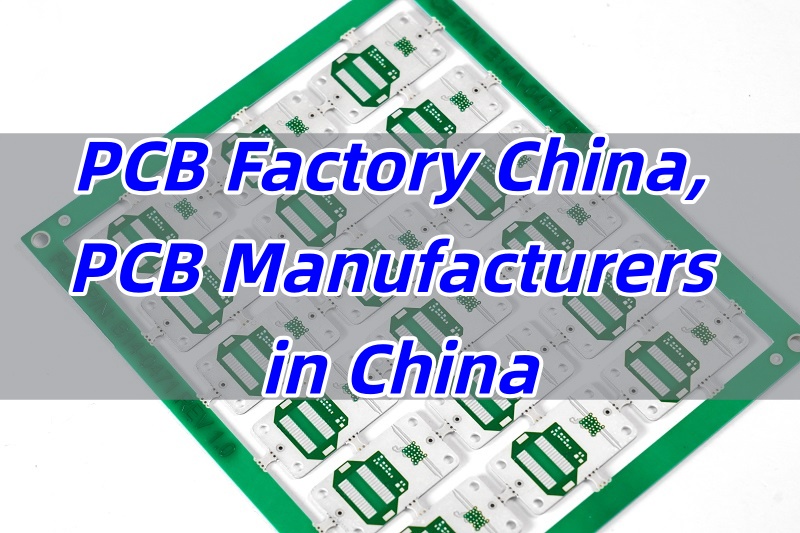
PCB Factory China provides high-quality circuit board manufacturing services with advanced technology, strict quality control, and fast delivery for global customers. As one of the top PCB manufacturers in China, EBest Circuit (Best Technology) has been delivering precision-engineered printed circuit boards since 2006, serving clients across 40+ countries.

Many electronics companies face constant challenges when looking for a reliable China PCB factory, such as:

  • Inconsistent quality between prototype and mass production runs
  • Long lead times that delay product launches and testing schedules
  • Hidden costs that increase overall project budgets
  • Lack of certifications or poor documentation during audits
  • Fragmented services that force buyers to coordinate between multiple vendors

At EBest Circuit (Best Technology), we address these challenges through:

  • ​19 years​ of specialized PCB manufacturing experience
  • ​24-hour rapid prototyping​ for urgent projects
  • ​260,000 sq.ft​ monthly production capacity
  • ​ISO 13485 & IATF 16949​ certified quality systems
  • ​Full turnkey solutions​ including DFM analysis and component sourcing
PCB Factory China

Why Choose PCB Factory China?​

​Within the global electronics manufacturing ecosystem, China has firmly established itself as the epicenter for Printed Circuit Board (PCB) production. Choosing a PCB factory in China is a strategic decision that extends far beyond mere cost considerations. It is a choice underpinned by a mature industrial chain, robust technical capabilities, stringent quality systems, and exceptional service efficiency. ​

​1. Unparalleled Cost-Effectiveness and Economies of Scale​
A primary advantage of the Chinese PCB industry lies in its powerful economies of scale and superior cost-control capabilities.

  • ​Integrated Supply Chain Cluster:​​ China boasts a complete supply chain for all critical PCB raw materials, from glass fiber, copper foil, and Copper Clad Laminate (CCL) to chemical reagents. Concentrated procurement by manufacturers drives down raw material costs, while highly dense PCB manufacturing clusters (e.g., in the Pearl River and Yangtze River Deltas) drastically reduce logistics and lead times.
  • ​High-Volume Manufacturing Efficiency:​​ Leading Chinese PCB factories operate with massive production capacities, achieving optimal economies of scale. During volume production, the fixed costs are significantly amortized. This cost advantage can be illustrated by a fundamental formula: Unit Cost = Total Fixed Cost / Output Quantity + Variable Cost per Unit. As the output quantity (Q) increases substantially, the unit cost (UC) decreases markedly, resulting in highly competitive pricing for customers.

​2. Mature and Comprehensive Industrial Chain Synergy​
China possesses the world’s most complete and responsive electronics manufacturing ecosystem.

  • ​One-Stop Shop Capability:​​ Many Chinese PCB factories offer not only fabrication but also value-added services like SMT assembly, component sourcing, and full PCBA testing. This “turnkey” model minimizes communication overhead, logistical risks, and production cycles. For instance, a design file can be transformed into a finished assembled board within the same industrial park or region, compressing a process that traditionally takes weeks internationally into a matter of days.
  • ​Rapid Response to Technology and Demand:​​ Proximity to the world’s largest consumer electronics market and innovation hubs enables Chinese PCB manufacturers to quickly identify market trends and adapt their technologies and capacities to meet evolving demands across sectors, from consumer electronics to automotive and 5G telecommunications.

​3. Strong Technical Prowess and Quality Assurance​
The label “Made in China” has evolved from “low-cost” to “high-quality,” with the PCB sector being a prime example.

  • ​Advanced Process Technology and Equipment:​​ Mainstream Chinese PCB manufacturers heavily invest in state-of-the-art manufacturing and inspection equipment, such as Laser Direct Imaging (LDI) systems, Automated Optical Inspection (AOI), and flying probe testers. Their expertise in producing high-layer count boards, HDI, Flexible PCBs (FPC), and high-frequency/speed boards is well-established. Industry data indicates that China accounts for over 50% of global PCB output value, with a continuously growing share in the high-end product segment.
  • ​Internationally Recognized Quality Systems:​​ The vast majority of export-oriented PCB factories hold international certifications like ISO 9001, IATF 16949 (automotive), UL, and RoHS. They implement rigorous quality control processes throughout production, ensuring full traceability and reliability from raw materials to finished goods.

​4. Exceptional Flexibility and Responsive Service​
Chinese PCB factories are renowned for their service flexibility and communication efficiency.

  • ​Rapid Prototyping and Low-Volume Support:​​ Whether for a startup’s prototype validation or a large corporation’s urgent request, Chinese factories excel in providing quick-turn prototyping services, often delivering samples within 24-72 hours, significantly accelerating customers’ R&D cycles.
  • ​Efficient Communication and Technical Support:​​ Benefiting from time zone advantages (for the Asian and European markets) and widely available English-speaking support teams, these factories facilitate near real-time communication. They provide prompt responses to Engineering Queries (EQ) and valuable Design for Manufacturability (DFM) feedback, ensuring projects proceed smoothly.

​In summary, selecting a PCB factory in China is a strategic decision that synthesizes economic advantage, operational efficiency, and proven reliability. The strengths are rooted in a deep industrial cluster, continuous technological investment, rigorous quality management, and a customer-centric service philosophy. This makes Chinese manufacturers not just a cost-driven option, but a strategic partner for enhancing product competitiveness and accelerating time-to-market. ​

China PCB Factory – EBest Circuit (Best Technology)

Founded in 2006, EBest Circuit (Best Technology) has grown into a leading ​PCB manufacturer China​ with:

  • ​160+​​ technical staff
  • ​97%​​ on-time delivery rate
  • ​1,700+​​ satisfied global clients

Our services cover:
✅ PCB Design & Layout
✅ Prototyping (24-hour turnaround available)
✅ Mass Production
✅ Free DFM Analysis
✅ Full PCB Assembly

​Product Range:​​

​Application Examples:​​

  1. ​5G Base Station PCBs: High-frequency, low-loss materials
  2. ​Medical Electronics: ISO 13485 compliant boards
  3. ​Automotive PCBs: IATF 16949 certified production
  4. ​Aerospace PCBs: High-reliability designs

Contact our team at sales@bestpcbs.com for project consultation.

Why Choose EBest Circuit (Best Technology) for Quick Turn PCB?

When deadlines are tight, our ​quick turn PCB​ services stand out because:

  1. ​Dedicated Rapid-Response Team​
    • 12-hour average response time
    • Engineering support during design phase
  2. ​Accelerated Production​
    • Same-day prototyping for simple designs
    • 3-5 day standard lead time for complex boards
  3. ​Quality Assurance​
    • 100% electrical testing
    • Automated optical inspection (AOI)
  4. ​Logistics Network​
    • Global shipping partners
    • Real-time order tracking

Technical Capability for China Low Volume PCB Assembly Factory

As one of China PCB contract manufacturers and China PCBA contract factories, EBest Circuit (Best Technology) excels in low-volume, high-mix production with:

​PCB Fabrication Capabilities​

ParameterStandardAdvanced
Layers1-1010-32
Min. Hole Size0.2mm0.1mm (laser)
Min. Line/Space4/4mil3/3mil
Copper Weight1-5oz5-20oz
Board Thickness0.4-3.5mm0.15-8.0mm

​Assembly Capabilities​

  • ​Component Types: 01005, 0.2mm pitch BGA
  • ​Placement Accuracy: Β±0.025mm
  • ​Soldering Methods: Reflow, selective, wave
  • ​Testing: Functional, ICT, X-ray

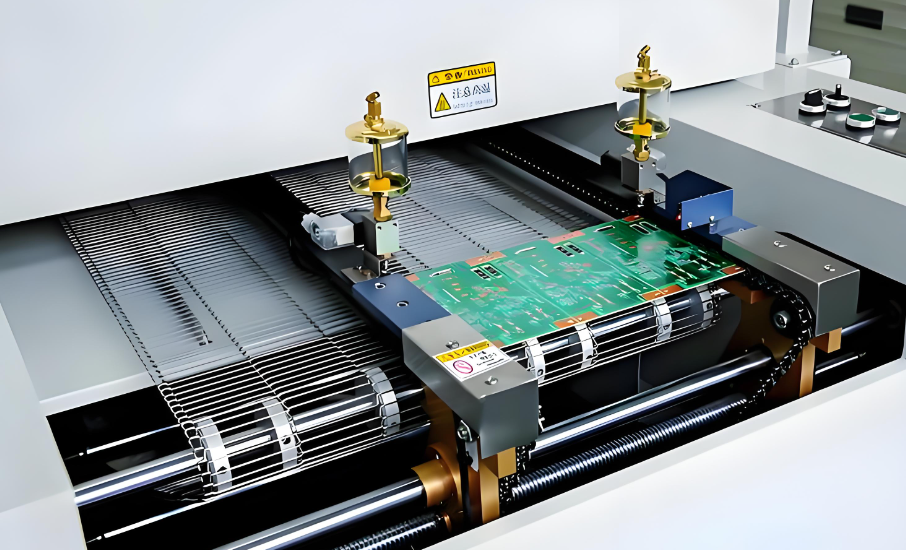
PCB Manufacturing Machine

Our ​28,900 sq.meter​ facility houses:

  1. ​Fabrication Equipment​
    • Laser direct imaging (LDI) systems
    • Automated optical inspection (AOI)
    • Plasma desmear lines
  2. ​Assembly Technology​
    • High-speed SMT lines (60,000 cph)
    • 3D SPI machines
    • X-ray inspection systems
  3. ​Testing Infrastructure​
    • Flying probe testers
    • Boundary scan
    • Thermal cycling chambers

How Do China Prototype PCB Assembly Factory Ensure Quality?

EBest Circuit (Best Technology) implements a 5-stage quality process:

  1. ​Incoming Material Check​
    • Copper foil thickness verification
    • Laminate dielectric testing
  2. ​Process Control​
    • Real-time impedance monitoring
    • Etch factor optimization
  3. ​Testing Protocols​
    • 100% electrical testing
    • Microsection analysis
  4. ​Final Inspection​
    • IPC-A-600 Class 3 standards
    • Cross-section sampling
  5. ​Continuous Improvement​
    • Monthly process capability studies
    • Customer feedback integration

What Certifications Should a Reliable China Prototype PCB Assembly Factory Have?

When searching for a trustworthy China prototype PCB assembly factory, certifications are a critical indicator of quality, compliance, and manufacturing capability. These certifications show that the factory follows internationally recognized standards, reduces risks in your supply chain, and ensures that your products meet both safety and performance requirements.

At EBest Circuit (Best Technology), we hold a comprehensive set of certifications to guarantee reliability and high standards across industries:

  • ISO 9001:2015 – Quality Management System
    Ensures consistent product quality and efficient processes, reducing defects and maintaining stable production for both prototypes and mass production.
  • ISO 13485:2016 – Medical Devices
    Demonstrates our strict adherence to quality management standards specific to medical device manufacturing, ensuring traceability and compliance with global regulations.
  • IATF 16949 – Automotive
    Highlights our capability to meet the rigorous requirements of the automotive industry, including risk management, defect prevention, and continuous improvement.
  • UL Recognition
    Confirms that our PCBs and assembly processes meet international safety standards, providing assurance for electrical performance and fire resistance.
  • RoHS/REACH Compliance
    Guarantees that all components and finished boards are free from hazardous substances, supporting environmentally friendly design and global regulatory requirements.

By maintaining these certifications and quality systems, EBest Circuit (Best Technology) ensures that every prototype PCB assembly meets both technical specifications and regulatory requirements, giving our clients peace of mind while accelerating product development.

How to Select a Reliable China PCB Factory?

Selecting the right China PCB factory can make or break your electronics project. Many companies rush into choosing a manufacturer without fully assessing capabilities, quality standards, or service, often leading to delays, unexpected costs, or quality issues. To avoid these pitfalls, it’s crucial to evaluate potential factories carefully before committing.

Here are five key factors to consider:

  1. ​Technical Match​
    • Verify capabilities match your requirements
  2. ​Quality Systems​
    • Request certification documents
  3. ​Communication​
    • Test response times and clarity
  4. ​Supply Chain​
    • Assess component sourcing networks
  5. ​References​
    • Review client testimonials

In closing, choosing a reliable China PCB factory requires careful consideration of technical ability, quality systems, communication, supply chain strength, and references. At EBest Circuit (Best Technology), we excel in all these areas. With ISO-certified quality systems, rapid prototyping capabilities, a robust supply chain, and a proven track record with clients worldwide, we help electronics companies bring their PCB projects from concept to reality smoothly and efficiently.

Case of Quick Turn PCB by EBest Circuit (Best Technology)

​Project:​​ Emergency medical device PCB
​Challenges:​​

  • 8-layer HDI design
  • 0.15mm laser microvias
  • 7-day total turnaround

​Our Solution:​​

  1. Dedicated engineering team
  2. Parallel processing of fabrication and component sourcing
  3. Overnight reliability testing

​Result:​​ Delivered 200 fully assembled boards in 6.5 days.

In conclusion, choosing the right ​PCB factory China​ requires balancing technical capability, quality assurance, and service flexibility. As one of the top PCB manufacturers in China, EBest Circuit (Best Technology) combines 19 years of expertise with state-of-the-art facilities to deliver:

  • ​High-quality boards​ meeting international standards
  • ​Rapid prototyping​ for fast-moving projects
  • ​Full technical solutions​ without quality compromise

Our ​260,000 sq.ft facility​ and ​160+ technical staff​ stand ready to support your PCB needs from design to delivery.

Contact us today at sales@bestpcbs.com for a free DFM analysis and quote.

FAQs

Q: What is your maximum finished copper thickness for PCBs?​​
A: Our maximum finished copper thickness is 30oz (1050Β΅m).

​Q: What is your minimum finished copper thickness for PCBs?​​
A: Our minimum finished copper thickness is 1/2oz (18Β΅m).

​Q: For heavy copper boards, can both the inner and outer layer copper reach 30oz?​​
A: Yes, for our heavy copper boards, both the internal and external copper weights can be manufactured to 30oz (1050Β΅m).

​Q: What does Tg mean in PCB materials?​​
A: Tg, or Glass Transition Temperature, is the critical temperature at which the base substrate changes from a solid state to a rubbery state. A higher Tg value indicates better resistance to heat, moisture, and chemicals, which improves the board’s overall stability and reliability. This is especially important for lead-free assembly processes.

​Q: What Tg values can you provide?​​
A: We commonly work with Tg130, Tg150, and High-Tg (β‰₯170) materials. We are capable of manufacturing boards with Tg values as high as 260.

​Q: What is your maximum PCB panel size?​​
A: Our maximum standard panel size is 610mm x 610mm.

You may also like