PCB manufacturing PCB manufacturing
Home > Blog

pcb design

PCB Line Width and Flow Current Comparison Table
Monday, August 19th, 2024

PCB Line Width and Flow Current Comparison Table

In PCB manufacturing, the term of “OZ†always refers to copper thickness, 1OZ thickness means evenly spread 1OZ copper foil on the 1 square foot areas, and this thickness is around 0.035mm. So, 35um, 50um, 70um correspond to 1OZ, 1.5OZ, 2OZ.

The full name of OZ is ounce, it is the weight per unit area to express the thickness of the copper foil, the format is: 1OZ=28.35g/FT2

PCB Line Width and Flow Current Comparison Table Chart

PCB Line Width and Flow Current Comparison Table Chart
Line width (mm)Current (A)Line width (mm)Current (A)Line width (mm)Current (A)
0.150.20.150.50.150.7
0.20.550.20.70.20.9
0.30.80.31.10.31.3
0.41.10.11.350.41.7
0.51.350.51.70.52.0
0.61.60.61.90.62.3
0.82.00.82.40.82.8
1.02.31.02.61.03.2
1.22.71.23.01.23.6
1.53.21.53.51.54.2
2.04.02.04.32.05.1
2.54.52.55.12.56.0
Copper thickness 1OZ (0.035mm)Copper thickness 1.5OZ (0.05mm)Copper thickness 2OZ (0.7mm)

From the chart as above:

35um copper thickness and 0.4mm line width, the current is 1.1A;

50um copper thickness and 0.4mm line width, the current is 1.35A;

70um copper thickness and 0.4mm line width, the current is 1.7A.

EBest Circuit (Best Technology) PCB Line Width and Flow Current Calculator

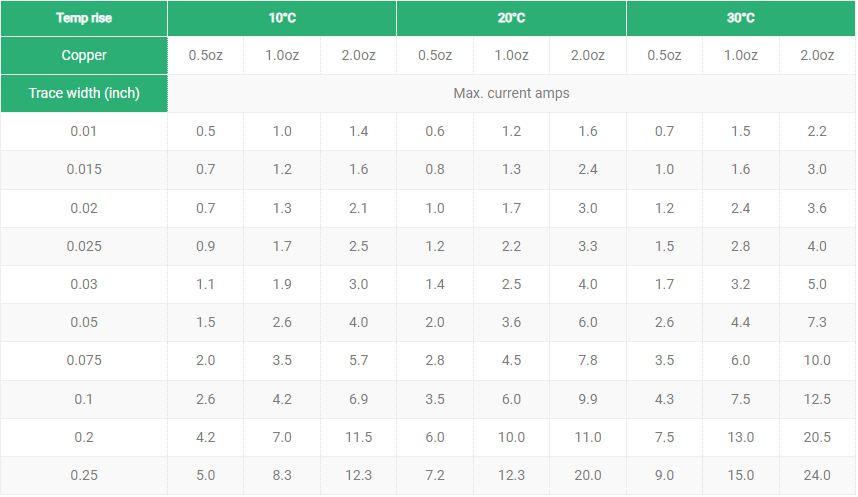
When using copper foil as a conductor for large currents, the width of the copper foil should be selected by reducing the current-carrying capacity values from the reference table by 50%. However, there are other methods to address this. In some power circuits, due to PCB constraints, the current-carrying paths are designed as long pads, and solder is added on top of them to form a thick current path. Besides adding tin to the copper foil to increase the current capacity, you can also consider using multiple PCB layers to increase the current. For instance, placing the same circuit on both the top and bottom layers or using short jumper wires can also help increase the current capacity.

How Wide Should the Trace be If Current is 1A?

1. Due to the limited thickness of the copper foil on the copper-clad board, the current-carrying capacity of the copper foil needs to be considered for strip-shaped copper foil that needs to carry a large current. Taking the typical thickness of 0.03mm as an example, if the copper foil is used as a strip-shaped conductor with a width of W (mm) and a length of L (mm), its resistance is 0.0005 L / W ohms. Additionally, the current-carrying capacity of the copper foil is related to the types of components installed on the PCB, their quantity, and the heat dissipation conditions. Under safe conditions, the current-carrying capacity can generally be calculated using the empirical formula: 0.15 W (A).

2. The calculation method is as follows: First, calculate the cross-sectional area of the track. Most PCBs have a copper foil thickness of 35μm (if unsure, you can ask the PCB manufacturer). Multiply this by the trace width to get the cross-sectional area, making sure to convert to square millimeters. There’s an empirical value for current density, which is 15-25 amperes per square millimeter. Multiply this by the cross-sectional area to get the current capacity.

3. I = K T^0.44 A^0.75, where K is a correction factor (0.024 for internal copper traces, 0.048 for external copper traces), T is the maximum temperature rise in degrees Celsius (copper’s melting point is 1060°C), A is the copper cross-sectional area in square mils (not square millimeters, so be mindful of the conversion), and I is the allowable maximum current in amperes (amps). Typically, 10 mil = 0.010 inches = 0.254 mm, which can carry 1A. Therefore, 250 mil = 6.35 mm can carry 8.3A.

4. The calculation of PCB current-carrying capacity has long lacked authoritative technical methods and formulas. Experienced CAD engineers can make accurate judgments based on personal experience. However, for CAD novices, this can be quite a challenge.

5. PCB current-carrying capacity depends on the following factors: trace width, trace thickness (copper foil thickness), and allowable temperature rise. As we all know, the wider the PCB trace, the greater the current-carrying capacity. Under the same conditions, a 10mil trace can carry 1A, but can a 50mil trace carry 5A? The answer is, of course, no.

Current-Carrying Capacity of External PCB Traces (1mil = 0.0254mm)

Line length – current carrying data chart (unit: A)
 
Line width (mil)Line length 5cmLine length 10cmLine length 15cmLine length 20cmLine length 25cmLine length 30cmLine length 35cmLine length 40cm
40.4030.201.0.1340.1010.0810.0670.0580.050
60.6040.3020.2010.1510.1210.1010.0860.075
80.7530.4030.2680.2010.1610.1340.1150.101
100.8860.5030.3360.2520.2010.1680.1440.126
121.0110.6040.4030.3020.2420.2010.1730.151
161.2450.8050.5370.4030.3220.2680.2300.201
201.4641.0070.6710.5030.4030.3360.2880.252
301.9641.5101.0070.7550.6040.5030.4310.378
402.4192.0131.3421.0070.8050.6710.5750.501
502.8442.5171.6781.2581.0070.8390.7190.629
603.2463.0202.0131.5101.2081.0070.8620.755
803.9993.9992.6842.0131.6111.3421.1501.007
1004.7014.7013.3562.5172.0131.6781.4381.258
1205.3655.3654.0273.0202.4132.0131.7261.510
1606.6106.6105.3694.0273.2212.6842.3012.013
2007.7707.7706.7115.0334.0273.3552.8762.517
2408.8688.8688.0536.0404.8324.0273.4513.020
2809.9179.9179.3957.0475.6374.6984.0273.523
32010.92510.92510.7388.0536.4435.3694.6024.027
36011.89911.89911.8999.0607.2486.0405.1774.530
40012.84412.84412.84410.0678.0536.7115.7525.033

For low-frequency, low-current PCB designs, the general trace width is around 10 mil, and for more compact designs, 6 mil may be used. The key factor in determining PCB trace width is the current: higher currents require wider traces, while lower currents can use narrower traces. The operating frequency also plays a role in determining the width.

  1. Ideally, the width of the PCB power trace should be at least 40 mil, with a minimum of 25 mil when conditions allow. Always opt for the widest trace possible to accommodate the current.
  2. Consider the actual current flow. Typically, a 10 mil trace can carry a maximum of 1A, so adjust the width according to the current requirements.
  3. The ground trace should be wider than the V+ trace and should surround the V+ trace to reduce interference and power ripple.
  4. When converted to millimeters, the positive power trace should be no less than 0.6mm wide, while the negative power trace should be wider than the positive trace and surround it.

How Are Multilayer Boards Constructed?

The multi-layer board is composed of several single sided PCB for the outer layer and some double-sided PCBs for the inner layer.

l Single-Sided Boards

In the most basic PCB design, components are placed on one side of the board, and the wiring is on the other. This is called a single-sided board. Due to strict routing limitations (since traces cannot cross each other), single-sided boards are mostly used in simpler circuits.

l Double-Sided Boards

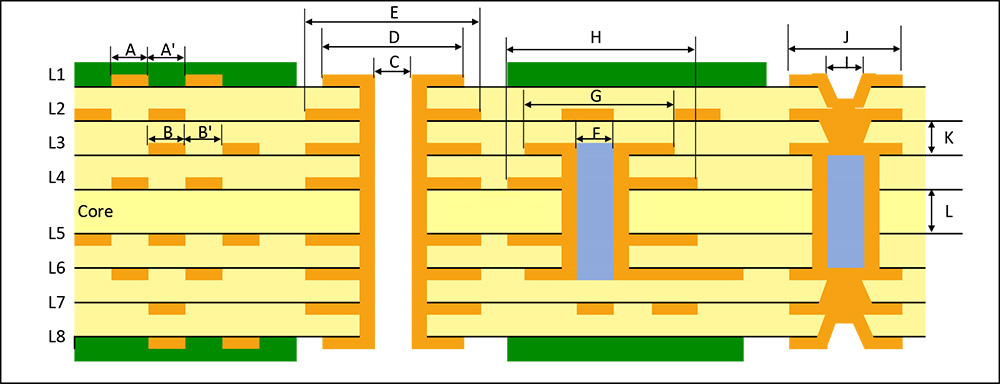
Double-sided boards have wiring on both sides. To connect the circuits on both sides, vias (small holes filled or coated with metal) are used. The larger area and ability to route traces through both sides make double-sided boards more suitable for complex circuits compared to single-sided boards.

l Multilayer Boards

To increase routing space, multilayer boards are created by combining multiple layers of single-sided or double-sided boards. For example, a four-layer or six-layer PCB might consist of a double-sided board as the core with single-sided boards on either side, all bonded together. Multilayer boards allow more complex designs, and while most modern PCBs use between 4 to 8 layers, designs with up to 100 layers are possible for advanced computing needs, though they are increasingly rare due to advances in other technologies.

The number of layers doesn’t always indicate the number of wiring layers—some layers may be added purely to adjust board thickness. Most motherboard designs consist of 4 to 8 layers, and while extremely complex multilayer boards were once used in supercomputers, they are now often replaced by clusters of standard machines.

Trace Width and Copper Pour Guidelines

When designing PCBs, a general rule is to use thicker traces for high-current areas (e.g., 50 mil or more) and thinner traces for low-current signals (e.g., 10 mil). In some electromechanical control systems, the instantaneous current through a trace can exceed 100A, in which case thin traces would fail.

An empirical rule of thumb is that 10A can safely pass through 1 square millimeter of trace cross-section. If the trace is too thin, it may burn out under high current. This phenomenon follows the energy equation: Q = I^2*t. For example, a trace designed for 10A can likely handle a sudden current spike of 100A for microseconds, but beyond that, other factors like stray inductance in the trace could generate strong counter-electromotive forces, potentially damaging other components. Longer and thinner traces have higher stray inductance, so their length must also be considered.

Copper Pouring on Vias and Pads

Most PCB design software offers options for how to connect vias or pads to copper planes, such as direct pour, orthogonal spokes, or 45-degree angled spokes. While many designers select based on aesthetics, these choices affect both current capacity and heat dissipation.

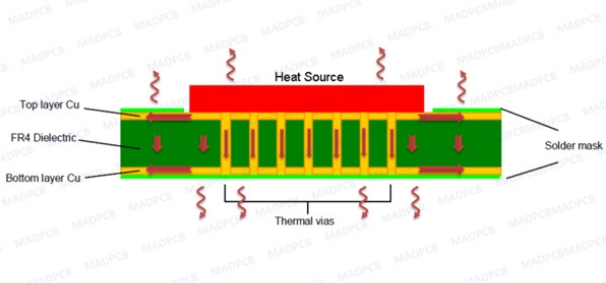
l Direct Pour: This method provides the strongest current-carrying capacity for pads or vias, making it ideal for high-power circuits. However, direct pours also enhance heat conduction, which, while beneficial for cooling components, can complicate soldering by rapidly dissipating heat, requiring higher soldering temperatures and larger soldering irons, which may reduce production efficiency.

l Orthogonal and 45-Degree Spokes: These methods reduce the contact area between the pad or via and the copper, slowing heat dissipation and making soldering easier. For low-power signal traces, orthogonal or 45-degree spokes are recommended, while direct pour is necessary for pads carrying high currents. The choice between orthogonal and 45-degree spokes is mainly aesthetic.

You may also like

India Customer Visit in EBest Circuit (Best Technology)
Thursday, July 4th, 2024

On July 3rd, 2024, we had India customers visit our office and factory. All our staff of our customer warmly welcome the guest from afar.

Our sales manager Peter, along with Connie and Marina, gave a detailed introduction to our main business and product expertise. They talked about our strict quality control, careful selection of PCB board materials, advanced production equipment, and mature manufacturing processes. Our guests seemed quite impressed with how thorough we are in ensuring top-notch quality.

PCB product introduction

Actually, we’ve been working with this customer for several years now, and it’s been a fantastic journey of building trust and collaboration. This visit was a great chance to dive into a new PCB project and show off our latest innovations, including electric heating films, ceramic PCBs, and bendable aluminum PCBs.

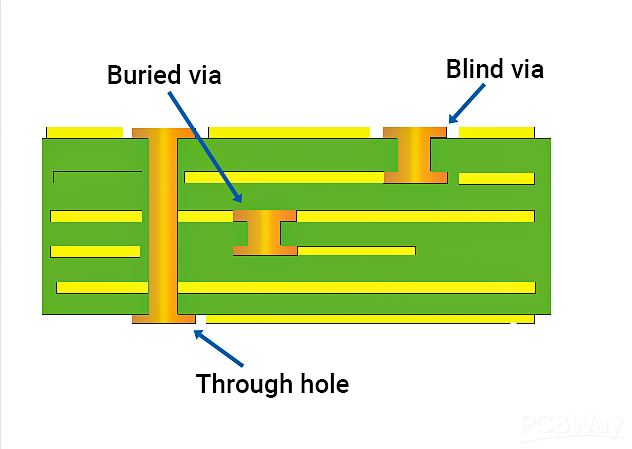
When checking the sample books, the customers specially mentioned the blind vias and checked the related products for many times. It looks like they are extremely interested in this technology.  You know, blind vias, buried vias, through hole vias, micro vias and thermal vias are always our strengthens.

PCB samples sharing

Next day, Connie will be taking our guests on a tour of our metal dome and dome array factory. It’s always exciting to show our partners the heart of our operations and let them see firsthand the dedication and precision that goes into our work.

Metal dome project talking

EBest Circuit (Best Technology) is a one-stop PCB and PCBA service provider in China and Vietnam. “High mix, Low-Middle Volume, High Quality and Fast Delivery” is our advantages. Custom PCBs available in our company as well. You can get high-quality PCB board and PCBA at a very transparent price. For more information, feel free to contact us at any time.

You may also like

High Speed PCB: How to Design It?
Wednesday, July 3rd, 2024

In today’s tech-driven world, creating efficient high speed PCB (Printed Circuit Board) is critical for ensuring devices can handle rapid data transfer without issues. These high speed PCBs are popular in the wireless devices which needs high signal transfer. Crafting high-speed circuits requires careful planning and precise execution to maintain signal quality and overall performance. In this blog, we introduced the basics of high-speed PCB design, offering practical tips and insights into the best materials and techniques for high-frequency applications.
What is a High Speed Circuit PCB?

High-speed PCB is a circuit board that can support signal transmission. High-speed signals usually refer to signals with frequencies higher than 50MHz, such as high-speed digital signals, high-speed analog signals, etc. These fast transitions can introduce challenges like signal reflections, electromagnetic interference (EMI), and crosstalk, which can disrupt performance if not properly managed.

Additionally, these signals will be affected by board materials, layout, wiring and other factors during transmission. Therefore, a specially designed circuit board is required to ensure the integrity and reliability of the signal. Here is a 4 layers high speed PCB for Iradar device with 50ohm single-ended impedance control.

high speed pcb for Iradar

Features of High-Speed PCB

  • High frequency
  • Low permittivity and low loss factor
  • Multilayer design
  • Strict impedance control
  • High-precision manufacturing
  • Low noise characteristic
  • High density circuit layout (micro-vias)
  • High performance

What is Considered High-Speed PCB Design?

High-speed PCB design focuses on managing the complexities that come with high-frequency signals and fast switching. Key considerations include:

– Signal Integrity: Ensuring signals travel without distortion or loss.

– Power Management: Distributing power effectively to minimize noise and voltage drops.

– Heat Handling: Managing heat from high-speed components to prevent overheating.

– Impedance Matching: Keeping impedance consistent to reduce signal reflections and loss.

– Differential Pair Routing: Reducing EMI and crosstalk by routing complementary signal pairs together.

This type of high speed pcb design requires a solid understanding of electromagnetic principles, advanced simulation tools, and precise manufacturing techniques. For those new to high-speed PCB design, EBest Circuit (Best Technology) offers expert guidance and solutions.
What’s the Best Material for High-Speed PCB Design?

Choosing the right material for high speed pcb is vital for maintaining signal integrity and achieving optimal performance. The material impacts the board’s dielectric constant (Dk), loss tangent, and overall signal quality. Common materials include:

– FR4: Widely used but not ideal for very high frequencies due to higher loss tangent.

– Rogers (RO4000 series): Preferred for high-speed designs thanks to its low dielectric constant and loss tangent.

– Teflon: Excellent for high-frequency applications but more expensive and harder to process.

Selecting the appropriate material ensures the PCB can handle high-speed signals without compromising performance.

Where is the High-Speed PCB Commonly Used in?

High-speed circuit boards are widely used in signal transmission applications, the typical fields are including:

1. Communication equipment – such as 5G base stations, optical fiber communication equipment, etc.

2. Data center – like high-performance computing, storage servers, etc.

3. Consumer electronics in our daily life – high-end smartphones, tablets, gaming devices, etc.

4. Aerospace and military – high speed are always used in high-end devices. For example, radar, navigation systems and other equipment with high reliability requirements.

What is the 3H Rule in High Speed PCB Design?

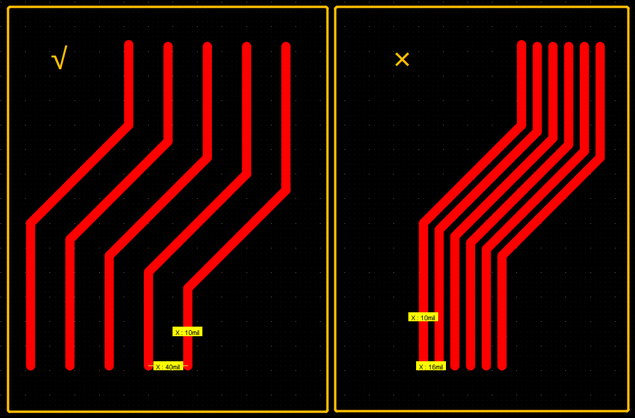
The 3H rule is a guideline suggesting that signal traces should be spaced at least three times the height of the dielectric (3H) between the signal layer and the adjacent ground or reference layer. This helps minimize crosstalk and maintain signal integrity, particularly for high-speed digital signals with rise times of 1 ns or less. Key aspects include:

– Trace Spacing: Keeping traces apart by at least 3H reduces electromagnetic coupling and interference.

– Signal Integrity: Adequate spacing helps maintain clear signals in high-speed circuits.

– Effectiveness: This rule is especially beneficial for fast digital signals, reducing the risk of crosstalk and interference.

For instance, if the dielectric height between the signal layer and the reference layer is 0.2 mm, traces should be at least 0.6 mm apart to follow the 3H rule.

How to Design a High-Speed Board?

Designing a high-speed PCB involves several strategies to ensure effective signal transmission, power distribution, and minimal EMI. Here’s a step-by-step approach:

Component Placement and Layer Stack-Up

Place high-speed components to minimize signal paths and interference. Group related components to simplify routing. In addition, create a layer stack-up that supports controlled impedance and reduces signal loss. Use ground planes between layers for a return path for high-frequency currents.

Trace Routing and Impedance Control

Keep high-speed traces short and direct, avoiding right-angle bends. Use microstrip or stripline configurations for controlled impedance and minimal noise. For impedance control, calculate and ensure consistent impedance for traces. Use differential pair routing for high-speed signals to reduce EMI and crosstalk.

High Speed PCB: How to Design It?

Power Distribution and EMI Mitigation

Use decoupling capacitors near high-speed components to filter noise and stabilize the power supply. Design a robust power distribution network to minimize impedance and ensure stable voltage. And employ proper grounding and shielding techniques. Route high-speed signals on inner layers between ground planes to reduce EMI and provide a consistent return path.

Simulation and Testing

Use signal integrity analysis tools like SI or PI to simulate the PCB layout, predicting signal behavior and identifying potential issues. Analyze aspects like eye diagrams to assess signal quality.

High-speed PCB design is a complex but rewarding endeavor that ensures your electronics perform efficiently in high-frequency environments. By understanding the fundamentals and applying the right techniques and materials, you can create robust, high-speed boards. EBest Circuit (Best Technology) is here to assist you with expert advice and solutions for your high-speed PCB needs.

You may also like

PCB Design for PICE Card, Industrial PCB Design Cases
Tuesday, June 25th, 2024

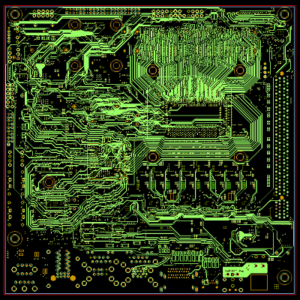
EBest Circuit (Best Technology) has been a leader in PCB manufacturing and design for over 17 years. Our R&D team allows us to offer customers quick and valuable PCB design solutions. Here, we share one of our industrial motherboard design for PICE card for your reference.
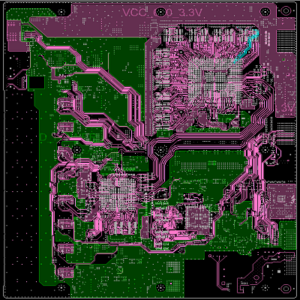
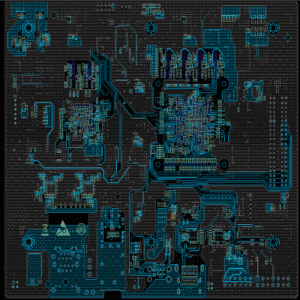
PICE card

[1]: Main chip: XCKU11P

[2]: 30A maximum current

[3]: Single pair differential line, 10G optical network

[4]: 14 layers PCB

If you need a custom industrial PCB design, please feel free to contact us.

You may also like

Video Decoder Hardware PCB Design Case Example
Tuesday, June 25th, 2024

A video decoder PCB design comprises several critical components that ensure efficient video signal processing. It includes the video decoder IC, memory modules (such as DDR RAM), power management units, and connectors for video input and output. You can see a video decoder pcb design example as following:

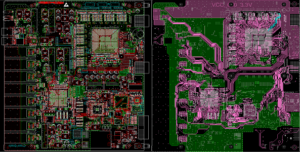
Video decoder

[1]: Xlinx: XC7K325T, Hisilicon: HI3521DV100_VI

[2]: Single pair differential line, 10G optical network, memory of DDR4

[3]: 12 layers PCB

Why choose us?

We are a China based fabricator with over 17 years experience, what we provide not only including PCB design service, but also PCB fabricating, PCB duplicating and component sourcing and so on. Choose EBest Circuit (Best Technology) you can enjoy:

  • Professional engineer evaluation
  • DFM analysis
  • One-time successully on prototyping
  • SI analysis of signal integrity
  • Electromagnetic compatibility (EMC) analysis

Contact us if you have any questions.
You may also like

High Speed PCB Design Guidelines, PCB Camera Design Case
Tuesday, June 25th, 2024

When designing high-speed PCBs, several critical factors must be considered to ensure optimal performance. These include signal integrity, impedance control, and minimizing electromagnetic interference (EMI). Below is an ultra high speed camera PCB solution made by EBest Circuit (Best Technology):

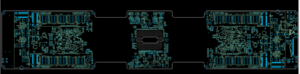
An ultra-high-speed camera rigid-flex circuit board

[1]: XCKU060 chip

[2]: 20A maximum current

[3]: Four DDR4 channels

[4]: 20 layers PCB

High Speed PCB Design Guidelines, PCB Camera Design Case

Camera PCB design considerations:

1. When the Camera adopts a connector: when the MIPI differential signal passes through the connector, the adjacent differential signal pairs must be isolated using GND pins; If it is not convenient to punch holes, the spacing between the difference pairs is at least 15mil.

2. If there is a reserved test point for the Camera connection seat, it should be close to the connection seat, and the Stub on the cable should be as short as possible.

3. Decoupling capacitors of AVDD/DOVDD/DVDD power supply need to be placed as close as possible to the Camera connection base.

4. The Camera layout needs to be far away from high-power radiation devices, such as GSM antennas.

5. CIF/MIPI and other signals, if there is a board to board connection through the connector, it is recommended that all signals be connected with a certain resistance value (between 2.2ohm and 10ohm, depending on the SI test), and reserve TVS devices.

EBest Circuit (Best Technology) offers one-stop solutions for our values customers. And we provide free technical support for our customers. If you have similiar requirements, welcome to contact us at any time!

You may also like

Differential Signal PCB Design, Fiber Optical SFP Module
Tuesday, June 25th, 2024

PCB design is one of an important process before the PCB manufacturing, it determines the overall performance of the whole product. We are an experienced PCB design and manufacturing vendor, with our professional technical team and advanced evaluated tools, we can make sure the PCB design one-time success. Today, we shared a example of fiber optical SFP modules design:

32X100G(QSFP28) large capacity convergence shunt

[1]: Marvell: 98CX8522

[2]: Single pair differential line, 25G optical network

[3]: 16 layers PCB

How to design a SFP optical module PCB?

SFP optical module interface PCB design depends on many aspects, including interface signal processing, timing control, power management and so on.

1. Determine the interface standard: SFP optical module interface standards, such as SFP, SFP+, QSFP and so on, you need to choose the appropriate interface standard according to the specific needs.

2. Choose the chip solution: According to the interface standard, choose the appropriate chip solution, usually including constant voltage source, amplifier, comparator, clock generator, EEPROM, etc.

3. Signal processing: For receiving and sending signals, filtering, amplification and comparison are required to ensure signal quality and stability.

4. Timing control: The timing and frequency of the clock signal need to be accurately controlled to ensure the correctness and stability of data transmission.

5. Power management: SFP optical module interface requires multiple power supplies, including Vcc, VCC-TX, VCC-RX, etc. Reasonable power management is required to ensure the stability and reliability of the power supply.

6. PCB design: According to the above requirements, PCB design is carried out, considering signal isolation, layering layout, status separation, signal integrity and other factors.

Feel freely to send message us if you are interested in PCB design.

You may also like

Motherboard Network Adapter PCB Design Solution Example
Tuesday, June 25th, 2024

A motherboard network adapter PCB comprises several key components, each playing a vital role in ensuring effective network connectivity. And between them, the PCB is the most important. Now, best technology is sharing an example about motherboard network PCB design.

10G/100G large capacity convergence shunt

[1]: Marvell: 98DX8548

[2]: 21A maximum current

[3]: Single pair differential line, 10G and 25G optical networks

[4]: 10 layers PCB

What are the considerations before PCB design?

PCB design involves several steps and some considerations need to be noticed. If you are a designer, think about these points before starting the design.

  • Manufacturing: prototyping study or mass production.
  • What it will be used in?
  • What kind of production technology it will used?
  • Material?
  • How many layers you want?
  • Whether need to do impedance control?

EBest Circuit (Best Technology) has more than 17 years in this industry, we have served for over 1200 customer all around the world. Our goal is to provide customer with best solutions and top notch quality products, and it is luckily that we did a good job. If you want to work with us or need a PCB manufacturer in Asia, contact us right now!

You may also like

High Speed PCB Design, Industrial PCB Case Sharing
Tuesday, June 25th, 2024

A high-speed circuit handles signals that switch quickly or operate at high frequencies, typically above 50 MHz, though some advanced systems may go into the GHz range. EBest Circuit (Best Technology) is a one-stop PCB manufacturer that covers pcb design, pcb layout, pcb diagram, DFM, SI, PI analysis, PCB manufacturing and so on. In the following, you can see a high speed pcb design solution for industrial switch that we cooperated with our customer.

32 x 400GE industrial switch

[1]: Marvell-400G chip

[2]: 200A maximum current

[3]: Single pair differential line 56G optical network

[4]: 24 layers high power PCB

What’s the Best Material for High-Speed PCB Design?

Choosing the right material is vital for maintaining signal integrity and achieving optimal performance. The material impacts the board’s dielectric constant (Dk), loss tangent, and overall signal quality. Common materials include:

  • FR4: Widely used but not ideal for very high frequencies due to higher loss tangent.
  • Rogers (RO4000 series): Preferred for high-speed designs thanks to its low dielectric constant and loss tangent.
  • Teflon: Excellent for high-frequency applications but more expensive and harder to process.

Selecting the appropriate material ensures the PCB can handle high-speed signals without compromising performance.

For the PCB design service, we can make sure the one-time success to save much time and money for customers. Our goal is to work with customers together and win more market with our clients. Just feel free to contact our technical team if you have similiar designs.
You may also like

Network Motherboard Design for Network Switching Cases
Tuesday, June 25th, 2024

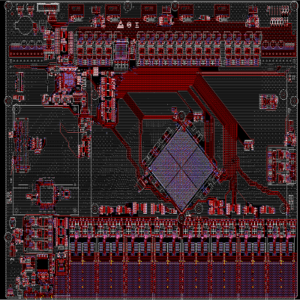
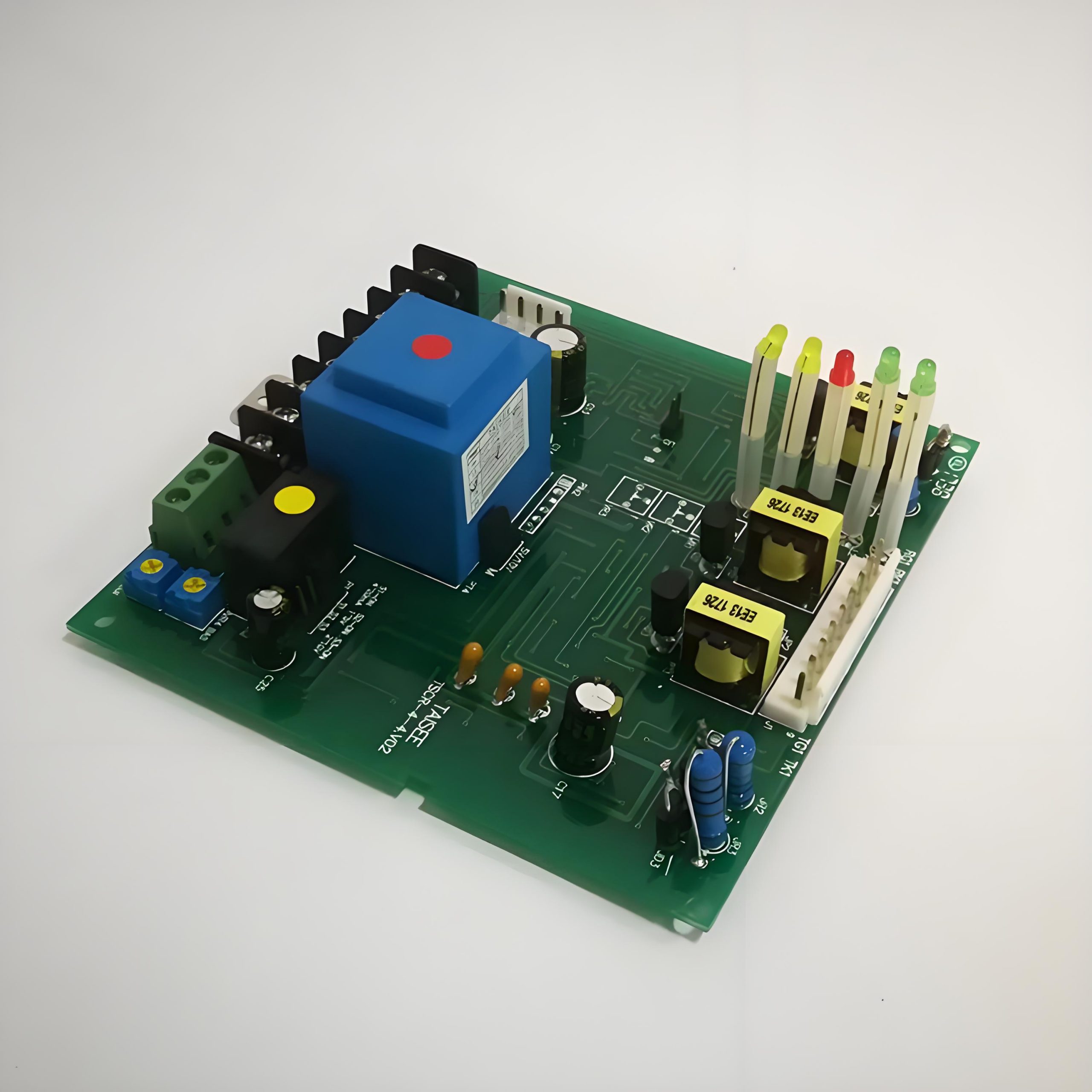
Best technology offers numerous PCB design solutions for our customer, from HDI design, high speed device PCB design, AI optical module design and network motherboard design for network switching. Below is one of our network motherboard design solutions:

An ATCA network switching motherboard

[1]:BCM88XXX, BCM55XXX chips

[2]:60A maximum current

[3]:8å£10ï¼§ optical network

 [4]:  8 x DDR3 chips

Network Switching Differential Pair Design Guide

  • Each TrxP/TrxN signal group (where xcx0-3) shall be routed as a differential pair. This includes the entire length of wiring processing.
  • The individual differential correspondences are packed together as tightly as possible. Impedance calculations are usually started by selecting the smallest line blank (4-5mil). The tracking width is then adjusted to achieve the necessary impedance.
  • Differential line group resistance of Ethernet is calculated at 100 ohms.
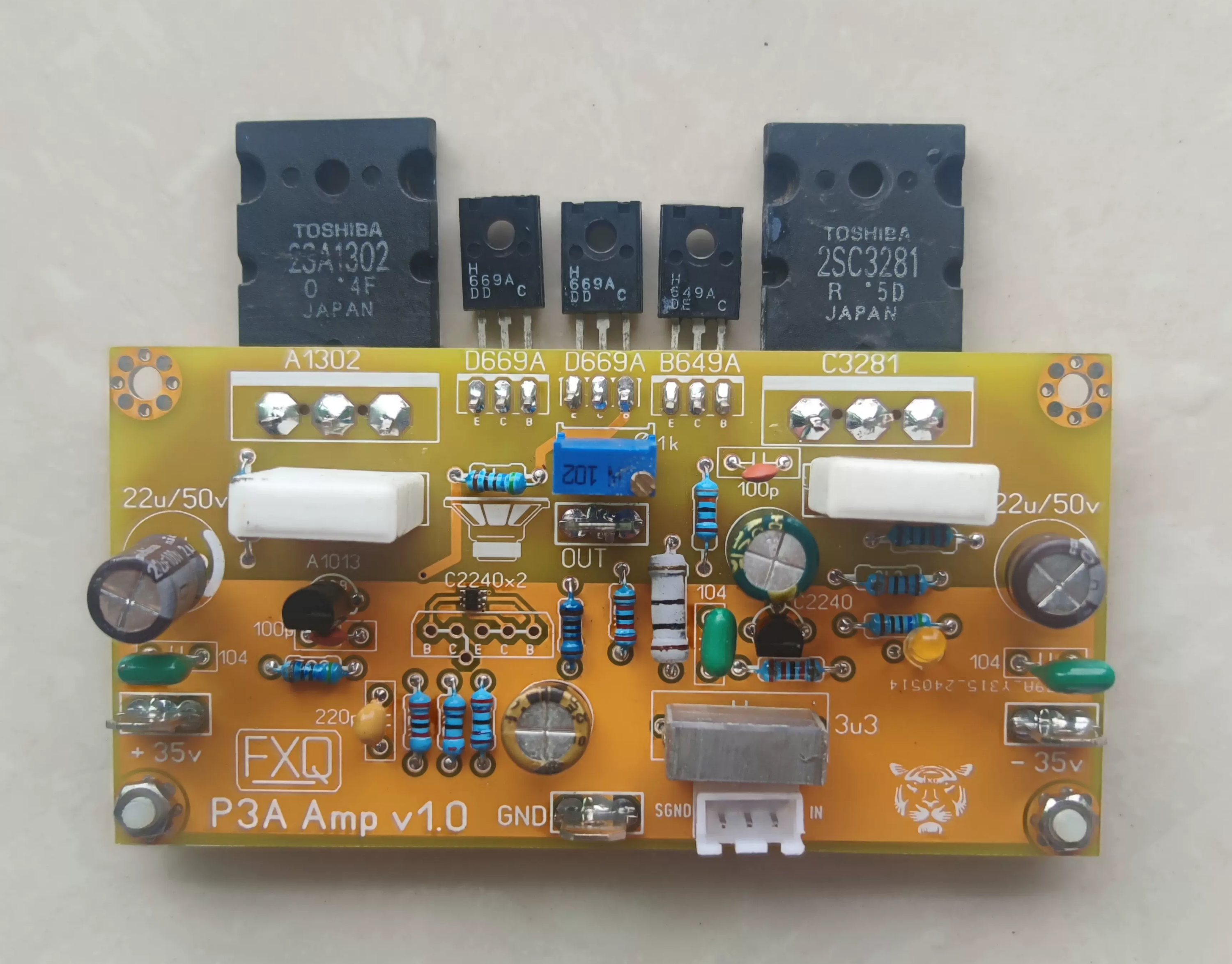
  • In general, when routing the four differential pairs of the Gigabit Ethernet to the r45 connector, at least one pair will pass through to the opposite outer layer.

  • Priority should be given to differential pair wiring. Terminals should be added after the routing is determined
  • The values of all resistance terminals in the Ethernet front end should be 1.0% tolerance
  • All capacitor termination Ethernet front ends in the module should have strict tolerances and high quality product media (npo)

You are welcome to contact us if you want to get your DIY network switching PCB designs.

You may also like