PCB manufacturing PCB manufacturing
Home > Blog

IoT PCB

IoT PCB Assembly Turnkey Service From Prototyping to Mass Production
Friday, June 5th, 2026

Looking for IoT PCB assembly turnkey service that can move smart hardware from prototype to production with fewer risks? IoT products often combine compact PCB layouts, wireless modules, sensors, power circuits, connectors, and functional testing requirements. A reliable turnkey PCBA partner helps reduce sourcing gaps, assembly errors, rework, and delivery uncertainty.

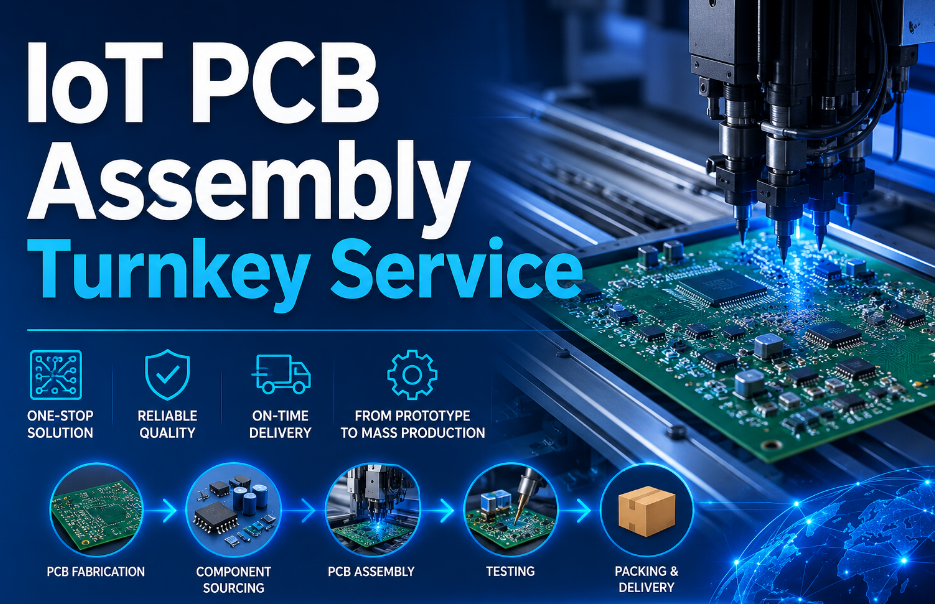
A complete IoT PCB assembly turnkey service brings PCB fabrication, component sourcing, SMT assembly, through-hole assembly, inspection, testing support, and delivery into one controlled workflow. This article explains service scope, product types, required files, process steps, quality control, delivery support, and how EBest supports IoT access control PCB, wireless modules, sensor boards, and industrial IoT PCBA projects.

IoT PCB Assembly Turnkey Service, https://www.bestpcbs.com/blog/2026/06/iot-pcb-assembly-turnkey-service/

What Is IoT PCB Assembly Turnkey Service?

IoT PCB assembly turnkey service is a one-stop PCBA solution for connected electronic products. It covers PCB fabrication, component sourcing, SMT assembly, through-hole assembly, mixed assembly, inspection, testing support, and delivery through one coordinated production flow.

This service is widely used for smart home devices, IoT access control PCB products, wireless sensor boards, industrial IoT modules, gateways, monitoring equipment, and asset tracking devices. These products usually require stable wireless communication, reliable power control, compact placement, and consistent batch quality.

The main advantage of IoT PCB assembly turnkey service is easier project management. Instead of coordinating bare boards, components, soldering, and inspection through separate suppliers, the full PCBA process can be managed through one production partner. This reduces communication gaps and lowers the risk of mismatch between PCB layout, BOM data, component packages, and assembly requirements.

For connected devices, PCBA quality directly affects signal stability, power reliability, operating life, and field performance. A weak assembly process can turn a promising product into a delayed or unreliable launch. That is why choosing a reliable IoT PCBA turnkey solution matters from sample validation to repeat production.

What Does an IoT PCB Assembly Turnkey Service Include?

An IoT PCB assembly turnkey service usually includes everything required to turn approved PCB files and component data into finished IoT PCB assemblies. The goal is to keep PCB production, component preparation, assembly, inspection, and delivery under one organized workflow instead of splitting the project across several separate vendors.

A typical IoT PCB assembly turnkey service project may include:

  • PCB manufacturing preparation
    The process starts with production files, board specifications, stack-up requirements, surface finish, copper weight, solder mask details, and panel requirements. For IoT products, this step helps confirm whether the board is suitable for compact components, RF sections, connectors, and power circuits.
  • BOM review and component preparation
    The BOM is checked for part numbers, package types, values, quantities, polarity, and approved alternatives. This helps reduce the risk of wrong parts, unavailable components, and last-minute sourcing issues before assembly starts.
  • Component sourcing and kitting
    Components can be prepared according to the approved BOM, including ICs, passive components, connectors, modules, sensors, relays, and power devices. Proper kitting helps keep the SMT and through-hole assembly process more stable.
  • SMT assembly
    Surface-mounted components are assembled through solder paste printing, placement, reflow soldering, and inspection. This step is important for IoT boards with dense layouts, fine-pitch packages, wireless modules, and small passive components.
  • Through-hole and mixed assembly
    Connectors, terminals, relays, switches, transformers, and other plug-in components may require through-hole soldering. Many IoT boards use mixed assembly, combining SMT parts with stronger mechanical or power-related components.
  • BGA, QFN, and fine-pitch assembly support
    IoT control boards, gateways, and wireless modules may include BGA, QFN, QFP, or other fine-pitch packages. These components require accurate placement, controlled soldering, and suitable inspection methods.
  • Inspection and testing support
    Inspection may include visual checking, AOI, X-ray inspection for hidden joints, continuity checks, power-on testing, and functional test support. Testing requirements should be confirmed before production so the finished PCBA matches the intended application.
  • Final checking, packing, and delivery
    Finished boards are checked for appearance, quantity, labels, packing method, and order consistency before shipment. This helps protect the assembled boards during transport and reduces problems after arrival.

For IoT access control PCB, smart sensor boards, wireless gateways, and monitoring devices, this full-service model helps reduce project handoff risk. It also makes the path from prototype builds to repeat production easier to manage.

What Types of IoT Products Use Turnkey PCB Assembly?

IoT PCB assembly turnkey service is suitable for IoT products that require stable hardware performance, reliable component sourcing, compact assembly, and repeatable production quality. These products often collect data, control equipment, connect to cloud platforms, or communicate with other smart devices.

Common product types include:

  • IoT access control PCB for smart locks, access terminals, card readers, relay control boards, and smart entry systems.
  • Smart home devices such as thermostats, lighting controllers, security sensors, smart switches, and home gateways.
  • Wireless sensor modules for temperature, humidity, motion, pressure, vibration, gas detection, and environmental monitoring.
  • Industrial IoT devices for machine monitoring, automation control, remote diagnostics, and equipment data collection.
  • Asset tracking devices using GNSS, Bluetooth, LTE, NB-IoT, LoRa, UWB, or other wireless technologies.
  • Smart monitoring systems for energy systems, agriculture, logistics, healthcare equipment, and building control.
  • Gateway and communication modules that connect sensors, edge devices, local networks, and cloud platforms.

These products require more than basic soldering. They require package matching, RF awareness, power stability, inspection discipline, and consistent production records. A well-managed turnkey IoT PCB assembly process helps reduce uncertainty across prototype builds, pilot runs, and repeat production.

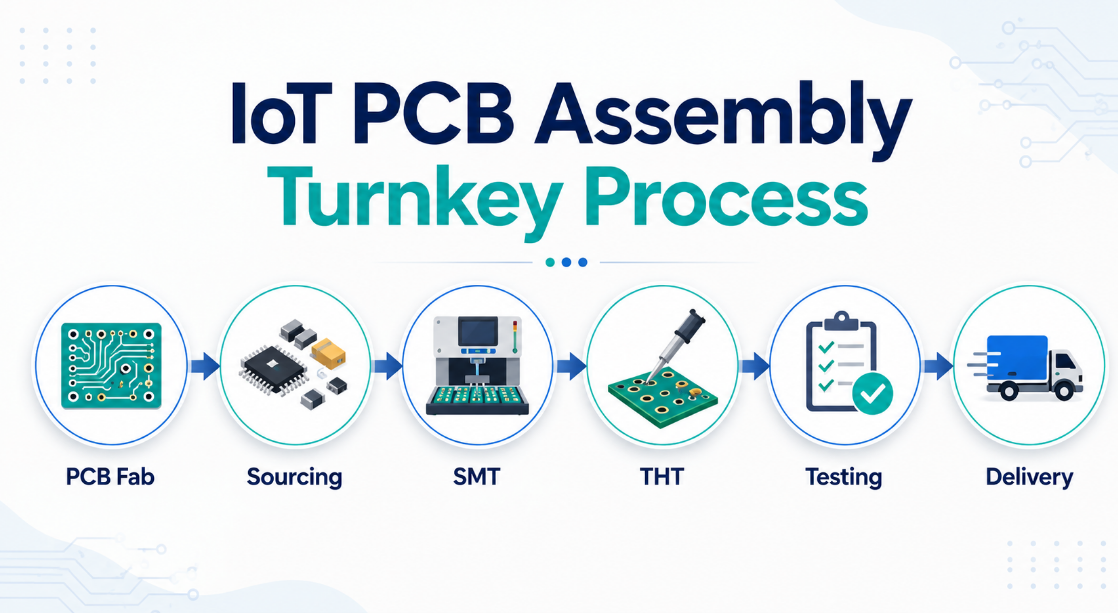
What Is the IoT PCB Assembly Turnkey Process?

The IoT PCB assembly turnkey service process should be clear, traceable, and easy to manage. A structured process reduces file errors, component mismatches, soldering defects, inspection gaps, and delivery uncertainty. It also helps the project move smoothly from prototype validation to mass production.

1. Project file review
Gerber files, BOM, CPL, assembly drawings, testing notes, and special requirements are reviewed before production starts.

2. DFM and assembly risk check
Footprint matching, component polarity, spacing, fiducials, panel format, soldering risk, and placement direction are checked.

3. PCB fabrication
Bare boards are produced according to material, layer count, copper weight, board thickness, surface finish, solder mask, and tolerance requirements.

4. Component sourcing
Components are prepared based on approved BOM data, manufacturer part numbers, package details, quantities, and substitute rules.

5. SMT assembly
Solder paste printing, component placement, reflow soldering, and AOI inspection are completed for surface-mounted components.

6. Through-hole assembly
Connectors, terminals, relays, switches, transformers, and other plug-in components are assembled with suitable soldering methods.

7. Inspection and testing
AOI, visual inspection, X-ray inspection for hidden joints, and functional testing support are arranged based on project requirements.

8. Final checking and packing
Finished IoT PCB assemblies are checked, labeled, protected with proper packing, and prepared for delivery.

    This process applies to IoT sensor PCB assembly, IoT module PCB assembly, IoT access control PCB assembly, smart device PCBA, and industrial IoT PCB assembly projects. Each step should be confirmed before the next stage begins, especially when the board includes RF modules, power control, or safety-related functions.

    IoT PCB Assembly Turnkey Process, https://www.bestpcbs.com/blog/2026/06/iot-pcb-assembly-turnkey-service/

    What Files Are Required for an IoT PCB Assembly Turnkey Quote?

    Complete files help the project review move faster and more accurately. For an IoT PCB assembly turnkey service quote, unclear files can cause wrong component selection, assembly delays, polarity mistakes, testing gaps, or repeated confirmation before production.

    The main files include:

    • Gerber files for PCB fabrication.
    • BOM file with reference designator, value, package, quantity, manufacturer part number, and approved alternatives.
    • CPL or pick-and-place file for SMT component position and rotation.
    • Assembly drawing showing polarity, connector direction, special components, and placement notes.
    • PCB specification including material, board thickness, copper weight, surface finish, solder mask color, and impedance requirements.
    • Testing instructions for power-on checks, communication verification, programming, or functional testing.
    • Panel requirements for assembly panel size, breakaway tabs, tooling holes, fiducials, and handling rules.
    • Sample photos or previous version files when the project is based on an existing IoT PCBA.

    For IoT access control PCB projects, extra details can make the review more accurate. These may include relay control requirements, power input range, lock control notes, connector details, communication interfaces, and test procedures. Clear files give production teams a stronger starting point and help reduce avoidable production risk.

    What Should Be Checked Before IoT PCB Assembly Starts?

    Before IoT PCB assembly starts, key production details should be confirmed carefully. IoT boards are often compact and function-heavy, so a small error in polarity, package selection, RF clearance, or connector direction can affect the final device.

    Important checks include:

    • BOM accuracy: part number, value, package, tolerance, voltage rating, and substitute rules.
    • Component polarity: diode, LED, IC, capacitor, connector, module, and relay direction.
    • Footprint matching: PCB pad size and actual component package compatibility.
    • RF section clearance: antenna keep-out area, shielding area, grounding, and impedance-sensitive sections.
    • Power circuit reliability: regulator rating, fuse selection, surge protection, current load, and thermal behavior.
    • Connector alignment: housing fit, cable direction, terminal position, and mechanical clearance.
    • Testing access: test points, programming pads, power input points, and communication interfaces.
    • Panel requirements: board spacing, tooling holes, fiducials, breakaway tabs, and assembly handling.

    These checks are especially important for IoT access control PCB assembly because the same board may manage locks, readers, relays, power modules, and wireless communication. When these details are confirmed early, the PCBA process becomes more predictable and easier to scale.

    What Are Common Challenges in IoT PCB Assembly Turnkey Projects?

    IoT PCB assembly turnkey service projects often involve more variables than standard PCBA orders. Wireless modules, sensors, fine-pitch ICs, connectors, battery circuits, PoE circuits, and mixed assembly components may all appear on one compact board. Without early review, these details can create performance and delivery risks.

    Common challenges include:

    • Component availability changes
      IoT products often use MCUs, wireless modules, sensors, memory chips, and power ICs. Approved substitutes should be discussed early so production can continue smoothly if the original part becomes unavailable.
    • RF signal instability
      Wi-Fi, Bluetooth, GNSS, LoRa, NB-IoT, LTE, and UWB modules may be affected by poor antenna clearance, weak grounding, shielding problems, or contamination near RF sections.
    • Fine-pitch soldering defects
      BGA, QFN, QFP, 01005 components, and dense SMT layouts require accurate placement, stable solder paste printing, controlled reflow, AOI, and X-ray inspection when hidden joints are involved.
    • Power and thermal concerns
      Battery-powered IoT devices, PoE boards, access control systems, and relay-control circuits may face voltage drop, current surge, heat buildup, or connector overload.
    • Testing gaps
      Some IoT PCBA projects require firmware programming, power-on testing, communication checks, relay action checks, and sensor response verification before delivery.
    • Prototype-to-production differences
      A prototype may pass basic validation, but larger production can expose sourcing, panelization, soldering, packing, or testing consistency issues.

    A reliable IoT PCB assembly turnkey service should not only assemble the board but also help identify production risks before they become repeated problems. This is where early file review, component confirmation, inspection control, and clear testing instructions become valuable.

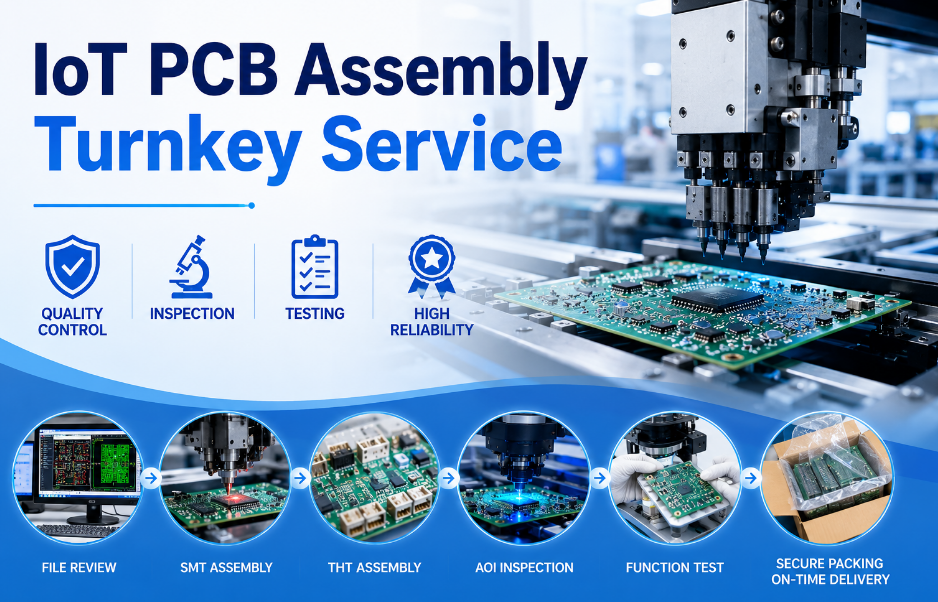
    How Does EBest Control Quality for IoT PCB Assembly Orders?

    EBest controls IoT PCB assembly quality from file review to final shipment, helping reduce assembly errors, rework, delivery risk, and batch inconsistency for IoT products.

    • File review before production
      EBest reviews Gerber files, BOM, CPL, assembly drawings, polarity marks, panel requirements, and testing notes before production starts. This helps identify missing data, footprint mismatches, unclear placement direction, and assembly risks before they affect production.
    • PCB fabrication control
      EBest checks PCB material, board thickness, copper thickness, solder mask, surface finish, hole quality, and board appearance. For IoT access control PCB and wireless IoT boards, stable PCB quality supports reliable power, signal, and mechanical performance.
    • Component verification
      EBest checks component package, value, quantity, polarity, and approved substitute status before assembly. This reduces the risk of wrong parts, unavailable components, or package mismatch in turnkey PCBA projects.
    • SMT process control
      EBest controls solder paste printing, placement accuracy, reflow soldering, and AOI inspection during SMT assembly. This helps reduce solder bridging, tombstoning, shifted components, missing parts, and poor solder joints on compact IoT PCBA.
    • BGA and fine-pitch inspection
      For BGA, QFN, QFP, and fine-pitch components, EBest can arrange X-ray inspection when required. This helps check hidden solder joints that cannot be confirmed by visual inspection alone.
    • Through-hole assembly inspection
      Connectors, relays, terminals, switches, and plug-in parts are checked for solder fill, alignment, pin trimming, and mechanical strength. This is important for IoT access control PCB projects with lock control, relay output, and external wiring.
    • Final inspection before shipment
      EBest checks board appearance, quantity, labels, packing condition, and order consistency before delivery. This helps reduce receiving-side problems and gives the finished PCBA a more reliable delivery condition.
    • Certified quality system support
      EBest holds ISO 9001:2015, ISO 13485:2016, IATF 16949, AS9100D, REACH, RoHS, and UL certifications. These certifications support controlled production for IoT access control PCB, smart sensor PCBA, wireless module PCBA, and industrial IoT PCB assembly projects.

    EBest supports SMT, THT, mixed assembly, BGA assembly, prototype PCB assembly, quick turn PCB assembly, and full turnkey PCB assembly. Its assembly capability includes 01005 minimum SMD components, 0.25 mm minimum BGA pitch, and component handling for reels, cut tape, tube, tray, and loose parts.

    IoT PCB Assembly Turnkey Service, https://www.bestpcbs.com/blog/2026/06/iot-pcb-assembly-turnkey-service/

    How Does EBest Support IoT PCB Prototyping and Mass Production?

    EBest supports IoT PCB projects from early sample builds to repeat production, helping projects verify function, improve assembly details, and scale with better production consistency.

    • Prototype PCB assembly for early validation
      EBest supports small-batch prototype PCB assembly for checking board function, soldering quality, connector fit, programming access, RF behavior, and power performance before larger production begins.
    • Quick turn support for urgent validation
      When an IoT project is under schedule pressure, EBest can support quick turn PCB assembly based on file readiness, component availability, and production complexity. This helps shorten the sample testing cycle.
    • BOM and component review before scaling
      EBest checks BOM details, package matching, substitute options, and sourcing risks before production volume increases. This helps prevent last-minute component problems during batch production.
    • Assembly feedback during prototype builds
      EBest can identify practical risks such as tight component spacing, difficult soldering areas, unclear polarity marks, weak panel format, or limited testing access. These findings help improve the next production version.
    • Stable production records for repeat orders
      Once the prototype is approved, EBest can keep production notes, component information, inspection requirements, and packing standards consistent. This helps reduce variation across different production batches.
    • Mass production workflow control
      For larger orders, EBest focuses on stable sourcing, SMT process control, through-hole assembly quality, inspection discipline, final checking, and delivery coordination. This supports long-term IoT PCBA production with fewer unexpected interruptions.
    • Broad IoT product coverage
      EBest can support IoT access control PCB, wireless sensor PCBA, smart home PCBA, gateway modules, asset tracking boards, industrial IoT PCBA, and smart monitoring device assemblies.

    This support helps an IoT PCB assembly turnkey service project move from sample approval to mass production without changing suppliers, rebuilding communication, or losing key production details.

    How Does EBest Ensure On-Time Delivery for IoT PCBA Projects?

    EBest improves delivery control by managing PCB fabrication, component sourcing, SMT assembly, through-hole assembly, inspection, and packing through one coordinated workflow. This makes IoT PCB assembly turnkey service projects easier to schedule and easier to track.

    • Early file confirmation
      EBest checks Gerber files, BOM, CPL, assembly drawings, panel requirements, and testing notes before production scheduling. This helps prevent delays caused by missing files or unclear instructions.
    • Component sourcing coordination
      EBest reviews component availability, package details, approved substitutes, and sourcing risks. For IoT PCBA orders, this helps reduce the chance of production being delayed by one missing MCU, module, connector, or power IC.
    • PCB and PCBA schedule planning
      EBest coordinates PCB fabrication, component preparation, SMT assembly, through-hole assembly, inspection, and packing based on project complexity. This keeps each stage better aligned.
    • Quick turn assembly support
      For prototype and low-volume IoT PCBA projects, EBest can support quick turn assembly depending on material readiness and production requirements. This helps speed up urgent validation and early project stages.
    • Production tracking across key stages
      EBest follows the order from PCB fabrication to SMT, THT, inspection, packing, and delivery preparation. Clear tracking helps reduce uncertainty during production.
    • Final checking before shipment
      EBest checks appearance, quantity, labels, packing, and order consistency before shipment. This helps avoid preventable delivery-side issues.
    • Capacity support for prototype and repeat orders
      EBest has monthly PCB capability of about 260,000 square feet / 28,900 square meters. Assembly lead time can reach 1–5 days, depending on project conditions, material readiness, and production complexity.

    For IoT access control PCB, sensor boards, wireless modules, and smart device PCBA projects, this delivery approach helps improve schedule predictability and reduce production interruptions.

    Why Choose EBest for IoT PCB Assembly Turnkey Service?

    EBest provides IoT PCB assembly turnkey service for smart devices, IoT access control PCB, wireless modules, sensor boards, gateways, and industrial connected equipment.

    • One-stop service reduces project complexity
      EBest covers PCB fabrication, component sourcing, SMT assembly, through-hole assembly, mixed assembly, inspection, testing support, and box assembly. This helps reduce the effort of coordinating several separate production links.
    • Strong PCBA capability for compact IoT products
      EBest supports 01005 SMD components, 0.25 mm BGA pitch, BGA assembly, QFN/QFP packages, mixed assembly, and multiple component supply formats. This is suitable for compact IoT boards with dense layouts and fine-pitch components.
    • Prototype-to-mass-production support
      EBest supports prototype PCB assembly, quick turn PCB assembly, and full turnkey PCB assembly. This helps projects verify samples, improve assembly details, and move into repeat orders more smoothly.
    • Wide PCB fabrication capability
      EBest can support FR4 PCB, multilayer PCB, flexible PCB, rigid-flex PCB, ceramic PCB, metal-based PCB, and high-frequency PCB. This gives IoT projects more flexibility when board structure, thermal performance, signal requirements, or size constraints change.
    • Quality certifications support production confidence
      EBest holds ISO 9001:2015, ISO 13485:2016, IATF 16949, AS9100D, REACH, RoHS, and UL. These certifications support controlled production for projects that require stable quality and documented manufacturing standards.
    • More than 19 years of PCB and PCBA experience
      EBest understands common production risks in IoT PCB assembly projects, including BOM issues, component sourcing risk, SMT defects, connector reliability, RF-sensitive areas, and batch consistency.
    • Value-added services support complete product delivery
      In addition to PCBA, EBest can support box assembly, injection molding, CNC machining, sheet metal, cable connection, labeling, and final assembly options. This is useful when an IoT project requires more than bare PCBA delivery.
    • Clear communication improves project efficiency
      EBest helps review files, confirm production details, coordinate sourcing, manage assembly, and arrange inspection. This gives the project a more organized path from technical files to finished IoT PCB assemblies.

    Choosing EBest means the project can get PCB fabrication, sourcing, assembly, inspection, delivery coordination, and value-added support from one experienced PCBA partner.

    IoT PCB Assembly Turnkey Service, https://www.bestpcbs.com/blog/2026/06/iot-pcb-assembly-turnkey-service/

    FAQs About IoT PCB Assembly Turnkey Service

    Q1: Can EBest assemble IoT PCBA with small-size components and fine-pitch packages?
    A1: Yes. EBest supports compact IoT PCBA with 01005 minimum SMD components and 0.25 mm minimum BGA pitch. This is suitable for wireless modules, sensor boards, smart control boards, and IoT access control PCB projects with limited PCB space.

    Q2: Can EBest handle both SMT and through-hole parts on the same IoT board?
    A2: Yes. EBest supports SMT, THT, and mixed assembly for IoT PCBA projects. This is useful when one board includes ICs, wireless modules, sensors, connectors, terminals, relays, and other plug-in components.

    Q3: What component package formats can EBest work with?
    A3: EBest can handle components supplied in reels, cut tape, tube, tray, and loose parts. This gives turnkey IoT PCB assembly projects more flexibility when different component types are used in one BOM.

    Q4: Can EBest support urgent IoT prototype assembly?
    A4: Yes. EBest supports quick turn PCB assembly, and assembly lead time can reach 1–5 days, depending on file readiness, component availability, quantity, testing requirements, and production complexity.

    Q5: What PCB materials or board types can be used for IoT products?
    A5: EBest supports FR4 PCB, multilayer PCB, flexible PCB, rigid-flex PCB, ceramic PCB, metal-based PCB, and high-frequency PCB. These options help match different IoT requirements such as compact structure, RF performance, thermal control, and mechanical flexibility.

    Q6: Can EBest help if the IoT product requires enclosure or final assembly support?
    A6: Yes. Besides PCBA, EBest can support box assembly, injection molding, CNC machining, sheet metal, cable connection, labeling, and final assembly. This is helpful when the project requires more than bare PCBA delivery.

    Q7: What certifications support EBest’s IoT PCB assembly service?
    A7: EBest holds ISO 9001:2015, ISO 13485:2016, IATF 16949, AS9100D, REACH, RoHS, and UL. These certifications support controlled production for IoT access control PCB, wireless module PCBA, sensor board PCBA, and industrial IoT PCB assembly projects.

    Q8: Can EBest support repeat IoT PCBA orders after the prototype is approved?
    A8: Yes. EBest supports prototype PCB assembly, quick turn PCB assembly, full turnkey PCB assembly, and repeat production. With monthly PCB capability of about 260,000 square feet / 28,900 square meters, EBest can support both sample validation and long-term IoT PCBA production.

    Request a Fast Quote for Your IoT PCB Assembly Turnkey Project

    EBest provides IoT PCB assembly turnkey service for IoT access control PCB, wireless modules, smart sensor boards, gateways, tracking devices, and industrial connected equipment. From PCB fabrication and component sourcing to SMT assembly, through-hole assembly, mixed assembly, inspection, and delivery support, EBest helps turn your IoT PCB project into reliable finished PCBA.

    Send your Gerber files, BOM, CPL, assembly notes, testing requirements, and quantity plan to sales@bestpcbs.com. EBest will review your project and provide a customized IoT PCBA turnkey solution with reliable quality, professional communication, and dependable production support.

    You may also like

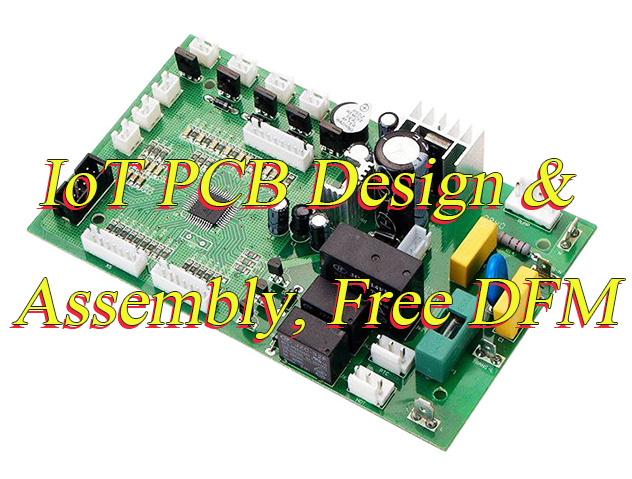
    IoT PCB Design & Assembly, Free DFM
    Tuesday, November 18th, 2025

    How to design an IoT PCB? Let’s discover benefits, applications, design guide and optimization strategies, assembly process for IoT circuit board.

    Are you troubled with these problems?

    • Does data transmission in IoT devices become unstable and frequently disconnect due to PCB signal interference?
    • Can PCB design achieve miniaturization while integrating complex IoT sensors, avoiding a sharp drop in yield during mass production?
    • Does the supply chain response speed for multiple batches of small orders slow down product iteration cycles?

    As an IoT PCB Manufacturer, EBest Circuit (Best Technology) can provide you service and solutions:

    • High-Frequency Micro-Amplitude Circuit Optimization: Ensuring Wi-Fi/Bluetooth module signal integrity and reducing bit error rate through precise impedance control processes.
    • HDI Rapid Prototyping: Achieving extreme compression of sensor modules using blind and buried vias and microvia stack-up technology, accelerating prototype verification.
    • Flexible Production System: A dynamic material early warning mechanism supports 48-hour turnaround for urgent orders, adapting to the agile development needs of smart home and wearable devices.

    Welcome to contact us if you have any inquiry for IoT PCB design, prototyping, assembly: sales@bestpcbs.com.

    What Is a PCB in IoT?

    IoT PCB is the core carrier connecting electronic components. It integrates components such as sensors, microcontrollers, and communication modules into a compact space through precise wiring, realizing data acquisition, processing, and transmission functions. At the same time, it must meet the characteristics of low power consumption, high reliability, and miniaturization, and is the key hardware foundation for IoT devices to achieve intelligent interconnection.

    What Is a PCB in IoT?

    What Are Advantages of IoT PCB?

    Benefits of IoT PCB board:

    • Miniaturization Support: Utilizing High-Density Interconnect (HDI) technology, microvia design, and fine linewidth/spacing processes, combined with ultra-small packaged components such as 0201/01005-level resistors and capacitors, and CSP/WLP, complex functions are implemented in a very small space, adapting to the size requirements of wearable devices and micro-sensors.
    • Ultra-Low Power Operation: Integrating a low quiescent current PMIC (Power Management Chip), an ultra-low power MCU (Microcontroller), and a high-efficiency DC-DC converter, with a finely designed power domain management and deep sleep wake-up mechanism, reducing overall power consumption and extending battery or energy harvesting system lifespan.
    • Multi-Mode Wireless Connectivity: Natively integrating and optimizing RF circuitry for wireless protocols such as Wi-Fi, Bluetooth LE, LoRa, NB-IoT, and Zigbee, ensuring 50-ohm impedance control of the antenna interface and signal integrity, enabling flexible device access to various networks.
    • Diverse Sensor Interfaces: Providing analog/digital sensor interface circuitry, supporting direct connection and signal conditioning (through integrated AFE analog front-end) for various physical quantity sensors such as temperature, humidity, light, motion, and environment, simplifying the sensing layer design.
    • Environmental Adaptability and Reliability: Utilizing industrial-grade/wide-temperature-range components and high-Tg board materials, combined with conformal coating for moisture and dust protection and vibration/shock resistance, ensures long-term stable operation in harsh or unattended environments.
    • Hardware-Level Security Mechanisms: Integrating a hardware security element (SE), circuit design supporting secure boot and secure OTA firmware updates, and employing physical anti-tamper detection and shielding measures, providing a physical foundation for device authentication, data encryption, and tamper prevention.
    • Manufacturing Cost and Efficiency Optimization: Adhering to DFM (Design for Manufacturability) principles, prioritizing cost-effective standard components and mature processes (such as primarily 4-layer boards), and adopting a modular (core board + baseboard) design improves production yield and reduces material and manufacturing costs for large-scale deployment.
    • Enhanced Functional Integration: Efficiently integrating high-speed digital, analog, RF, and power mixed-signal circuits within a limited space, reducing the number of external components and system complexity through precise layer stack-up planning and routing strategies (such as blind and buried via technology).
    What Are Advantages of IoT PCB?

    What Are Applications of IoT PCB?

    Applications of IoT PCB board:

    • Smart wearable devices – smartwatches and health monitoring bracelets
    • Environmental monitoring sensor networks – smart agriculture soil/weather stations and building air quality monitoring points
    • Industrial equipment predictive maintenance systems – motor vibration monitoring sensors and production line status monitoring nodes
    • Smart home terminals – networked thermostats, smart door locks, and security sensors
    • Logistics asset tracking tags – cargo tracking devices and container status monitoring terminals
    • Portable medical monitoring devices – remote ECG monitors and blood glucose data acquisition terminals
    • Smart utility meters –remotely read water meters, electricity meters, and gas meters
    • Vehicle-to-everything (V2X) terminals –vehicle telematics units (T-Boxes) and tire pressure monitoring modules
    • Smart city infrastructure – smart street light controllers and parking space detection sensors
    • Industrial IoT gateways – edge computing nodes connecting field devices to cloud platforms

    How to Design an IoT PCB?

    Below is a detailed design guide for IoT PCB board for your reference:

    1. Hardware Selection and Modular Design

    Core Component Selection

    • Microcontroller (MCU): Prioritize low-power, high-integration ARM Cortex-M series (e.g., STM32L4/STM32U5) or RISC-V architecture chips supporting Bluetooth/Wi-Fi/NB-IoT protocols. Verify long-term supply guarantees (LTS) and ecosystem support (e.g., SDK, development tools).
    • Sensor Modules: Select digital/analog sensors (e.g., temperature, acceleration, gas sensors) based on application scenarios, ensuring interface compatibility (I²C/SPI/UART) and calibration accuracy requirements.
    • Wireless Modules: Evaluate RF performance (TX power, receive sensitivity), power modes, and certification standards (FCC/CE/IC). Prefer multi-band, low-power modules (e.g., Semtech LoRa SX1276).

    Modular Design Principles

    • Implement standard interfaces (e.g., MIPI, USB Type-C) for plug-and-play functionality of modules (power, communication, sensors), enhancing maintainability and scalability.
    • Reserve test points (TP) and debug interfaces (e.g., JTAG/SWD) for post-debugging and firmware updates.

    2. Circuit Design and Low-Power Optimization

    Low-Power Architecture Design

    • Implement multi-level power management strategies: dynamic voltage frequency scaling (DVFS), sleep/deep sleep mode switching, and RTC timer wake-up mechanisms.
    • Use low-power components (e.g., ultra-low leakage MOSFETs, low-power op-amps) and avoid leakage current paths.

    Anti-Interference and Signal Integrity

    • EMC Design: Comply with CISPR 22/EN 55022 standards. Suppress high-frequency noise via filter capacitors, ferrite beads, and common-mode chokes. Key signal lines (e.g., clocks, RF) use differential routing with controlled impedance (50Ω/100Ω).
    • Power Integrity: Utilize multi-stage filtering (π-type networks), power plane partitioning (digital/analog zones), and avoid ground bounce and power noise.

    3. Layout and Routing Strategies

    Layer Planning and Thermal Management

    • Adopt 4-layer or higher PCB structures: top/bottom layers for signal routing, inner layers for power/ground planes. Reduce signal crosstalk.
    • Place high-power devices (e.g., power amplifiers) with thermal vias or thermal pads, paired with thermal interface materials (e.g., thermal pads) for optimized heat conduction.

    Routing Rules

    • High-speed signal lines (e.g., SPI, SDIO) use serpentine routing for timing control, avoiding signal reflections. RF lines remain short and straight, distanced from digital lines to minimize coupling.
    • Critical trace widths match impedance requirements (e.g., 50Ω microstrip) and are validated via TDR testing.
    • Avoid sharp-angle traces to reduce signal radiation and impedance discontinuities.

    4. Power System Design

    Power Architecture Selection

    • Choose linear regulators (LDOs) for low-noise scenarios or switching regulators (DC-DCs) for high-efficiency conversion based on application needs.
    • Battery-powered systems require protection circuits (overcharge/over-discharge/short-circuit) with low-battery detection and sleep mode switching.

    Power Path Design

    • Implement power path management for automatic switching between battery and external power (e.g., USB), preventing reverse current flow.
    • Isolate critical chips with independent power domains using inductors/capacitors to reduce noise coupling.

    5. Signal Integrity and EMC Design

    High-Speed Signal Processing

    • Match impedance (source/terminal) for high-frequency signals (e.g., RF, high-speed digital) to minimize reflections and ringing.
    • Shield sensitive circuits with enclosures or metal casings to reduce external interference.

    EMC/EMI Compliance Design

    • Conduct EMC pre-compliance analysis via simulation tools (e.g., Ansys HFSS, Altium Designer) to optimize layout and shielding.
    • Add common-mode chokes and TVS diodes to critical interfaces (e.g., USB, Ethernet) for ESD and surge protection.

    6. Testing and Verification Process

    Functional Testing

    • Perform unit, integration, and system-level testing to validate hardware functionality, communication protocols, and power performance.
    • Analyze signal integrity using logic analyzers, oscilloscopes, and spectrum analyzers.

    Environmental and Reliability Testing

    • Follow IEC 60068 standards for environmental testing (temperature, vibration, humidity) to ensure stability across conditions.
    • Conduct accelerated life testing (ALT) and thermal cycling to validate solder joint and component reliability.

    7. Environmental and Design for Manufacturing (DFM/DFA)

    Environmental Standards

    • Comply with RoHS, REACH, and other regulations. Use lead-free solder and eco-friendly materials.
    • Prioritize recyclable materials and low-toxicity chemicals to minimize environmental impact.

    Design for Manufacturing

    • Adhere to IPC-2221/IPC-2222 standards to optimize PCB dimensions, pad spacing, and trace widths for improved manufacturing yield.
    • Use DFM tools (e.g., Altium Designer DFM, Mentor Graphics) for manufacturability analysis, avoiding design flaws (e.g., acid traps, missing pads).

    8. Documentation and Collaboration Tools

    Design Documentation Management

    • Use version control systems (e.g., Git) to manage schematics, PCB layouts, and BOM files for traceability.
    • Generate detailed design documentation (schematics, PCB layouts, test reports) for team collaboration and maintenance.

    Collaboration Tools

    • Leverage cloud-based platforms (e.g., Eagle Upverter) for real-time collaboration and design reviews.
    • Utilize project management tools (e.g.,Trello) to track design progress and issue resolution.
    How to Design an IoT PCB?

    IoT Circuit Board Design Consideration

    EMC Optimization Design

    • High-frequency signal path control: Use differential pair routing (e.g., LVDS, USB3.0) to reduce crosstalk. Critical traces (e.g., RF modules, clock lines) require length matching (error ≤5%) to avoid antenna effects.
    • Filtering and shielding measures: Parallel X/Y capacitors (e.g., 100nF+10μF combination) at power entry points. Sensitive circuits (e.g., ADC sampling) adopt metal shielding cans, with continuous ground planes connected to the main ground via single-point grounding to prevent ground bounce noise.

    Low-Power Dynamic Power Management

    • Multi-level power domain partitioning: Set independent power domains based on chip power characteristics (e.g., STM32L low-power MCUs). For instance, sensor modules use LDOs (drop ≤200mV), while wireless modules adopt high-efficiency DC-DC converters (efficiency ≥90%).
    • Dynamic voltage frequency scaling (DVFS): Adjust core voltage dynamically (e.g., 1.8V→0.9V) in tandem with load changes (sleep/wake modes), paired with GPIO configurations for fast wake-up (≤10μs).
    • Battery life optimization: Design CC/CV charging circuits for lithium batteries (e.g., ER14505) to avoid overcharge (≤4.25V) and over-discharge (≥2.5V), extending device endurance (≥5 years in typical scenarios).

    Wireless Module Layout and Antenna Design

    • Antenna isolation and matching: Keep antenna areas away from metal objects (distance ≥λ/4). Use π-type matching networks (inductor+capacitor) to tune impedance to 50Ω, with S11 ≤-10dB (in-band).
    • Multi-protocol coexistence strategy: For 2.4GHz bands (Wi-Fi/BLE/Zigbee), employ TDMA or SAW filters to minimize mutual interference, ensuring RSSI ≥-80dBm.
    • Anti-interference design: Set guard bands (width ≥2mm) at PCB edges to prevent high-frequency signals from crossing split ground planes. Critical RF paths use microstrip lines (50Ω±10% impedance).

    Design for Manufacturing (DFM) and Test (DFT)

    • DFM rule verification: Conduct DRC checks (e.g., line width/spacing ≥6mil via Altium Designer/OrCAD). Copper thickness ≥1oz meets current-carrying needs; pad dimensions align with IPC-7351 standards (e.g., QFN pad spacing error ≤±0.05mm).
    • Test point design: Place test probe points (spacing ≥100mil) at critical nodes (power, ground, signal lines) for 100% electrical continuity verification via ICT (e.g., flying probe testing).
    • Thermal design validation: Use ANSYS Icepak for thermal simulation of power devices (e.g., MOSFETs), ensuring junction temperature ≤125°C (Ta=85°C environment). Thermal via arrays density ≥50 vias/cm?.

    Hardware Security and Anti-Tamper Design

    • Data encryption module: Integrate hardware encryption engines (e.g., AES-128/256) with secure memories (e.g., ATECC608) to protect keys (≥256-bit), preventing side-channel attacks (e.g., power analysis).
    • Physical anti-tamper measures: Deploy anti-tamper circuits (e.g., capacitive sensors) around critical chips (e.g., MCUs). Trigger data wipe and device lock upon casing breach.
    • Supply chain security: Use unique device IDs (UIDs) and digital signatures (e.g., ECDSA) to verify firmware authenticity, blocking malicious code injection.

        IoT PCB Assembly Process

        Below is a detailed guide for IoT PCB assembly process:

        1. Material Preparation and Verification

        • Incoming Quality Control (IQC): Strictly inspect PCB substrate impedance (verified by TDR for ±5% accuracy) and warpage (meeting IPC-6012 standard ≤0.75%); validate 01005/0201 component package dimensions and RF module S-parameters (e.g., S11/S21 initial performance).
        • Moisture Sensitive Devices (MSD) Control: Bake moisture-sensitive components like BGA and CSP according to MSL levels (e.g., 125°C/24h for BGA), with smart storage systems monitoring exposure time.

        2. Solder Paste Printing

        • Stencil Process: Laser-cut ultra-thin stencil (0.1-0.13mm) with micro-apertures matching 01005 components (trapezoidal aperture design, 1:1.2 opening ratio), electropolished for Ra≤0.5μm wall smoothness.
        • Vision Alignment System: High-precision dual-camera Mark point positioning (±10μm accuracy), dynamic compensation for PCB warpage; 3D SPI monitors solder paste thickness (target 4-6μm) and provides feedback on squeegee pressure curves.

        3. Surface Mount Technology (SMT)

        • High-Speed Mounting Strategy: Micro-components (e.g., 01005/0201) follow a “small-first, large-second” sequence with ±15μm placement head accuracy; RF components (inductors/capacitors) are prioritized to minimize thermal impact.
        • High-Precision Placement Technology: BGA/LGA components utilize 3D laser calibration systems for real-time X/Y/Z axis offset compensation; QFN component bottom pads are verified for coplanarity via infrared thermal imaging.

        4. Reflow Soldering

        • Temperature Profile Control: Customized profiles based on solder paste specifications and component temperature tolerance, with peak temperatures of 235-245°C and liquidus times of 30-45s; nitrogen atmosphere reduces oxidation (oxygen content ≤50ppm).
        • Cooling Zone Slope Management: Cooling rate controlled at -2~-5°C/s to prevent thermal stress damage; furnace temperature testers validate actual profiles against set parameters.

        5. Automated Optical Inspection (AOI)

        • Post-Solder Defect Detection: X-ray and AI for BGA solder joint inspection; 3D solder paste inspection predicts bridging/solder ball defects, with big data analyzing correlations between printing parameters and defects.

        6. Through-Hole and Selective Soldering

        • Wave Soldering Process: Dual-wave soldering (preheat/main wave) with nitrogen protection minimizes through-hole component solder voids; selective soldering fixtures consider thermal capacity matching to avoid SMD component overheating.
        • Hand Soldering Rework: Low-residue solder wire (e.g., RMA type) and micro-manipulation stations for micro-component rework, with temperatures ≤350°C to prevent substrate damage.

        7. Cleaning and Decontamination

        • Precision Cleaning Process: Medical-grade IoT boards use water-based cleaners (e.g., Tergo series) with 40kHz ultrasonic oscillation, validated by SIR testing (surface insulation resistance ≥10⁹Ω).

        8. Coating and Protection

        • Conformal Coating Application: Robotic arms control coating thickness (50-100μm), with UV-curable coatings achieving 30-second curing; silicone coatings offer -60~200°C wide-temperature performance.
        • Underfill Process: BGA component underfill via capillary action, with UV/thermal dual-cure adhesives ensuring complete filling; reliability verified by accelerated aging tests (-40~125°C/1000 thermal cycles).

        9. Functional Circuit Test (FCT) and RF Calibration

        • Power Management Testing: Dynamic current testers validate μA-level standby current, with power ripple analyzers detecting switching noise; low-power mode switching time ≤1ms.
        • RF Performance Verification: VNA tests antenna impedance matching (Smith chart, target VSWR≤1.5); Wi-Fi module transmit power meets FCC/CE standards, with receiver sensitivity better than -90dBm.
        • Over-the-Air (OTA) Testing: Chamber environments validate wireless firmware update rates (e.g., BLE 2Mbps mode), with channel simulators testing multipath fading immunity.

        10. Final Inspection and Packaging

        • Visual Re-inspection Standards: Manual inspection with 10-20X magnifiers checks coating integrity, with label placement error ≤1mm; metallographic microscopes verify solder joint microstructures (e.g., IMC layer thickness).
        • Burn-in Testing: High-temperature burn-in (85°C/85% RH for 168 hours) screens for early failures; critical products undergo HAST testing (130°C/85% RH/96h) for accelerated life verification.
        IoT PCB Assembly Process

        Why Choose EBest Circuit (Best Technology) as IoT PCB Assembly Manufacturer?

        Reasons why choose us as IoT PCB assembly manufacturer:

        • Free DFM (Design for Manufacturing) analysis: Professional front-end design verification to identify process risks early, reduce late-stage design modification costs, and help international engineers optimize design efficiency.
        • Rapid lead time guarantee: Leveraging intelligent production line scheduling to achieve 7-10 day fast delivery for conventional IoT PCB assembly, with emergency order response time shortened to 48 hours.
        • 99.2% on-time delivery rate: Real-time tracking of production nodes through MES systems, combined with intelligent warehousing and logistics coordination, ensures zero delays for overseas client project schedules.
        • Full batch inspection quality commitment: Triple inspection system of AOI + X-ray + flying probe testing achieves 100% full inspection per batch, with defect rate below 50ppm.
        • International standard quality control process: Strict adherence to IPC-A-610E Class 2/3 standards, implementing 18 quality gates from IQC to OQC, ensuring compliance with EU RoHS and REACH environmental requirements.
        • Transparent cost structure: Detailed quotation and cost analysis reports provided, no hidden fees, supporting price gradient optimization for small-batch prototyping and mass production.
        • Professional technical support team: Bilingual engineers available 24/7 for online support, assisting with technical challenges in overseas projects such as RF calibration and fine-pitch soldering.
        • Environmentally compliant and sustainable production: Lead-free soldering processes and recyclable packaging, ISO 14001 certified, meeting environmental access thresholds for European and American markets.
        • Cost-effective solutions: Process optimization and economies of scale reduce unit costs, offering price competitiveness on par with international manufacturers while ensuring quality, enhancing client product market profitability.

          Our PCBA Manufacturing Capabilities

          ItemCapabilities
          Placer Speed13,200,000 chips/day
          Bare Board Size0.2 x 0.2 inches – 20 x 20 inches/ 22*47.5 inches
          Minimum SMD Component01005
          Minimum BGA Pitch0.25mm
          Maximum Components50*150mm
          Assembly TypeSMT, THT, Mixed assembly
          Component PackageReels, Cut Tape, Tube, Tray, Loose Parts
          Lead Time1 – 5 days

          How to Get A Quote For IoT PCB Board Project?

          To obtain a quote for an IoT PCB board project, submit the following essential checklist items:

          • Design Files: Provide complete Gerber files, BOM (Bill of Materials) list, coordinate files, and circuit schematics for accurate design interpretation by manufacturers.
          • Board Specifications: Specify PCB dimensions (length × width × thickness), number of layers (e.g., 4-layer/6-layer), substrate material type (e.g., FR4, aluminum substrate, high-frequency materials), and surface finish processes (e.g., HASL, ENIG, OSP).
          • Process Parameters: Indicate minimum trace width/spacing, minimum hole size (including through-hole/blind via/buried via), impedance control requirements, copper foil thickness, and special process needs (e.g., immersion gold, thick copper plating, back drilling).
          • Production Quantity: Clarify order volume (e.g., small-batch prototype, large-scale mass production) and batch delivery requirements, which impact unit costs.
          • Delivery Timeline: Specify the required lead time from order placement to delivery (e.g., 7-day rapid board, 15-day standard), noting that urgent orders may incur additional fees.
          • Testing Standards: State whether flying probe testing, ICT (In-Circuit Testing), AOI (Automated Optical Inspection), or functional testing is required to ensure product quality compliance.
          • Packaging and Logistics: Describe packaging methods (e.g., anti-static bags, vacuum packaging) and transportation modes (air/sea/land freight), with any associated costs confirmed in advance.

          Welcome to contact us if you have any request for IoT PCB: sales@bestpcbs.com.

          You may also like