
Moisture sensitive device handling PCB assembly controls protect plastic-packaged components from absorbed moisture that can expand during soldering and damage internal interfaces. The risk is difficult to manage after the fact because an affected package may show no obvious external warning before reflow.
A practical plan identifies sensitive parts, verifies packaging, starts exposure at a defined event, controls storage and kitting, handles uncertain material, and carries the history through reflow, rework, and shipment. Exact limits come from the current component label, manufacturer instructions, customer requirements, and approved handling standard.
Can your assembler show the remaining exposure allowance for each opened reel at the moment it reaches reflow?
If the answer depends on memory, a handwritten date without a time, or a shared estimate for several split reels, the process cannot reliably distinguish usable material from uncertain material.
EBest Circuit can review BOM, AVL, manufacturer part numbers, supplier labels, packaging condition, assembly route, reflow exposure, lot-traceability requirement, quantity, and schedule before confirming a project-specific moisture-control plan.
No dry-cabinet condition, bake profile, floor-life limit, resealing method, or equipment capability should be assumed without that review.
Identify Moisture-Sensitive Parts Before They Reach the Line
Map each manufacturer part number to the current moisture classification and handling instruction supplied for that exact package. Record the approved source, package type, lot, date code, label data, dry-pack status, and any customer-specific controls.
Do not infer one requirement from a similar component family or distributor description. A package change, alternate source, or revised manufacturer notice can change the applicable handling route. The component sourcing service page explains why source and part identity must remain connected to assembly planning.
Inspect Dry Packs, Labels, Desiccant, and Indicators at Receipt
Receiving should verify that the part, lot, quantity, label, sealed bag, desiccant, humidity indicator where required, and accompanying instructions are consistent. Check for tears, punctures, weak seals, missing fields, water damage, or evidence that the package has already been opened.
Capture the condition before warehouse relabeling. If a supplier label is covered or discarded, the assembly team may lose the only direct link to the original moisture status.
Quarantine Missing or Contradictory Moisture Data
Uncertain material is a disposition problem, not a production scheduling problem. Hold parts when the label, indicator, bag condition, exposure history, part number, or lot record is missing or contradictory. Engineering, quality, sourcing, and the customer can then choose an approved route.
Do not reset a clock by creating a new internal label. A new label can improve traceability only when it preserves the verified prior history.
Start the Exposure Clock at a Defined Event
Define exactly when controlled dry storage ends and exposure begins. The trigger may be bag opening or another event specified by the approved method; record date, time, operator, material identity, location, and applicable allowance.
The same rule must cover bags opened for inspection, sampling, relabeling, programming, or partial kitting. A reel should not receive a fresh allowance simply because it moves to another department.
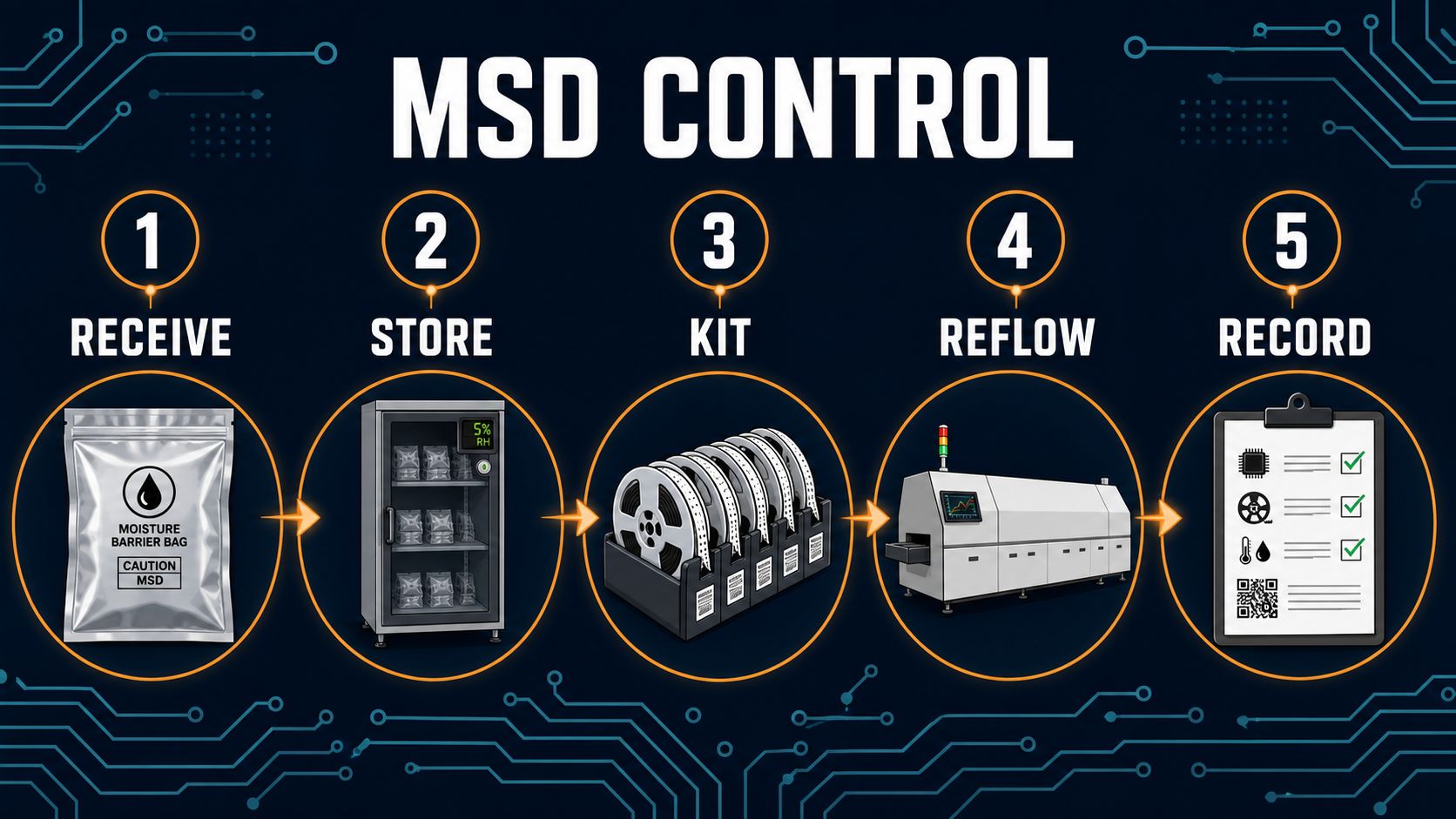
Store Sealed and Opened Material Under Separate Rules
A sealed verified dry pack and an opened reel are different inventory states. Define locations, environmental controls, identification, access, monitoring, alarm response, and record requirements for each state. Prevent ordinary warehouse stock from being mistaken for controlled open material.
Storage equipment does not repair an unknown history. Its conditions and recovery assumptions must come from an approved procedure, not a generic rule copied from another product.
Build Kitting Around Remaining Floor Life
Kit only the quantity and timing that the line can consume within the approved remaining allowance. Coordinate setup, feeder loading, line stops, changeovers, inspection holds, maintenance, and expected reflow time rather than treating placement as the finish point.
Use first-expiring material deliberately and keep the reel identity visible at the feeder. A complete kit is not production-ready if its most constrained component will expire before soldering.
Link Reel Splits and Partial Lots to One Exposure History
When a reel, tray, or tube is divided, each child container must retain the parent part, manufacturer, lot, date code, quantity, moisture data, opening time, prior exposure, and remaining status. Barcodes or system records are useful only when the join is reliable.
Do not let a partial reel return to stock with a new local identifier that hides its earlier exposure. The PCB assembly traceability guide shows how component, process, and test records should connect.
Coordinate Staging, Placement, and Reflow Windows
Plan to the point of thermal exposure, not merely feeder load. Queue time, line balance, inspection, double-sided assembly, selective operations, interruptions, and weekend holds can consume the allowed window.
Record the actual route and define what happens when a board or component waits longer than planned. The lead-free PCB assembly guide explains why material handling and thermal planning must be coordinated rather than optimized separately.
Bake Only Under an Approved Component-Specific Route
Baking is not a universal reset button. Confirm that the exact component, carrier, packaging, terminals, labels, trays, tapes, and reels can tolerate the selected route, and follow the current manufacturer or customer-approved instruction.
Define authorization, equipment, loading, time, temperature, maximum repetitions when applicable, cooling, handling after bake, new status, and records. Excessive or inappropriate baking can create other material or solderability risks.
Reseal Returned Material With Its Remaining-Life Record
Line return should preserve, not restart, the history. Record removal time, consumed quantity, remaining exposure, condition, desiccant and indicator requirements, reseal event, operator, and new controlled-storage location.
Use packaging appropriate to the approved method and protect labels from being separated from the reel. Recounting inventory does not replace exposure reconciliation.
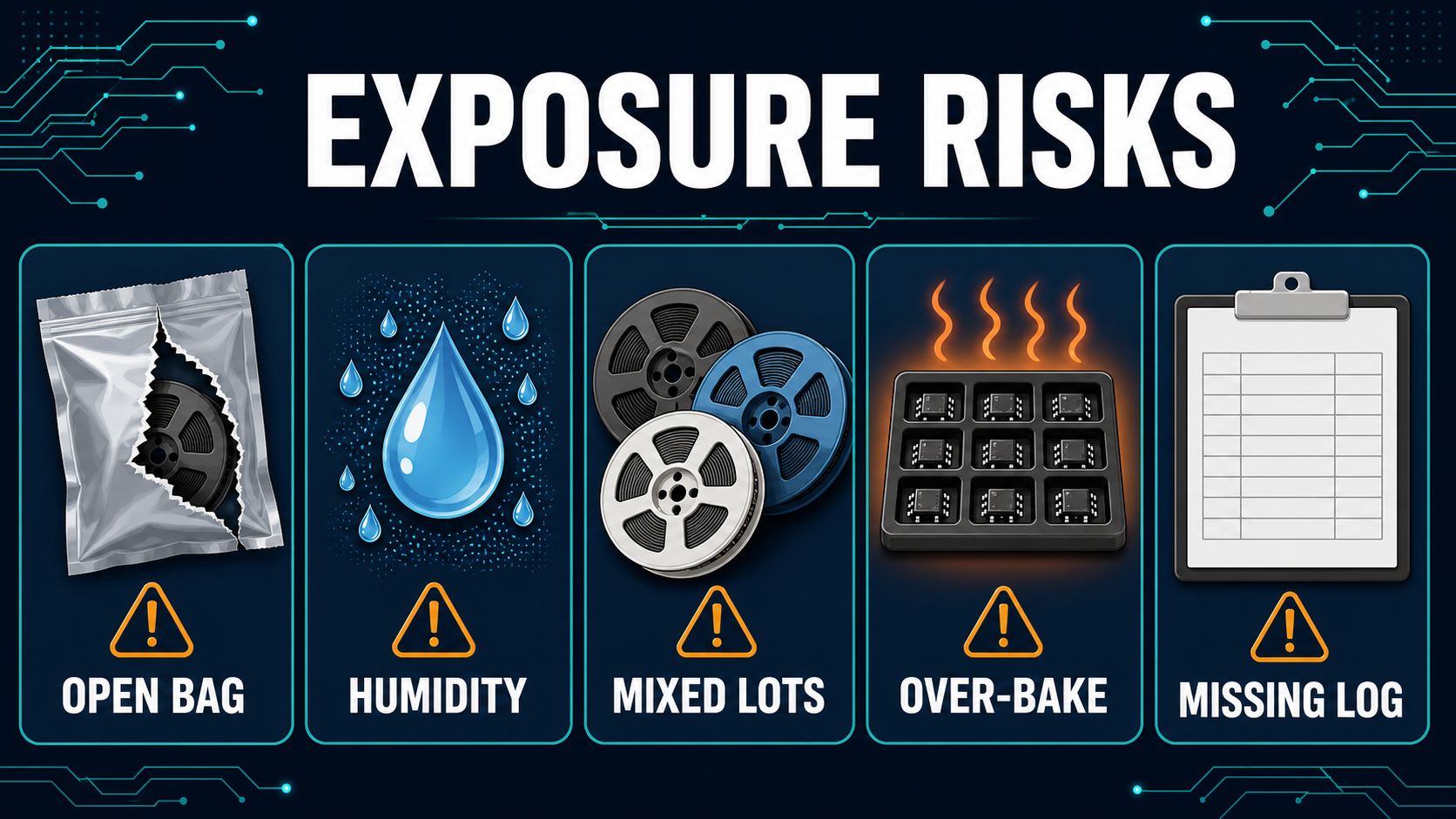
Contain Expired, Damaged, or Uncertain Material
Stop and identify all affected containers and assemblies when the allowed exposure is exceeded or the history cannot be proven. Preserve labels, times, environmental records, line location, affected board serials or lots, and any completed reflow.
Disposition may include approved recovery, inspection, test, customer review, scrap, or another documented action. Do not blend uncertain parts with verified stock or process them simply to avoid a line stop.
Keep Moisture History Through Rework and Second-Side Reflow
Additional thermal cycles and repair handling require their own review. Account for assemblies waiting between sides, packages exposed during troubleshooting, replacement components opened for rework, and any component-specific restrictions.
The BGA soldering guide provides useful context for moisture-sensitive packages and reflow evidence. Link rework material and results back to the affected assembly.
Prove the part identity, opening time, remaining exposure, and reflow window before loading the line.
Send Gerber or ODB++, BOM, AVL, manufacturer part numbers, supplier labels, packaging requirements, assembly route, reflow plan, quantity, traceability, test, and schedule.
Part | Label | Pack | Clock | Store | Reflow | Record
Compare Assembly Quotes by Included MSD Controls
Normalize receiving inspection, controlled storage, exposure tracking, partial-reel handling, line staging, approved recovery, resealing, traceability, reporting, and exclusions. One quote may include ordinary warehouse handling while another includes a project-specific control plan.
Ask who supplies dry packaging, how opening and return events are recorded, what creates a production hold, who approves baking, and which records ship with the product.
Send an RFQ Package That Defines Moisture Handling
Provide one revision-controlled package. Include PCB and assembly files, BOM and AVL, manufacturer part numbers, approved alternates, lot/date-code restrictions, supplier packaging and label requirements, classification data, customer standard, assembly sides, reflow route, line timing, recovery approval, traceability, test, quantity, forecast, and delivery target.
State whether the customer expects per-reel, per-lot, or per-serial evidence. The PCBA manufacturing guide helps align these component controls with the full build route.
Moisture-Sensitive Device Handling FAQ
What makes an electronic component moisture sensitive?
Its package can absorb moisture that may expand during soldering and stress internal package interfaces; use the exact manufacturer classification and handling data.
When does floor-life exposure begin?
Use the event defined by the approved handling method and record it consistently, including bags opened for inspection or partial kitting.
Can a new label restart the exposure clock?
No. Relabeling must preserve verified prior history; it cannot create new remaining life.
Should every opened reel be baked?
No. Bake only when the exact part and packaging have an approved route and the material status requires it.
What happens when a reel is split?
Each child container needs the parent identity, lot, moisture data, opening time, prior exposure, quantity, and remaining status.
Does dry storage erase earlier exposure?
Do not assume so. Apply the approved rule for the exact component and preserve the full history.
Why track reflow time instead of placement time?
The critical plan must include staging, line stops, inspection holds, and the actual path to the relevant thermal cycle.
How should uncertain material be handled?
Quarantine it, preserve evidence, identify affected assemblies, and obtain documented engineering or quality disposition.
Does EBest publish universal dry-cabinet or bake settings?
No. The capability source does not confirm those settings; the project must be reviewed against component and customer requirements.
What should be sent for an MSD-controlled quote?
Send PCB data, BOM/AVL, manufacturer parts, moisture labels or requirements, assembly/reflow route, quantity, traceability, test, and schedule.
Turn moisture status from a warehouse note into a release-ready assembly record.
Email Gerber or ODB++, BOM, AVL, part and packaging data, approved handling requirements, assembly and reflow route, exposure evidence, quantity, test, traceability, and delivery target. EBest Circuit will confirm project-specific support.
Files | BOM | MSL | Pack | Clock | Reflow | Trace