PCB manufacturing PCB manufacturing
Home > Blog

high tg pcb

TG Full Form in PCB: Glass Transition Temperature and High Tg Material Selection
Wednesday, June 24th, 2026

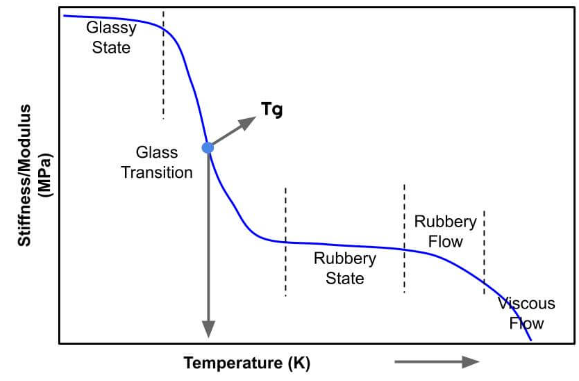
TG full form in PCB is glass transition temperature. In PCB material engineering, it is usually written as Tg, not TG, and it describes the temperature range where the resin system in a PCB laminate changes from a hard, glass-like condition to a softer, more flexible state.

For engineers and buyers, Tg is not just a material label. It affects dimensional stability, plated through-hole reliability, soldering performance, delamination risk, and long-term service life. When a PCB will face lead-free reflow, high operating temperature, dense multilayer construction, automotive electronics, power modules, or harsh environments, selecting the right Tg value becomes a practical reliability decision.
TG Full Form in PCB

What Is the TG Full Form in PCB Materials?

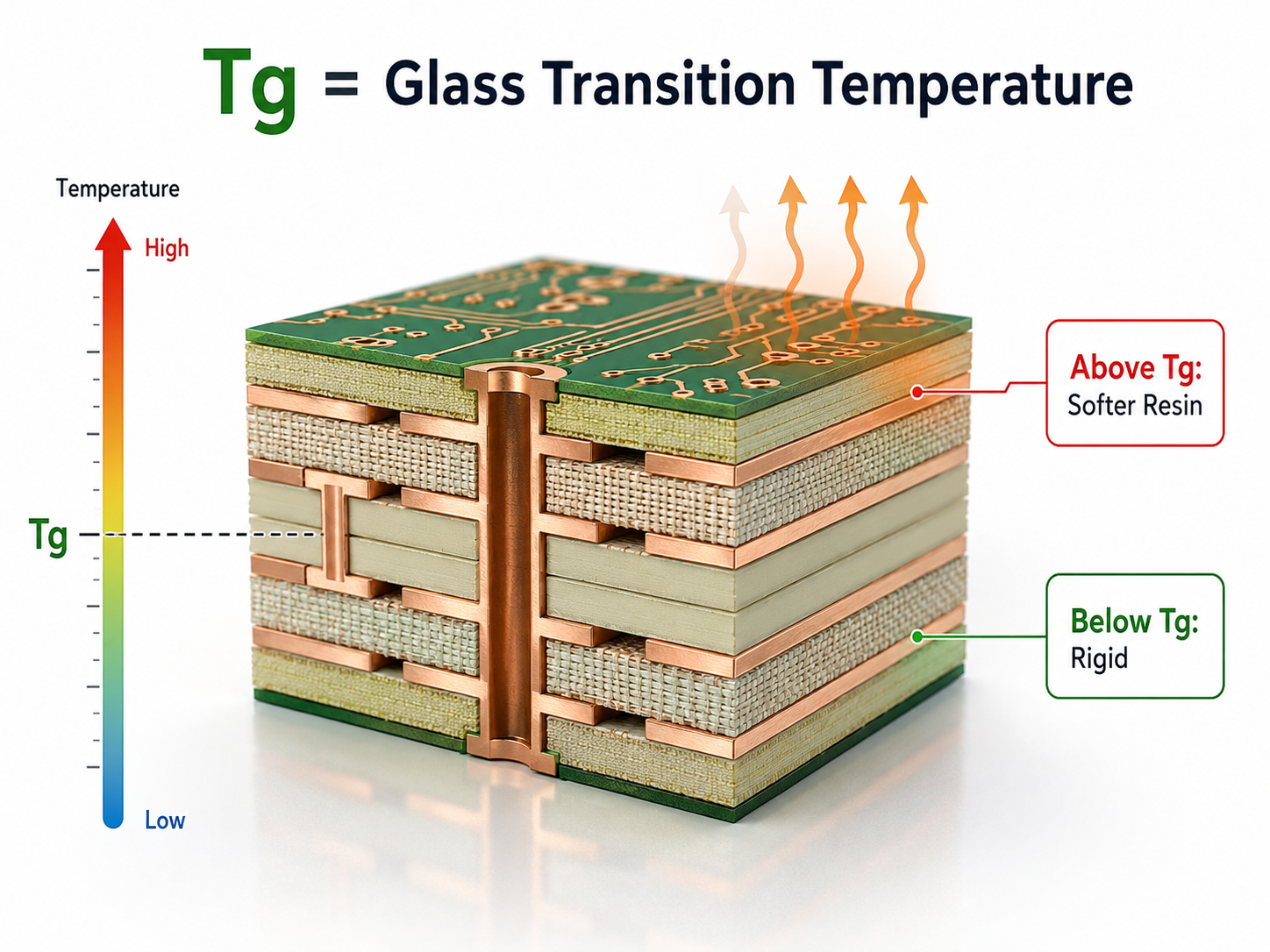
The TG full form in PCB materials is glass transition temperature. It refers to the temperature region where the polymer resin inside the laminate begins to lose stiffness and becomes more rubber-like.

Most common FR4 PCB materials are made from woven glass fabric and epoxy resin. The glass fiber provides mechanical reinforcement, while the resin bonds the structure together. When the board temperature stays below Tg, the laminate remains relatively rigid and dimensionally stable. When the temperature approaches or exceeds Tg, the resin expands faster, softens, and becomes more vulnerable to mechanical and thermal stress.

This does not mean the PCB melts at Tg. A PCB laminate does not suddenly turn into liquid. Instead, its mechanical behavior changes. That is why Tg should be understood as a reliability threshold, not a simple maximum working temperature.

Why Does Tg Matter in PCB Design and Manufacturing?

Tg matters because it influences how well a PCB survives heat during assembly, operation, and environmental stress. A board with insufficient Tg may still pass a quick electrical test, but it can become less stable after repeated thermal exposure.

During PCB assembly, especially lead-free soldering, the board may experience peak reflow temperatures around 245–260°C depending on solder paste profile, component type, and thermal mass. Although the exposure time is short, the laminate must tolerate high thermal strain without delamination, excessive expansion, via cracking, or resin degradation.

In actual manufacturing, Tg becomes more important when the PCB has:

  • Multiple reflow cycles
  • Dense multilayer stack-up
  • Small vias or high aspect ratio plated holes
  • Heavy copper areas
  • Large components with high thermal mass
  • Long operating time near elevated temperature
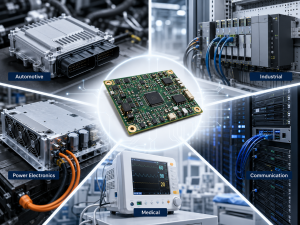
  • Automotive, industrial, power, LED, or communication applications

A proper Tg selection helps the PCB maintain shape, bonding strength, and electrical insulation after heat exposure. It also gives the fabricator a safer process window during lamination, drilling, plating, solder mask curing, and assembly.
Why Does Tg Matter in PCB Design and Manufacturing?

How Does Glass Transition Temperature Work in a PCB Laminate?

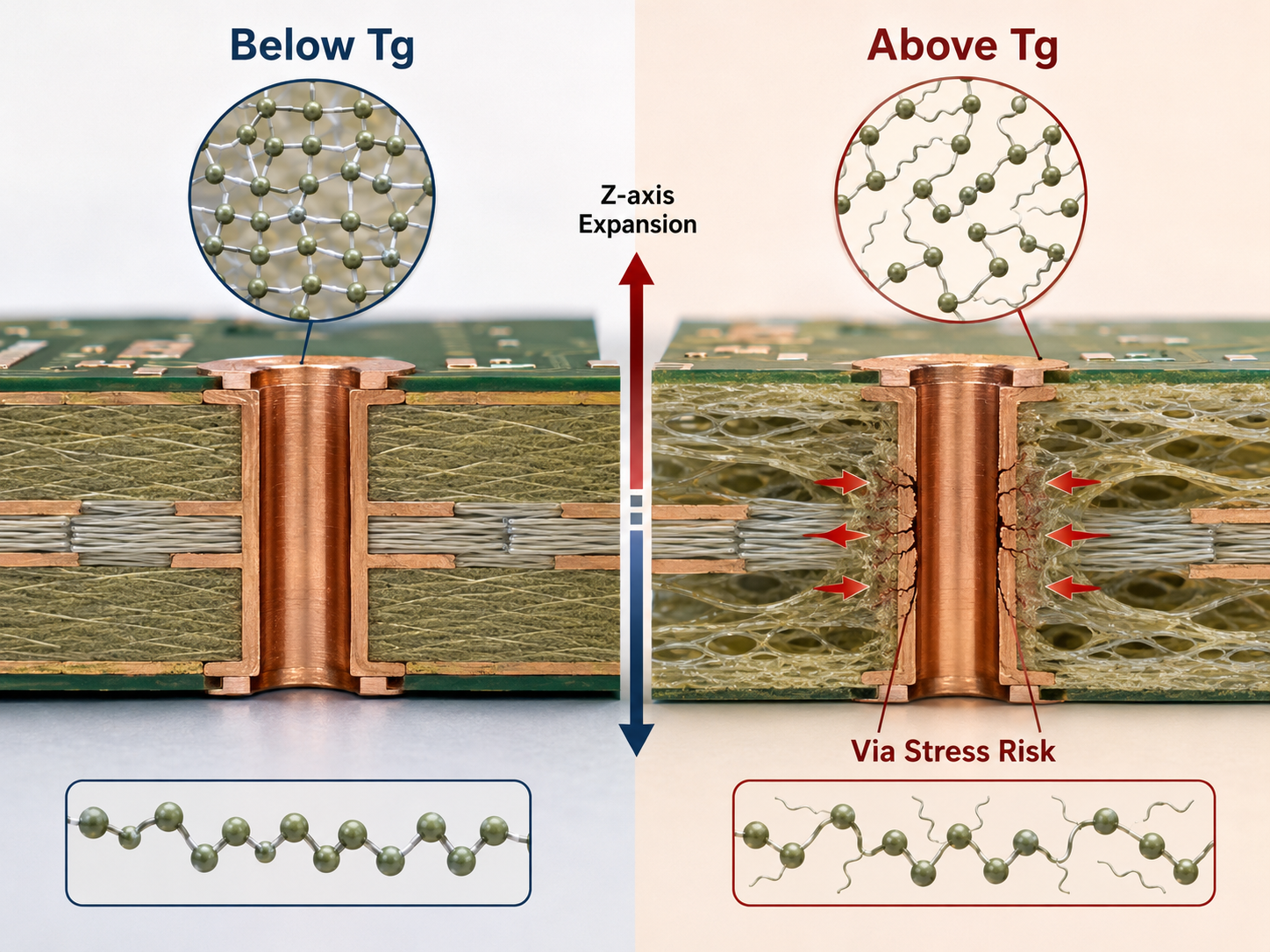
Glass transition temperature works through the resin system inside the laminate. Below Tg, resin molecules have limited movement, so the material remains stiff. Near and above Tg, molecular movement increases, and the material becomes more flexible.

This change affects several PCB behaviors at the same time. The Z-axis expansion usually increases, meaning the board becomes more likely to expand through its thickness. This is important because plated through holes and vias run through that same irection. When the laminate expands too much, copper barrels may stretch, fatigue, or crack.

Tg also affects warpage control. A laminate that softens too much during high-temperature processing may move unevenly, especially when copper distribution is unbalanced. This can cause assembly problems such as poor solder joint formation, BGA coplanarity issues, or connector misalignment.

In simple terms, Tg tells you when the board material starts to behave differently under heat. Good PCB design does not only ask, “What is the Tg value?” It also asks, “How will this material behave during real production and field use?”
How Does Glass Transition Temperature Work in a PCB Laminate?

What Are the Main Tg Ranges for PCB Materials?

PCB Tg ranges vary by laminate family, resin chemistry, and test method. Many engineers use Tg categories as a quick material selection guide, but the final decision should also consider Td, CTE, copper thickness, layer count, reflow profile, and reliability requirements.

Material CategoryTypical Tg RangeCommon PCB UseRelative CostKey Limitation
Standard FR4About 130–150°CConsumer electronics, simple industrial boards, low to medium thermal demandLowLess suitable for repeated high-temperature exposure
Mid Tg FR4About 150–170°CGeneral multilayer PCB, moderate assembly and reliability requirementsMediumMay not be enough for harsh thermal cycling
High Tg FR4About 170–180°C+Automotive, industrial control, power electronics, dense multilayer boardsMedium to highHigher material cost and more process control required
High-performance FR4 / lead-free laminateAround 180–200°C+ depending on systemHigh-reliability multilayer PCB, multiple reflow cycles, higher thermal stressHighNeeds correct stack-up and lamination control
High-frequency or specialty laminateDepends on material familyRF, microwave, high-speed digital, hybrid stack-upsHighTg alone cannot define RF or signal performance

A higher Tg value is useful, but it is not the only target. For example, a board with high Tg but poor Z-axis CTE may still have via reliability concerns. A lower-loss material may be better for RF design even if its Tg comparison is not the main selection factor.

What Materials Are Used in High Tg PCB Laminates?

High Tg PCB laminates usually use improved epoxy resin systems, multifunctional resin systems, or specialty resin blends. The goal is to improve thermal stability, reduce excessive expansion, and support more demanding assembly conditions.

High Tg FR4

This is the most common option for projects that need better heat resistance while keeping standard PCB fabrication compatibility. It is widely used in industrial electronics, power control boards, automotive modules, and multilayer PCB designs.

Lead-free compatible FR4

Lead-free assembly often requires higher peak soldering temperatures than older tin-lead processes. Lead-free compatible laminates are designed to survive modern reflow profiles with better thermal endurance.

Halogen-free high Tg materials

These materials are selected when environmental compliance or specific customer requirements limit halogen content. They may be used in consumer electronics, industrial control, and export-oriented products.

High-speed and high-frequency laminates

These materials focus on dielectric stability, low loss, controlled impedance, and signal integrity. Tg is still relevant, but Dk, Df, copper roughness, moisture behavior, and stack-up design often become more important.

Polyimide materials

Polyimide laminates offer strong thermal endurance and are used in demanding applications such as aerospace, military electronics, and high-temperature environments. They are usually more expensive and require experienced fabrication control.

Tg, Td, CTE, and MOT: What Is the Difference?

Tg is important, but it should not be read alone. Several thermal parameters work together when evaluating PCB material reliability.

ParameterFull NameWhat It MeansWhy It Matters
TgGlass transition temperatureResin changes from rigid to more flexible behaviorHelps estimate thermal stability and expansion behavior
TdDecomposition temperatureMaterial begins chemical degradation at a defined weight loss levelImportant for lead-free assembly and long-term heat exposure
CTECoefficient of thermal expansionHow much the material expands with temperatureCritical for via reliability, warpage, and thermal cycling
MOTMaximum operating temperatureLong-term operating temperature rating under defined conditionsUseful for application-level safety and service life
T260 / T288Time to delamination at 260°C / 288°CHow long material resists delamination at high temperatureRelevant for soldering and thermal stress screening

A common mistake is choosing a PCB laminate only by Tg. In practice, a reliable board needs balanced thermal properties. For example, a high Tg material with low Z-axis expansion can be better than a material that only looks good on a datasheet headline. For multilayer boards, via reliability is often more closely related to thermal expansion and copper plating quality than to Tg alone.

Standard FR4 vs High Tg PCB: Which One Should You Choose?

Standard FR4 is suitable for many normal electronics. High Tg PCB is a better choice when the design faces higher heat, repeated reflow, dense multilayer construction, or long-term reliability requirements.

Project ConditionStandard FR4 May Be EnoughHigh Tg PCB Is Recommended
Operating temperatureLow to moderateElevated or near thermal limit
Layer count1–4 layers, simple stack-up6 layers or above, dense routing
Assembly processSingle reflow, moderate thermal loadMultiple reflow cycles or high thermal mass
Copper designStandard copper thicknessHeavy copper, large copper planes, power circuits
Via structureSimple through holesHigh aspect ratio vias, dense via arrays, BGA fanout
Product fieldConsumer or basic commercial useAutomotive, industrial, power, LED, telecom, medical equipment
Reliability demandNormal service environmentThermal cycling, vibration, humidity, long service life

If the board only works in a mild environment, high Tg material may not bring enough benefit to justify the added cost. If the board has a dense BGA, power section, high layer count, or harsh operating condition, high Tg material can reduce production risk and improve long-term stability.
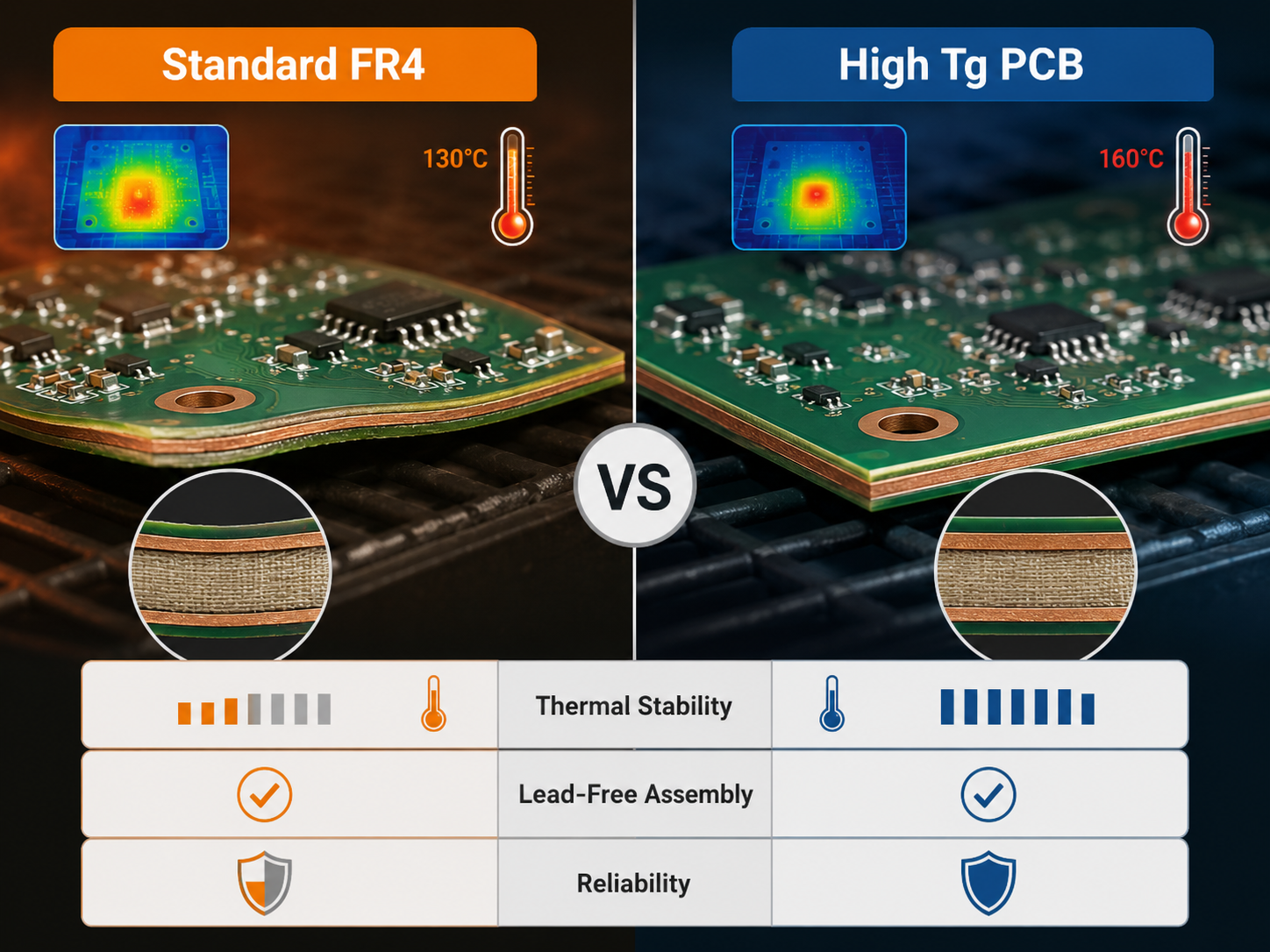
Standard FR4 vs High Tg PCB

Where Are High Tg PCBs Used?

High Tg PCBs are used where heat, density, and reliability meet. They are common in electronics that must operate for long periods without material instability.

Automotive electronics

Engine control units, battery management systems, lighting modules, charging systems, and sensor control boards may face heat, vibration, and thermal cycling. High Tg materials help improve stability during both assembly and field use.

Industrial control systems

Motor drives, PLC modules, power controllers, and automation equipment often work near heat sources or inside enclosed cabinets. High Tg PCB materials support better thermal endurance.

Power electronics

Power supplies, inverters, converters, and high-current control boards may combine heavy copper, large pads, and repeated thermal load. High Tg selection can support better lamination stability and via reliability.

LED lighting and thermal products

High-power LED applications need careful thermal design. In some cases, metal core PCB, ceramic PCB, or copper base PCB may be more suitable than high Tg FR4. Still, high Tg FR4 can be useful for driver boards and control circuits.

Communication and high-speed electronics

Routers, base stations, servers, and high-speed modules need stable dielectric and mechanical performance. Tg is one part of the material decision, along with Dk, Df, impedance control, and copper roughness.

Medical and aerospace-related electronics

For regulated or mission-critical electronics, material consistency and traceability matter. High Tg laminates may be selected when the product requires higher process reliability and long-term environmental stability.
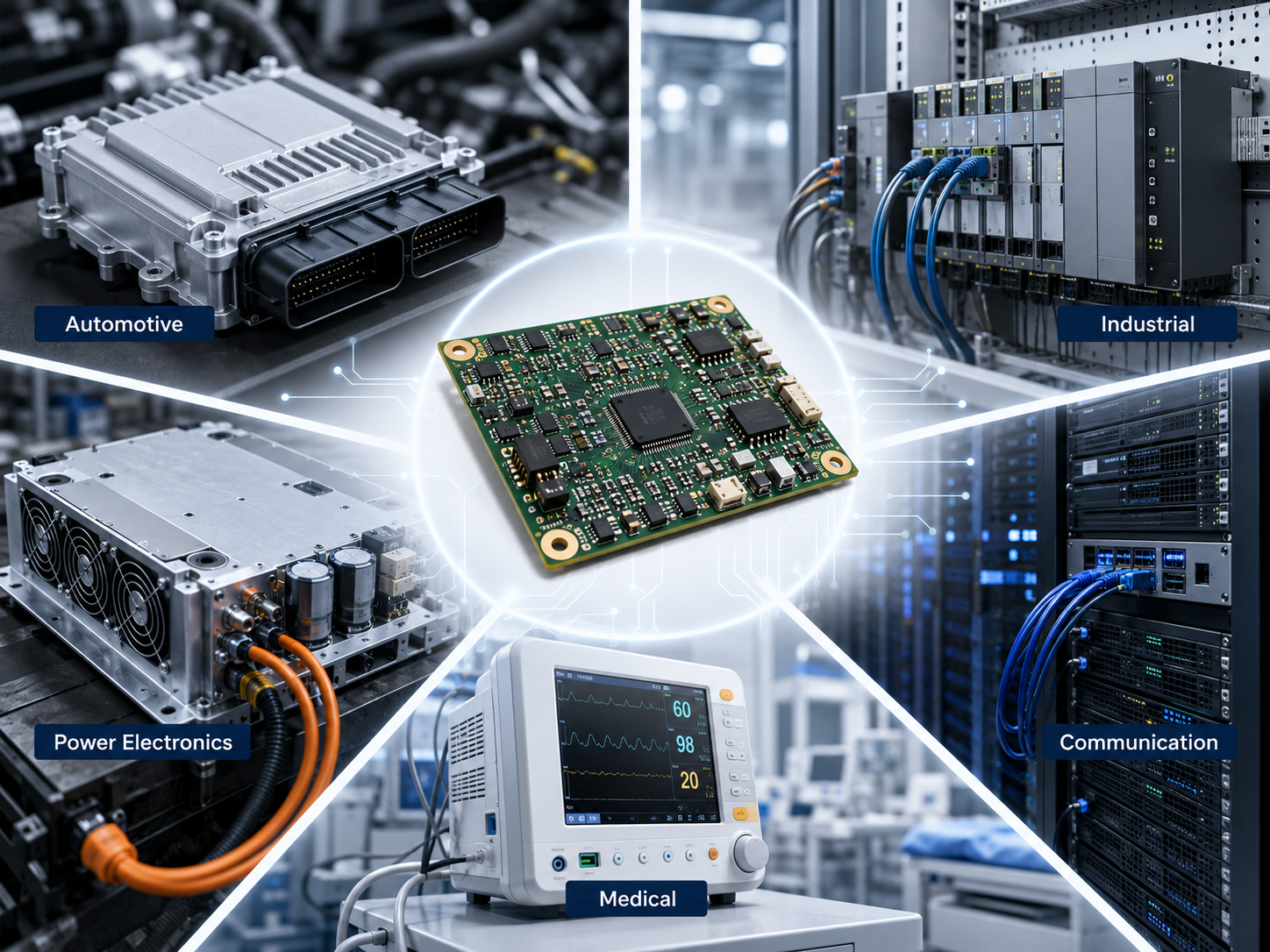
Where Are High Tg PCBs Used?

What Design Rules Help High Tg PCBs Stay Reliable?

High Tg material improves the process window, but design still decides much of the final reliability. A poorly balanced stack-up can create stress even when the material is good.

For high Tg PCB design, engineers should review these points before fabrication:

  • Keep the stack-up symmetrical to reduce warpage.
  • Balance copper distribution between layers where possible.
  • Avoid extreme copper imbalance around large planes and open areas.
  • Confirm dielectric thickness for impedance and lamination stability.
  • Use proper annular ring and drill-to-copper clearance.
  • Avoid unnecessary high via aspect ratios.
  • Add thermal relief only where solderability requires it.
  • Match material Tg, Td, and CTE with the assembly profile.
  • Define controlled impedance requirements clearly.
  • Specify IPC class and acceptance criteria when reliability is critical.

BGA areas need special attention. The fabricator should review pad size, solder mask defined or non-solder mask defined pads, via-in-pad filling, microvia structure, and flatness. When a board has both high-density routing and high thermal exposure, early DFM review can prevent expensive rework later.

What Manufacturing Controls Matter for High Tg PCB?

High Tg PCB manufacturing requires good control over lamination, drilling, plating, solder mask curing, surface finish, and final inspection. The material is stronger than standard FR4 in thermal behavior, but it still needs correct processing.

Material verification

The laminate and prepreg should match the customer’s required Tg grade, IPC slash sheet, material brand, or approved equivalent. Substitution should not happen without approval when reliability is important.

Lamination profile control

High Tg materials often need proper temperature, pressure, vacuum, and curing time. Poor lamination can lead to voids, weak bonding, or hidden delamination risk.

Drilling and desmear control

High Tg resin systems may behave differently during drilling and hole preparation. Drill quality affects hole wall smoothness, plating adhesion, and through-hole reliability.

Copper plating quality

Vias and plated through holes must have sufficient copper thickness and uniform coverage. Thermal cycling stress often concentrates at copper barrels.

Solder mask and surface finish compatibility

The solder mask and surface finish should match the assembly process. ENIG, immersion silver, immersion tin, OSP, and HASL each have different handling and solderability considerations.

Inspection and testing

AOI, electrical testing, microsection inspection, solderability checks, thermal stress testing, and impedance testing may be required depending on the product class.

A strong factory does not only ask what Tg you want. It checks whether the selected material, stack-up, copper design, drilling structure, and assembly process are aligned.

What Failures Can Happen When Tg Is Chosen Poorly?

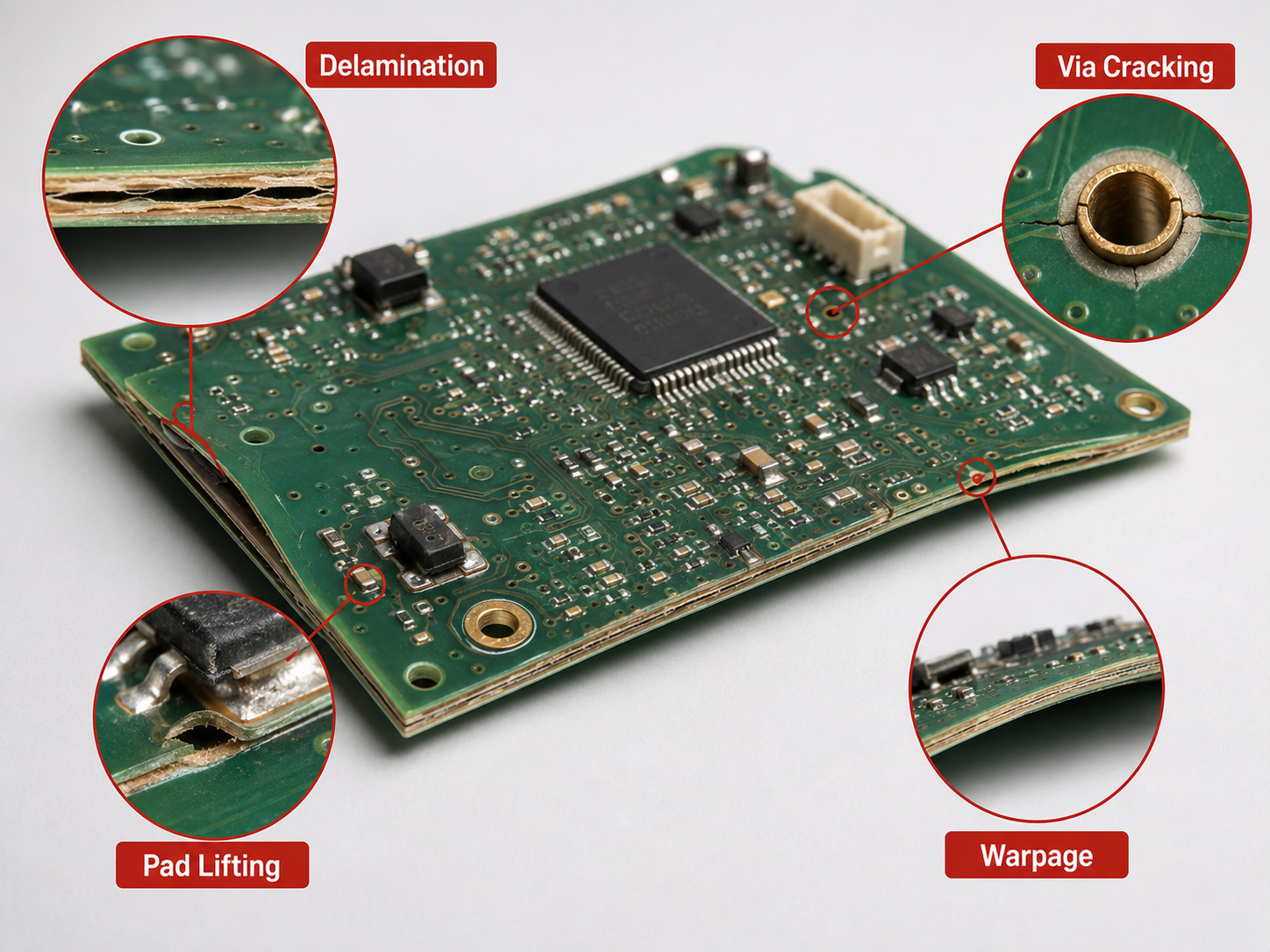
When Tg is too low for the real operating or assembly condition, the PCB may show several reliability issues. Some failures appear during production. Others appear after months of use.

Failure ModePossible CauseTypical SignPractical Prevention
DelaminationResin expansion, weak bonding, excessive heat exposureBlistering, layer separation, popcorn-like damageUse suitable Tg/Td material and controlled lamination
Via barrel crackingHigh Z-axis expansion and thermal cyclingIntermittent open circuit, failed continuity testImprove material CTE, plating thickness, and via design
Pad liftingResin softening and poor copper adhesionPads detach during rework or solderingSelect better laminate and control soldering temperature
WarpageUnbalanced copper, high heat, stack-up asymmetryBGA solder joint issues, assembly flatness problemsBalance stack-up and copper distribution
CAF riskMoisture, voltage bias, poor material or process controlLeakage path between conductorsUse CAF-resistant material and proper spacing or cleanliness control
Solder joint fatigueBoard movement under thermal cyclingCracked solder joints near large componentsImprove material stability and assembly design

Failure analysis should not stop at “material problem.” A Tg-related failure may also involve stack-up design, copper imbalance, moisture absorption, reflow profile, drill quality, plating control, or poor storage. The best solution is a combined review of design files, material certificates, production records, and assembly conditions.

How Much Does a High Tg PCB Cost and How Should Buyers Specify It?

High Tg PCB usually costs more than standard FR4 because the laminate is more expensive and the process may require tighter control. The cost increase depends on material grade, board size, layer count, copper thickness, surface finish, impedance control, tolerance, test requirements, and order quantity.

Buyers should not request only “high Tg” without details. The term can be interpreted differently by different suppliers. A clear RFQ should include:

  • Required Tg value or approved material model
  • IPC-4101 slash sheet if specified by the project
  • Layer count and stack-up
  • Board thickness and tolerance
  • Copper thickness for inner and outer layers
  • Minimum trace width and spacing
  • Minimum hole size and via aspect ratio
  • Surface finish
  • Solder mask color and legend requirements
  • Controlled impedance requirements
  • IPC class requirement
  • Assembly process, if PCBA is included
  • Expected operating environment
  • Quantity, delivery schedule, and testing requirements

For cost control, buyers can ask the supplier to suggest an equivalent material, but the approval should be based on datasheet comparison and project risk. For automotive, medical, aerospace-related, or long-life industrial products, material substitution should be handled carefully.

How to Choose a High Tg PCB Supplier?

A reliable high Tg PCB supplier should understand both material selection and production control. The supplier should be able to review the design before quoting, explain material options, and identify risks that may affect yield or long-term reliability.

When selecting a supplier, check whether they can support:

  • High Tg FR4 and lead-free compatible materials
  • Multilayer PCB stack-up engineering
  • Controlled impedance design and testing
  • Heavy copper and thermal design review
  • Via reliability control and microsection inspection
  • Material traceability
  • AOI and electrical testing
  • PCBA support if assembly is required
  • Engineering feedback before mass production
  • Stable delivery for prototypes and batch orders

For overseas buyers sourcing from China, the key is not to find the lowest material quote. The stronger approach is to choose a source factory that can review manufacturability, confirm material availability, provide clear communication, and support both prototype and mass production. This reduces the risk of redesign, rework, delayed delivery, and hidden quality issues.

Best Technology supports custom PCB and PCBA manufacturing for FR4 PCB, high Tg PCB, multilayer PCB, heavy copper PCB, metal core PCB, ceramic PCB, flexible PCB, rigid-flex PCB, high-frequency PCB, and turnkey assembly projects. For projects with thermal stress or long-term reliability requirements, our engineering team can review your Gerber files, stack-up, copper thickness, material needs, and assembly conditions before quotation.

Frequently Asked Questions

Q1: What is the TG full form in PCB?

A1: TG full form in PCB is glass transition temperature, commonly written as Tg. It describes the temperature range where the resin in a PCB laminate changes from a hard, glass-like state to a softer and more flexible state. It is important because this change affects expansion, rigidity, warpage, via reliability, and heat resistance during soldering and product operation.

Q2: Is Tg the same as melting temperature?

A2: No. Tg is not the melting temperature. PCB laminate resin does not simply melt at Tg. Instead, it changes mechanical behavior and becomes less rigid. The board may still remain solid, but its expansion and stress behavior can change noticeably. This is why Tg is used as a reliability indicator rather than a melting point.

Q3: What is considered a high Tg PCB?

A3: In many PCB projects, high Tg PCB usually refers to laminates with Tg around 170°C or higher, although some suppliers classify high Tg above 180°C depending on the material system and test method. The safest way is to specify the exact Tg value, material model, or IPC material requirement instead of using only the phrase “high Tg.”

Q4: Do all PCB projects need high Tg material?

A4: No. Standard FR4 is suitable for many consumer, commercial, and low-thermal-stress applications. High Tg material becomes more valuable when the PCB has high operating temperature, multiple reflow cycles, dense multilayer structure, heavy copper, high via density, or stricter reliability requirements. The best choice depends on product environment, not only material grade.

Q5: Why is high Tg PCB more expensive?

A5: High Tg PCB is more expensive mainly because the laminate costs more and fabrication may need tighter process control. Cost can also increase with layer count, copper thickness, controlled impedance, surface finish, material brand, testing requirements, and delivery urgency. However, in high-reliability products, the added material cost may reduce failure risk and rework cost.

Call to Action

TG full form in PCB is glass transition temperature, and its real value is in helping engineers and buyers judge thermal reliability. A suitable Tg value can support better dimensional stability, stronger via reliability, safer lead-free assembly, and longer product life. Still, Tg should always be evaluated together with Td, CTE, copper design, stack-up, assembly profile, and operating environment.

For selection, standard FR4 is practical for mild applications, while high Tg PCB is better for dense multilayer boards, power electronics, automotive modules, industrial control systems, and products exposed to repeated heat. For procurement, the most important step is to define material requirements clearly and choose a supplier that can review manufacturability before production.

If you need high Tg PCB, FR4 PCB, multilayer PCB, heavy copper PCB, metal core PCB, ceramic PCB, rigid-flex PCB, or turnkey PCB assembly, you can send your Gerber files, stack-up, material requirements, copper thickness, surface finish, quantity, and application details to our engineering team at sales@bestpcbs.com for technical review and quotation. 
You may also like

High Tg PCB
Friday, April 10th, 2026

High Tg PCB is designed for electronic products that need better thermal stability, stronger dimensional control, and more reliable performance under heat. Compared with standard FR4 materials, high Tg PCB laminates maintain better mechanical integrity during elevated operating temperatures, repeated soldering cycles, and demanding thermal environments.

At EBest Circuit, we manufacture custom high Tg FR4 PCBs for customers in automotive, industrial control, LED lighting, power electronics, telecom, and other heat-sensitive applications.

Send your Gerber files, stackup, quantity, and material requirements to sales@bestpcbs.com for a fast quotation and engineering review.

What Is High Tg PCB?

Tg stands for Glass Transition Temperature. It is the temperature at which the PCB base material changes from a hard, glass-like state to a softer, rubber-like state. A high Tg PCB typically uses laminate materials with a Tg above 170°C, making it more suitable for thermal-intensive applications than standard FR4.

This type of PCB is widely used in products where heat is part of the design challenge, not just an occasional condition. That includes automotive electronics, industrial systems, LED modules, power conversion devices, telecom equipment, and other assemblies exposed to repeated or continuous thermal stress.

What Is High Tg PCB?

Why Choose High Tg PCB?

When the operating temperature of a PCB rises beyond the normal range, standard FR4 may no longer provide enough stability. Once the board temperature exceeds its Tg point, the substrate begins to soften, which can increase expansion, reduce dimensional stability, and affect long-term reliability. High Tg PCB materials help reduce these risks by offering better resistance to thermal stress.

A high Tg board is commonly selected when your project requires:

  • Better heat resistance during operation
  • Improved stability during lead-free soldering
  • Stronger resistance to thermal cycling
  • Lower risk of warpage in multilayer structures
  • More reliable performance in demanding environments

In practical design, the Tg value of the PCB material should usually remain above the real working temperature to give the product a better reliability margin.

Standard FR4 vs High Tg FR4

Choosing between standard FR4 and high Tg FR4 depends on the actual thermal load of the product, not only on board cost.

Material GradeTypical Tg ValueTypical Use
Standard FR4130–140°CGeneral electronics
Mid Tg FR4Around 150°CModerate thermal demand
High Tg FR4Around 170°C or aboveHigh-temperature and high-reliability designs

High Tg FR4 is often preferred when the design involves multiple lamination cycles, multilayer structures, higher soldering temperatures, stronger thermal stress during assembly, or elevated working temperatures during long-term operation.

Key Benefits of High Tg PCB

Better Thermal Stability

High Tg materials can withstand higher temperatures without softening as quickly as standard materials. This helps the board remain more stable during operation and assembly.

Lower CTE

A lower coefficient of thermal expansion helps reduce stress on copper circuits, plated holes, solder joints, and mounted components.

Improved Mechanical Strength

High Tg laminates offer better dimensional stability under thermal cycling, which is important in products exposed to repeated heating and cooling.

Enhanced Reliability

These materials are widely used in industrial, automotive, aerospace, and other harsh-environment electronics because they support more stable long-term performance.

Better Dimensional Stability

High Tg materials show smaller dimensional change under high temperature and humidity, which helps reduce manufacturing and reliability issues caused by environmental variation.

Key Benefits of High Tg PCB

High Tg PCB Materials We Can Support

Different projects require different material systems. We can support a wide range of high Tg laminate options based on your application, stackup, and reliability target.

For standard high Tg FR4 projects, S1170 is often used when the customer does not specify a laminate brand.

What Parameters Matter in a High Tg FR4 Datasheet?

When selecting a high Tg PCB material, engineers and buyers should review more than just one Tg number. Important parameters include:

  • Tg value
  • CTE
  • Dielectric constant
  • Flammability rating, typically UL94 V-0
  • Thermal stability in actual application conditions

These values help determine whether the material fits the electrical, mechanical, and thermal requirements of the final product.

For specific datasheet of high Tg materials, please download:

  • Download (PDF) S1170 Download (PDF) S1000-2 Download (PDF) FR406
  • Download (PDF) FR408
  • Download (PDF) IS410
  • Download (PDF) DS370HR
  • Download (PDF) N4000-6
  • Download (PDF) N4000-11
  • Download (PDF) Rogers 4350B

Tg vs Td: What Is the Difference?

Tg is the temperature where the PCB material begins to soften and lose rigidity. It mainly affects mechanical behavior and dimensional stability.

Tg vs Td: What Is the Difference?

Td, or decomposition temperature, is the point where the material starts to chemically break down. This is irreversible and can cause permanent board failure.

PropertyTgTd
Full NameGlass Transition TemperatureDecomposition Temperature
Main EffectMechanical softeningChemical breakdown
ReversibleGenerally reversible after coolingNot reversible
Engineering FocusDimensional stabilityMaterial survival limit

Typical Applications of High Tg PCB

High Tg PCB is widely used in applications where thermal reliability matters more than using the lowest-cost standard laminate.

Automotive Electronics

Suitable for control units, lighting electronics, and other systems exposed to elevated temperatures and repeated thermal cycling.

Industrial Controls

Supports stable performance in control systems that operate in demanding factory or field environments.

LED Lighting

Offers better thermal tolerance than standard FR4 in LED modules and lighting drivers with higher heat dissipation needs.

Power Electronics

Useful in designs that handle higher currents, power conversion loads, and continuous heat generation.

Telecom Equipment

Supports more reliable operation in communication systems where thermal stability can affect performance consistency.

Aerospace and Harsh Environments

Applicable in electronics that require stronger reliability under wide temperature swings and long service cycles.

Our High Tg PCB Manufacturing Capabilities

ItemCapability
Product TypeHigh Tg FR4 PCB, multilayer PCB, custom thermal-stable PCB
Material OptionsShengyi, Isola, Hitachi, Nelco, Rogers and other specified brands
Order VolumePrototype, pilot run, and mass production
Support ServiceEngineering review, material selection support, DFM assistance
Application CoverageAutomotive, industrial, LED, telecom, power electronics, aerospace-related projects
Supply SupportChina and Vietnam factory support for global customers

When Should You Consider Ceramic Instead?

High Tg FR4 is a strong upgrade over normal FR4, but it is not the right answer for every thermal design. If the board working temperature rises far beyond the normal range of high Tg FR4, such as in very high-temperature power or special industrial environments, ceramic PCB may be the better solution.

High Tg PCB is stronger than standard FR4, more cost-effective than ceramic in many applications, and suitable for a wide range of industrial and commercial electronics.

Why Work With EBest Circuit for High Tg PCB?

  • 20+ years of PCB manufacturing experience
  • Custom high Tg PCB support for different industries and reliability levels
  • Quick-turn prototype service
  • Flexible order quantities
  • Engineering support for material and stackup review
  • Strict quality control during fabrication
  • China and Vietnam factory support
  • Convenient export quotation support for overseas customers

For OEMs, EMS providers, and purchasing teams, a reliable high Tg PCB supplier should do more than fabricate the board. The supplier should also help confirm whether the selected material, structure, and production route truly match the end-use temperature and reliability target.

Custom High Tg PCB Services

We can support high Tg PCB projects for:

  • Prototype builds
  • Pilot runs
  • Mass production
  • Multilayer high Tg FR4 boards
  • High-temperature industrial control boards
  • Automotive-grade thermal-stable PCB projects
  • LED and power electronics boards
  • Application-specific material selection support

If your project already has Gerber files, stackup details, and material requirements, we can quote directly. If not, our engineering team can help review the design and recommend a suitable high Tg option based on temperature, process, and cost targets.

FAQs About High Tg PCB

What is considered a high Tg PCB material?

In most PCB applications, materials with a Tg around 170°C or higher are considered high Tg materials.

Is high Tg FR4 better than standard FR4?

For higher-temperature or high-reliability applications, yes. High Tg FR4 offers better thermal stability and dimensional control than standard FR4.

Can high Tg PCB be used for LED applications?

Yes. High Tg PCB is often used in LED products that generate more heat than general electronic assemblies.

What is the difference between Tg and Td?

Tg is the temperature where the material softens. Td is the temperature where the material starts to decompose chemically.

Is high Tg PCB suitable for multilayer boards?

Yes. High Tg materials are often selected for multilayer boards because they provide better dimensional stability during lamination and soldering processes.

Can you support prototype and mass production orders?

Yes. EBest Circuit supports prototype, pilot, and mass production orders for custom high Tg PCB projects.

Request a Quote for High Tg PCB

Looking for a dependable high Tg PCB manufacturer for your next project?

Send us your Gerber files, stackup, quantity, copper thickness, board thickness, material preference, and application requirements. Our engineering team will review your project and recommend a suitable high Tg PCB solution for both prototype and production.

Email: sales@bestpcbs.com

You may also like

HDI & High TG PCB Solutions for High-Reliability Electronics
Monday, December 22nd, 2025

Why do HDI & high TG PCB solutions matter so much for high-reliability electronics? Because failures rarely come from a single “big” mistake. They often start from small issues: marginal solder joints, microcracks around vias, drift in impedance, or repeated thermal shock.
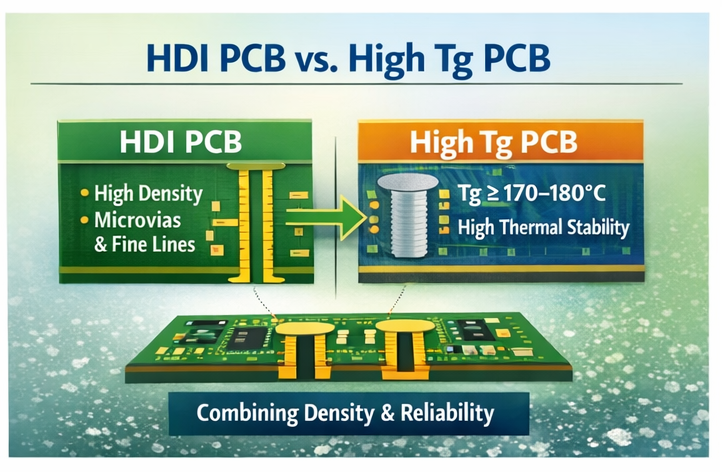
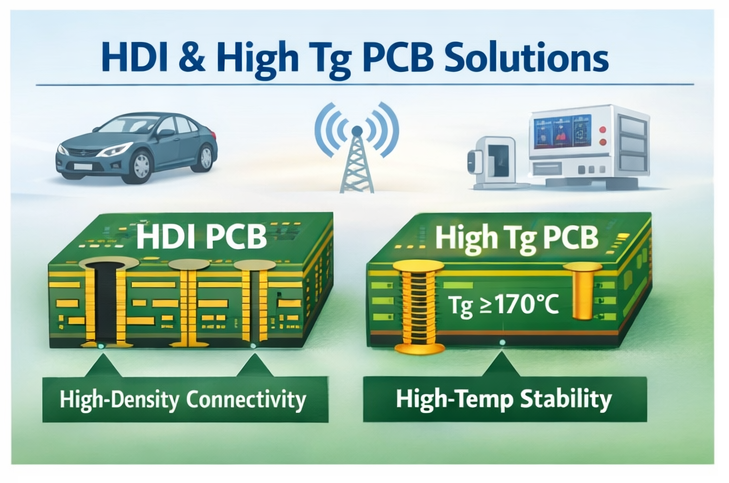
An HDI PCB helps by shortening trace length, controlling impedance, and reducing stubs. A high Tg PCB helps by raising the glass transition temperature, so the board structure stays stable under higher reflow and operating temperatures.

When you integrate both, you gain:

  • Better control of high-speed signals in dense layouts
  • Stronger resistance to repeated lead-free reflow cycles
  • Improved reliability in wide temperature ranges
  • Smaller, lighter boards that still carry complex circuits

For sectors like automotive ADAS, 5G equipment, and industry automation, this combination is often no longer “nice to have”. It becomes a base requirement.

What Are HDI & High Tg PCB Solutions?

HDI & High Tg PCB solutions refer to PCB designs that use high-density interconnection structures together with high-temperature glass transition materials. Rather than treating HDI PCB and high Tg PCB as separate topics, this concept views them as a design “toolbox” that works as a system.

A typical HDI & high Tg PCB stack-up may include:

  • High Tg FR4 or hybrid material core
  • One or more HDI buildup layers with microvias
  • Fine lines and spaces for dense routing
  • Controlled impedance structures for high-speed signals
  • Multiple lamination cycles using high Tg prepregs

These solutions focus on two goals at the same time: interconnection density and temperature endurance. The design approach covers layout rules, via strategy, material selection, and process limits from the start, not as late-stage fixes.

HDI & High TG PCB Solutions for High-Reliability Electronics

What Is an HDI PCB and Why Is It Used in Modern Electronics?

An hdi pcb (High-Density Interconnect PCB) uses finer features and advanced via structures to pack more circuitry into a smaller area. You will often see:

  • Microvias (laser-drilled) between layers
  • Sequential build-up (1+N+1, 2+N+2, 3+N+3, and so on)
  • Fine line/space (e.g., 75 ”m/75 ”m or better)
  • Via-in-pad for BGA breakout

Modern ICs such as high pin-count BGAs, fine-pitch QFNs, and SiP modules simply cannot be routed on old-style 1-via-per-pin layouts. HDI PCB structures shorten critical paths, reduce via stubs, and keep return paths tight.

Key advantages of hdi pcb in modern designs include:

  • Smaller board size with the same or higher function density
  • Better signal integrity for multi-gigabit links
  • Improved power distribution with dense stitching vias
  • Room for mechanical design freedom in slim devices

Because of this, HDI PCB technology is common in smartphones, tablets, communication modules, automotive radar, and compact industrial controllers.

What Is a High Tg PCB and How Does It Improve Reliability?

A high tg pcb uses laminate with a higher glass transition temperature than standard FR4. Tg is the point where the resin system changes from glassy to rubbery. Above this point, mechanical properties weaken quickly.

In a high Tg PCB, the Tg value might be 170–180°C or higher, instead of around 130–140°C for common materials. This increased Tg gives several benefits:

  • Better dimensional stability during lead-free reflow
  • Lower risk of pad lifting, delamination, or barrel cracks
  • Reduced mechanical stress during temperature cycling
  • Improved long-term reliability in high-temperature service

High Tg PCB materials also tend to have better thermal endurance over time, which helps in automotive under-hood zones, power supplies, motor drives, and LED lighting. They can handle more thermal stress without visible or hidden damage.

What Is a High Tg PCB and How Does It Improve Reliability?

Differences Between HDI PCB and High Tg PCB

HDI and high Tg describe two different aspects of a PCB: one structural, one material. They often coexist, but they are not the same.

AspectHDI PCBHigh Tg PCB
Main focusInterconnect density and routingThermal and mechanical stability
Key featuresMicrovias, fine lines, via-in-padTg ≄ 170–180°C, better thermal endurance
Typical driverFine-pitch BGAs, compact form factorLead-free reflow, high operating temperature
Impact on layoutStrong effect on routing and stack-upModerate; affects stack-up and DFM margin
Impact on reliabilityBetter signal and via performanceLower risk of warpage and delamination
Cost driversLaser drilling, lamination cycles, yieldMaterial price, process window, lamination setup

An HDI PCB can use standard Tg material when the thermal profile is mild. A high Tg PCB can have no HDI features at all if density remains low. When the project pushes both limits, you combine them.

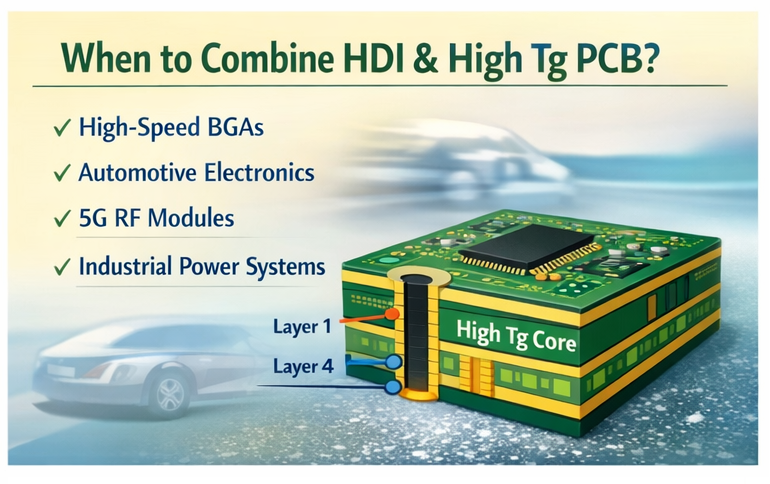
When Should HDI PCB and High Tg PCB Be Combined?

When Should HDI PCB and High Tg PCB Be Combined?

Combining HDI PCB and high Tg PCB makes sense when a design faces both density and thermal stress at the same time. Typical cases include:

  • High-speed compute boards with large BGAs and multiple reflow passes
  • Automotive radar or camera modules near engines or outdoor zones
  • 5G RF front-ends in compact housings with limited airflow
  • Industrial motion control or power electronics running at elevated temperature

You should consider an HDI & high Tg PCB solution if:

  • The layout requires microvias or sequential lamination to escape key components
  • The assembly line uses lead-free profiles with high peak temperature
  • The product will see frequent on-off cycling or wide ambient temperature swings
  • Field reliability and long service life carry high business value

In these scenarios, HDI brings routing freedom and signal quality, while high Tg materials protect the board structure against thermal and mechanical stress.

HDI & High Tg PCB Applications

HDI & high Tg PCB solutions appear in many sectors. Some typical applications are:

  • Automotive electronics: ADAS, camera modules, radar, infotainment, EV control units
  • Telecom and networking: 5G small cells, base stations, high-speed backplanes
  • Industrial control: PLCs, servo drives, motion controllers, sensor hubs
  • Medical devices: Imaging equipment, patient monitoring, compact diagnostic tools
  • Consumer and wearable devices: Smartphones, tablets, smartwatches, AR/VR devices

All these products share common requirements: compact size, strict reliability targets, and long-term stability under shifting loads. HDI PCB structures handle fine-pitch and high-speed paths, while high Tg PCB materials carry the thermal and mechanical burden.

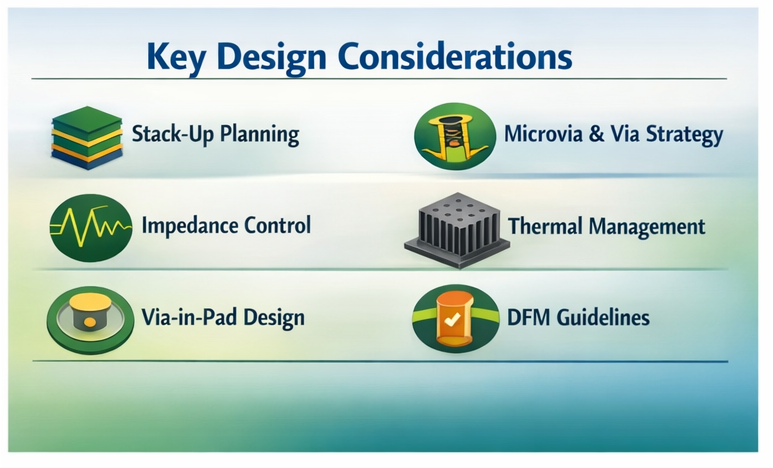
What Are the Key Design Considerations for HDI & High Tg PCB?

Designing HDI & high Tg PCB solutions is not just about choosing a material with higher Tg and shrinking traces. It needs careful coordination between layout, stack-up, and process limits. Key points include:

What Are the Key Design Considerations for HDI & High Tg PCB?

1. Stack-up planning early

    Decide the HDI level (1+N+1, 2+N+2, etc.), copper thickness, and layer count early. Include high Tg material data, Dk/Df values, and lamination constraints in the first draft.

    2. Microvia and buried via strategy

    Keep microvia aspect ratios within the fabricator’s safe range. Use staggered rather than stacked microvias when reliability priority is high, unless the project can support enhanced filling processes.

    3. Impedance control with high-speed pairs

    High-density routing often pushes traces close together. Work with the fabricator to set precise trace width and spacing for each impedance class, considering the actual dielectric constant of the high Tg material.

    4. Thermal management and copper balance

    High Tg PCB materials support higher temperature, but heat still needs paths. Balance copper areas across the panel to reduce warpage. Provide solid ground planes, thermal vias, and clear heat paths.

    5. Solder mask and via-in-pad design

    When using via-in-pad on HDI pads, confirm filling and capping processes. Poorly filled vias can trap flux or reduce solder joint strength.

    6. Design for manufacturability (DFM)

    Follow the manufacturer’s design rules for minimum line/space, annular ring, drill size, and pad shapes. Good DFM work reduces scrap and supports stable quality.

    What Manufacturing Challenges Exist in HDI & High Tg PCB?

    Manufacturing HDI PCB involves several engineering challenges because the process pushes the limits of micro-fabrication, interlayer reliability, material control, and inspection accuracy. Each stage demands strict tolerance management to keep performance stable in high-density layouts.

    • Microvia and blind-via drilling accuracy is difficult because HDI requires via diameters

    below 0.15 mm. Laser drilling must stay stable and precise to avoid rough walls, incomplete holes, or weak plating that may cause electrical issues in stacked via structures.

    • Layer-to-layer registration and lamination control demand micron-level alignment.

    High-order HDI needs multiple lamination cycles, and any shift in imaging, resin flow, or pressure can create opens, shorts, or signal loss.

    • Fine-line etching becomes harder as line width and spacing drop to 3 mil or less. Thin

    traces are sensitive to under-etching or over-etching, and thicker copper (4–10 oz) makes precise control even more challenging.

    • Plating and via filling must deliver uniform copper to keep interconnections stable.

    Voids, trapped gas, or uneven filling weaken microvias and reduce long-term reliability, especially when the design needs high breakdown voltage.

    How EBest Circuit (Best Technology) Supports HDI & High Tg PCB Solutions?

    EBest Circuit (Best Technology) supports HDI & High Tg PCB Solutions from early design review through mass production and assembly. Our team focuses on turning demanding ideas into stable, repeatable products.

    • Engineering and DFM for HDI and high Tg

    Our engineers review your stack-up, HDI level, and component layout at the start. We suggest suitable high Tg materials, via strategies, and impedance structures based on your performance and cost targets.

    • HDI PCB manufacturing capability

    We support fine line and space routing, laser-drilled microvias, via-in-pad, and multi-step lamination. Typical HDI builds such as 1+N+1, 2+N+2, and higher structures can be handled with controlled registration and repeatable yields.

    • High Tg and advanced materials

    We work with well-known high Tg PCB laminates and can also support hybrid builds for projects that need both RF and digital performance. Material selection focuses on Tg, Td, Dk/Df, and reliability under your real reflow profile.

    • PCBA assembly with process control

    EBest Circuit (Best Technology) provides SMT and through-hole assembly for HDI and high Tg boards in both China and Vietnam. Lead-free profiles, X-ray for BGA, and AOI help keep quality stable for dense layouts.

    • Quality systems and traceability

    Our factories follow ISO9001, ISO13485 for medical, IATF16949 for automotive, and AS9100D for aerospace. We also run MES systems to track each lot from material incoming through final shipment. This supports clear traceability and faster root-cause analysis if any issue appears.

    For buyers who need a long-term partner for HDI & high Tg PCB solutions, this combination of engineering support, HDI process capability, and certified quality systems reduces risk and saves internal effort.

    FAQs about HDI & High Tg PCB Solutions

    1. Is HDI PCB always more expensive than a standard multilayer board?

    HDI PCB usually costs more per panel due to laser drilling, extra lamination, and tighter controls. However, the total product cost can drop because the board is smaller, the BOM can be simplified, and performance improves.

    2. When do I really need a high Tg PCB instead of normal FR4?

    You should consider a high Tg PCB when your design uses lead-free solder, has more than one reflow cycle, or runs in high ambient temperatures. Automotive, power, and industrial products are common cases where high Tg material significantly improves reliability.

    3. Can I use HDI without high Tg material for consumer products?

    Yes. Many consumer devices use hdi pcb structures on mid-range Tg materials because their operating temperature is moderate and lifetime targets are shorter. The decision depends on your thermal profile and reliability goals.

    4. Are stacked microvias less reliable than staggered ones?

    Stacked microvias can be reliable when the process is well controlled, but they need stricter plating and filling quality. For very harsh environments, many designers still prefer staggered microvias for extra margin, unless dense routing forces stacking.

    5. How early should I involve EBest Circuit (Best Technology) in an HDI & high Tg PCB project?

    The best time is before you freeze the stack-up and routing strategy. Early DFM and material discussion help avoid later redesign, reduce risk, and shorten the path from prototype to stable mass production.

    If you are planning a new design that needs smaller size, higher speed, and stronger thermal performance, HDI & High Tg PCB Solutions may be the right direction. You can share your Gerber files, stack-up ideas, or even just a concept, and EBest Circuit (Best Technology) will help you evaluate practical options, costs, and timelines for your next project.

    You may also like

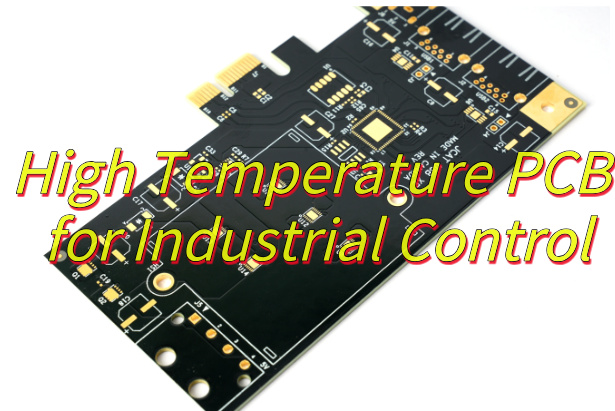
    High Temperature PCB for Industrial Control
    Wednesday, June 25th, 2025

    Looking for high temperature PCB for your project? This article explores high-temperature PCB solutions from material selection to thermal management and cost-performance optimization for harsh environments.

    18-Year High Temperature PCB Manufacturing Expert | Rapid Prototyping & Precision Assembly Your Hardware Accelerator!

    PCB Manufacturing Service Offered include:

    24-Hour Rapid Prototyping: Industry’s Fastest Delivery, 10% Off on Rush Orders
    Aerospace Grade Quality Control: 6-Layer HDI Board ±0.05mm Accuracy, 100% AOI Full Inspection
    Full-Stack Services: From Design Review to Mass Assembly, Direct Supply from ISO-Certified Factory

    Order Now and Get a Free DFM Analysis Report, Making Your IoT/Industrial Control Projects One Step Ahead! Contact us now: sales@bestpcbs.com.

    What Is High Temperature PCB?

    High temperature PCBs or High Tg PCBs are specialized circuit boards designed to operate reliably in industrial environments with elevated temperatures. These boards utilize thermally stable materials such as polyimide-based substrates and high-temperature laminates that maintain structural integrity and electrical performance at sustained temperatures between 150°C and 250°C.

    In industrial control systems, these PCBs feature enhanced copper plating for better heat dissipation and modified dielectric materials that prevent thermal degradation. The manufacturing process incorporates precise thermal management techniques to ensure consistent performance in applications like factory automation, power electronics, and process monitoring equipment.

    Their ability to withstand thermal cycling and harsh operating conditions makes them indispensable for industrial applications where standard PCBs would experience premature failure due to heat-related stress or material breakdown. The design considerations include optimized trace layouts and robust interlayer connections to maintain signal integrity under continuous thermal load.

    What Is High Temperature PCB?

    What Is Material of High Temperature PCB?

    Material of high temperature PCB:

    • Polyimide Resins – The most common base material for high temperature PCBs, offering continuous operation up to 260°C with excellent chemical resistance and mechanical stability.
    • Ceramic-Filled PTFE Composites – Provide superior thermal conductivity while maintaining electrical insulation properties, ideal for high-frequency applications in industrial environments.
    • High Tg FR-4 Variants – Fiberglass-reinforced epoxy laminates with glass transition temperatures above 170°C, suitable for cost-sensitive applications with moderate heat requirements.
    • Thermally Conductive Prepregs – Specialized bonding layers that maintain adhesion at elevated temperatures while facilitating heat transfer between board layers.
    • Heavy Copper Foils – Thicker copper layers (2-20 oz) that enhance current carrying capacity and improve heat dissipation across the circuit board.
    • High Temperature Solder Masks – Modified coatings that withstand repeated thermal cycling without cracking or discoloration, protecting underlying circuits.
    • Metal Core Substrates – Aluminum or copper bases that function as integrated heat spreaders, particularly valuable for power electronics in industrial controls.
    • Ceramic Substrates – Used in extreme environments, offering unmatched thermal performance with operating temperatures exceeding 350°C.
    • Specialty Thermoplastics – Materials like PEEK and PEI that combine high temperature resistance with chemical inertness for harsh industrial applications.

    When to Use High Tg PCB?

    Below are when to use high Tg PCB:

    • Lead-Free Soldering Processes‌: When manufacturing requires RoHS-compliant lead-free soldering (peak temperatures 250-260°C), standard FR-4 (Tg 130-140°C) risks delamination. High Tg materials (Tg ≄ 170°C) maintain structural integrity during repeated thermal cycles.
    • High-Power Industrial Equipment‌: For motor drives, power converters, or servo controllers with concentrated heat generation, high Tg substrates resist warping and prevent copper trace separation caused by prolonged operation above 120°C.
    • Multi-Layer Board Designs‌: Complex industrial PCBs with 8+ layers demand high Tg prepregs to withstand lamination temperatures while ensuring interlayer bonding strength, reducing via cracking risks during thermal expansion.
    • Harsh Environment Operations‌: In facilities like foundries or chemical plants where ambient temperatures exceed 100°C, high Tg materials (preferably Tg > 180°C) prevent resin softening and preserve dielectric properties.
    • Extended Product Lifespan Requirements‌: Industrial automation systems with 10+ year service expectations benefit from high Tg PCBs’ slower thermal degradation rates, minimizing insulation resistance decline over time.
    • Thermal Cycling Conditions‌: Applications experiencing frequent temperature fluctuations (e.g., outdoor control cabinets, metal processing machinery) require high Tg substrates to resist cumulative CTE mismatch damage.
    • High-Density Component Mounting‌: Boards with fine-pitch BGAs or miniaturized components need high Tg materials’ superior dimensional stability to maintain alignment during assembly and operation.
    When to Use High Tg PCB?

    How to Optimize High Temperature PCB Design for Efficient Heat Dissipation?

    Methods about how to optimize high temperature PCB design for efficient heat dissipation:

    Select Thermally Conductive Substrates

    • Use High Temperature PCB Design materials like aluminum-backed or copper-clad laminates to enhance heat transfer away from components. These substrates often feature thermal conductivity ratings exceeding 1.0 W/m·K, significantly reducing hotspot formation in power-intensive industrial controls.

    Incorporate Thick Copper Traces

    • Design traces with 2–3 oz/ftÂČ copper thickness to minimize electrical resistance and heat generation in high-current paths. This approach is critical for motor drives or power supplies, where thinner traces would otherwise act as focal points for thermal stress.

    Strategically Place Heat-Generating Components

    • Position components like MOSFETs, diodes, or inductors near thermal vias or metallic cores. Aligning these elements with PCB edges or dedicated heat sinks ensures direct heat dissipation into chassis mounts, preventing thermal runaway in enclosed industrial enclosures.

    Leverage Thermal Vias and Ground Planes

    • Implement staggered arrays of thermal vias (0.2–0.3 mm diameter) beneath high-power devices to spread heat across inner ground planes. This technique reduces localized temperature spikes by 15–20% in multilayer boards used for factory automation controllers.

    Optimize Component Spacing and Airflow

    • Maintain minimum clearances of 3–5 mm between heat-sensitive components and heat sources. Pair this with forced-air cooling channels or natural convection pathways to lower junction temperatures by 25–30% in compact industrial IoT gateways.

    Use Thermal Interface Materials (TIMs)

    • Apply phase-change pads or graphite sheets between PCBs and heat sinks to reduce thermal resistance. TIMs with 3–5 W/m·K conductivity improve heat transfer efficiency in power generation control modules operating at 180°C ambient temperatures.

    Simulate and Validate Thermal Performance

    • Conduct computational fluid dynamics (CFD) simulations early in the High Temperature PCB Design phase to identify hotspots. Iterate on copper weights, via placements, and component orientations based on simulation data to ensure compliance with industrial thermal standards.

    Why Choose High Temperature PCB for Industrial Control?

    Reasons why choose high temperature PCB for industrial control:

    Uninterrupted Operation in Extreme Heat

    • High temperature PCBs ensure industrial control systems function reliably in environments exceeding 150°C, such as near furnaces, engines, or solar inverters. By resisting thermal degradation, they minimize unexpected downtime, directly reducing production losses and maintenance costs.

    Extended Service Life

    • Materials like polyimide and ceramic-reinforced laminates resist cracking, delamination, and solder joint fatigue under repeated thermal cycling. This durability translates to fewer replacements and lower lifecycle costs for equipment in power plants or automated manufacturing lines.

    Stable Signal Integrity

    • Dielectric formulations in High temperature PCBs maintain consistent electrical properties despite prolonged heat exposure. This prevents timing errors or data corruption in precision control systems, safeguarding product quality and operational safety.

    Resistance to Harsh Chemicals

    • Industrial environments often involve oils, solvents, or corrosive gases. High temperature PCBs with chemically inert coatings and sealed edges resist corrosion, reducing the need for protective enclosures and frequent inspections.

    Compliance with Safety Standards

    • Using high temperature PCBs helps meet stringent industry certifications (e.g., UL 94V-0 for flame resistance) without additional modifications. This streamlines regulatory approvals for medical devices, aerospace components, or heavy machinery.

    Cost-Effective Performance at Scale

    • While high temperature PCBs may have a higher upfront cost, their ability to withstand thermal stress reduces long-term expenses related to repairs, replacements, and production delays. For high-volume industrial applications, this ROI becomes evident within 2–3 years.
    Why Choose High Temperature PCB for Industrial Control?

    How to Maintain Signal Integrity in High Temperature PCB Board for PLC Control System?

    Methods about maintaining signal integrity in high temperature PCB board for PLC control system:

    • Select Low-Loss Dielectric Materials‌: Choose substrates with stable dielectric constants (Dk) and low dissipation factors (Df) across operating temperatures to minimize signal attenuation at high frequencies.
    • Control Impedance with Thermal Compensation‌: Adjust trace width and spacing based on material expansion rates at elevated temperatures to maintain consistent impedance (e.g., 50Ω/100Ω differential) throughout thermal cycles.
    • Shield Sensitive Signals‌: Route high-speed traces (e.g., clock lines, RS-485) between ground planes or use guard traces to reduce crosstalk and EMI, which worsen with temperature-induced noise.
    • Minimize Via Stubs‌: Use blind/buried vias or back-drilling to eliminate stub effects that cause signal reflections, especially critical in multi-layer designs for PLCs.
    • Optimize Power Delivery Networks (PDNs)‌: Decouple power rails with high-temperature-rated capacitors (X7R/C0G) placed close to ICs, ensuring stable voltage despite parasitic inductance changes from heat.
    • Implement Differential Signaling‌: Prefer differential pairs (e.g., CAN, Ethernet) over single-ended traces to reject common-mode noise amplified by thermal interference.
    • Simulate Signal Behavior Under Heat Stress‌: Perform transient thermal analysis combined with SI tools to predict skew, jitter, and eye diagram degradation at peak temperatures.
    • Validate with High-Temperature Testing‌: Characterize signal rise times, BER, and crosstalk while operating the PCB at maximum rated temperature to verify real-world performance.
    How to Maintain Signal Integrity in High Temperature PCB Board for PLC Control System?

    How to Ensure the Reliability of Industrial Control PCB under High Temperature Conditions?

    Methods about how to ensure the reliability of industrial control PCB under high temperature conditions:

    Select Thermally Stable Substrate Materials

    • Choose High Temperature PCB substrates with glass transition temperatures (Tg) exceeding 170°C, such as polyimide or ceramic-filled epoxy. These materials resist softening and dimensional changes at sustained temperatures up to 200°C, ensuring mechanical stability in PLC interfaces or motor drives.

    Optimize Copper Trace Geometry

    • Design traces with 2–3 oz/ftÂČ copper thickness to reduce current density and minimize Joule heating. For example, a 10-mil trace carrying 3A current in a power distribution network will operate 15°C cooler than a 1-oz trace, extending solder joint lifespan in industrial actuators.

    Implement Component Derating

    • Select capacitors, resistors, and ICs rated for 20–30% above maximum operating temperatures. For instance, using X7R dielectric capacitors (rated for 125°C) in 150°C environments prevents capacitance drift by 10% compared to standard components, stabilizing filter circuits in sensor interfaces.

    Enhance Solder Joint Robustness

    • Use SnAgCu (SAC305) solder alloy with 260°C reflow tolerance and apply 5–10% larger solder paste stencils for heat-generating components. This reduces voiding by 40% in BGA packages, preventing solder joint fractures under thermal cycling in VFD controllers.

    Incorporate Thermal Vias and Heat Spreaders

    • Place 0.3 mm diameter thermal vias in 1.5 mm arrays beneath power MOSFETs and voltage regulators to conduct heat to inner ground planes. Pair this with 20-mil copper heat spreaders to lower junction temperatures by 25°C in compact PLC modules.

    Conduct Accelerated Life Testing

    • Subject prototypes to 1,000 thermal cycles (-40°C to 180°C) and 10,000 hours of continuous operation at 150°C. Identify weak points like delamination or parameter drift in analog-to-digital converters (ADCs) early, reducing field failure risks by 60%.

    Apply Conformal Coatings for Environmental Protection

    • Use silicone or parylene coatings with 200°C continuous service ratings to shield against moisture, dust, and chemical contaminants. For example, a 25-ÎŒm parylene layer prevents arc-over in high-voltage relay interfaces exposed to industrial solvents.

    Validate via Computational Fluid Dynamics (CFD)

    • Simulate airflow patterns and temperature gradients in enclosed control cabinets to optimize PCB placement. Adjust spacing between boards and add ventilation slots to lower ambient temperatures by 10–15°C in crowded automation panels.

    How to Balance Performance and Cost in High Temperature Industrial Control PCB Fabrication?

    Below are ways about how to balance performance and cost in high temperature industrial control PCB fabrication:

    Select Cost-Effective High-Temperature Substrates

    • Use FR-4 variants with Tg ≄ 170°C (e.g., ISOLA IS410) for moderate thermal demands or polyimide blends (e.g., Dupont Pyralux AP) for temperatures up to 260°C. These materials offer 25–30% lower CTE than standard FR-4, ensuring solder joint reliability at 15–20% lower cost than exotic ceramics.

    Design Hybrid Layer Stackups

    • Combine high-performance outer layers (e.g., Megtron 6 for signal integrity) with standard FR-4 cores for inner power planes. This reduces material costs by 15–20% while maintaining thermal stability. For example, a 4-layer board using Megtron 6 for outer layers and FR-4 for inner layers achieves 42% lower transmission loss in power distribution networks.

    Optimize Trace Geometry for Current Capacity

    • Use 2–3 oz/ftÂČ copper thickness for high-current paths to minimize Joule heating. For instance, a 15-mil trace carrying 5A reduces temperature rise by 18°C compared to 1-oz copper. Employ thermal simulation tools (e.g., Siemens Simcenter) to identify bottlenecks and adjust trace widths dynamically, avoiding over-engineering.

    Implement Smart Component Placement

    • Position heat-generating components (e.g., MOSFETs, inductors) near thermal vias or board edges to leverage natural convection. Maintain 8–10 mm spacing between hot components and temperature-sensitive ICs to prevent thermal runaway. In PLC control modules, this reduces junction temperatures by 12–15°C.

    Apply Targeted Thermal Management

    • Use 0.3 mm thermal vias in 1.2 mm arrays beneath power devices, lowering thermal resistance by 22%. Apply 20-mil copper heat spreaders only in critical areas (e.g., under BGA packages) rather than entire boards, cutting material costs by 30%. For example, a 50×50 mm copper spreader reduces hotspot temperature by 28°C in motor drive circuits.

    Automate Manufacturing Processes

    • Invest in dual-track reflow ovens with AI-driven temperature profiling. These systems reduce energy consumption by 45% and improve first-pass yield by 5–8% through adaptive heat control. Pair with laser direct imaging (LDI) for ±3ÎŒm linewidth accuracy, eliminating photo tooling costs and reducing setup time by 60%.

    Validate via Accelerated Stress Testing

    • Conduct 500-cycle thermal shock tests (-40°C to 180°C) on prototypes to identify weak points early. Replace failed components with equivalents rated for 20% higher temperatures, adding minimal cost while extending MTBF by 2–3x. For example, using X7R capacitors instead of Y5V in 150°C environments prevents 35% capacitance drift.

    Conclusion

    High-temperature PCBs provide thermal stability, reliability, and signal integrity. Material selection, thermal management, and cost-performance balance are main factors in design. These PCBs are used in PLC systems, automotive electronics, and heavy machinery to prevent delamination, warping, and signal loss under extreme heat.

    For high-temperature PCB solutions, contact ‌EBest Circuit (Best Technology)‌. We offer ‌24/7 rapid prototyping‌, ‌military-grade quality control‌, and ‌free DFM analysis‌ to ensure robust performance. ‌Request a quote today‌ to advance your industrial projects: sales@bestpcbs.com.

    You may also like

    What is FR4 material in PCB? – EBest Circuit (Best Technology)
    Friday, July 12th, 2024

    FR4 is a commonly used material in the printed circuit boards (PCBs) manufacturing. If you’re in the electronics field, you’ve likely heard of it. It is the footstone of a circuit board, provides good mechanical strengthen and electrical insulation properties. Today, we will share informational about FR4 material, its types, advantages and alternatives. Keep reading if you are interested in.

    What is FR4 material in PCB? - EBest Circuit (Best Technology)

    What does FR4 stand for?

    FR4 stands for “Flame Retardant 4”, also called FR-4 Epoxy Glass Cloth by PCB manufacturers. It is not a material name, but a material grade, so there are many types of FR-4 grade materials used in general circuit boards. But most are composites made with so-called Tera-Function epoxy resins plus fillers and glass fibers. FR4 is made from woven glass-reinforced epoxy resin. The typical composition of FR4 includes approximately 60% glass fabric and 40% epoxy resin by weight.

    What is FR4 material in PCB? - EBest Circuit (Best Technology)

    This composite material is known for its high mechanical strength and flame-retardant properties. The “4” in FR4 signifies the level of flame retardancy. It means the material is resistant to catching fire, which is critical in preventing electrical fires in electronic devices.

    What are the classifications of FR4 materials?

    FR4 materials are classified based on various properties and specifications to cater to different applications and requirements. These classifications help in selecting the right type of FR4 material for specific PCB needs. Here are the primary classifications of FR4 materials:

    1. Standard FR4

    Standard FR4 is the most commonly used classification. It offers a good balance of electrical insulation, mechanical strength, flame retardancy, and cost-effectiveness. Standard FR4 materials have a glass transition temperature (Tg) typically around 130°C to 140°C. They are suitable for general-purpose PCBs used in consumer electronics, industrial controls, and telecommunications equipment.

    2. High Tg FR4

    High Tg FR4 materials are designed for applications requiring higher thermal performance. These materials have a higher glass transition temperature, usually above 170°C. High Tg FR4 is used in applications where the PCB is exposed to higher temperatures, such as automotive electronics, aerospace, and high-power devices. The increased Tg provides better stability and performance at elevated temperatures. This is the high Tg FR4 PCB that we made before.

    3. Low Dk FR4

    Low Dk (Dielectric Constant) FR4 materials are used in high-frequency applications where signal integrity is crucial. So, we called it as “High-frequency FR4”. These materials have a lower dielectric constant, which reduces signal loss and improves signal transmission. Low Dk FR4 is often used in RF and microwave circuits, where maintaining signal integrity is essential.

    4. High CTI FR4

    High CTI (Comparative Tracking Index) FR4 materials have an improved resistance to electrical tracking. These materials are used in applications where the PCB is exposed to high voltages and harsh environments. High CTI FR4 provides better insulation and reduces the risk of electrical failure due to tracking.

    5. Halogen-Free FR4

    Halogen-free FR4 materials are designed to meet environmental and safety requirements by eliminating halogens. Which can be harmful if released during PCB manufacturing or disposal. These materials are used in applications where reducing environmental impact is a priority. Halogen-free FR4 offers similar performance to standard FR4 but without the use of halogenated flame retardants.

    Benefits of using FR4 as PCB material

    • Excellent Electrical Insulation
    • High Mechanical Strength
    • Flame Retardancy
    • Moisture Resistance
    • Cost-Effectiveness
    • Thermal Stability
    • Ease of Fabrication

    Properties of FR4 material

    PropertyParameter
    Vertical flexural strengthNormal State: E-1/150, 150±5℃≄340Mpa
    Parallel layer impact strength≄230KJ/m
    Insulation resistance after water immersion (d-24/23)≄5.0×108Ω
    Vertical electrical strength≄14.2MV/m
    Parallel layer breakdown≄40KV
    Relative Dielectric Constant (50hz)≀5.5
    Relative Dielectric Constant (1mhz)≀5.5
    Dielectric Loss Factor (50hz)≀0.04
    Dielectric Loss Factor (1mhz)≀0.04
    Water Absorption (D-24/23, 1.6mm Thickness)≀19mg
    Density1.70-1.90g/cmÂł
    FlammabilityFV0

    What is the Difference Between IMS and FR4 PCB?

    IMS (Insulated Metal Substrate) and FR4 PCBs serve different purposes. IMS PCBs are designed for applications requiring efficient heat dissipation. They have a metal base layer that helps manage heat more effectively than FR4. This makes IMS ideal for high-power applications like LED lighting.

    IMS insulated metal substrate PCB

    On the other hand, FR4 PCBs are used in general electronic applications due to their balance of performance and cost. While IMS excels in thermal management, FR4 is preferred for its electrical properties and versatility.

    What is the Cost of FR4 PCB Per Square Inch?

    The cost of an FR4 PCB can vary based on several factors. These include the board’s thickness, the number of layers, and the complexity of the design. On average, the cost per square inch of FR4 PCB ranges from $0.10 to $0.50. However, this is a rough estimate. For a precise quote, it’s best to contact PCB manufacturers with your specific requirements. If you are searching for a PCB supplier, EBest Circuit (Best Technology) is here to waiting for you.

    Why is Rogers Better Than FR4 Material?

    Rogers material is often considered superior to FR4 in high-frequency applications. Here are some key reasons why Rogers might be chosen over FR4.

    1. Lower Dielectric Loss
    2. Higher Thermal Conductivity
    3. Improved Dimensional Stability
    4. Consistent Dielectric Constant
    5. Superior Performance in High-Frequency Applications
    6. Compliance with Stringent Industry Standards

    What Material is Similar to FR4?

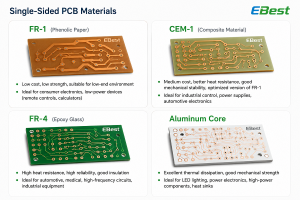
    Several materials are similar to FR4 and can be used as alternatives. One such material is CEM-1, which is also a composite material made from epoxy and fiberglass. It offers good mechanical strength and electrical properties but is less flame retardant than FR4.

    Another alternative is polyimide, known for its excellent thermal stability and flexibility. It is often used in applications requiring high-temperature resistance. However, polyimide is more expensive than FR4. For specific applications, materials like PTFE (Teflon) can also be considered, especially in high-frequency applications.

    FAQs

    1. Can FR4 be used in high-temperature applications?

    FR4 can withstand moderate temperatures, but for high-temperature applications, materials like polyimide are preferred.

    2. Is FR4 environmentally friendly?

    FR4 is not biodegradable but can be recycled to some extent. Proper disposal and recycling methods should be followed.

    3. How does the thickness of FR4 affect PCB performance?

    The thickness of FR4 can impact the board’s mechanical strength and thermal dissipation. Thicker boards offer more durability but may also increase the cost.

    4. Are there any disadvantages to using FR4?

    FR4 has limitations in high-frequency and high-temperature applications. It is also less effective in thermal management compared to materials like IMS.

    5. Can FR4 PCBs be used in flexible circuits?

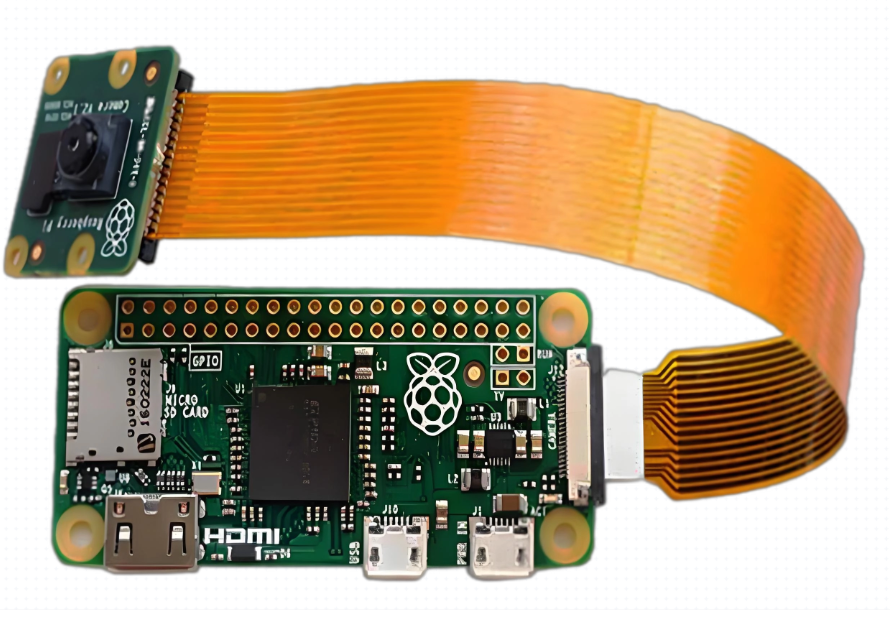
    FR4 is rigid and not suitable for flexible circuits. For flexible applications, materials like polyimide are used. But recently, EBest Circuit (Best Technology) developed a new product called “semi-flexible FR4 PCB”, its flex area is made by FR4 material.

    • Is FR4 RoHS Compliant?

    Yes, FR4 is RoHS compliant. This means that it meets the regulations set by the European Union to limit the use of specific hazardous materials found in electrical and electronic products.

    • What is FR4 Tg?

    The glass transition temperature (Tg) of FR4 is a critical property that indicates the temperature at which the material transitions from a hard, glassy state to a soft, rubbery state.

    EBest Circuit (Best Technology) excels not only in PCB and assembly manufacturing, but also in offering top-quality PCB design services. Our professional engineering team is ready to support your innovation across various industries, including communications, healthcare, industrial, and consumer electronics. We welcome all the questions or inquiries from you.

    You may also like