PCB manufacturing PCB manufacturing
Home > Blog

e24 resistor values

Standard Resistor Values: E-Series and BOM Checks
Tuesday, August 18th, 2026

This guide explains how standard resistor values work and how to turn a calculation into a controlled BOM decision. The goal is to reduce sourcing questions, unapproved substitutions, placement errors, and PCBA rework before files reach production.

standard resistor values
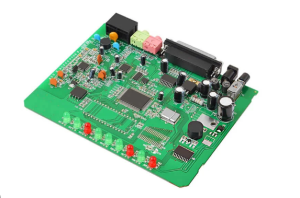
Standard resistor values support clearer selection before PCB assembly.

What Are Standard Resistor Values?

Standard resistor values are preferred nominal resistance values arranged in E-series. Instead of manufacturing every possible resistance, suppliers offer repeatable values across each decade, such as 10 Ω, 100 Ω, 1 kΩ, 10 kΩ, and 100 kΩ.

The number after E indicates how many nominal values appear in one decade. E12 contains 12 values, E24 contains 24, and E96 contains 96. A base value repeats by powers of ten, so 4.7 can represent 4.7 Ω, 47 Ω, 470 Ω, 4.7 kΩ, or 47 kΩ.

Before selecting a part, confirm:

  • The acceptable resistance window under worst-case operating conditions.
  • Tolerance and temperature coefficient, not only the nominal value.
  • Package, power rating, working voltage, pulse capability, and technology.
  • A manufacturer part number that is available for the intended production quantity.

A value being standard does not guarantee that every manufacturer offers it in every package or rating. The datasheet and orderable part number remain the final production reference.

Standard Resistor Values Table

The table below lists common base values within one decade. Multiply or divide them by powers of ten to reach the required range. For example, the E24 base value 24 can represent 2.4 Ω, 24 Ω, 240 Ω, 2.4 kΩ, or 24 kΩ.

SeriesValues per decadeCommon tolerance associationBase values
E6620%10, 15, 22, 33, 47, 68
E121210%10, 12, 15, 18, 22, 27, 33, 39, 47, 56, 68, 82
E24245%10, 11, 12, 13, 15, 16, 18, 20, 22, 24, 27, 30, 33, 36, 39, 43, 47, 51, 56, 62, 68, 75, 82, 91
E48482%Finer three-significant-digit spacing
E96961%Finer three-significant-digit spacing
E1921920.5% or tighterVerify the selected product family and datasheet

These tolerance relationships are common associations, not universal purchasing rules. For example, manufacturers also offer many E24 values with 1% tolerance. Always qualify the actual resistor family rather than inferring every specification from the E-series alone.

standard resistor values
Engineers compare E-series options, tolerance, and availability before releasing a resistor part.

E Series Resistors and Tolerance

A denser E-series provides more nominal values within each decade. It helps the selected resistance sit closer to the calculated target, but it does not prove that the full circuit will meet its error budget.

DecisionWhat can go wrongWhat to verify
Use a wider-tolerance partGain, bias, current, or threshold may move outside limits.Worst-case circuit result at both tolerance limits.
Choose a tighter E-seriesThe nominal value is closer, but drift or ratio error may still dominate.TCR, matching, long-term stability, and adjacent component tolerances.
Reduce BOM varietyA convenient common value may not meet the function.Whether the substituted value remains inside the approved electrical window.

For a pull-up or indicator circuit, an E12 or E24 value may provide enough margin. A precision divider, sensor interface, amplifier feedback path, or current-sense circuit may need an E96 value, tighter tolerance, lower TCR, or matched network. The customer engineering team owns the functional limits and released design; the assembly supplier should follow the approved BOM and substitution rules.

E24 Resistor Values for General PCB Assemblies

E24 resistor values offer 24 nominal choices per decade and are widely used where a 5% value provides sufficient circuit margin. The series adds intermediate options such as 11, 13, 16, 20, 24, 30, 36, 43, 51, 62, 75, and 91 that are not present in E12.

E24 is often practical when:

  • The function is tolerant of modest resistance variation.
  • The value is used for non-critical bias, indication, damping, or ordinary pull-up and pull-down duties.
  • Cost, availability, and lower BOM variety matter more than very fine nominal spacing.
  • Worst-case calculations confirm that the chosen value and tolerance are safe.

Do not use the application name alone to approve a resistor. A 330 Ω part may work for one LED circuit but overdrive or underdrive another because supply voltage, LED forward voltage, and target current differ. Calculate the function first, then select the E24 value that keeps the full operating range within limits.

E96 Resistor Values for Precision Circuits

E96 resistor values provide 96 nominal choices per decade and are commonly associated with 1% resistors. Their three-significant-digit spacing supports closer selection for analog feedback, sensing, precision division, filtering, and control functions.

E96 base values (100–976 within one decade)
100, 102, 105, 107, 110, 113, 115, 118, 121, 124, 127, 130
133, 137, 140, 143, 147, 150, 154, 158, 162, 165, 169, 174
178, 182, 187, 191, 196, 200, 205, 210, 215, 221, 226, 232
237, 243, 249, 255, 261, 267, 274, 280, 287, 294, 301, 309
316, 324, 332, 340, 348, 357, 365, 374, 383, 392, 402, 412
422, 432, 442, 453, 464, 475, 487, 499, 511, 523, 536, 549
562, 576, 590, 604, 619, 634, 649, 665, 681, 698, 715, 732
750, 768, 787, 806, 825, 845, 866, 887, 909, 931, 953, 976

Move the decimal point to reach the required decade: 487 can represent 48.7 Ω, 487 Ω, 4.87 kΩ, or 48.7 kΩ. Before releasing an E96 part, confirm whether absolute tolerance, resistor ratio, TCR, thermal gradients, noise, or long-term drift controls the real accuracy.

A tighter nominal value can also increase sourcing constraints. When alternates are allowed, define the acceptable resistance, tolerance, TCR, package, power, voltage, technology, and qualification requirements rather than approving ‘same value’ substitutions.

How to Find the Nearest Standard Resistor Value

The nearest numerical value is not automatically the safest production choice. The correct direction depends on what failure must be prevented. A higher resistance may reduce LED current, but it may also slow a pull-up edge or change amplifier gain.

Use this selection sequence:

  1. Calculate the ideal resistance using worst-case supply, load, temperature, and component limits.
  2. Define the minimum and maximum resistance that keep the circuit inside its approved operating window.
  3. Select the appropriate E-series and identify the nearest lower and higher standard values.
  4. Apply resistor tolerance to both candidates and repeat the worst-case calculation.
  5. Verify power dissipation, derating, working voltage, pulse energy, TCR, package, footprint, and availability.
  6. Release one exact manufacturer part number and document the approved alternate criteria.

Example: an LED calculation produces 193 Ω. Possible preferred values include 180 Ω and 200 Ω in E24, or 191 Ω and 196 Ω in E96. If excess current is the main risk, the higher value may provide more margin, but brightness and minimum-current requirements must still be checked. The calculation, not the lookup table, approves the part.

Standard SMD Resistor Values for PCBA

Standard SMD resistor values follow the same preferred E-series used by through-hole resistors. Package size changes assembly and electrical limits; it does not create a separate nominal-value system.

A BOM line that says only ’10 kΩ resistor’ leaves too many production decisions unresolved. A sourcing team may find many 10 kΩ parts with different tolerance, size, power, working voltage, TCR, pulse rating, construction, termination, lifecycle status, and price.

A production-ready resistor BOM line should confirm:

  • Nominal resistance with an unambiguous unit, such as 4.7 kΩ rather than 4.7.
  • Tolerance, package, power rating, and maximum working voltage.
  • TCR, pulse capability, current-sense construction, or other function-specific limits when relevant.
  • Manufacturer name, exact manufacturer part number, and lifecycle status.
  • Approved alternates or a clear no-substitution instruction.
  • Footprint, pick-and-place data, polarity rules where applicable, and assembly drawing consistency.

Very small SMD resistors may have no readable top marking. Reel labels, incoming inspection, feeder setup, material traceability, automated optical inspection, and electrical test requirements therefore matter more than visual identification alone.

standard resistor values
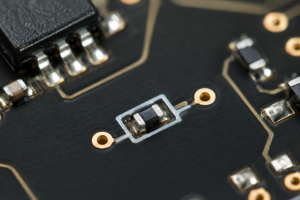
BOM, reel, footprint, and inspection checks help prevent wrong-value SMD resistor substitutions.

EBest Circuit (Best Technology) can support PCB fabrication, BOM and component sourcing review, SMT or through-hole assembly, inspection, and agreed testing coordination within the released project scope. The customer retains responsibility for circuit function, tolerance limits, approved substitutions, firmware, certification, and final product validation.

FAQ About Standard Resistor Values

1. What are the most common standard resistor values?

Common examples include 10 Ω, 22 Ω, 47 Ω, 100 Ω, 220 Ω, 330 Ω, 470 Ω, 1 kΩ, 2.2 kΩ, 4.7 kΩ, 10 kΩ, 47 kΩ, and 100 kΩ. Their popularity does not make them correct for every circuit.

2. What is the difference between E12, E24, and E96?

E12 has 12 nominal values per decade, E24 has 24, and E96 has 96. A denser series gives more choices, but tolerance, TCR, power, voltage, package, and availability still need separate confirmation.

3. Are 1% resistors always E96 values?

No. E96 is commonly associated with 1% tolerance, but tolerance and nominal-value series are separate specifications. Many E24 values are also available as 1% parts.

4. Can I always choose the nearest standard resistor value?

No. Compare both the lower and higher candidates under worst-case circuit conditions. The safe direction depends on whether the function controls current, gain, timing, bias, threshold, damping, or another parameter.

5. Are standard SMD resistor values different from through-hole values?

They use the same preferred-value concept. The available resistance range and electrical limits vary by package, resistor technology, tolerance, power, voltage, and manufacturer.

Ready to move your resistor-controlled PCB assembly into production? Send your Gerber files, controlled BOM, pick-and-place data, assembly drawings, quantity, approved substitution rules, and test requirements to sales@bestpcbs.com. EBest Circuit (Best Technology) will review the package for PCB fabrication and PCBA quotation, helping you identify unclear resistor specifications before sourcing and assembly.

You may also like

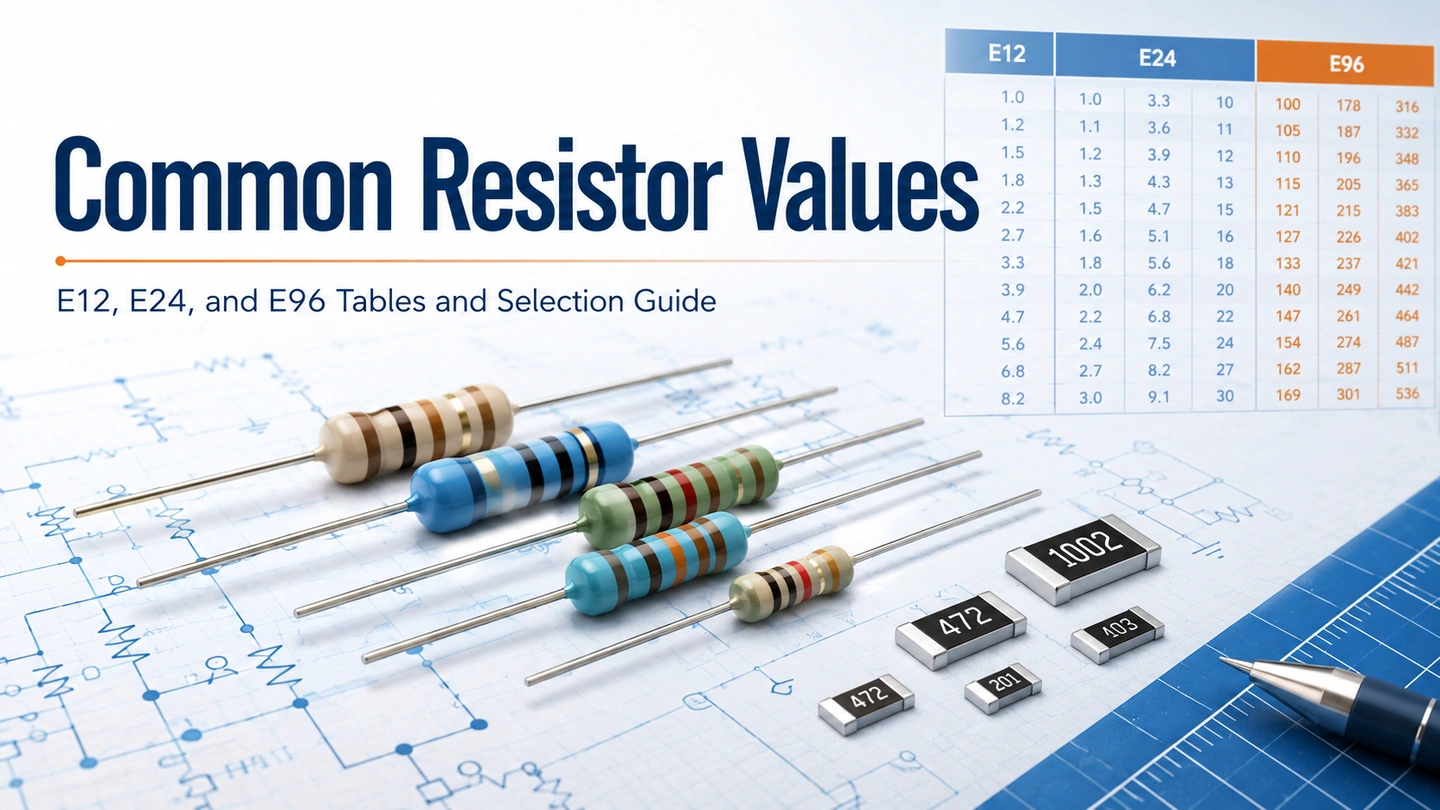
Common Resistor Values: E12, E24, and E96 Tables
Thursday, July 23rd, 2026

Resistors are available in thousands of values, but circuit designers repeatedly use a much smaller group. Values such as 100Ω, 220Ω, 1kΩ, 4.7kΩ, 10kΩ, and 100kΩ appear frequently because they belong to standardized preferred-number series and suit many practical circuit functions.

Understanding common resistor values is useful for schematic design, prototyping, component sourcing, and PCBA quotation. It helps engineers replace calculated values with parts that are readily available without creating unacceptable electrical error.

This guide explains the E12, E24, and E96 series, shows how standard values scale across ohms, kilohms, and megohms, and provides practical selection guidance for LEDs, pull-up circuits, Arduino projects, SMD assemblies, and production electronics.

Common resistor values guide with through-hole and SMD resistors and E12, E24, and E96 tables

What Are Common Resistor Values?

Common resistor values are standardized resistance values that manufacturers produce in large volumes. Frequently used examples include 10Ω, 22Ω, 47Ω, 100Ω, 220Ω, 330Ω, 470Ω, 1kΩ, 2.2kΩ, 4.7kΩ, 10kΩ, 47kΩ, 100kΩ, and 1MΩ.

These values cover many recurring functions:

  • LED current limiting
  • Signal pull-up and pull-down
  • Transistor biasing
  • Operational-amplifier feedback
  • Voltage division and RC timing
  • Input protection and current sensing

A value is not automatically suitable just because it is common. The selected resistor must still meet the circuit’s resistance accuracy, power dissipation, voltage rating, temperature coefficient, pulse tolerance, and package requirements.

For example, 10kΩ is widely used as a pull-up resistor because it provides low static current in many low-speed digital circuits. It may be too high for a fast communication bus with significant capacitance, where 2.2kΩ or 4.7kΩ could produce a faster rise time.

Why Do Resistors Use Standard Values?

Manufacturers use preferred-number series to cover a resistance range without producing every possible integer value. The values in each series are approximately distributed on a logarithmic scale, keeping the percentage difference between neighboring values relatively consistent.

Standardization gives designers predictable ranges, reduces distributor inventory, simplifies manufacturing and testing, and makes it easier for purchasing teams and PCBA factories to qualify equivalent parts.

Suppose a calculation produces 4.86kΩ. A designer may choose 4.7kΩ from the E12 or E24 series, or 4.87kΩ from the E96 series. The correct choice depends on the acceptable circuit error, not simply which number is closest.

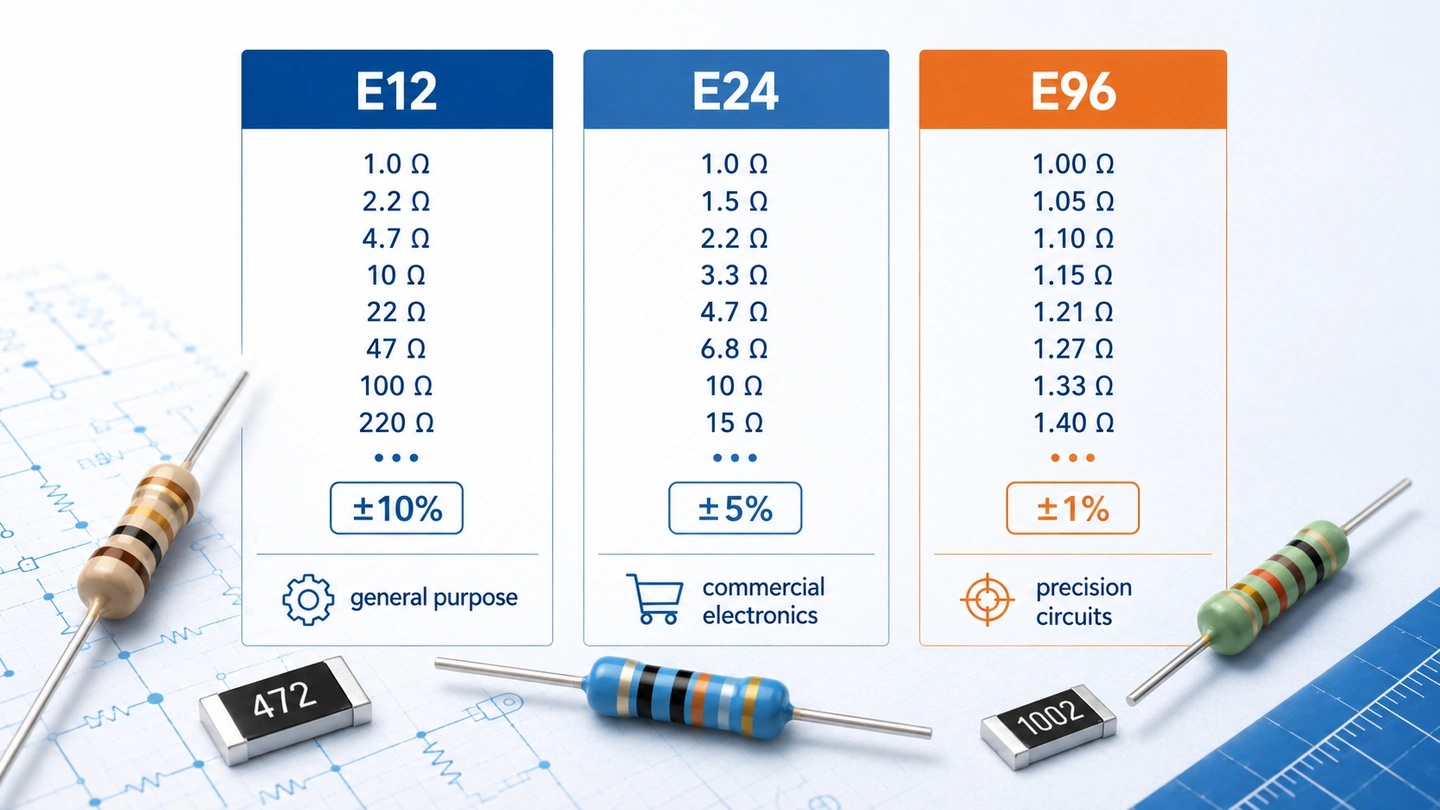
What Do E12, E24, and E96 Resistor Values Mean?

The number following the letter E indicates how many standard values are included within each decade. A decade is any resistance range with a 10:1 ratio, such as 10Ω to 100Ω or 1kΩ to 10kΩ.

Series Values per Decade Common Tolerance Typical Use
E12 12 ±10% Basic circuits, repair, and educational projects
E24 24 ±5% Commercial electronics and general PCBA
E96 96 ±1% Precision analog, feedback, sensing, and control
E192 192 ±0.5% or tighter Instrumentation and precision measurement

A 1% resistor is often selected from the E96 series, but the two terms are not interchangeable. Tolerance describes manufacturing accuracy. The E series describes the spacing between nominal values.

Comparison of E12, E24, and E96 resistor value series and common tolerances

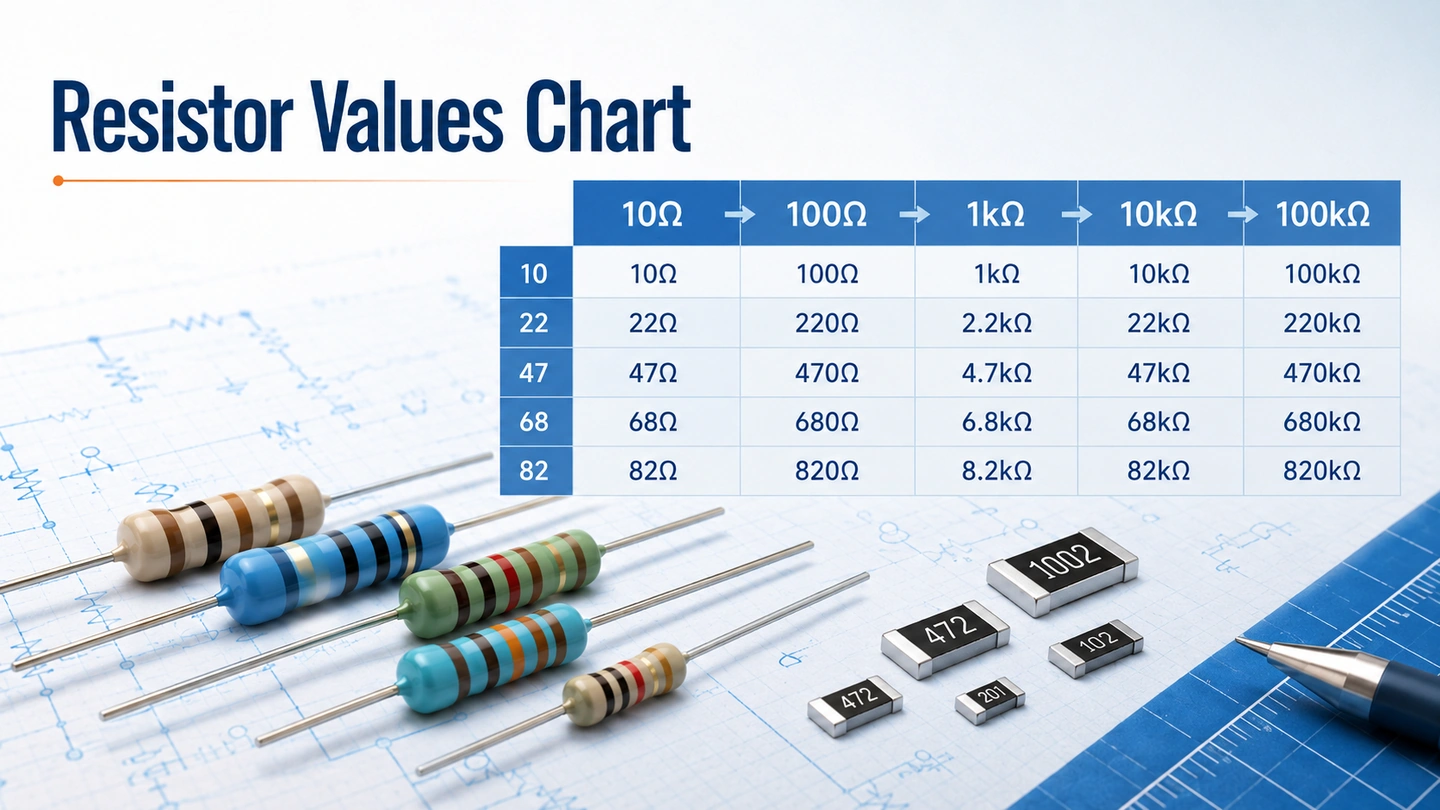
Standard Resistor Values Table

A standard resistor table normally lists the base values for one decade. The same numbers are then multiplied or divided by powers of 10.

Base Value ×1 ×10 ×100 ×1,000
10 10Ω 100Ω 1kΩ 10kΩ
22 22Ω 220Ω 2.2kΩ 22kΩ
47 47Ω 470Ω 4.7kΩ 47kΩ
68 68Ω 680Ω 6.8kΩ 68kΩ
82 82Ω 820Ω 8.2kΩ 82kΩ

The same pattern continues into megohms. For example, the base number 47 can represent 4.7Ω, 47Ω, 470Ω, 4.7kΩ, 47kΩ, 470kΩ, or 4.7MΩ. This decade method is more useful than memorizing a separate list for every resistance range.

Standard resistor values chart showing decade scaling from ohms to kilohms

E12 Resistor Values

The E12 series contains 12 base values per decade:

10 12 15 18 22 27
33 39 47 56 68 82

Common E12 values between 100Ω and 1kΩ are 100Ω, 120Ω, 150Ω, 180Ω, 220Ω, 270Ω, 330Ω, 390Ω, 470Ω, 560Ω, 680Ω, and 820Ω.

E12 is suitable where modest resistance variation does not materially affect performance, including indicator LEDs, non-critical bias networks, basic switching circuits, and hobby electronics. It is less appropriate for precision voltage dividers, sensor conditioning, current measurement, or amplifier gain networks where resistor ratio accuracy directly affects output performance.

E24 Resistor Values

The E24 series provides 24 values per decade:

10 11 12 13 15 16 18 20
22 24 27 30 33 36 39 43
47 51 56 62 68 75 82 91

E24 is one of the most commonly used series in general electronics. It offers enough selection for power supplies, transistor circuits, digital interfaces, LED products, consumer devices, and industrial control boards without creating excessive BOM variety.

Values such as 110Ω, 200Ω, 240Ω, 360Ω, 510Ω, 750Ω, 1.3kΩ, 3.6kΩ, and 9.1kΩ are available in E24 but not in E12. For cost-sensitive PCBA production, E24 values with ±5% tolerance are often sufficient unless a circuit function requires more precise control.

E96 Resistor Values

The E96 series contains 96 base values per decade and is commonly associated with ±1% resistors.

100 102 105 107 110 113 115 118
121 124 127 130 133 137 140 143
147 150 154 158 162 165 169 174
178 182 187 191 196 200 205 210
215 221 226 232 237 243 249 255
261 267 274 280 287 294 301 309
316 324 332 340 348 357 365 374
383 392 402 412 422 432 442 453
464 475 487 499 511 523 536 549
562 576 590 604 619 634 649 665
681 698 715 732 750 768 787 806
825 845 866 887 909 931 953 976

The table uses 3-digit base numbers, and the decimal position changes with the resistance range. For example, 487 may represent 48.7Ω, 487Ω, 4.87kΩ, or 48.7kΩ.

E96 values are useful in precision voltage dividers, filter networks, amplifier feedback loops, ADC input circuits, current regulation, and sensor interfaces.

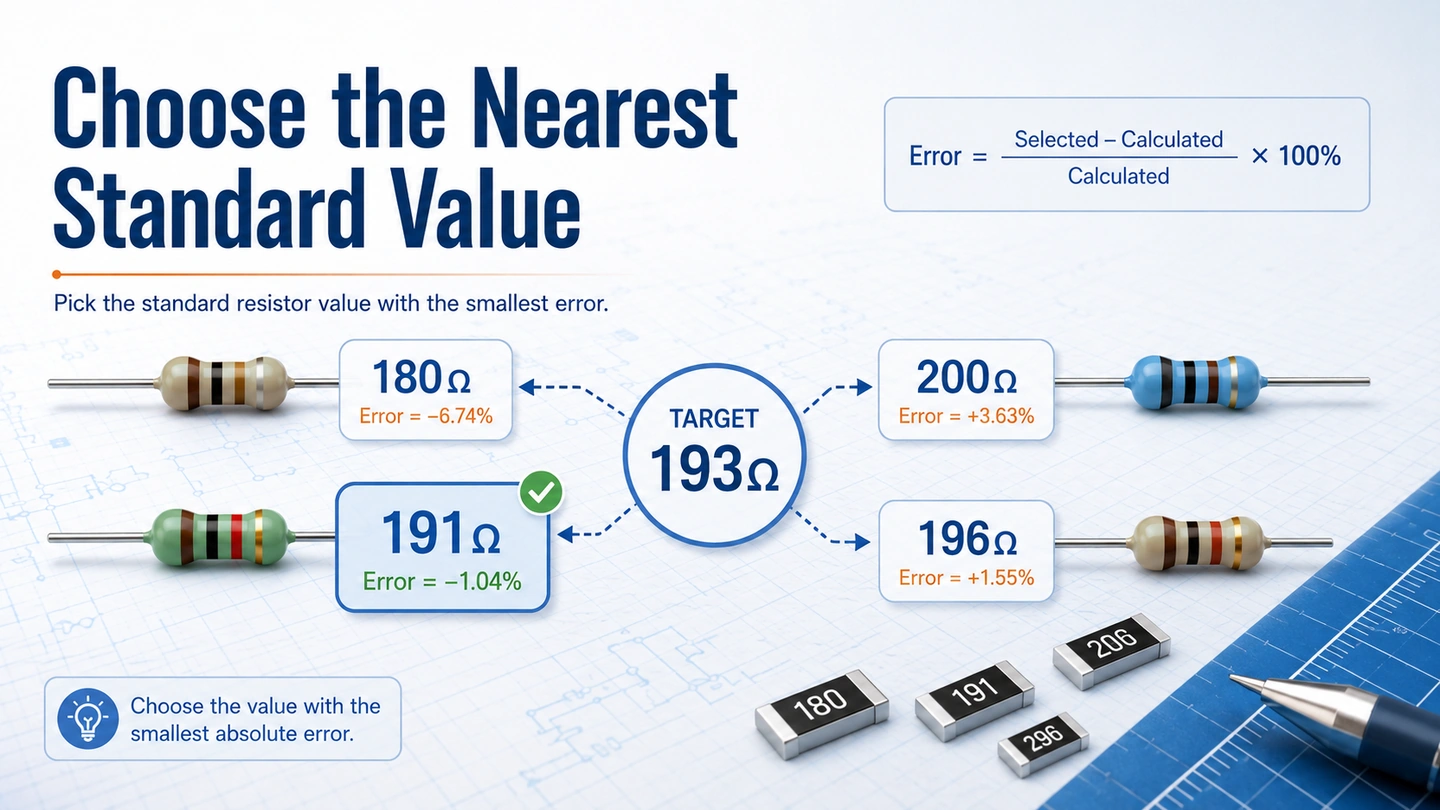
How to Find the Nearest Standard Resistor Value

A common resistor values calculator performs four basic steps:

  1. Calculate the theoretical resistance.
  2. Select the preferred E series.
  3. Identify the nearest lower and higher standard values.
  4. Recalculate the actual circuit result for both options.

Assume an LED calculation produces 193Ω. The nearest common options may be 180Ω in E12 or E24, 200Ω in E24, and 191Ω or 196Ω in E96.

The nearest numerical value is not always the safest choice. For current limiting, selecting the next higher resistor generally reduces current. For a timing or feedback circuit, the lower or higher choice may shift frequency, gain, or threshold in different directions.

Error = (Rselected − Rcalculated) ÷ Rcalculated × 100%

After selecting a nominal value, include resistor tolerance and the tolerances of other components in the worst-case calculation.

Example of selecting the nearest standard resistor value for a calculated 193 ohm target

Common Resistor Values for LEDs

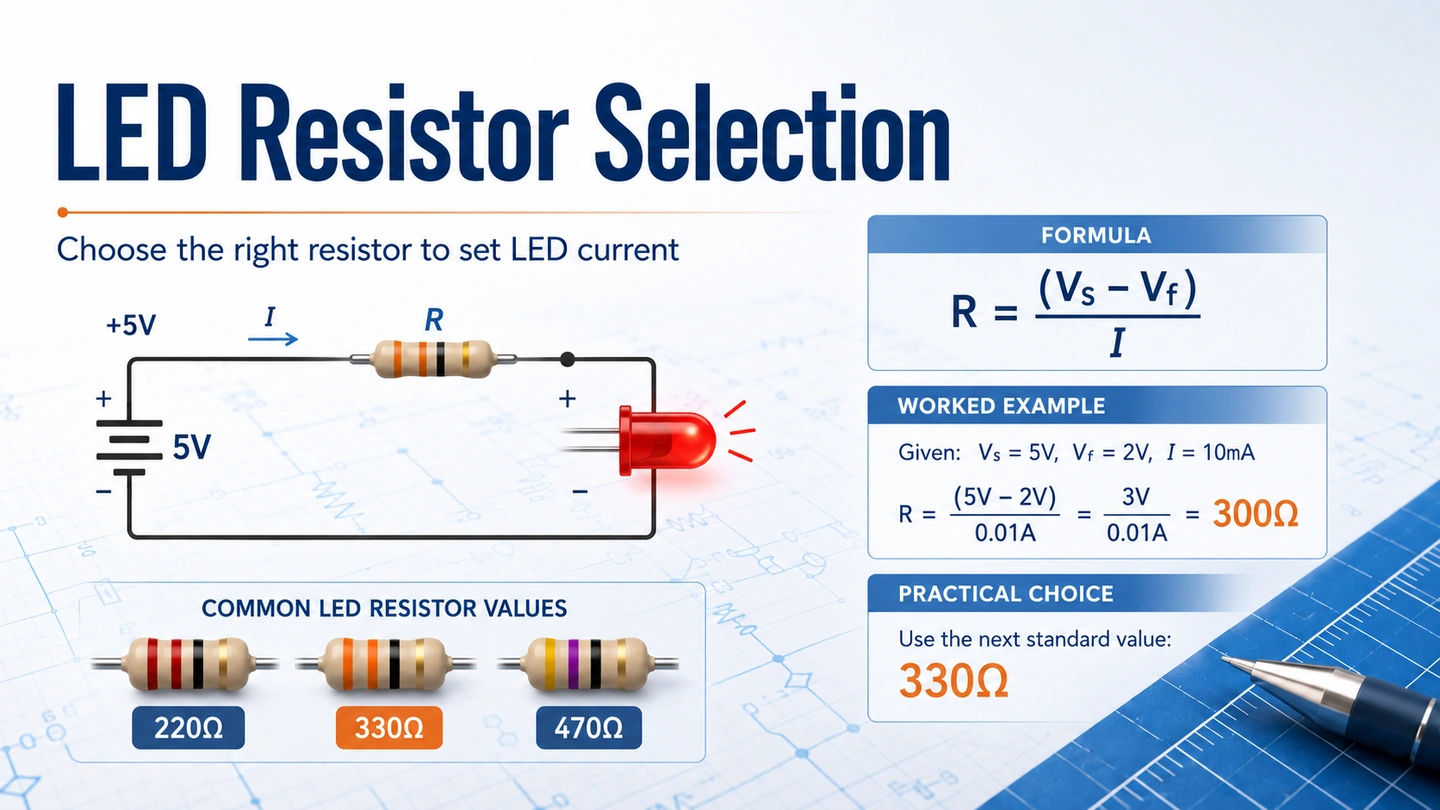
An LED resistor should be calculated from the supply voltage, LED forward voltage, and required current:

R = (VS − VF) ÷ I

For a 5V supply, a red LED with a 2V forward voltage, and a target current of 10mA:

R = (5V − 2V) ÷ 0.01A = 300Ω

A 300Ω resistor exists in the E24 series. A designer could also use 330Ω to reduce the current slightly:

I = (5V − 2V) ÷ 330Ω = 9.1mA

Common LED resistor values include 100Ω, 150Ω, 220Ω, 330Ω, 470Ω, 680Ω, and 1kΩ. They are common because they suit many low-voltage indicator circuits, not because they are universally correct.

Also verify resistor power with P = I²R. At 9.1mA through 330Ω, power dissipation is about 27mW. A standard 0.1W or 0.125W SMD resistor provides comfortable margin under normal ambient conditions.

LED resistor selection example using a 5 volt supply and a 330 ohm practical resistor value

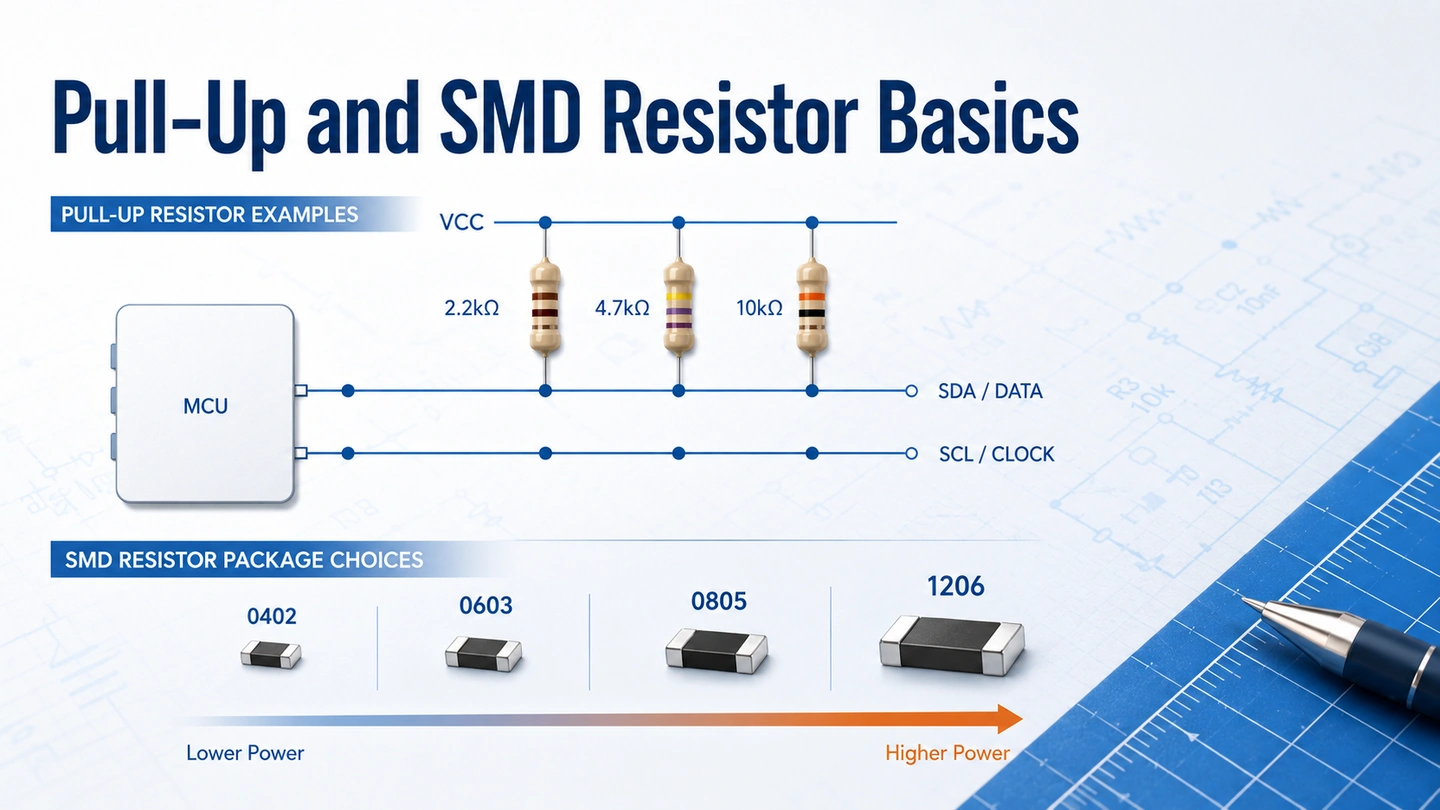
Common Pull-Up and Pull-Down Resistor Values

Typical pull-up and pull-down values include 1kΩ, 2.2kΩ, 4.7kΩ, 10kΩ, 47kΩ, and 100kΩ.

Lower resistance provides a stronger logic state and faster charging of parasitic capacitance, but it draws more current when the signal is pulled to the opposite level. Higher resistance reduces static current but becomes more sensitive to leakage, interference, and slow signal transitions.

Selection should consider input leakage current, logic thresholds, supply voltage, trace and input capacitance, required rise time, switching frequency, noise environment, and open-drain current capability.

For a slow push-button input, 10kΩ is often practical. For an I²C bus, 2.2kΩ to 4.7kΩ may be more appropriate, but the correct value should be calculated from bus capacitance, operating voltage, rise-time requirements, and device sink-current limits.

Pull-up resistor examples and comparison of 0402, 0603, 0805, and 1206 SMD resistor packages

Common Resistor Values for Arduino and General Electronics

Arduino projects often use common resistor values because they are easy to source and cover standard interface functions.

Application Typical Starting Value Selection Note
LED current limiting 220Ω–1kΩ Calculate from voltage and LED current
Push-button pull-up/down 10kΩ Internal pull-up may remove the external part
Transistor base resistor 1kΩ–10kΩ Calculate from load current and transistor gain
MOSFET gate resistor 22Ω–220Ω Controls ringing and switching speed
Analog voltage divider 1kΩ–100kΩ Check ADC input impedance and source resistance
Sensor biasing 4.7kΩ–100kΩ Follow sensor datasheet requirements

These values are starting points, not fixed design rules. A 10kΩ/10kΩ divider, for example, halves the input voltage but may be unsuitable when the ADC requires a low source impedance or when the circuit must minimize standby current.

Are SMD Resistor Values Different from Through-Hole Values?

SMD and through-hole resistors generally use the same E-series values. A 10kΩ resistor can be supplied as an axial through-hole component or in 0402, 0603, 0805, 1206, and larger SMD packages.

The package affects physical and electrical capability rather than the nominal value system.

Package Typical General-Purpose Power Rating Practical Consideration
0402 Around 0.063W Compact but harder to assemble and rework
0603 Around 0.1W Common for compact commercial PCBAs
0805 Around 0.125W More thermal margin and easier inspection
1206 Around 0.25W Suitable for higher dissipation and voltage

These ratings vary by resistor series and manufacturer. High-power, pulse-rated, high-voltage, and current-sense versions may differ substantially.

Extreme resistance values may also be unavailable in very small packages. Low-ohmic shunt resistors need suitable terminal construction and current capacity, while high-megohm values require control of leakage and surface contamination.

How to Choose Resistor Tolerance and Power Rating

Tolerance should be selected according to the sensitivity of the circuit function. A ±5% resistor may be adequate for LED current limiting or a non-critical pull-up. A ±1% resistor is more suitable for amplifier gain, regulated feedback, and matched dividers. Precision measurement circuits may require ±0.1% tolerance and a low temperature coefficient.

Power can be calculated using P = VI, P = I²R, or P = V²/R.

Do not operate a resistor continuously at its absolute power limit. Ambient temperature, copper area, enclosure temperature, airflow, nearby heat sources, and pulse conditions can reduce usable capacity.

For a PCBA quotation, the BOM should specify:

  • Nominal resistance and tolerance
  • Package and power rating
  • Temperature coefficient when important
  • Voltage or pulse requirement
  • Preferred manufacturer or approved alternatives

EBest Circuit can review these details during BOM and DFM checking. Clear specifications reduce sourcing questions and prevent an apparently equivalent resistor from introducing a tolerance, voltage, or reliability issue.

Downloadable Standard Resistor Values PDF

Download this printable reference for the E12, E24, and E96 preferred resistor values, decade scaling, selection formulas, and SMD package guidance.

FAQ

1. What are the most common resistor values?

Frequently used values include 100Ω, 220Ω, 330Ω, 470Ω, 1kΩ, 2.2kΩ, 4.7kΩ, 10kΩ, 47kΩ, 100kΩ, and 1MΩ. Their popularity comes from standard E-series spacing and broad usefulness in common circuit functions.

2. Why are 220-ohm resistors so common?

A 220Ω resistor is part of the E12, E24, and higher series. It is widely used for LED current limiting, transistor interfaces, signal damping, and protection in low-voltage circuits. Its suitability must still be confirmed by calculation.

3. Why is 4.7kΩ a common resistor value?

4.7kΩ belongs to the E12 series and provides a practical balance between current consumption and signal strength. It is frequently used in pull-up circuits, transistor bias networks, feedback paths, and sensor interfaces.

4. What is the difference between E12, E24, and E96 resistor values?

E12 contains 12 values per decade, E24 contains 24, and E96 contains 96. A larger series gives designers more values and allows closer matching to a calculated resistance.

5. Are 1% resistors always E96 values?

No. E96 is commonly associated with 1% resistors, but tolerance and nominal-value series are separate specifications. Manufacturers may offer E24 values with 1% tolerance or E96 values in other tolerances.

6. Do 0402 and 0603 resistors have different standard values?

They generally use the same E-series values. The difference is package size, which affects power, voltage, thermal performance, assembly difficulty, and available resistance range.

7. How do I choose the nearest standard resistor value?

Choose the required E series, identify the nearest higher and lower values, and calculate circuit performance with both. The best option is the one that keeps current, voltage, timing, or gain within the permitted range.

8. What resistor value should I use for an LED?

Calculate it using R = (VS − VF)/I. Select the next suitable standard value and confirm resistor power. Values such as 220Ω, 330Ω, and 470Ω are common, but they are not correct for every LED circuit.

9. Is 4.7kΩ or 10kΩ better for a pull-up resistor?

4.7kΩ provides a stronger pull-up and faster rise time, while 10kΩ uses less current. The correct choice depends on leakage, capacitance, switching speed, supply voltage, and noise exposure.

10. Can I replace a resistor with the next higher standard value?

Sometimes. A higher value may reduce current, alter gain, change a timing constant, or shift a voltage-divider output. Recalculate the affected function and include tolerance before approving the substitution.

Conclusion

Common resistor values follow standardized E-series rather than an arbitrary list. E12 and E24 cover most general-purpose circuits, while E96 provides finer selection for precision designs. The nearest numerical value is not always the best engineering choice; tolerance, power, voltage, temperature behavior, package size, and sourcing availability must also be checked.

For PCB or PCBA quotation, provide the complete BOM with resistor values, tolerances, packages, power requirements, and approved alternatives. EBest Circuit can support component review, PCB fabrication, prototype assembly, and production PCBA. Send your project files to sales@bestpcbs.com for engineering review and quotation.

You may also like