Resistors are available in thousands of values, but circuit designers repeatedly use a much smaller group. Values such as 100Ω, 220Ω, 1kΩ, 4.7kΩ, 10kΩ, and 100kΩ appear frequently because they belong to standardized preferred-number series and suit many practical circuit functions.
Understanding common resistor values is useful for schematic design, prototyping, component sourcing, and PCBA quotation. It helps engineers replace calculated values with parts that are readily available without creating unacceptable electrical error.
This guide explains the E12, E24, and E96 series, shows how standard values scale across ohms, kilohms, and megohms, and provides practical selection guidance for LEDs, pull-up circuits, Arduino projects, SMD assemblies, and production electronics.
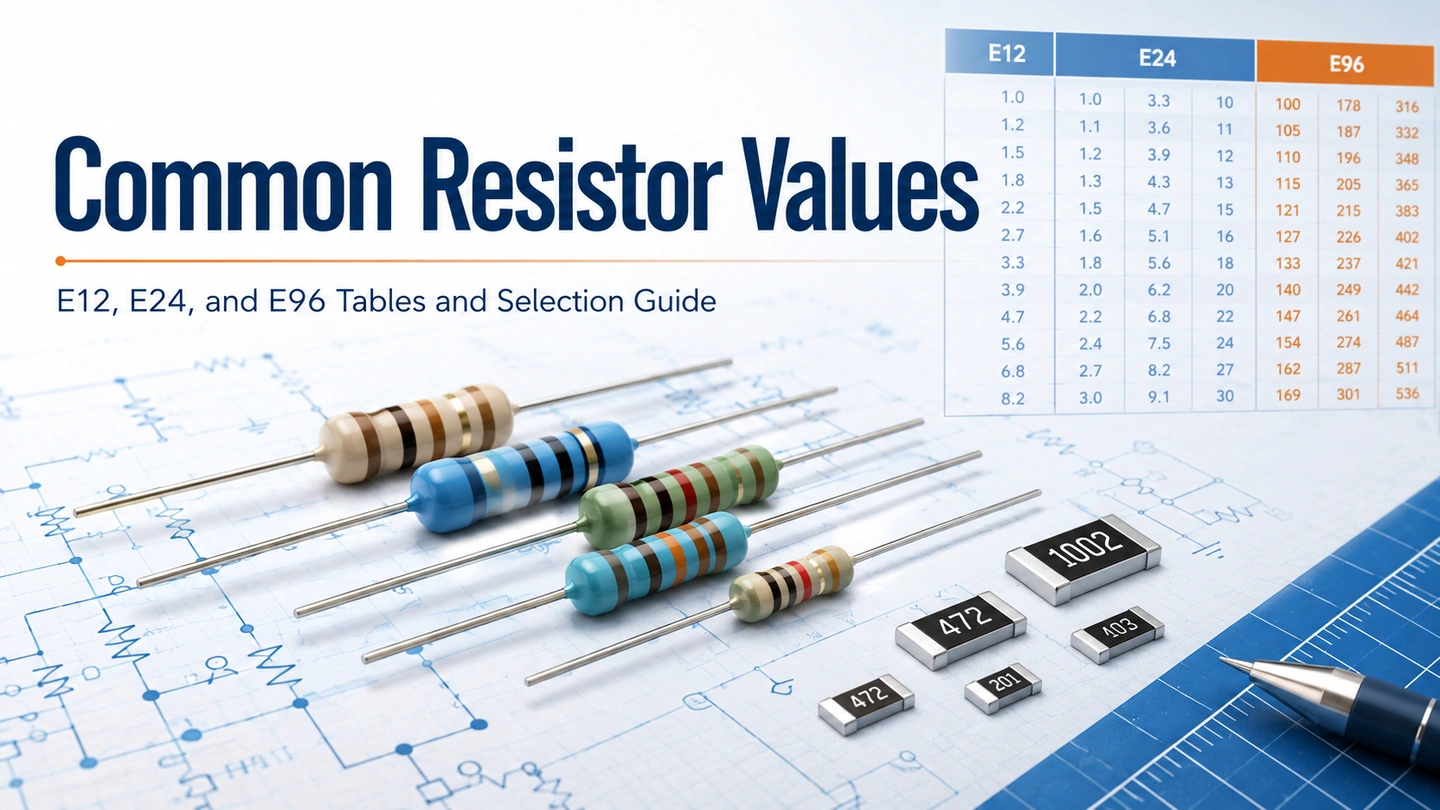
What Are Common Resistor Values?
Common resistor values are standardized resistance values that manufacturers produce in large volumes. Frequently used examples include 10Ω, 22Ω, 47Ω, 100Ω, 220Ω, 330Ω, 470Ω, 1kΩ, 2.2kΩ, 4.7kΩ, 10kΩ, 47kΩ, 100kΩ, and 1MΩ.
These values cover many recurring functions:
- LED current limiting
- Signal pull-up and pull-down
- Transistor biasing
- Operational-amplifier feedback
- Voltage division and RC timing
- Input protection and current sensing
A value is not automatically suitable just because it is common. The selected resistor must still meet the circuit’s resistance accuracy, power dissipation, voltage rating, temperature coefficient, pulse tolerance, and package requirements.
For example, 10kΩ is widely used as a pull-up resistor because it provides low static current in many low-speed digital circuits. It may be too high for a fast communication bus with significant capacitance, where 2.2kΩ or 4.7kΩ could produce a faster rise time.
Why Do Resistors Use Standard Values?
Manufacturers use preferred-number series to cover a resistance range without producing every possible integer value. The values in each series are approximately distributed on a logarithmic scale, keeping the percentage difference between neighboring values relatively consistent.
Standardization gives designers predictable ranges, reduces distributor inventory, simplifies manufacturing and testing, and makes it easier for purchasing teams and PCBA factories to qualify equivalent parts.
Suppose a calculation produces 4.86kΩ. A designer may choose 4.7kΩ from the E12 or E24 series, or 4.87kΩ from the E96 series. The correct choice depends on the acceptable circuit error, not simply which number is closest.
What Do E12, E24, and E96 Resistor Values Mean?
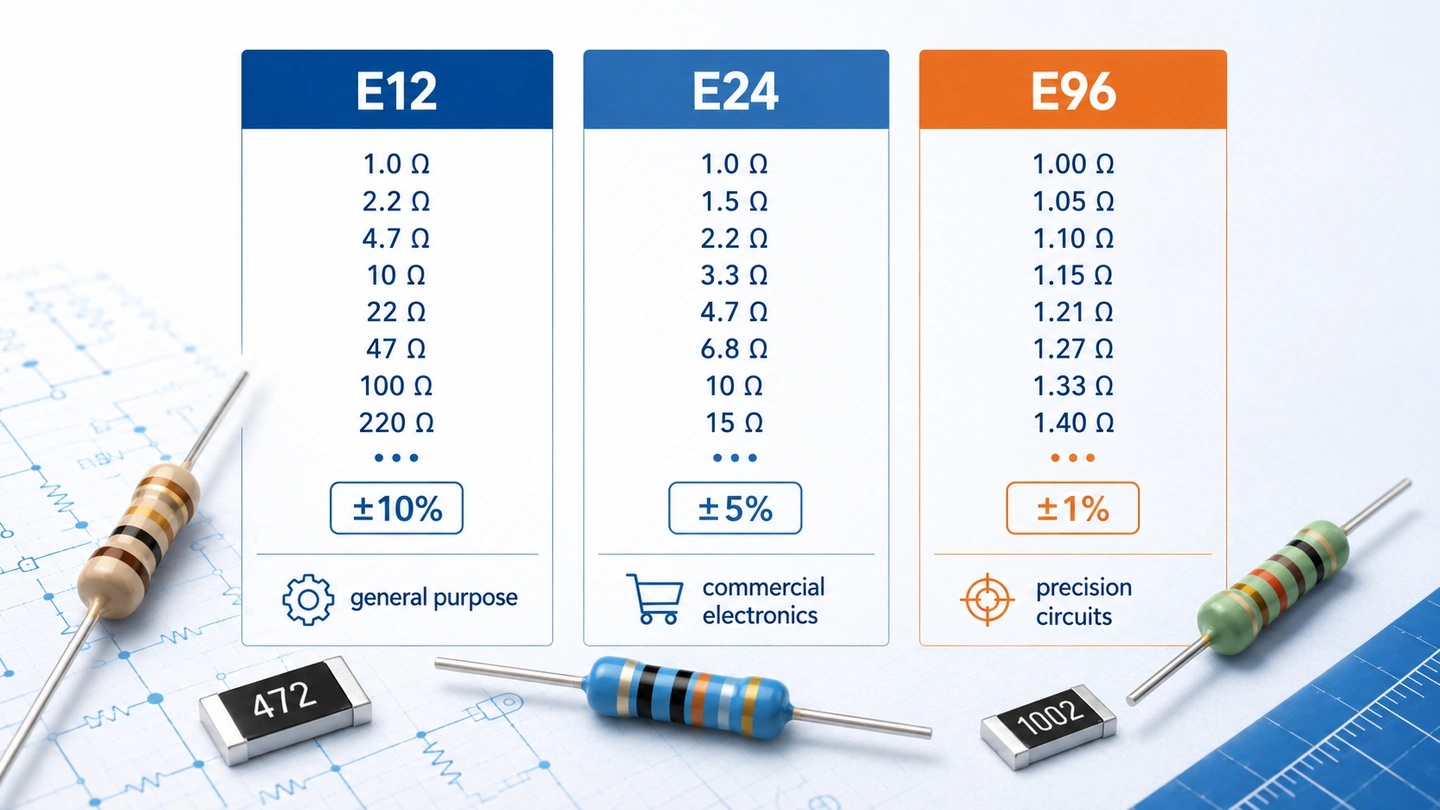
The number following the letter E indicates how many standard values are included within each decade. A decade is any resistance range with a 10:1 ratio, such as 10Ω to 100Ω or 1kΩ to 10kΩ.
| Series | Values per Decade | Common Tolerance | Typical Use |
|---|---|---|---|
| E12 | 12 | ±10% | Basic circuits, repair, and educational projects |
| E24 | 24 | ±5% | Commercial electronics and general PCBA |
| E96 | 96 | ±1% | Precision analog, feedback, sensing, and control |
| E192 | 192 | ±0.5% or tighter | Instrumentation and precision measurement |
A 1% resistor is often selected from the E96 series, but the two terms are not interchangeable. Tolerance describes manufacturing accuracy. The E series describes the spacing between nominal values.
Standard Resistor Values Table
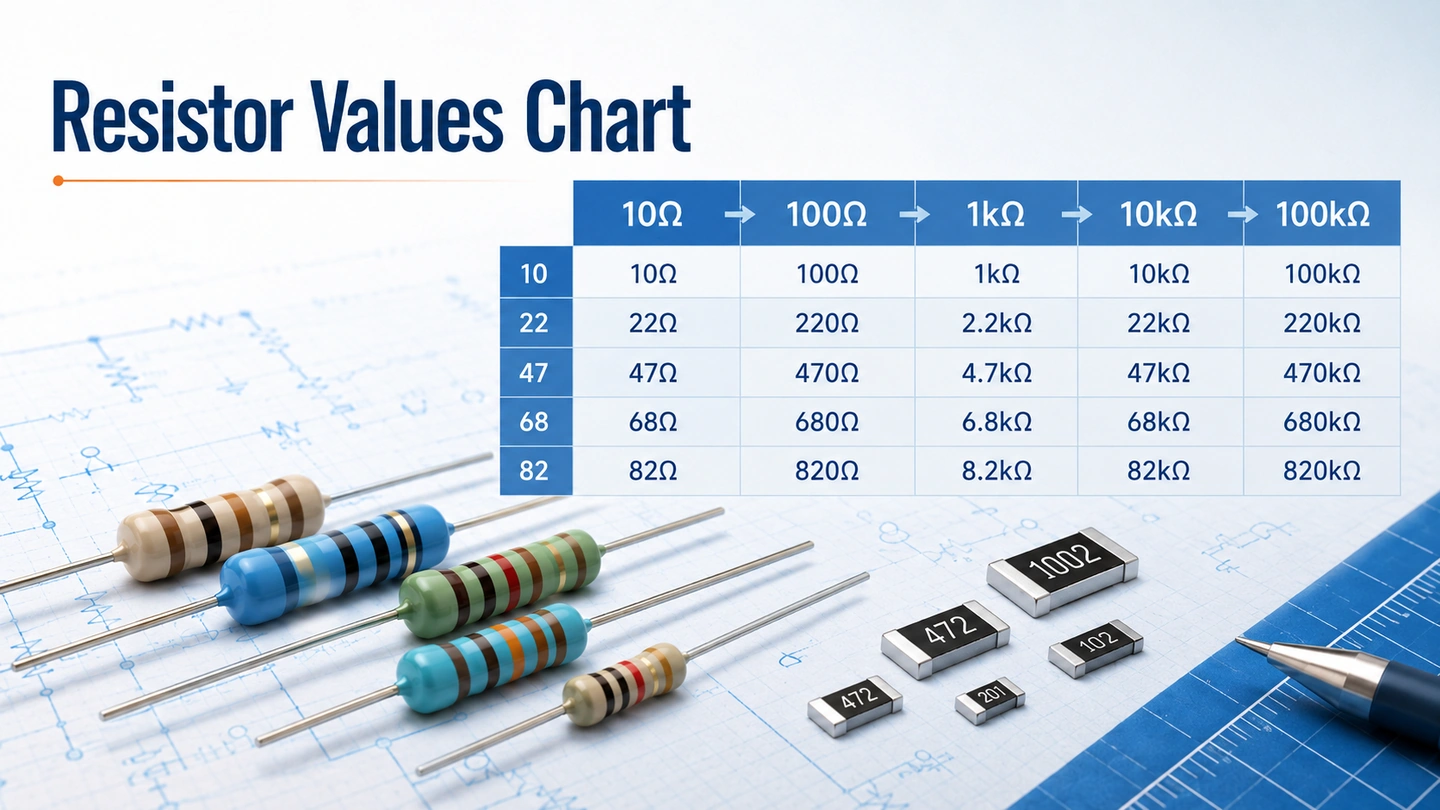
A standard resistor table normally lists the base values for one decade. The same numbers are then multiplied or divided by powers of 10.
| Base Value | ×1 | ×10 | ×100 | ×1,000 |
|---|---|---|---|---|
| 10 | 10Ω | 100Ω | 1kΩ | 10kΩ |
| 22 | 22Ω | 220Ω | 2.2kΩ | 22kΩ |
| 47 | 47Ω | 470Ω | 4.7kΩ | 47kΩ |
| 68 | 68Ω | 680Ω | 6.8kΩ | 68kΩ |
| 82 | 82Ω | 820Ω | 8.2kΩ | 82kΩ |
The same pattern continues into megohms. For example, the base number 47 can represent 4.7Ω, 47Ω, 470Ω, 4.7kΩ, 47kΩ, 470kΩ, or 4.7MΩ. This decade method is more useful than memorizing a separate list for every resistance range.
E12 Resistor Values
The E12 series contains 12 base values per decade:
| 10 | 12 | 15 | 18 | 22 | 27 |
| 33 | 39 | 47 | 56 | 68 | 82 |
Common E12 values between 100Ω and 1kΩ are 100Ω, 120Ω, 150Ω, 180Ω, 220Ω, 270Ω, 330Ω, 390Ω, 470Ω, 560Ω, 680Ω, and 820Ω.
E12 is suitable where modest resistance variation does not materially affect performance, including indicator LEDs, non-critical bias networks, basic switching circuits, and hobby electronics. It is less appropriate for precision voltage dividers, sensor conditioning, current measurement, or amplifier gain networks where resistor ratio accuracy directly affects output performance.
E24 Resistor Values
The E24 series provides 24 values per decade:
| 10 | 11 | 12 | 13 | 15 | 16 | 18 | 20 |
| 22 | 24 | 27 | 30 | 33 | 36 | 39 | 43 |
| 47 | 51 | 56 | 62 | 68 | 75 | 82 | 91 |
E24 is one of the most commonly used series in general electronics. It offers enough selection for power supplies, transistor circuits, digital interfaces, LED products, consumer devices, and industrial control boards without creating excessive BOM variety.
Values such as 110Ω, 200Ω, 240Ω, 360Ω, 510Ω, 750Ω, 1.3kΩ, 3.6kΩ, and 9.1kΩ are available in E24 but not in E12. For cost-sensitive PCBA production, E24 values with ±5% tolerance are often sufficient unless a circuit function requires more precise control.
E96 Resistor Values
The E96 series contains 96 base values per decade and is commonly associated with ±1% resistors.
| 100 | 102 | 105 | 107 | 110 | 113 | 115 | 118 |
| 121 | 124 | 127 | 130 | 133 | 137 | 140 | 143 |
| 147 | 150 | 154 | 158 | 162 | 165 | 169 | 174 |
| 178 | 182 | 187 | 191 | 196 | 200 | 205 | 210 |
| 215 | 221 | 226 | 232 | 237 | 243 | 249 | 255 |
| 261 | 267 | 274 | 280 | 287 | 294 | 301 | 309 |
| 316 | 324 | 332 | 340 | 348 | 357 | 365 | 374 |
| 383 | 392 | 402 | 412 | 422 | 432 | 442 | 453 |
| 464 | 475 | 487 | 499 | 511 | 523 | 536 | 549 |
| 562 | 576 | 590 | 604 | 619 | 634 | 649 | 665 |
| 681 | 698 | 715 | 732 | 750 | 768 | 787 | 806 |
| 825 | 845 | 866 | 887 | 909 | 931 | 953 | 976 |
The table uses 3-digit base numbers, and the decimal position changes with the resistance range. For example, 487 may represent 48.7Ω, 487Ω, 4.87kΩ, or 48.7kΩ.
E96 values are useful in precision voltage dividers, filter networks, amplifier feedback loops, ADC input circuits, current regulation, and sensor interfaces.
How to Find the Nearest Standard Resistor Value
A common resistor values calculator performs four basic steps:
- Calculate the theoretical resistance.
- Select the preferred E series.
- Identify the nearest lower and higher standard values.
- Recalculate the actual circuit result for both options.
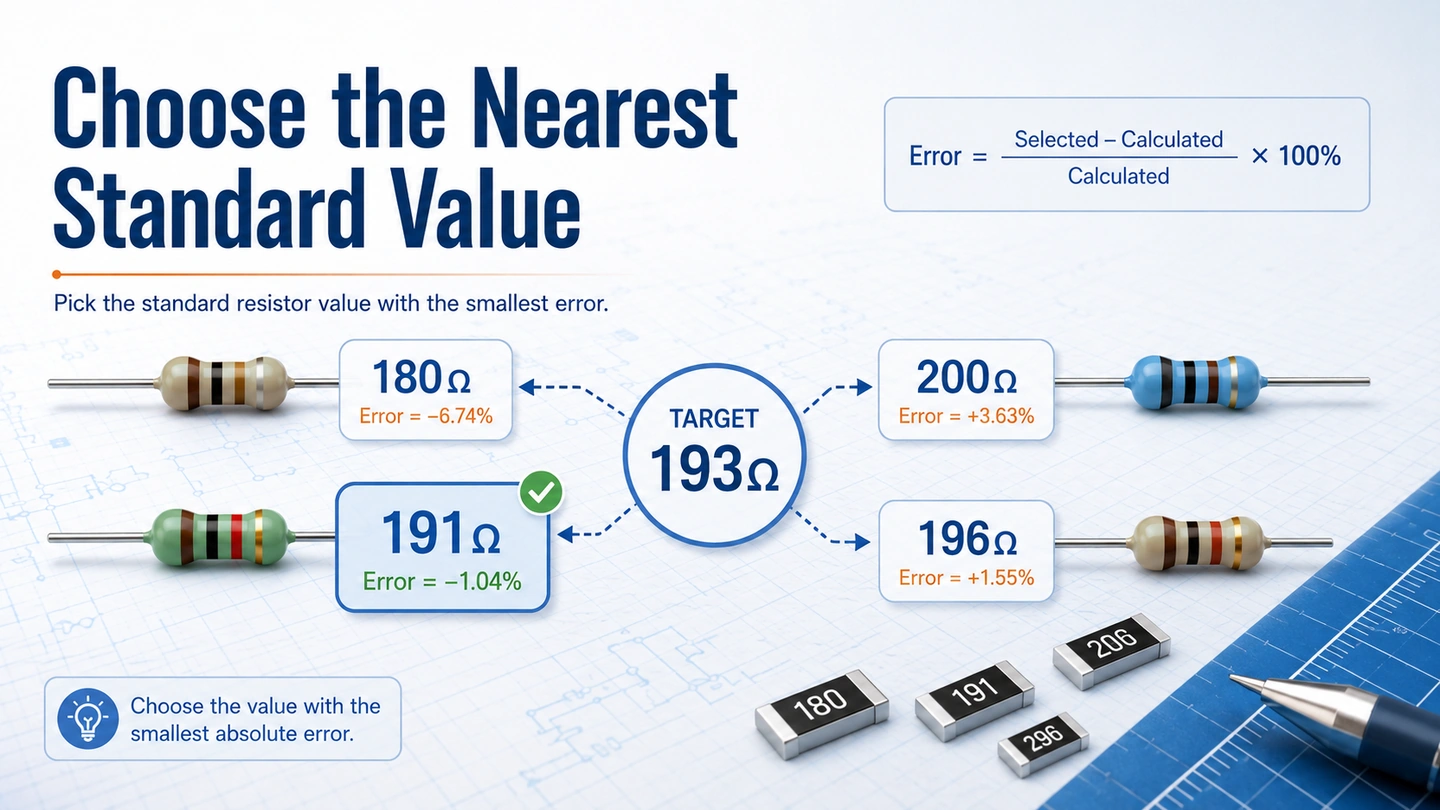
Assume an LED calculation produces 193Ω. The nearest common options may be 180Ω in E12 or E24, 200Ω in E24, and 191Ω or 196Ω in E96.
The nearest numerical value is not always the safest choice. For current limiting, selecting the next higher resistor generally reduces current. For a timing or feedback circuit, the lower or higher choice may shift frequency, gain, or threshold in different directions.
After selecting a nominal value, include resistor tolerance and the tolerances of other components in the worst-case calculation.
Common Resistor Values for LEDs
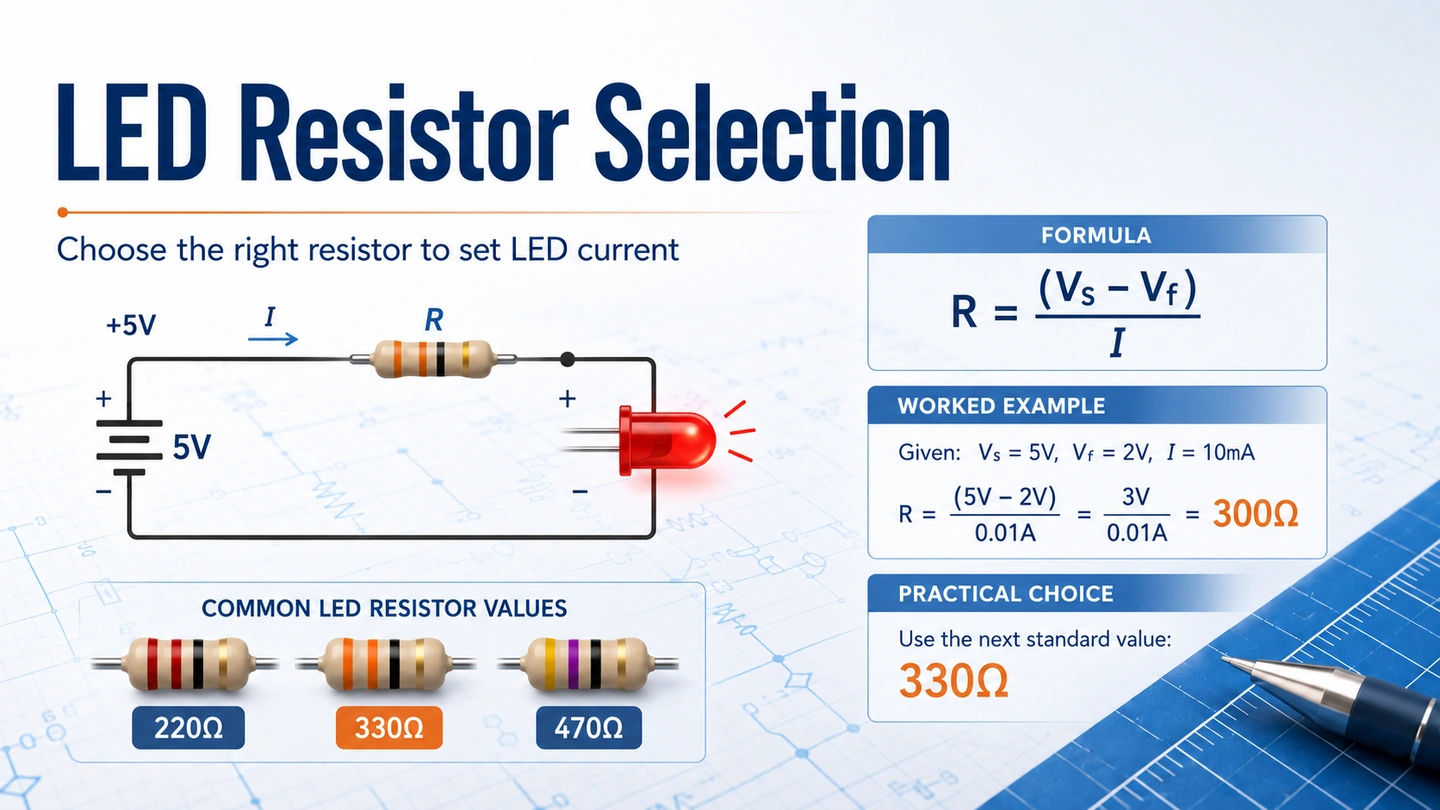
An LED resistor should be calculated from the supply voltage, LED forward voltage, and required current:
For a 5V supply, a red LED with a 2V forward voltage, and a target current of 10mA:
A 300Ω resistor exists in the E24 series. A designer could also use 330Ω to reduce the current slightly:
Common LED resistor values include 100Ω, 150Ω, 220Ω, 330Ω, 470Ω, 680Ω, and 1kΩ. They are common because they suit many low-voltage indicator circuits, not because they are universally correct.
Also verify resistor power with P = I²R. At 9.1mA through 330Ω, power dissipation is about 27mW. A standard 0.1W or 0.125W SMD resistor provides comfortable margin under normal ambient conditions.
Common Pull-Up and Pull-Down Resistor Values
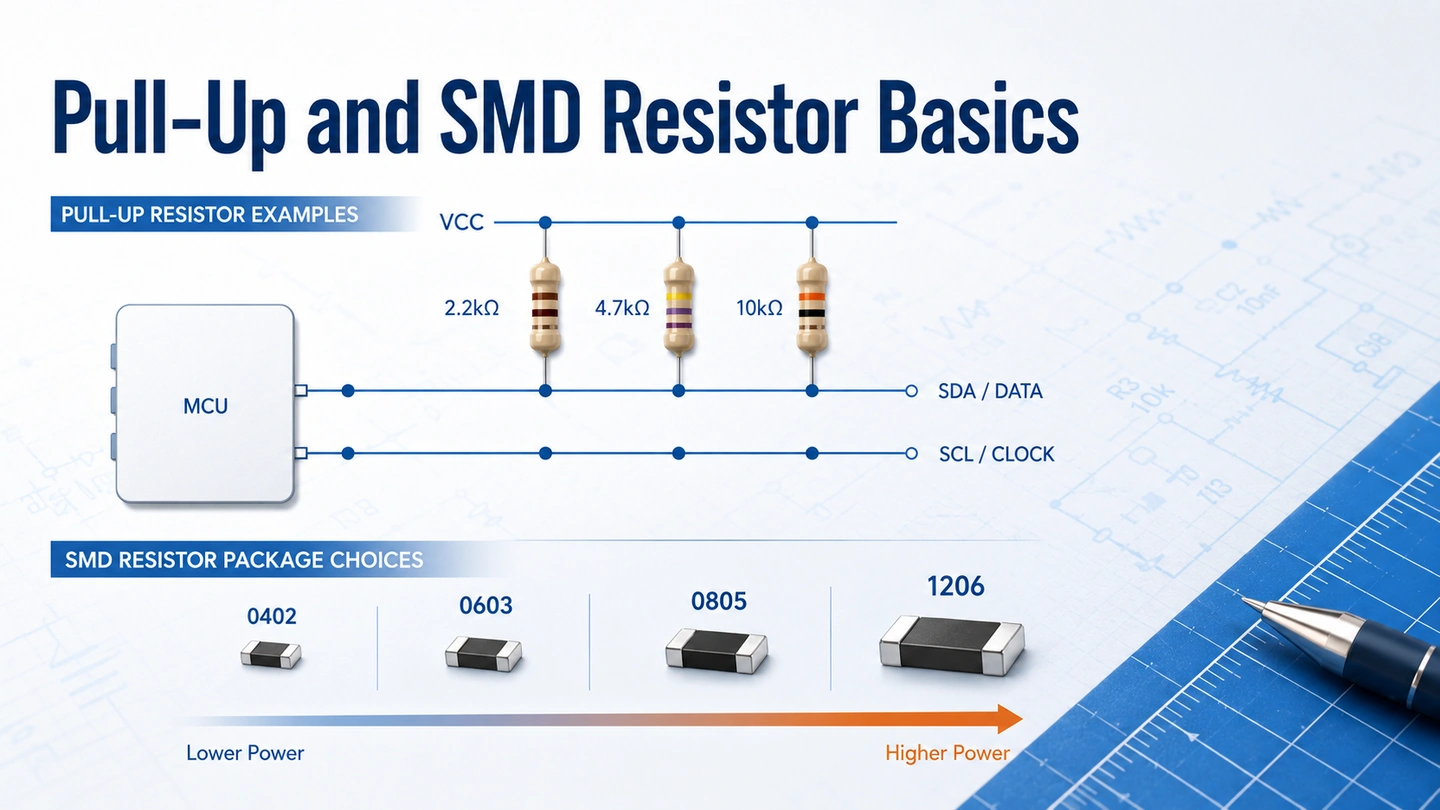
Typical pull-up and pull-down values include 1kΩ, 2.2kΩ, 4.7kΩ, 10kΩ, 47kΩ, and 100kΩ.
Lower resistance provides a stronger logic state and faster charging of parasitic capacitance, but it draws more current when the signal is pulled to the opposite level. Higher resistance reduces static current but becomes more sensitive to leakage, interference, and slow signal transitions.
Selection should consider input leakage current, logic thresholds, supply voltage, trace and input capacitance, required rise time, switching frequency, noise environment, and open-drain current capability.
For a slow push-button input, 10kΩ is often practical. For an I²C bus, 2.2kΩ to 4.7kΩ may be more appropriate, but the correct value should be calculated from bus capacitance, operating voltage, rise-time requirements, and device sink-current limits.
Common Resistor Values for Arduino and General Electronics
Arduino projects often use common resistor values because they are easy to source and cover standard interface functions.
| Application | Typical Starting Value | Selection Note |
|---|---|---|
| LED current limiting | 220Ω–1kΩ | Calculate from voltage and LED current |
| Push-button pull-up/down | 10kΩ | Internal pull-up may remove the external part |
| Transistor base resistor | 1kΩ–10kΩ | Calculate from load current and transistor gain |
| MOSFET gate resistor | 22Ω–220Ω | Controls ringing and switching speed |
| Analog voltage divider | 1kΩ–100kΩ | Check ADC input impedance and source resistance |
| Sensor biasing | 4.7kΩ–100kΩ | Follow sensor datasheet requirements |
These values are starting points, not fixed design rules. A 10kΩ/10kΩ divider, for example, halves the input voltage but may be unsuitable when the ADC requires a low source impedance or when the circuit must minimize standby current.
Are SMD Resistor Values Different from Through-Hole Values?
SMD and through-hole resistors generally use the same E-series values. A 10kΩ resistor can be supplied as an axial through-hole component or in 0402, 0603, 0805, 1206, and larger SMD packages.
The package affects physical and electrical capability rather than the nominal value system.
| Package | Typical General-Purpose Power Rating | Practical Consideration |
|---|---|---|
| 0402 | Around 0.063W | Compact but harder to assemble and rework |
| 0603 | Around 0.1W | Common for compact commercial PCBAs |
| 0805 | Around 0.125W | More thermal margin and easier inspection |
| 1206 | Around 0.25W | Suitable for higher dissipation and voltage |
These ratings vary by resistor series and manufacturer. High-power, pulse-rated, high-voltage, and current-sense versions may differ substantially.
Extreme resistance values may also be unavailable in very small packages. Low-ohmic shunt resistors need suitable terminal construction and current capacity, while high-megohm values require control of leakage and surface contamination.
How to Choose Resistor Tolerance and Power Rating
Tolerance should be selected according to the sensitivity of the circuit function. A ±5% resistor may be adequate for LED current limiting or a non-critical pull-up. A ±1% resistor is more suitable for amplifier gain, regulated feedback, and matched dividers. Precision measurement circuits may require ±0.1% tolerance and a low temperature coefficient.
Power can be calculated using P = VI, P = I²R, or P = V²/R.
Do not operate a resistor continuously at its absolute power limit. Ambient temperature, copper area, enclosure temperature, airflow, nearby heat sources, and pulse conditions can reduce usable capacity.
For a PCBA quotation, the BOM should specify:
- Nominal resistance and tolerance
- Package and power rating
- Temperature coefficient when important
- Voltage or pulse requirement
- Preferred manufacturer or approved alternatives
EBest Circuit can review these details during BOM and DFM checking. Clear specifications reduce sourcing questions and prevent an apparently equivalent resistor from introducing a tolerance, voltage, or reliability issue.
Downloadable Standard Resistor Values PDF
Download this printable reference for the E12, E24, and E96 preferred resistor values, decade scaling, selection formulas, and SMD package guidance.
FAQ
1. What are the most common resistor values?
Frequently used values include 100Ω, 220Ω, 330Ω, 470Ω, 1kΩ, 2.2kΩ, 4.7kΩ, 10kΩ, 47kΩ, 100kΩ, and 1MΩ. Their popularity comes from standard E-series spacing and broad usefulness in common circuit functions.
2. Why are 220-ohm resistors so common?
A 220Ω resistor is part of the E12, E24, and higher series. It is widely used for LED current limiting, transistor interfaces, signal damping, and protection in low-voltage circuits. Its suitability must still be confirmed by calculation.
3. Why is 4.7kΩ a common resistor value?
4.7kΩ belongs to the E12 series and provides a practical balance between current consumption and signal strength. It is frequently used in pull-up circuits, transistor bias networks, feedback paths, and sensor interfaces.
4. What is the difference between E12, E24, and E96 resistor values?
E12 contains 12 values per decade, E24 contains 24, and E96 contains 96. A larger series gives designers more values and allows closer matching to a calculated resistance.
5. Are 1% resistors always E96 values?
No. E96 is commonly associated with 1% resistors, but tolerance and nominal-value series are separate specifications. Manufacturers may offer E24 values with 1% tolerance or E96 values in other tolerances.
6. Do 0402 and 0603 resistors have different standard values?
They generally use the same E-series values. The difference is package size, which affects power, voltage, thermal performance, assembly difficulty, and available resistance range.
7. How do I choose the nearest standard resistor value?
Choose the required E series, identify the nearest higher and lower values, and calculate circuit performance with both. The best option is the one that keeps current, voltage, timing, or gain within the permitted range.
8. What resistor value should I use for an LED?
Calculate it using R = (VS − VF)/I. Select the next suitable standard value and confirm resistor power. Values such as 220Ω, 330Ω, and 470Ω are common, but they are not correct for every LED circuit.
9. Is 4.7kΩ or 10kΩ better for a pull-up resistor?
4.7kΩ provides a stronger pull-up and faster rise time, while 10kΩ uses less current. The correct choice depends on leakage, capacitance, switching speed, supply voltage, and noise exposure.
10. Can I replace a resistor with the next higher standard value?
Sometimes. A higher value may reduce current, alter gain, change a timing constant, or shift a voltage-divider output. Recalculate the affected function and include tolerance before approving the substitution.
Conclusion
Common resistor values follow standardized E-series rather than an arbitrary list. E12 and E24 cover most general-purpose circuits, while E96 provides finer selection for precision designs. The nearest numerical value is not always the best engineering choice; tolerance, power, voltage, temperature behavior, package size, and sourcing availability must also be checked.
For PCB or PCBA quotation, provide the complete BOM with resistor values, tolerances, packages, power requirements, and approved alternatives. EBest Circuit can support component review, PCB fabrication, prototype assembly, and production PCBA. Send your project files to sales@bestpcbs.com for engineering review and quotation.