PCB manufacturing PCB manufacturing
Home > Blog

surface mount resistor

Surface Mount Resistor Guide: Sizes, Codes, Types & Values
Wednesday, September 9th, 2026

A surface mount resistor is a compact resistor mounted directly onto PCB pads and assembled using surface mount technology. Common packages range from tiny 01005 and 0201 parts to larger 1206, 2010, and 2512 resistors used where more power or board space is available.

Selecting the right part involves more than resistance value. Engineers also need to consider resistor type, package size, tolerance, power rating, working voltage, TCR, and markings. This guide explains the most common surface mount resistor sizes, types, codes, and values, then shows how to choose one for a PCB.
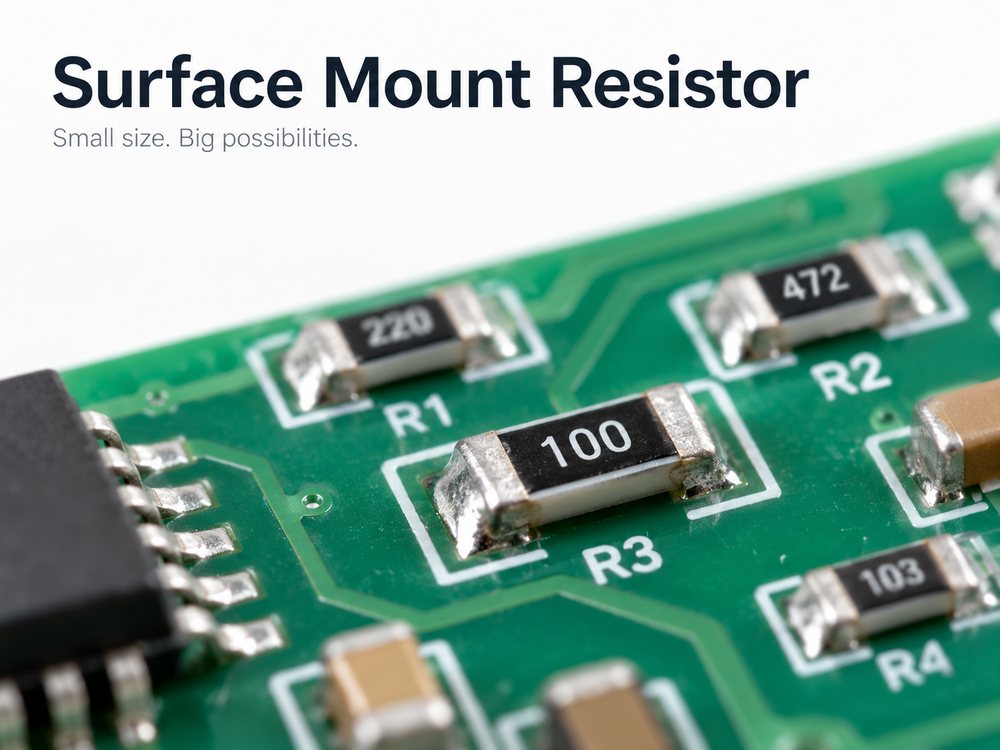
Surface mount resistor mounted on a printed circuit board

What Is a Surface Mount Resistor?

A surface mount resistor is a resistor designed to sit directly on conductive pads on the surface of a PCB. It does not use long leads passing through drilled holes like a through-hole resistor.

Other names commonly used for the same component include:

  • SMD resistor
  • chip resistor
  • surface mount chip resistor
  • SMT resistor

SMD means surface-mount device, while SMT refers to the process used to assemble surface-mount components.

A typical chip resistor contains:

  • a ceramic substrate
  • a resistive layer
  • metal terminal electrodes
  • a protective coating

During PCB assembly, solder paste is printed on the pads, the resistor is placed by pick-and-place equipment, and the joint is formed during reflow soldering.

The surface mount resistor symbol on a schematic is normally the same standard resistor symbol used for a through-hole part. Its reference designator is usually R, such as R1 or R24. Package information such as 0603 or 0805 is defined in the PCB footprint rather than the schematic symbol.

What Are the Main Surface Mount Resistor Types?

The main surface mount resistor types differ in resistive material, precision, temperature stability, current capability, and cost.
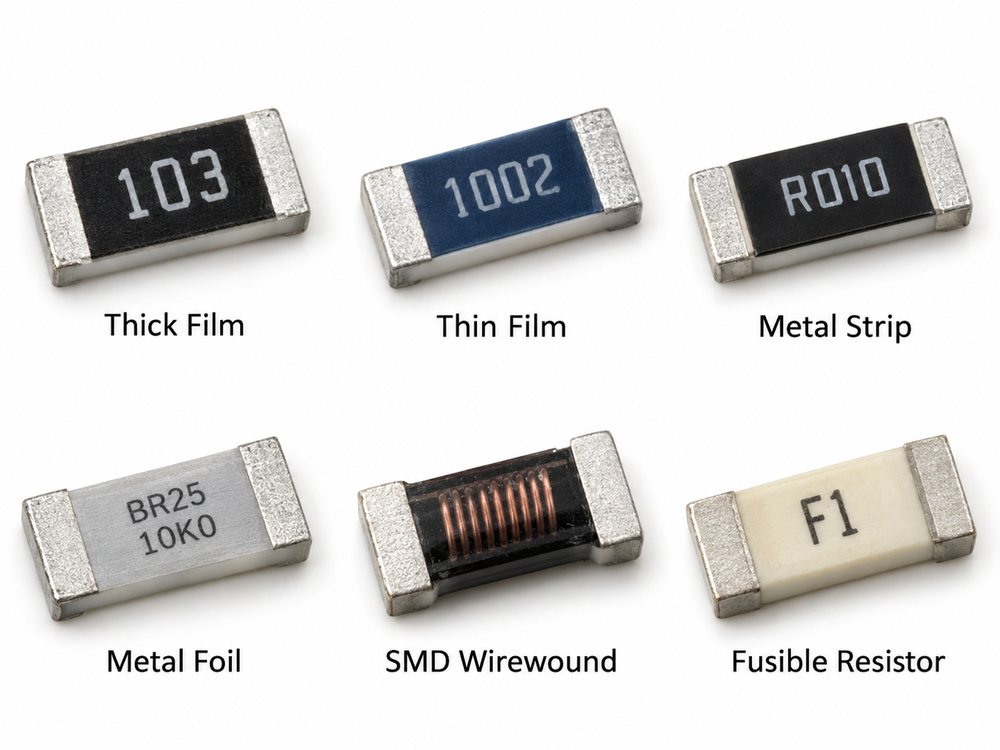
Comparison of thick film, thin film, metal strip, metal foil, wirewound and fusible surface mount resistor types
Type Main Characteristic Common Use
Thick film Cost-effective and widely available General PCB circuits
Thin film High precision and low TCR Analog and measurement circuits
Metal strip Very low resistance Current sensing
Metal foil High stability and accuracy Precision electronics
SMD wirewound Higher power and pulse capability Power circuits
Fusible Designed to open under overload Circuit protection

Thick-film resistors

These are the standard choice for many PCB designs. They cover a broad resistance range and are readily available in packages such as 0402, 0603, 0805, and 1206.

Typical uses include:

  • pull-up and pull-down networks
  • LED current limiting
  • bias circuits
  • general signal conditioning

Thin-film resistors

Thin-film parts are used when tighter tolerance and lower temperature coefficient are required. They are common in:

  • precision amplifiers
  • sensor interfaces
  • measurement circuits
  • accurate voltage dividers

Metal strip resistors

Metal strip parts are mainly used for low-resistance current sensing. Values may be measured in milliohms rather than ohms, making them useful in battery systems, power supplies, motor drives, and power converters.

The resistor type should therefore match the electrical requirement. Two resistors with the same resistance and package size can have very different tolerance, TCR, pulse capability, and stability.

What Surface Mount Resistor Sizes Are Common?

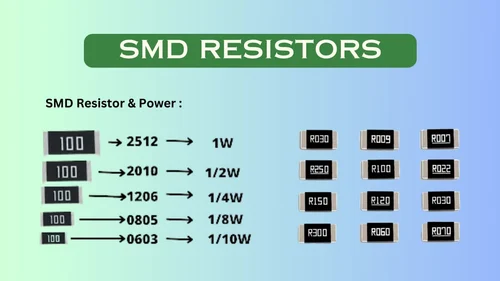
Common surface mount resistor sizes include 0201, 0402, 0603, 0805, 1206, 2010, and 2512. Smaller packages reduce PCB area, while larger packages generally offer higher power capability and easier handling.
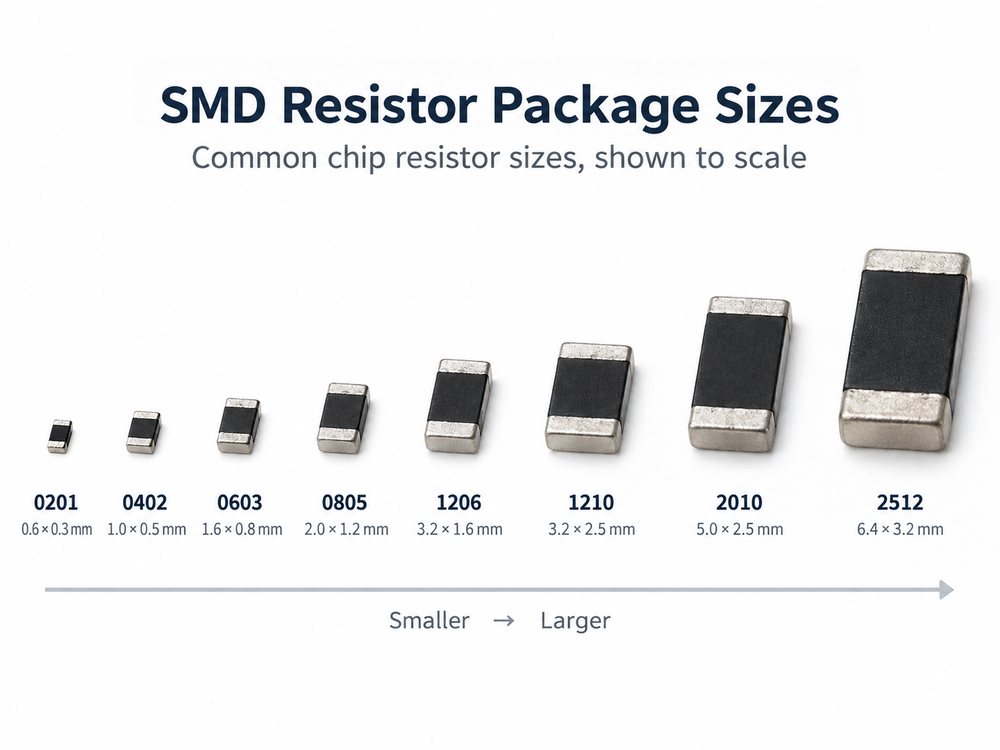
Surface mount resistor size comparison from 0201 to 2512 packages
Imperial Size Metric Code Approx. Size (mm) Typical Conventional Power*
01005 0402 0.4 × 0.2 ~0.03 W
0201 0603 0.6 × 0.3 ~0.05 W
0402 1005 1.0 × 0.5 ~0.063 W
0603 1608 1.6 × 0.8 ~0.10 W
0805 2012 2.0 × 1.25 ~0.125 W
1206 3216 3.2 × 1.6 ~0.25 W
1210 3225 3.2 × 2.5 ~0.5 W
2010 5025 5.0 × 2.5 ~0.75 W
2512 6332 6.3 × 3.2 ~1 W

*These are common reference ratings rather than universal specifications. The exact rating must be checked in the resistor manufacturer’s datasheet.

The imperial package code approximately represents component length and width in hundredths of an inch. For example:

  • 0603 ≈ 0.06 × 0.03 inch
  • 0805 ≈ 0.08 × 0.05 inch
  • 1206 ≈ 0.12 × 0.06 inch

Metric and imperial codes should not be confused. An imperial 0603 package, for example, corresponds to metric 1608 rather than metric 0603.

Package size also affects manufacturability. Moving from 0805 or 0603 to 0402, 0201, or smaller parts generally requires tighter control of:

The smallest surface mount resistor is therefore not automatically the best choice. Use a smaller package when PCB density requires it, not simply because the package is available.

How Do You Read Surface Mount Resistor Codes and Markings?

Surface mount resistor markings use numbers and letters to represent resistance because the component body is too small for traditional color bands. The most common surface mount resistor code systems are 3-digit codes, 4-digit codes, R notation, and EIA-96.
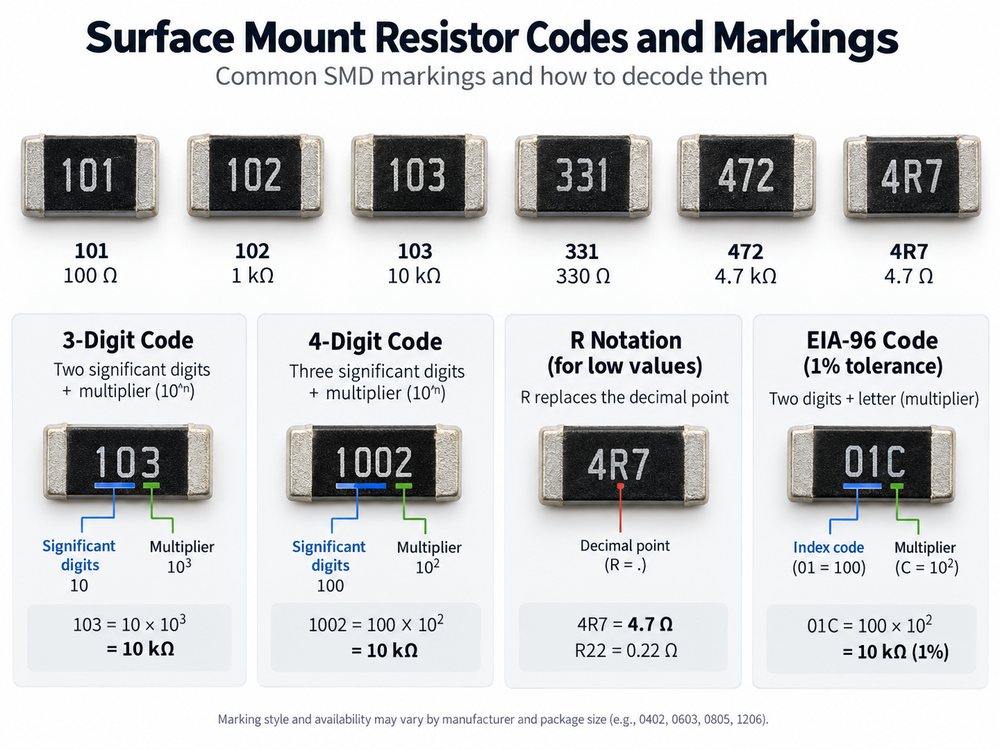
Surface mount resistor codes and markings showing 3-digit, 4-digit, R notation and EIA-96 examples

3-digit surface mount resistor code

The first two digits are significant figures. The third digit tells you how many zeros to add.

Code Calculation Value
101 10 × 101 100 Ω
102 10 × 102 1 kΩ
103 10 × 103 10 kΩ
331 33 × 101 330 Ω
472 47 × 102 4.7 kΩ

4-digit surface mount resistor code

The first three digits are significant figures and the fourth digit is the multiplier.

Examples:

  • 1001 = 100 × 101 = 1 kΩ
  • 4701 = 470 × 101 = 4.7 kΩ
  • 1002 = 100 × 102 = 10 kΩ
  • 4702 = 470 × 102 = 47 kΩ

Four-digit markings are often found on tighter-tolerance resistor series.

R notation

For low resistance values, R is used as the decimal point.

Examples:

  • R10 = 0.10 Ω
  • R47 = 0.47 Ω
  • 2R2 = 2.2 Ω
  • 4R7 = 4.7 Ω

EIA-96 resistor markings

EIA-96 uses two digits followed by a letter. The two-digit number refers to one of 96 standard base values, while the letter gives the multiplier.

Because the number is a lookup code rather than the resistance itself, an EIA-96 surface mount resistor code chart or calculator is usually the quickest way to decode it.

Unmarked surface mount resistors

01005, 0201, and some other small resistors may have no readable top marking. Their value should be identified using:

Appearance alone is not enough because different values can use identical packages.

Surface Mount Resistor Values: What Do 100, 101, 102 and 103 Mean?

For a standard 3-digit surface mount resistor marking, the first two digits give the significant value and the third digit gives the multiplier.
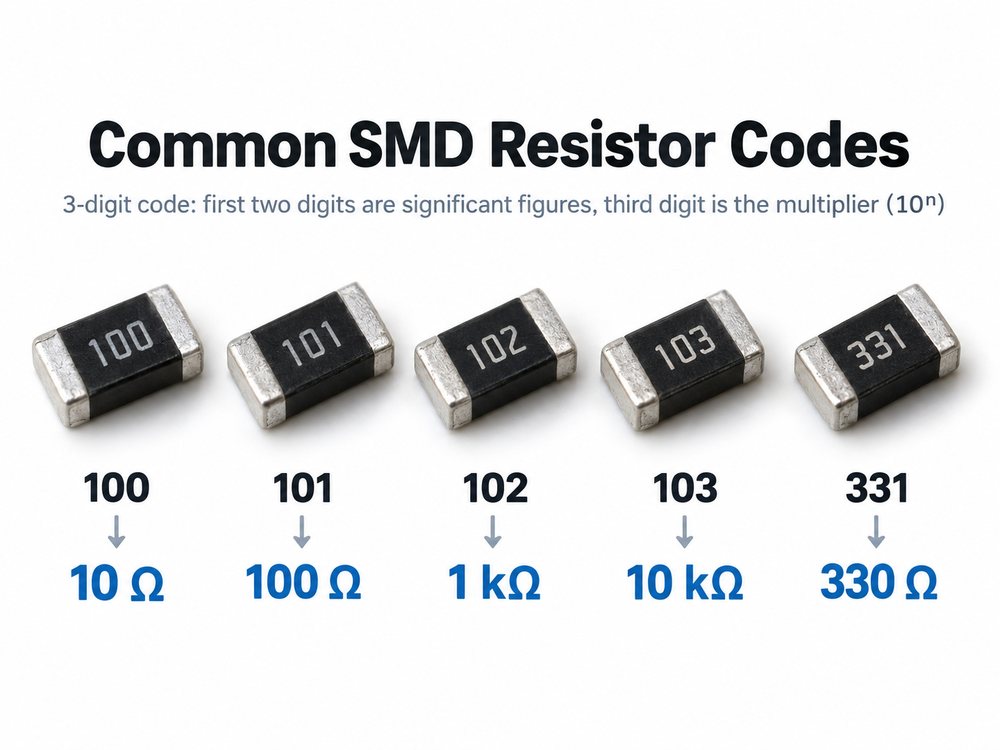
Common SMD resistor code values including 100, 101, 102, 103 and 331
Surface Mount Resistor Code Resistance Value
100 10 Ω
101 100 Ω
102 1 kΩ
103 10 kΩ
221 220 Ω
331 330 Ω
472 4.7 kΩ
104 100 kΩ

The code 100 is particularly easy to misread.

100 means:

10 × 100 = 10 Ω

It does not normally mean 100 Ω.

A 100 ohm surface mount resistor commonly uses the code 101:

10 × 101 = 100 Ω

Other common examples are:

  • 102 surface mount resistor = 1 kΩ
  • 103 surface mount resistor = 10 kΩ
  • 331 surface mount resistor = 330 Ω
  • 472 surface mount resistor = 4.7 kΩ

For example, a standard 330 ohm 0805 surface mount resistor may carry the marking 331 when that resistor series uses body markings.

How Do You Choose the Right Surface Mount Resistor for a PCB?

Choose a surface mount resistor by checking the required resistance first, then tolerance, power, voltage, temperature behavior, pulse load, and package size.

The main specifications are:

  • Resistance: Match the nominal value required by the circuit.
  • Tolerance: ±5% and ±1% are common; precision designs may need ±0.5%, ±0.1%, or tighter.
  • Power rating: Calculate actual dissipation and leave suitable operating margin.
  • Working voltage: Check this separately from wattage, especially in high-voltage circuits.
  • TCR: Use a lower temperature coefficient when resistance stability over temperature matters.
  • Pulse rating: Check surge capability for startup, switching, discharge, and transient loads.
  • Package: Select a size that meets both electrical and PCB space requirements.
  • Availability: Check whether the exact series is practical to source throughout production.

Resistor power can be estimated using:

P = I2R

P = V2 / R

Package wattage should not be treated as a universal limit. The usable power also depends on the exact resistor series, ambient temperature, PCB copper area, and manufacturer derating curve.

Package selection also affects assembly. An electrically suitable 0201 resistor may be unnecessary if an 0603 fits comfortably and the product does not require extreme component density.

For production PCBs, the preferred package is usually the smallest size that meets the electrical and layout requirements without adding unnecessary assembly difficulty.

Surface Mount Resistor vs Through-Hole Resistor: Which Should You Use?

The surface mount resistor vs through hole choice depends on assembly method, PCB area, mechanical needs, and power requirements. A surface mount resistor is usually preferred for compact and automated PCB assembly, while a through-hole resistor remains useful when easy manual handling, mechanical retention, or certain high-power requirements matter more.
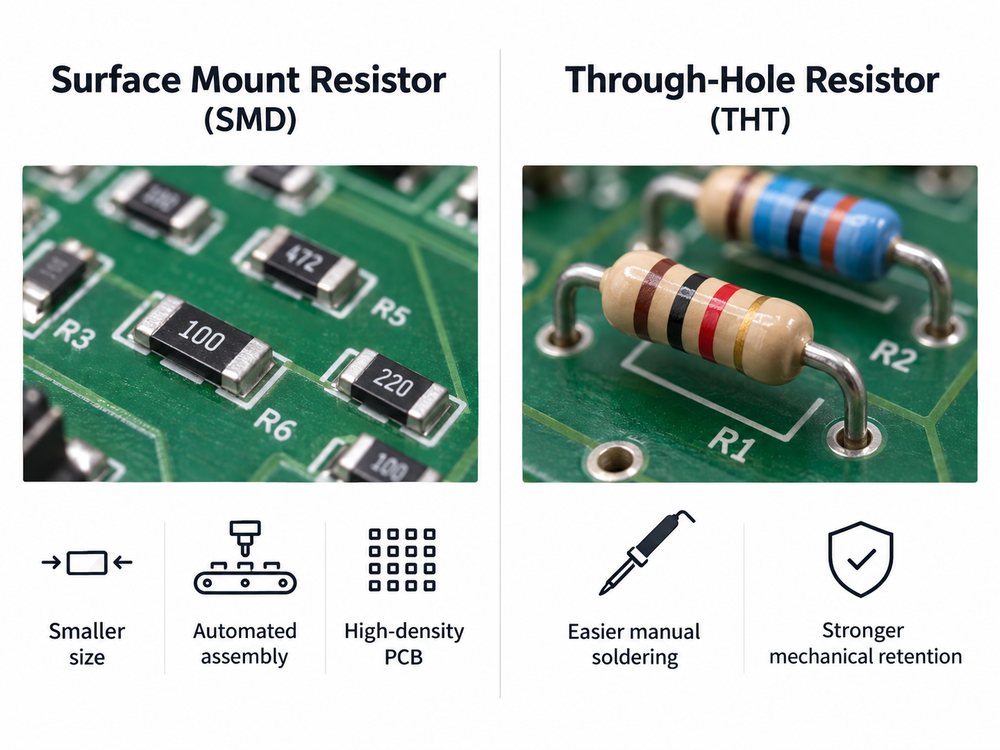
Surface mount resistor versus through-hole resistor comparison on printed circuit boards
Factor Surface Mount Resistor Through-Hole Resistor
PCB area Smaller Larger
Automated assembly Well suited Less efficient
Component density Higher Lower
Lead inductance Lower Higher
Manual soldering More difficult Easier
Mechanical retention Lower Stronger
Rework Harder at small sizes Usually easier
High-density PCB Preferred Less suitable

Choose a surface mount resistor when the design prioritizes:

  • compact PCB size
  • automated SMT production
  • high component density
  • short electrical paths
  • double-sided component placement

Choose a through-hole resistor when the design benefits more from:

  • manual assembly
  • straightforward repair
  • stronger mechanical retention
  • large leaded power components
  • simple prototype construction

For most modern volume-produced PCB assemblies, surface mount resistors are the default choice.

FAQs About Surface Mount Resistors

1. What does 102 mean on a surface mount resistor?

102 means 1 kΩ. The first two digits are 10, and the third digit adds two zeros: 10 × 100 = 1,000 Ω.

2. What does 103 mean on a surface mount resistor?

103 means 10 kΩ: 10 × 1,000 = 10,000 Ω.

3. Is an 0805 resistor always 1/8 watt?

No. Around 0.125 W is a common conventional rating, but the actual rating depends on the resistor series, construction, temperature, and manufacturer.

4. What is the smallest surface mount resistor size?

01005-class and smaller specialized resistors are available. The smallest practical package for a PCB depends on placement capability, stencil printing, inspection, rework, and required production yield.

5. Why do some surface mount resistors have no markings?

Small packages may not have enough body area for readable markings. Their resistance should be verified from the BOM, reel label, manufacturer part number, or measurement.

6. Is an SMD resistor the same as an SMT resistor?

In everyday use, the terms often refer to the same type of component. Technically, SMD means surface-mount device, while SMT is the manufacturing technology used to assemble it.

If you are preparing a PCB or PCBA project and need support with component package selection, SMT manufacturability, stencil design, or assembly planning, send your Gerber files, BOM, and assembly requirements to sales@bestpcbs.com

You may also like

SMD Resistor Dimensions: The Ultimate Guide to Packages, Footprints & Selection
Wednesday, December 3rd, 2025

If you’ve ever stared at a PCB prototype covered in misplaced components or wasted weeks reworking a design because the resistors didn’t fit, you know the frustration. smd resistor dimensions aren’t just arbitrary numbers—they’re the backbone of reliable electronics design. Understanding smd resistor dimensions ensures your components integrate seamlessly with PCBs, perform as expected under load, and avoid costly manufacturing delays. Whether you’re a hobbyist building a DIY project or an engineer designing industrial equipment, getting the dimensions right is non-negotiable. Let’s break down everything you need to know to stop guessing and start choosing with confidence.

SMD Resistor Dimensions: The Ultimate Guide to Packages, Footprints & Selection https://www.bestpcbs.com/blog/2025/12/smd-resistor-dimensions/

2. What Are SMD Resistors? A Quick Primer for Beginners

SMD resistors (Surface Mount Device resistors) are the compact, lead-free workhorses of modern electronics. Unlike traditional through-hole resistors that require drilled holes in PCBs, SMD resistors mount directly onto the board’s surface, saving valuable space and enabling faster assembly. Their key advantages over through-hole alternatives include a 50% smaller footprint, better high-frequency performance, and compatibility with automated pick-and-place machines—critical for mass production. But here’s the catch: their small size means smd resistor dimensions directly dictate what they can do. A tiny 0201 resistor might fit in a smartwatch, but it can’t handle the power demands of an industrial power supply. Size isn’t just about space—it’s about functionality.

SMD Resistor Dimensions: The Ultimate Guide to Packages, Footprints & Selection https://www.bestpcbs.com/blog/2025/12/smd-resistor-dimensions/

3. Understanding SMD Resistor Dimension Codes (Imperial vs. Metric)

One of the most common headaches with SMD resistors is decoding their size codes—and it’s easy to see why. Two global systems dominate: imperial (used primarily in North America and Europe) and metric (favored in Asia). The 4-digit codes look similar, but they mean entirely different things. Let’s demystify them:

  • Imperial codes: The first two digits = length (in 1/100 of an inch), the last two = width (in 1/100 of an inch). For example, 0402 = 0.04” (length) x 0.02” (width), and 1206 = 0.12” x 0.06”.
  • Metric codes: The first two digits = length (in millimeters), the last two = width (in millimeters). So 1608 = 1.6mm x 0.8mm, and 3216 = 3.2mm x 1.6mm.

The biggest mistake? Confusing imperial 0603 with metric 0603. Imperial 0603 = 1.6mm x 0.8mm (metric 1608), while metric 0603 = 0.6mm x 0.3mm (imperial 0201)—a difference that can ruin your entire PCB. Pro tip: Always confirm the code system with your supplier, and keep a conversion chart handy (multiply inches by 25.4 to get millimeters, or pide millimeters by 25.4 for inches).

4. smd resistor package dimensions

Common SMD Resistor Package Sizes (Detailed Specs + Comparative Chart)

When people talk about smd resistor dimensions, they’re usually referring to package size—the physical length, width, and height of the component. Here are the most widely used packages, with specs that matter:

Imperial CodeMetric CodeDimensions (mm)Dimensions (inch)Rated Power (W)Height (mm)
020106030.6 x 0.30.024 x 0.0120.050.25
040210051.0 x 0.50.039 x 0.0200.0630.35
060316081.6 x 0.80.063 x 0.0310.100.45
080520122.0 x 1.20.079 x 0.0470.1250.55
120632163.2 x 1.60.126 x 0.0630.250.75
251264326.4 x 3.20.252 x 0.1261.001.20

Notice how power rating scales with size? A 2512 package can handle 1W of power, while a tiny 0201 maxes out at 0.05W. This is because larger packages have more surface area for heat dissipation—critical for high-power applications.

SMD Resistor Dimensions: The Ultimate Guide to Packages, Footprints & Selection https://www.bestpcbs.com/blog/2025/12/smd-resistor-dimensions/

How Package Dimensions Impact Thermal Dissipation & Assembly

Thermal management is where smd resistor dimensions really shine (or fail). Smaller packages like 0201 and 0402 are great for compact devices (think smartphones or wearables), but they struggle with heat. If you push a 0402 resistor beyond its 0.063W limit, it’ll overheat, drift in resistance, or even burn out. Larger packages like 1206 and 2512 spread heat more effectively, making them ideal for power supplies or industrial controls.

Assembly is another factor. Ultra-small packages (0201) require precision automated equipment—forget hand-soldering them unless you have steady hands and a microscope. For hobbyists or small-batch projects, 0805 and 1206 are the sweet spot: easy to solder manually while still saving space.

SMD Resistor Dimensions: The Ultimate Guide to Packages, Footprints & Selection https://www.bestpcbs.com/blog/2025/12/smd-resistor-dimensions/

5. smd resistor footprint dimensions

What Is an SMD Resistor Footprint? (Land Pattern Basics)

If smd resistor dimensions are about the component itself, footprint dimensions are about how it connects to the PCB. A footprint (or land pattern) is the layout of copper pads on the PCB where the resistor solders. Think of it as the resistor’s “home”—if the home is too big or too small, the resistor won’t sit right.

Footprints follow global standards set by IPC (Association Connecting Electronics Industries) and JEDEC (Joint Electron Device Engineering Council). These standards ensure compatibility across manufacturers—so a 0805 resistor from Texas Instruments fits the same footprint as one from Yageo. Ignoring these standards leads to problems: pads too small cause poor solder joints, while pads too large result in solder bridging (short circuits) or the resistor shifting during assembly.

Standard Footprint Dimensions by Package

Here are the IPC-recommended footprint dimensions for the most common SMD resistor packages (pad length x width x gap between pads):

  • 0603 (1608): Pad length = 1.2mm, pad width = 0.8mm, gap = 0.4mm
  • 0805 (2012): Pad length = 1.5mm, pad width = 1.0mm, gap = 0.5mm
  • 1206 (3216): Pad length = 2.0mm, pad width = 1.4mm, gap = 0.6mm
  • 2512 (6432): Pad length = 3.0mm, pad width = 2.5mm, gap = 0.8mm

These are starting points—adjustments may be needed for high-temperature applications or flexible PCBs. Always cross-check with your resistor’s datasheet and your PCB design software (Altium, KiCad) for manufacturer-specific recommendations.

6. Key Factors to Consider When Choosing SMD Resistor Dimensions

PCB Space Constraints (High-Density vs. Industrial Designs)

The first question to ask: How much space do you have? High-density designs (like wearables or IoT sensors) demand tiny packages (0201, 0402) to fit all components. Industrial equipment or power supplies have more room, so you can opt for larger packages (1206, 2512) that offer better performance and easier assembly. Don’t force a small package if space allows—bigger often means more reliable.

Power Requirements & Performance Tradeoffs

Power rating is non-negotiable. Calculate the maximum power your resistor will handle (using Ohm’s Law: P = VÂČ/R or P = IÂČR) and choose a package that exceeds that by 20-30% for safety. For example, if your circuit requires 0.1W, a 0603 (0.1W) works, but a 0805 (0.125W) gives extra headroom for heat spikes.

Assembly Method (Automated vs. Hand Soldering)

Automated pick-and-place machines handle tiny packages (0201, 0402) with ease, but hand soldering them is frustrating (and error-prone). If you’re building prototypes or small batches, stick to 0805 or 1206. For mass production, automated assembly opens up smaller package options.

Global Supply Chain Compatibility

Not all packages are equally available worldwide. Ultra-small packages (0201) may be harder to source in some regions, or more expensive. Stick to common packages (0402, 0603, 0805, 1206) for easier procurement and consistent quality across suppliers.

7. Common Mistakes in SMD Resistor Dimension Selection (And Fixes)

Even experienced engineers mess up smd resistor dimensions—here are the top mistakes and how to avoid them:

  • Mistake 1: Ignoring thermal limits. Solution: Always derate resistors (use a higher power rating than needed) and check datasheets for temperature vs. power curves.
  • Mistake 2: Confusing imperial and metric codes. Solution: Label your BOM (Bill of Materials) with both codes (e.g., 0603 / 1608) and confirm with suppliers.
  • Mistake 3: Choosing a package too small for hand soldering. Solution: For manual assembly, avoid anything smaller than 0805 unless you have specialized tools.
  • Mistake 4: Mismatched footprints. Solution: Use PCB design software’s built-in footprint libraries (Altium, KiCad) or download from the resistor manufacturer’s website.

8. SMD Resistor Dimensions for Specific Applications

Consumer Electronics (Smartphones, Wearables)

Space is at a premium here—so packages like 0201 and 0402 are standard. These tiny SMD resistors fit in tight spaces while handling low power (0.05-0.1W). Examples: A smartphone’s display driver might use 0402 resistors, while a fitness tracker uses 0201s.

Industrial Equipment (Power Supplies, Controls)

Industrial gear needs durability and heat resistance. Packages like 1206 and 2512 are common, as they handle higher power (0.25-1W) and dissipate heat better. A factory’s motor controller, for example, might use 2512 resistors to handle power spikes.

Automotive & Medical Devices

These industries demand reliability in harsh conditions (extreme temperatures, vibration). Packages like 0805, 1206, and 1210 are preferred—they’re robust enough to withstand automotive underhood temperatures or medical device sterilization cycles. Automotive infotainment systems often use 0805 resistors, while medical monitors use 1206s.

9. How to Measure SMD Resistor Dimensions Accurately

If you’re unsure about a resistor’s size (or suspect a counterfeit), measuring it is simple—you just need the right tools:

  1. Gather tools: Digital calipers (with 0.01mm precision) and a magnifying glass or microscope (for tiny packages).
  2. Measure length: Place the resistor on a flat surface and measure the longest side (avoid pressing too hard—SMD resistors are fragile).
  3. Measure width: Measure the shorter side perpendicular to the length.
  4. Measure height: Measure from the flat surface to the top of the resistor (this affects PCB clearance).
  5. Verify: Cross-check your measurements with the code on the resistor (e.g., if you measure 1.6mm x 0.8mm, it should be a 0603 / 1608 package).

Pro tip: Counterfeit resistors often have incorrect dimensions—if your 0805 resistor measures 1.8mm x 0.9mm instead of 2.0mm x 1.2mm, it’s likely fake.

10. SMD Resistor Dimensions vs. Through-Hole Resistors: Comparison

How do smd resistor dimensions stack up against traditional through-hole resistors? Let’s break it down:

  • Size: SMD resistors are 50-70% smaller in footprint. A 1206 SMD resistor (3.2mm x 1.6mm) is tiny compared to a through-hole 1/4W resistor (6.3mm x 3.2mm).
  • Height: SMD resistors sit 0.25-1.2mm above the PCB, while through-hole resistors stand 8-10mm tall—critical for low-profile devices.
  • Performance: SMD resistors have better high-frequency performance (less parasitic inductance) and faster heat dissipation (direct contact with the PCB).
  • Assembly: Through-hole resistors are easier to hand-solder but slower to assemble in bulk. SMD resistors require automation for mass production but save time overall.

When to choose SMD: Most modern electronics (consumer, industrial, automotive) benefit from SMD’s small size and performance. When to choose through-hole: Prototyping (easy to solder), high-power applications (some through-hole resistors handle 5W+), or legacy designs.

11. FAQ: Common Questions About SMD Resistor Dimensions

  • Q1: What do the 4 digits in SMD resistor codes represent?A1: For imperial codes (e.g., 0402), the first two digits = length (1/100 inch), last two = width (1/100 inch). For metric codes (e.g., 1608), first two = length (mm), last two = width (mm).
  • Q2: Can I replace a 0603 resistor with a 0805 if space allows?A2: Yes—if the power rating is equal or higher. A 0805 (0.125W) can replace a 0603 (0.1W) as long as your PCB has space for the larger footprint.
  • Q3: Why do different manufacturers label the same package with slightly different dimensions?A3: Manufacturers have minor tolerances (±0.1mm for length/width). Stick to IPC/JEDEC standards, and the differences won’t affect compatibility.
  • Q4: Which SMD resistor size is easiest for hand soldering?A4: 0805 is the sweet spot—large enough to handle with tweezers and solder with a standard iron, but small enough to save space.
  • Q5: Are there standard footprint dimensions for all SMD resistor packages?
    A5: Yes—IPC/JEDEC sets global standards. Use your PCB design software’s library or download from manufacturers like Yageo or Vishay.
  • Q6: Does temperature affect SMD resistor dimensions?
    A6: Negligibly. SMD resistors are made of ceramic and metal films, which have low thermal expansion. Temperatures up to 150°C won’t change their dimensions enough to cause issues.
  • Q7: What’s the smallest mass-produced SMD resistor size?
    A7: 01005 (imperial) or 0402 (metric) = 0.4mm x 0.2mm. It’s used in ultra-compact devices like smartwatches but requires specialized assembly.
  • Q8: How do I calculate the right footprint for my PCB?
    A8: Use IPC-7351 (the industry standard) or your resistor’s datasheet. Most PCB design software (Altium, KiCad) has built-in calculators to generate footprints based on package size.

12. Final Thoughts: Mastering SMD Resistor Dimensions for Better Designs

smd resistor dimensions might seem intimidating at first, but they’re just a matter of understanding tradeoffs—space vs. power, size vs. assembly ease. The key takeaway? Never choose a package based on size alone—align it with your application’s power needs, assembly method, and PCB constraints. By mastering code translation, footprint standards, and application-specific sizing, you’ll eliminate rework, reduce costs, and build more reliable electronics.

Remember: A SMD resistor is only as good as its fit—get the dimensions right, and everything else falls into place. For more details, check out IPC-7351 (the definitive guide to footprint design) or reach out to your resistor supplier for custom recommendations. Whether you’re building a prototype or scaling to mass production, this guide will keep your designs on track.

You may also like