IPC-1752A should not become the reason your quotation, production release, or shipment is delayed. If you define the declaration correctly at the RFQ stage, the supplier can identify missing material data early and return a file that matches the part you are approving.
The phrase “IPC-1752A required” is not enough. It does not tell the supplier whether you need data for a bare PCB, an assembled PCB, or a finished product—or how deeply the materials must be reported. Leaving those decisions until after the order can lead to clarification rounds, a revised quotation, and unusable documentation.
This guide helps you define the right request, send the right inputs, and check the returned XML before it enters your compliance records.
What Is IPC-1752A?
Use IPC-1752A to receive material data in a consistent structure—not as a shortcut for proving compliance. It is a material-declaration standard for exchanging structured information about materials, components, printed boards, subassemblies, and products.
The standard defines a reporting structure. It does not by itself decide whether a product complies with every environmental regulation, and it is not a PCB workmanship or acceptability standard. The applicable regulation, declarable-substance list, threshold, exemption, and acceptance decision remain separate questions.
For versions that incorporate Amendments 1, 2, and 3, the exchange file is XML rather than a companion IPC PDF form. The practical RFQ instruction is therefore simple: name the required amendment or schema and the validation method. Do not ask only for “an IPC form,” because the supplier still will not know which electronic file your system can accept.
The distinction is simple: IPC-1752A organizes declaration data; it does not replace the technical and regulatory requirements behind that data.
What Does an IPC-1752A Declaration Cover?
Define the product boundary first so the returned declaration matches what you are buying. A bare PCB declaration may cover laminate, prepreg, copper, surface finish, solder mask, legend ink, and other controlled fabrication materials. A PCBA declaration may also involve populated components, solder alloy, adhesive, coating, mechanical items, cables, connectors, and other materials in the agreed assembly scope.
This is where many requests become difficult. A fabrication drawing identifies how to build the board, but it is not a complete material declaration. A BOM identifies purchased parts, but manufacturer names, exact part numbers, approved alternatives, and supplier declarations may still be missing.
Before requesting a declaration, define these boundaries:
- bare PCB, PCBA, subassembly, or finished product;
- one part number or a family of products;
- prototype lot, production revision, or all approved revisions;
- manufacturer part numbers and approved substitutes included in the BOM;
- customer-supplied parts, consigned materials, and excluded items;
- required declaration class, schema version, substance list, and reporting date.
A file can be technically complete and still be useless if it names the wrong revision or excludes part of the assembly. Clear scope prevents that avoidable review failure.
Which Declaration Class Does Your Request Require?
Choose the class before quotation to get enough evidence without creating unnecessary cost and delay. Different classes require different reporting depth, collection effort, and upstream evidence.
| Class | Typical purpose | Buyer decision |
|---|---|---|
| A | Answers defined product-level query statements | Specify the required query list |
| B | Reports information for selected material groups | Define the groups and thresholds |
| C | Reports against declarable-substance lists | Identify the applicable list and revision |
| D | Provides full material disclosure | Confirm the required level of detail |
This table is a planning guide, not a substitute for the applicable standard, schema documentation, or the customer’s compliance procedure. The same product can require different declarations for different customers or markets.
Class D is not automatically the best choice. It can require substantially more supplier data than a targeted Class C request. Conversely, a broad statement of conformity may be insufficient when the customer needs homogeneous-material-level detail.
If the class is left open, the supplier may quote a limited documentation scope while your customer expects a deeper disclosure. Resolving that mismatch after order placement can trigger a re-quote or delay the document package.
What Information Should PCB and PCBA Buyers Provide?
Send complete identifiers and released files once, and you reduce repeated questions later. The supplier cannot infer a declaration from a product name or end-use description; the data must connect to the exact material and component sources used in production.
For the bare PCB, provide:
- released Gerber or ODB++ data and fabrication drawing;
- approved stack-up and exact material requirements;
- surface finish, solder mask, legend, copper, and special-process requirements;
- customer-approved material substitutions and approval route;
- PCB part number, revision, quantity, and production location requirements;
- required material certificates, declarations, or traceability records.
For PCBA, also provide:
- a BOM with manufacturer and manufacturer part number fields;
- approved alternate parts and substitution rules;
- assembly drawings, placement data, and process notes;
- customer-supplied or consigned-part identification;
- required solder alloy, coating, adhesive, cleaning, and other process materials;
- the exact declaration scope for purchased components and assembly materials.
Generic descriptions such as “1 kΩ resistor” or “equivalent connector” are not enough for part-specific material-data collection. The declaration must correspond to the exact approved source used in production.
How Can a PCB Supplier Support Material Data Collection?
A capable supplier helps expose documentation gaps before they can hold up production or shipment. Its role is to connect the released manufacturing configuration with traceable material and purchasing information—not to invent missing compliance data after the boards are built.
For PCB fabrication, the supplier can reconcile the quoted stack-up with the approved laminate, prepreg, copper, finish, solder mask, and other specified materials. If a material change is proposed, it should be identified for customer approval because a seemingly similar substitute may have different declaration data.
For PCBA, BOM sourcing should retain the approved manufacturer part number and record any authorized alternative. Supplier declarations or manufacturer documentation can then be coordinated against the actual purchased part rather than a generic BOM description.
Manufacturing support may include:
- checking that part numbers, revisions, and material specifications are complete;
- identifying missing supplier declarations or ambiguous BOM lines;
- maintaining approved-source and lot-traceability records;
- coordinating available laminate, component, and process-material documentation;
- reporting proposed substitutions before purchase or production;
- supporting agreed inspection and testing requirements.
This support does not transfer the requestor’s responsibility for selecting regulations, declaration classes, thresholds, or final compliance acceptance. It also does not mean that every upstream supplier can provide every requested data field. Gaps should be disclosed early so that the buyer can decide whether to approve an alternative, change the requirement, or select another source.
What Should You Verify in an IPC-1752A XML File?
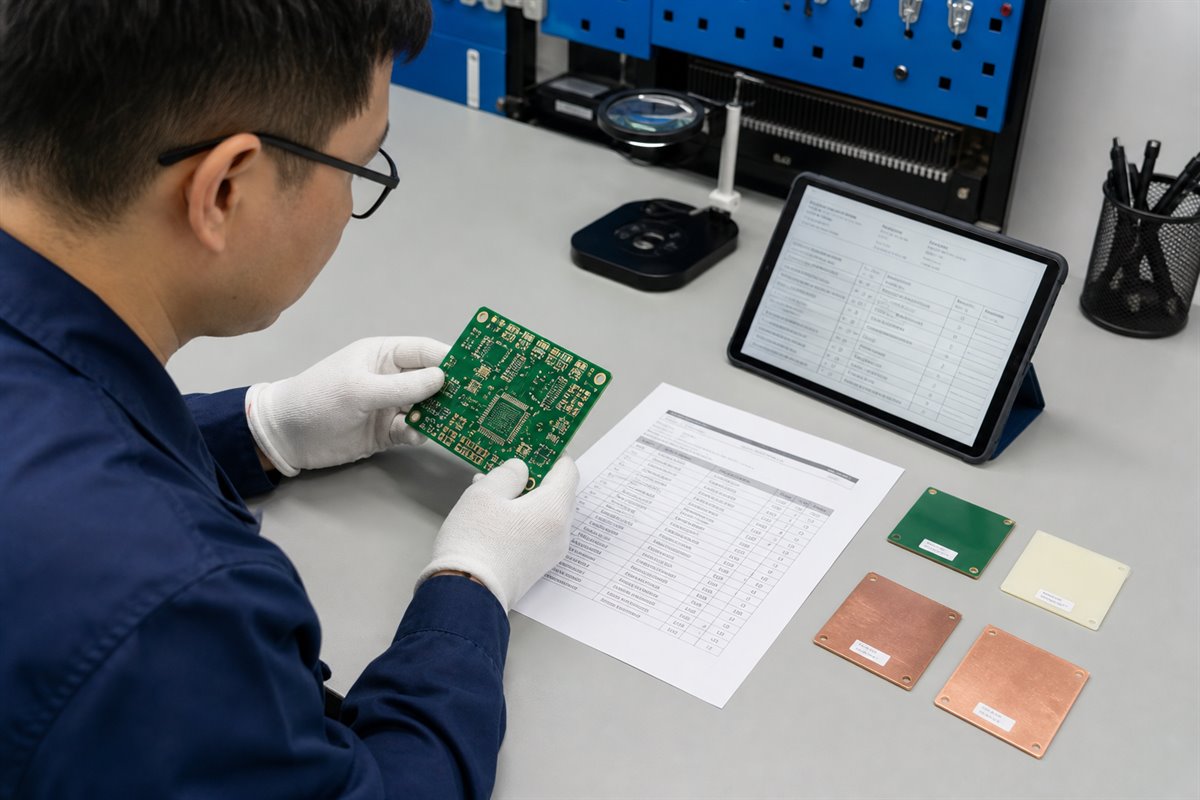
Validate the XML before accepting it, so the wrong part, revision, schema, or substance list does not enter your controlled records. A file that opens successfully is not necessarily the file your order required.
Check the declaration against the purchase record:
- requestor and supplier identities;
- product or part number and revision;
- declaration class and applicable query or substance list;
- schema and amendment version;
- declared mass, units, and material hierarchy where required;
- manufacturer part numbers for purchased components;
- exemptions, statements, dates, and signatures or authorization fields;
- file-validation result from a compatible tool;
- consistency with the approved BOM, AVL, stack-up, and production records.
Amendment 3 introduced identification codes intended to make declarations more reliably machine-readable. Even so, buyers should not depend on visual inspection alone. Use a compatible validator and retain the validation result with the controlled purchasing and quality records.
Do not silently edit a supplier’s declaration to make it pass validation. If the file is incomplete or inconsistent, return the issue to the responsible source and preserve the corrected revision.
How Does IPC-1752A Relate to RoHS and REACH?
Do not let one XML file create false confidence about market compliance. IPC-1752A can carry information used in a RoHS, REACH, or other material-compliance review, but it is the reporting structure—not the regulation or the final approval decision.
RoHS addresses restrictions on specified substances in electrical and electronic equipment. REACH includes obligations related to substances, mixtures, articles, and substances of very high concern. Applicable requirements can depend on the market, product type, concentration threshold, exemption, and date.
An IPC-1752A declaration can structure the supplier’s response against an identified list. It cannot determine which legal obligations apply to the buyer’s finished product. A “RoHS compliant” statement without the applicable directive version, exemption basis, declared scope, and supporting supplier information may not answer the customer’s real question.
Keep three layers separate:
- The customer defines the applicable regulatory and reporting requirements.
- IPC-1752A structures the requested material-declaration data.
- Suppliers provide evidence for the materials and parts within their controlled scope.
This separation prevents a common sourcing mistake: treating one declaration file as a universal compliance certificate for every market and every product configuration.
What Should You Include in Your RFQ?
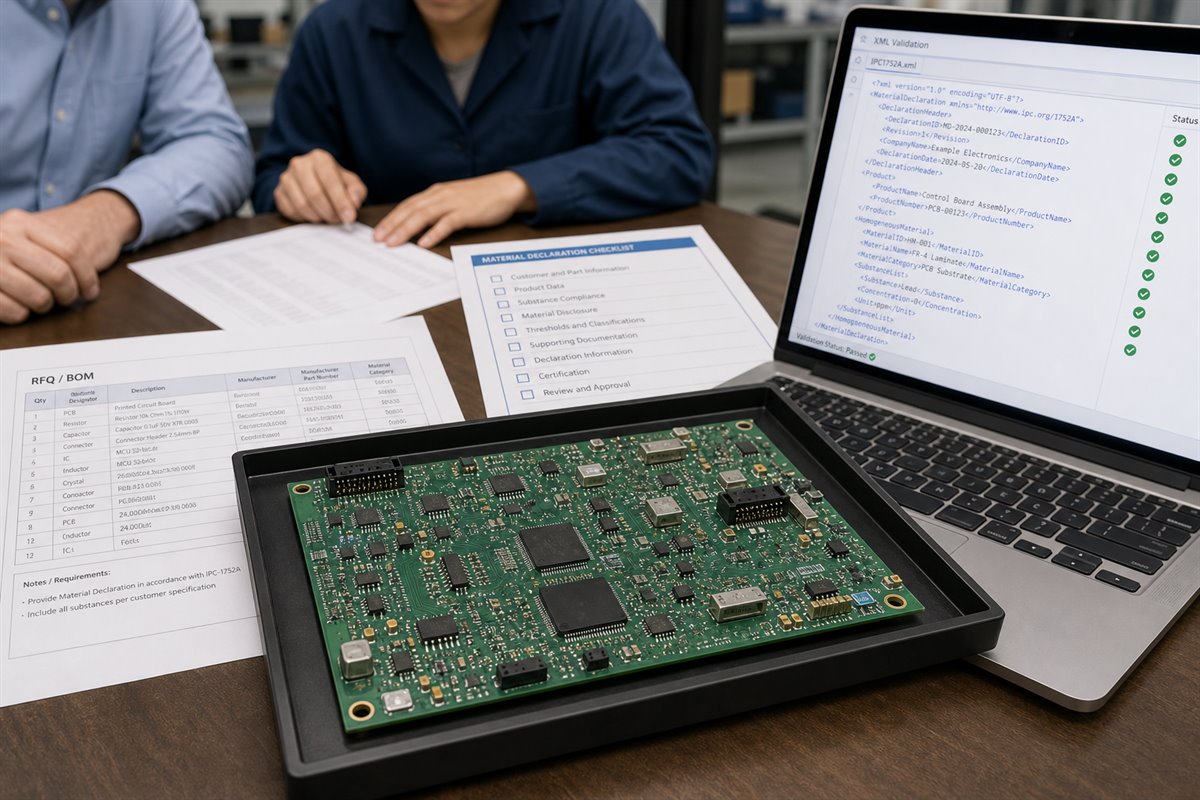
Make the documentation a quoted deliverable from day one. Stating it in the RFQ protects your lead time and budget because the supplier can evaluate collection effort, upstream availability, validation, and delivery timing before accepting the order.
An effective RFQ should state:
- whether the request covers a bare PCB or PCBA;
- PCB part number, assembly number, and revision;
- IPC-1752A class, amendment, and schema required;
- applicable query list, declarable-substance list, and revision;
- reporting threshold and expected disclosure depth;
- accepted validation tool or verification method;
- required supplier, material, and component evidence;
- rules for alternates, substitutions, and customer approval;
- required file name, delivery stage, and document-retention period;
- treatment of unavailable upstream data and escalation route.
Send the RFQ together with the fabrication data, approved stack-up, BOM, AVL, assembly files, and inspection requirements. EBest Circuit can review the PCB/PCBA manufacturing package, BOM sourcing scope, material-document availability, and agreed traceability requirements before quotation.
For a practical feasibility review, email the released files and documentation checklist to sales@bestpcbs.com. The response should clearly separate what can be supported, what requires upstream supplier confirmation, and what remains the customer’s compliance decision.
FAQs About IPC-1752A
These short answers address the questions most likely to block an RFQ, supplier comparison, or declaration approval.
Is IPC-1752A a PCB manufacturing standard?
No. It is a material-declaration data-exchange standard. PCB fabrication and assembly workmanship requirements are defined through other specifications, drawings, acceptance criteria, and customer requirements.
Can I download and complete an IPC-1752A PDF form?
For IPC-1752A with Amendments 1, 2, and 3, IPC specifies XML as the exchange format and does not provide a companion PDF form. Compatible third-party tools are used to generate and validate the XML.
Does an IPC-1752A file prove RoHS and REACH compliance?
Not by itself. It structures supplier declaration data. The applicable regulations, lists, thresholds, exemptions, product scope, and final acceptance still need to be defined and reviewed.
Should every PCB or PCBA order require a Class D declaration?
No. The required class should match the customer’s reporting purpose. A targeted declaration may be sufficient for one request, while another may require full material disclosure. Define the class before quotation.
What should I send EBest Circuit for an IPC-1752A-related PCB or PCBA inquiry?
Send the released PCB data, stack-up, BOM with manufacturer part numbers, AVL or alternate rules, assembly files, part revisions, and the exact declaration class, schema, substance list, validation method, and required supporting records. EBest Circuit can then assess the manufacturing, sourcing, PCBA, traceability, and document-coordination scope. To review your next IPC-1752A requirement, contact sales@bestpcbs.com.