A PCB assembly manufacturer turns bare circuit boards, components, placement data, and test requirements into finished PCBAs that can be inspected, tested, and shipped for prototype or production use. For buyers, the important question is not only who can place parts on a board. The better question is which manufacturer can review your BOM, CPL, DFM risks, component sourcing rules, assembly method, and test plan before the order starts.
This guide is written for engineers and procurement teams comparing PCB assembly manufacturers. It explains what to prepare before requesting a quote, how to compare supplier responses, and which risks usually create cost changes, schedule delays, or assembly defects.
PCB Assembly Manufacturer at a Glance
A reliable PCB assembly manufacturer should connect fabrication readiness, component preparation, SMT or through-hole assembly, inspection, testing, and shipment into one controlled workflow. A low assembly price is not useful if the supplier misses a BOM mismatch, package error, polarity issue, or test requirement.
| Assembly area | What to confirm | Buyer risk if missed |
|---|---|---|
| BOM review | MPN, quantity, package, alternates, lifecycle status | Wrong parts, shortages, substitutions, quote changes |
| CPL / placement | Coordinates, rotation, side, polarity, fiducials | Misplaced or reversed components |
| Assembly method | SMT, through-hole, BGA, selective soldering, manual steps | Wrong process route or hidden labor cost |
| Inspection and test | AOI, visual, X-ray where needed, functional test criteria | Defects shipped or delayed acceptance |
Are PCB Assembly Delays Coming From BOM, DFM or Placement Issues?
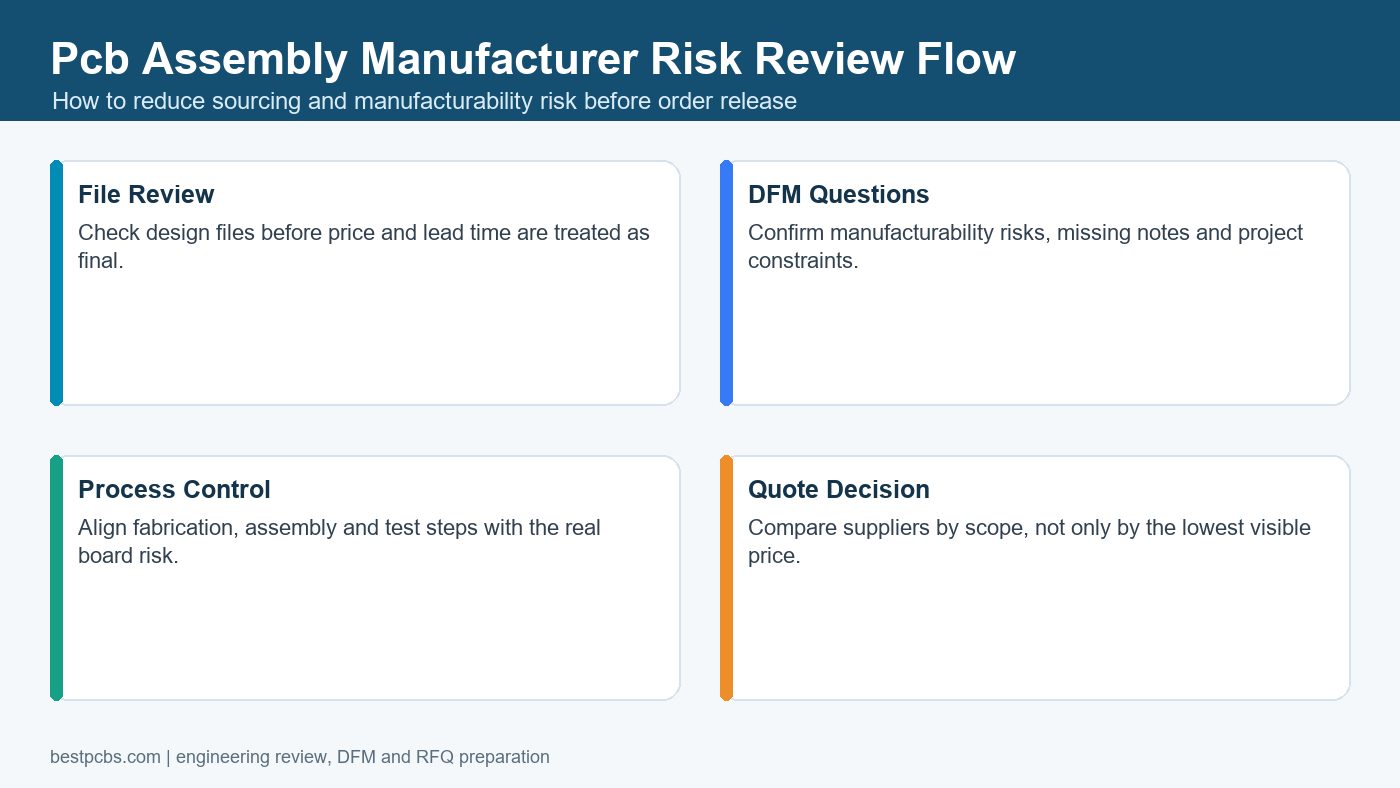
PCB assembly buyers often lose time when fabrication data, BOM details, placement files and inspection expectations are not reviewed together before production.
| Customer Pain Point | Project Risk | How bestpcbs Helps |
|---|---|---|
| BOM details are incomplete or substitute rules are unclear | Component sourcing can stall or the wrong part can be approved under schedule pressure | bestpcbs reviews the BOM with the fabrication package and asks buyers to clarify substitutes, polarity, package and sourcing requirements before assembly. |
| CPL or placement data does not match the board revision | Parts may be placed in the wrong location or orientation | bestpcbs checks Gerber or ODB++ files together with BOM, CPL and assembly notes so revision conflicts can be found before release. |
| Fine-pitch or leadless packages are treated like simple SMT | Soldering defects, bridges or insufficient inspection may appear late | bestpcbs asks for package details, inspection needs and assembly drawings so the assembly plan can match the real component risk. |
| Testing expectations are not defined | A board can pass visual checks but still fail in the final product | bestpcbs confirms electrical, functional or customer-defined test requirements during RFQ review. |
When You Need a PCB Assembly Manufacturer
You need a PCB assembly manufacturer when the project requires more than bare board fabrication and must become a working PCBA. This includes prototypes for bring-up, pilot runs, low-volume production, industrial control boards, LED electronics, sensor modules, communication devices, and other electronics that require components mounted and checked.
If your project also needs bare board fabrication, using a supplier that can coordinate both sides can reduce handoff risk. The PCBA and PCB assembly service page is the main service reference for this path.
PCB Fabrication vs PCB Assembly vs Turnkey PCBA
PCB fabrication builds the bare board, PCB assembly mounts components, and turnkey PCBA combines fabrication, component sourcing, assembly, inspection, and shipment under one supplier workflow. Many buyer problems happen because these scopes are mixed together in the RFQ.
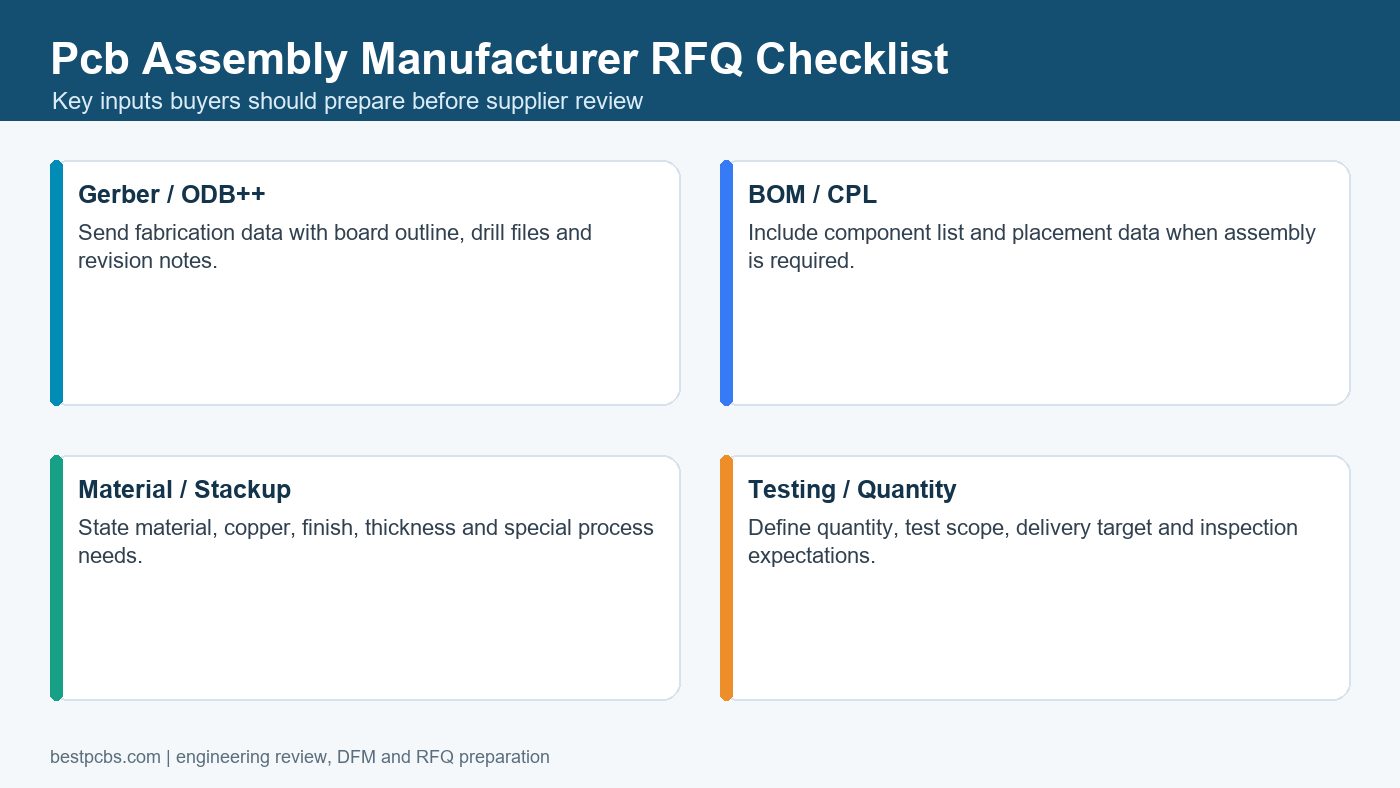
For bare boards, the key files are Gerber or ODB++, drill data, stackup, material, copper, finish, and outline. For assembly, the supplier also needs BOM, CPL, assembly drawing, polarity notes, substitution rules, and test requirements. For turnkey PCBA, component sourcing and approval rules become part of the quote.
Files a PCB Assembly Manufacturer Needs for Quote
A useful PCB assembly quote needs fabrication files, component data, placement data, quantity, inspection requirements, and clear notes about substitutions and testing. Missing files do not only delay the quote; they can hide cost drivers until the project is already in motion.
| File or input | Why it matters |
|---|---|
| Gerber or ODB++ | Defines the board copper, solder mask, silkscreen, outline, and manufacturing data. |
| Drill files | Clarifies holes, vias, plated slots, and mechanical features. |
| BOM | Lists approved parts, quantities, manufacturers, values, and sourcing constraints. |
| CPL / pick-and-place | Provides coordinates, side, and rotation for component placement. |
| Assembly drawing | Clarifies polarity, connectors, mechanical notes, special parts, and manual operations. |
| Test requirements | Defines what must be inspected or functionally checked before shipment. |
The PCB manufacturer online guide gives a practical way to organize these files before submitting an RFQ.
BOM Review and Component Sourcing Risks
BOM review is one of the most important assembly steps because a single wrong package, unavailable component, or unapproved substitute can stop the build. A PCB assembly manufacturer should not treat the BOM as a simple shopping list.
Ask whether the supplier checks manufacturer part numbers, package consistency, alternates, lifecycle status, minimum order issues, lead-time risk, and approved substitutions. If the supplier will source components, define who approves replacements and whether customer-supplied parts are allowed. Bestpcbs buyers can use the component sourcing support page as a related reference.
DFM and DFA Review Before Assembly
DFM and DFA review help catch problems that look acceptable in CAD but create soldering, placement, inspection, or test issues during assembly. These checks should happen before production starts, not after components are already on the line.
Important checks include footprint-to-BOM match, polarity marks, component spacing, solder mask clearance, via-in-pad risk, fiducial placement, panelization, connector access, test point access, thermal concerns, and whether the assembly drawing matches the BOM and CPL. The PCB design for manufacturability checklist explains the design-side logic behind these checks.
SMT, Through-Hole, BGA and Mixed Assembly
The right assembly method depends on the component package mix, board design, inspection needs, mechanical strength, and production quantity. SMT is common for compact electronics, through-hole is useful for stronger mechanical joints or connectors, and BGA requires careful placement and inspection planning.
Many real PCBAs use mixed assembly. A board may include fine-pitch ICs, LEDs, connectors, relays, sensors, power parts, hand-soldered items, and test pads. The quote should define which side is assembled, which components need special handling, whether X-ray is needed for hidden joints, and whether the assembly has any manual operations.
Testing and Inspection Before Shipment
Inspection and testing should match the risk of the PCBA, not just the order quantity. A simple prototype may need visual inspection and basic electrical checks, while a production or industrial board may need AOI, X-ray for hidden joints, functional testing, programming, fixture checks, or customer-defined pass/fail criteria.
Ask what inspection is included, what requires extra setup, and what the supplier needs from you. If functional testing is required, provide firmware, test fixture notes, connector access, power limits, safety notes, and pass/fail conditions.
What Affects PCB Assembly Cost?
PCB assembly cost is affected by setup, component count, package difficulty, sourcing risk, soldering method, inspection, testing, quantity, and how complete the RFQ package is. Unit price alone is not enough to compare suppliers.
| Cost driver | Why it changes cost | How to reduce uncertainty |
|---|---|---|
| Component count | More placements increase machine time and inspection effort. | Send a clean BOM and CPL. |
| Package complexity | Fine pitch, BGA, QFN, connectors, and odd-form parts need more review. | Provide drawings, polarity notes, and inspection needs. |
| Sourcing | Unavailable or risky components change schedule and cost. | Define approved alternates and substitution rules. |
| Testing | Functional tests, fixtures, and programming add setup effort. | Separate must-have tests from optional checks. |
Lead Time Risks in PCB Assembly Projects
PCB assembly lead time is usually affected by file completeness, DFM questions, component availability, assembly complexity, testing setup, and approval delays. A supplier can move faster when the buyer provides complete and consistent files.
Before you push for speed, confirm whether the bottleneck is bare board fabrication, component sourcing, SMT setup, manual soldering, testing, or final approval. If a date is critical, state whether you need bare boards, assembled samples, functional test completion, or shipment by that date.
How to Compare PCB Assembly Manufacturers
Compare PCB assembly manufacturers by their ability to prevent avoidable build risk, not only by price or homepage claims. A strong supplier response should identify missing data, explain assumptions, and ask useful questions before production.
- Can they review BOM, CPL, Gerber, and drawings together?
- Can they support SMT, through-hole, BGA, and mixed assembly when needed?
- Do they explain sourcing risk and substitution approval?
- Do they define inspection and test scope clearly?
- Do they avoid unsupported promises about yield, certification, or guaranteed lead time?
Questions to Ask Before Sending an RFQ
The best RFQ questions reveal whether the supplier understands your real assembly risk. Ask practical questions that affect cost, schedule, quality, and future repeatability.
- What files are missing or unclear in this RFQ package?
- Which components have sourcing or substitution risk?
- Are any footprints, polarity marks, or rotations unclear?
- Which inspection steps are included, and which require extra setup?
- What should be changed before moving from prototype to production?
Common PCB Assembly Sourcing Mistakes
Common mistakes include sending incomplete files, comparing quotes with different assumptions, ignoring BOM risk, skipping test planning, and treating all assembly suppliers as interchangeable. These mistakes often create late cost changes or delivery delays.
Do not assume a quote includes component sourcing, functional testing, programming, conformal coating, packaging, or special inspection unless those items are listed. If a requirement matters, put it in the RFQ instead of relying on a later email thread.
Frequently Asked Questions About PCB Assembly Manufacturers
What does a PCB assembly manufacturer do?
A PCB assembly manufacturer mounts and solders components onto bare printed circuit boards, then inspects and tests the finished PCBA according to the project requirements.
Is PCB assembly the same as PCB manufacturing?
No. PCB manufacturing often means bare board fabrication, while PCB assembly means mounting components. Many buyers need both, and turnkey PCBA combines fabrication, sourcing, assembly, inspection, and shipment.
What files are required for a PCB assembly quote?
Typical files include Gerber or ODB++, drill data, BOM, CPL, assembly drawing, quantity, revision, material notes, inspection requirements, and functional test instructions if needed.
Can a supplier source components for PCB assembly?
Yes, if the supplier offers component sourcing. The buyer should provide approved part numbers, alternates, substitution rules, and any customer-controlled sourcing restrictions.
Final RFQ Recommendation
Before choosing a PCB assembly manufacturer, prepare a complete RFQ package and compare how each supplier handles BOM risk, DFM questions, assembly method, testing, and assumptions. A clear quote should reduce surprises rather than hide them.
For a PCB assembly review or quotation, send your Gerber or ODB++ files, BOM, CPL, assembly drawings, quantity, material notes, surface finish, component sourcing rules, testing requirements, and target lead time to sales@bestpcbs.com. The Best Technology / bestpcbs team can review the package and help identify the questions that should be solved before prototype, pilot, or production assembly begins.
You may also like





Tags: PCB Assembly, pcb manufacturing, PCB Supplier Selection