PCB manufacturing PCB manufacturing
Home > Blog

electronic manufacturing services

What Is Electronic Manufacturing Services? Electronic Contract Manufacturing Explained
Friday, July 24th, 2026

Electronic manufacturing services are outsourced engineering and production activities used to turn an electronic design into assembled, tested, and deliverable hardware. The scope may start with new product introduction and PCB fabrication, then continue through component sourcing, SMT and through-hole assembly, programming, inspection, functional testing, cable integration, and box build.
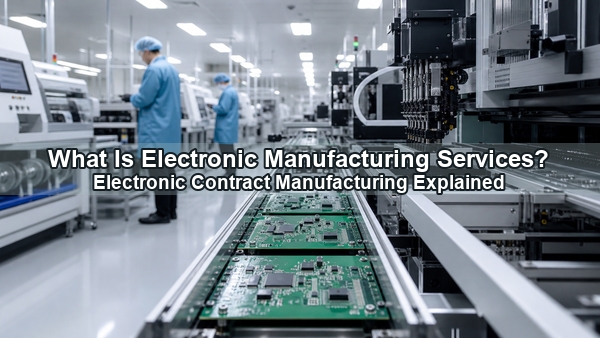
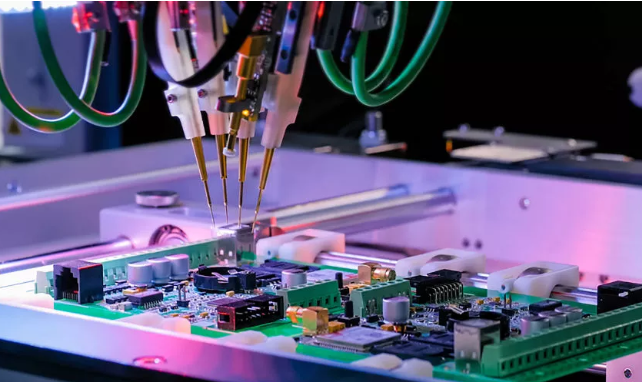
Electronic manufacturing services production line with PCB assembly equipment

What Is Electronic Manufacturing Services?

Electronic manufacturing services, commonly shortened to EMS, describe a manufacturing model in which a specialist company builds electronic assemblies or finished systems for another organization. The product owner usually controls the brand and product requirements, while the EMS provider executes an agreed portion of engineering, material control, manufacturing, inspection, testing, and fulfillment.

The exact boundary is contractual rather than universal. One program may require only PCB assembly from supplied materials. Another may include DFM review, PCB fabrication, component sourcing, firmware loading, conformal coating, cable assembly, enclosure integration, final test, and packaging. This is why EMS should be defined by the actual process scope rather than by the acronym alone.

What Does an EMS Company Do?

An EMS company converts controlled product data into a repeatable manufacturing process. It coordinates engineering release, materials, tooling, equipment programs, work instructions, process inspection, test results, nonconformance control, and production records.

At the PCB assembly level, this work can include stencil preparation, solder paste printing, 3D SPI, component placement, reflow, AOI, selective or wave soldering, X-ray inspection, programming, and functional testing. At system level, it may extend to wire harnesses, displays, power modules, mechanical parts, labels, and enclosure assembly.

Which Services Are Included in Electronic Manufacturing Services?

The service range normally follows the product lifecycle. A provider may perform every stage or only the modules assigned to it.

  • Engineering review, NPI planning, DFM, DFA, DFT, and production documentation
  • Prototype PCB, multilayer PCB, HDI, rigid-flex, metal-core, ceramic, or other board fabrication
  • Approved component sourcing, incoming inspection, moisture control, and lot traceability
  • SMT, through-hole, mixed-technology, BGA, press-fit, and manual assembly
  • Firmware programming, calibration, AOI, X-ray, electrical test, and functional test
  • Cleaning, coating, potting, wire harness assembly, box build, labeling, and packaging
  • Controlled repair, rework, engineering-change implementation, and repeat production support
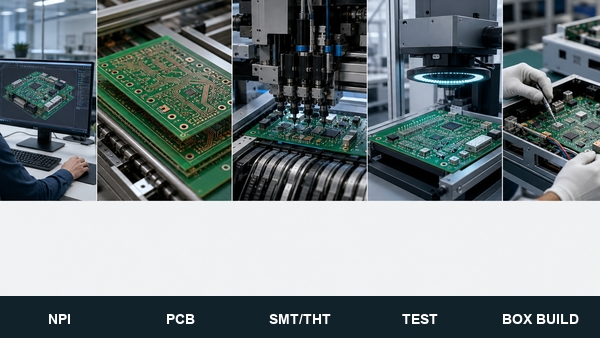
Electronic manufacturing services workflow from NPI through box build

A service list is only meaningful when its interfaces are defined. For example, component sourcing requires an approved BOM and substitution policy; functional testing requires test limits and a controlled fixture; box build requires mechanical drawings, cable definitions, torque values, and product-level acceptance criteria.

How Does the EMS Process Work from NPI to Production?

The EMS process begins by converting design data into a controlled manufacturing package. During NPI, engineering teams align PCB data, BOM revisions, placement coordinates, assembly drawings, firmware, mechanical files, and test requirements. Conflicts must be resolved before machine programs and tooling are released.

Prototype builds then validate both the design and the process. The resulting evidence may include first-article inspection, solder paste measurements, placement verification, X-ray records for hidden joints, programming logs, and functional results. Corrections are incorporated through revision control before a pilot run confirms repeatability at a larger batch size.

Volume production adds tighter material planning, calibrated process windows, scheduled equipment maintenance, statistical monitoring, serialized or lot-level traceability, and formal change control. The manufacturing flow should remain linked to one approved revision so that the board data, BOM, software, test limits, and mechanical configuration cannot drift apart.

How Are DFM, DFA, and DFT Used in EMS?

DFM, DFA, and DFT are complementary reviews that reduce different manufacturing risks before production data is frozen.

Review Primary purpose Typical checks
DFM Confirm that the PCB and product can be manufactured within stable process limits Stack-up, trace and space, drill-to-copper clearance, solder mask, panelization, materials, and tolerances
DFA Make assembly efficient and reduce placement or soldering errors Footprints, polarity, component spacing, fiducials, nozzle access, thermal balance, and hand-assembly access
DFT Provide practical access and limits for inspection and electrical verification Test points, probe clearance, boundary scan, programming access, fixture interfaces, and pass/fail criteria

A useful review produces specific, traceable actions. It should identify the affected location, explain the manufacturing mechanism, and state whether the issue requires a design change, a process exception, or a test adjustment.

How Do SMT, THT, and Box Build Fit into EMS?

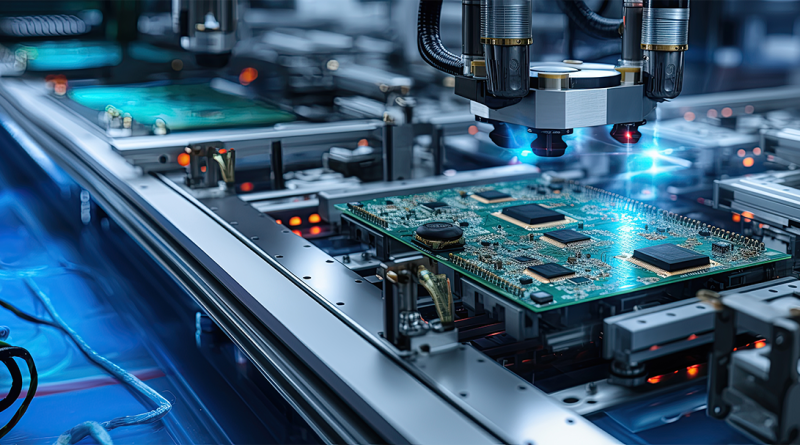
SMT handles most compact and high-density components by printing solder paste, placing parts automatically, and soldering them in a controlled reflow profile. The process is normally monitored with SPI before placement and AOI after reflow. X-ray is added when solder joints are hidden beneath BGA, QFN, LGA, or similar packages.
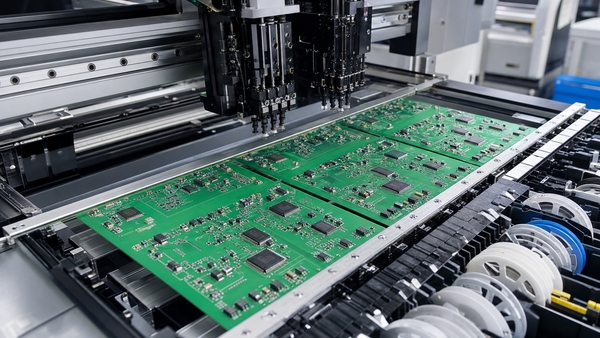
SMT PCB assembly within an electronic manufacturing services factory

THT is used where leaded parts provide mechanical strength, power handling, connector retention, or compatibility with large transformers and relays. Components may be inserted manually or automatically, then soldered by wave, selective, or hand processes. Mixed assemblies need a sequence that protects temperature-sensitive parts and maintains access for inspection.

Box build begins after the PCBA has passed its defined inspections. It integrates the board with enclosures, displays, fans, switches, power supplies, thermal interfaces, cables, and labels. The final operation may include firmware configuration, calibration, dielectric or grounding checks, full functional test, and packaging.

How Are Electronic Assemblies Inspected and Tested?

No single inspection method can prove every aspect of an electronic assembly. A reliable test strategy combines methods according to the defect types that must be detected.

  • SPI measures solder paste volume, area, height, and offset before components are placed.
  • AOI checks visible component presence, orientation, polarity, solder fillets, and placement conditions.
  • X-ray examines hidden solder joints, voiding patterns, bridging, and alignment under bottom-terminated packages.
  • Flying-probe or ICT checks selected nets, component values, opens, shorts, and programmed electrical limits.
  • Functional test powers the assembly and verifies interfaces, outputs, communication, control logic, and application behavior.
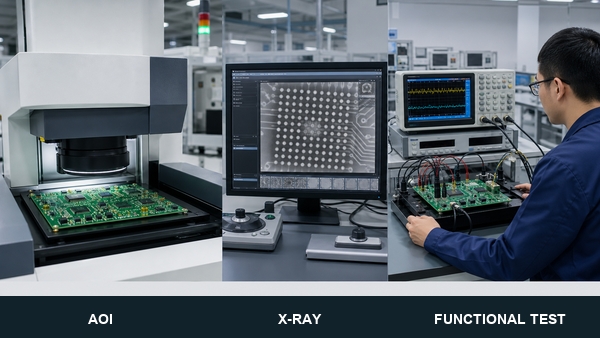
AOI X-ray and functional testing for electronic assemblies

Inspection coverage should follow the product architecture. AOI cannot verify firmware behavior, and functional test may not reveal a marginal hidden solder joint without the right stimulus. Test results also need revision, serial or lot identity, equipment status, and acceptance limits to remain useful after production.

What Is the Difference Between EMS and OEM?

An OEM owns or markets the product under its brand, while an EMS provider performs assigned engineering and manufacturing services. The OEM generally defines product function, compliance goals, approved revisions, and market requirements. The EMS provider develops and controls the production process needed to build the approved configuration.

The boundary can vary. Some OEMs retain design, sourcing, firmware, and system testing while outsourcing only assembly. Others assign the EMS provider a broader lifecycle role. The difference is therefore based on ownership and responsibility, not simply on whether a company operates manufacturing equipment.

What Is the Difference Between EMS, ECM, CM, and ODM?

These terms overlap, but they emphasize different parts of the business relationship.

Term Main emphasis Typical responsibility
EMS Electronics manufacturing service scope Engineering support, manufacturing, testing, integration, and lifecycle operations
ECM Contractual outsourcing model for electronics Builds electronic assemblies or products under another company’s specification
CM General contract manufacturing Manufactures a product or subassembly under contract; the term is not limited to electronics
ODM Original design plus manufacturing Develops a design or platform and manufactures versions for other brands

EMS and ECM are often used interchangeably. EMS focuses on the collection of services; ECM emphasizes the contract-manufacturing relationship. For a deeper treatment of scope and commercial models, see the existing electronic contract manufacturing guide.

What Is an Example of Electronic Manufacturing?

An industrial controller provides a practical example. The process can begin with fabrication of a multilayer control PCB and a power-interface PCB. Components are then sourced to the approved BOM, inspected, moisture-managed where required, and assembled through SMT and THT processes.

After reflow and soldering, AOI and X-ray check workmanship, firmware is programmed, and the boards enter functional testing with simulated sensors, communication loads, and power conditions. The PCBAs are installed in an enclosure with a display, terminals, cable harnesses, and grounding hardware. A final system test confirms input handling, outputs, communications, alarms, and thermal behavior before packaging.
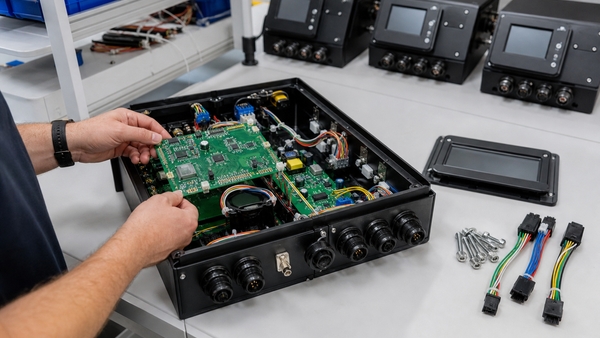
Electronic manufacturing services box build and system integration

How Does EMS Support Prototypes and Volume Production?

Prototype EMS work prioritizes design learning, rapid revision, first-article visibility, and flexible materials. Tooling may be simplified, and manual operations may be acceptable when they do not hide production risks. Even so, machine programs, component identities, assembly findings, firmware, and test results should be recorded so that decisions are not lost between builds.

Pilot production verifies process capability at a representative batch size. It exposes panel-flow, feeder capacity, line balancing, fixture throughput, coating or curing time, packaging, and traceability issues that a small prototype lot may not reveal. Volume production then uses controlled work instructions, qualified equipment, stable material sources, defined sampling, and change approval to maintain repeatability.

Which Industries Use Electronic Manufacturing Services?

EMS is used wherever an electronic product requires repeatable assembly and documented verification. Industrial controls often need robust connectors, mixed SMT/THT assembly, power-stage testing, and long product life. Medical electronics may require stronger traceability and process documentation. Automotive electronics emphasize change control, environmental performance, and high-volume consistency.

Communication, aerospace, energy, test equipment, lighting, and consumer products use different combinations of high-speed layout, thermal management, compact packaging, coating, calibration, and system integration. The relevant EMS capability is the one that matches the actual board technology, component packages, test coverage, environment, and production stage.

FAQ About Electronic Manufacturing Services

What does EMS stand for in electronics?

EMS stands for electronic manufacturing services. The term covers outsourced engineering, assembly, testing, integration, and lifecycle operations for electronic products.

Is EMS the same as PCB assembly?

No. PCB assembly is one manufacturing operation within EMS. A broader EMS program may also include NPI, PCB fabrication, component control, programming, system test, cables, coating, box build, and packaging.

Does an EMS provider design electronic products?

Some providers offer design or design-assistance services, while others manufacture only from released product data. The assigned design responsibility must be stated clearly because it affects approvals, revision control, validation, and intellectual-property boundaries.

Can EMS include both prototypes and mass production?

Yes. The controls differ by stage, but one EMS provider can support prototypes, pilot runs, and volume production when its engineering, sourcing, equipment, test, and traceability systems cover the complete transfer.

What does an EMS provider test?

Testing can cover bare-PCB continuity, solder paste, visible assembly defects, hidden solder joints, circuit values, firmware programming, electrical interfaces, and final product functions. The required combination depends on product risk and test access.

Conclusion

Electronic manufacturing services connect product data with a controlled production system that can include NPI, PCB fabrication, component management, assembly, testing, box build, and repeat production. The most important distinction is not the acronym but the defined responsibility, revision control, manufacturing evidence, and test coverage at each stage.

EBest Circuit (Best Technology) supports PCB fabrication, component sourcing, SMT and through-hole assembly, inspection, functional testing, and box-build integration for prototype and production programs. For technical manufacturing support, contact sales@bestpcbs.com.
You may also like

Electronic Contract Manufacturing: Services, Costs, and Supplier Selection
Friday, July 10th, 2026
Electronic Contract Manufacturing services, costs, and supplier selection

Electronic contract manufacturing allows an OEM to outsource PCB fabrication, component sourcing, assembly, testing, and product integration to a specialist manufacturer. It is commonly used by companies that own the product design but do not want to operate an internal electronics factory.

The right manufacturing model depends on the product volume, technical complexity, quality requirements, and level of supply-chain support needed. This guide explains the main services, quotation files, cost factors, and supplier-selection criteria.

What Is Electronic Contract Manufacturing?

Electronic contract manufacturing is an arrangement in which an external supplier manufactures electronic assemblies or complete products for another company. The customer normally owns the design, intellectual property, product specification, and brand.

The supplier may handle PCB production, component purchasing, SMT assembly, testing, coating, cable assembly, box build, and packaging. The service can cover prototypes, pilot runs, or mass production.

What Does ECM Mean in Electronic Manufacturing?

ECM stands for electronic contract manufacturing. It describes the outsourcing relationship between a product owner and the company responsible for manufacturing its electronics.

Term Meaning
ECM Electronic contract manufacturing
EMS Electronics manufacturing services
OEM Original equipment manufacturer
ODM Original design manufacturer
JDM Joint design manufacturer

ECM and EMS are often used interchangeably. ECM refers more to the outsourcing model, while EMS refers to the manufacturing services being supplied.

What Electronics Contract Manufacturing Services Are Available?

The service scope can begin with a bare PCB and extend to a fully assembled, tested, and packaged product.

  • DFM and engineering review
  • PCB fabrication
  • Component sourcing
  • SMT and through-hole assembly
  • Firmware programming
  • AOI and X-ray inspection
  • Electrical and functional testing
  • Conformal coating and potting
  • Cable and wire-harness assembly
  • Box-build assembly, packaging, and logistics

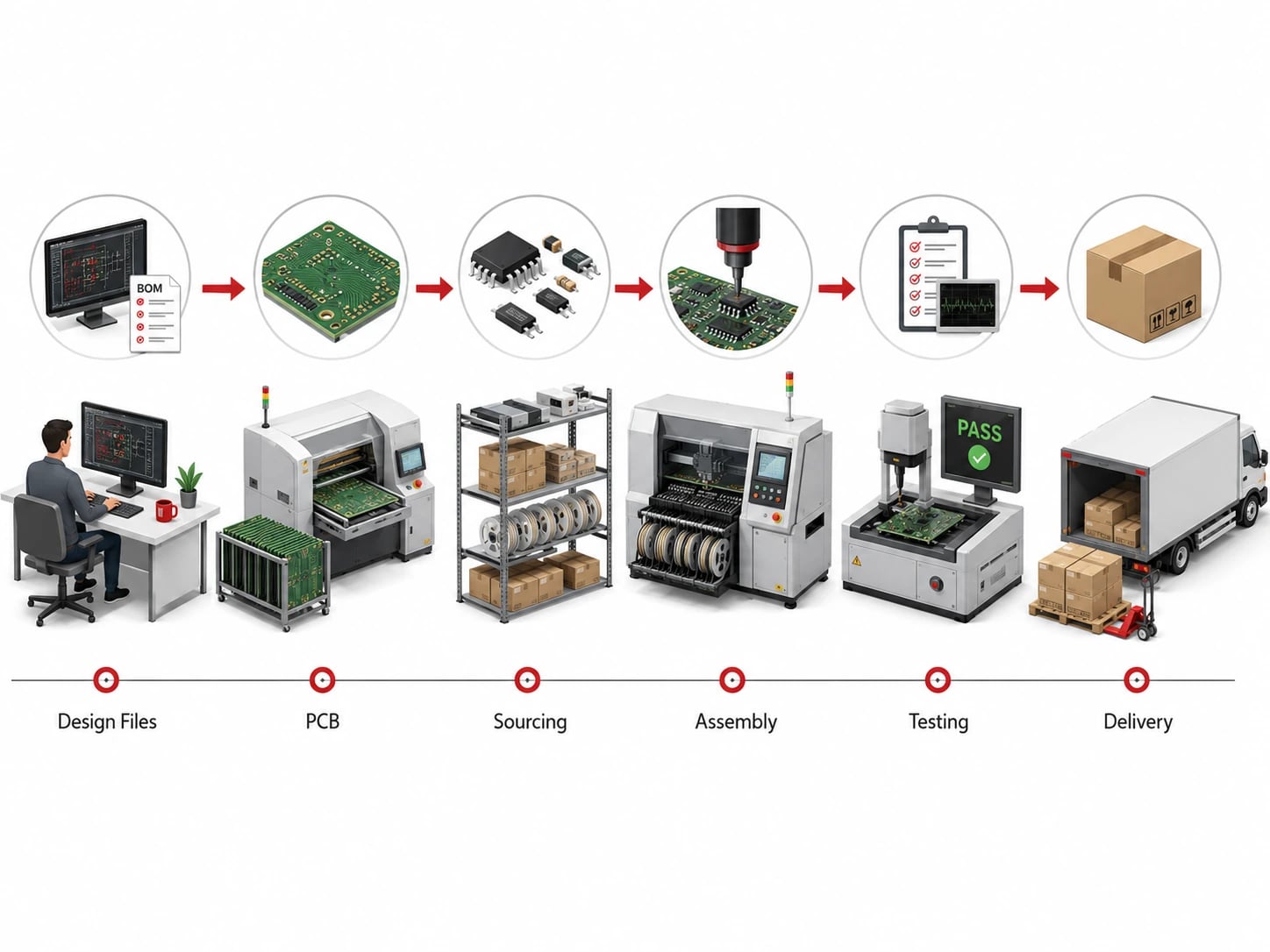
Electronic contract manufacturing workflow from design files to delivery

Engineering and NPI Support

New product introduction support helps turn an engineering design into a repeatable production process. The manufacturer may review footprints, solder-mask clearances, polarity markings, panelization, stencil design, test access, and assembly risks.

A useful DFM review should identify specific problems rather than simply state that a design is manufacturable.

PCB Fabrication

An ECM provider may produce PCBs internally or source them through approved manufacturing partners. Supported technologies may include multilayer FR-4, HDI, high-Tg, heavy-copper, rigid-flex, metal-core, and ceramic PCBs.

The supplier’s capability should match the actual board. Stacked microvias, controlled impedance, thick copper, or special laminates require relevant process experience.

Component Sourcing

Under a turnkey arrangement, the manufacturer purchases parts according to the approved BOM. Buyers should confirm approved purchasing channels, part-number control, traceability, moisture-sensitive handling, obsolescence management, and substitution procedures.

No component should be replaced without written approval when its electrical, mechanical, thermal, or regulatory characteristics could affect the product.

PCB Assembly and Testing

Assembly may include SMT, through-hole insertion, selective soldering, press-fit installation, BGA assembly, and manual soldering. Inspection may involve SPI, AOI, X-ray, flying-probe, in-circuit, and functional testing.

AOI and X-ray can detect assembly defects, but they do not confirm full product operation. Functional testing is needed for communication, power sequencing, sensor inputs, firmware, or system performance.

What Is Turnkey Electronic Contract Manufacturing?

Turnkey electronic contract manufacturing means the supplier manages most purchasing and production activities. The customer provides approved design files, quantities, quality requirements, and test criteria.

The manufacturer then coordinates PCB fabrication, BOM sourcing, assembly, programming, inspection, testing, and delivery. The quotation should state whether tooling, test fixtures, programming, packaging, freight, and excess materials are included.

Turnkey vs Consigned Electronic Contract Manufacturing

The main difference is who purchases and controls the production materials.

Consideration Turnkey Manufacturing Consigned Manufacturing
Material purchasing ECM supplier Customer
Customer workload Lower Higher
Inventory control Mainly supplier-managed Mainly customer-managed
Price structure Materials and production combined Mainly assembly charges
Suitable for One-stop production projects Customer-controlled components
Main risk Unclear sourcing or excess stock Missing parts or incomplete kits

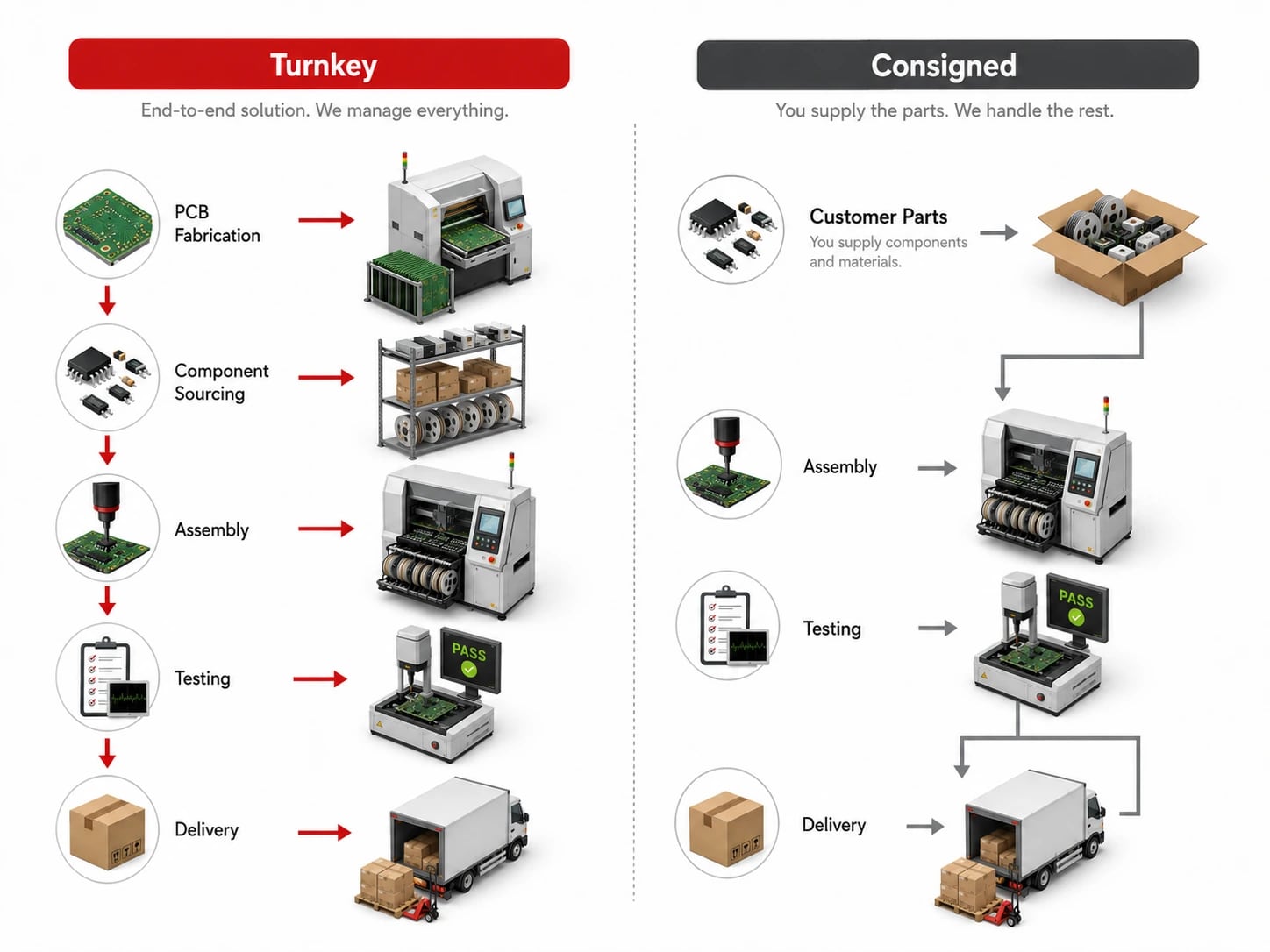
Turnkey versus consigned electronic contract manufacturing comparison

Turnkey manufacturing works well when the supplier has reliable sourcing channels. Consigned production is useful when the customer supplies proprietary modules, allocated semiconductors, pre-programmed ICs, or globally purchased parts.

What Products Can an Electronic Contract Manufacturer Produce?

An electronic contract manufacturer can produce individual PCB assemblies, electronic modules, or complete devices.

  • Industrial controllers and motor drives
  • Medical monitoring equipment
  • Automotive sensors and control modules
  • Communication gateways
  • IoT devices
  • Battery-management systems
  • Consumer electronics
  • Aerospace instruments

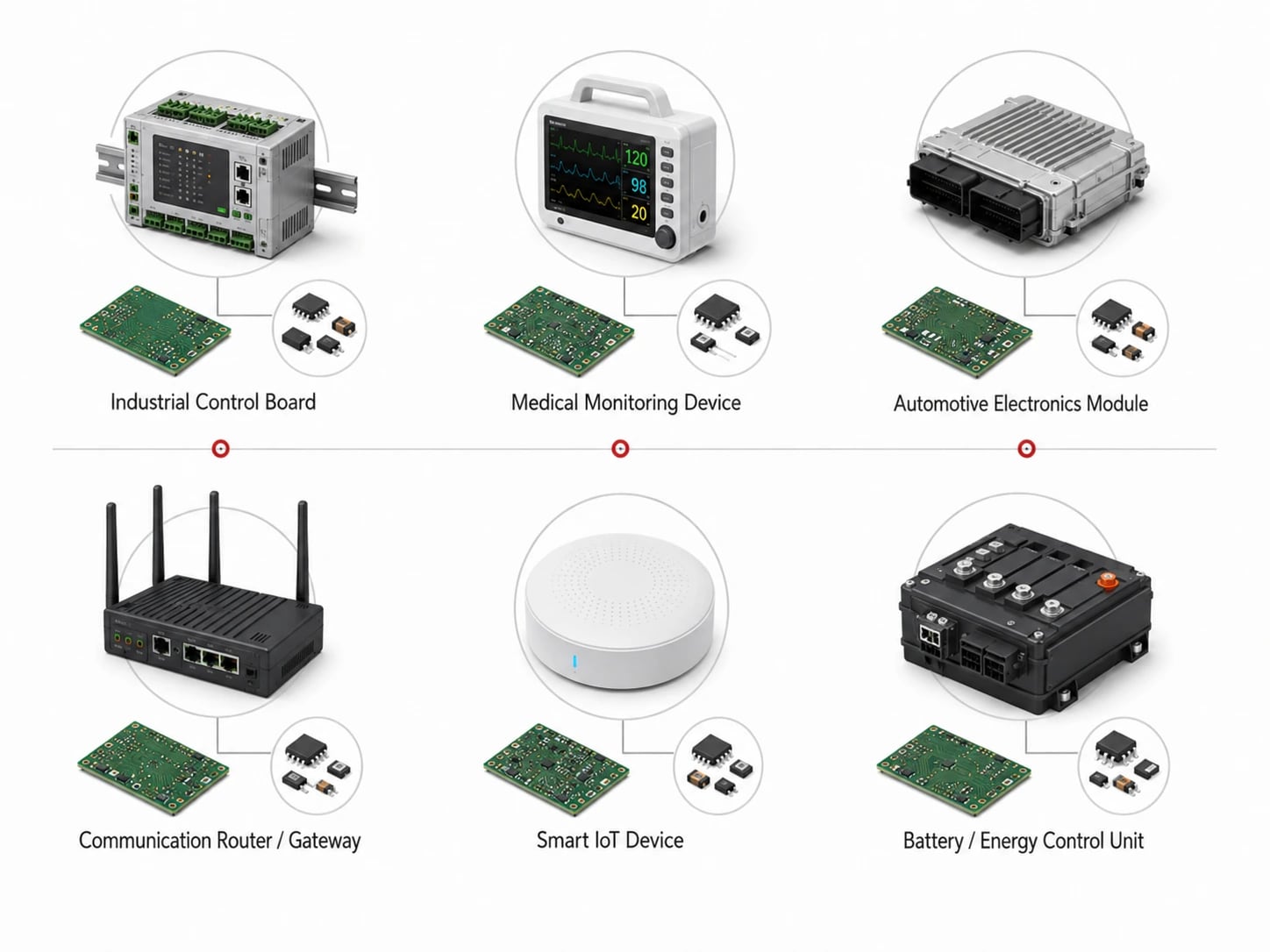
Electronic products made through contract manufacturing

Supplier selection should also consider operating temperature, service life, annual volume, traceability, environmental exposure, regulatory requirements, and the consequences of field failure.

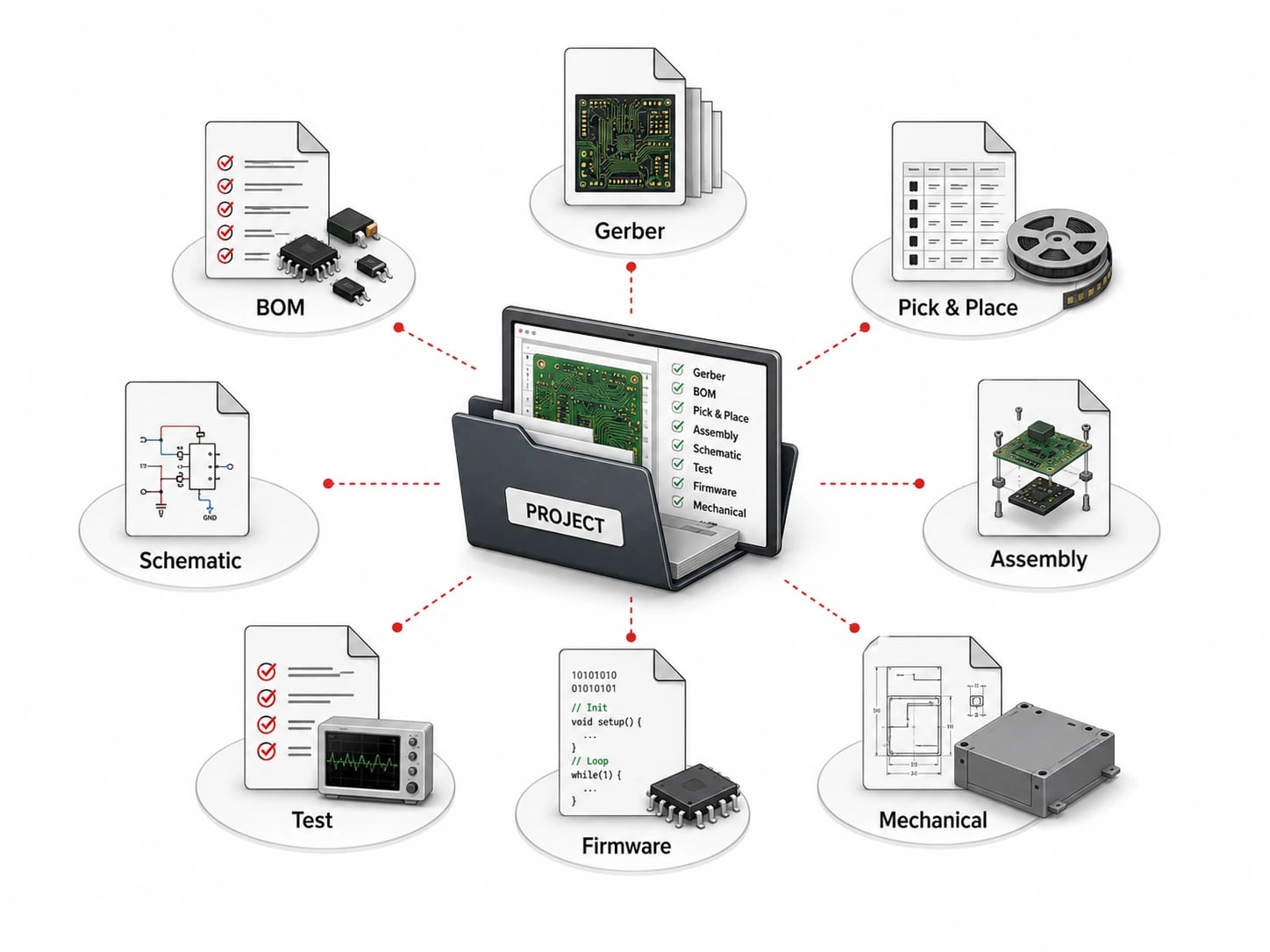
What Files Are Required for Electronic Contract Manufacturing?

A complete production package reduces quotation assumptions and prevents revision errors.

File or Information Required Content
Gerber, ODB++, or IPC-2581 files PCB layers, profile, solder mask, silkscreen, paste, and drill data
PCB specification Material, thickness, copper weight, surface finish, impedance, and tolerances
Bill of materials Reference designators, quantities, manufacturers, full part numbers, and alternates
Pick-and-place file Coordinates, rotations, board side, and reference designators
Assembly drawing Polarity, orientation, special mounting, and do-not-fit parts
Schematic Circuit connections, voltage rails, and component relationships
Test specification Test steps, limits, fixtures, and pass/fail criteria
Firmware files Programming file, version, checksum, and instructions
Mechanical files STEP models, enclosure drawings, and cable drawings
Quantity information Prototype quantity, annual forecast, and delivery schedule

Files required for an electronic contract manufacturing project

The BOM should use complete manufacturer part numbers. All production files should also carry the same revision to prevent mismatches between PCB, BOM, and placement data.

What Are the Benefits of Electronic Contract Manufacturing?

Electronic contract manufacturing gives product companies access to established equipment, process engineers, sourcing channels, and quality systems without building an internal factory.

  • Lower equipment investment
  • Faster prototype-to-production transfer
  • Access to specialized assembly processes
  • Flexible production capacity
  • Consolidated component sourcing
  • Established inspection and testing
  • Easier scaling from pilot to volume production

The supplier must still match the production model. A prototype shop may lack volume controls, while a large mass-production plant may give limited attention to small engineering orders.

How Much Does Electronic Contract Manufacturing Cost?

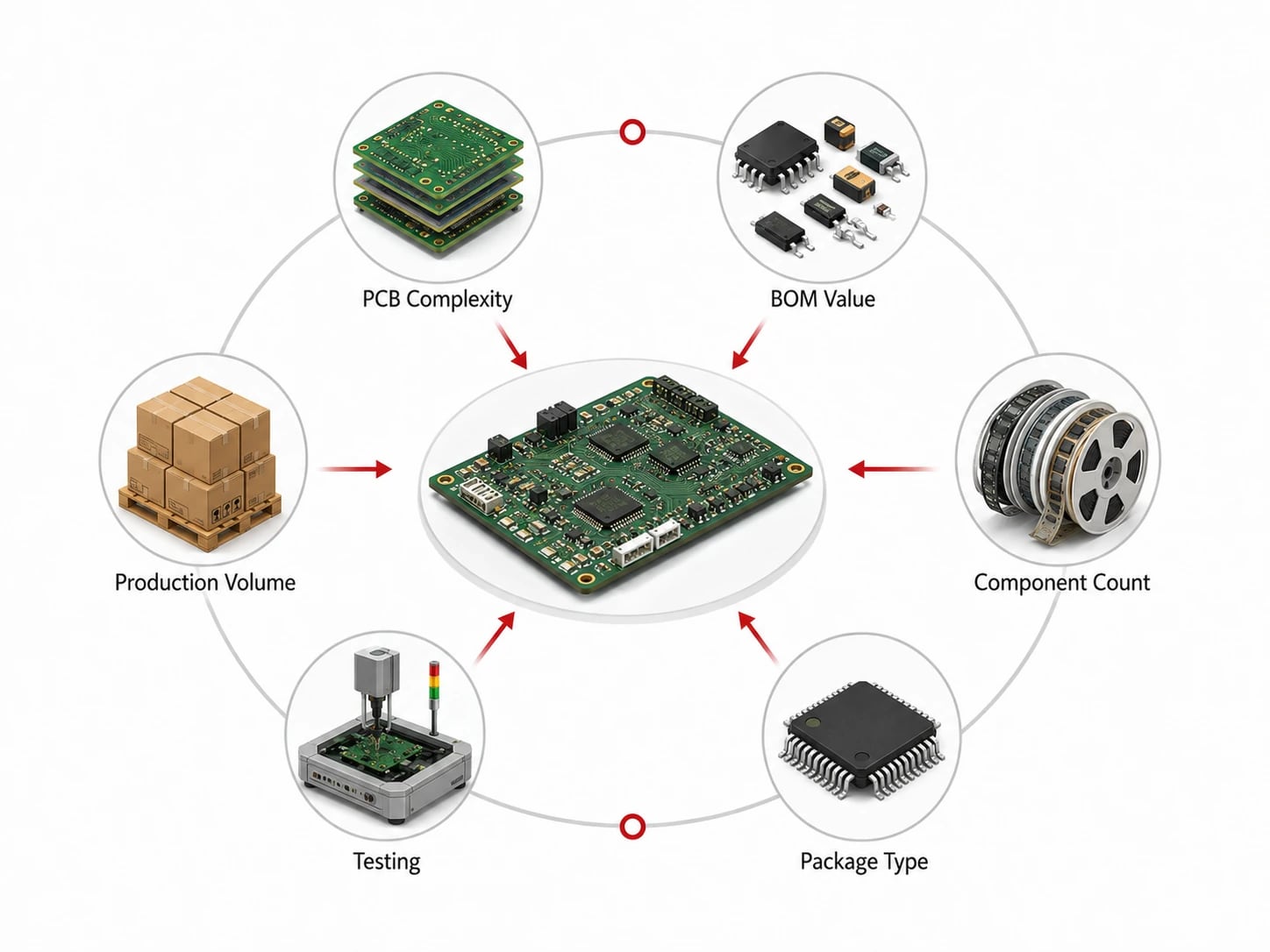
Electronic contract manufacturing does not have a fixed price per board. Cost depends on the PCB specification, BOM value, component count, assembly difficulty, production quantity, and testing scope.

PCB + Components + Assembly + Testing + Tooling + Finishing + Packaging and Logistics
Cost Factor Typical Impact
PCB complexity HDI, more layers, special materials, and tight tolerances increase cost
BOM value Expensive or scarce parts raise material cost
Component count More placements require additional machine and inspection time
Package type Fine-pitch BGA, 01005, and press-fit parts need tighter process control
Order volume Higher volume spreads setup and engineering costs
Testing Fixtures, programming, functional tests, and burn-in add cost
Additional processes Coating, potting, cleaning, and box build add materials and labor
Lead time Expedited PCB and component sourcing increase the price

Main cost factors in electronic contract manufacturing

Prototype unit prices are normally higher because setup, stencil, programming, and engineering charges are divided across fewer boards. Compare quotations only when PCB specifications, component brands, quantities, test requirements, and delivery terms are the same.

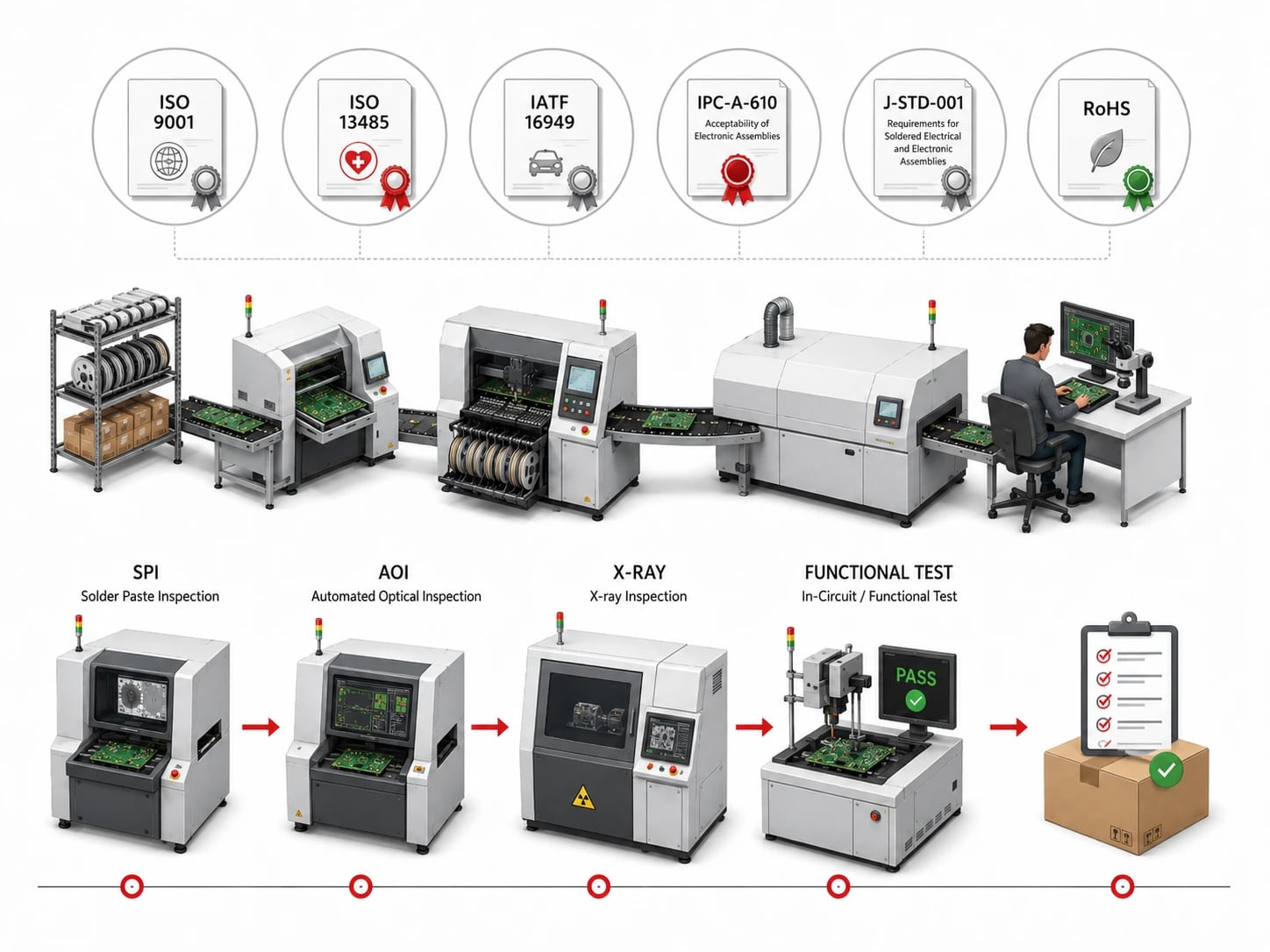
What Quality Standards Should an Electronic Contract Manufacturer Follow?

The required standards depend on the product, target industry, customer requirements, and destination market.

Standard Main Application
ISO 9001 General quality-management systems
ISO 13485 Medical-device manufacturing
IATF 16949 Automotive manufacturing
AS9100 Aviation, space, and defense
IPC-A-610 Electronic assembly acceptance
J-STD-001 Soldering process requirements
IPC/WHMA-A-620 Cable and wire-harness workmanship
RoHS and REACH Restricted-substance compliance

PCB assembly inspection process and quality standards

Not every project needs every standard. Buyers should confirm that certification covers the actual production site and review calibration, operator training, traceability, change control, nonconformance handling, and test records.

Why Choose EBest Circuit for Electronic Contract Manufacturing?

EBest Circuit, also known as Best Technology, provides PCB fabrication, component sourcing, PCB assembly, testing, coating, and box-build services.

The company supports multilayer FR-4, HDI, high-Tg, heavy-copper, rigid-flex, metal-core, and ceramic PCBs, together with SMT, through-hole assembly, BGA placement, programming, conformal coating, functional testing, and final integration.

EBest Circuit is suitable for customers that need prototype review, high-mix production, pilot builds, or repeat orders under one supplier. For an accurate quotation, provide complete production files, target quantities, component requirements, testing criteria, and required quality documentation.

FAQs

What is electronic contract manufacturing?

Electronic contract manufacturing is the outsourcing of electronic production to an external manufacturer. The service may include PCB fabrication, sourcing, assembly, testing, box build, packaging, and logistics.

What does ECM stand for in electronics?

ECM stands for electronic contract manufacturing. It describes a business arrangement in which one company manufactures electronic products for another company under contract.

Is electronic contract manufacturing the same as EMS?

The terms are closely related. ECM describes the outsourcing model, while EMS describes the manufacturing services offered by the supplier.

What is turnkey electronic contract manufacturing?

Turnkey electronic contract manufacturing means the supplier manages most materials and manufacturing activities. The customer provides approved product files and requirements.

What services does an electronic contract manufacturer provide?

Typical services include PCB fabrication, component sourcing, SMT and through-hole assembly, programming, inspection, testing, coating, cable assembly, box build, packaging, and logistics.

Can an ECM company handle prototype production?

Yes. Choose a supplier that offers engineering review, flexible sourcing, first-article inspection, and a clear transfer process from prototype to repeat production.

How do I compare electronic contract manufacturing companies?

Compare PCB and assembly capability, similar project experience, certifications, testing resources, sourcing controls, supported volume, communication, lead time, and commercial transparency.

What files are needed to get an ECM quotation?

At minimum, provide Gerber or ODB++ files, PCB specifications, BOM, pick-and-place data, assembly drawings, order quantity, and delivery requirements.

How long does electronic contract manufacturing take?

A standard prototype PCBA using available components may take about 10 to 20 working days after file approval. Specialized PCBs, long-lead parts, fixtures, coating, or box build can extend the schedule.

Electronic contract manufacturing can simplify the move from a validated design to repeatable production. The best supplier should match the product’s technical requirements, order volume, quality level, testing needs, and communication expectations.

For PCB fabrication, turnkey PCB assembly, component sourcing, testing, or box-build support, contact EBest Circuit at sales@bestpcbs.com.
You may also like

Electronic Manufacturing Services, Electronic Manufacturer in China
Tuesday, October 14th, 2025

What is electronic manufacturing services? Let’s compare different electronic manufacturers in USA, UK, Canada, France, Australia through this blog.

Are you worried about these problems?

  • How to ensure stable delivery amid supply chain fluctuations causing production delays?
  • How to reduce costs for small-batch, multi-variety orders?
  • How to quickly validate products amid rapid tech iteration and long R&D cycles?

As an electronic manufacturer, EBest Circuit (Best Technology) can provide you service and solutions:

  • Rapid Delivery: 20-year supply chain pool + smart scheduling cuts bulk order delivery by 30%, 24-hour rapid prototyping for small batches.
  • Cost Optimization: Modular design + flexible line reduces per-unit cost by 15%, seamless scaling from 1 to 10,000+ pieces.
  • R&D Acceleration: End-to-end “design-prototype-test” service, 72-hour prototype validation, shrinks time-to-market gap.

Welcome to contact us if you have any request for electronic manufacturing service: sales@bestpcbs.com.
What is Meaning of Electronic Manufacturing Services?

Electronics Manufacturing Services (EMS) refers to an industry dedicated to providing full-process outsourcing solutions for electronic brand owners. It covers the entire process from product design, engineering development, raw material procurement and management, manufacturing (such as PCB assembly and system integration), testing and verification (including circuit, functional, and environmental testing), logistics distribution, to after-sales maintenance.

Unlike traditional OEM (focused solely on contract manufacturing) or ODM (combining design and production), EMS achieves vertical integration of supply chain management, quality control, regulatory compliance adaptation, and global logistics networks. This enables brand owners to concentrate on core R&D and market expansion while reducing production costs, shortening time-to-market, and enhancing operational efficiency.

Typical services include end-to-end “design-manufacturing-after-sales” solutions for clients in sectors like communications equipment, medical electronics, and automotive electronics, forming a globally distributed manufacturing network through large-scale production and intelligent management, thereby serving as an indispensable “manufacturing hub” in the electronics industry chain.

What is Meaning of Electronic Manufacturing Services?

Why Choose Electronic Manufacturing Services?

Benefits of electronic manufacturing services:

  • Full-Process Design Optimization Support: Through DFM (Design for Manufacturability) analysis, over 80% of manufacturability issues can be identified early, reducing design iteration cycles by 30%. This allows designers to focus on core innovation rather than production adaptation challenges.
  • Scalable Cost Control: Centralized procurement and supply chain integration optimize material costs, with bulk purchasing strategies reducing component costs by 15-25%. Automated production lines minimize manual intervention, lowering manufacturing costs by approximately 20%, while lean production reduces waste rates and enhances resource utilization.
  • Multi-Tier Quality Assurance System: Combining AOI (Automated Optical Inspection), X-ray testing, and functional testing ensures PCB reliability. The testing protocol includes six core inspection categories, maintaining defect rates below 0.03%, significantly outperforming industry averages. This reduces post-launch maintenance costs and product recall risks.
  • Rapid Time-to-Market & Flexible Production Capacity: Vertical integration of manufacturing resources shortens product launch cycles, reducing prototype-to-mass-production timelines by 40%. Scalable production supports dynamic needs from small-batch prototyping to large-scale manufacturing, eliminating the fixed costs of in-house production lines.
  • Supply Chain Risk Mitigation: Global supplier network management provides inventory buffering and logistics optimization. During component shortages, multi-source procurement strategies safeguard critical component supply, preventing project delays. Smart logistics systems minimize transportation damage and delivery time variability.
  • Technical Knowledge Sharing: Accumulated industry expertise enhances design optimization. Access to process databases and case libraries helps engineers rapidly identify optimal manufacturing parameters, reducing trial-and-error costs. Shared test data accelerates product iteration cycles and boosts R&D efficiency.
Why Choose Electronic Manufacturing Services?

Applications of Electronic Manufacturing Service

  • Communications equipment manufacturing: such as base station equipment and routers, requires high-precision assembly and testing.
  • Medical electronics: such as medical imaging equipment and monitors, demand high reliability and compliance.
  • Automotive electronics: such as in-car entertainment systems and autonomous driving modules, involve complex supply chains and quality control.
  • Industrial control: such as PLCs and sensor modules, require durability and environmental adaptability.
  • Consumer electronics: such as smartphones and tablets, require rapid iteration and large-scale production.

Electronic Manufacturing Services USA​

Below are electronic manufacturer in USA:

  • Jabil Inc.: A global leader in electronic manufacturing services (EMS), headquartered in Florida, offering integrated design, manufacturing, and supply chain solutions across medical, automotive, consumer electronics, and other industries.
  • Flex Ltd.: Renowned for end-to-end EMS capabilities spanning design engineering to full-scale production, with expertise in medical, automotive, and consumer electronics sectors, backed by a global manufacturing footprint.
  • Sanmina Corporation: Based in San Jose, California, this EMS provider specializes in PCB assembly and comprehensive manufacturing services, operating production facilities across the U.S., Europe, and Asia to support multinational clients.
  • Plexus Corp.: Headquartered in Neenah, Wisconsin, it delivers tailored electronic manufacturing solutions for diverse industries through production sites in the U.S., Europe, and Asia, emphasizing technical precision and quality control.
  • Benchmark Electronics: With its headquarters in Tempe, Arizona, this contract manufacturer supports clients through a distributed production network spanning the U.S., Mexico, and Asia, enabling cost-effective scaling and rapid deployment.
  • Celestica Inc.: A supply chain-centric EMS firm that extends its capabilities across the electronics manufacturing value chain, leveraging global resources to optimize client operations.
  • TTM Technologies: Focused on advanced PCB technology development and manufacturing, this company excels in high-precision circuit board solutions for demanding applications.
  • RUSH PCB Inc.: Located in Silicon Valley, it provides flexible EMS from low-volume prototypes to high-volume production, catering to automotive, industrial, and telecommunications sectors with agile manufacturing processes.
  • STAR ENGINEERING, INC: A contract manufacturer specializing in high-reliability circuit board production for aerospace, automotive, marine, and medical markets, adhering to stringent quality and compliance standards.
  • Flash PCB: A U.S.-based EMS provider dedicated to PCB design, fabrication, and assembly, serving niche markets such as medical, aerospace, and defense with specialized engineering expertise.
Electronic Manufacturing Services USA​

Electronic Manufacturing Services UK

Below are electronic manufacturer in UK:

  • TT Electronics plc: Offers specialized electronic manufacturing services including design, testing, surface-mount and through-hole assembly, serving markets in the UK, Europe, North America, and China.
  • FermionX: Leading UK South Coast EMS provider with 3 SMT production lines, delivering services from PCB assembly to complete electromechanical integration, holding certifications such as ISO 13485 and ISO 9001.
  • Esprit Electronics: With over 30 years of experience, delivers comprehensive EMS solutions including supply chain management, new product introduction, SMT/through-hole processes, and end-to-end packaging/logistics for UK/European markets.
  • Electronic Technicians Ltd (ETL): Boasts over 40 years of contract electronics manufacturing expertise, providing full-spectrum contract manufacturing services.
  • GB Electronics (UK) Ltd: Specializes in power electronics and complex hybrid assembly for medical, industrial, and scientific instrumentation, with expertise in multi-core cable assembly and electromechanical construction.
  • Welwyn Systems Ltd: Part of the TT Electronics Group, focused on professional design and testing services.
  • AB Electronic Assemblies: Also under TT Electronics Group, this South Wales-based contract manufacturer delivers tailored electronics solutions.
  • Time Electronics Ltd: Since 1967, dedicated to designing and manufacturing calibration, test, and measurement instruments, covering electronic device assembly and production.

Electronic Manufacturing Services Canada​

Below are electronic manufacturer in Canada:

  • Celestica: A global EMS leader providing design, manufacturing, and supply chain solutions for computing, communications, medical, and aerospace industries. Services span full product lifecycle including prototyping, testing, and global logistics.
  • Creation Technologies: Specializes in high-complexity, medium-to-low volume electronics manufacturing serving aerospace, medical, and industrial technology sectors. Operates 13 facilities across Canada, USA, Mexico, and China, delivering end-to-end solutions from design to delivery.
  • Vexos: Offers comprehensive EMS and custom material solutions for medical, automotive, communications, and defense markets. With factories in Canada, USA, China, and Vietnam, emphasizes rapid prototyping and new product introduction (NPI).
  • Sanmina: Global EMS provider with Ottawa-based design center focused on RF, optical, and microelectronics development. Delivers technology-intensive solutions for communications, medical, and industrial applications.
  • Flex: Though headquartered in Singapore, maintains Canadian design hubs supporting client product development through its “Sketch to Scale” program. Services cover communications, consumer electronics, and automotive sectors.
  • Jabil: EMS giant with Ottawa operations specializing in optical communications and data center infrastructure manufacturing. Provides full-flow services from design to testing for communications, medical, and industrial clients.
Electronic Manufacturing Services Canada​

Electronic Manufacturing Services France​

Below are electronic manufacturer in France:

  • Asteelflash Group: Headquartered in France, this EMS provider offers end-to-end electronic manufacturing services spanning R&D design, NPI (New Product Introduction), rapid prototyping, material procurement, production, testing, and after-sales support. It serves sectors including aviation, industrial equipment, medical devices, and telecommunications. Notably, the company was acquired by USI (Universal Scientific Industrial) in 2019.
  • Éolane (Yilan): Established in 1975, Éolane is a French EMS leader with over 40 years of expertise. Specializing in electronics manufacturing and engineering services, it caters to industrial, medical, automotive, and communication sectors. Its longstanding experience ensures reliable solutions for complex technical requirements.
  • Cofidur EMS: A French EMS company focused on aviation and industrial electronics, while also extending services to medical, telecommunications, and PC industries. It combines precision engineering with scalable production capabilities to meet diverse client needs.
  • Lacroix Electronics: Primarily serving the industrial sector, Lacroix also operates in aviation, medical electronics, and automotive segments. Its services emphasize robust production processes and adherence to stringent quality standards across multiple high-reliability industries.
  • ALL CIRCUITS: Recognized as a notable French EMS contract manufacturer, ALL CIRCUITS holds a position in global EMS rankings. It delivers flexible production solutions tailored to various electronics applications, maintaining competitive edge through technical proficiency and responsive supply chain management.

Australian Electronic Manufacturing Services​

Below are electronic manufacturer in Australia:

  • Entech Electronics: Established in 1986 and headquartered in Adelaide, South Australia, this Australian-owned contract manufacturer specializes in PCB assembly, electromechanical integration, and HMI solutions. Serving IoT, medical, aerospace, industrial electronics, and mining sectors, with production facilities in Adelaide and Shenzhen, China.
  • Wavetronics: Based in Sydney, offering full-spectrum EMS including SMT/through-hole assembly, prototype development, system integration testing, and material procurement. Serves major Australian brands with emphasis on technical training and automated production.
  • SRXGlobal: Headquartered in Sydney with operations in Melbourne, Singapore, and Malaysia. Provides electronic design, engineering development, and manufacturing solutions for medical, industrial, defense, and communications sectors. Strengths include cross-border supply chain management and high-standard production processes.
  • Circuitwise: Sydney-based PCB assembly specialist holding ISO 13485 medical device manufacturing certification. As a 100% Australian-owned enterprise, profits remain domestically. Primarily serves medical technology innovation needs.
  • Microconsultants Pty Ltd: Founded in the 1980s in Frankston, Victoria. Offers contract design and manufacturing services for medium-to-small batch high-quality production. Utilizes a flexible “cottage industry” model integrating experienced technicians.
  • GPC Electronics: Former chair of the Australian Electronic Manufacturing & Communications Equipment Association (AEEMA). Specializes in telecom equipment contract manufacturing, leveraging local supply chains (metal/plastic components) and representing early industry cluster development.
  • General Power Controls: Established in the 1980s in Penrith, NSW. Assembles computing, communications, amplifiers, and appliance control systems. Emphasizes automation to reduce import dependency while serving local SMEs.

Why Choose EBest Circuit (Best Technology) as Electronic Manufacturer in China?

Reasons why choose us as electronic manufacturer in China:

  • Full-link quality control system: Implementing dual ISO 9001/IATF 16949 certified processes from raw material intake to finished product shipment. Equipped with German SMT machines and AOI intelligent inspection systems, defect rates are controlled below 0.3%, significantly outperforming industry averages and ensuring zero-defect delivery.
  • Cost optimization through value engineering: Leveraging DFM analysis for design optimization and Yangtze River Delta supply chain cluster advantages, achieving 15-20% material cost reduction while maintaining EU ROHS compliance. This provides clients with cost-effective solutions without compromising quality.
  • Flexible manufacturing and rapid response: Supports seamless transition from small-batch prototyping (starting at 500 units) to mass production. Features 7-day rapid prototyping cycles and 21-day standard lead times, with dynamic capacity allocation systems enabling exceptional responsiveness to urgent orders.
  • Core technology R&D capabilities: Boasts 32 patents covering precision PCB design and EMC solutions, with proven expertise in 5G communication modules and new energy vehicle BMS systems, positioning at the forefront of industry technical development.
  • Production transparency through digital systems: Client-dedicated MES systems provide real-time production data synchronization, enabling 24/7 online monitoring of critical processes. Weekly progress reports ensure transparent supply chain management and reduced client communication overhead.
  • Global compliance and regulatory assurance: Products certified to CE, FCC, UL standards with dedicated compliance teams tracking regulatory updates. This mitigates market access risks associated with certification non-compliance for international clients.
  • Customized R&D services: Full-process support from concept design to mass production, staffed by 20 senior engineers completing over 50 client customization projects annually. Supports flexible ODM/OEM collaboration models tailored to client needs.

Welcome to contact us if you have any request for electronic manufacturing services​: sales@bestpcbs.com.
You may also like