





Electronic contract manufacturing allows an OEM to outsource PCB fabrication, component sourcing, assembly, testing, and product integration to a specialist manufacturer. It is commonly used by companies that own the product design but do not want to operate an internal electronics factory.
The right manufacturing model depends on the product volume, technical complexity, quality requirements, and level of supply-chain support needed. This guide explains the main services, quotation files, cost factors, and supplier-selection criteria.
What Is Electronic Contract Manufacturing?
Electronic contract manufacturing is an arrangement in which an external supplier manufactures electronic assemblies or complete products for another company. The customer normally owns the design, intellectual property, product specification, and brand.
The supplier may handle PCB production, component purchasing, SMT assembly, testing, coating, cable assembly, box build, and packaging. The service can cover prototypes, pilot runs, or mass production.
What Does ECM Mean in Electronic Manufacturing?
ECM stands for electronic contract manufacturing. It describes the outsourcing relationship between a product owner and the company responsible for manufacturing its electronics.
| Term | Meaning |
|---|---|
| ECM | Electronic contract manufacturing |
| EMS | Electronics manufacturing services |
| OEM | Original equipment manufacturer |
| ODM | Original design manufacturer |
| JDM | Joint design manufacturer |
ECM and EMS are often used interchangeably. ECM refers more to the outsourcing model, while EMS refers to the manufacturing services being supplied.
What Electronics Contract Manufacturing Services Are Available?
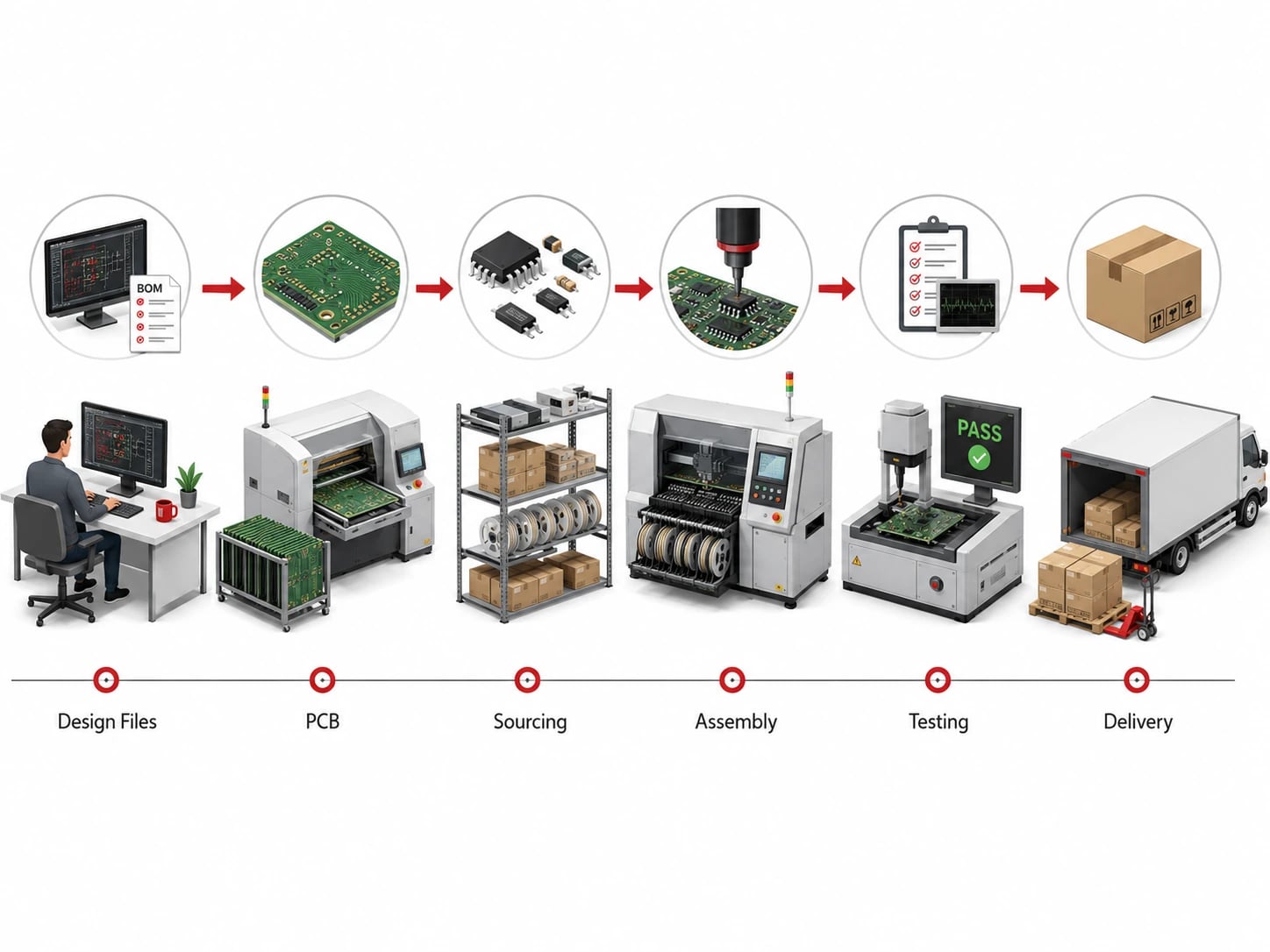
The service scope can begin with a bare PCB and extend to a fully assembled, tested, and packaged product.
- DFM and engineering review
- PCB fabrication
- Component sourcing
- SMT and through-hole assembly
- Firmware programming
- AOI and X-ray inspection
- Electrical and functional testing
- Conformal coating and potting
- Cable and wire-harness assembly
- Box-build assembly, packaging, and logistics
Engineering and NPI Support
New product introduction support helps turn an engineering design into a repeatable production process. The manufacturer may review footprints, solder-mask clearances, polarity markings, panelization, stencil design, test access, and assembly risks.
A useful DFM review should identify specific problems rather than simply state that a design is manufacturable.
PCB Fabrication
An ECM provider may produce PCBs internally or source them through approved manufacturing partners. Supported technologies may include multilayer FR-4, HDI, high-Tg, heavy-copper, rigid-flex, metal-core, and ceramic PCBs.
The supplier’s capability should match the actual board. Stacked microvias, controlled impedance, thick copper, or special laminates require relevant process experience.
Component Sourcing
Under a turnkey arrangement, the manufacturer purchases parts according to the approved BOM. Buyers should confirm approved purchasing channels, part-number control, traceability, moisture-sensitive handling, obsolescence management, and substitution procedures.
No component should be replaced without written approval when its electrical, mechanical, thermal, or regulatory characteristics could affect the product.
PCB Assembly and Testing
Assembly may include SMT, through-hole insertion, selective soldering, press-fit installation, BGA assembly, and manual soldering. Inspection may involve SPI, AOI, X-ray, flying-probe, in-circuit, and functional testing.
AOI and X-ray can detect assembly defects, but they do not confirm full product operation. Functional testing is needed for communication, power sequencing, sensor inputs, firmware, or system performance.
What Is Turnkey Electronic Contract Manufacturing?
Turnkey electronic contract manufacturing means the supplier manages most purchasing and production activities. The customer provides approved design files, quantities, quality requirements, and test criteria.
The manufacturer then coordinates PCB fabrication, BOM sourcing, assembly, programming, inspection, testing, and delivery. The quotation should state whether tooling, test fixtures, programming, packaging, freight, and excess materials are included.
Turnkey vs Consigned Electronic Contract Manufacturing
The main difference is who purchases and controls the production materials.
| Consideration | Turnkey Manufacturing | Consigned Manufacturing |
|---|---|---|
| Material purchasing | ECM supplier | Customer |
| Customer workload | Lower | Higher |
| Inventory control | Mainly supplier-managed | Mainly customer-managed |
| Price structure | Materials and production combined | Mainly assembly charges |
| Suitable for | One-stop production projects | Customer-controlled components |
| Main risk | Unclear sourcing or excess stock | Missing parts or incomplete kits |
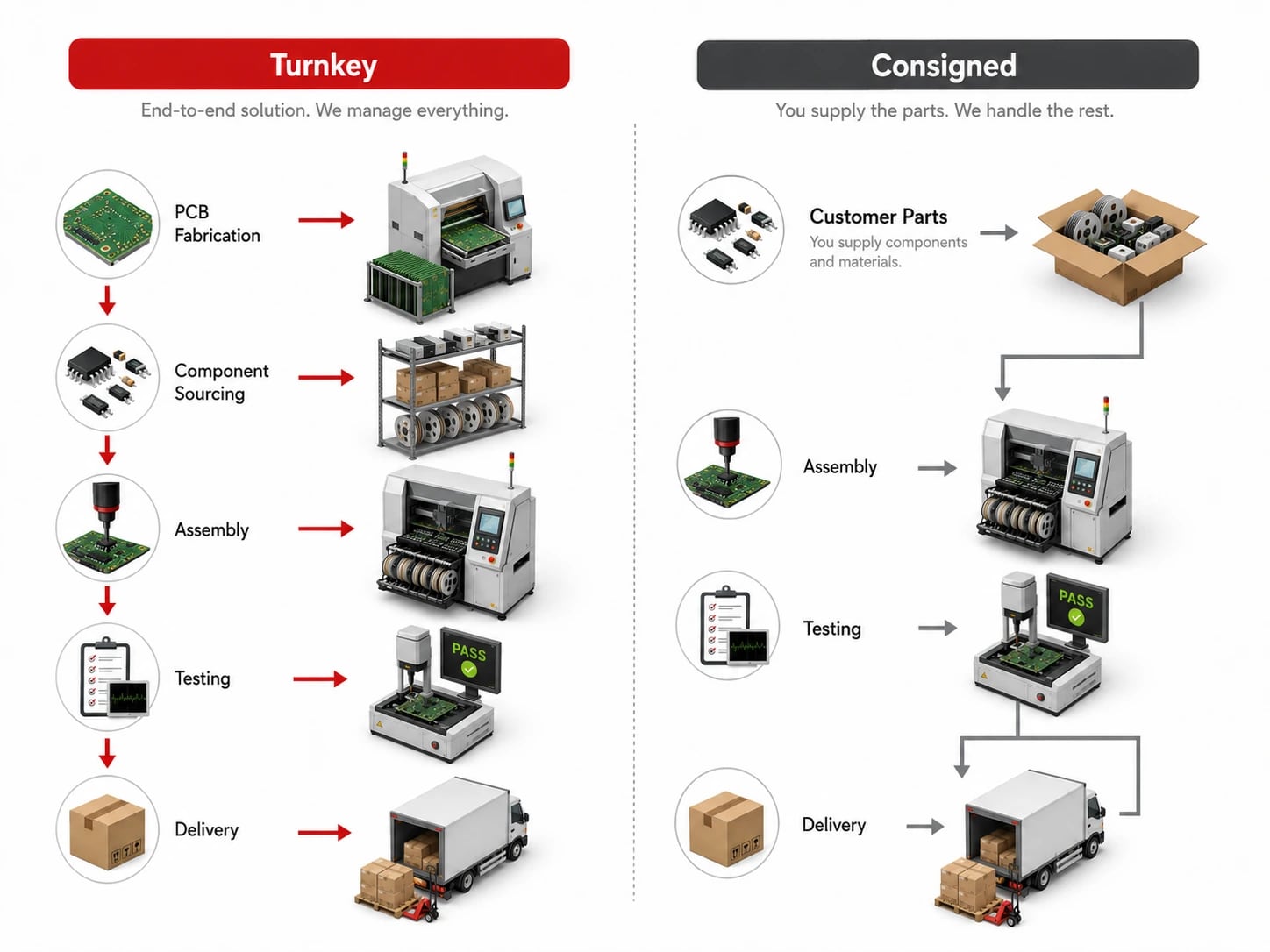
Turnkey manufacturing works well when the supplier has reliable sourcing channels. Consigned production is useful when the customer supplies proprietary modules, allocated semiconductors, pre-programmed ICs, or globally purchased parts.
What Products Can an Electronic Contract Manufacturer Produce?
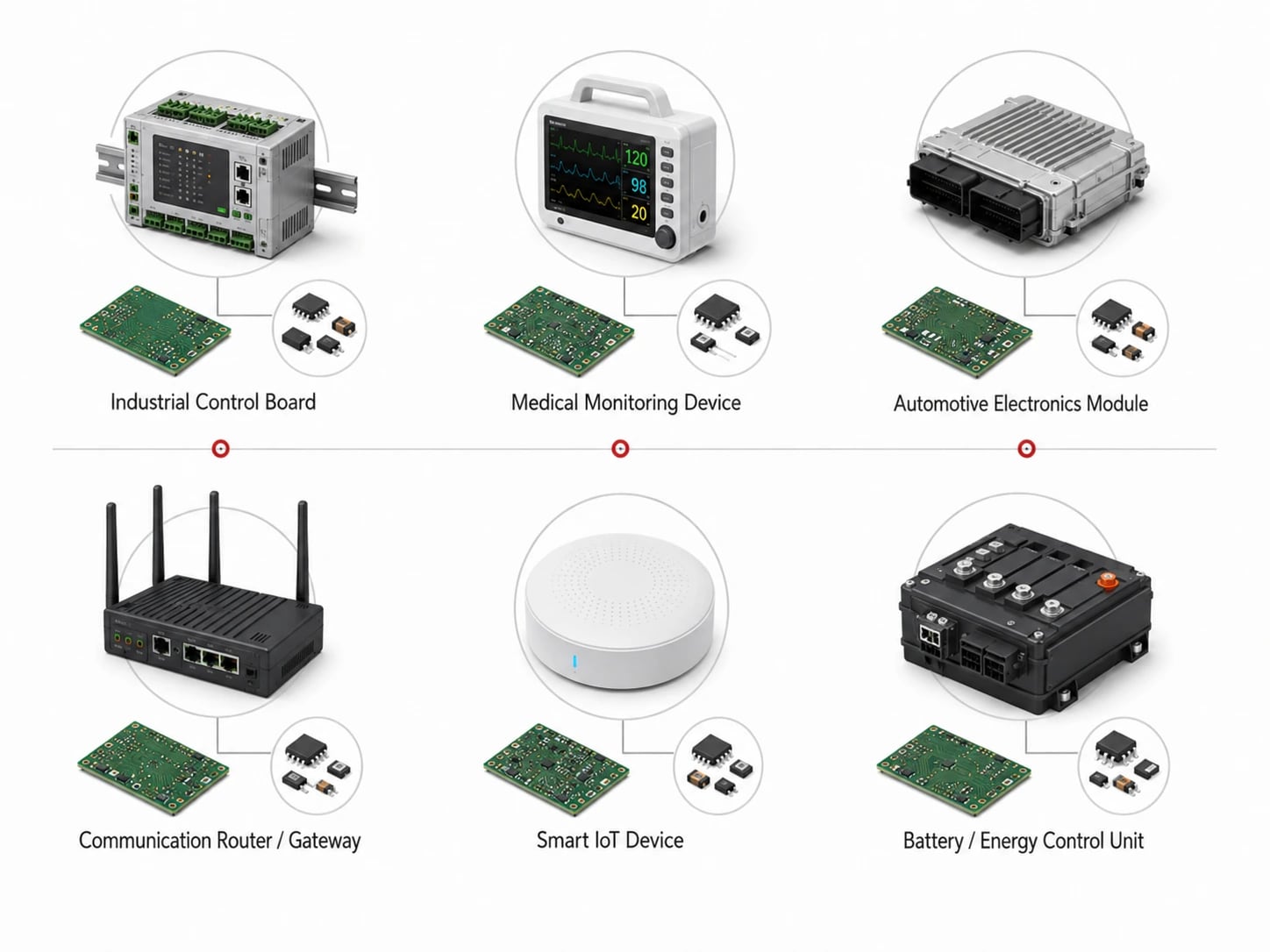
An electronic contract manufacturer can produce individual PCB assemblies, electronic modules, or complete devices.
- Industrial controllers and motor drives
- Medical monitoring equipment
- Automotive sensors and control modules
- Communication gateways
- IoT devices
- Battery-management systems
- Consumer electronics
- Aerospace instruments
Supplier selection should also consider operating temperature, service life, annual volume, traceability, environmental exposure, regulatory requirements, and the consequences of field failure.
What Files Are Required for Electronic Contract Manufacturing?
A complete production package reduces quotation assumptions and prevents revision errors.
| File or Information | Required Content |
|---|---|
| Gerber, ODB++, or IPC-2581 files | PCB layers, profile, solder mask, silkscreen, paste, and drill data |
| PCB specification | Material, thickness, copper weight, surface finish, impedance, and tolerances |
| Bill of materials | Reference designators, quantities, manufacturers, full part numbers, and alternates |
| Pick-and-place file | Coordinates, rotations, board side, and reference designators |
| Assembly drawing | Polarity, orientation, special mounting, and do-not-fit parts |
| Schematic | Circuit connections, voltage rails, and component relationships |
| Test specification | Test steps, limits, fixtures, and pass/fail criteria |
| Firmware files | Programming file, version, checksum, and instructions |
| Mechanical files | STEP models, enclosure drawings, and cable drawings |
| Quantity information | Prototype quantity, annual forecast, and delivery schedule |
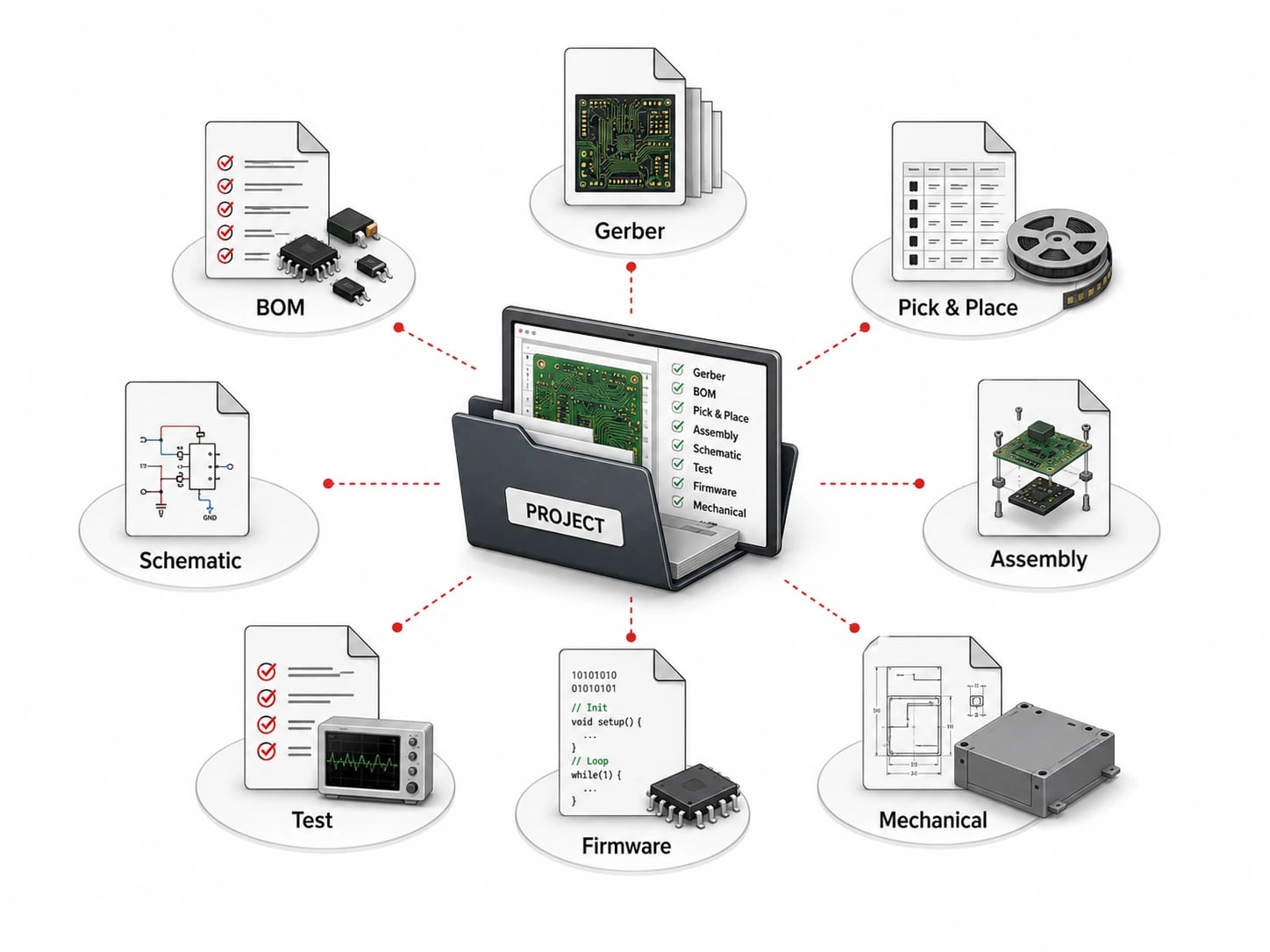
The BOM should use complete manufacturer part numbers. All production files should also carry the same revision to prevent mismatches between PCB, BOM, and placement data.
What Are the Benefits of Electronic Contract Manufacturing?
Electronic contract manufacturing gives product companies access to established equipment, process engineers, sourcing channels, and quality systems without building an internal factory.
- Lower equipment investment
- Faster prototype-to-production transfer
- Access to specialized assembly processes
- Flexible production capacity
- Consolidated component sourcing
- Established inspection and testing
- Easier scaling from pilot to volume production
The supplier must still match the production model. A prototype shop may lack volume controls, while a large mass-production plant may give limited attention to small engineering orders.
How Much Does Electronic Contract Manufacturing Cost?
Electronic contract manufacturing does not have a fixed price per board. Cost depends on the PCB specification, BOM value, component count, assembly difficulty, production quantity, and testing scope.
| Cost Factor | Typical Impact |
|---|---|
| PCB complexity | HDI, more layers, special materials, and tight tolerances increase cost |
| BOM value | Expensive or scarce parts raise material cost |
| Component count | More placements require additional machine and inspection time |
| Package type | Fine-pitch BGA, 01005, and press-fit parts need tighter process control |
| Order volume | Higher volume spreads setup and engineering costs |
| Testing | Fixtures, programming, functional tests, and burn-in add cost |
| Additional processes | Coating, potting, cleaning, and box build add materials and labor |
| Lead time | Expedited PCB and component sourcing increase the price |
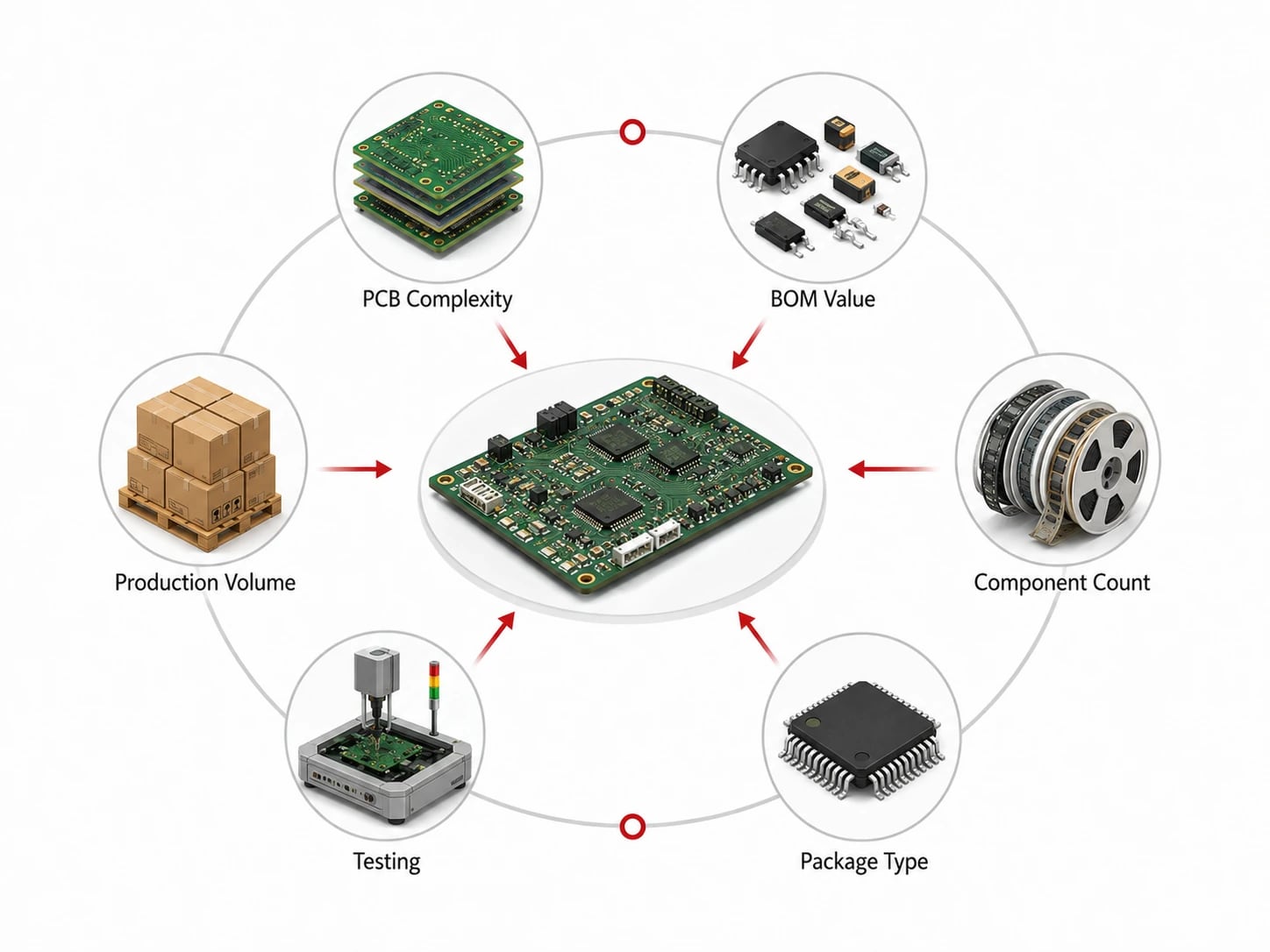
Prototype unit prices are normally higher because setup, stencil, programming, and engineering charges are divided across fewer boards. Compare quotations only when PCB specifications, component brands, quantities, test requirements, and delivery terms are the same.
What Quality Standards Should an Electronic Contract Manufacturer Follow?
The required standards depend on the product, target industry, customer requirements, and destination market.
| Standard | Main Application |
|---|---|
| ISO 9001 | General quality-management systems |
| ISO 13485 | Medical-device manufacturing |
| IATF 16949 | Automotive manufacturing |
| AS9100 | Aviation, space, and defense |
| IPC-A-610 | Electronic assembly acceptance |
| J-STD-001 | Soldering process requirements |
| IPC/WHMA-A-620 | Cable and wire-harness workmanship |
| RoHS and REACH | Restricted-substance compliance |
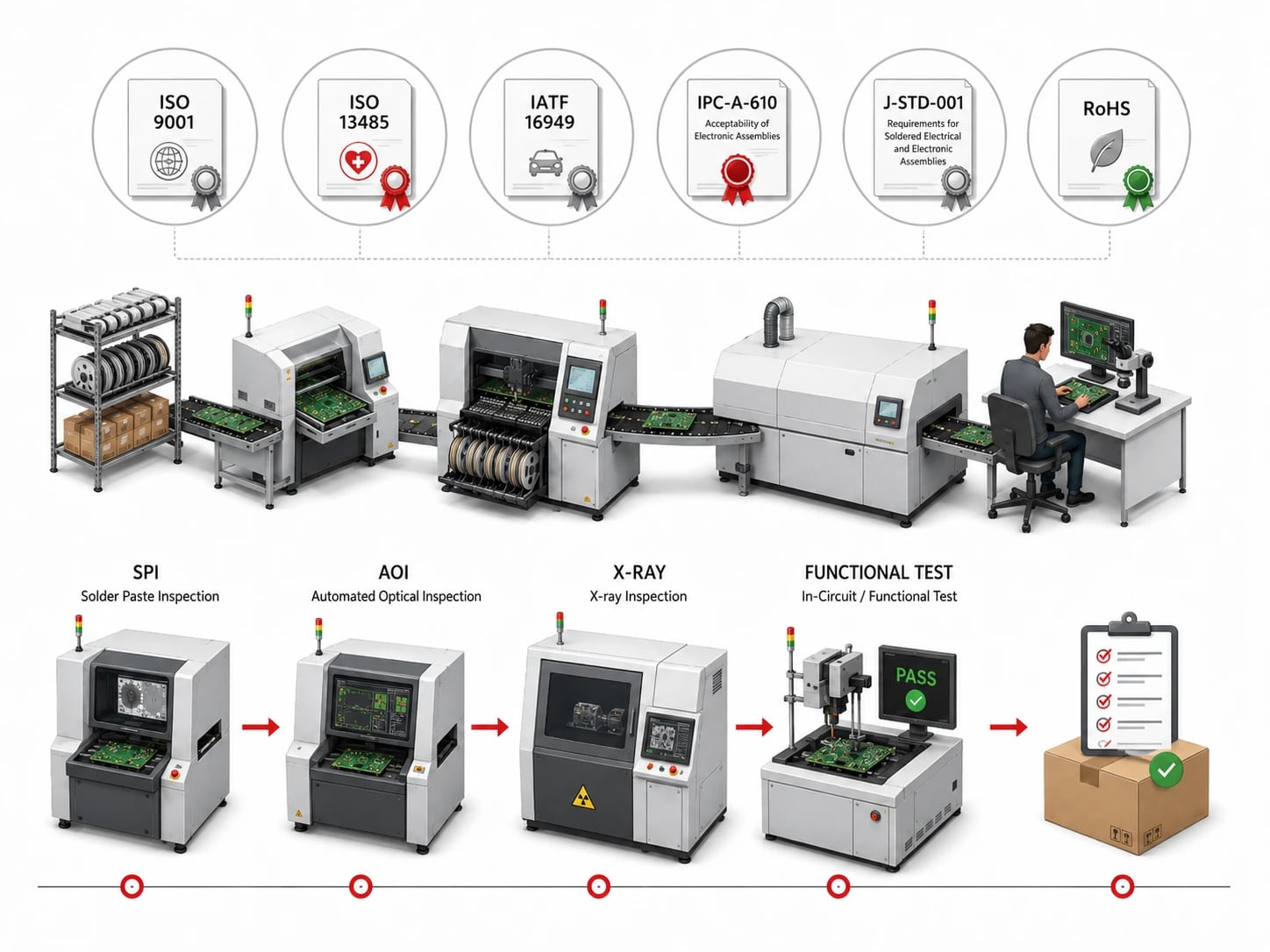
Not every project needs every standard. Buyers should confirm that certification covers the actual production site and review calibration, operator training, traceability, change control, nonconformance handling, and test records.
Why Choose EBest Circuit for Electronic Contract Manufacturing?
EBest Circuit, also known as Best Technology, provides PCB fabrication, component sourcing, PCB assembly, testing, coating, and box-build services.
The company supports multilayer FR-4, HDI, high-Tg, heavy-copper, rigid-flex, metal-core, and ceramic PCBs, together with SMT, through-hole assembly, BGA placement, programming, conformal coating, functional testing, and final integration.
EBest Circuit is suitable for customers that need prototype review, high-mix production, pilot builds, or repeat orders under one supplier. For an accurate quotation, provide complete production files, target quantities, component requirements, testing criteria, and required quality documentation.
FAQs
What is electronic contract manufacturing?
Electronic contract manufacturing is the outsourcing of electronic production to an external manufacturer. The service may include PCB fabrication, sourcing, assembly, testing, box build, packaging, and logistics.
What does ECM stand for in electronics?
ECM stands for electronic contract manufacturing. It describes a business arrangement in which one company manufactures electronic products for another company under contract.
Is electronic contract manufacturing the same as EMS?
The terms are closely related. ECM describes the outsourcing model, while EMS describes the manufacturing services offered by the supplier.
What is turnkey electronic contract manufacturing?
Turnkey electronic contract manufacturing means the supplier manages most materials and manufacturing activities. The customer provides approved product files and requirements.
What services does an electronic contract manufacturer provide?
Typical services include PCB fabrication, component sourcing, SMT and through-hole assembly, programming, inspection, testing, coating, cable assembly, box build, packaging, and logistics.
Can an ECM company handle prototype production?
Yes. Choose a supplier that offers engineering review, flexible sourcing, first-article inspection, and a clear transfer process from prototype to repeat production.
How do I compare electronic contract manufacturing companies?
Compare PCB and assembly capability, similar project experience, certifications, testing resources, sourcing controls, supported volume, communication, lead time, and commercial transparency.
What files are needed to get an ECM quotation?
At minimum, provide Gerber or ODB++ files, PCB specifications, BOM, pick-and-place data, assembly drawings, order quantity, and delivery requirements.
How long does electronic contract manufacturing take?
A standard prototype PCBA using available components may take about 10 to 20 working days after file approval. Specialized PCBs, long-lead parts, fixtures, coating, or box build can extend the schedule.
Electronic contract manufacturing can simplify the move from a validated design to repeatable production. The best supplier should match the product’s technical requirements, order volume, quality level, testing needs, and communication expectations.
For PCB fabrication, turnkey PCB assembly, component sourcing, testing, or box-build support, contact EBest Circuit at sales@bestpcbs.com.
You may also like
Tags: contract manufacturing electronics, Electronic Contract Manufacturing, electronic manufacturing services