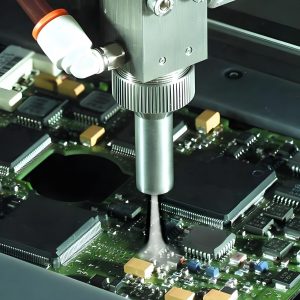
What does solder flux do? Solder flux removes surface oxides, limits new oxidation during heating, and helps molten solder wet copper pads, component leads, wires, and terminals. Without enough flux activity, solder may bead up or pull away from the metal instead of forming a clean joint.
In electronics soldering, flux may come from flux-core wire, solder paste, liquid flux, or tacky flux used during rework. The chemistry varies by process, but the purpose is the same: keep the soldering surface clean enough for solder to spread and bond while the joint is hot.
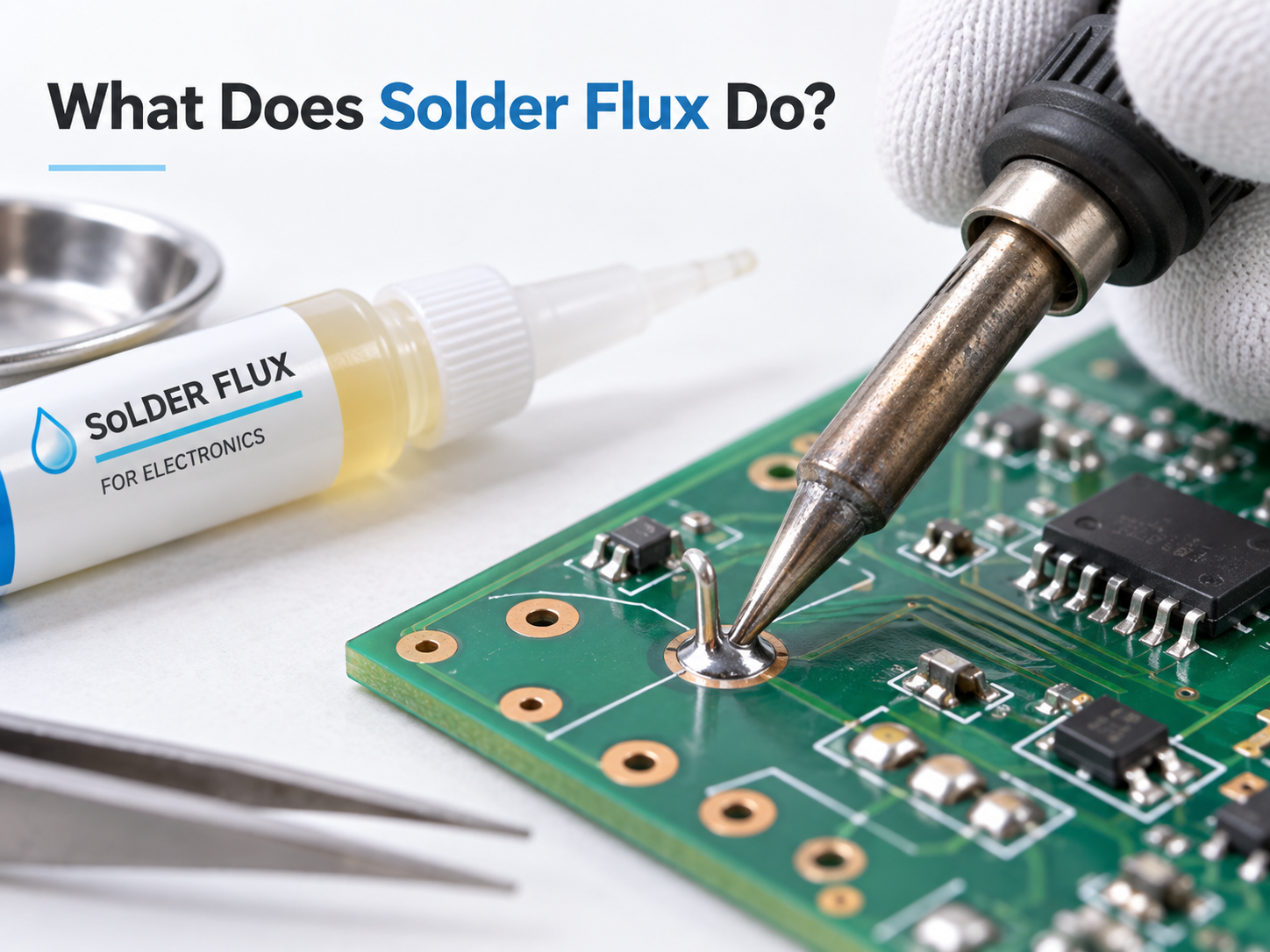
What Does Solder Flux Actually Do?
Solder flux mainly cleans and protects the metal surface so molten solder can wet it properly.
Its main functions are:
- Remove oxides: Activators react with oxide films on copper pads and component terminals.
- Limit re-oxidation: Flux temporarily protects hot metal from further exposure to oxygen.
- Improve wetting: Molten solder can spread across clean metal instead of remaining in rounded beads.
- Support joint formation: Better wetting helps solder make continuous contact with both surfaces being joined.
This is why adding suitable flux can improve a stubborn solder joint even when the soldering temperature is already high enough.
Flux itself is not an adhesive. It prepares the surface so solder can form the actual electrical and mechanical connection.
How Does Solder Flux Work During Soldering?
Solder flux works by becoming chemically active as the joint heats up, removing surface oxides before molten solder reaches the metal.
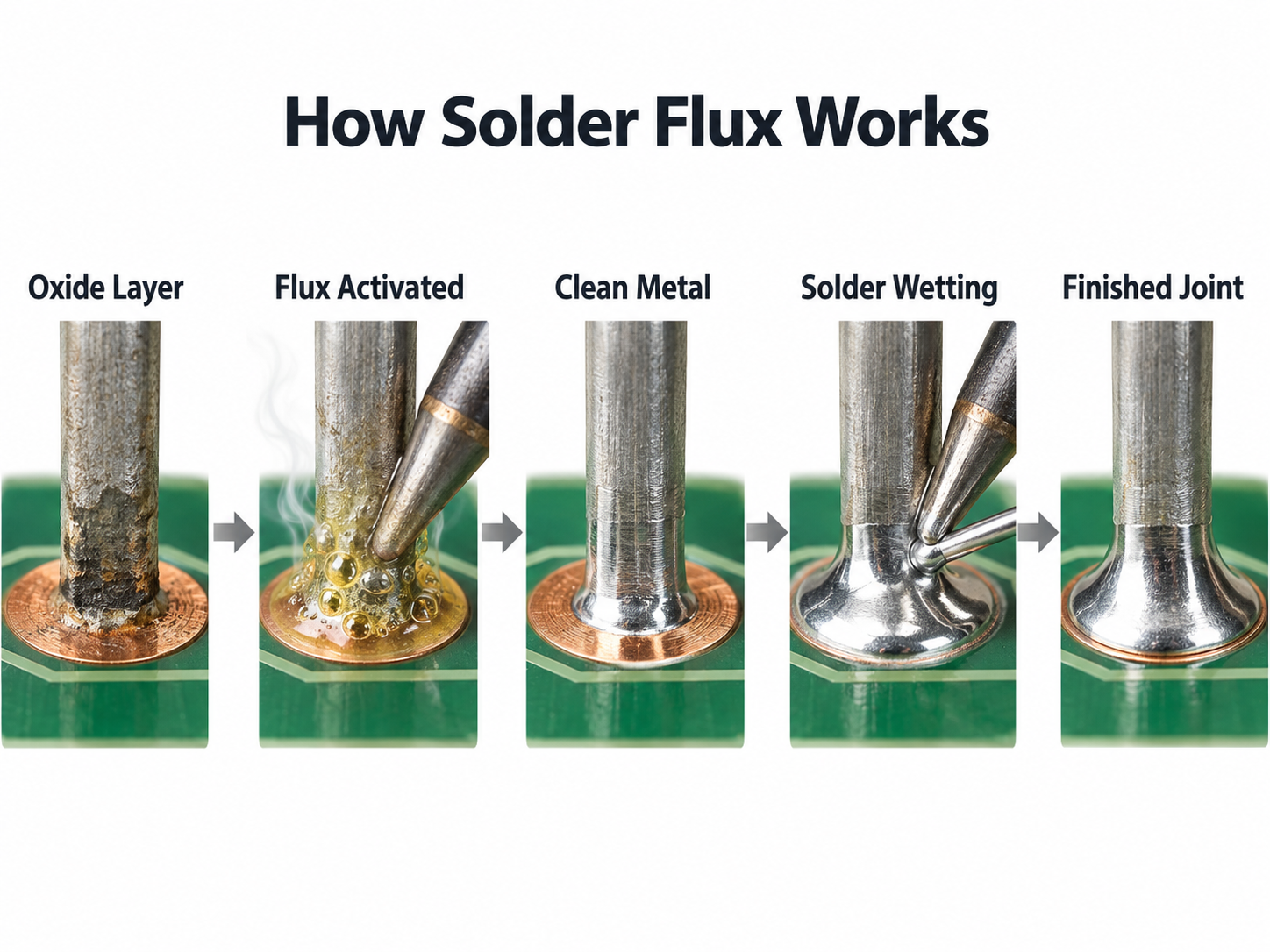
A typical sequence is:
- Copper pads or component leads have a thin oxide layer.
- Flux is applied or released from solder wire or solder paste.
- Heat activates the flux.
- Flux chemistry reacts with the oxide layer.
- Cleaner metal is exposed.
- Molten solder wets and spreads across the surface.
- The solder cools and forms the joint.
The most important result is better wetting.
Good wetting produces smooth contact between the solder and the metal surface. Poor wetting can leave:
- rounded solder beads
- incomplete pad coverage
- uneven fillets
- solder that pulls away from the pad or lead
Increasing iron temperature alone does not fix an oxide problem. Excessive heat can accelerate oxidation while also increasing the risk of pad damage or component stress.
Do You Need Flux to Solder?
Yes, most soldering processes need flux activity, but you do not always need to apply flux separately.
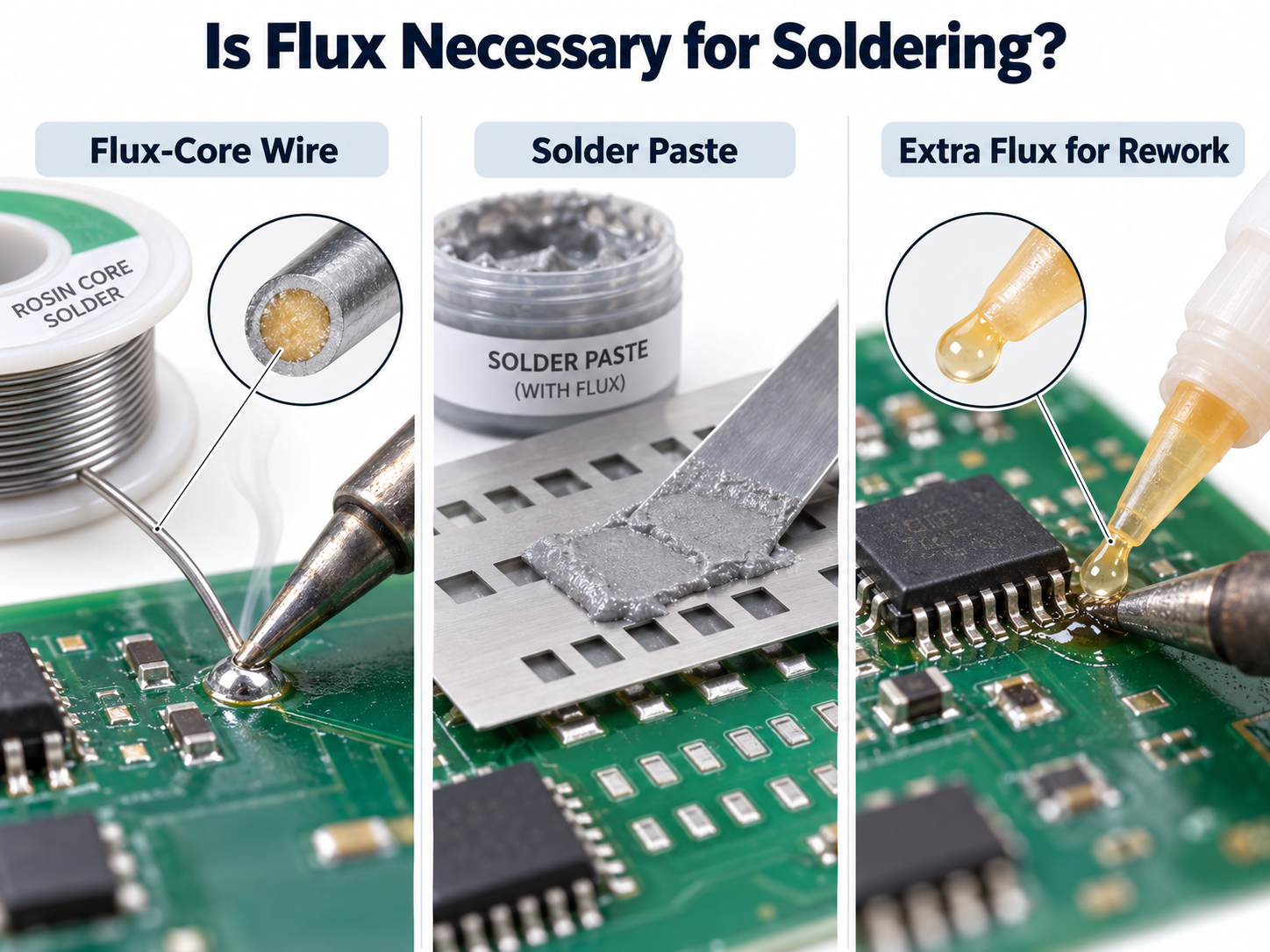
Flux may already be present in:
- flux-core solder wire
- SMT solder paste
- some solder preforms
- certain specialty solder products
Extra flux is more useful when the existing flux is no longer sufficient, such as during:
- PCB rework
- repeated heating of an old solder joint
- soldering oxidized pads or leads
- drag soldering
- fine-pitch IC soldering
- BGA or QFN rework
So, if you are using flux-core solder or solder paste, the process already includes flux. Separate flux is only needed when additional oxide removal or wetting support is required.
In production PCBA, flux choice is more than a soldering consumable decision. It can affect solder wetting, residue control, ionic cleanliness, conformal coating compatibility, inspection results, and long-term reliability. For SMT, wave soldering, selective soldering, or rework projects, EBest Circuit can review flux and soldering process requirements together with the PCB design, BOM, and assembly conditions.
Does Solder Already Have Flux in It?
Some solder contains flux, while other solder products do not.
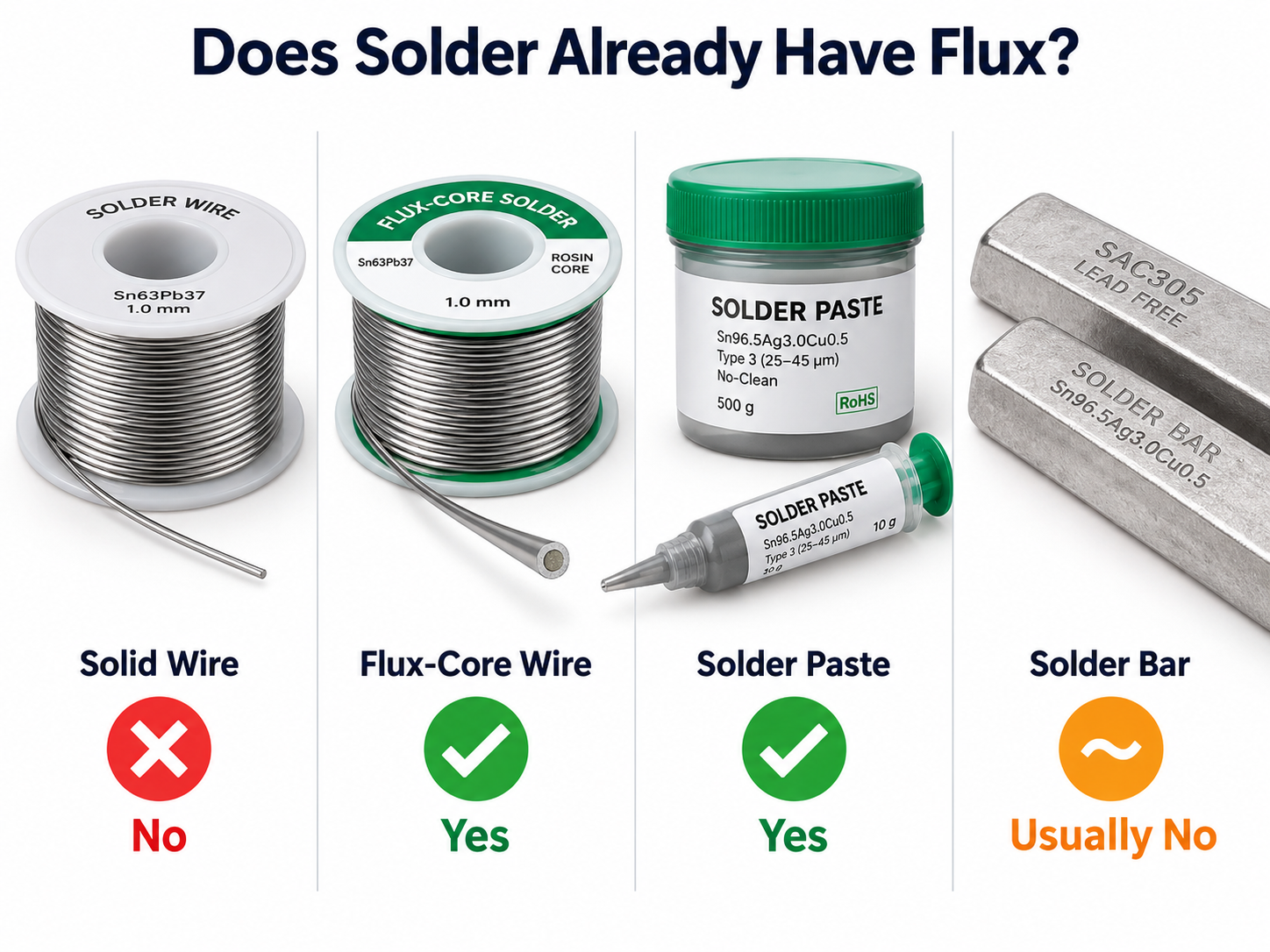
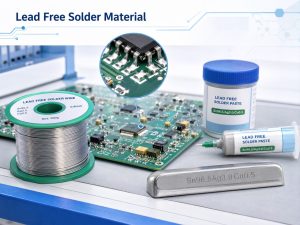
| Solder Material | Contains Flux? | Typical Use |
| Solid solder wire | No | Controlled or specialized soldering |
| Flux-core solder wire | Yes | Hand soldering and repair |
| SMT solder paste | Yes | Reflow assembly |
| Solder bar | Usually no | Wave and selective soldering |
| Solder preform | Depends on product | Specialized assembly |
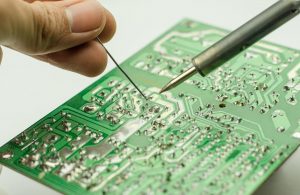
Flux-core solder wire is common in manual electronics soldering. When the wire melts, the internal flux is released directly into the joint.
Solder paste also contains flux, but in a different form. It combines fine solder alloy powder with a flux system designed for stencil printing and reflow.
Extra flux may still help when:
- the original flux has already been consumed
- the joint has been reheated several times
- the surface is oxidized
- additional wetting is needed around fine-pitch leads
What Does Solder Flux Contain?
Solder flux usually contains a base material, activators, and a carrier or solvent.
The main ingredients are:
- Base or resin: Often rosin or synthetic resin. It provides the main flux medium.
- Activators: React with metal oxides during heating.
- Solvent or carrier: Helps liquid flux spread and evaporates as the assembly heats.
Depending on the product, manufacturers may also add:
- wetting agents
- corrosion inhibitors
- stabilizers
- rheology modifiers
- thixotropic agents
The exact formulation affects flux activity, residue, storage stability, application method, and cleaning requirements.
What Types of Flux Are Used in Electronics Soldering?
The main flux types used in electronics are rosin-based, no-clean, and water-soluble flux.
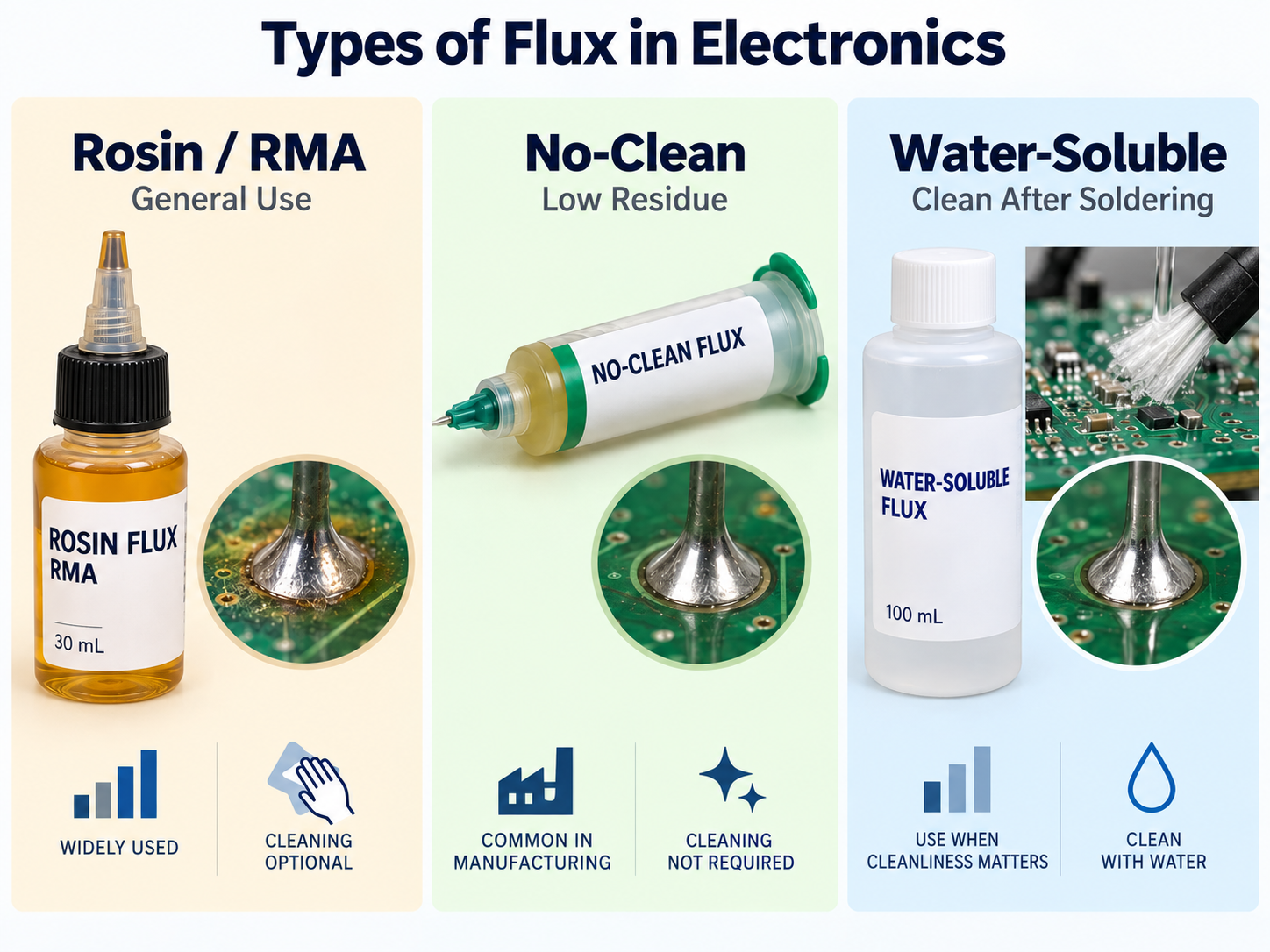
| Flux Type | Activity | Cleaning | Typical Use |
| Rosin / RMA | Low to medium | Depends on formulation | Hand soldering, repair |
| No-clean | Low to medium | Often not required | SMT, reflow, wave soldering |
| Water-soluble | Medium to high | Normally required | More difficult solderability conditions |
Rosin and RMA flux
Rosin flux is widely used in electronics. RMA, or mildly activated rosin, adds more oxide-removal capability while remaining suitable for many PCB applications.
No-clean flux
No-clean flux leaves a relatively small amount of residue after soldering and is common in production assembly.
The term “no-clean” does not mean the board is residue-free. It means the remaining residue is designed to stay on the board when the process and product requirements allow it.
Water-soluble flux
Water-soluble flux offers higher activity and can handle more difficult oxidation. Its residues normally need to be removed after soldering.
For PCB work, plumbing or highly acidic flux should not be used because the residue may be too corrosive for electronic assemblies.
Liquid Flux vs Paste Flux: What Is the Difference?
Liquid flux spreads easily, while paste or tacky flux stays in place more effectively.
| Flux Form | Main Characteristic | Typical Use |
| Liquid flux | Low viscosity, spreads easily | Wave soldering, selective soldering, repair |
| Flux pen | Controlled liquid application | PCB touch-up |
| Gel / tacky flux | Stays around the joint | SMD, BGA and QFN rework |
| Paste-type flux | Thick, localized application | Hand soldering and rework |
Liquid flux is useful when the material needs to flow into narrow spaces or across multiple leads.
Tacky and gel fluxes are more useful during rework because they remain around the component instead of immediately spreading across the board.
Flux paste is not the same as solder paste. Flux paste contains flux chemistry, while solder paste contains both solder alloy powder and flux.
Which Flux Is Best for Soldering Electronics?
The best flux for soldering electronics depends on the soldering process, surface condition, residue requirement, and cleaning method.
| Application | Typical Flux Choice |
| General PCB hand soldering | Rosin/RMA or electronics-grade no-clean |
| Fine-pitch IC soldering | Liquid or tacky flux |
| SMT reflow | Flux system already contained in solder paste |
| Wave soldering | Process-specific liquid flux |
| BGA/QFN rework | Tacky or gel flux |
| Oxidized surfaces | Higher-activity flux with suitable cleaning |
Also check:
- solder alloy compatibility
- PCB surface finish
- flux activity level
- residue limits
- cleaning capability
- conformal coating requirements
- product reliability requirements
A more active flux is not automatically better. Higher activity may improve oxide removal, but it can also increase cleaning requirements.
Does Flux Need to Be Cleaned After Soldering?
Flux residue should be cleaned when the chemistry or assembly requirements make residue unacceptable.
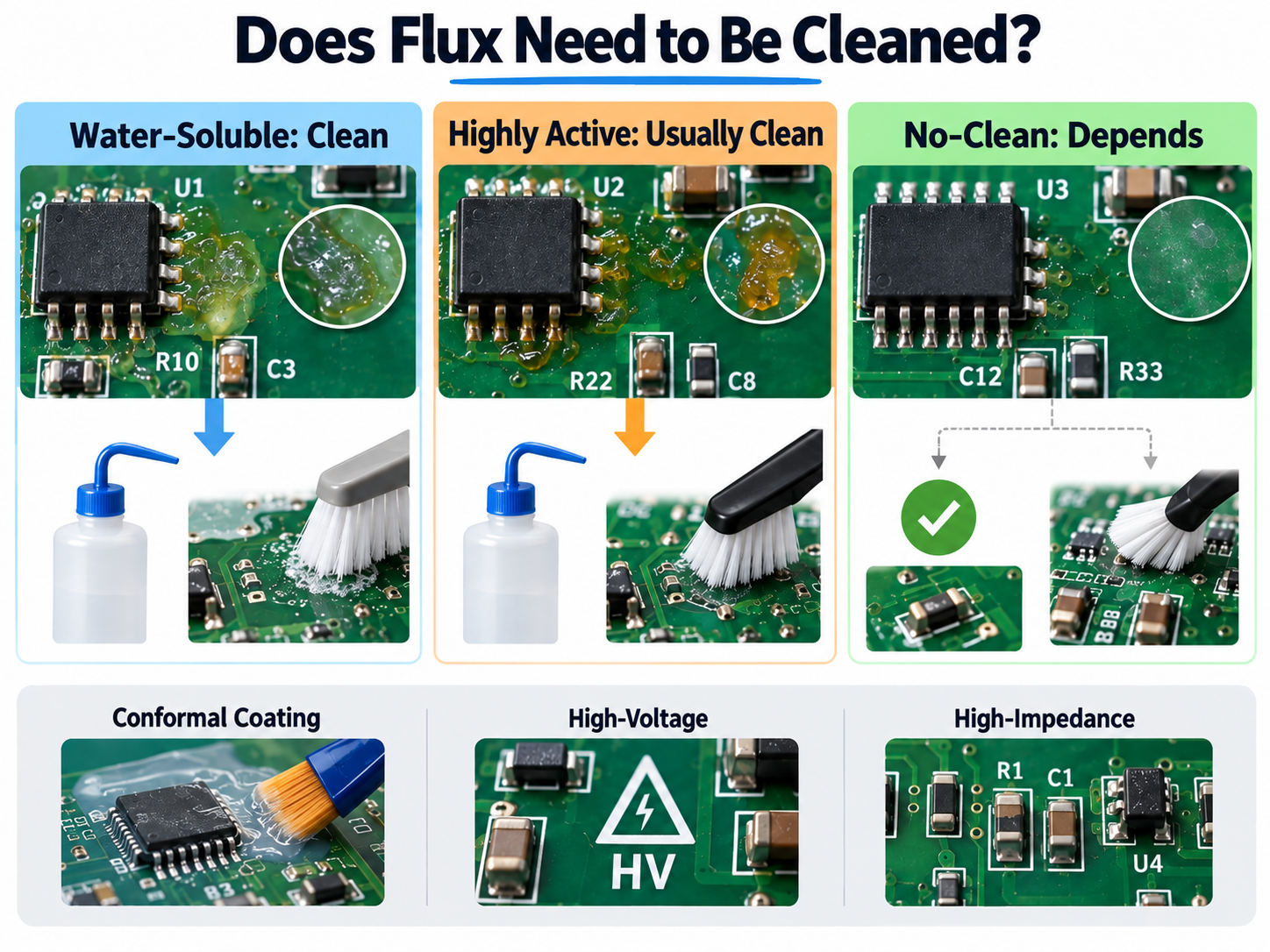
Typical guidance is:
- Water-soluble flux: Normally clean after soldering.
- Highly activated flux: Usually clean unless the product specification states otherwise.
- No-clean flux: May remain if the process and reliability requirements allow it.
Cleaning deserves extra attention for:
- high-voltage assemblies
- high-impedance circuits
- assemblies receiving conformal coating
- products exposed to high humidity
- assemblies with strict ionic cleanliness limits
Using too much flux can also leave unnecessary residue, especially during hand soldering and repair. Applying only the amount needed for proper wetting usually gives a cleaner and more repeatable result.
FAQ About Solder Flux
1. What happens if you solder without flux?
Without enough flux, surface oxides can prevent solder from wetting properly. The solder may bead up, form incomplete fillets, or fail to bond evenly to the pad or component lead.
2. Can you use too much flux when soldering?
Yes. Too much flux can leave heavy residue, spread contamination across the PCB, and increase cleaning or inspection work. Use enough to support wetting without flooding the area.
3. Does flux make solder stick better?
Yes, indirectly. Flux removes oxides and improves wetting, allowing molten solder to bond more effectively with the metal surface. Flux itself is not an adhesive.
4. Can you use plumbing flux for electronics soldering?
No. Plumbing flux can be too aggressive or corrosive for PCB assemblies. Use flux specifically formulated for electronics.
5. Why does solder bead up even when I use flux?
Common causes include severe oxidation, contamination, insufficient heat, weak or expired flux, or poor solderability of the surface finish.
6. Do you need extra flux with flux-core solder?
Not always. Flux-core solder already contains flux. Extra flux is mainly useful for rework, oxidized surfaces, fine-pitch soldering, or joints that have already been heated.
Solder flux plays a simple but important role in electronics assembly: it keeps the soldering surface clean enough for molten solder to wet and form a reliable joint.
If you are preparing a PCB or PCBA project and need support with soldering process requirements, assembly manufacturability, or production planning, send your Gerber files, BOM, and assembly requirements to sales@bestpcbs.com