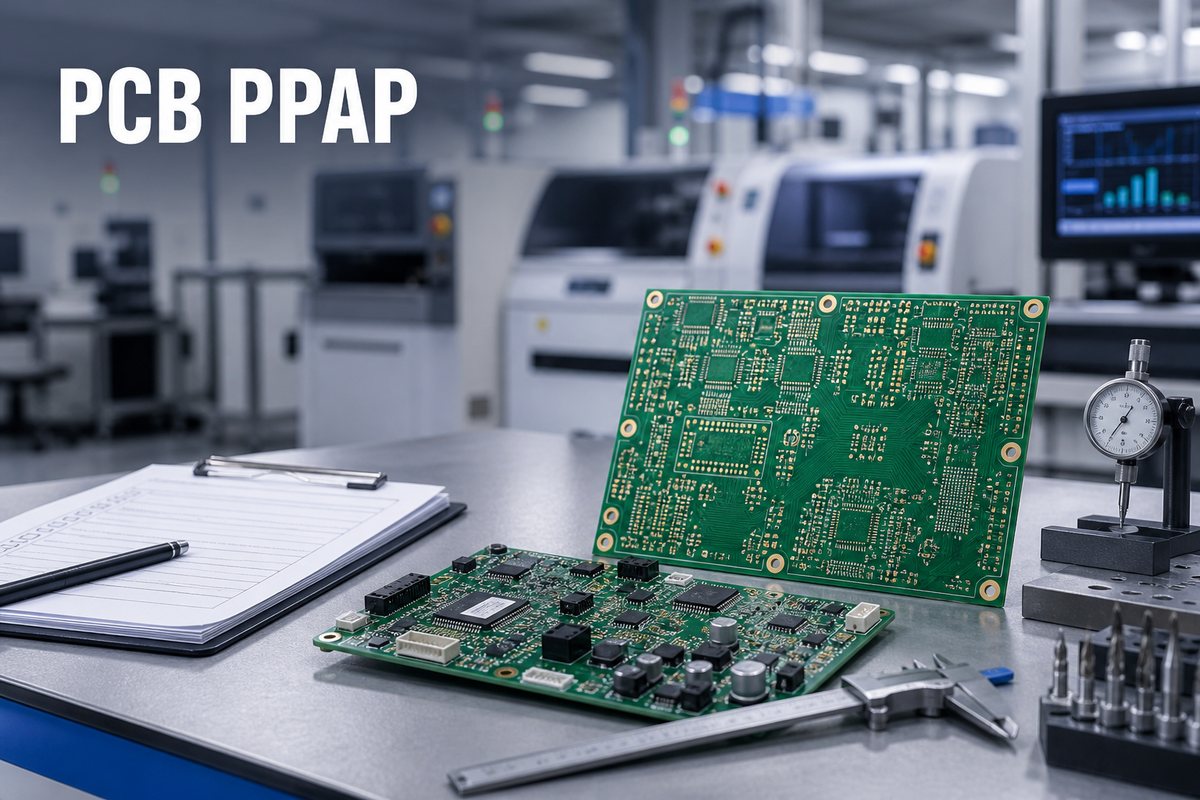
PCB PPAP applies the production part approval process PPAP to a PCB or PCBA so buyers can approve more than a sample that happens to pass inspection. The submission should show that the agreed board revision, materials, manufacturing process, inspection plan and production records can repeatedly meet the customer’s requirements. If the required evidence is not defined before quotation, approval can be delayed by missing documents, unplanned testing, unclear responsibilities or a production change that was never submitted for review.
EBest Circuit (Best Technology) helps customers connect PPAP requirements with PCB fabrication, component sourcing, PCBA assembly, testing and traceability. In the first half of 2026, our engineering team delivered 18 completed PPAP reports, giving customers structured production evidence for PCB approval and traceability. This practical experience helps customers define the required submission before production, keep manufacturing evidence connected to the correct revision and move from approval samples to repeat orders with fewer documentation gaps.
What Is the Production Part Approval Process PPAP?
The production part approval process PPAP is used to confirm that a supplier understands the engineering design record and specification requirements and that the planned production process can consistently make conforming parts under actual production conditions.
For a PCB or PCBA buyer, PPAP is therefore not just a folder of forms. It is a decision package used to answer whether the supplied part is ready for production approval.
A useful PCB PPAP submission should help the customer confirm:
- The correct PCB, BOM and assembly revisions were used.
- Materials, components and approved sources match the agreed requirements.
- The production process is defined and controlled.
- Measurements and test results meet the acceptance criteria.
- Samples came from a representative production process.
- Material, process and inspection records can be traced to the delivered batch.
- Future changes will be reviewed before they affect approved production.
The customer or authorized approval organization decides whether the submission is approved. The PCB or PCBA supplier prepares the manufacturing evidence within its agreed scope; it does not replace the customer’s product-design responsibility, system validation or final approval authority.
What Must PCB PPAP Prove Before Production?
PCB PPAP must connect the approved product definition to a repeatable manufacturing process. A visually acceptable sample is not enough if the supplier cannot show which revision, material lot, process settings and inspection results produced it.
Before production approval, buyers should be able to answer five questions:
- Was the correct product built? The Gerber data, drawing, stack-up, BOM, CPL, firmware or programming instructions and other controlled files must use the approved revision.
- Were the correct materials and components used? Laminate, copper weight, surface finish, solder mask, components and approved substitutions must match the agreed specification.
- Can the manufacturing process repeat the result? Fabrication, stencil, SMT, through-hole, reflow, wave soldering, coating, programming and testing requirements must be translated into controlled production instructions where applicable.
- Does the product meet the measurable requirements? Dimensional, electrical, soldering, cleanliness, functional or reliability results should be matched to the customer’s acceptance criteria.
- Can the evidence be traced? The supplier should be able to connect the sample and report to the relevant order, material batch, production route and inspection record.
This is why PPAP should be discussed before the approval build. Adding a special study, customer form, third-party test or traceability requirement after production may require new samples or a repeat production run.

Which PPAP Documents Should Come From Your PCB Supplier?
The AIAG PPAP framework contains 18 potential elements, but that does not mean every PCB supplier automatically owns every element or that every submission requires the same package. The customer should define the required level, customer-specific forms and responsibility for each item.
The most practical approach is to separate customer-controlled inputs from supplier manufacturing evidence.
| Responsibility | Typical information or evidence |
|---|---|
| Customer or design owner | Approved drawing and design record, revision, specifications, special characteristics, application requirements, acceptance criteria and customer-specific forms |
| PCB/PCBA supplier | Process flow, manufacturing instructions, applicable PFMEA and control plan, material records, dimensional results, electrical or assembly inspection results, initial samples and batch traceability within the agreed scope |
| Customer and supplier to confirm | Part Submission Warrant ownership, MSA or capability studies, laboratory requirements, IMDS submission, component sub-tier evidence, master sample, checking aids and retention period |
For an efficient quotation, ask the supplier to identify each requested item as:
- Included in the quoted PPAP scope.
- Available from an existing manufacturing record.
- Requiring a dedicated production study or sample run.
- Requiring an approved external laboratory or sub-tier supplier.
- Supplied or approved by the customer.
- Not applicable to the PCB or PCBA project.
This prevents a common commercial problem: both parties agree to “PPAP,” but the customer expects a complete customer-specific package while the quotation covers only samples and basic inspection reports.
How Do PPAP Levels Change What Your Supplier Submits?
The PPAP submission level controls what is sent to the customer and what must remain available for review. It does not change the underlying obligation to manufacture the approved part consistently.
| PPAP level | General submission expectation |
|---|---|
| Level 1 | Part Submission Warrant only |
| Level 2 | Warrant, product samples and limited supporting data |
| Level 3 | Warrant, product samples and complete supporting data |
| Level 4 | Warrant and other requirements defined by the customer |
| Level 5 | Warrant, samples and complete supporting data available for review at the supplier’s manufacturing location |
Level 3 is frequently requested in automotive supply chains, but it should not be treated as the automatic requirement for every PCB or PCBA. The customer must specify the submission level and any customer-specific additions.
Before accepting a level, confirm:
- The exact document list and form revision.
- Whether evidence is submitted, retained or reviewed on site.
- The required sample quantity and production-run conditions.
- Which special characteristics require capability evidence.
- Whether sub-tier PCB, component or laboratory records are required.
- The target submission date and review cycle.
A clear level definition makes the supplier’s quotation more accurate and reduces the risk of discovering additional work immediately before approval.
PPAP vs FAI: What Is Different for PCB Approval?
PPAP and first article inspection both use measured evidence, but they answer different questions.
| Approval method | Main question |
|---|---|
| FAI | Does the first manufactured item conform to the drawing and specified characteristics? |
| PPAP | Can the defined production process repeatedly manufacture conforming parts and maintain the required evidence? |
An FAI report may be part of the evidence used during PCB qualification, but dimensional conformity alone does not establish the full production-control picture expected from PPAP.
PCB PPAP may extend beyond FAI by connecting the results to:
- Process flow and production controls.
- Material and component traceability.
- Risk analysis and control planning where required.
- Measurement-system or process-capability evidence for specified characteristics.
- Sample origin and representative production conditions.
- Change notification and resubmission requirements.
The customer should still define whether it needs FAI, PPAP or both. Treating the terms as interchangeable can leave important evidence missing from the approval package.
When Do PCB Changes Require a New PPAP Submission?
An approved sample does not give unrestricted permission to change the product or process. A change may alter electrical performance, reliability, solderability, fit, traceability or long-term repeatability even when the finished board looks similar.
Changes that should be reviewed against the customer’s PPAP rules include:
- PCB drawing, Gerber, stack-up or specification revision.
- Laminate, copper, solder mask, surface finish or other material change.
- BOM revision or component substitution.
- Change of an approved material or component source.
- New tooling, stencil, fixture or manufacturing equipment.
- Significant change to fabrication, assembly, coating, programming or test methods.
- Transfer to another production line, factory or sub-tier supplier.
- Restart after an extended production interruption.
- Correction following a nonconformance that changes the approved process.
The existence of a change does not automatically determine the required submission level. The supplier should notify the customer with enough information for the customer to decide whether approval, limited evidence or a complete resubmission is required.
For PCB and PCBA programs, revision control is especially important because one commercial part number may involve several connected files. Gerber data, BOM, CPL, assembly drawings, test instructions and firmware references must remain aligned.
What Should Be Confirmed Before a PCB PPAP Quote?
A PCB PPAP quotation should make the approval work visible. Quoting only the board or assembly price leaves both parties exposed to extra samples, testing fees, engineering time and schedule changes later.
Send the following information with the RFQ:
- Approved Gerber data, drawing and revision.
- BOM and CPL for PCBA projects.
- Required PPAP level and customer-specific checklist.
- Sample quantity and expected production-run quantity.
- Special characteristics and acceptance limits.
- Required dimensional, electrical, functional or reliability tests.
- Required forms, language and file format.
- IMDS, material declaration or sub-tier evidence requirements.
- Required laboratory accreditation, if applicable.
- Submission date and planned production-approval date.
- Change-notification and document-retention requirements.
The supplier’s quotation should then clarify:
- Which PPAP documents are included.
- Which tests are performed internally or externally.
- Whether a dedicated production run is required.
- Sample, tooling, fixture and laboratory charges.
- Expected preparation and review schedule.
- Information still required from the customer.
This gives the buyer a usable approval plan instead of a low initial price followed by unplanned documentation charges and delayed production.
How Does EBest Support PCB PPAP Evidence?
EBest Circuit (Best Technology) supports PCB fabrication, component sourcing, PCBA assembly, inspection and customer-defined testing coordination through one project path. Our IATF 16949 quality-management capability and engineering experience provide a practical foundation for automotive and other controlled-production projects.
Our engineering department completed 18 PPAP reports in the first half of 2026. During the same period, the team also prepared IQ, OQ and PQ reports for five products, created 332 new SMT programs and maintained 489 product and process records in MES. These are not presented as identical PPAP packages; they demonstrate active experience in converting customer requirements into controlled manufacturing and supporting records.
Depending on the confirmed project scope, EBest can coordinate:
- Pre-production review of PCB, BOM, CPL, drawings and special requirements.
- DFM review and engineering questions before the approval build.
- Process flow, manufacturing instructions, SOPs and control records.
- First-article and trial-production issue review.
- Material, order and product-batch traceability through MES.
- Incoming, in-process and outgoing inspection records.
- Electrical, AOI, X-ray, functional or other agreed testing.
- Component sourcing and approved-substitution control.
- PCB fabrication, PCBA assembly and repeat production.
Our MES records can connect incoming materials, warehouse activity, production stages, inspection and shipment to the relevant order or product record. This helps customers investigate a question without separating the approval sample from the manufacturing history that produced it.
For each new project, EBest first reviews the customer’s requested PPAP level, document list, special characteristics and testing requirements. We then identify what can be supplied from our manufacturing scope, what requires a dedicated study or third party, and what must come from the customer. This prevents a certification or approval promise from being made before the evidence has been defined.

FAQs About Production Part Approval Process PPAP
Is PPAP required for every PCB or PCBA?
No. PPAP is commonly associated with automotive and other controlled supply chains, but the customer determines whether it is required. Many industrial, medical or high-reliability buyers may request similar evidence without using the complete AIAG PPAP format.
Is PCB PPAP a separate AIAG standard?
No. PCB PPAP is the production part approval process applied to a PCB or PCBA supplied part. The applicable submission requirements still come from the customer’s PPAP manual and customer-specific requirements.
Is Level 3 PPAP always required for automotive PCBs?
No. Level 3 is frequently requested, but it is not a universal default for every program. The customer must define the submission level and any additional documents.
What is a Part Submission Warrant?
The Part Submission Warrant, or PSW, summarizes the submitted part and records the supplier’s declaration that the applicable PPAP requirements have been met. The required format and signature responsibility should be confirmed with the customer.
Can an FAI report replace PPAP?
Not automatically. FAI primarily confirms that an initial item meets specified characteristics. PPAP addresses the broader ability of the production process to make conforming parts consistently. The customer decides whether FAI, PPAP or both are required.
Does a BOM substitution require PPAP resubmission?
It may. A component substitution can affect fit, function, reliability, compliance, sourcing approval and test results. The proposed change should be submitted to the customer before use, and the customer should decide the required approval evidence.
How early should PPAP requirements be discussed?
They should be defined before quotation and before the approval build. Early confirmation allows the supplier to include the correct samples, production conditions, studies, records, third-party tests and schedule.
Can EBest provide a complete Level 3 PPAP package?
EBest has practical PPAP-report experience, including 18 reports completed in the first half of 2026. However, the exact package depends on the customer’s checklist, product scope and responsibility allocation. We review every requested element before confirming the deliverables.
Need manufacturing evidence that stays connected to your approved PCB revision and repeat production? Send your Gerber files, drawings, BOM/CPL, PPAP level, document checklist, sample quantity and testing requirements to sales@bestpcbs.com. EBest Circuit will review the requested scope and help you prepare a clear quotation and approval plan for your PCB PPAP project.