PCB manufacturing PCB manufacturing
Home > Blog

low volume PCB

Low Volume PCB Manufacturing for Prototype and Small Batch Builds
Monday, July 20th, 2026
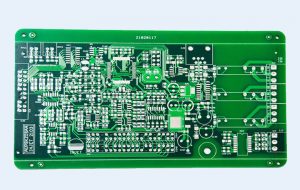
Low volume PCB manufacturing for prototype small batch and PCBA projects

Low volume PCB manufacturing is the build stage between one-off prototypes and full production. It is used when buyers need a controlled small batch for engineering validation, pilot builds, market testing, product launch, replacement parts or specialty electronics without committing to a large production run.

The right low volume PCB partner should help with DFM review, stackup confirmation, material selection, fabrication, optional PCBA, testing, packaging and repeat-order planning. The wrong partner treats the order like a quick hobby prototype and leaves the buyer to discover production risk too late.

Before ordering a low volume PCB build, check whether the supplier can support the next production step.

Low volume PCB buyers usually face a different problem from hobby prototype buyers: the board must be affordable, but it also has to be repeatable, documented and ready for the next build.

  • The first quote looks cheap, but it excludes assembly, testing, components, tooling, stencil, packaging or shipping.
  • The supplier accepts Gerber files without checking stackup, drill, solder mask, panelization or assembly risk.
  • The minimum order quantity is too high for validation but too small for a stable production process.
  • The build moves from prototype to small batch without clear BOM/CPL control.
  • The buyer cannot tell whether the same supplier can support repeat production after the pilot run.

EBest Circuit supports low volume PCB manufacturing with DFM, PCBA and production planning together.

  • We review Gerber, ODB++, drill, stackup, fabrication drawings, BOM, CPL, quantity and test requirements before quoting.
  • We help buyers confirm whether the project is a prototype, low volume build, pilot run or early production order.
  • We support PCB fabrication and PCBA coordination, including BOM/CPL checks and inspection planning when assembly is included.
  • We focus on cost control, manufacturability, quality checks and repeat-order stability instead of only a low first price.

Low Volume PCB Manufacturing in One Practical Answer

Low volume PCB manufacturing produces a small, controlled batch of printed circuit boards before or instead of mass production. It is best for engineering validation, pilot builds, market testing, specialized equipment, medical electronics, industrial controls, telecom devices, LED products and replacement or service parts.

When Is Low Volume PCB Manufacturing the Right Choice?

Choose low volume manufacturing when the design is beyond a single prototype but not ready for a large production order. This stage lets buyers verify manufacturability, assembly quality, component supply, test coverage and user feedback before scaling.

Low Volume PCB Manufacturing vs Prototype PCB Builds

A prototype proves the design can work; a low volume build proves the design can be built repeatedly. Prototype orders often prioritize speed and learning. Low volume orders need clearer documentation, stable process controls, BOM accuracy and inspection evidence.

Build Stage Typical Goal Supplier Focus
Prototype Validate design function Fast DFM feedback and quick build learning
Low volume Validate repeatability and launch readiness Stable files, controlled cost, PCBA support and test planning
Production Scale repeat orders Process consistency, procurement control and long-term quality evidence

What Buyers Should Send for a Low Volume PCB Quote

A complete RFQ package helps the supplier quote the real project, not a simplified version of the board. Send Gerber or ODB++, NC drill, stackup, fabrication drawing, quantity, material, finish and acceptance notes.

If the order includes assembly, include BOM, CPL, assembly drawing, polarity notes, test instructions, programming needs and any packaging or labeling requirements. For related early-stage planning, see the prototype PCB manufacturing RFQ guide.

How EBest Circuit Handles Low Volume PCB Projects

EBest Circuit treats low volume PCB manufacturing as a bridge from first builds to repeatable production. The RFQ review checks fabrication files, assembly scope, material needs, quantity, testing and cost assumptions together.

For fabrication-focused orders, review EBest Circuit’s PCB manufacturing capabilities. For assembled boards, use PCBA and SMT assembly support to prepare BOM/CPL files, placement data, inspection needs and test expectations.

DFM Review Before a Low Volume PCB Build

DFM review is essential because small batches often expose problems that a one-off prototype missed. Check spacing, annular ring, drill size, copper balance, solder mask, silkscreen, panelization, fiducials, stackup, material and test access.

For design-to-production handoff, the PCB design and manufacturing DFM workflow gives a practical checklist for avoiding file-release mistakes.
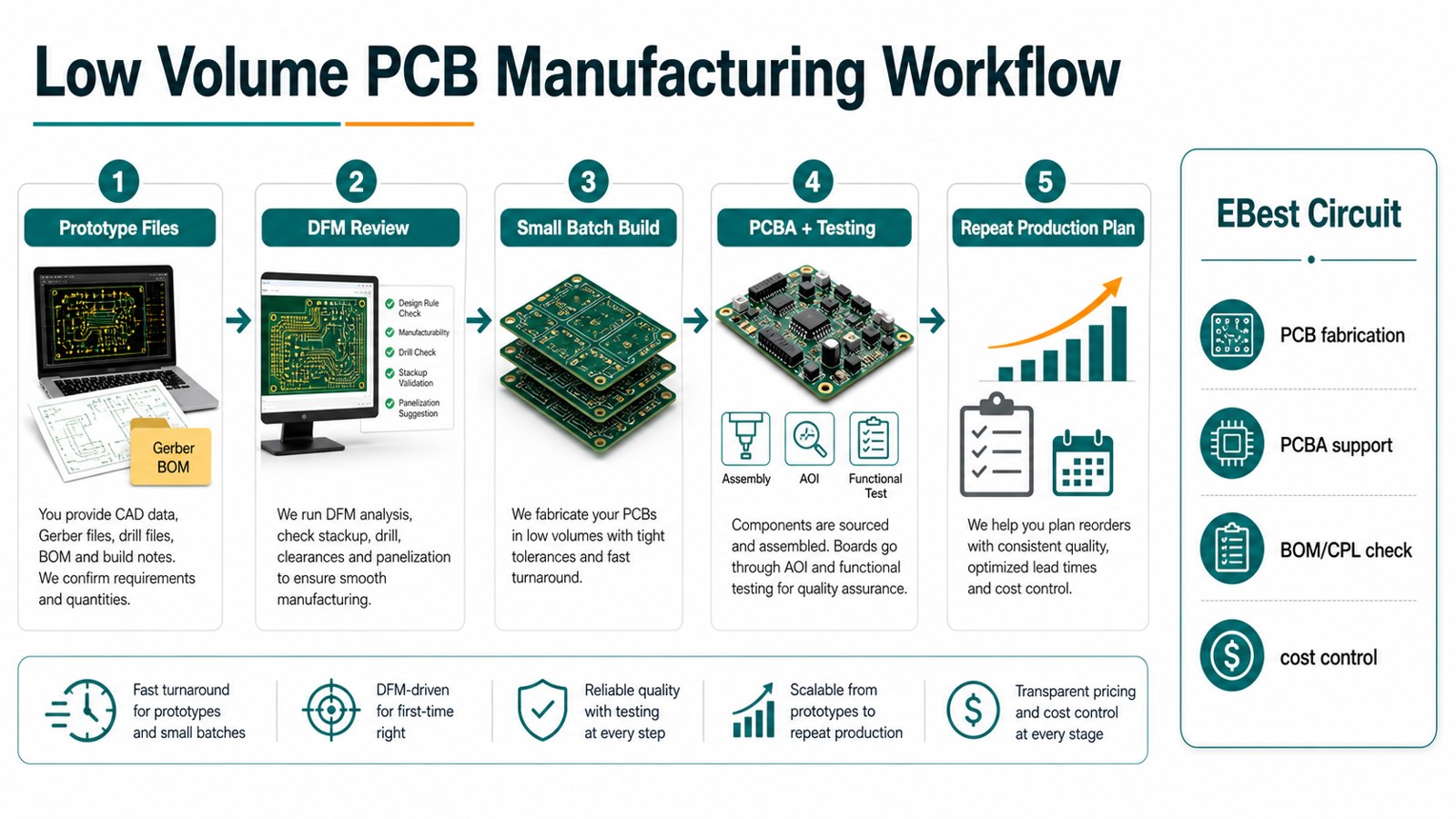
Low volume PCB manufacturing workflow from prototype files to DFM small batch PCBA testing and repeat production

PCBA Support for Low Volume Orders

Low volume PCB manufacturing often becomes a PCBA decision once components, placement, inspection and testing are included. The supplier should review BOM, CPL, assembly drawing, polarity, substituted parts, stencil needs, AOI, X-ray needs and functional test expectations.

Cost Drivers in Low Volume PCB Manufacturing

Low volume PCB cost depends on setup effort as much as unit price. Tooling, material, panelization, stencil, component sourcing, test fixtures, inspection, packaging and shipping can matter more than the bare-board price.

Cost Factor Why It Changes Price Buyer Action
Quantity Setup cost is spread across fewer units Ask for price breaks at realistic quantities
Board complexity Layer count, spacing, vias and finish affect process risk Request DFM feedback before approval
Assembly BOM sourcing, placement, inspection and test add cost Send BOM/CPL early
Testing Functional or fixture testing may need preparation Define acceptance criteria
Repeat orders Stable files can reduce future cost and delay Control revisions and documentation

MOQ, Lead Time and Repeat Production Planning

The best low volume supplier should explain MOQ and lead time by build stage. A buyer may need 10 boards for validation, 50 for a pilot run and 200 for launch inventory. The supplier should help plan these steps without forcing an oversized first order.

For cost-focused supplier checks, see the cheap PCB manufacturing cost and quality checklist.

Quality Checks for Low Volume PCB and PCBA

Quality checks should match the board type and order risk. Bare boards may need electrical test and visual inspection. Assemblies may need AOI, X-ray for hidden solder joints, programming, first article review and functional testing.

Common Low Volume PCB Sourcing Mistakes

The biggest mistake is comparing suppliers only by the first visible unit price. A low quote can become expensive if the supplier cannot support DFM feedback, BOM control, PCBA testing, repeat orders or clear delivery planning.

Low Volume PCB Manufacturing FAQ

What is low volume PCB manufacturing?
It is a controlled small-batch PCB build used after prototypes or for specialty products that do not require mass production.

Is low volume PCB manufacturing the same as prototype PCB manufacturing?
No. Prototype builds focus on learning and validation. Low volume builds focus on repeatability, documentation, PCBA readiness, quality checks and launch planning.

What files are needed for a low volume PCB quote?
Send Gerber or ODB++, drill files, fabrication drawing, stackup, quantity, material and surface finish. For PCBA, also send BOM, CPL, assembly drawing and test notes.

Can EBest Circuit support low volume PCB assembly?
Yes. EBest Circuit can review fabrication files, BOM, CPL, DFM risk, assembly scope, testing and repeat-order planning for low volume PCB and PCBA projects.

Final RFQ Recommendation

Choose a low volume PCB manufacturer that can help you move from prototype learning to repeatable production. The right supplier gives clear DFM feedback, understands PCBA scope, explains cost and MOQ, and prepares the build for the next order.

Send your Gerber or ODB++, drill files, fabrication drawing, BOM, CPL, quantity, materials, surface finish, testing requirements and target delivery plan to sales@bestpcbs.com. EBest Circuit can review your low volume PCB manufacturing requirements and provide a practical quotation path for PCB fabrication, PCBA and small-batch production.

You may also like

Low Volume PCB Manufacturing Quote Checklist
Wednesday, July 15th, 2026
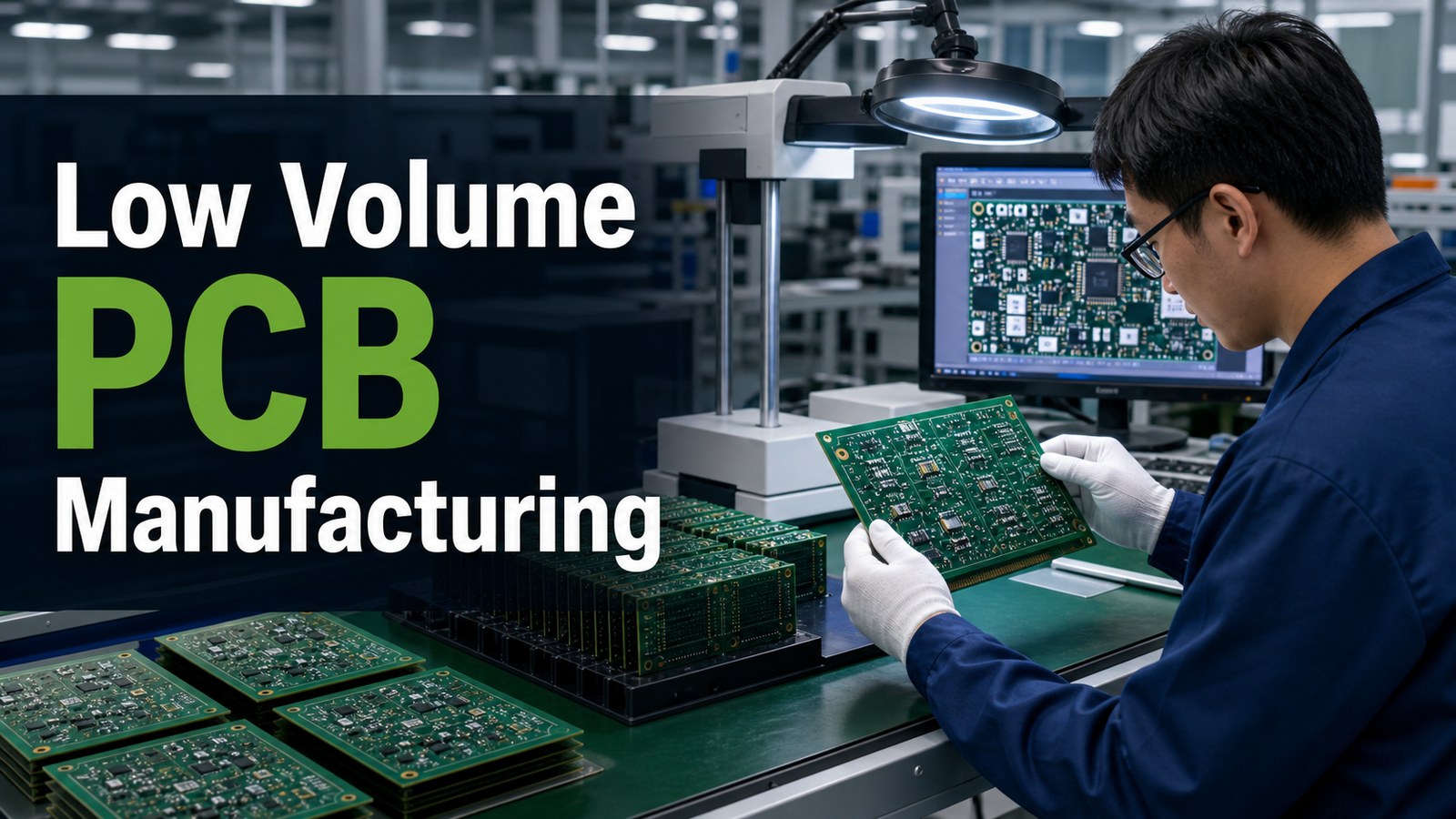
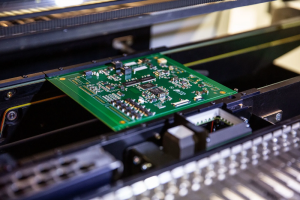
Low volume PCB manufacturing and inspection for small batch boards

Low volume PCB manufacturing is the controlled production of small batches of printed circuit boards for prototypes, engineering validation, pilot runs, service parts, or early product launch. The goal is not only to make a few boards cheaply. The goal is to catch design, material, assembly, and testing risks before the project moves into larger production.

This guide is for engineers and buyers preparing a low-volume PCB order. It explains how to decide quantity, what affects price, what files to send, how to reduce rework, and how to compare suppliers when the build needs both flexibility and manufacturing discipline.

Low Volume PCB Manufacturing at a Glance

A low-volume PCB manufacturing order should combine fast engineering feedback with enough process control to support the next build. Small quantity does not mean the board can skip DFM review, material confirmation, or inspection planning.

Use case Typical goal Buyer focus
Prototype Validate circuit and layout Fast DFM feedback, clear file review, basic testing.
Pilot run Prepare for production Repeatability, assembly planning, BOM risk, inspection.
Service or niche product Build limited demand boards Stable quality, cost control, revision tracking.

When Low Volume Manufacturing Makes Sense

Low volume manufacturing makes sense when you need real boards for testing, customer samples, pilot production, or controlled market launch before committing to higher quantities. It is also useful for industrial equipment, replacement boards, custom electronics, and product variants where demand is limited but reliability still matters.

Choose low volume when the design may still change, when component availability is uncertain, or when the product needs field feedback before scaling. If the board includes mounted components, coordinate the fabrication plan with the PCBA and PCB assembly service requirements early.

Low Volume PCB vs Prototype PCB

A prototype PCB proves a design concept, while a low-volume PCB build should also prepare the project for repeatable production. The two can overlap, but the buyer expectations are different.

Prototype orders often prioritize speed and design learning. Low-volume orders also need revision control, stable material choices, packaging requirements, BOM review, test expectations, and cost visibility for the next production step. Treat the low-volume build as a bridge between engineering and supply-chain decisions.

DFM Review Before Small Batch Production

DFM review is still important in low-volume PCB manufacturing because a small batch can expose problems before they become expensive at scale. Do not skip review simply because the order quantity is low.

Review trace and spacing, annular ring, drill files, solder mask clearances, board outline, panelization, copper balance, component clearance, test point access, and any special process notes. The PCB design for manufacturability checklist can help your team prepare design files before requesting a quote.

What Affects Low Volume PCB Cost?

Low volume PCB cost depends on setup effort, board complexity, material, finish, testing, assembly needs, and how many assumptions the supplier must resolve before production. Unit price can look high because setup and engineering review are spread across fewer boards.

Cost factor Why it matters How to manage it
Quantity Setup cost is divided across fewer boards. Ask for price breaks at practical quantity points.
Complexity Small holes, dense routing, multilayer stackups, and special finishes add process work. Send complete design notes and accept manufacturable alternatives when possible.
Assembly BOM sourcing, setup, placement, and inspection add cost. Provide BOM, CPL, alternates, and test requirements early.
Testing Functional tests or fixtures can cost more than the boards in small runs. Define must-test items and optional checks separately.

Board Specifications to Confirm Before Quoting

Confirm the board specifications before quoting so suppliers compare the same build instead of quoting different assumptions. The most common missing details are finished thickness, copper weight, material, surface finish, impedance, and special drill or slot requirements.

For low-volume orders, it is often better to state “target” requirements and ask for engineering confirmation than to leave fields blank. This keeps the quote useful while still allowing the manufacturer to flag better options.

Assembly and Component Sourcing for Low Volume Builds

Low-volume PCBA projects need extra attention to BOM availability, substitutions, package fit, CPL accuracy, and inspection method. A small run can be delayed by a single unavailable component or a mismatch between BOM and footprint.

Send the BOM, CPL, assembly drawing, polarity notes, and approved substitution rules. If supplier sourcing is needed, clarify who approves alternates and whether partial kits or customer-supplied parts are allowed. See component sourcing support for the supply-chain side of a PCBA build.

Testing and Quality Control for Small Batches

Testing for low-volume PCB manufacturing should match the risk of the board, not just the quantity ordered. A small batch used in field equipment may need more careful inspection than a larger batch used for a simple fixture.

Define whether you need bare-board electrical test, AOI, X-ray for hidden solder joints, dimensional checks, functional testing, firmware loading, or customer-defined acceptance criteria. If functional testing needs special fixtures or software, provide those requirements before the quote.

Lead Time and Schedule Risks

Low-volume schedule risk usually comes from incomplete files, unresolved DFM questions, material availability, BOM shortages, and unclear test requirements. A supplier can only move quickly when the technical package is complete enough to start.

Send the latest revision, identify which details are fixed, and separate urgent needs from negotiable preferences. If the order is tied to an engineering milestone, say which date matters most: bare board delivery, assembled samples, test completion, or shipment.

How to Compare Low Volume PCB Suppliers

Compare low-volume suppliers by engineering response quality, quote clarity, assembly support, and ability to handle changes without losing traceability. The lowest initial price is not useful if the quote hides missing files, weak BOM assumptions, or unclear test scope.

  • Does the supplier ask DFM questions before production?
  • Can they support both bare boards and assembly when needed?
  • Do they explain cost drivers and quantity price breaks?
  • Can they manage BOM alternates and customer approvals?
  • Do they document revision, packaging, inspection, and test requirements?

RFQ Checklist for Low Volume PCB Manufacturing

A complete RFQ package helps the supplier quote the build you actually need, not a simplified version that changes later. For low-volume orders, clarity is especially valuable because every extra communication loop can consume the schedule.

  • Gerber or ODB++ files, drill data, and board outline
  • Stackup, material, copper weight, surface finish, and impedance notes
  • Quantity options and target delivery date
  • BOM, CPL, assembly drawing, and approved alternates for PCBA
  • Inspection, functional test, programming, packaging, and labeling requirements

If you want to organize files before uploading or emailing them, the PCB manufacturer online guide gives a practical RFQ preparation path.

Common Low Volume PCB Manufacturing Mistakes

The most common mistakes are treating a low-volume order as a throwaway prototype, hiding unfinished requirements, comparing incomplete quotes, and postponing assembly or test questions. These mistakes usually cause quote revisions, delivery delays, or rework.

Be clear about what the build must prove. If the goal is electrical validation, say so. If the goal is pilot production, ask for repeatability and inspection planning. If the goal is customer samples, include packaging, labeling, and cosmetic requirements.

Frequently Asked Questions About Low Volume PCB Manufacturing

What is considered low volume PCB manufacturing?

Low volume generally means a small production quantity used for prototypes, pilot runs, service parts, engineering validation, or limited product demand. The exact quantity depends on project type and supplier setup.

Is low volume PCB manufacturing more expensive per board?

Usually yes, because setup, engineering review, tooling, testing, and communication effort are divided across fewer boards. A higher unit price can still be cost-effective if it prevents production mistakes.

Can low volume PCB orders include assembly?

Yes. Low-volume PCBA can include component sourcing, SMT, through-hole assembly, inspection, testing, and packaging when BOM, CPL, drawings, and test requirements are provided.

How can I reduce low volume PCB quote delays?

Send complete fabrication and assembly files, define quantity options, state material and finish needs, provide approved component alternates, and separate must-have requirements from flexible preferences.

Final RFQ Recommendation

For low volume PCB manufacturing, the best quote is the one based on complete files, clear assumptions, and the right level of quality control for the next project stage. Prepare the order as a serious engineering build even when the quantity is small.

For a low-volume PCB or PCBA quotation, send Gerber or ODB++ files, drill data, stackup notes, BOM, CPL, drawings, quantity options, material expectations, surface finish, testing requirements, and target lead time to sales@bestpcbs.com. The Best Technology / bestpcbs team can review the files, identify missing details, and help you move from prototype or pilot build toward a more stable production plan.

You may also like

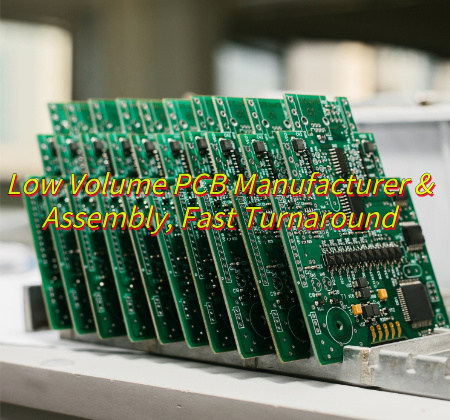
Low Volume PCB Manufacturer & Assembly, Fast Turnaround
Thursday, September 18th, 2025

Why choose low volume PCB? Let’s explore meaning, benefits, applications, manufacturing and assembly processes, delivery time for low volume PCB.

Are you troubled with these problems?

  • Waiting 48hours for a quote?
  • Forced to order 10pcs when you need 2?
  • Found silent tweaks in your Gerber files?

As a low volume PCB manufacturer, EBest Circuit (Best Technology) can provide you service and solution:

  • Dedicated Project Ally – A single technical contact handles all needs 24/7, eliminating supplier runarounds.
  • Order Just 1 Board – Pay only for materials used ($0 setup fees), with real-time cost breakdowns.
  • Pre-Production DFM Analysis – Get actionable feedback within 12hrs. Your design intent stays uncompromised.

Welcome to contact us if you have any request for low volume PCB: sales@bestpcbs.com.

What Does Low Volume PCB Mean?

Low Volume PCB refers to a production model with single-order quantities typically ranging from 5 to 500 pieces, providing highly flexible manufacturing services for product R&D, prototype validation, and small-scale trial production. Unlike traditional mass production, it removes high mold fees and minimum order quantity restrictions, enabling rapid design iteration (e.g., design modifications within 48 hours), multi-process compatibility (e.g., high-frequency materials/HDI blind vias), and complex technical verification (e.g., ±5% impedance control).

What Does Low Volume PCB Mean?

Why Choose Low Volume PCBs?

Advantages of Low volume PCBs:

Lower upfront investment

  • Avoid high tooling costs and material deposits.
  • Ideal for limited R&D/startup budgets.

Faster design iteration

  • Receive prototypes in 72 hours (vs. weeks for traditional manufacturing).
  • Rapidly test and refine designs.

Flexibility for special requirements

  • Support niche materials (ceramic/flex PCBs).
  • Accept customer-supplied components.

Enhanced quality control

  • 100% manual inspection per board.
  • Catch flaws before mass production.

Seamless market testing

  • Launch pilot batches (100-500 units) for user validation.
  • Customize labels/certifications per region.
Why Choose Low Volume PCBs?

When to Choose Low Volume PCB Board?

Applications of low volume PCB board:

  • Smart Wearable Devices: Smart Watch, AR/VR Glasses.
  • Medical Devices: Portable Monitor, High-Precision Surgical Instruments.
  • Industrial Control Systems: PLC Controller, Industrial Robot Core Board.
  • New Energy Vehicle BMS: Battery Management System.
  • IoT Terminals: Smart Meters, Environmental Monitoring Nodes.
  • Aerospace Special Circuit Boards: Satellite Control Modules, Radar Systems.
  • Consumer Electronics: Robotic Vacuum Cleaners, Smart Door Locks.

Low-Volume PCB Manufacturing Processes

1. Material Cutting: Large-size copper-clad laminates are cut to design dimensions, supporting small-batch multi-variety production and minimizing material waste.

2. Drilling: CNC drilling machine creates through-holes/blind vias/buried vias with ±0.05mm hole position accuracy.

3. Hole Metallization: Chemical copper deposition + electroplating forms conductive layers for multi-layer board interlayer electrical interconnection.

4. Dry Film Lamination: Photosensitive dry film is applied to the board surface as a mask base for pattern transfer.

5. Pattern Exposure: UV exposure machine transfers Gerber file patterns to dry film, forming resist patterns.

6. Pattern Etching: Alkaline etching solution removes unprotected copper to form precise circuit patterns
Solder

7. Mask Printing: Liquid photosensitive solder mask ink is applied and developed to form a permanent protective layer.

8. Surface Finish: Immersion gold/OSP/ENIG and other processes enhance soldering reliability and corrosion resistance.

9. Profile Machining: CNC milling/laser cutting enables rapid shaping of irregular-shaped boards.

10. Electrical Testing: Flying probe/fixture testing completes 100% electrical performance verification, ensuring no shorts/opens.

11. Final Inspection: Manual visual inspection + AOI optical inspection double-verify appearance and dimensional compliance.

12. Packaging & Shipping: Anti-static vacuum packaging + anti-vibration cushioning materials, customized labels with batch/serial numbers, integrated logistics tracking system for full traceability

Low-Volume PCB Manufacturing Processes

Low Volume PCB Assembly Processes

1. Component Preparation: Sorting and inspecting SMD/DIP components per BOM list, supporting small-batch multi-variety needs with rapid material switching capabilities.

2. Solder Paste Printing: High-precision stencil printing with ±0.02mm thickness control for uniform solder pad coverage.

3. SMD Placement: Modular pick-and-place machines enable high-speed precision mounting of micro-components (01005 chips, BGA packages).

4. Reflow Soldering: 10-zone nitrogen reflow oven achieves lead-free soldering with ±1°C temperature precision for reliable joints.

5. Through-Hole Assembly: Manual/automated insertion machines handle through-hole components, accommodating irregular shapes and precision placement.

6. Selective Soldering: Localized wave/selective soldering for through-hole parts minimizes thermal stress while ensuring consistent joint quality.

7. Functional Testing: ICT/FCT systems validate electrical performance, complemented by AOI/X-ray inspection for micro-defect detection.

8. Conformal Coating: Acrylic/silicone spray applied per requirements to enhance moisture/dust/corrosion resistance.

9. Packaging & Shipping: Custom anti-static packaging with cushioning materials, integrated logistics tracking for secure and traceable delivery.

Low Volume PCB Assembly Processes

Why Choose EBest Circuit (Best Technology) as Low Volume PCB Manufacturer?

Reasons why choose us as low volume PCB manufacturer:

  • One-Stop Solution: Full-link service covering PCB design to assembly, eliminating the need for clients to coordinate with multiple suppliers. Reduces R&D cycle by over 30% and lowers cross-department communication costs.
  • Free DFM Design Optimization: 19-year experienced engineering team provides Design for Manufacturing (DFM) analysis to identify design flaws early, minimize subsequent modification costs, improve first-board success rate by 40%, and avoid rework losses in mass production.
  • 19 Years of Experience Accumulation: Focused on low-volume PCB production, serving over 2,000 clients. Rich process database enables rapid adaptation to complex process requirements, ensuring enhanced production efficiency and yield.
  • Four-Layer Quality Control System: Incoming material inspection, in-process patrol inspection, 100% final product inspection, and reliability testing. Achieves full batch inspection with defect rate below 0.3%, significantly outperforming industry averages and ensuring product reliability.
  • Dynamic Cost Optimization Solutions: Customized cost-reduction strategies based on client budgets, including material substitution, process adjustments, and batch pooling. Reduces costs by 15%-30% while maintaining quality, maximizing cost-effectiveness.
  • 24-Hour Rapid Prototyping: 24-hour expedited prototyping for double-sided boards, 3-day delivery for 4-6 layer boards, 50% faster than conventional timelines. Accelerates design validation and market entry.
  • Flexible Production Scheduling: Dedicated production lines support small-batch orders starting at 50 pieces. Intelligent scheduling system enables rapid line changes (under 2 hours), flexibly accommodating multi-version and multi-batch production needs.
  • Professional Assembly Support: Comprehensive assembly services including SMT placement, DIP insertion, and conformal coating. Combined with precise soldering temperature curve control and solder joint inspection, ensures component assembly accuracy of ±0.025mm and stable electrical performance.

    Our Low Volume PCB Lead Time

    Lead time for 1-50 pieces

    LayersNormal ServiceFastest Service
    17 Days24 H
    28 Days24 H
    410 Days48 H
    610 Days72 H
    812 Days72 H
    ≥10TBDTBD

    Lead time for 50-500 pieces

    LayersNormal ServiceExpedited Service
    14-6 Days2-3 Days
    25-8 Days2-3 Days
    48-12 Days3-5 Days
    68-12 Days4-6 Days
    812-16 Days6-8 Days
    ≥1018-20 DaysTBD

    How to Get a Quote for Low Volume PCB Project?

    Essential Quote Submission Checklist for Low Volume PCB Projects

    • Design Data: Complete Gerber files (274X, NC Drill) with layer-specific details (dimensions, copper thickness, via specs).
    • BOM: Detailed component list with part numbers, manufacturers, quantities, and critical component flags.
    • Technical Specs: PCB layer count, material type (e.g., FR4, high-Tg), surface finish (ENIG/HASL/OSP), impedance targets, and special processes (HDI, blind vias).
    • Quantity & Timeline: Annual/batch volume and required delivery dates (prototypes to mass production).
    • Quality Standards: IPC-A-600/A-610 compliance, reliability tests (thermal cycling, vibration), and certifications (RoHS, UL).
    • Assembly Needs (If Applicable): SMT/DIP specs, solder paste type, test protocols (ICT/FCT), and coating requirements.

    Welcome to contact us if you have any inquiry for low volume PCB design, manufacturing, assembly: sales@bestpcbs.com.

    You may also like