

A CAF test report supports a PCB decision only when its specimen, geometry, stress conditions and failure rule match the question being asked. “Passed 1,000 hours” is not enough on its own. First identify what was tested and how a failure would have been recognized; then decide whether the evidence applies to your construction.
This guide explains the test principle, compares neighboring insulation tests and provides a worked report-review method. Numerical report rows below are invented examples, not EBest Circuit measurements or a customer qualification. Testing should be performed by a suitably equipped laboratory under a controlled plan, not improvised by applying voltage to an assembled product.
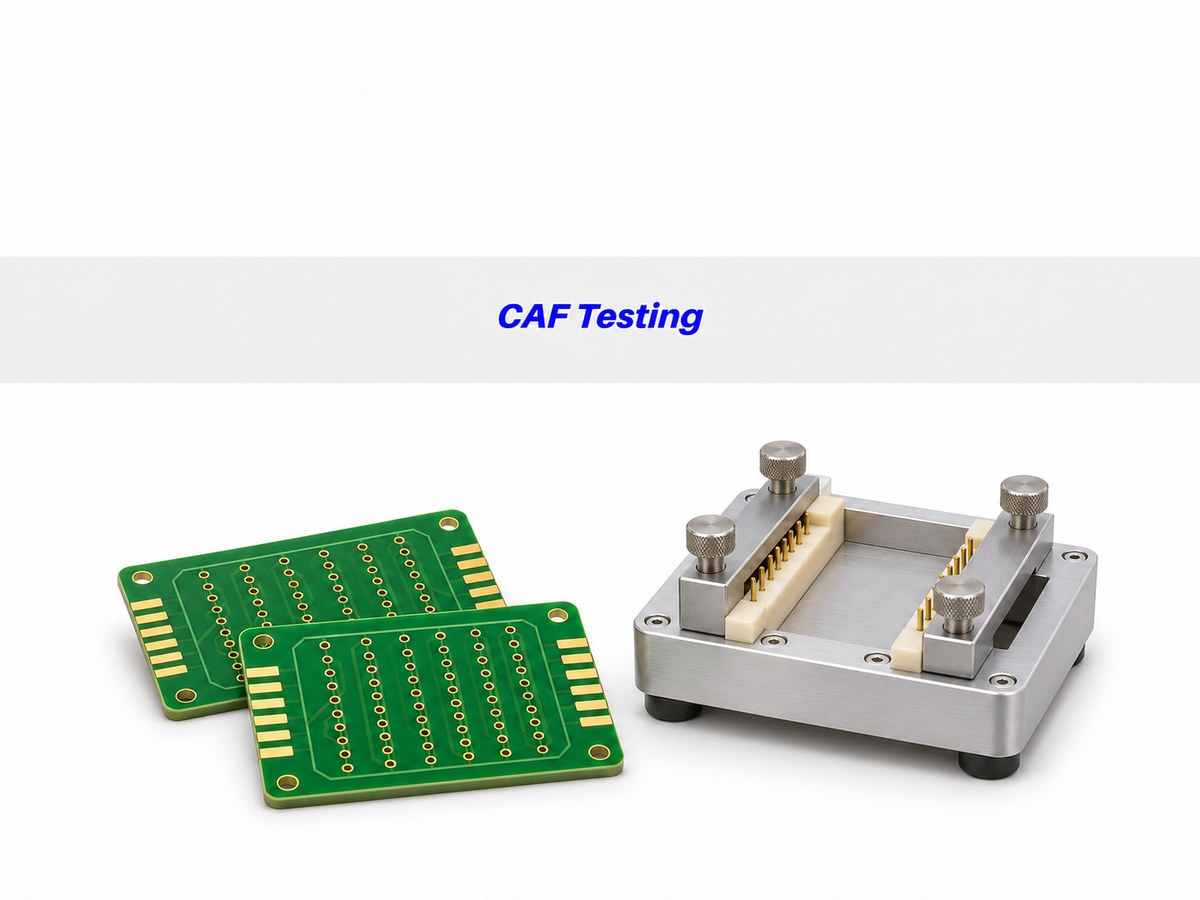
What Is a CAF Test, and What Is the Working Principle?
Conductive anodic filament formation is an electrochemical failure mechanism inside a susceptible dielectric construction. Moisture, electrical bias and a suitable internal path can allow conductive growth to reduce insulation resistance. The test evaluates the construction under specified conditions while tracking electrical behavior over time.
The official IPC-TM-650 method 2.6.25C, dated February 2021, addresses X-Y CAF resistance. Its existence does not mean that every test called “CAF” used that revision or that every product has the same acceptance requirements. Record the agreed method and deviations.
The useful output is more than a final resistance. The history shows when behavior changed and whether the change coincided with a chamber event, measurement switch or process interruption. Physical examination is then needed to support a failure-mechanism conclusion. A low reading alone is evidence of an electrical problem, not a complete diagnosis of its origin.
CAF Test vs SIR vs Dielectric Withstand Test
These tests ask different questions. Choose the test that can reveal the risk rather than selecting the most severe-looking voltage or the longest duration. Passing one does not automatically satisfy the others.
| Evaluation | Primary question | What the result does not automatically prove |
|---|---|---|
| CAF resistance evaluation | Does the tested internal construction resist the defined biased environmental stress? | All surface contamination behavior, every geometry or field lifetime |
| Surface insulation resistance evaluation | How does the defined surface pattern behave under its test conditions? | The internal glass/resin path represented by a different CAF specimen |
| Dielectric withstand evaluation | Can the specified insulation withstand the defined electrical stress? | Long-duration electrochemical behavior in a different humidity and bias environment |
For an unexplained leakage issue, begin by defining the suspected path: internal, surface, connector, cable or fixture. The answer determines the relevant specimen and controls. “Insulation test passed” is too broad a statement to close the investigation. Likewise, an SPDR laminate report characterizes a different material question; dielectric-property data do not substitute for CAF evidence.
CAF Test Conditions: Which Parameters Must Be in the Report?
Keep the specimen identity, material construction, conductor geometry, preconditioning, temperature, humidity, bias, measurement schedule and failure definition together. If one is missing, the headline duration cannot be interpreted confidently. A material name alone does not describe the manufacturing process or the finished dielectric path.
| Record group | Evidence needed | Decision it supports |
|---|---|---|
| Specimen and construction | Coupon revision, laminate system, layer structure, fabrication identity and sampled lot | Whether the tested article represents the proposed board |
| Geometry and conditioning | Measured or controlled spacing, path type, orientation and prior thermal exposure | Whether two results can be compared |
| Stress and measurement | Actual chamber/bias records, interruptions, instrument and fixture checks | Whether the electrical history is valid |
| Analysis and disposition | Baseline, criterion, individual results, failure evidence and approved exclusions | What may be accepted, held or investigated |
Do not compare two “1,000-hour passes” if one used a different stress, spacing or thermal history. Also separate the specified chamber setting from the actual record. An unreported interruption can make apparently continuous test hours misleading. The cited method notes that a 5% relative-humidity difference can change measured resistance by 0.5–1.0 decade; environmental records are therefore part of interpreting the electrical result, not administrative detail.
CAF Test Spacing: Why Hole Size and Fiber Direction Matter
The electrical path is influenced by the physical conductor boundaries, not merely their center-to-center pitch. For two holes, pitch alone does not establish the dielectric distance between the relevant walls. A change of drilled diameter can change that separation without moving either center.
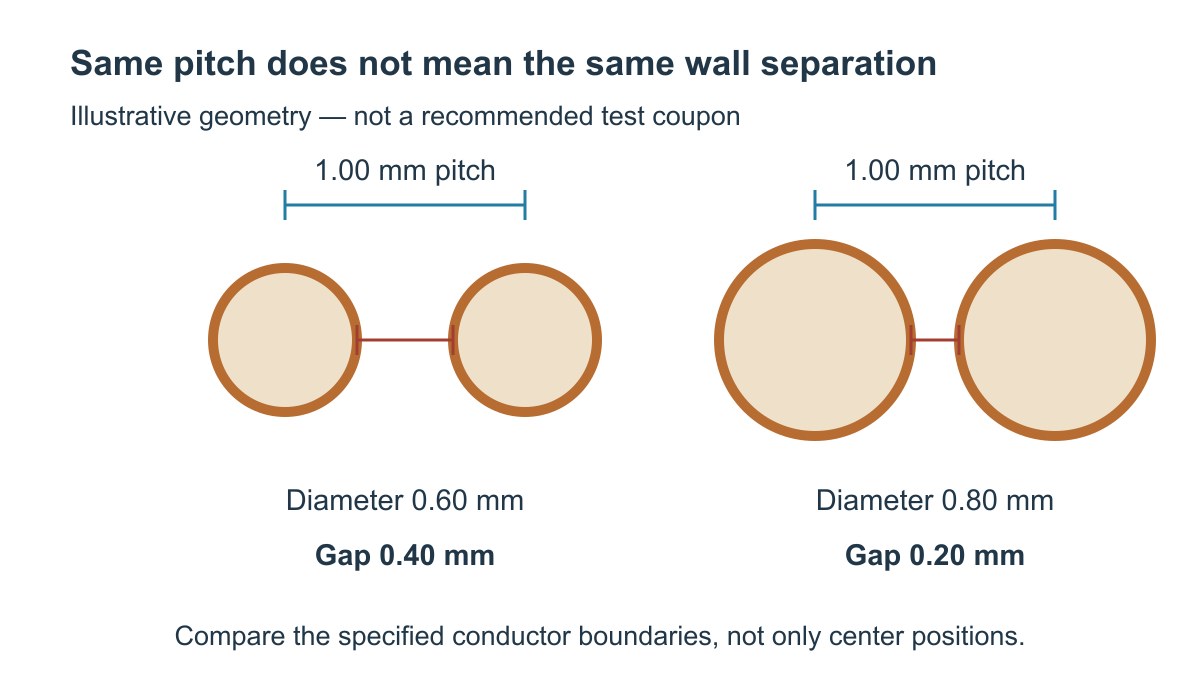
For a purely geometric example with equal diameters, wall separation is pitch minus diameter. At an assumed 1.00 mm pitch, a 0.60 mm diameter leaves 0.40 mm, while a 0.80 mm diameter leaves 0.20 mm. These are illustrative dimensions, not minimum clearances or approved CAF designs.
Orientation and construction also need to remain controlled when comparing results. A diagonal path through a woven structure is not necessarily represented by a result from an aligned path. Ask the laboratory to show the specimen drawing and measurement boundary rather than reducing the whole geometry to one unlabeled “spacing” number.
CAF Resistance Calculation: Read the Change, Not Only the Final Ohms
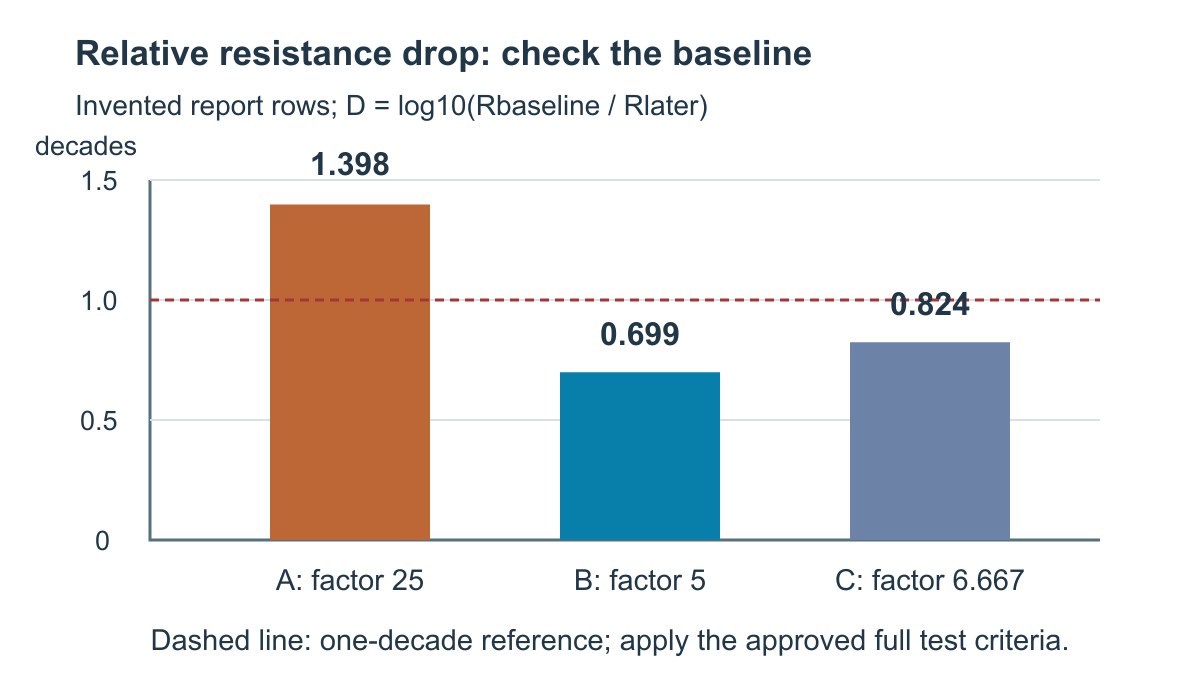
A decade is a factor of ten on a logarithmic scale. In the cited method’s stated non-lognormal analysis route, a drop of more than one decade is a failure criterion. The cited baseline relates to the 96-hour stabilization measurement, with the averaging definitions specified in the method. Apply the controlled baseline and agreed plan, not an arbitrary day-zero reading.
For the following hypothetical rows, assume the approved baseline values are already established. Define the drop as D = log10(Rbaseline/Rlater). A ratio of 25 gives D = 1.398 decades; a ratio of five gives D = 0.699. This arithmetic explains the comparison; it is not a complete implementation of the standard.
| Invented report row | Resistance and calculated drop | Interpretation under stated rules |
|---|---|---|
| A | 200 GΩ → 8 GΩ; factor 25; 1.398 decades | Exceeds a one-decade drop; investigate and apply the approved disposition. |
| B | 40 GΩ → 8 GΩ; factor 5; 0.699 decades | Does not exceed that relative criterion; may still fail a separate product requirement. |
| C | 200 GΩ → 30 GΩ; factor 6.667; 0.824 decades | Does not exceed that relative criterion; review all other required evidence. |
A and B finish at the same resistance but have different relative changes. That is why “final R = 8 GΩ” cannot replace the baseline and analysis rule. At an illustrative 100 V, 8 GΩ corresponds to 12.5 nA by Ohm’s law, while 200 GΩ corresponds to 0.5 nA. These are measurement-scale examples, not recommended test voltages.
CAF Test Failures: First Exclude the Measurement Path
A high-resistance measurement can be limited by fixture, wiring or surface leakage. For an idealized parallel example, a 100 GΩ specimen with a 10 GΩ unwanted fixture path reads 1/(1/100 + 1/10) = 9.09 GΩ. The instrument does not know which path carried the current unless the setup provides evidence to distinguish them.
Have the laboratory check suitable fixture controls and channel behavior under the same relevant environmental conditions. A dry-room fixture check cannot automatically establish performance in a humid chamber. Compare raw channel data with chamber events and control specimens before assigning the change to the laminate.
Then distinguish surface effects from internal damage and inspect the suspect location. The IPC method notes that CAF filaments can be small and easily disrupted during investigation. Failure analysis should preserve the evidence and document why another cause is accepted or excluded. An exclusion needs a reason and traceable approval; it must not be a convenient way to remove bad numbers.
CAF-Resistant Material vs Qualified PCB Construction
A material supplier’s CAF claim is useful evidence, but it is not qualification of every board made from that material. Drilling, preparation, construction and subsequent thermal exposure can change the relevant path. Evaluate the material and the manufacturing combination rather than treating the label as a finished-board certificate.
For example, Isola’s public IS550H announcement reports CAF performance at 1,500 V for 1,000 hours. That headline does not provide every specimen and process detail needed to rank it against another report. Ask for comparable conditions before concluding that one material or supplier is better.
A defensible material comparison uses matched geometries, conditioning, bias, environment, sample population and analysis. If the reports differ, mark the result “not directly comparable” and identify the missing experiment. Do not invent a numerical conversion from test hours to years in service.
CAF Testing Applications: What Decision Can the Evidence Support?
Dense via fields. The task is to assess whether the intended conductor arrangement and construction are represented by the coupon. Review the actual boundaries, orientation and relevant manufacturing process. A wider-spaced generic coupon may not answer the design’s tighter-spacing question.
Material or process changes. Compare the proposed change against a controlled baseline while holding unrelated conditions as constant as practical. If a laminate change also introduces a new drill process and assembly history, a different result cannot be attributed confidently to resin chemistry alone.
High-voltage or humid-environment boards. Establish application-relevant requirements with the responsible reliability and safety teams. A CAF result is one part of evidence; it does not replace the applicable insulation coordination, dielectric, environmental or product-safety assessment. Keep the product’s moisture and condensation controls in that wider review. Do not energize a field product to reproduce a laboratory test.
Supplier qualification. Require the tested facility, construction and lot evidence to match the scope of approval. A historical report from an unidentified factory is weak support for a new process. Use the result to approve a defined scope or request missing evidence, not as a blanket quality slogan.
CAF Test Report Checklist: When Should Approval Stop?
Stop approval when the report cannot be linked to the specimen, when the baseline or criterion is unclear, when required stress records are missing or when exclusions lack evidence. Request the missing information before using the word “qualified.” A clear limitation is more useful than an unsupported pass.
Use row B from the calculation table as a review exercise. Ask which relative rule was applied, whether a separate absolute product limit exists and what raw data support the result. The correct answer may be “no relative failure under this rule, but the product requirement is not met.” That is a real engineering distinction, not a contradiction.
Also review sample size and dependence. If a hypothetical test had zero failures in 25 independent, identically stressed coupons, the one-sided 95% binomial upper bound on the per-coupon failure probability is 1 − 0.051/25 ≈ 11.29%. This does not estimate field failure rate. Many potential sites on one coupon do not automatically create that many independent samples.
Record the final decision as approve, limited-scope approve, hold for evidence or investigate. State what construction and conditions the decision covers and what change would trigger review. That makes the report a usable release tool rather than a PDF filed after the purchase decision.
CAF Test FAQs
Does a falling insulation resistance prove CAF?
No. Investigate fixture, surface and other paths before confirming the internal mechanism. Preserve physical evidence and document the analysis.
Is a 1,000-hour pass enough to compare two laminates?
Not without comparable geometry, stress, conditioning, sample population and failure rules. Equal duration does not mean equal severity or evidence.
What does a one-decade resistance drop mean?
A factor-of-ten reduction. Use the approved baseline and exact method criterion; do not confuse a relative drop with an absolute product limit.
Can two samples with the same final resistance have different results?
Yes. The invented A and B rows both end at 8 GΩ, but their drops are factors of 25 and five. Additional product criteria may affect both.
Does CAF resistance replace dielectric withstand testing?
No. The tests investigate different aspects of insulation performance. Select the required evaluations for the product and application.
Does CAF-resistant laminate guarantee the finished PCB?
No. The construction and manufacturing history need evidence within the intended approval scope.
Do zero failures prove zero risk?
No. Sample size, duration, conditions and dependence limit the conclusion. Do not turn laboratory survival into an unsupported service-life prediction.
What should accompany a CAF report request?
Provide the intended construction, application requirements, controlled specimen definition and the decision the evidence must support. Ask the laboratory to identify the method revision, analysis and report limitations.
Technical References
- IPC-TM-650 2.6.25C, February 2021: X-Y CAF resistance test; analysis and reporting in sections 5.3–5.5
- Isola IS550H material announcement: example of a material-level CAF claim
Custom Multilayer PCBs and PCBA: Define the Reliability Scope Before Ordering
Order a controlled construction, not an undefined reliability promise. Send EBest Circuit your fabrication files, stackup, material requirements, quantities and required qualification or acceptance evidence. Ask the manufacturing quotation to identify the proposed build scope and any requirements needing confirmation. For an automotive HDI project, review the automotive HDI PCB manufacturing enquiry scope separately from the CAF qualification plan.
Email sales@bestpcbs.com with your controlled package and requested delivery date. If CAF evidence is required, state the applicable plan and report scope explicitly. This article is not a claim that EBest Circuit owns a CAF laboratory, offers the test described or guarantees every laminate and geometry without evaluation.