





What is PCB epoxy, and why is it used in so many electronic products? From FR-4 substrates and protective coatings to encapsulation compounds and adhesives, PCB epoxy plays a critical role in improving electrical insulation, mechanical stability, and environmental resistance.
Because different epoxy materials are designed for different applications, understanding their properties and performance is essential. In this guide, you’ll learn about the main types of PCB epoxy, their performance characteristics, common applications, and factors that affect long-term PCB reliability.
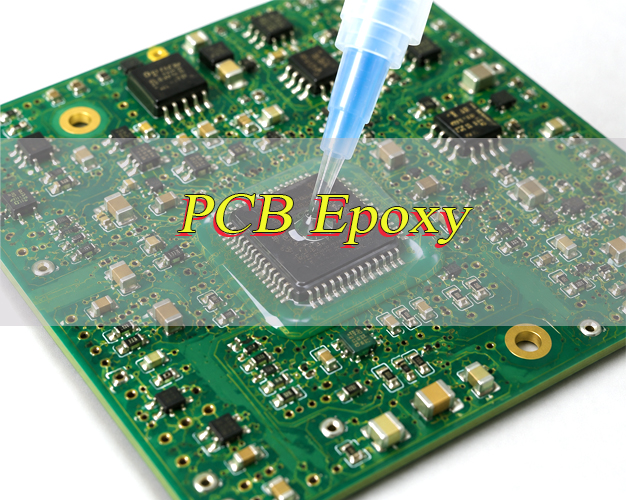
What is Epoxy in PCB?
Epoxy is a thermosetting polymer widely used throughout PCB manufacturing and assembly processes. Once cured, it forms a durable material that provides electrical insulation, mechanical support, and environmental protection.
The most common example is FR-4, where epoxy resin is combined with fiberglass cloth to create a rigid substrate capable of supporting copper circuitry while maintaining excellent insulation properties.
In addition to PCB substrates, epoxy is also used as an adhesive, coating, encapsulation compound, and staking material. These applications help protect assemblies from moisture, vibration, dust, and chemicals.
Because of its excellent insulation, adhesion, and durability, epoxy remains one of the most important materials used in modern PCB manufacturing.
Why Use Epoxy on PCB?
Uppercase PCB needs stable structural protection and electrical insulation support in production and service. PCB epoxy is the most mainstream auxiliary material to meet these demands. It can solve common problems such as circuit short circuit, structural looseness and environmental corrosion in PCB operation, and improve the overall stability of circuit boards. Here are reasons why use epoxy on PCB:
- Excellent insulation performance: Cured PCB epoxy forms a dense insulating layer on PCB surfaces and gaps. It effectively isolates circuits and prevents short circuit faults caused by circuit contact. It also avoids current leakage and ensures safe operation of electronic circuits.
- Strong structural bonding effect: This material can bond copper foil, glass fiber substrates and electronic components firmly. It fixes loose parts of the PCB and enhances the overall structural firmness. It is widely used in pcb epoxy staking and internal lamination processes.
- Effective environmental protection: Cured epoxy layer resists moisture, dust, acid and alkali corrosion. It isolates external humid and corrosive air from the PCB internal circuit. It greatly extends the service life of finished circuit boards.
- Good shock and wear resistance: The cured epoxy colloid has certain toughness and hardness. It can buffer external vibration and impact force, and reduce component wear and falling off. It protects PCB circuits in complex working conditions.
What Kind of Epoxy for PCB Board?
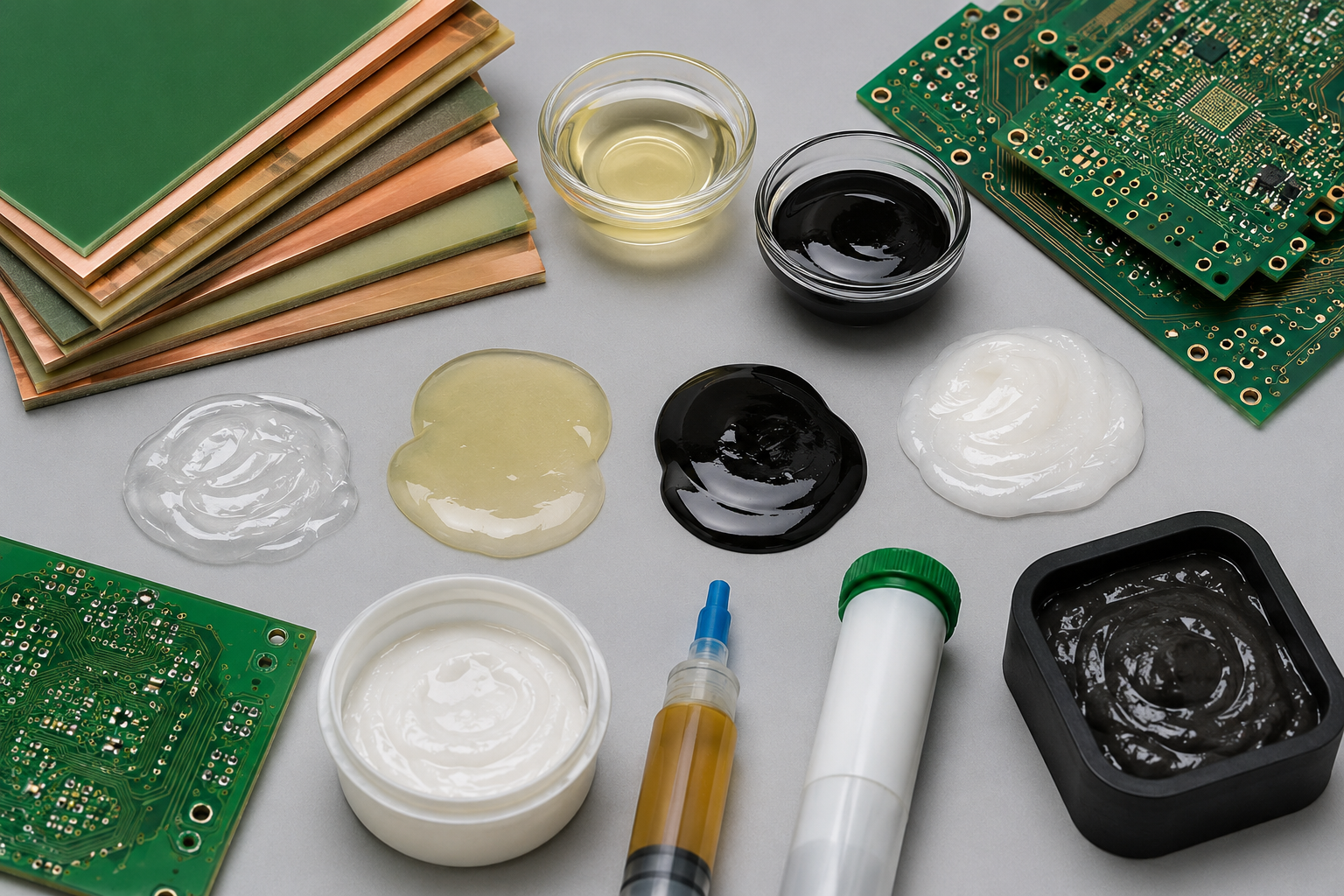
Different epoxy products are used in PCB manufacturing and assembly depending on the application. Some are designed for structural bonding, while others focus on protection, insulation, thermal management, or component reinforcement. Selecting the appropriate epoxy helps improve reliability and manufacturing consistency.
Epoxy Adhesives
Epoxy adhesives are commonly used to bond components, heat sinks, connectors, and mechanical parts to a PCB. They provide strong adhesion, excellent durability, and good resistance to temperature and vibration.
Epoxy Encapsulation Compounds
PCB encapsulation epoxy completely surrounds electronic assemblies to protect them from moisture, dust, chemicals, and mechanical damage. This type of epoxy is widely used in industrial, automotive, and outdoor electronic products.
Potting Epoxy
Potting compounds fill cavities or enclosures around electronic assemblies. Compared with thin coatings, potting provides a higher level of environmental protection and mechanical support.
Epoxy Coatings
Epoxy PCB coating materials create a protective barrier on the PCB surface. They help prevent corrosion, contamination, and moisture-related failures while improving long-term reliability.
Staking Epoxy
PCB epoxy staking is used to secure large or vibration-sensitive components such as transformers, inductors, connectors, and capacitors. It helps prevent movement and reduces stress on solder joints.
Thermally Conductive Epoxy
This type of epoxy contains thermally conductive fillers that improve heat transfer. It is commonly used in LED modules, power electronics, and high-power assemblies where temperature management is important.
Conductive Epoxy
Conductive epoxy contains metallic particles that allow electrical conductivity after curing. It is sometimes used as an alternative to solder for specialized interconnection applications.
What Performance Parameters Do PCB Epoxy Have?
The performance parameters of PCB epoxy resin are listed below. These indicators directly determine the insulation capability, heat resistance, structural stability and overall service life of finished circuit boards, so they are essential references for material evaluation.
| Parameter | Typical Value / Range |
|---|---|
| Glass Transition Temperature (Tg) | 120°C – 250°C |
| Thermal Conductivity | 0.2 – 8.0 W/m·K |
| Dielectric Constant (Dk @ 1GHz) | 3.0 – 5.0 |
| Dissipation Factor (Df @ 1GHz) | 0.002 – 0.030 |
| Volume Resistivity | 10¹³ – 10¹⁶ Ω·cm |
| Surface Resistivity | 10¹² – 10¹⁵ Ω |
| Dielectric Strength | 15 – 35 kV/mm |
| Moisture Absorption | 0.05% – 1.00% |
| CTE (X-Y Direction) | 10 – 25 ppm/°C |
| CTE (Z Direction) | 40 – 250 ppm/°C |
| Tensile Strength | 40 – 100 MPa |
| Flexural Strength | 80 – 180 MPa |
| Compressive Strength | 100 – 250 MPa |
| Adhesion Strength | 10 – 35 MPa |
| Hardness | Shore D 75 – 95 |
| Viscosity | 500 – 100,000 cP |
| Cure Temperature | 25°C – 180°C |
| Cure Time | 5 Minutes – 24 Hours |
| Operating Temperature | -55°C to +200°C |
| Thermal Decomposition Temperature (Td) | 280°C – 400°C |
| UL Flammability Rating | UL94 V-0 / V-1 / V-2 |
| Cure Shrinkage | 0.1% – 2.0% |
| Water Resistance | Excellent |
| Chemical Resistance | Good to Excellent |
What Are the Common Applications of Epoxy in PCB Manufacturing?
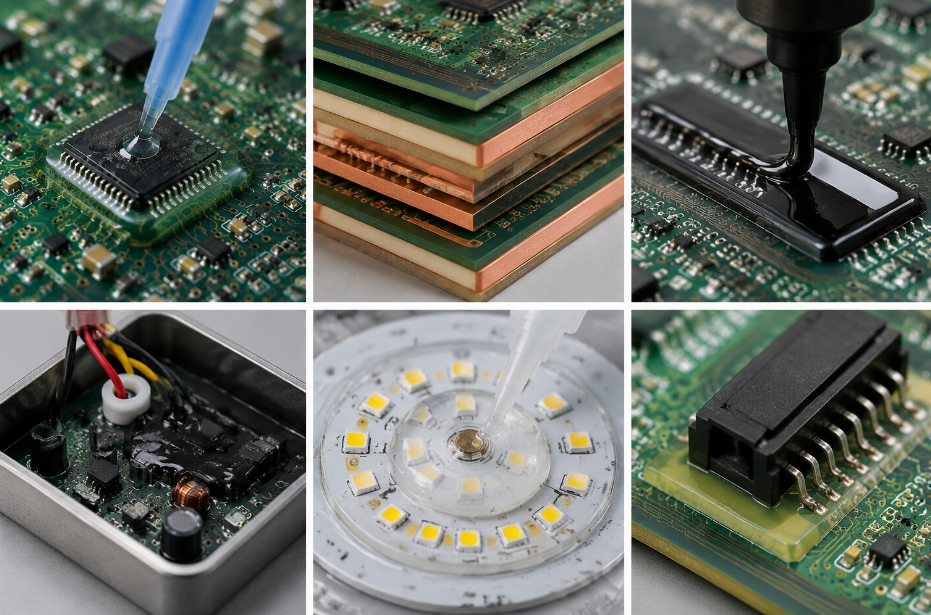
Epoxy materials are used throughout PCB fabrication and assembly.
FR-4 Laminate Production
- Forms the base PCB structure
- Bonds fiberglass layers together
- Provides electrical insulation
PCB Encapsulation
- Protects circuits from moisture
- Improves environmental resistance
- Extends service life
PCB Epoxy Staking
- Secures heavy components
- Improves vibration resistance
- Reduces mechanical stress
Epoxy PCB Coating
- Protects traces and solder joints
- Prevents corrosion
- Improves durability
Thermal Management
- Transfers heat from components
- Improves temperature control
- Supports power electronics
Epoxy Ink PCB Screen Printing
- Creates legends and markings
- Improves identification
- Supports manufacturing processes
How Does Epoxy Affect PCB Performance and Reliability?
Epoxy is more than just a protective material. It directly influences electrical performance, thermal stability, mechanical durability, and environmental resistance. Choosing the right epoxy can significantly improve the reliability and lifespan of a PCB assembly.
Improves Electrical Insulation
Epoxy creates an insulating barrier between conductive traces and components. High insulation resistance helps prevent electrical leakage, short circuits, and signal interference, especially in humid or contaminated environments.
Enhances Mechanical Stability
PCB assemblies are often exposed to vibration, impact, and thermal expansion. Epoxy helps secure components, distribute mechanical stress, and reduce the risk of cracked solder joints or component movement during operation.
Increases Resistance to Moisture and Chemicals
Moisture is one of the most common causes of PCB failure. Epoxy coatings and encapsulation materials help prevent water ingress, corrosion, oxidation, and chemical contamination, improving long-term reliability in harsh environments.
Supports Thermal Reliability
Temperature fluctuations cause materials to expand and contract at different rates. Properly selected epoxy materials help reduce thermal stress, minimize delamination risks, and improve stability during repeated heating and cooling cycles.
Protects Against Environmental Damage
Dust, salt spray, industrial pollutants, and other contaminants can gradually degrade electronic assemblies. Epoxy provides an additional protective layer that helps maintain performance in challenging operating conditions.
Extends Service Life
By improving insulation, strengthening mechanical support, enhancing environmental protection, and reducing thermal stress, epoxy contributes directly to longer product life and lower failure rates throughout the operating lifecycle.
How to Remove Epoxy Coating from PCB?
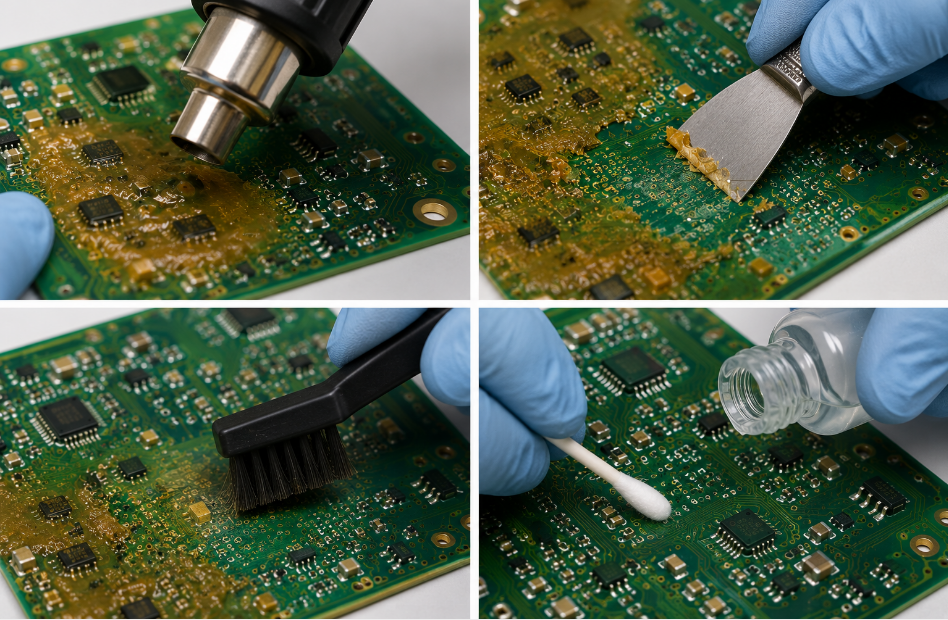
Removing epoxy from a PCB can be challenging because epoxy is designed to create a strong and durable bond. The removal method depends on the epoxy type, coating thickness, and whether the PCB needs to remain functional after the process. Careful removal helps minimize damage to copper traces, solder joints, and electronic components.
Identify the Type of Epoxy
Before starting, determine whether the material is a conformal coating, staking adhesive, encapsulation compound, or potting resin. Thin epoxy coatings are generally easier to remove than fully encapsulated assemblies.
Use Controlled Heat for Softening
Many epoxy materials become softer when exposed to moderate heat. A hot air station or heat gun can help loosen the material and make mechanical removal easier. Excessive temperatures should be avoided because they may damage nearby components or PCB substrates.
Remove Small Areas Mechanically
For localized epoxy deposits, precision knives, scrapers, or micro-grinding tools can be used to gradually remove the material. This method is commonly used when removing PCB epoxy staking around connectors, transformers, or large capacitors.
Apply Chemical Removers When Necessary
Specialized epoxy-removal solvents may help break down certain formulations. However, compatibility should always be verified because some chemicals can affect solder masks, plastics, or component markings.
Remove Encapsulation in Stages
For PCB encapsulation epoxy, complete removal is usually performed gradually. Combining heat, mechanical tools, and chemical softeners often produces better results than relying on a single method.
Clean and Inspect the PCB
After removal, clean the surface thoroughly to eliminate residue. Inspect traces, pads, vias, and nearby components for damage before performing repairs, testing, or reassembly.
Know When Replacement Is More Practical
In some cases, fully cured potting compounds are extremely difficult to remove without damaging the assembly. For heavily encapsulated products, replacing the module may be more practical than attempting complete epoxy removal.
FAQs About PCB Epoxy
Q1: Does epoxy stick to PCB?
A1: Yes. Epoxy bonds well to FR-4 substrates, copper surfaces, solder masks, and many electronic components. Proper cleaning before application improves adhesion and durability.
Q2: Will PCB potting epoxy help with heat sink performance?
A2: Standard potting compounds mainly provide insulation and protection. Thermally conductive potting materials containing ceramic fillers can improve heat transfer and support heat dissipation.
Q3: How Does Epoxy Dispensing PCB Work?
A3: Epoxy dispensing involves applying controlled amounts of resin to specific PCB locations using manual or automated equipment. After curing, the material provides protection, bonding, or structural reinforcement.
Q4: What is the role of filler in epoxy in PCB adhesives?
A4: Fillers improve thermal conductivity, mechanical strength, dimensional stability, and moisture resistance. Common fillers include silica, alumina, and ceramic particles.
Conclusion
The performance of a PCB depends not only on circuit design but also on material selection and manufacturing quality. Choosing the right PCB epoxy helps improve electrical insulation, thermal stability, and environmental protection, ultimately contributing to a more reliable and longer-lasting product.
EBest specializes in PCB fabrication and PCB assembly services, supporting FR4 PCB, Metal Core PCB, HDI PCB, RF PCB, Ceramic PCB. If you need a quick quotation for prototypes or volume production, simply send your Gerber files, BOM list, or project requirements to sales@bestpcbs.com, and our team will provide manufacturing recommendations and pricing based on your project needs.
You may also like

Tags: epoxy on pcb, epoxy pcb coating, pcb epoxy removal, pcb epoxy resin