

A low helium reading does not, by itself, prove a ceramic package is hermetic. It is only useful if the report identifies what was sealed, which test condition was used and whether the procedure covers both small leaks and larger openings. A large opening can let the tracer escape before a delayed fine-leak reading is taken.
Consider a metallized ceramic base with feedthroughs and a sealed metal lid. You are approving the completed cavity, not the ceramic material alone. Start by matching the report to that assembly and drawing revision. Then verify the leak ranges, volume, timing and reporting basis before comparing any number with the acceptance limit.
Hermetic ceramic package
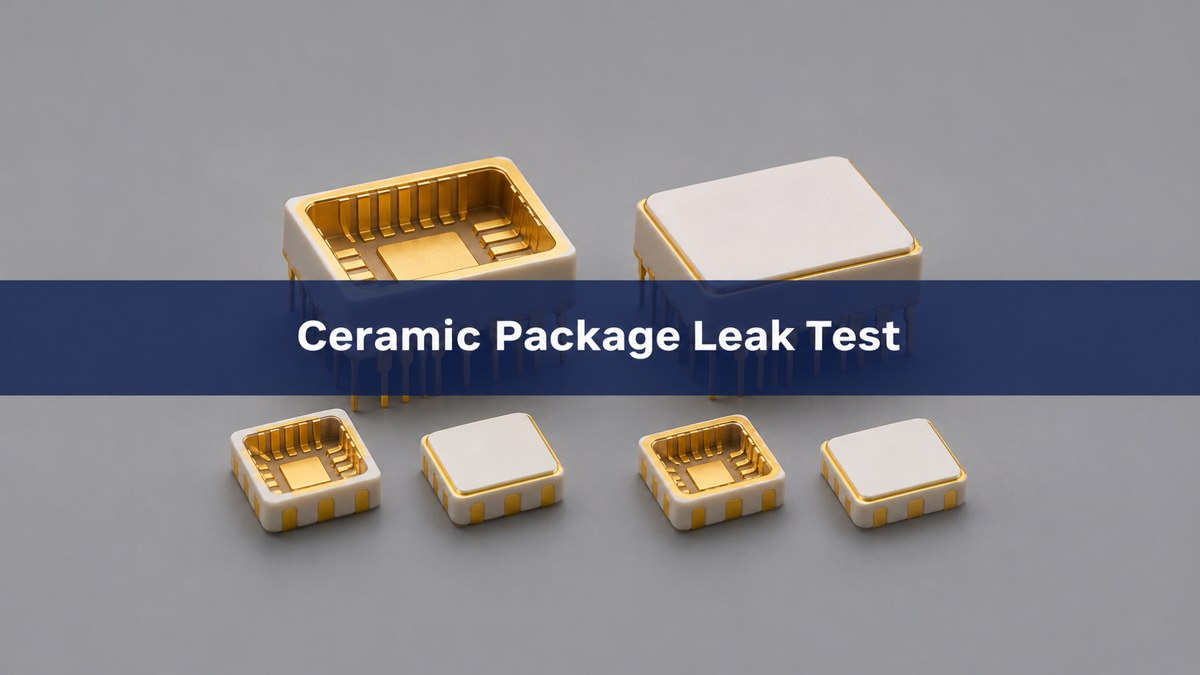
A hermetic ceramic package uses a ceramic body as part of a sealed enclosure. Depending on the design, the lid seam, braze, feedthrough interfaces and ceramic body all contribute to the boundary. Dense ceramic can be a useful starting material, but a material property cannot establish that the completed interfaces seal.
On the inspection drawing, identify the surfaces enclosing the gas volume. A substrate with no sealed cavity is not the same test specimen as an assembled package. For the broader construction context, see the ceramic DIP package guide. Do not infer that any particular footprint is hermetic from its material or appearance.
Hermetic seal leak test
Test the boundary that will be released. A pass on an empty ceramic body with a provisional fixture does not clear the lid seam on a fully assembled unit. Likewise, a visual check can identify a damaged seam but cannot quantify gas flow through a leak path.
For first articles, mark what is included: the final lid and seal, the electrical feedthroughs and any port that remains part of the finished enclosure. Match the sample identifiers to the report. If sealing or rework takes place afterward, agree on what must be retested; do not carry the earlier result forward automatically.
Helium leak testing
Helium is a tracer. A detector distinguishes its signal from the background and may report a calibrated helium leak rate. In one method for sealed packages, helium enters through a leak while the package is exposed to it, and the detector looks for tracer escaping from the package after transfer to the instrument.
That is not the same setup as spraying helium on an evacuated vessel or moving a sniffer over a pressurized joint. Ask which arrangement produced the result. For a delayed sealed-package test, the exposure history and interval before readout matter because the amount of tracer retained can change. Use the approved lab procedure and equipment, not an improvised pressure setup.
Fine leak vs gross leak test
Fine-leak and gross-leak checks cover different parts of the problem. A fine-leak method measures small leakage under its validated conditions; a gross-leak method checks for openings too large for that fine-leak setup to assess reliably. Some approved systems can cover both ranges in one sequence. The report should show the coverage, not merely the name of the detector.

| Check | What it can support | Do not infer |
| Fine leak | Comparison with the small-leak criterion at the specified test condition | A low value does not rule out a large opening outside the validated range. |
| Gross leak | Detection of larger openings within its validated range | Passing does not establish the fine-leak limit. |
| Combined method | Both checks when the procedure demonstrates the required coverage | One report line does not establish the ranges or the valid sequence. |
If a supplier reports only a fine-leak pass with no gross-leak evidence, request the missing result or proof that the approved method covered both. Do not invent a new sequence or assume all gross-leak methods are interchangeable.
Cavity volume calculation
Use internal free volume, not the package’s outside dimensions. In a hypothetical cavity with internal dimensions of 3 mm × 2 mm × 0.50 mm, the gross space is 3.0 mm³. If the installed parts displace 0.6 mm³, the estimated free volume is 2.4 mm³, or 0.0024 cm³. This example defines an input; it does not establish any limit or authorize a particular method.
Record which version of the cavity calculation was used. A thicker die, different lid or larger internal attachment can change the free volume without changing the external outline. The selected method can then need a new review. Published work on sub-microlitre cavities explains why traditional helium techniques should not be extrapolated to much smaller volumes without validation. Read the study abstract.
Helium leak rate units
Identify both the units and the gas basis. A report can express a helium detector reading in atm·cm³/s He and a contract can specify an equivalent standard leak rate for air. A shared unit format does not make those quantities the same. Do not compare them directly or apply a universal helium-to-air factor.
For the ceramic package example, ask the lab to report the measured value, the derived value if one is used, and the condition or calculation supporting that conversion. If the number is below the instrument’s validated reporting threshold, report it as below that threshold. It is not a zero leak rate.
MIL-STD-883 Method 1014
Method 1014 is one reference for testing the seals of microelectronic devices with designed internal cavities. Name the actual revision and selected condition on the drawing or order where the method applies. The exact apparatus, sequence, time conditions and acceptance criteria depend on what the project invokes. The number on the cover of a laboratory report is not enough to determine which procedure was used.
The DLA Method 1014.19 text in MIL-STD-883-1 Change 2 distinguishes internal free volume, measured tracer response and equivalent standard leak rates. It also includes different methods and test conditions. Apply the revision and condition specified for your order; a general-purpose IP rating or dielectric test does not replace the package seal test.
Leak test report
A useful report lets another reviewer reconstruct the pass/fail decision. In addition to the result, ask for the test boundary, volume basis and records showing the result belongs to that part and procedure.
| Report field | Check before acceptance |
| Assembly identity | Traceable sample or lot, final seal configuration, drawing revision, condition of testing. |
| Procedure | Invoked revision and test condition, covered leak ranges and pass/fail criteria. |
| Volume and measurement | Internal free volume, gas basis, units, calibration and reporting limit. |
| Sequence and transfer | Applicable exposure, transfer and readout records; both leak checks where required. |
| Disposition | Actual results, missing or invalid data, and authorized retest or hold. |
If the report values look favourable but it names a different seal revision or gives only an unexplained reading, hold the decision and ask for the traceable record. Do not tighten or loosen limits after seeing the numbers. A passing result establishes the stated acceptance condition, not an unlimited operating life.
Frequently asked questions
Does a package with no bubbles pass the helium fine-leak requirement?
No. A visual gross-leak check is not the same measurement. Confirm the approved method and data for the fine-leak criterion separately.
Does a dry ceramic material datasheet prove the lid is sealed?
No. The datasheet describes the material. The final package still requires evidence for its sealed interfaces, including the lid and feedthroughs.
Can a unit pass before rework and be accepted afterward?
Use the approved rework and requalification plan. If the repair changes a boundary or seal, the prior result does not necessarily cover the repaired condition.
What if the report says ‘no leak detected’?
Ask for the reporting limit, gas basis and test condition. That statement alone does not establish that the measurement was sensitive enough for the agreed limit.
Can testing an unpopulated package replace testing the filled cavity?
Only if the applicable qualification plan permits the substitution on documented evidence. The contents can change free volume and may change the seal process or configuration.
Can helium on the outside affect a result?
Residual tracer or elevated background can affect the detector signal. Ask for the relevant verification and handling records; do not subtract a guessed background number.
Do all sealed ceramic designs require the same test conditions?
No. The controlling specification and package design determine what conditions are appropriate. Confirm the required method with the lab and the purchaser before building the lot.
Does passing a leak test prove the interior is dry?
No. Seal testing asks whether gas can pass through a boundary under defined conditions. It does not measure moisture or other residual gases trapped inside during sealing.
Discuss your ceramic substrate drawing
For a Best Technology inquiry, send the ceramic grade, metallization drawing, seal interfaces and any stated acceptance test to sales@bestpcbs.com. Separate the bare substrate requirements from the assembled package test and identify which party will provide the evidence.