Searching for an FPC manufacturer Israel usually means the project has moved beyond basic flexible PCB research. Buyers now need to know who can manufacture the required flex construction, whether production must stay in Israel, how quickly prototypes can be delivered, and whether fabrication, component sourcing, assembly, and testing can be coordinated without adding more suppliers.
EBest Circuit is a China-based PCB and PCBA manufacturer serving Israeli customers rather than an Israeli domestic manufacturer. With 20+ years of PCB and PCBA manufacturing experience, we support FPC, rigid-flex, HDI, component sourcing, and downstream assembly for international projects. For Israeli programs that do not require local production, EBest provides another sourcing option to compare on process capability, quality systems, lead time, PCBA coverage, and repeat-production support.
Top 5 FPC Manufacturers in Israel to Compare
Israel has several established PCB companies supporting flexible and rigid-flex designs. Their strengths differ, so the following list is better treated as a supplier shortlist rather than an absolute quality ranking.
| Company | Main Strength |
|---|---|
| Eltek / Nistec | High-reliability flex and rigid-flex |
| Print Electronics | Flex, rigid-flex, HDI |
| PCB Technologies | Advanced PCB + turnkey PCBA |
| TracePCB | Flex prototypes and electrical testing |
| Ma’agalim D.S. | PCB design, flex fabrication, assembly |
Eltek / Nistec is particularly relevant for high-reliability flex and rigid-flex projects.
Print Electronics covers flexible PCB, rigid-flex, HDI, and other advanced constructions.
PCB Technologies combines PCB fabrication with PCBA and advanced packaging, which can be useful when a project needs broader manufacturing support.
TracePCB is relevant for prototype and lower-volume projects where engineering support and electrical testing matter.
Ma’agalim D.S. combines PCB design, fabrication, assembly, and turnkey support, including flex and rigid-flex projects.
The right supplier depends less on the company name than on whether its actual process capability fits the released FPC design.
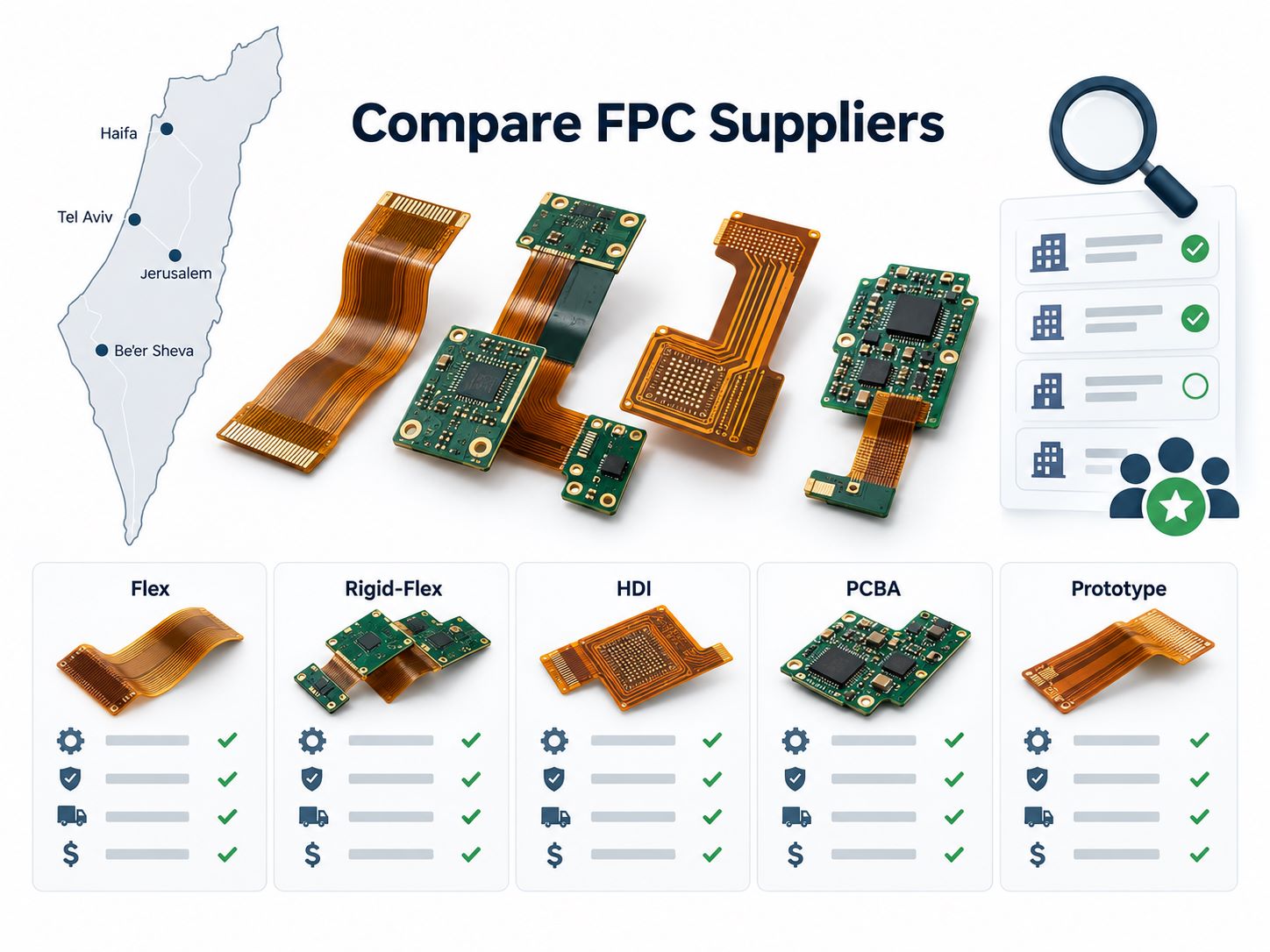
What FPC Manufacturing Capabilities Matter for Israeli Projects?
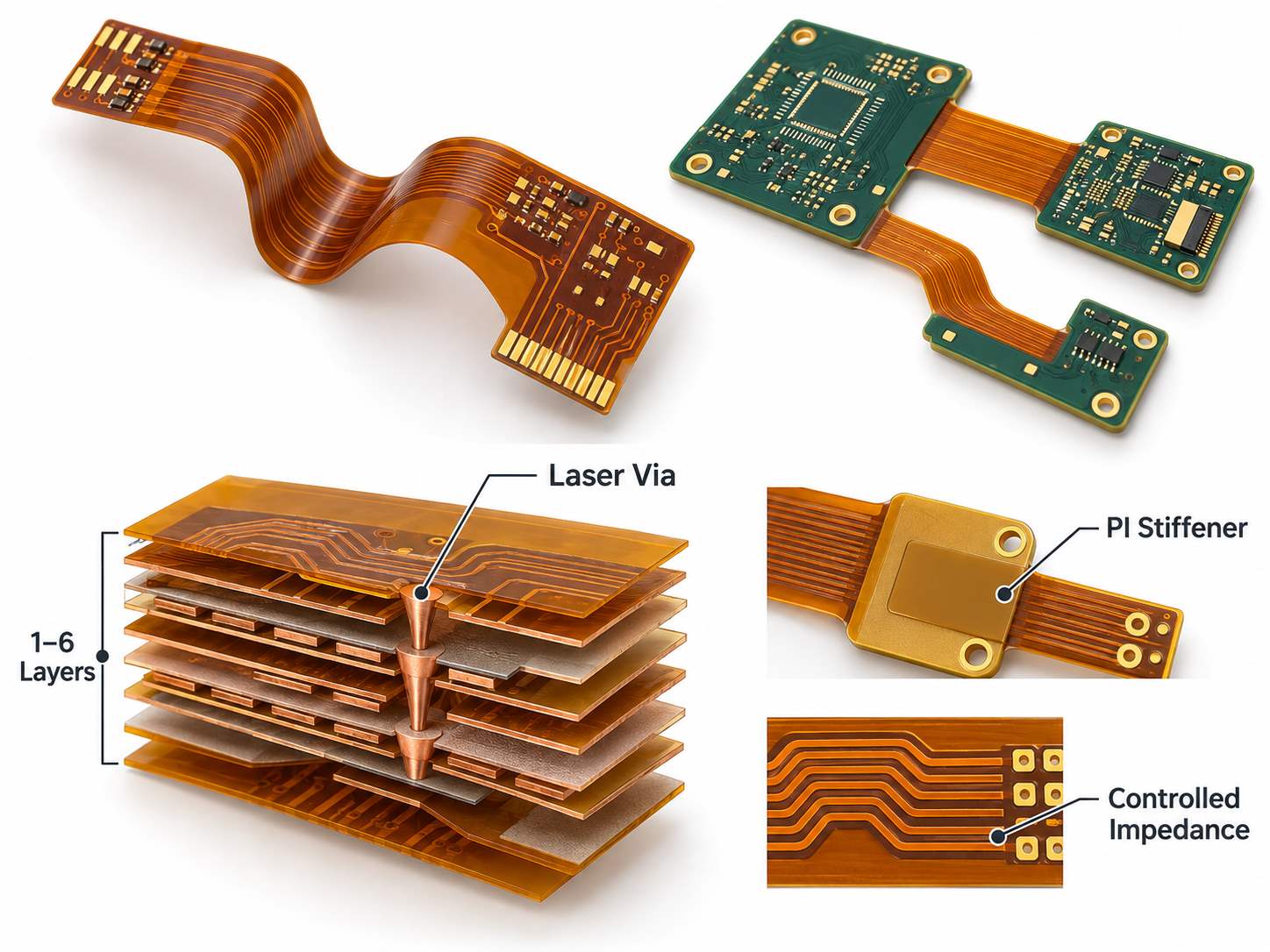
For Israeli FPC projects, supplier fit can be judged quickly by comparing the released design with the factory’s actual production limits. EBest Circuit supports standard and advanced flexible PCB production with the following capabilities:
| FPC Capability | EBest Circuit |
|---|---|
| Layer count | 1–6 layers standard; up to 8 layers by review |
| Finished thickness | 0.06–0.60 mm |
| Maximum panel size | 240 × 780 mm standard; up to 240 × 1200 mm |
| Flex copper | 0.33–2 oz |
| Finished copper | Inner up to 2 oz standard / 3 oz special; outer up to 3 oz |
| Mechanical drill | Down to 0.15 mm |
| Laser via | 3–4 mil standard; 2–3 mil special |
| PTH aspect ratio | 10:1 standard; up to 12:1 |
| Minimum BGA pad | 10 mil standard; 8 mil special |
| Impedance tolerance | ±10% |
| Outline tolerance | ±0.10 mm |
| Surface finish | ENIG, hard gold, OSP, immersion tin, ENEPIG |
Fine-line capability changes with copper thickness:
| Finished Copper | Standard Trace / Space | Special Process |
|---|---|---|
| 18 μm | 3 / 3 mil | 2.5 / 2.5 mil |
| 35 μm | 4 / 4 mil | 3.5 / 3.5 mil |
| 70 μm | 6 / 8 mil | 5.5 / 7 mil |
EBest Circuit also supports adhesive and adhesiveless polyimide constructions, multiple coverlay options, and PI stiffeners for connector or reinforcement areas.
For projects requiring 8-layer FPC, 2–3 mil laser vias, fine-line routing, controlled impedance, heavier copper, or long-format flex, these limits provide a practical way to determine whether the design fits standard production or needs a special-process review.
How Is Flexible PCB Quality Controlled for Bending and Assembly?
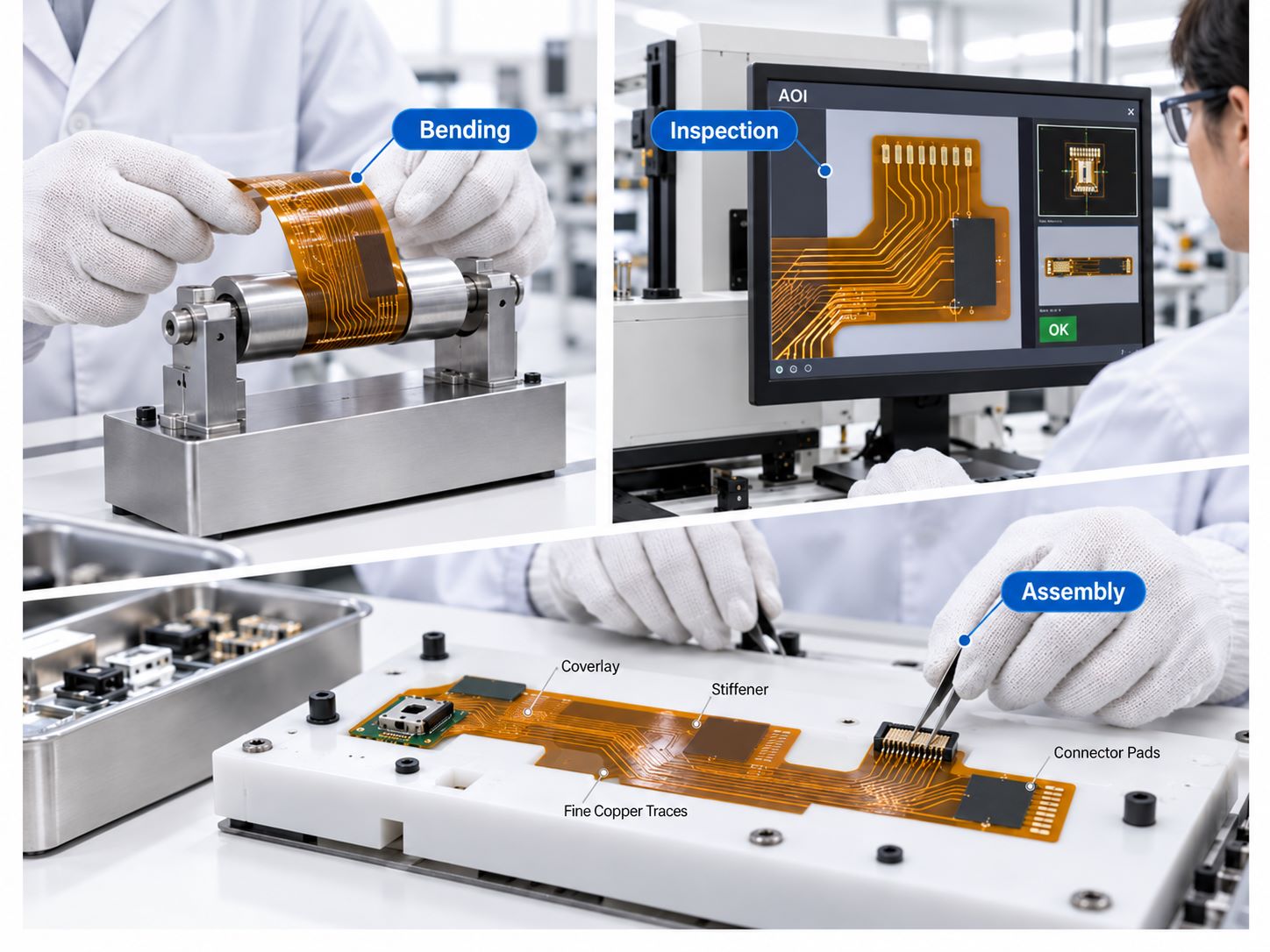
Flexible PCB quality is not only about passing electrical testing. The board also has to survive handling, forming, assembly, and the bending conditions defined by the product.
For EBest FPC projects, quality control focuses on flex-specific risks:
- Bend-area protection: vias, stiffener edges, copper transitions, and coverlay openings are reviewed around the bend zone.
- Layer registration: copper and coverlay need to remain aligned around fine-pitch pads and connector areas.
- Thickness control: finished flex thickness affects bend behavior and mechanical fit.
- Stiffener accuracy: reinforcement must support the intended area without creating an unnecessary stress point.
- Electrical continuity: flying-probe or fixture testing helps detect opens and shorts before assembly.
- Assembly protection: flex sections can be supported during printing, placement, reflow, inspection, and handling.
When assembly is included, SPI, AOI, X-ray, ICT, or functional testing can be selected according to the component package and acceptance requirements.
The customer benefit is less risk of treating an FPC like a thin rigid PCB. Fabrication and assembly controls need to reflect how the circuit will actually bend and function in the finished product.
Which Certifications Matter for Flexible PCB Production in Israel?
The relevant certification depends on the final product. An industrial FPC, medical flex circuit, automotive sensor, and aerospace rigid-flex assembly may require very different supplier qualifications.
| Application | Common Qualification |
|---|---|
| General industrial | ISO 9001, IPC |
| Medical | ISO 13485 |
| Automotive | IATF 16949 |
| Aerospace | AS9100D |
| Flex PCB workmanship | IPC-6013 / customer specification |
| Environmental compliance | RoHS, REACH |
EBest Circuit supports projects under ISO 9001, ISO 13485, IATF 16949, and AS9100D quality systems, together with applicable IPC, UL, RoHS, and REACH requirements.
These certifications should not be treated as a logo checklist.
For example, ISO 13485 may become a supplier-qualification requirement for a medical program, while AS9100D may be decisive for an aerospace sourcing plan. For a general industrial FPC, the approved material, IPC acceptance criteria, flex construction, traceability, and testing requirements may matter more.
The important question is whether the supplier’s quality system matches the actual project requirement.
How Fast Can FPC Prototypes and Production Orders Ship to Israel?
For standard EBest PCB projects, fabrication is commonly planned around 3–5 working days, with expedited options available for qualifying builds.
Flexible PCB lead time can change when the design includes:
- special PI or adhesive systems;
- uncommon copper thickness;
- multilayer flex;
- controlled impedance;
- laser microvias;
- tight stiffener tolerances;
- special coverlay openings;
- rigid-flex lamination;
- additional testing.
For Israeli customers, the useful delivery date is not simply the number of days needed to fabricate the bare FPC.
A realistic schedule should consider:
engineering approval → material readiness → FPC fabrication → assembly/testing → shipment to Israel
This matters when comparing local production with an overseas supplier. Local manufacturing may shorten logistics, while an overseas route may offer broader capacity, different pricing, integrated PCBA, or better volume scalability.
The useful comparison is therefore the complete delivery schedule, not just the bare-board fabrication time.
Can One FPC Manufacturer Handle Flex PCB Assembly Too?
Yes. This can be particularly useful for flexible circuits because assembly and mechanical handling are closely connected to the FPC construction.
If fabrication and assembly are separated, the customer may need to coordinate:
FPC manufacturer → component supplier → SMT house → inspection/test provider
EBest Circuit can combine FPC fabrication, component sourcing, SMT/THT assembly, inspection, and agreed testing within the same project.
The customer gains:
- Fewer supplier handoffs: less coordination between separate PCB and assembly vendors.
- Better flex handling: fixtures and support methods can be planned around flexible sections.
- Better stiffener coordination: connector and component areas can be reviewed together with assembly requirements.
- Clearer BOM control: turnkey, partial-turnkey, and consigned sourcing are available.
- One responsibility path: PCB-related assembly issues do not need to be negotiated between unrelated factories.
For overseas sourcing, combining FPC and PCBA is one of the clearest ways to reduce the extra coordination created by distance.
FPC Manufacturing Case Study for an Israeli Customer
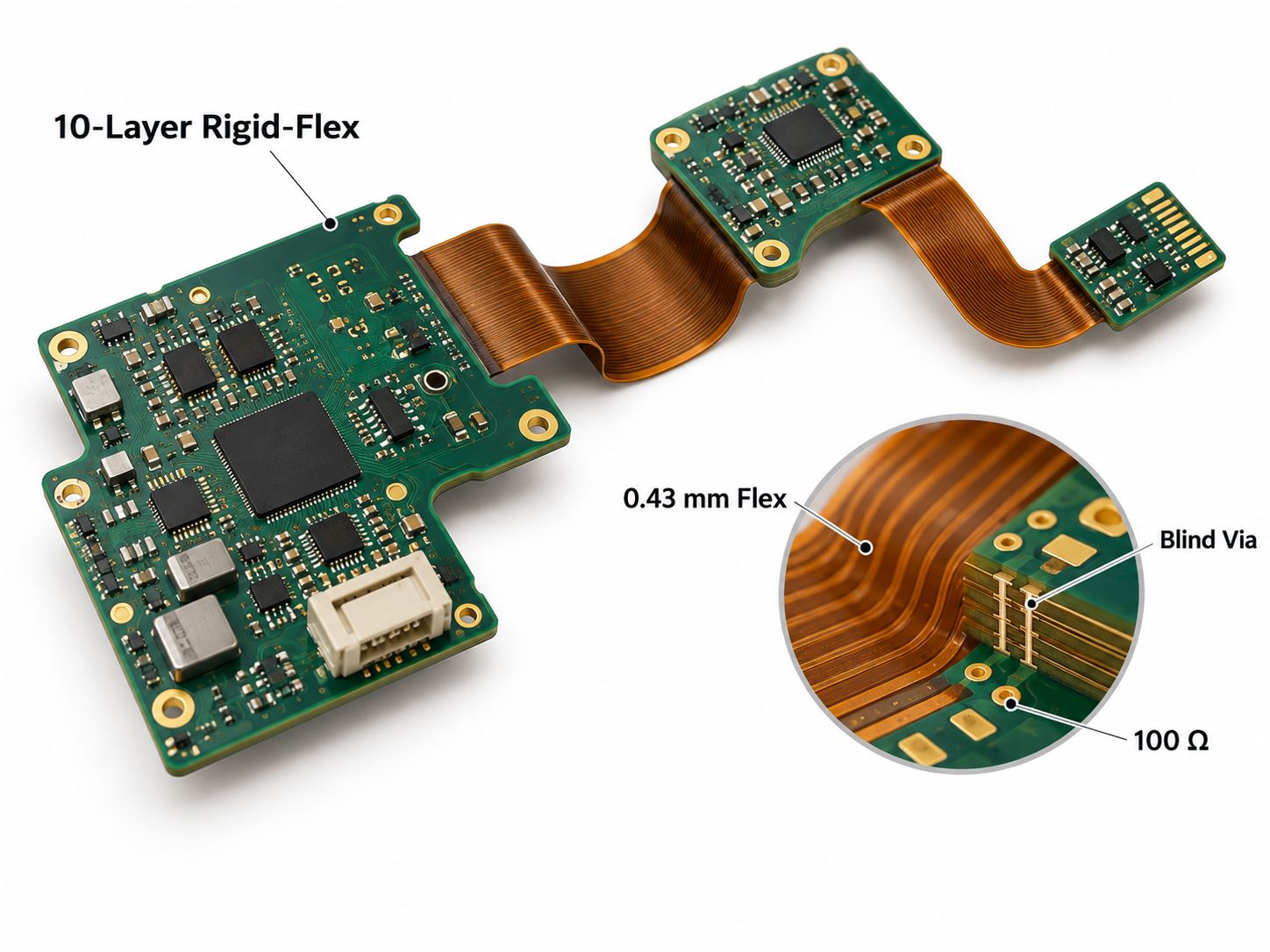
A documented Israeli flex-related project involved a 10-layer rigid-flex industrial-control PCB.
| Item | Specification |
|---|---|
| Structure | 10-layer rigid-flex |
| Flex section | 4 flex layers |
| Flex thickness | 0.43 mm ±0.03 mm |
| Surface finish | ENIG |
| Via type | Blind vias |
| Impedance | 100 Ω differential |
The manufacturing challenge was not simply producing a 10-layer PCB. The flex materials, rigid sections, blind vias, finished thickness, coverlay, and controlled impedance all had to remain aligned with the approved stackup.
EBest reviewed the construction as one manufacturing package before fabrication.
For the customer, the benefit was a controlled release before production instead of discovering stackup, impedance, or flex-construction differences after the rigid-flex boards had already been manufactured.
When Does an Overseas FPC Manufacturer Make Sense for Israeli Buyers?
An overseas FPC manufacturer only makes sense when the project is allowed to use overseas production.
A local Israeli supplier may be the stronger choice when:
- the contract explicitly requires Israeli production;
- defense or security rules restrict manufacturing location;
- frequent face-to-face engineering support is necessary;
- domestic logistics are part of the qualification plan.
An overseas supplier becomes more attractive when location is not mandatory and the buyer is comparing:
- FPC or rigid-flex process capability;
- prototype and production capacity;
- component sourcing;
- integrated PCBA;
- material availability;
- repeat-volume pricing;
- certification coverage.
EBest Circuit serves Israeli customers from its Asian manufacturing base. It should therefore be evaluated as an overseas FPC and PCBA partner, not as an Israeli domestic manufacturer.
Why Choose EBest Circuit for FPC Projects in Israel?
For Israeli customers that can use overseas production, EBest Circuit is most useful when the project needs more than a basic flex PCB quotation.
Customers gain:
- More FPC capability: 1–6 layers standard, special builds up to 8 layers, laser vias, controlled impedance, fine-line routing, and multiple PI construction options.
- Fewer supplier handoffs: FPC fabrication, sourcing, PCBA, and testing can stay within one project.
- Earlier flex-design review: bend areas, coverlay, stiffeners, vias, materials, and impedance are checked before production.
- Better revision control: approved PCB data, BOM, assembly information, and substitutions remain aligned.
- Support beyond prototypes: the approved manufacturing package can continue into repeat production.
EBest Circuit is a China-based PCB and PCBA manufacturer serving Israeli customers, not an Israeli manufacturer. If domestic production is mandatory, a qualified Israeli factory is the appropriate choice.
If overseas production is allowed, compare suppliers on FPC process fit, quality control, PCBA coverage, total lead time, and responsibility when the design or BOM changes rather than bare-board price alone.
FAQs About FPC Manufacturers in Israel
Are flexible PCBs manufactured in Israel?
Yes. Israel has local suppliers supporting flexible and rigid-flex PCB manufacturing. Buyers should still confirm the actual manufacturing site, technology coverage, PCBA scope, and any outsourced production steps.
What is the difference between FPC and flex PCB?
FPC stands for Flexible Printed Circuit and is commonly used interchangeably with flex PCB. Both refer to circuits built on flexible dielectric materials such as polyimide.
What materials are commonly used for FPC?
Polyimide is the most common flexible dielectric. FPC constructions may also use rolled or electrodeposited copper, adhesive or adhesiveless PI, coverlay, stiffeners, and different surface finishes.
Can an FPC manufacturer also assemble the board?
Yes. EBest Circuit can combine FPC fabrication with component sourcing, SMT/THT assembly, inspection, and customer-defined testing.
What affects FPC manufacturing lead time?
Layer count, PI material, copper thickness, coverlay, stiffeners, microvias, controlled impedance, surface finish, quantity, and assembly scope can all affect the schedule.
When should an Israeli buyer use an overseas FPC manufacturer?
Consider overseas production when domestic manufacturing is not mandatory and the project benefits from broader manufacturing capacity, integrated PCBA, component sourcing, special FPC processes, or repeat-volume production.
Ready to Start Your FPC Project?
If your search for an FPC manufacturer Israel has reached the quotation stage, send your Gerber files, stackup, fabrication drawing, BOM, CPL, assembly requirements, quantity, and target delivery date to sales@bestpcbs.com. EBest Circuit can review the flex construction, bend areas, materials, stiffeners, impedance, assembly requirements, and manufacturability before quotation.