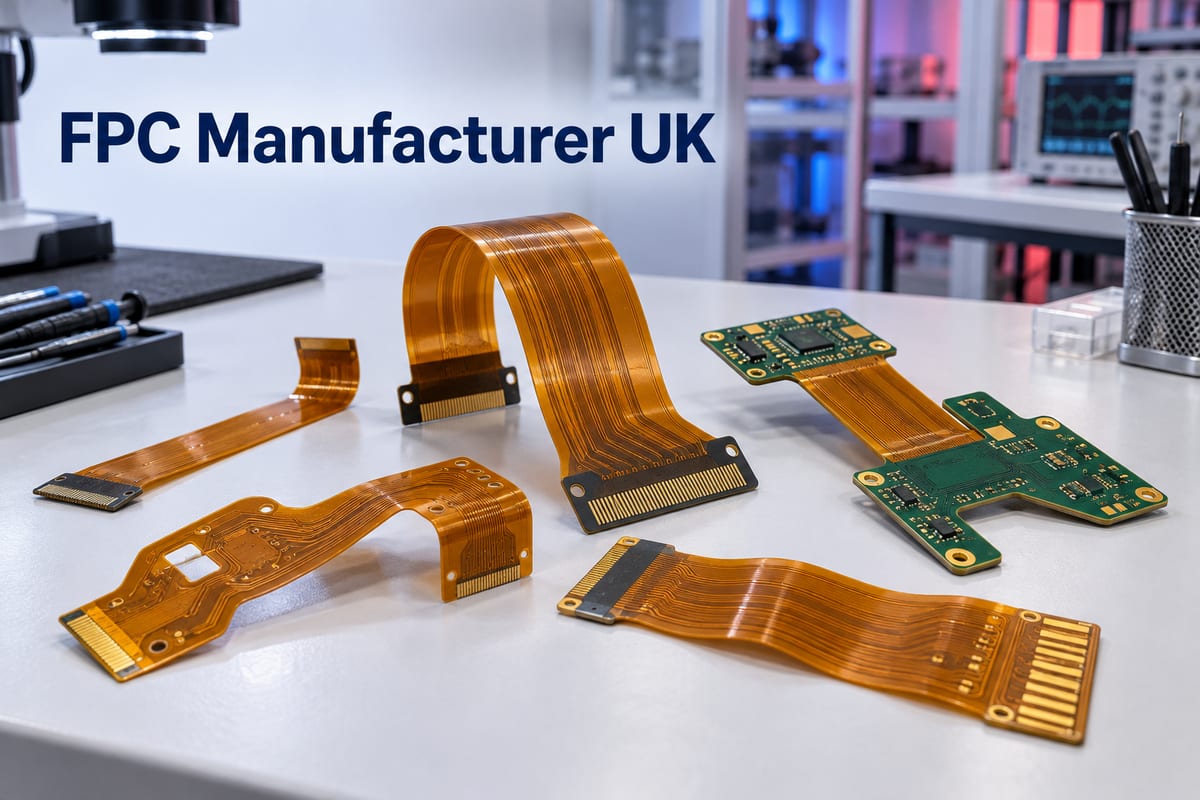
FPC manufacturer UK searches lead to companies with very different strengths. Some operate PCB factories in the UK, some specialise in flexible circuits for demanding applications, and others combine local customer support with offshore production. The most useful comparison is therefore not a long directory. It is a clear view of what each manufacturer actually produces and which type of project it suits.
This guide compares five UK manufacturers, shows published FPC process capabilities, and explains where an offshore option may fit. EBest Circuit (Best Technology) manufactures flexible and rigid-flex PCBs for UK customers that need engineering communication, scalable production, and optional assembly through one technical contact. To discuss a released design, email sales@bestpcbs.com with your Gerber or ODB++ data, stack-up, quantity, and application details.
Which FPC Manufacturers Serve UK Projects?
The five companies below have identifiable UK manufacturing operations and publicly describe flexible or rigid-flex PCB capability. They are not ranked because their strongest applications are different.
| Manufacturer | UK operation | Best suited to |
|---|---|---|
| GSPK Circuits | North Yorkshire | General flex, rigid-flex, and specialist PCB projects |
| Exception PCB | Tewkesbury | Complex multilayer, HDI, and advanced rigid-flex builds |
| Merlin Flex | Hartlepool | Dedicated flex manufacturing and added-value assembly |
| Amphenol Trackwise | Stonehouse | Long-length FPCs for aerospace, EV, medical, and industrial systems |
| Cambridge Circuit Company | Cambridge | In-house prototypes and fast-turn flex or flex-rigid boards |
GSPK Circuits is a broad UK PCB manufacturer rather than a flex-only company. Its North Yorkshire facility produces flex and rigid-flex boards alongside HDI, RF, IMS, and other specialist constructions. GSPK is relevant when a project needs conventional or complex flexible circuitry from a manufacturer with a published process table and UK production.
Exception PCB manufactures flex and rigid-flex PCBs at its Tewkesbury facility. Its published capability extends to high-layer-count rigid-flex, fine features, laser microvias, and filled vias. It is a stronger candidate when the flex construction is part of a dense multilayer or HDI design rather than a simple flexible interconnect.
Merlin Flex is the dedicated flexible-circuit business within Merlin PCB Group. It manufactures flexible and flex-rigid PCBs in Hartlepool and also provides component assembly. Its specialist focus makes it relevant to customers who want a UK source centred on flex technology rather than a general PCB supplier that also offers flex.
Amphenol Trackwise occupies a distinct position. Its continuous roll-to-roll process produces multilayer flexible circuits that can extend far beyond conventional panel lengths. It is particularly relevant when an FPC replaces a large wiring harness in aerospace, electric-vehicle battery systems, medical equipment, or industrial machinery.
Cambridge Circuit Company offers in-house UK production of multilayer, flex, flex-rigid, plated-through-hole, and single-sided boards. The company emphasises prototype and fast-turn manufacturing, making it a practical option for development teams that prioritise short feedback loops and local production.
How Do UK FPC Suppliers Differ by Application?
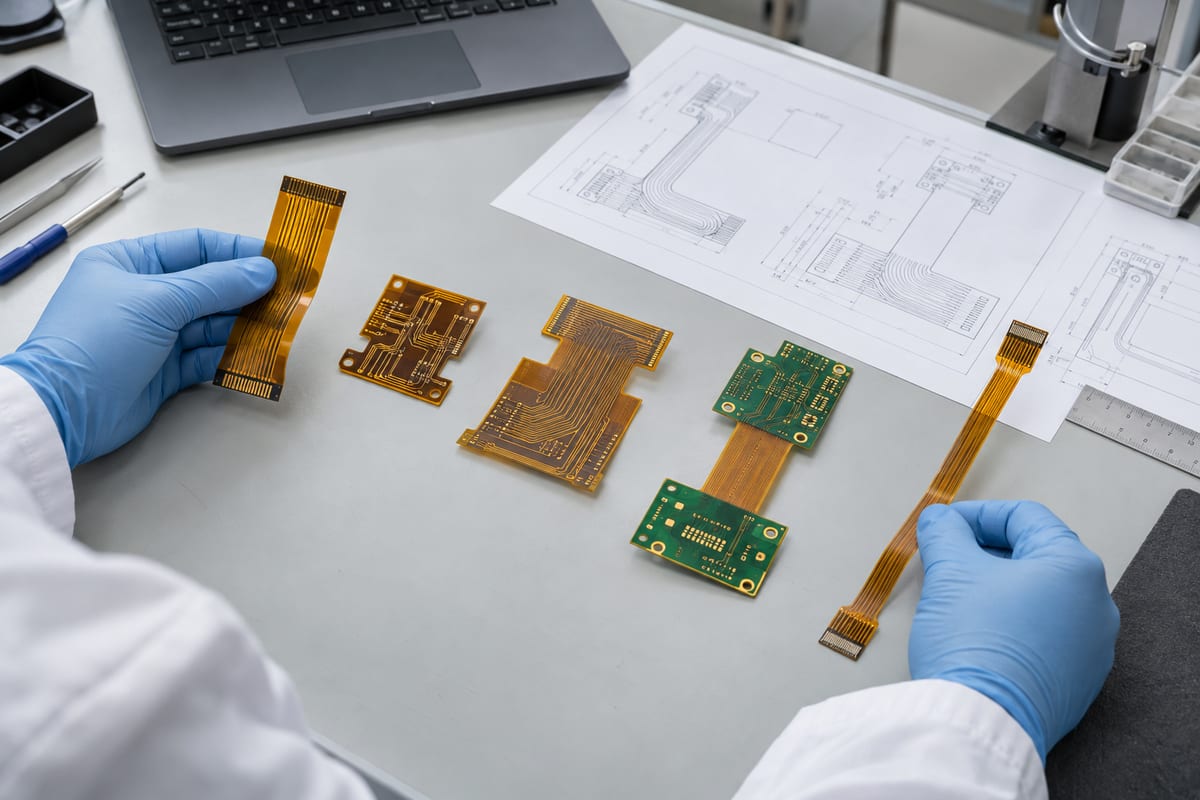
The best supplier depends on where the FPC will operate and what the finished product demands from it. UK manufacturers position their capabilities around different application markets.
Supplier strengths by application:
| Application | Relevant UK suppliers | Best match |
|---|---|---|
| Aerospace and defence | Trackwise, Exception PCB, Graphic PLC | Long harness replacement or complex rigid-flex avionics |
| Automotive and EV | Trackwise | Battery-pack and cell-control interconnects |
| Medical equipment | Trackwise, Graphic PLC | Miniature interconnects and high-reliability flex-rigid |
| Industrial and scientific | GSPK, Trackwise | Conventional flex or extended power and signal routing |
| Consumer and wearable | Merlin Flex, Cambridge Circuit | General flex production and fast prototypes |
Trackwise is most distinctive when circuit length or harness replacement drives the design. Exception PCB and Graphic PLC better match dense, high-reliability rigid-flex assemblies. GSPK covers a broader range of conventional and specialist flex builds, while Merlin Flex and Cambridge Circuit Company provide more general flex manufacturing or prototype routes. The last two matches are based on published manufacturing scope rather than a stated specialisation in consumer or wearable products.
Application is the first filter, not the final decision. After identifying suppliers active in the relevant market, compare the actual circuit construction with their published process capabilities.
Which Flex and Rigid-Flex PCBs Can UK Suppliers Produce?
UK manufacturers cover more than one type of flexible circuit. The construction should be matched to the product rather than selected from the name alone.
- Single-sided FPCs: Suit simple connections, sensors, membrane-style interfaces, and low-density routing.
- Double-sided FPCs: Provide more routing space and plated interconnection while remaining thinner and simpler than most multilayer constructions.
- Multilayer FPCs: Support higher connection density, shielding, controlled routing, or a larger number of conductors in limited space.
- Rigid-flex PCBs: Integrate rigid component areas and flexible interconnects into a single manufactured structure. They can remove separate cables and connectors, but the transition between rigid and flexible areas adds manufacturing complexity. Exception PCB, GSPK, Merlin Flex, and Cambridge Circuit Company all publicly present rigid-flex or flex-rigid capability.
- Dynamic-flex circuits: Are designed for repeated movement rather than a single installation bend. They require greater attention to copper type, grain direction, bend radius, layer balance, conductor routing, and the position of coverlay or stiffener transitions. A supplier that can manufacture an FPC is not automatically the right source for a circuit expected to complete thousands or millions of bending cycles.
- Long-length FPCs: Form a more specialised category. Trackwise uses a continuous manufacturing process for circuits that exceed standard panel dimensions. This construction is relevant when a product designer wants to replace a long cable harness with a thin, repeatable printed interconnect.
What Manufacturing Capabilities Do UK FPC Suppliers Offer?
GSPK publishes standard and advanced flex and rigid-flex manufacturing values. The figures below show what one established UK manufacturer states it can support; they should not be treated as universal limits for every UK supplier.
| Capability | Standard | Advanced |
|---|---|---|
| Flex layers | 2 | 8 |
| Rigid layers | 10 | 14 |
| Overall thickness | 0.20–3.20 mm | 0.06–5.00 mm |
| Maximum board size | 266.7 × 430 mm | 350 × 500 mm |
| Inner track/gap, 17 µm copper | 90 µm | 50 µm |
| Outer track/gap, 17 µm base copper | 100 µm | 75 µm |
| Copper options | 0.5 oz and 1 oz | Up to 2 oz |
| Stiffener options | Coverlay, FR-4, prepreg | Aluminium also available |
GSPK also lists HASL, lead-free HASL for single-sided FPCs, ENIG, and OSP for constructions without stiffeners. Larger board sizes and higher flex-layer counts may be available after review.
Three practical conclusions can be drawn from this table. First, UK manufacturing is not limited to simple one- or two-layer flexible circuits; GSPK publishes an advanced flex capability of eight layers and rigid sections up to fourteen layers. Second, fine-line capability changes with copper thickness and whether the conductor is on an inner or external layer, so a single “minimum track” number can be misleading. Third, layer count, thickness, board size, copper, finish, and stiffener requirements must be evaluated as one construction. A design cannot assume that every advanced limit can be combined simultaneously.
Which UK FPC Suppliers Support Aerospace and High-Reliability Applications?
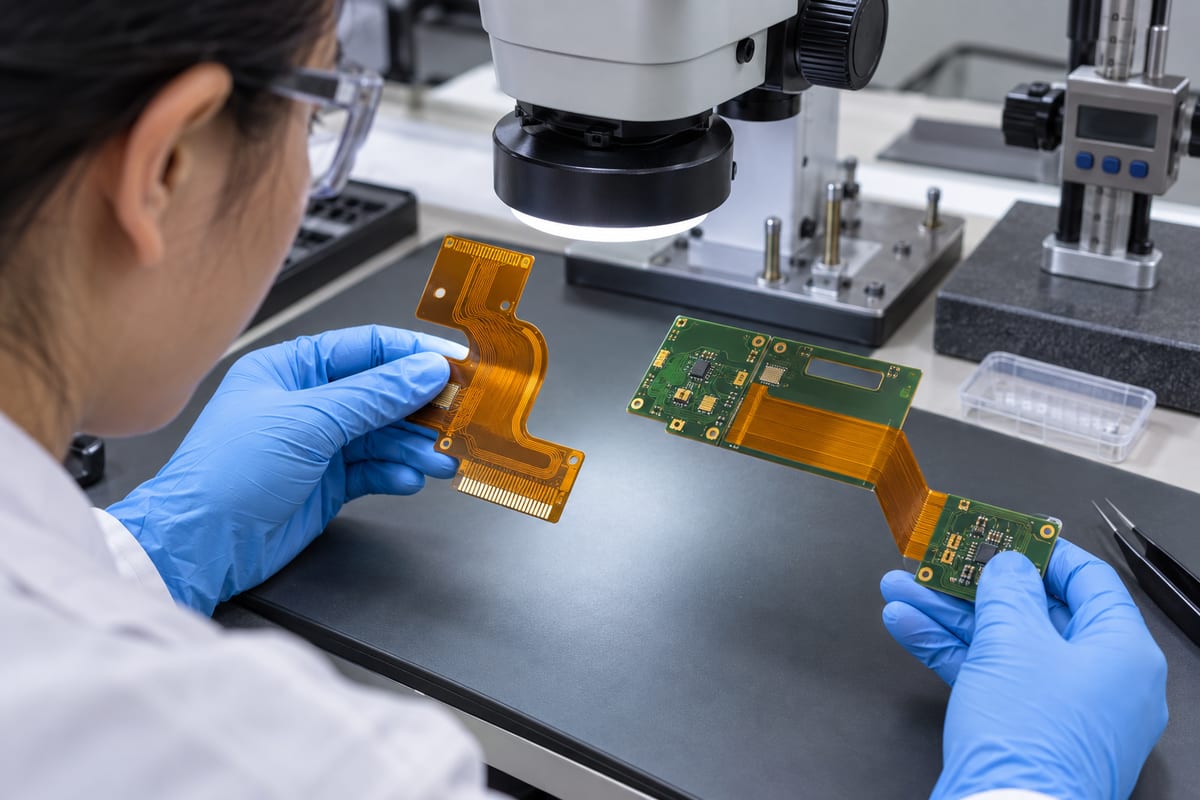
For aerospace and high-reliability work, supplier fit becomes clearer when companies are compared by the manufacturing capability they publicly associate with demanding applications. The five examples below offer different strengths; they should not be treated as interchangeable.
| UK manufacturer | Relevant strength | Projects it may suit |
|---|---|---|
| Amphenol Trackwise | Roll-to-roll long FPC | Aircraft harness replacement |
| Exception PCB | 24-layer rigid-flex and HDI | Dense avionics and defence boards |
| Graphic PLC | Flex-rigid and advanced vias | Avionics, space, and medical |
| GSPK Circuits | UK specialist flex production | Defence and controlled UK supply |
| PW Circuits | Flex-rigid and Class 3 | High-reliability, mid-volume builds |
Amphenol Trackwise is the most distinctive choice when circuit length is the central problem. Its continuous roll-to-roll process supports working panels up to 100 metres long and 630 mm wide, with up to eight copper layers for prototypes and four for production, subject to construction. Trackwise states that it has manufactured a flexible multilayer circuit longer than 72 metres. This capability is relevant when a printed circuit replaces wiring across an aircraft wing, vehicle battery system, or other large structure; it adds little value to an ordinary short FPC.
Exception PCB is more relevant when high reliability is combined with dense rigid-flex construction. Its published capability includes up to 24 rigid-flex layers, up to 12 flex layers, track and gap down to 60 µm on its advanced process, laser microvias down to 75 µm, and copper or resin via filling. These features make it a stronger candidate for compact assemblies in which the rigid section carries HDI components while the flex section replaces separate interconnects.
Graphic PLC positions its UK manufacturing around high-technology PCBs for avionics, space, security, medical, and other high-reliability sectors. Its stated strengths include flex-rigid construction, HDI, blind and buried vias, filled and stacked vias, and sequential build-up. It may therefore be relevant when the project needs both flex-rigid integration and advanced via structures.
GSPK Circuits offers a broader specialist-PCB route from its North Yorkshire facility. Its published material identifies defence as a sector that can benefit from controlling processes such as ENEPIG internally rather than sending boards to an external subcontractor. This may matter when the customer values UK production and a shorter, more visible manufacturing chain alongside flex or rigid-flex capability.
PW Circuits publicly lists single- and double-sided flex, multilayer flex-rigid, specialist material experience, and IPC 6013 Class 3 among its capabilities and approvals. It may suit customers that need UK prototype-to-mid-volume production and requirements associated with more demanding flexible-circuit acceptance.
The useful distinction is not that all five companies serve “high reliability.” Trackwise solves unusual circuit-length problems; Exception PCB and Graphic address complex constructions; GSPK offers broad specialist production with UK process control; and PW Circuits combines flex capability with demanding-board approvals. The application and released construction determine which strength is relevant.

UK Manufacturing or Offshore Production: Which Model Fits?
The right model depends on what the project needs at its current stage.
UK manufacturing is a stronger fit when:
- local production or supply-chain visibility is required;
- early revisions need rapid engineering feedback;
- an unusual construction benefits from close technical discussion;
- low-volume or urgent prototypes are the immediate priority.
Offshore production is a stronger fit when:
- the design is stable and volumes are expected to grow;
- production cost is important;
- multilayer flex, rigid-flex, sourcing, and PCBA need one supply route;
- international logistics can be planned into the schedule.
A hybrid route can fit when:
- a UK factory supports development or urgent prototypes; and
- a qualified offshore factory handles repeat production.
The choice is not “UK quality” versus “offshore cost.” Whichever model is used, materials, stack-up, copper type, coverlay openings, stiffeners, bend regions, finish, and testing must remain controlled. Otherwise, the prototype and production board may look similar while behaving differently.
How Can EBest Circuit Support UK FPC Projects?
EBest Circuit (Best Technology) is an offshore option for UK customers that need flexible or rigid-flex PCB production beyond a local prototype order. Its role is to give the customer one technical route from a released design to repeat manufacturing, while keeping the construction agreed during quotation visible throughout the project.
Support for UK projects centres on four practical outcomes:
- Direct technical communication: Questions about the stack-up, polyimide, copper, coverlay, stiffeners, bend areas, and finish are resolved with the manufacturing team before production. This reduces the risk of commercial messages being passed between the customer, a broker, and an unidentified factory.
- A controlled move from prototype to production: The agreed materials, layer structure, flex thickness, openings, and test requirements can remain part of the same manufacturing definition as quantities increase. The customer does not need to restart the technical discussion simply because the project moves beyond its first build.
- Offshore production with a defined scope: UK customers can use EBest Circuit when local production does not provide the required commercial fit, production capacity, or flex and rigid-flex process range. The value comes from matching the released construction to an established process, not from choosing an offshore quotation on price alone.
- Optional fabrication-to-assembly continuity: When the project includes connectors or mounted components, sourcing and PCBA can follow the same technical handoff. When only bare FPCs are required, the project can remain fabrication-only without an unnecessary assembly package.
The manufacturing capabilities discussed earlier in this article provide the technical basis for this support. EBest Circuit confirms the usable combination for each design rather than assuming that separate maximum values for layers, copper, thickness, and fine features can all be applied at once.
Send your Gerber or ODB++ data, drill files, stack-up, mechanical drawing, target quantity, and bending conditions to sales@bestpcbs.com. EBest Circuit can then confirm whether the design fits its manufacturing scope and whether bare-board production or a combined fabrication-and-assembly route is more appropriate.
FAQs About FPC Manufacturer UK
Are all companies appearing as UK FPC manufacturers producing boards in the UK?
No. Search results can include UK factories, local sales offices, PCB brokers, assembly companies, and overseas manufacturers serving UK customers. Verify the stated production location and the company responsible for manufacturing control rather than relying on the page title alone.
Which UK manufacturer is suitable for a complex rigid-flex PCB?
Exception PCB publicly presents high-layer-count rigid-flex, HDI, microvia, and via-filling capabilities, making it a relevant candidate for complex builds. GSPK and Merlin Flex also publish substantial flex and rigid-flex capabilities. The final choice should be based on the complete stack-up and feature combination rather than layer count alone.
Which UK manufacturer specialises in long flexible circuits?
Amphenol Trackwise specialises in long-length multilayer flexible circuits manufactured with a continuous roll-to-roll process. Its technology is most relevant when the FPC replaces an extended wiring harness or must span a structure much larger than a conventional PCB panel.
Can UK FPC manufacturers also assemble components?
Some can. Merlin Flex publicly includes added-value component assembly, while other UK suppliers may provide assembly internally or through partners. Confirm whether the same organisation controls fabrication and assembly, especially when connectors, stiffeners, and component areas interact mechanically.
When should a UK customer consider an offshore FPC manufacturer?
An offshore manufacturer may be appropriate when the design is sufficiently defined, production volume is expected to grow, pricing must remain competitive, or fabrication and PCBA need to be coordinated. The offshore source should still demonstrate that its materials and process limits fit the released construction.
If you are comparing a UK factory with an experienced offshore FPC manufacturer UK customers can work with directly, EBest Circuit can evaluate your design against practical fabrication and assembly capabilities. Contact sales@bestpcbs.com for a project-specific review.