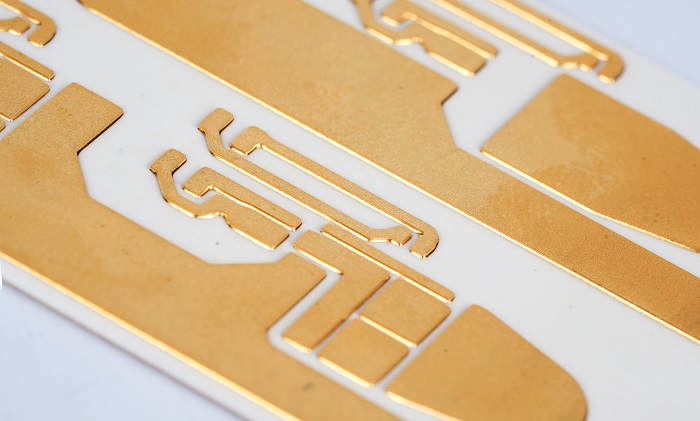
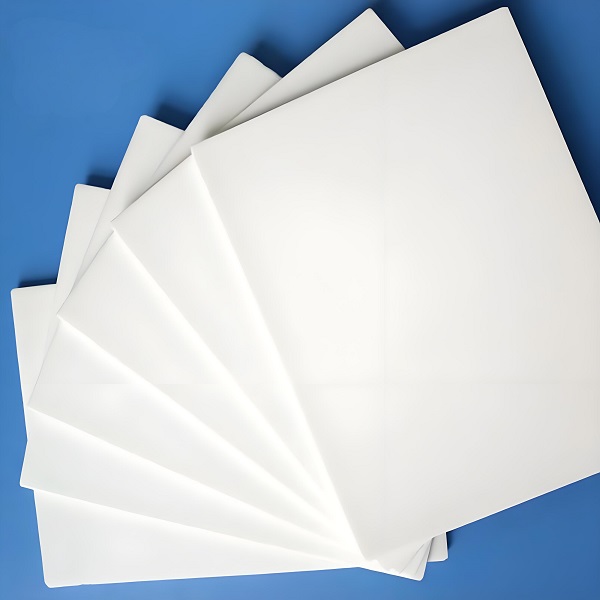
Alumina board is a ceramic substrate made from aluminum oxide, widely used when a circuit or structural part needs electrical insulation, heat transfer, dimensional stability, and long service life.
In electronics manufacturing, it is often selected for ceramic PCBs, power modules, LED substrates, RF circuits, sensors, heaters, and industrial control boards. Compared with FR4, alumina offers much higher thermal conductivity and better high-temperature stability, while staying more cost-friendly than aluminum nitride in many projects.
What Is an Alumina Board?
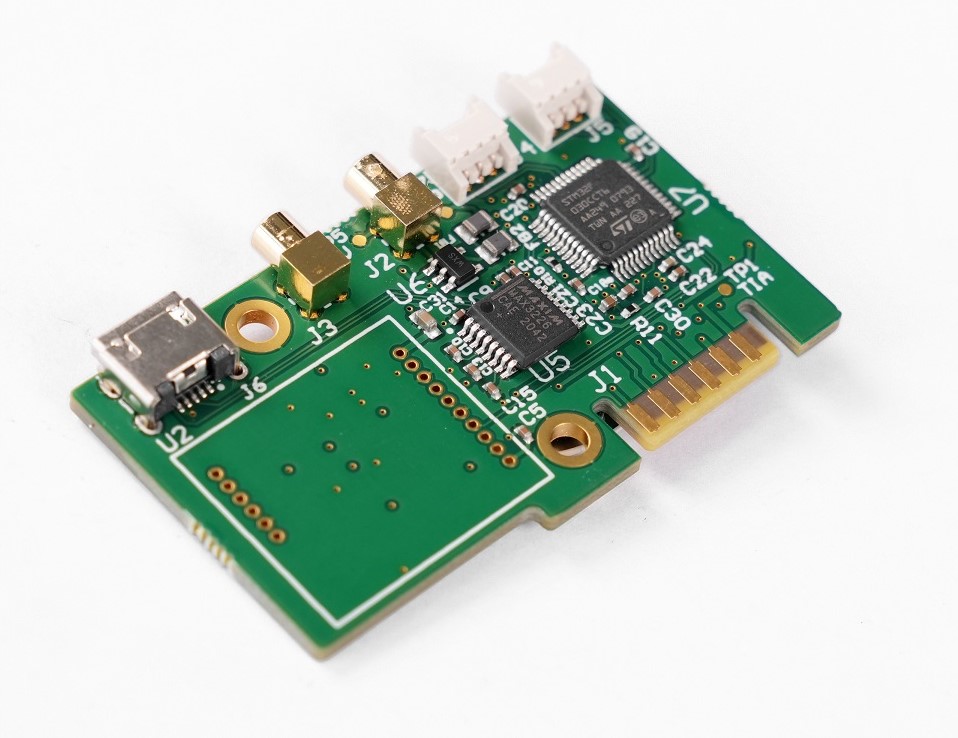
An alumina board is a flat ceramic plate made mainly from aluminum oxide, also written as Al₂O₃. In electronic manufacturing, it can serve as an insulating base, a thermal carrier, or a circuit substrate after metallization. When copper, silver, gold, or tungsten conductors are applied to its surface, the board becomes part of a ceramic PCB or hybrid circuit.
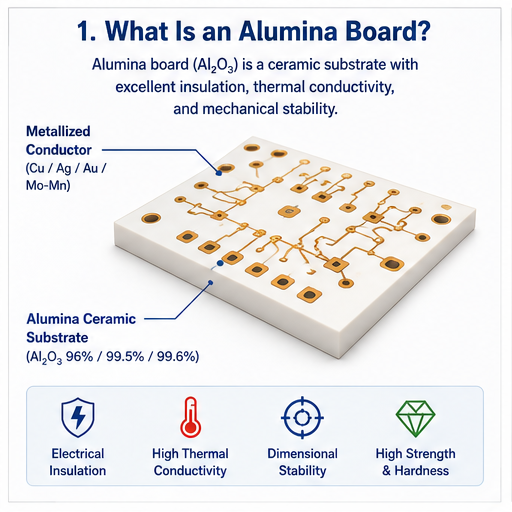
The most common grades used in electronics are 96% alumina and high-purity alumina such as 99.5% or 99.6%. 96% alumina is widely used because it balances cost, strength, insulation, and thermal performance. Higher-purity alumina is preferred when a project needs tighter electrical stability, finer thin-film circuits, or better surface quality. Microwaves101 notes that 96% alumina is a workhorse material in microwave integrated circuits, while 99.5% alumina is often used in thin-film networks.
In simple terms, alumina board is chosen when standard organic PCB materials cannot provide enough heat resistance, insulation, or mechanical stability for the working environment.
Why Does Alumina Board Matter in Electronic Manufacturing?
Modern electronics are getting smaller, hotter, and more power-dense. That creates a clear material challenge. A substrate must carry the circuit, isolate voltage, transfer heat, resist aging, and keep dimensions stable during thermal cycling.
FR4 is suitable for many standard electronic products, but its thermal conductivity is low. Cadence lists typical FR4 thermal conductivity at about 0.3–0.5 W/mK, while alumina is commonly around 20–30 W/mK and aluminum nitride can reach much higher ranges. This gap explains why engineers consider alumina when heat flow is part of the circuit design, not only a mechanical detail.
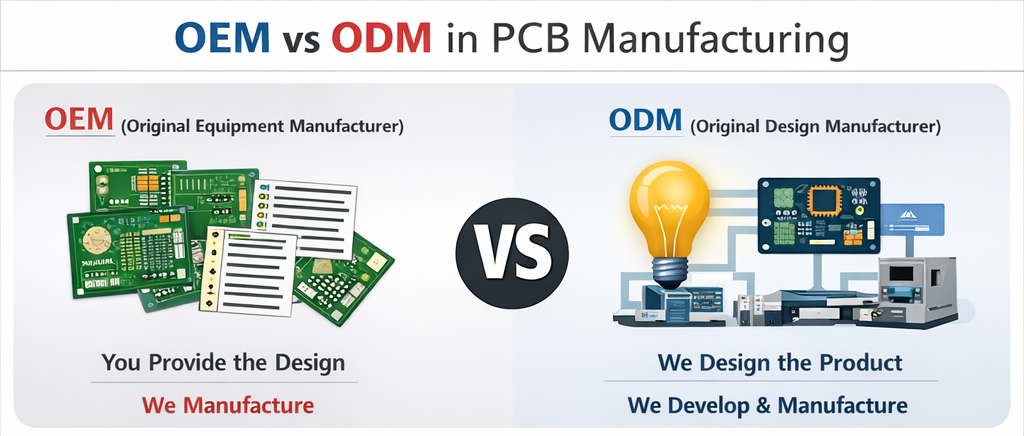
For buyers, alumina also matters because it offers a practical middle ground. It gives better heat dissipation than FR4 and many metal-core boards, while keeping cost lower than AlN in many mass-production projects. For OEM and ODM products, that balance can improve reliability without forcing the project into an unnecessarily expensive substrate.
How Does an Alumina Board Work in a Circuit?
An alumina board works by combining three functions in one substrate: insulation, heat conduction, and mechanical support.
Electrical insulation: Alumina is a ceramic insulator. It helps separate conductive paths even in high-voltage or compact circuit layouts. This is useful in power electronics, ignition systems, heating controls, sensors, and high-reliability modules.
Thermal conduction: Heat generated by chips, resistors, LEDs, or power devices can move through the alumina substrate more efficiently than through FR4. This reduces hot-spot accumulation and supports stable component operation.
Mechanical stability: Alumina has high hardness and good dimensional stability. Du-Co lists 96% dense alumina as having strong electrical, wear-resistant, high-temperature, and mechanical properties, with a safe operating temperature listed at 1550°C for the ceramic material itself.
In a ceramic PCB, conductive patterns are formed on alumina by thick-film printing, thin-film deposition, DPC, DBC, or other metallization methods. The best process depends on current load, line width, thermal path, cost target, and assembly method.
Common Types of Alumina Board for Engineering Projects
Alumina boards are usually classified by purity, surface finish, metallization method, and final use.
| Type | Common Use | Main Advantage | Typical Consideration |
|---|---|---|---|
| 96% alumina board | Ceramic PCB, LED substrate, heater board, power control | Good cost-performance balance | Surface roughness and tolerance must match the circuit process |
| 99.5% / 99.6% alumina board | Thin-film circuit, RF module, precision sensor | Better purity and electrical stability | Higher material and processing cost |
| Thick-film alumina board | Hybrid circuit, resistor network, sensor module | Mature and cost-efficient | Conductor thickness and current capacity need review |
| Thin-film alumina board | RF, microwave, precision circuit | Fine traces and stable signal behavior | Requires cleaner process control |
| Metallized alumina board | Brazing, soldering, power module, package base | Supports strong conductor bonding | Metallization stack must match assembly conditions |
| Plain alumina ceramic board | Insulation plate, fixture, spacer, heat-resistant carrier | Simple structure and stable insulation | Machining tolerance and edge quality are key |
For most industrial and commercial electronic products, 96% alumina is the starting point. Higher-purity grades are selected after the design team confirms frequency, surface finish, leakage current, dielectric loss, or long-term environmental requirements.
Alumina Board Materials and Key Technical Properties
The key material properties of alumina board include thermal conductivity, dielectric strength, dielectric constant, volume resistivity, coefficient of thermal expansion, hardness, and flexural strength.
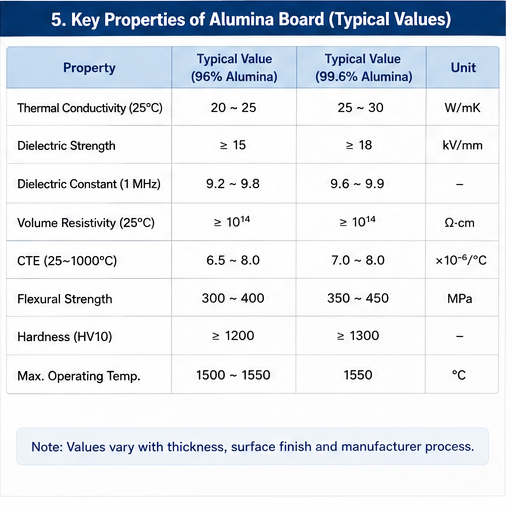
Typical values vary by purity, forming method, sintering recipe, grain structure, surface finish, and supplier specification. A property chart from Superior Technical Ceramics shows thermal conductivity values rising across different alumina grades, with listed room-temperature values from 19 W/mK to 35 W/mK for several alumina and high-purity alumina materials. The same chart lists dielectric constants around 9.0–9.9 at 1 MHz for many grades.
| Property | Typical Engineering Meaning | Why It Matters |
|---|---|---|
| Thermal conductivity | Heat transfer capability | Helps move heat away from power devices or LEDs |
| Dielectric strength | Insulation resistance under voltage stress | Supports compact high-voltage layouts |
| Dielectric constant | Signal propagation behavior | Important for RF, microwave, and impedance-sensitive designs |
| CTE | Expansion under temperature change | Affects solder joints, copper bonding, and package stress |
| Surface roughness | Topography of the ceramic surface | Impacts thin-film circuits, printing accuracy, and bonding |
| Flexural strength | Resistance to bending stress | Important during machining, assembly, and field vibration |
| Volume resistivity | Bulk insulation property | Supports leakage control in high-voltage applications |
For procurement, the safest approach is to request the actual material datasheet from the manufacturer instead of using one universal value. Alumina grades with the same purity can still behave differently in production.
Alumina Board vs FR4, Aluminum PCB, AlN, and Si3N4
Alumina board is often compared with FR4, aluminum PCB, aluminum nitride, and silicon nitride. Each material has its own best-fit area.
| Material | Thermal Performance | Electrical Insulation | Mechanical Behavior | Cost Level | Best-Fit Applications |
|---|---|---|---|---|---|
| FR4 | Low | Good for standard circuits | Easy to process | Low | Consumer electronics, control boards, general PCB |
| Aluminum PCB / MCPCB | Medium, depends on dielectric layer | Insulation layer is the limiting point | Good for flat LED boards | Medium | LED lighting, power boards, thermal spreader designs |
| Alumina board | High compared with FR4 | Excellent | Hard and stable | Medium | Ceramic PCB, power module, RF, sensors, heaters |
| Aluminum nitride | Very high | Excellent | More demanding process | High | High-power laser, advanced power module, high-heat device |
| Silicon nitride | Good | Good | Strong fracture toughness | High | Automotive power modules, vibration-prone systems |
MADPCB lists 96% alumina at about 24 W/mK and 99.6% alumina at about 29 W/mK, while AlN is listed much higher and SiN is noted for stronger shock resistance and structural reliability.
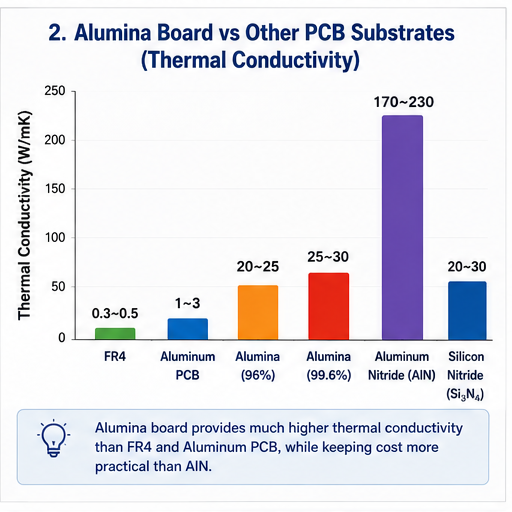
The practical conclusion is straightforward: choose alumina when your project needs better thermal and electrical performance than FR4 or standard MCPCB, while keeping cost more controlled than AlN.
How to Choose the Right Alumina Board for Your Design?
Choosing the right alumina board starts with the application environment, not the material name. Engineers should define heat load, voltage stress, line width, assembly process, size tolerance, and field conditions before selecting the grade.
For LED and lighting modules, 96% alumina is often enough when the design needs good heat dissipation, high reflectivity, and stable insulation. It is useful for high-brightness LEDs, UV modules, and compact lighting products.
For RF and microwave circuits, surface flatness, dielectric constant, dielectric loss, conductor geometry, and metallization method become more important. High-purity alumina is often selected for finer circuit control.
For power electronics, current capacity, copper thickness, thermal resistance, solder joint reliability, and ceramic cracking risk should be reviewed together. The substrate must support both electrical load and heat flow.
For sensors and medical electronics, cleanliness, dimensional control, insulation stability, and process traceability are important. The material must support stable performance over the product lifecycle.
A good selection rule is to avoid choosing alumina only because it sounds “high-end.” Use it when the operating condition creates a real need for ceramic insulation, heat conduction, high-temperature stability, or precise circuit behavior.
Alumina Board Manufacturing Process and Metallization Options
The manufacturing route depends on whether the alumina board is a plain ceramic sheet, a metallized substrate, or a finished ceramic PCB.
A typical alumina board process includes powder preparation, forming, drying, binder removal, sintering, lapping or polishing, laser cutting or CNC machining, cleaning, metallization, patterning, plating, inspection, and packaging. For ceramic PCB production, additional steps may include conductor printing, copper deposition, etching, firing, surface finish, solder mask where applicable, and assembly.
Common metallization methods include:
| Process | How It Works | Suitable Use |
|---|---|---|
| Thick film | Conductive paste is screen-printed and fired | Hybrid circuits, sensors, resistor networks, cost-sensitive ceramic PCB |
| Thin film | Metal layers are deposited and patterned | RF, microwave, precision circuits, fine-line designs |
| DPC | Copper is deposited directly on ceramic and patterned | Fine circuits, LEDs, sensors, compact ceramic PCB |
| DBC | Copper foil is bonded to ceramic at high temperature | Power modules and high-current designs |
| AMB | Active metal brazing bonds metal to ceramic | High-reliability power modules and demanding thermal cycles |
Thick-film technology is widely used because it is mature and cost-effective. MADPCB describes thick-film processing as adding conductor layers such as copper or silver onto a ceramic substrate through screen printing, with a typical conductor thickness range of 7–20 μm.
For custom alumina boards, the manufacturer should confirm the metallization stack, adhesion strength, solderability, plating thickness, edge quality, and cleaning standard before batch production.
Testing Methods and Quality Standards for Alumina Boards
Quality control for alumina board production should cover raw material, ceramic forming, surface treatment, metallization, circuit pattern, electrical performance, and final packaging.
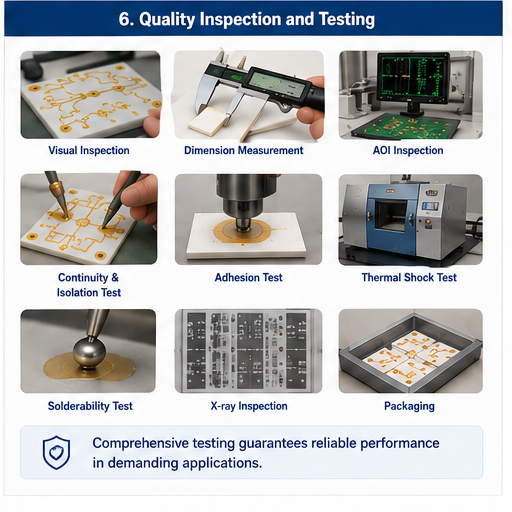
Common inspection items include:
| Test Item | Purpose | Typical Production Value |
|---|---|---|
| Visual inspection | Checks cracks, chips, stains, pinholes, edge damage | Prevents visible defects from entering assembly |
| Dimension measurement | Confirms length, width, thickness, hole size, flatness | Supports assembly fit and fixture compatibility |
| Surface roughness test | Confirms finish for printing, plating, or bonding | Improves metallization consistency |
| AOI | Checks pattern accuracy and surface defects | Useful for finished ceramic PCB |
| Continuity and isolation test | Verifies circuit open/short conditions | Essential before assembly |
| Adhesion test | Checks metal-to-ceramic bond strength | Important for soldering and thermal cycling |
| Thermal shock test | Evaluates reliability under temperature change | Useful for automotive, LED, and power modules |
| Solderability test | Confirms assembly readiness | Reduces SMT or solder joint issues |
| X-ray inspection | Checks voids and hidden assembly defects | Useful after PCBA assembly |
For standards, alumina board projects may involve ISO 9001 quality management, RoHS and REACH material compliance, UL requirements where applicable, and IPC-related workmanship expectations for assembled electronics. For PCBA, IPC-A-610 is commonly used as an assembly acceptance reference. For bare ceramic substrates, supplier-specific drawings, agreed inspection criteria, and material datasheets are especially important because ceramic boards differ from standard FR4 PCB production.
Common Failure Modes and Factory-Level Prevention
Alumina boards are reliable when the design and manufacturing process are matched correctly. Most issues come from mismatch between material behavior, copper design, assembly temperature, and mechanical handling.
| Failure Mode | Common Cause | Prevention Method |
|---|---|---|
| Ceramic cracking | Sharp internal corners, improper panel handling, high assembly stress | Add radius design, improve fixtures, control loading pressure |
| Metallization peeling | Weak bonding, contaminated surface, wrong firing profile | Improve cleaning, verify paste or copper process, test adhesion |
| Edge chipping | Aggressive cutting, poor packaging, thin fragile geometry | Use laser cutting or optimized machining, add protective packing |
| Solder joint fatigue | CTE mismatch between ceramic, copper, and components | Review pad size, solder alloy, thermal cycle conditions |
| Hot spots | Poor thermal path, insufficient copper area, weak interface material | Simulate heat flow and improve copper layout or mounting method |
| Electrical leakage | Surface contamination, poor cleaning, insufficient spacing | Strengthen cleaning process and confirm creepage/clearance |
| Warpage or flatness issue | Sintering variation, thin large panel, unsuitable tolerance | Define flatness early and use proper ceramic forming control |
From a factory perspective, early DFM review is valuable. The manufacturer should check hole-to-edge spacing, board thickness, trace width, copper coverage, metallization type, panel format, firing conditions, and assembly temperature before production starts.
Alumina Board Applications and Project Examples
Alumina board is used across many industries where heat, insulation, and stability are part of the product design.
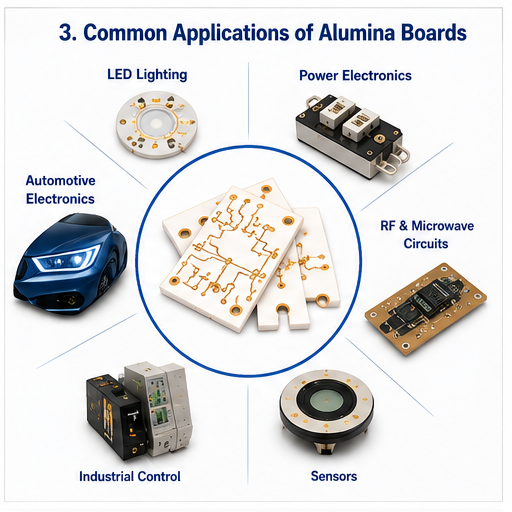
Power electronics: Alumina substrates support switching devices, rectifiers, power resistors, and driver modules. They help manage heat while keeping electrical insulation stable.
LED lighting: High-power LED modules use alumina boards for heat transfer and light reflection. Applications include industrial lighting, UV curing, automotive lamps, and compact optical modules.
RF and microwave circuits: Alumina is used in antennas, filters, hybrid circuits, microwave modules, and sensor front ends. Its stable dielectric behavior supports more predictable circuit performance than many general-purpose materials.
Medical electronics: Alumina boards can be used in sensor modules, diagnostic devices, heating elements, and compact control circuits that need insulation and dimensional stability.
Industrial control: Ceramic boards appear in motor drives, power conversion, automation sensors, high-temperature monitoring, and harsh-environment control systems.
Automotive electronics: Alumina is used in ignition modules, LED headlight circuits, sensor packaging, and power control designs. For vibration-heavy or high-shock areas, engineers may compare alumina with silicon nitride during material selection.
Practical case example: In a high-power LED module, replacing FR4 with alumina can reduce thermal bottlenecks between the LED chip and heat sink. The final result depends on copper design, solder layer, thermal interface material, and mechanical mounting, so the substrate upgrade should be reviewed as part of the whole thermal path.
Cost Factors, Procurement Advice, and Supplier Selection
The cost of alumina board depends on more than the ceramic material itself. Purity, thickness, tolerance, surface finish, board size, hole design, metallization, copper thickness, surface finish, testing level, and order quantity all affect the final price.
| Cost Factor | Why It Changes Price |
|---|---|
| Alumina purity | Higher purity usually needs tighter material control |
| Thickness and size | Thin, large, or unusual shapes increase handling difficulty |
| Tolerance | Tight tolerance may require lapping, polishing, or precision machining |
| Surface roughness | Thin-film and bonding applications need better surface control |
| Metallization method | DPC, DBC, AMB, thick film, and thin film have different process costs |
| Hole and slot design | Ceramic machining is more demanding than FR4 drilling |
| Copper thickness | Higher current designs need stronger metallization planning |
| Testing requirements | Thermal shock, adhesion, AOI, and traceability add process value |
| Quantity | Batch production improves unit cost after setup is absorbed |
For procurement teams, the best supplier is one that can discuss both ceramic processing and electronic manufacturing. A pure ceramic shop may understand material forming, while a PCB/PCBA manufacturer can better support circuit layout, solderability, DFM, testing, and assembly.
A reliable China-based source factory should provide clear drawings review, material confirmation, tolerance advice, sample validation, batch consistency, global shipping support, and documentation. For US and European buyers, RoHS, REACH, traceability, packaging protection, and consistent communication are often as important as unit price. For Southeast Asian buyers, lead time, batch flexibility, and cost control usually carry more weight.
Pre-Order Checklist for Custom Alumina Board Projects
Before placing an alumina board order, prepare a complete technical package. This reduces engineering back-and-forth and keeps sampling closer to the final production target.
Use this checklist:
| Item | What to Confirm |
|---|---|
| Application | LED, RF, power, sensor, heater, insulation, or ceramic PCB |
| Material grade | 96%, 99.5%, 99.6%, or another specified alumina grade |
| Board size | Length, width, thickness, tolerance, and flatness |
| Surface finish | As-fired, lapped, polished, or customized roughness |
| Metallization | Thick film, thin film, DPC, DBC, AMB, or plain ceramic |
| Conductor material | Copper, silver, gold, tungsten, molybdenum-manganese, or other stack |
| Circuit files | Gerber, DXF, CAD drawing, stack-up, and BOM if assembly is needed |
| Electrical needs | Voltage, current, insulation, impedance, frequency, creepage distance |
| Thermal needs | Power loss, heat sink method, operating temperature, thermal cycling |
| Assembly method | SMT, wire bonding, soldering, brazing, screw mounting, or adhesive bonding |
| Test requirements | AOI, e-test, adhesion, thermal shock, X-ray, functional test |
| Compliance | RoHS, REACH, UL-related needs, ISO documentation, customer-specific standard |
| Packaging | Anti-chip protection, vacuum packing, tray packing, label, traceability |
The earlier these details are shared, the faster the engineering team can recommend the right process and avoid unnecessary prototype iterations.
FAQs About Alumina Board
What is alumina board used for?
Alumina board is used as an insulating, heat-conductive, and mechanically stable ceramic base. In electronics, it is common in ceramic PCBs, LED modules, power circuits, RF boards, sensors, heaters, and high-temperature control systems. It is also used as an insulating plate, spacer, fixture, or heat-resistant structural part in industrial equipment.
Is alumina board the same as ceramic PCB?
An alumina board is the ceramic substrate material. A ceramic PCB is a finished circuit board built on a ceramic substrate, often with copper, silver, gold, or other conductive patterns. So, an alumina board can become part of a ceramic PCB after metallization, patterning, surface finishing, and electrical testing.
Why choose alumina board instead of FR4?
Engineers choose alumina board when the circuit needs better thermal conductivity, stronger insulation, higher temperature stability, or more stable dimensions than FR4 can provide. FR4 remains practical for standard electronics, while alumina fits high-power, high-temperature, compact, or reliability-sensitive designs where heat and insulation are major design factors.
Is alumina board better than aluminum PCB?
Alumina board offers ceramic insulation and strong thermal stability, while aluminum PCB relies on a metal base plus a dielectric insulation layer. For many LED and power applications, both can work. Alumina becomes attractive when the design needs ceramic insulation, high operating stability, compact spacing, or better resistance to harsh environments.
What is the common thickness of alumina board?
Common alumina board thicknesses include 0.25 mm, 0.38 mm, 0.5 mm, 0.635 mm, 1.0 mm, and 1.5 mm, although availability depends on the supplier and process. Thin boards support compact thermal paths, while thicker boards improve stiffness and handling strength. The final choice should match assembly stress and thermal needs.
Can alumina board be used for high-frequency circuits?
Yes. Alumina board is widely used in RF, microwave, hybrid, and sensor circuits. Its dielectric constant and low loss behavior can support stable circuit performance when the layout is designed correctly. For high-frequency designs, engineers should confirm dielectric constant, loss tangent, thickness tolerance, surface roughness, and metallization accuracy before production.
What is the difference between 96% and 99.6% alumina board?
96% alumina is widely used because it offers a strong balance of cost, insulation, thermal conductivity, and manufacturability. 99.6% alumina has higher purity and is often selected for finer circuits, better surface quality, or more demanding electrical stability. The better choice depends on circuit accuracy, budget, and operating environment.
Can alumina board crack during production or assembly?
Alumina is hard and stable, but ceramic materials require proper handling. Cracking risk increases with sharp corners, thin large panels, high mounting pressure, poor machining design, or severe thermal shock. A good manufacturer can reduce this risk through DFM review, radius design, controlled cutting, suitable packaging, and fixture optimization.
What surface finish can be used on alumina ceramic PCB?
Surface finish depends on the metallization system. Ceramic PCBs may use ENIG, silver, gold, nickel, or other finishes depending on soldering, wire bonding, brazing, or corrosion requirements. For thick-film and thin-film circuits, conductor material and firing process also affect finish selection. The assembly method should be confirmed first.
How much does custom alumina board cost?
Cost depends on purity, size, thickness, tolerance, surface roughness, hole design, metallization method, copper thickness, testing, and quantity. A simple plain alumina plate costs less than a precision metallized ceramic PCB. For accurate pricing, provide drawings, Gerber files, material grade, tolerance, and test requirements at the quotation stage.
What files are needed for alumina board manufacturing?
For plain alumina boards, a mechanical drawing with size, thickness, tolerance, holes, slots, and surface requirements is usually enough. For ceramic PCB production, provide Gerber files, stack-up, material grade, copper thickness, surface finish, BOM, pick-and-place file, and assembly drawing if PCBA service is required.
How do I choose a reliable alumina board supplier?
Choose a supplier that can review design feasibility, confirm ceramic grade, control tolerance, provide metallization options, perform inspection, and support sample-to-batch production. For electronic products, a PCB and PCBA manufacturer with ceramic substrate experience is valuable because it can review both material behavior and assembly reliability.
Conclusion:
Alumina board is a practical ceramic substrate for electronic products that need heat transfer, electrical insulation, and long-term stability. It is especially useful in ceramic PCBs, LED modules, power electronics, RF circuits, sensors, industrial controls, and high-temperature applications.
For engineering selection, 96% alumina is often the best starting point because it provides a strong balance of performance and cost. Higher-purity alumina should be considered for RF, thin-film, precision, or demanding electrical applications. For procurement, the most important step is to send complete technical files and ask the manufacturer to review material grade, tolerance, metallization, testing, and assembly compatibility before mass production.
If you need custom alumina boards, ceramic PCB fabrication, PCB assembly, OEM manufacturing, ODM production, sample development, or batch production support, our engineering team can help review your design, optimize the manufacturing process, and provide a practical quotation. Please contact us at sales@bestpcbs.com.