BBT testing in PCB manufacturing is used to verify whether the copper network is correctly connected before the boards move into assembly. By detecting open circuits, short circuits, and unwanted electrical connections, BBT helps prevent defective boards from entering PCBA production.
For PCB projects that require stable quality control, EBest Circuit supports bare PCB manufacturing and PCBA assembly with electrical testing, AOI inspection, X-ray inspection, and traceable quality processes. Customers can provide Gerber files, layer information, copper thickness, surface finish requirements, and production quantities to receive an engineering review and quotation guidance through sales@bestpcbs.com.
What Is BBT Testing in PCB?
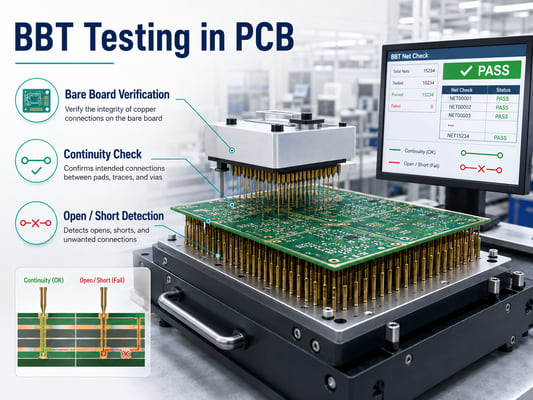
BBT testing stands for Bare Board Testing. It is a form of bare board PCB testing performed on a completed PCB before components are assembled. The purpose is to confirm that all designed conductive paths match the PCB data and that there are no unwanted electrical failures.
During BBT testing, test probes contact specific points on the PCB surface, and the system checks whether each circuit connection meets the expected electrical conditions.
A typical BBT system verifies:
- Open circuits caused by broken traces or incomplete plating
- Short circuits between adjacent copper paths
- Incorrect connections caused by manufacturing defects
- Continuity problems in multilayer PCB structures
Unlike visual inspections such as AOI, BBT does not inspect the physical appearance of traces. It verifies the actual electrical performance of the finished board.
For multilayer, HDI, fine-pitch, and high-density PCB designs, BBT becomes especially valuable because many defects cannot be reliably identified through visual inspection alone.
Why Is BBT Testing Required for PCB Manufacturing?
PCB manufacturing involves multiple processes that can affect electrical connections, including imaging, etching, lamination, drilling, and copper plating. Even small process variations can create electrical failures that are difficult to detect without testing.
BBT testing is required because it provides a final electrical verification before PCB assembly.
Common reasons manufacturers perform BBT include:
| Purpose | Engineering Value |
| Detect open circuits | Prevents broken signal or power paths |
| Detect shorts | Avoids unexpected current paths and board failure |
| Verify circuit continuity | Confirms the PCB matches the original design |
| Improve assembly yield | Reduces defective boards reaching SMT production |
For customers purchasing assembled boards, detecting PCB defects before component placement is usually more cost-effective. A faulty bare board can cause additional losses from component usage, assembly labor, and functional testing.
How Does BBT Testing Work?
The BBT testing process compares the manufactured PCB against the original electrical design data, usually generated from Gerber or ODB++ files.
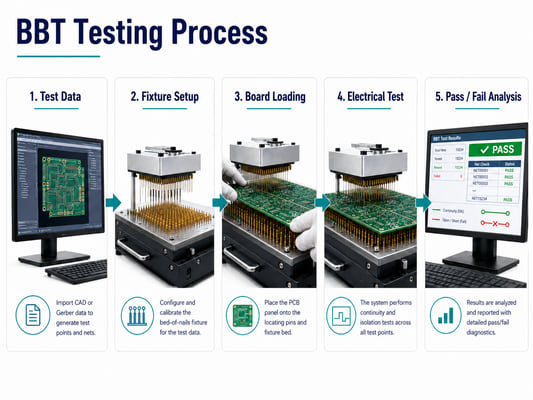
The general workflow includes the following steps:
- Test data preparation The PCB test system imports design files and identifies electrical nets, test points, and expected connections.
- Test fixture preparation A fixture with test probes is created according to the PCB structure. Each probe contacts specific pads or vias on the board.
- PCB loading and positioning The bare PCB is placed into the testing equipment with accurate alignment.
- Electrical measurement The tester applies electrical signals to verify continuity and isolation between different circuits.
- Result evaluation The system compares measured results with the design database and identifies defective locations if failures occur.
For high-volume production, fixture-based BBT is widely used because it offers fast testing speed and repeatable results. For prototypes or low-volume orders, manufacturers may choose flying probe testing because it avoids fixture costs.
What Is the BBT Testing Procedure in PCB Manufacturing?
A PCB BBT test normally starts after the PCB fabrication process is completed. The exact sequence may vary depending on the factory process flow and customer requirements.
A typical procedure includes:
| Step | Operation | Purpose |
| 1 | Import PCB test data | Define electrical networks |
| 2 | Prepare testing fixture | Ensure probe contact accuracy |
| 3 | Load PCB panels | Position boards for testing |
| 4 | Perform electrical test | Check continuity and insulation |
| 5 | Analyze test results | Separate qualified and failed boards |
Before testing begins, manufacturers usually confirm:
- Correct Gerber or ODB++ data
- PCB revision consistency
- Test point accessibility
- Required test coverage level
For complex multilayer PCBs, proper test preparation is important because insufficient test points or incorrect data mapping can reduce testing effectiveness.
When Does BBT Testing Start During PCB Production?
BBT testing starts after PCB fabrication is completed and before PCB assembly begins.
A typical PCB manufacturing sequence is:
Inner layer fabrication → Lamination → Drilling → Copper plating → Outer layer imaging → Surface finish → BBT testing → Final inspection → PCB assembly
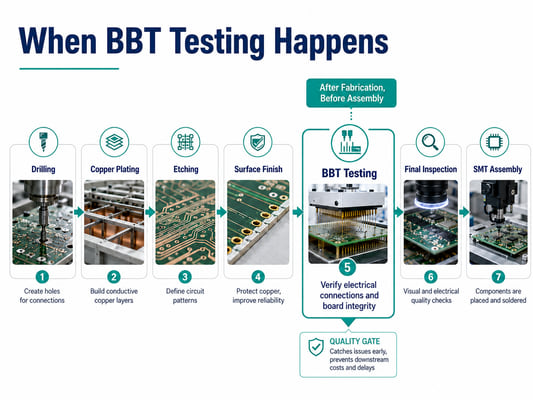
The timing is important because BBT verifies the finished bare board before components are mounted.
For PCB manufacturers and buyers, performing BBT before SMT assembly helps avoid:
- Component waste caused by defective boards
- Assembly line interruptions
- Additional troubleshooting time after assembly
For prototype quantities, customers may choose alternative electrical testing methods depending on production volume and cost requirements.
What Defects Can BBT Testing Detect on a PCB?
BBT testing focuses on electrical failures that affect PCB functionality. It is especially effective for identifying hidden connection problems inside complex PCB structures.
Common defects detected by BBT include:
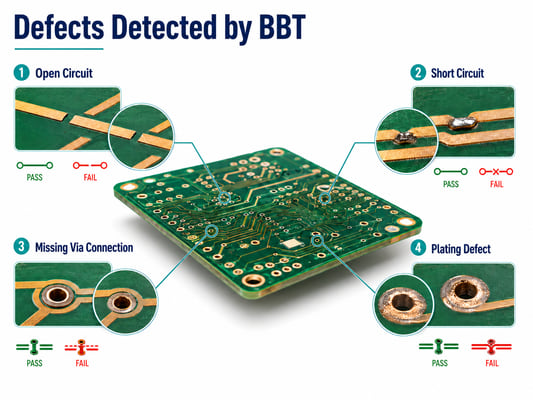
- Open circuits caused by broken copper traces
- Short circuits between different electrical nets
- Missing connections between layers
- Incorrect via connections
- Plating-related continuity problems
However, BBT does not replace every inspection method. For example:
- AOI checks physical defects such as trace shape, solder mask issues, and missing copper patterns.
- X-ray inspection checks internal structures such as hidden solder joints or vias.
- BBT confirms electrical connectivity.
A reliable PCB quality system usually combines multiple inspection methods based on product requirements.
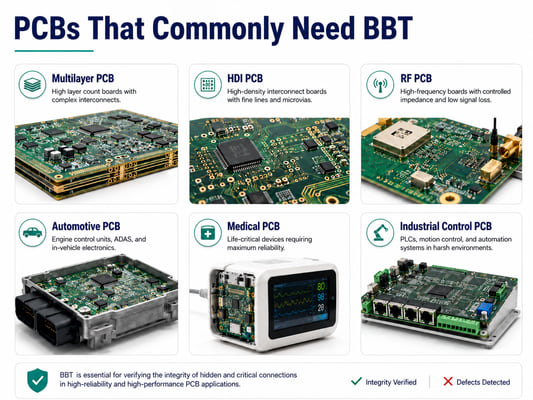
What Types of PCB Require BBT Testing?
Most professional PCB manufacturers recommend electrical testing for boards where reliability and circuit density are important.
Common applications include:
- Multilayer PCBs
- HDI PCBs
- High-frequency RF PCBs
- Automotive electronics
- Medical equipment boards
- Industrial control systems
- Power electronics PCBs
The need for BBT depends mainly on:
- PCB complexity
- Production quantity
- Reliability requirements
- Cost of failure after assembly
For simple single-sided boards with low-risk applications, customers may use different inspection strategies. However, for multilayer boards used in critical electronics, BBT is generally considered a standard quality step.
How Much Does PCB BBT Testing Cost?
The BBT testing cost is not a fixed amount because it depends on PCB design, production volume, and testing requirements.
The main factors affecting cost include:
| Factor | Cost Impact |
| PCB size | Larger boards require larger fixtures and more testing resources |
| Layer count | Complex designs require more test points and verification |
| Production quantity | High volume reduces average testing cost |
| Fixture requirement | Custom fixtures increase initial setup cost |
| Test coverage | Higher coverage requires more testing time |
For mass production, fixture-based BBT usually provides a lower cost per board because the testing speed is high.
For prototypes, low-volume orders, or frequent design changes, flying probe testing may be more practical because no dedicated fixture is required.
When requesting a quotation, customers should provide:
- PCB dimensions
- Layer count
- Gerber or ODB++ files
- Production quantity
- Required test method
- Expected delivery schedule
These details allow manufacturers to evaluate the most suitable testing solution.
Flying Probe Test vs BBT: What Is the Difference?
The choice between BBT and flying probe testing mainly depends on production volume, lead time, and cost structure.
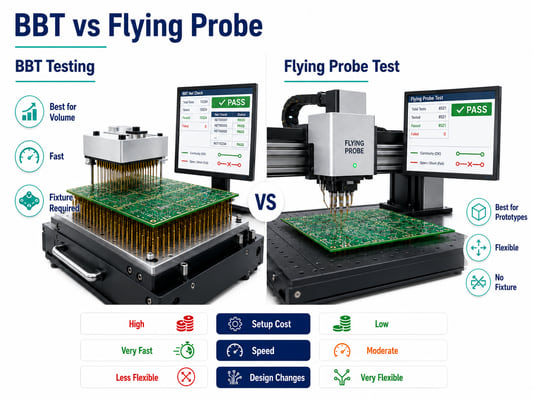
| Item | BBT Testing | Flying Probe Testing |
| Main application | Medium and high-volume production | Prototype and low-volume production |
| Fixture requirement | Requires dedicated fixture | No dedicated fixture needed |
| Testing speed | Faster for mass production | Slower due to probe movement |
| Initial setup cost | Higher | Lower |
| Design changes | Requires fixture updates | Easier for frequent changes |
For customers producing thousands of PCBs, BBT is usually more economical because the fixture investment is distributed across many boards.
For prototypes or engineering samples where the design may change frequently, flying probe testing often provides better flexibility.
How Do PCB Manufacturers Ensure Reliable BBT Testing Results?
Reliable BBT testing depends on more than having testing equipment. The accuracy of the final result also depends on data preparation, equipment maintenance, and process control.
Important factors include:
- Accurate test data generated from the latest PCB design revision
- Proper fixture maintenance and probe condition checks
- Controlled testing parameters
- Clear failure analysis procedures
- Production traceability
At EBest Circuit, PCB projects are supported by engineering review, fabrication control, and inspection processes including electrical testing, AOI, and PCBA verification. This helps customers evaluate manufacturing risks before moving into volume production.
For projects with tight reliability requirements, customers should confirm:
- Testing standard
- Test coverage requirement
- Inspection reports needed
- Traceability expectations
FAQs About BBT Testing in PCB
What does BBT stand for in PCB?
BBT stands for Bare Board Testing. It is an electrical test used to verify PCB connectivity before component assembly.
Is BBT testing included in PCB manufacturing?
Many PCB manufacturers include basic electrical testing as part of their production process, but customers should confirm whether BBT is included in the quotation.
What is the difference between BBT and flying probe testing?
BBT uses a dedicated fixture and is suitable for volume production, while flying probe testing uses moving probes and is more flexible for prototypes.
Can BBT testing detect PCB open and short circuits?
Yes. BBT is mainly used to detect open circuits, short circuits, and other electrical connection failures.
How long does PCB BBT testing take?
Testing time depends on PCB size, design complexity, test coverage, and production quantity. High-volume production usually benefits from faster fixture-based testing.
Conclusion
BBT testing in PCB manufacturing is an important electrical verification step that confirms whether a bare PCB meets the intended circuit design before assembly. Understanding the BBT testing process, testing procedure, timing, and cost factors helps engineers and purchasing teams choose the right manufacturing approach.
For PCB projects requiring reliable electrical performance, EBest Circuit provides PCB and PCBA manufacturing support with engineering communication, quality inspection, and production testing capability. Send your Gerber files, PCB specifications, and production requirements to sales@bestpcbs.com for engineering review and quotation support.