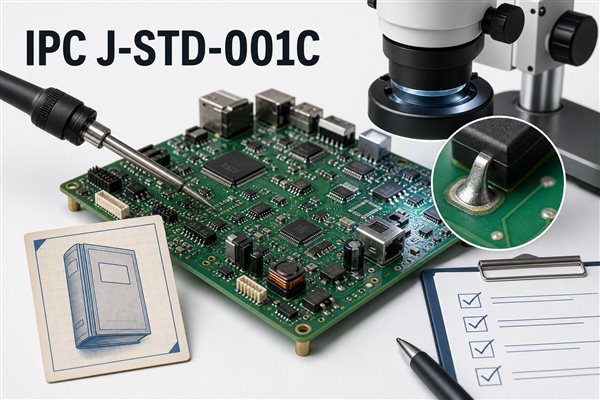
IPC J-STD-001C is the March 2000 revision of the industry standard titled Requirements for Soldered Electrical and Electronic Assemblies. It defined material, process, workmanship, and acceptance requirements for producing soldered assemblies, but it is now a historical revision rather than the latest issue.
Revision C may still matter when an older drawing, purchase order, regulated program, or service requirement names it. A manufacturer should not silently substitute the newest edition. The applicable revision, product class, addendum, and customer-specific requirements must be resolved from the contract and engineering documentation before production begins.
What Is IPC J-STD-001C?
IPC J-STD-001C is a legacy process and workmanship standard for soldered electrical and electronic assemblies. IPC and EIA issued Revision C in March 2000, and Revision D replaced it in February 2005.
The standard was designed to build quality into the assembly process, not merely inspect a finished board. Its subject matter covered the conditions needed to produce reliable soldered interconnections, including:
- approved materials, components, tools, and equipment;
- personnel proficiency and process control;
- wire and terminal connections;
- through-hole and surface-mount assembly;
- cleaning, residue control, coating, and encapsulation;
- inspection, verification, rework, and nonconformance handling.
The wording “IPC-EIA J-STD-001C” refers to this same Revision C document family. The formal designation is commonly written as IPC/EIA J-STD-001C.
Is IPC J-STD-001C Still Current?
No. IPC J-STD-001C is historical, and IPC lists Revision J, released in 2024, as the current published base standard. Revision C remains useful only when a contract, drawing, maintenance program, or archived qualification record specifically requires it.
| Revision | Issue Date | Status or Role |
|---|---|---|
| J-STD-001C | March 2000 | Historical revision |
| J-STD-001D | February 2005 | Replaced Revision C |
| J-STD-001H | September 2020 | Earlier modern revision still cited by some contracts |
| J-STD-001J | 2024 | Current published base revision at the time of writing |
A newer issue is not automatically substituted into every existing agreement. The drawing, purchase order, customer specification, and order-of-precedence clauses determine what applies. If those documents conflict or omit the revision, the customer and manufacturer should resolve the point in writing before assembly.
What Are the IPC J-STD-001C Requirements?
The IPC J-STD-001C requirements establish how a controlled soldering process should be prepared, executed, verified, and documented. People searching “ipc j std 001c requirements” are usually trying to identify this practical manufacturing scope, not only a finished-joint inspection rule.
At project level, the requirements affect five connected decisions:
- Product definition: identify the end-product class and any contract-specific acceptance criteria.
- Process definition: control materials, equipment, temperatures, handling, soldering methods, and cleaning.
- Workmanship: produce acceptable wire, terminal, through-hole, and surface-mount connections.
- Verification: define inspection, test, sampling, and objective evidence before shipment.
- Disposition: control rework, repair, use-as-is decisions, and rejected product.
The exact acceptance limits belong to the licensed standard and the applicable customer documentation. A blog summary cannot replace the controlled copy used on the production floor.
Which Product Class Applies to the Assembly?
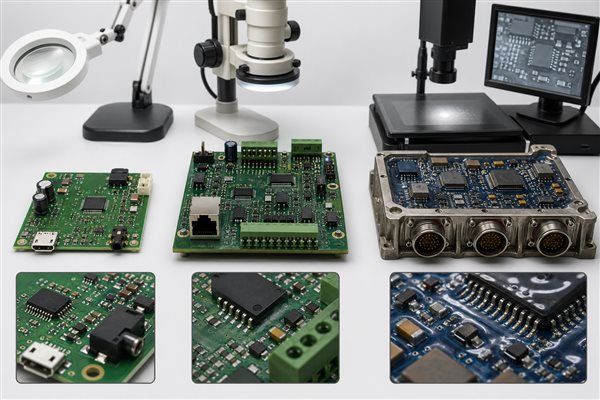
The user or customer should select Class 1, Class 2, or Class 3 according to the product’s required performance, service continuity, and operating environment. The class is not simply a manufacturer-selected quality grade.
| Class | Intended Use | Typical Priority |
|---|---|---|
| Class 1 | General electronic products | Completed function |
| Class 2 | Dedicated-service electronic products | Continued performance and extended life |
| Class 3 | High-performance or harsh-environment products | Performance on demand and minimal tolerance for downtime |
Class selection changes the acceptance criteria and verification effort. It should therefore be shown clearly on the drawing or purchase documentation. Writing only “build to IPC standards” leaves the assembler without enough information.
What Materials and Process Controls Does J-STD-001 Address?
J-STD-001 addresses the materials, equipment, environment, handling, and process controls that can change solder-joint quality. The goal is a repeatable manufacturing process with evidence that it remains under control.
Relevant controls include solder alloys, fluxes, solder paste, tools, soldering systems, cleanliness, electrostatic discharge precautions, thermal exposure, and storage or handling conditions. The approved process must also account for component and laminate limitations rather than applying one temperature profile to every assembly.
For production, this means the assembler should connect the standard to practical records: approved material lists, equipment calibration, reflow profiles, work instructions, operator qualifications, first-article results, inspection records, and nonconformance reports.
How Does the Standard Cover Wire, Through-Hole, and SMT Assembly?
The standard covers the major soldered interconnection methods used in electronic assemblies, including wire and terminal work, plated through-hole connections, and surface-mount technology. Each process requires appropriate preparation, soldering, inspection, and handling.
For an assembled PCB, the process plan should separate operations that have different failure modes:
- Wire and terminal assembly: conductor preparation, mechanical support, insulation clearance, wetting, and strain control.
- Through-hole assembly: component preparation, hole fill, wetting, lead condition, and solder-side control.
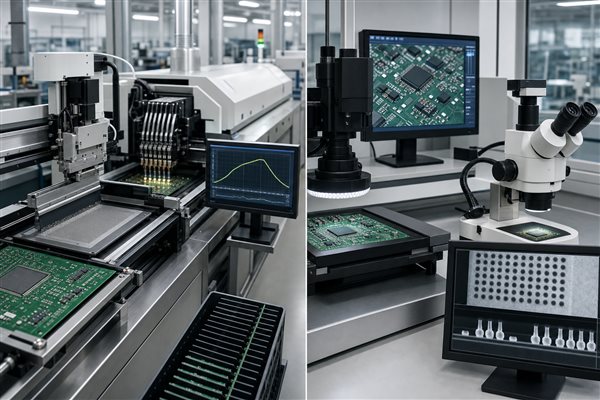
- SMT assembly: solder paste deposition, placement, controlled reflow, component alignment, and termination acceptance.
- Mixed technology: sequence planning so later operations do not damage earlier joints or temperature-sensitive components.
Our guide to the SMT process explains how printing, placement, reflow, and inspection fit together on a modern assembly line.
How Are Cleaning, Coating, Rework, and Verification Controlled?
Cleaning, protective coating, rework, and verification must be planned as controlled manufacturing operations. They should not be treated as cosmetic finishing steps performed after quality decisions are complete.
Residue and contamination can affect insulation resistance, coating adhesion, test access, and long-term reliability. Inspection should therefore occur at the correct stage, and cleanliness requirements should match the flux chemistry, assembly use, and customer specification. Our article on cleaning assembled boards after soldering covers the practical cleaning sequence.
Rework also needs authorization, documented methods, trained personnel, and post-rework verification. Repeated thermal cycles can damage pads, vias, components, or laminate even when the final joint looks acceptable.
How Does J-STD-001 Differ from IPC-A-610?
J-STD-001 primarily specifies materials, manufacturing processes, and requirements for producing soldered assemblies, while IPC-A-610 primarily supports acceptance inspection of completed electronic assemblies. They are complementary, not interchangeable.
| Document | Primary Focus | Main Users |
|---|---|---|
| J-STD-001 | Materials, soldering processes, process control, and assembly requirements | Manufacturing engineers, operators, trainers, and quality teams |
| IPC-A-610 | Visual acceptance of completed electronic assemblies | Inspectors, quality teams, and customer acceptance personnel |
A contract may require both documents. The assembly plan should then state which revision and class apply to each, plus any drawing notes or customer criteria that take precedence. Technologies with hidden joints may also require defined methods such as X-ray inspection in PCB assembly.
What Is the IPC J STD 001 Latest Revision?
The current published base revision is IPC J-STD-001J, released in 2024. People searching “ipc j std 001 latest revision” should distinguish the newest published document from the revision contractually required for a specific build.
Revision J continues the standard’s process-control approach while updating requirements and illustrations for current assembly practice. IPC reported changes that include hardware-installation requirements and graphics addressing bubbles in X-ray images. The current revision should be considered for new documentation, but engineering and quality teams must control any transition from an older edition.
Do not mix a base standard with an addendum from another revision. IPC’s revision table states that space and automotive addenda are revision-matched; for example, a Revision C space addendum belongs with Revision C, not Revision J.
Where Can You Get the IPC J STD 001C PDF Legally?
An official IPC or authorized standards distributor is the appropriate source for a licensed copy. The search phrase “ipc j std 001c pdf” often leads to unofficial file-sharing pages, but an unauthorized scan may be incomplete, altered, or unsuitable for controlled production use.
Before purchasing or retrieving a controlled copy, confirm:
- the exact revision named by the contract;
- whether an amendment or addendum is required;
- the permitted number of users or production locations;
- whether the quality system needs a controlled electronic or printed copy;
- how obsolete copies will be removed from active work areas.
A training handout, online summary, or free PDF cannot substitute for the licensed standard when acceptance decisions depend on exact clauses, tables, or figures.
When Can a Legacy Contract Still Require Revision C?
A legacy contract can still require Revision C when it explicitly names J-STD-001C and has not been formally changed. This often occurs in long-life equipment, spares, repair programs, controlled drawings, or customer specifications frozen around an earlier qualification baseline.
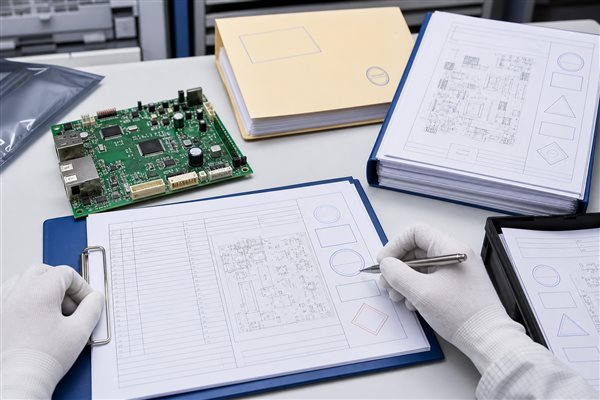
Before accepting such an order, the assembler should review the purchase order, assembly drawing, workmanship notes, approved deviations, product class, and addendum. If a newer manufacturing process is proposed, both parties should document whether it is permitted and how equivalence will be verified.
Revision control also prevents a subtle failure: quoting to one standard, building to another, and inspecting to a third. A clear contract review keeps the applicable requirements aligned from quotation through shipment.
What Should a PCB Assembly Specification State?
A usable PCB assembly specification should state the standard, revision, class, addendum, inspection scope, testing, traceability, and customer-specific requirements. “IPC compliant” alone is too vague for production control.
Include these items in the drawing, purchase order, or controlled quality note:
- J-STD-001 revision and product class;
- IPC-A-610 revision and class, when required;
- space, automotive, or other applicable addendum;
- lead-free or tin-lead material restrictions;
- special cleaning and ionic-contamination requirements;
- AOI, X-ray, electrical test, functional test, or sampling requirements;
- operator qualification and record-retention expectations;
- approved rework, deviation, and change-control process.
These details also help an assembler choose the right PCB assembly fabrication methods and prepare an accurate quotation.
FAQ About IPC J-STD-001C
Does Revision C cover lead-free soldering?
Revision C predates widespread lead-free production. Do not assume its legacy requirements fully represent current lead-free materials and processes. Confirm the contract, approved alloys, process qualification, and whether a later revision is required.
Is J-STD-001 certification the same as company compliance?
No. Personnel certification shows that individuals completed an approved training program. Product compliance also depends on the specified revision, class, controlled processes, materials, inspection, records, and customer requirements.
Can IPC-A-610 replace J-STD-001?
No. IPC-A-610 is mainly an acceptance reference for completed assemblies, while J-STD-001 addresses how soldered assemblies are produced and controlled. A contract may use both.
Should a new product specify Revision C?
Usually, a new product should be evaluated against the current revision and current customer or regulatory requirements. Revision C is more appropriate when a controlled legacy baseline specifically requires it.
How Can EBest Circuit Support a Standards-Controlled PCBA Project?
At EBest Circuit, we review the assembly data and quality requirements before production so the applicable revision, class, materials, inspection, and testing are understood. We can support prototype and production PCB assembly with SMT, through-hole, and mixed-technology processes, but the customer must identify any mandatory standard revision or program-specific addendum.
For a quotation, send your Gerber files, BOM, assembly drawings, quantities, test requirements, and the controlled workmanship specification to sales@bestpcbs.com. We will review the package and clarify any missing revision or acceptance information before the build proceeds.
For quick reference, bookmark this ipc j std 001c guide and verify every project against its controlled contract documents.