An HVAC capacitor can retain electrical charge after power to the air conditioner or heat pump has been switched off. That stored energy is why knowing how to discharge an HVAC capacitor safely matters before testing, disconnecting, or replacing one.
If you need to know how to discharge an AC capacitor safely or how to safely discharge an HVAC capacitor, the safest workflow is straightforward: isolate the equipment from power, verify that the circuit is de-energized, discharge the capacitor through a suitable resistance or purpose-built discharge tool, and then measure again before touching the terminals.
This is not a job for guesswork. HVAC equipment may contain hazardous line voltage in addition to the charge stored in the capacitor. If you cannot positively identify the disconnect, capacitor terminals, or correct test points, have a qualified HVAC technician perform the work.
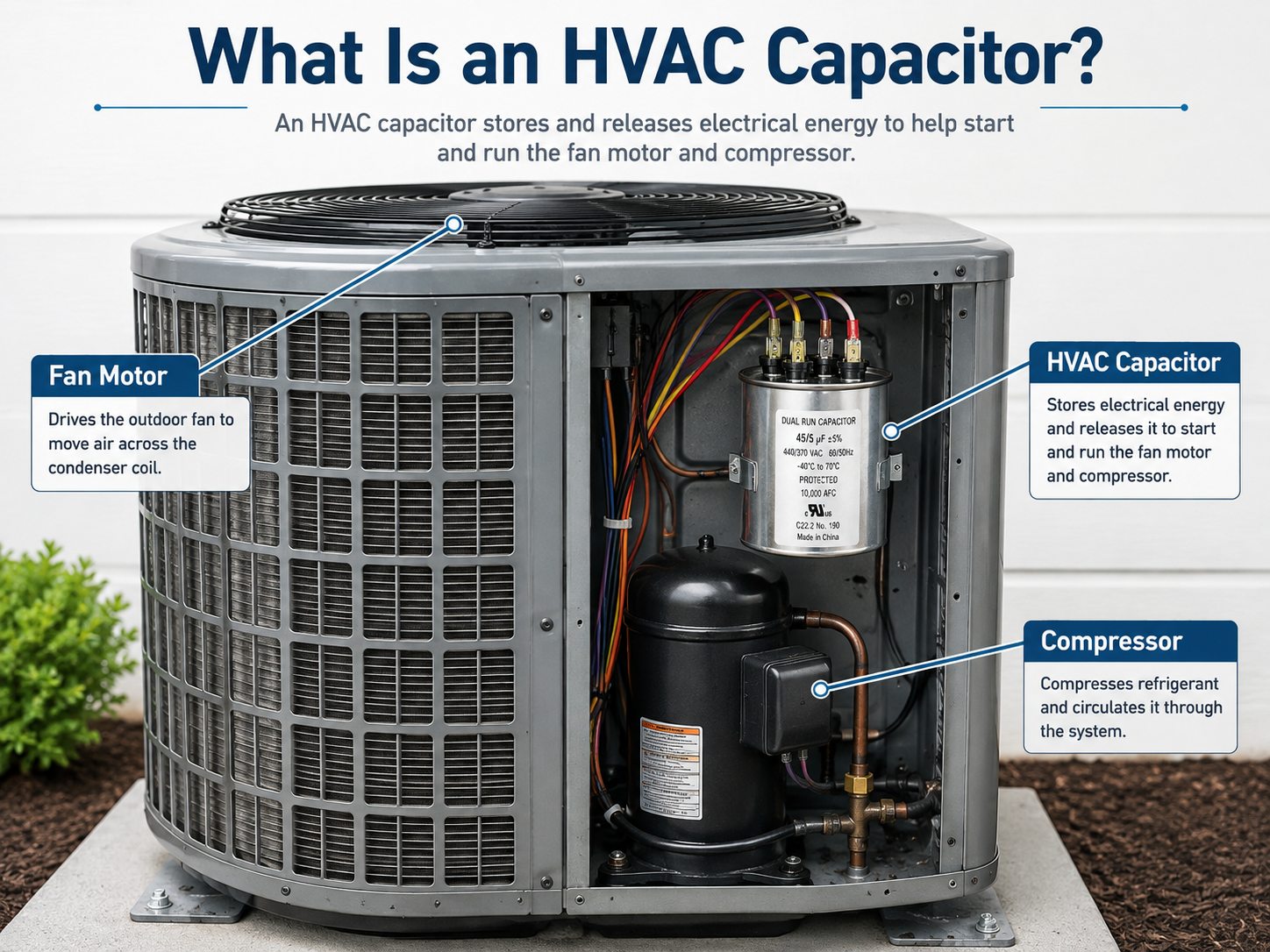
What Is an HVAC Capacitor?
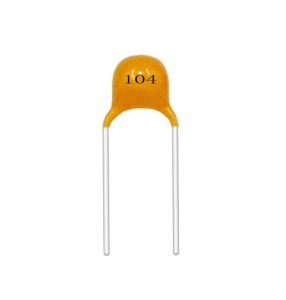
An HVAC capacitor is an electrical component that temporarily stores energy and helps motors in air conditioners and heat pumps start or run efficiently. In a typical residential HVAC system, capacitors are commonly connected to the compressor, condenser fan motor, or blower motor.
- Start capacitors provide a short burst of energy to help a motor start.
- Run capacitors remain in the circuit while the motor operates.
- Dual-run capacitors combine two run capacitors in one housing, usually serving the compressor and condenser fan motor. Their terminals are commonly marked C, FAN, and HERM.
HVAC capacitors are normally rated in microfarads (F) and by their maximum operating voltage, such as 370 VAC or 440 VAC. The important point for servicing is that a capacitor stores electrical energy. Removing power from the HVAC unit does not automatically prove that the capacitor terminals are safe to touch.
Do You Need to Discharge an HVAC Capacitor?
Yes. Before touching, testing, disconnecting, or replacing an HVAC capacitor, treat it as charged until you have verified otherwise.
Switching off the thermostat is not enough. Turning off a breaker or service disconnect removes the incoming supply, but the capacitor itself is an energy-storage component.
E = ½CV²
where E is stored energy in joules, C is capacitance in farads, and V is voltage across the capacitor. Voltage matters considerably because it is squared in the equation.
You should discharge the capacitor before removing its wires, checking capacitance out of circuit, replacing the capacitor, handling exposed terminals, or working around a connected motor or compressor circuit.
Do not assume that waiting several minutes always makes a capacitor safe. Some HVAC circuits provide a natural discharge path, but a failed resistor, disconnected motor winding, open circuit, or different system design may leave stored voltage present.
What Do You Need to Safely Discharge an AC Capacitor?
You do not need many tools, but the ones you use should be suitable for electrical service.
- a properly rated digital multimeter;
- insulated meter probes;
- an appropriately rated resistor-based capacitor discharge tool or purpose-built discharge device;
- appropriate eye and electrical protection;
- the HVAC wiring diagram or service documentation when available.
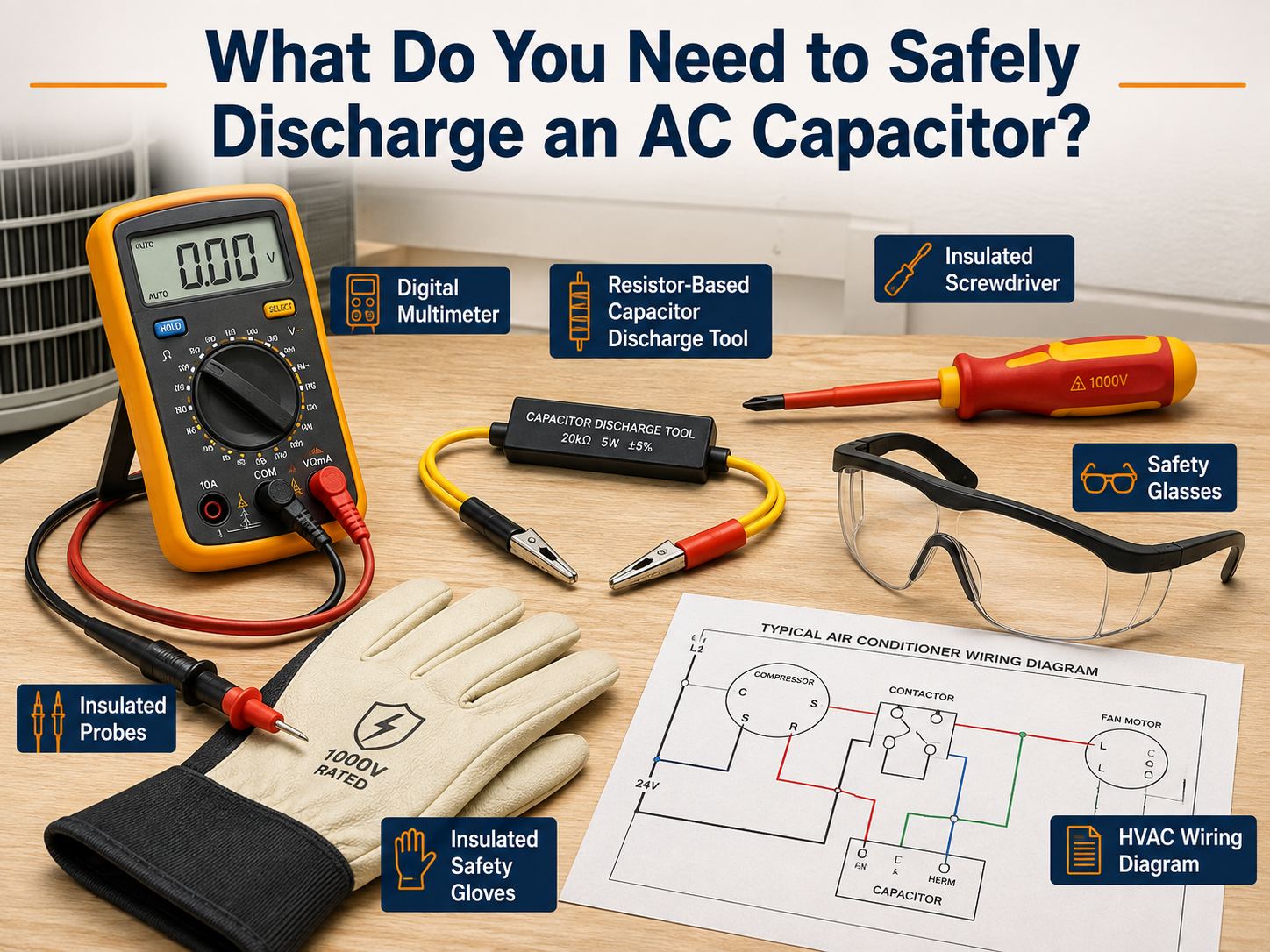
The key distinction is between discharging and verifying. A resistor or dedicated discharge tool gives stored energy a controlled path. A multimeter is mainly used to determine whether voltage is still present.
| Method | Best Use | Main Consideration |
|---|---|---|
| Resistor-based discharge tool | Controlled capacitor discharge | Limits peak current |
| Purpose-built capacitor discharge tool | Frequent HVAC service | Convenient and controlled |
| Digital multimeter | Verify supply and residual voltage | Not the preferred primary discharge device |
| Direct screwdriver short | Not preferred | Creates very high instantaneous current |
A 20 kΩ, 5 W resistor is one example commonly used in capacitor discharge demonstrations and test procedures. It should not be treated as a universal specification for every HVAC capacitor. The discharge component must be suitable for the capacitor voltage, capacitance, stored energy, and expected discharge time.
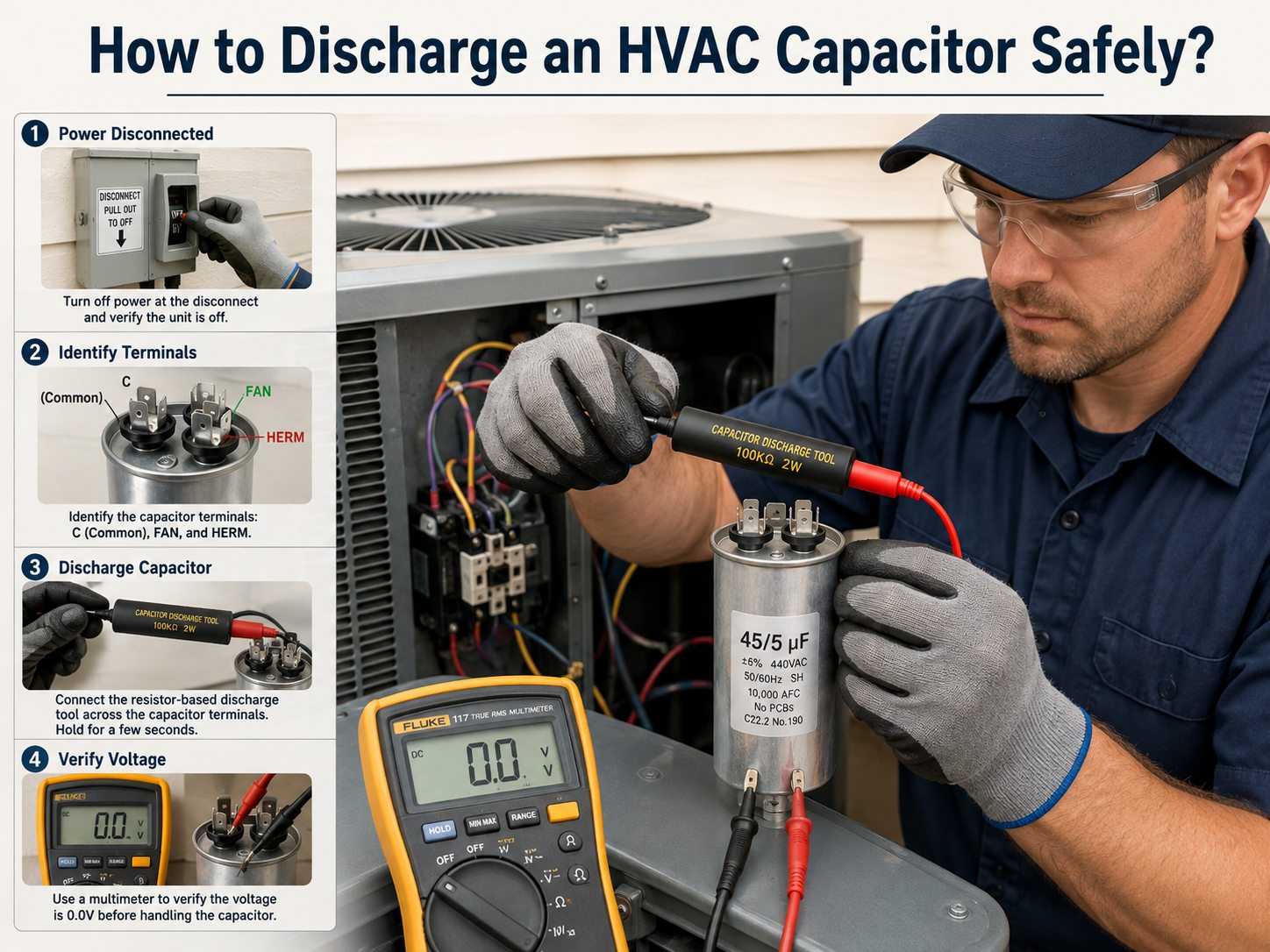
How to Discharge an HVAC Capacitor Safely?
The correct process is not simply touching two capacitor terminals together. First make sure the HVAC equipment itself has been electrically isolated.
Step 1: Shut Off Power to the HVAC System
Turn the HVAC system off and isolate its electrical supply using the appropriate service disconnect and breaker arrangement.
Do not rely only on the thermostat. A thermostat controls system operation; it does not provide reliable electrical isolation. Outdoor condensing units and heat pumps often have a service disconnect nearby, but installations vary. Use the equipment wiring diagram and service instructions where available.
Step 2: Verify That Power Is Actually Off
Before reaching into the electrical compartment, use an appropriately rated meter and safe test procedure to verify that the incoming supply has been de-energized.
This matters because breakers may be mislabeled, the wrong disconnect may have been opened, or another electrical supply may still be present. If you are not trained to perform an absence-of-voltage test safely, stop and use a qualified technician.
Step 3: Locate and Identify the Capacitor Terminals
After confirming that the equipment is de-energized, identify the capacitor and its terminal markings. A single run capacitor normally has two electrical terminal groups.
A common dual-run capacitor normally has three:
- C — common;
- FAN — condenser fan motor circuit;
- HERM — hermetic compressor circuit.
Do not identify terminals based only on physical position. Read the markings on the actual capacitor and compare them with the HVAC wiring diagram. Before removing any wires, take a clear photograph or label the conductors.
Step 4: Connect the Discharge Tool
For a resistor-based method, establish a discharge path across the relevant capacitor terminals using insulated equipment designed for the task.
On a single capacitor, discharge across its two terminal groups. On a typical dual-run capacitor, both capacitor sections need to be discharged. This normally means using C as one side of the discharge path and addressing the HERM and FAN sections separately.
Do not hold exposed resistor leads, metal probe sections, or capacitor terminals during discharge.
Step 5: Allow the Stored Charge to Bleed Off
Keep the resistor connected long enough for the voltage to decay.
V(t) = V₀e−t/RC
where V(t) is voltage after time t, V₀ is initial capacitor voltage, R is discharge resistance, and C is capacitance. The product RC is the electrical time constant.
For example, a 45 µF capacitor discharged through 20 kΩ has a time constant of 0.9 seconds. After approximately five time constants, or about 4.5 seconds, the capacitor voltage is theoretically below 1% of its initial value.
This calculation is useful for understanding discharge behavior, but it does not replace a voltage measurement.
Step 6: Verify the Voltage Before Touching the Capacitor
After discharging, measure across the relevant capacitor terminals again. Proceed only after the meter confirms that the stored voltage has dropped to a safe level according to the applicable service procedure.
isolate → verify supply → discharge → verify capacitor
Do not use the absence of a spark as proof that a capacitor is discharged.
How to Discharge an HVAC Capacitor With a Resistor?
A resistor gives the stored charge a controlled path instead of allowing the capacitor to release energy almost instantaneously.
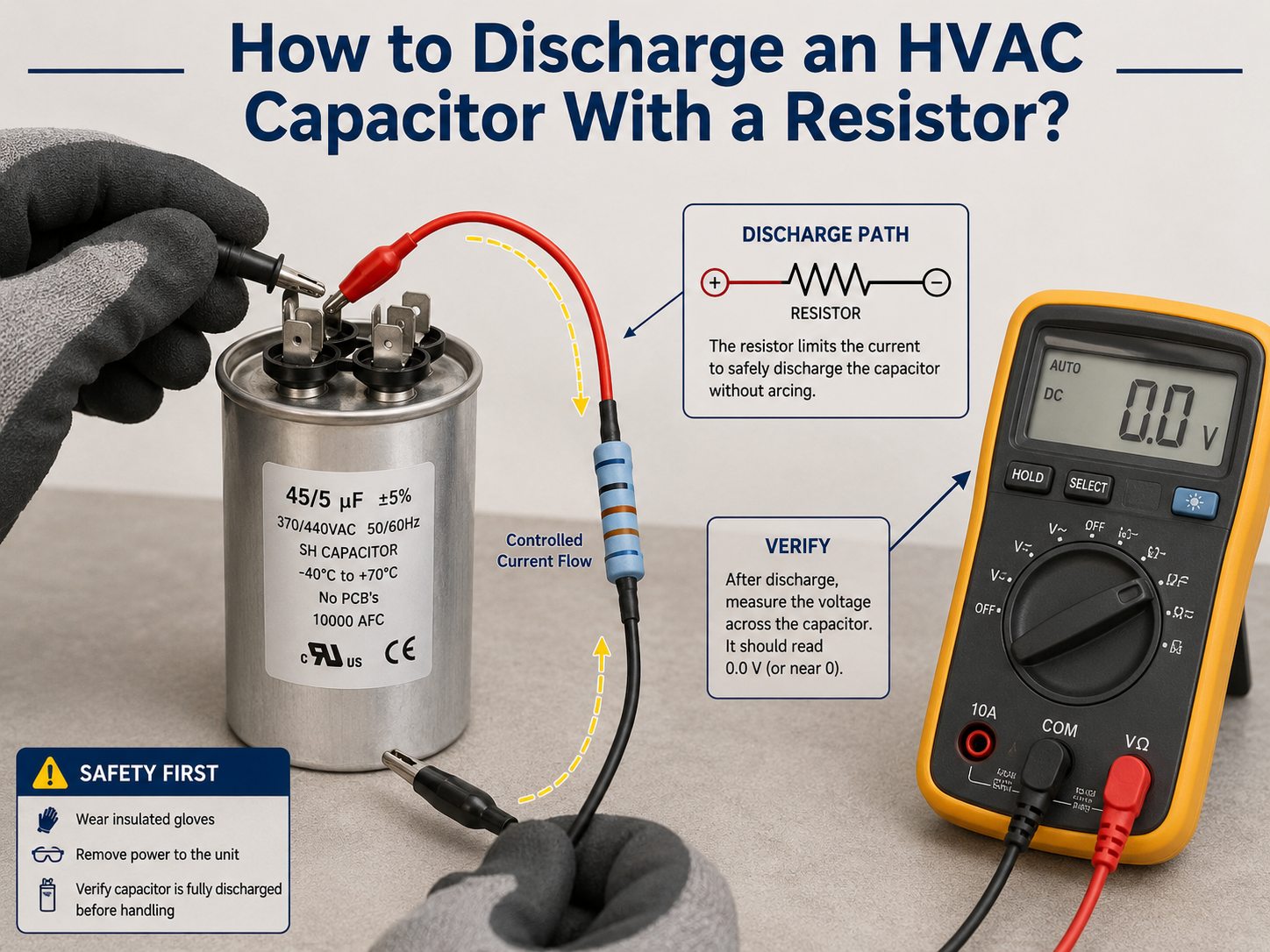
I₀ = V₀ / R
Increasing resistance reduces peak current but also extends discharge time. Selecting a resistor therefore involves more than choosing an ohmic value.
- resistance;
- power rating;
- pulse-energy capability;
- resistor voltage rating;
- capacitor capacitance;
- capacitor voltage;
- insulation;
- required discharge time.
For example, if a 370 V capacitor were discharged through a 20 kΩ resistor:
I₀ = 370 / 20,000 = 0.0185 A ≈ 18.5 mA
That is far more controlled than intentionally creating a near-zero-ohm short. A resistor-based discharge tool is therefore preferable when you want a predictable and repeatable discharge process.
Can You Discharge an HVAC Capacitor With a Multimeter?
If you are researching how to discharge an AC capacitor with a multimeter, note that a multimeter can provide an electrical path across a capacitor, so connecting some meters may cause the capacitor voltage to decline. However, a conventional digital multimeter should primarily be used to measure and verify voltage, not as the preferred HVAC capacitor discharge tool.
Most digital multimeters have relatively high input impedance so that they do not significantly load the circuit being measured.
Consider a simplified example using a hypothetical 10 MΩ meter input and a 45 µF capacitor:
τ = RC = 10,000,000 × 45 × 10−6 = 450 s
One time constant would be 7.5 minutes. Five time constants would be approximately 37.5 minutes. The actual result varies by meter, but the example illustrates why relying on an ordinary high-impedance multimeter as the discharge path can be slow.
Multimeter → verify remaining voltage
Do not confuse an ordinary digital multimeter with a meter or tester that has a purpose-designed Low-Z or discharge function.
Can You Discharge an AC Capacitor Without a Resistor?
Yes, an AC capacitor can lose its charge without an external resistor, but that does not mean every alternative is equally suitable.
Some HVAC circuits provide internal discharge paths through motor windings, bleed resistors, control circuits, or connected loads. The problem is that these paths may not always be available. A failed component or open circuit can prevent the capacitor from discharging as expected.
Another common technique is directly bridging capacitor terminals with a screwdriver. That can discharge the capacitor, but it creates a very low-resistance path and therefore a high instantaneous current.
- visible arcing;
- damaged screwdriver surfaces;
- damaged capacitor terminals;
- pitting;
- unnecessary electrical stress.
The key distinction is simple: a method that can discharge a capacitor is not automatically the best method for servicing one. A controlled resistive discharge followed by voltage verification is more predictable.
How to Discharge a Dual Run HVAC Capacitor?
A dual-run capacitor contains two capacitor sections inside one housing. It commonly serves both the compressor and the condenser fan motor.
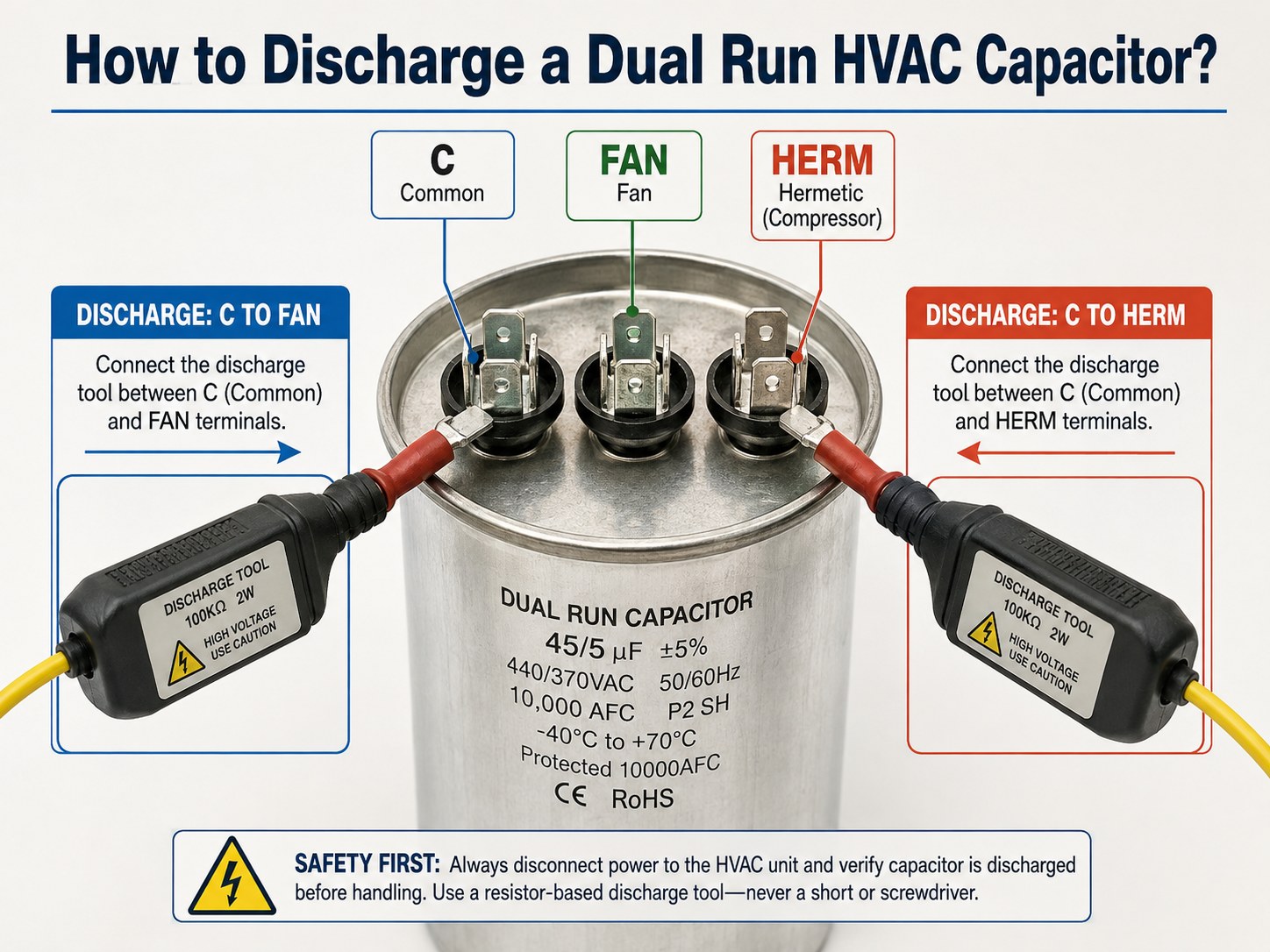
Its three terminal groups are usually:
C — Common
The shared connection for both capacitor sections.
FAN — Fan
The capacitor section connected to the condenser fan motor.
HERM — Hermetic
The capacitor section connected to the compressor.
Because two capacitor sections are present, checking only one terminal pair does not fully address the component. For a typical dual-run capacitor, a resistor-based discharge procedure should address:
- C to HERM
- C to FAN
After discharge, verify both sections with a multimeter. Do not blindly bridge HERM to FAN or copy a wiring arrangement from an unrelated unit. Always use the markings on the actual capacitor, the HVAC wiring diagram, and the manufacturer’s service information where available.
How to Discharge a Heat Pump Capacitor?
The discharge principle for a heat pump is the same:
What changes is the electrical system surrounding the capacitor. A heat pump outdoor unit may contain compressor circuits, fan motor circuits, reversing-valve controls, crankcase heater circuits, defrost electronics, contactors, control boards, and inverter electronics on variable-speed models.
Do not assume that every heat pump uses the same electrical architecture as a conventional single-stage air conditioner.
Before discharging the capacitor, determine which capacitor is being serviced, whether it is a single or dual-run capacitor, which motor each section serves, whether multiple electrical sources are present, and whether inverter electronics are involved.
If the unit contains unfamiliar high-voltage electronics or multiple stored-energy components, use the manufacturer’s service documentation or a qualified technician.
How Do You Confirm the Capacitor Is Fully Discharged?
Verification is what turns a discharge attempt into a controlled procedure.
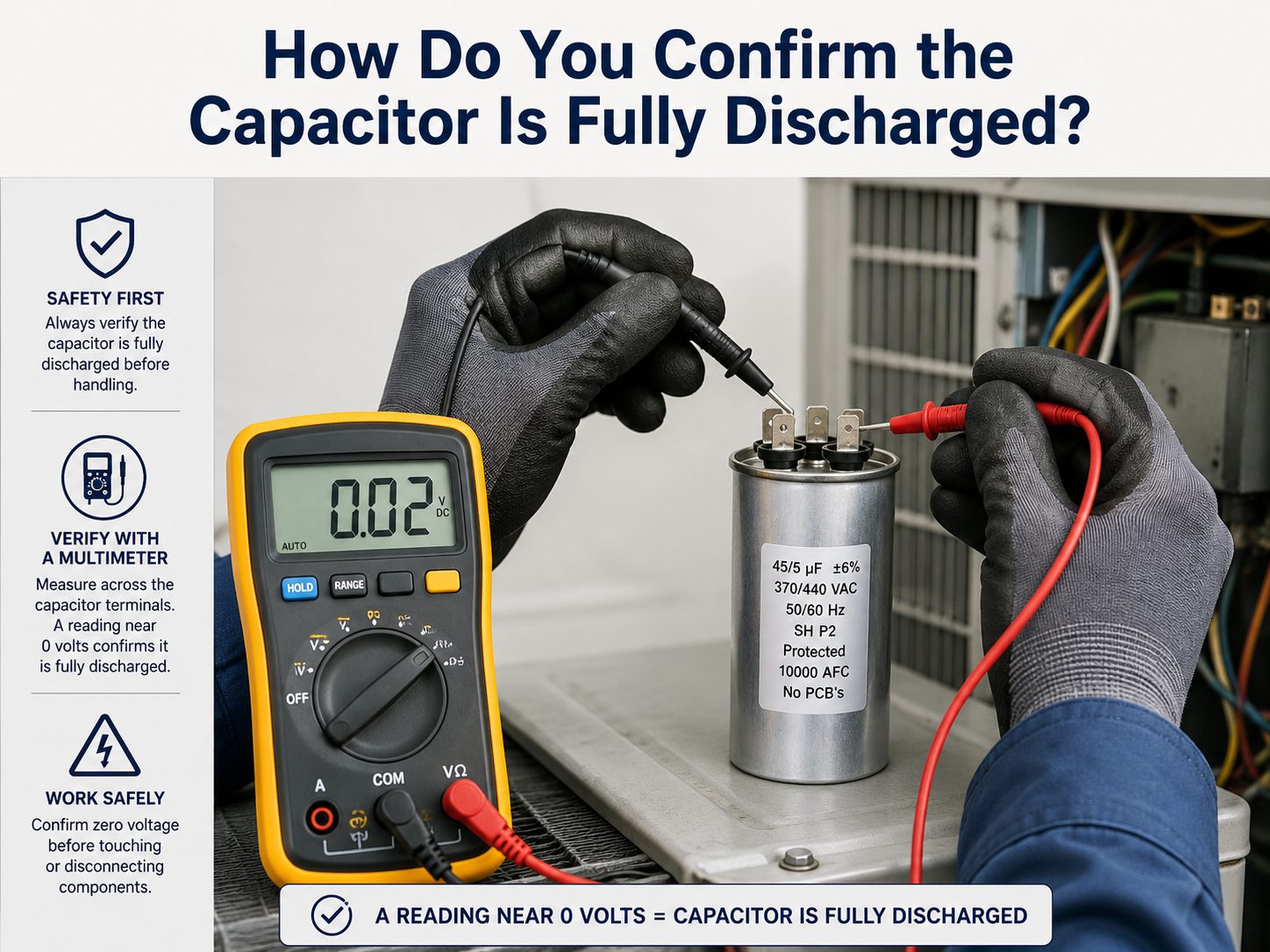
After applying the discharge device, use a properly rated multimeter to measure across every relevant capacitor section.
For a single capacitor, check its two terminal groups. For a dual-run capacitor, normally verify:
- C to HERM
- C to FAN
Do not assume that because one section reads near zero, the other section is also discharged.
Also remember that two separate conditions must be verified:
- Incoming HVAC power is off.
- Stored capacitor voltage has been removed.
These are not the same test. If voltage appears again after the capacitor has been discharged, stop and investigate. The reading may indicate another connected energy source, circuit interaction, incorrect isolation, or stored charge elsewhere in the system.
HVAC Capacitor Discharge Mistakes to Avoid
Most capacitor-discharge problems come from skipping a basic verification step rather than from complicated electrical theory.
- Assuming thermostat OFF means electrically safe. Isolate the actual electrical supply.
- Skipping the absence-of-voltage test. Confirm that incoming power is off.
- Assuming time guarantees discharge. Verify voltage with a meter.
- Using an arbitrary resistor. Check resistance, power, voltage, and pulse-energy capability.
- Using a screwdriver as the default discharge method. A hard short creates unnecessary peak current.
- Confusing C, FAN, and HERM. Read the capacitor labels before making connections.
- Checking capacitance before discharging the capacitor. Stored voltage can interfere with testing and create a safety hazard.
- Disconnecting wires without documenting them. Photograph the original wiring first.
- Using “no spark” as a test. No visible arc does not prove that voltage is absent.
If the actual electrical layout does not match the documentation you are using, stop rather than improvise.
FAQs About Discharging an HVAC Capacitor
How Long Does an HVAC Capacitor Take to Discharge?
There is no single discharge time for every HVAC capacitor. The time depends mainly on capacitance, discharge resistance, starting voltage, and connected circuitry.
V(t) = V₀e−t/RC
After approximately five RC time constants, the voltage theoretically falls below 1% of its initial value. For example, a 45 µF capacitor and 20 kΩ resistor have a time constant of 0.9 seconds, so five time constants equal about 4.5 seconds. Always verify the actual voltage afterward instead of relying only on the calculation.
Will an AC Capacitor Discharge Itself After Power Is Turned Off?
Sometimes, but you should not assume that it will. A capacitor may discharge through motor windings, bleed resistors, or other connected circuitry. However, an open circuit or failed component can interrupt that path. Treat the capacitor as charged until a meter confirms otherwise.
Can You Discharge an AC Capacitor With a Screwdriver?
A screwdriver can create a direct short across capacitor terminals and therefore discharge the capacitor. It is not the preferred controlled method. A hard short can create high peak current, an electrical arc, pitted terminals, or damaged tool surfaces. A resistor-based discharge device limits the current and provides a more predictable process.
Can a Multimeter Discharge an HVAC Capacitor?
Technically, many multimeters provide some resistance across the capacitor and can gradually lower its voltage. In practice, an ordinary high-impedance digital multimeter may discharge the capacitor very slowly. Use a suitable resistor or capacitor discharge tool to remove the stored energy, then use the multimeter to verify the result.
Can an HVAC Capacitor Shock You After the Power Is Off?
Yes. Removing incoming power does not automatically remove energy already stored in the capacitor. That is why safe servicing requires both power isolation and capacitor discharge verification.
Should You Discharge an HVAC Capacitor Before Testing It?
Yes. Before measuring capacitance or disconnecting the capacitor from the circuit:
- isolate the HVAC equipment;
- verify that incoming voltage is absent;
- discharge the capacitor;
- verify that the stored voltage is gone;
- disconnect the capacitor as required by the test procedure.
Knowing how to safely discharge an HVAC capacitor is ultimately less about making the capacitor “spark” and more about controlling the electrical state of the entire service area. Isolate the equipment, confirm that incoming power is off, use a controlled discharge path, and verify the result before handling the terminals.
If the equipment contains unfamiliar wiring, multiple supplies, inverter electronics, or you cannot confidently perform electrical measurements, use a qualified HVAC technician.