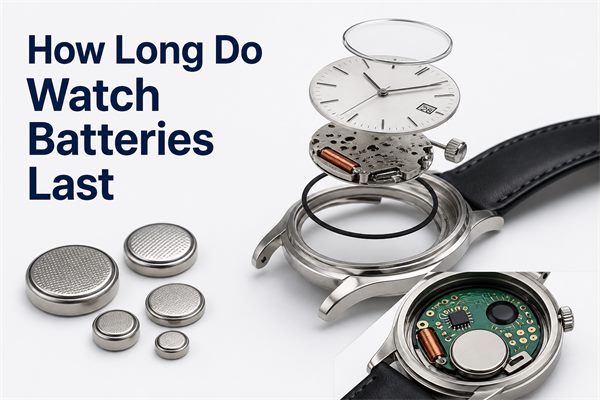
Most conventional quartz watches run for roughly 2–5 years on one cell, which is the practical answer to how long do watch batteries last. The exact interval depends on the movement, battery chemistry, alarms, backlight, sensors, temperature, and how long the cell was already installed before purchase.
That range does not apply to every watch. Solar watches recharge a secondary cell, while smartwatches may need charging after hours or days. The model manual and battery code are more reliable than a brand-wide estimate.
How Long Do Watch Batteries Last on Average?
How long do watch batteries last on average? Many conventional quartz watches specify about 3 years, while some low-drain models specify around 5 years. A reasonable planning range is therefore 2–5 years, but the exact model specification should control the answer.
Manufacturers calculate battery life under defined operating conditions. Frequent alarms, illumination, radio synchronization, sensors, or chronograph use can shorten the result. A battery installed at the factory for testing may also have less remaining life when the watch reaches the buyer.
How Long Should a Watch Battery Last by Watch Type?
How long should a watch battery last depends first on whether the watch uses a replaceable primary cell or a rechargeable power system.
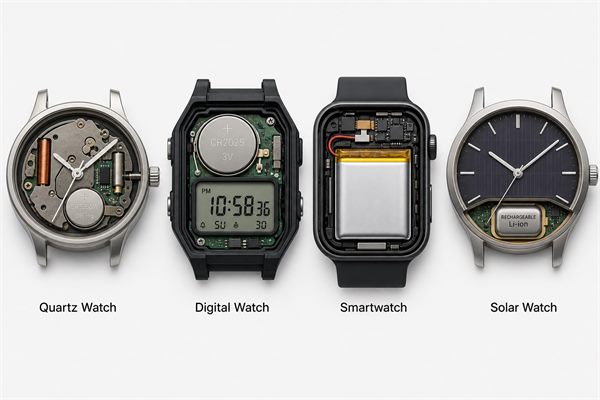
| Watch type | Practical power interval | What changes it |
|---|---|---|
| Basic analog quartz | Often about 2–5 years | Movement current, cell size, complications, temperature |
| Digital watch | Often about 2–10 years by model | Backlight, alarm, sensors, radio functions |
| Solar or light-powered watch | Rechargeable; no routine primary-cell interval | Light exposure, storage, secondary-cell condition |
| Smartwatch | Commonly hours to several days per charge | Display, GPS, wireless radios, health sensors, apps |
These are categories, not promises. Check the user guide for the exact caliber or module and the usage assumptions behind its rating.
Which Battery Types Are Used in Watches?
Most traditional quartz watches use a small silver-oxide cell because it provides stable voltage and good low-drain performance. Some digital watches use primary lithium coin cells, while lower-cost products may use alkaline button cells.
- Silver oxide (SR): common in analog quartz movements; nominal voltage is typically about 1.55 V.
- Alkaline (LR): similar shapes may exist, but the discharge behavior and capacity can differ.
- Primary lithium (CR): commonly 3 V and used in many digital modules.
- Rechargeable lithium-ion or lithium-polymer: used in smartwatches.
- Rechargeable secondary cells: used in solar and kinetic systems; they are not ordinary disposable substitutes.
Match the exact code, diameter, thickness, chemistry, and terminal arrangement. A cell that physically fits may still be electrically wrong.
What Makes a Watch Battery Drain Faster?
Higher current demand, extreme temperature, moisture, contamination, and a defective movement can all shorten watch battery life.
- Frequent backlight, alarm, vibration, GPS, Bluetooth, or sensor use.
- Aging lubricant or mechanical resistance that makes the movement work harder.
- Corrosion, moisture ingress, or conductive contamination on the movement PCB.
- An incorrect battery type, low-quality cell, or cell stored under poor conditions.
- A short circuit, damaged coil, failing component, or poor battery contact.
If several new cells fail unusually quickly, replacing the battery again is not a complete diagnosis. The watch needs current-consumption and movement checks.
How Can You Tell a Watch Battery Is Failing?
A stopped display is the clearest sign, but some watches give earlier warnings such as a second hand moving in larger intervals, a fading LCD, weak illumination, intermittent resets, or functions that stop under load.
Do not leave a depleted cell inside for an extended period. Leakage is not inevitable, but a damaged or exhausted cell can contaminate contacts and the movement. Remove it promptly using the correct service procedure.
How Long Do Watch Batteries Last in Storage?
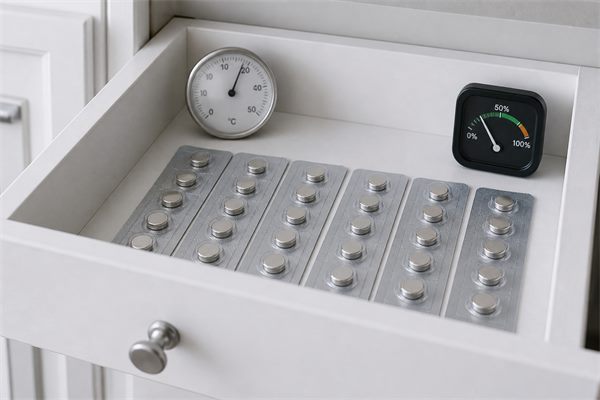
How long do watch batteries last in storage depends on chemistry, packaging, temperature, humidity, and the manufacturer’s date code. As one evidence point, an Energizer silver-oxide technical manual reports more than 90% service maintenance after five years at 21°C for the cited system.
The related question how long do watch batteries last unopened should still be answered from the package and manufacturer documentation. Some packaged silver-oxide watch cells are marketed for five-year storage, but that does not automatically apply to every chemistry or supplier.
- Keep cells in their original packaging until use.
- Store them dry at moderate room temperature.
- Keep loose cells away from coins, tools, and other conductive objects.
- Do not refrigerate unless the manufacturer specifically instructs it.
- Use older in-date stock first and reject swollen, corroded, or damaged cells.
When Should a Watch Battery Be Replaced?
Replace a primary watch battery when the low-battery indicator appears, the watch stops, or a measured cell can no longer support the movement under load. Routine replacement before a long trip can be reasonable when the cell is near the model’s expected interval.
Do not use the calendar alone when a watch shows abnormal drain, moisture, intermittent operation, or corrosion. Those symptoms call for diagnosis rather than a scheduled cell swap.
How Is a Watch Battery Replaced Safely?
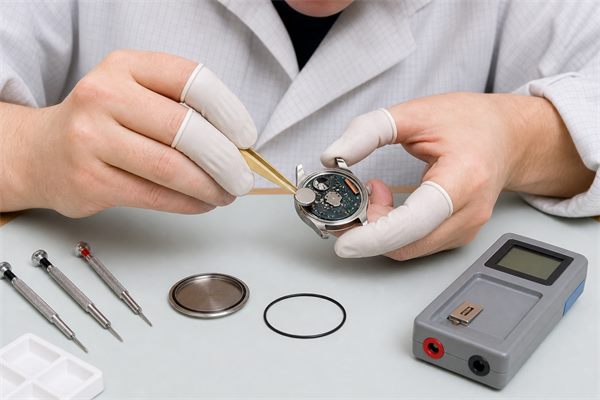
A safe replacement uses the exact cell, suitable tools, clean handling, correct polarity, and inspection of the case gasket and contacts. Water-resistant watches may also need gasket replacement, lubrication, controlled case closure, and pressure testing.
- Identify the watch model, movement, and specified battery code.
- Open the case with the correct tool without damaging the back or seal.
- Record battery polarity and retaining-clip position before removal.
- Inspect for leakage, corrosion, damaged contacts, and gasket wear.
- Install the fresh cell without shorting it or contaminating the surfaces.
- Reset the movement only when the service documentation requires it.
- Close the case correctly and verify timekeeping and water resistance as applicable.
For a valuable, vintage, dive, or sealed watch, professional service is usually safer than an improvised home replacement.
What Is Different About Smartwatch Battery Life?
Smartwatch battery life is measured per charge rather than by the multi-year replacement interval used for a low-drain quartz movement. Displays, processors, GPS, wireless radios, haptics, and optical sensors create a much larger and more variable load.
The design challenge extends beyond the cell. A smartwatch PCB must integrate power management, charging, sensors, RF, display connections, and protection in a compact wearable enclosure. Flexible interconnects may also be needed; our flex PCB guide explains how thin flexible circuits support space-limited products.
FAQ About Watch Battery Life
Can a watch battery last 10 years?
Yes, some low-power watch models specify very long battery life, but 10 years is not normal for every quartz watch. Check the exact module specification.
Why did my new watch battery die quickly?
The cell may have been old, incorrect, damaged, or poorly connected. Excess movement current, corrosion, moisture, alarms, and lighting can also cause rapid drain.
Does stopping the watch save battery?
It may reduce some movement load in certain designs, but it is not a universal storage method and does not stop battery self-discharge.
Can I replace silver oxide with alkaline?
Only if the watch manufacturer or a reliable cross-reference approves the substitution. Similar size does not guarantee equivalent voltage behavior or service life.
Do unopened watch batteries expire?
Yes. Self-discharge and material aging continue in storage, so follow the package date and storage instructions.
Should watch batteries be kept in a refrigerator?
Usually no. Cool, dry room-temperature storage in original packaging is safer unless the manufacturer gives different instructions.
Can a dead watch battery leak?
It can, especially if damaged, overheated, deeply discharged, or left installed for a long time. Remove exhausted cells promptly.
Will a battery replacement affect water resistance?
It can. Opening the case disturbs the sealing system, so the gasket and closure should be inspected and pressure-tested when water resistance matters.
How long does a solar watch run without light?
It varies by model and power-saving mode. For example, Citizen states that Eco-Drive can run for over six months from a full charge, but the exact reserve belongs to the model specification.
Is smartwatch battery health the same as charge duration?
No. Charge duration is runtime between charges; battery health describes how much rechargeable capacity remains as the cell ages.
What Should You Remember About Watch Battery Life?
For a standard quartz watch, 2–5 years is a useful starting range, not a guarantee. Confirm the exact model specification, treat storage life separately from installed life, and investigate abnormal drain instead of repeatedly replacing cells.
For product teams developing smartwatches or other battery-powered wearables, power performance depends on the cell, firmware, electronics, interconnects, assembly, and testing. At EBest Circuit, we support compact PCB fabrication, circuit board assembly, and wearable-electronics manufacturing. If your project is ready for review, send the Gerber files, BOM, quantity, power requirements, and test plan to sales@bestpcbs.com. Our guide to charging and battery-management PCB design provides related engineering context.
You can also return to this watch battery life guide when comparing installed life, unopened storage, and replacement timing.