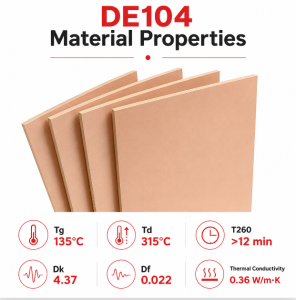
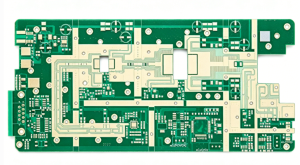
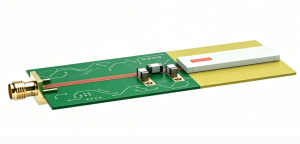
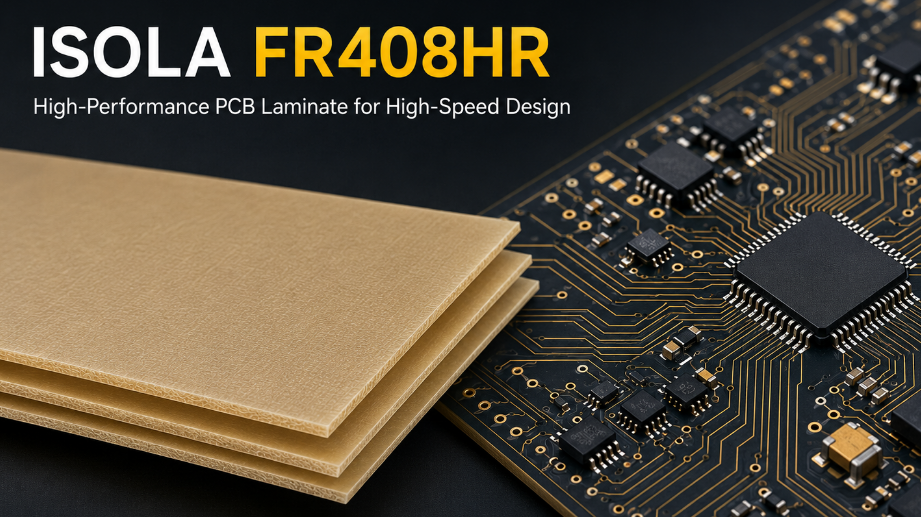
FR408HR is a high-performance PCB laminate for high-speed projects that require stable Dk, low Df, high Tg, controlled impedance and reliable lead-free assembly. It is often selected when standard FR4 cannot provide enough signal integrity or thermal stability for multilayer PCB fabrication.
This guide explains FR408HR from a practical manufacturing view, including material properties, datasheet values, thickness options, FR4 comparison, 370HR and Rogers 4350B selection, application areas, price factors and sourcing advice for custom high-speed PCB projects.
What Is FR408HR PCB Material?
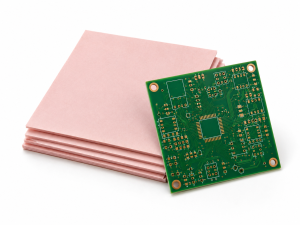
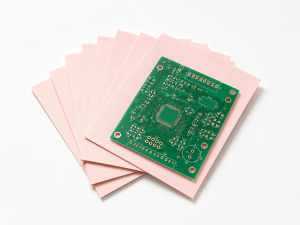
FR408HR PCB material is a high-performance FR-4 laminate and prepreg system from Isola. It is used for multilayer PCB applications that require better thermal and electrical stability than common FR4.
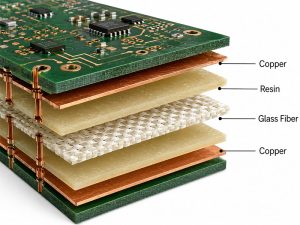
The laminate uses a multifunctional resin system with electrical-grade E-glass fabric. It can be processed with familiar FR4 manufacturing methods while offering better signal performance, stronger lead-free assembly reliability and improved resistance to thermal stress.
In real PCB production, this material is not an ultra-low-loss RF laminate. It is a balanced option for high-speed digital PCB, dense multilayer PCB, controlled impedance PCB and reliable electronic products.
Why Is Isola FR408HR Used for High-Speed PCB Design?
Isola FR408HR is used in high-speed PCB design because it provides lower dielectric loss, stable Dk, high Tg and good multilayer process compatibility. These features help reduce signal attenuation and improve assembly reliability.
Key reasons include:
- Lower Df reduces insertion loss on high-speed traces.
- Stable Dk supports controlled impedance routing.
- High Tg improves lead-free reflow reliability.
- Strong thermal stability reduces delamination risk.
- CAF resistance supports fine spacing and dense routing.
- FR4-like processing helps control manufacturing cost.
As a result, this Isola laminate is common in networking hardware, communication equipment, industrial control, medical electronics and high-speed computing products.
What Is the Dielectric Constant and Dk Value of FR408HR?
The FR408HR dielectric constant, also called Dk, is commonly listed around 3.68. This value affects impedance, signal propagation speed and trace geometry, so it is critical for high-speed PCB design.
However, Dk is not identical in every construction. It changes with frequency, resin content, glass style, dielectric spacing and copper roughness. For controlled impedance PCB, the correct value should come from the selected core and prepreg structure.
| Frequency | Dk |
|---|---|
| 100 MHz | 3.72 |
| 1 GHz | 3.69 |
| 2 GHz | 3.68 |
| 5 GHz | 3.64 |
| 10 GHz | 3.65 |
For stable impedance, confirm the stackup with the PCB manufacturer before layout release. This prevents impedance deviation after fabrication.
What Is the Loss Tangent and Df Value of FR408HR?
The FR408HR loss tangent, also called Df value, is commonly listed around 0.0092. Df measures dielectric loss, which directly affects insertion loss and signal attenuation on high-speed traces.
A lower Df helps the signal travel farther with less energy loss. This is important for differential pairs, long routing paths, fast edge rates and multilayer designs with controlled impedance.
| Frequency | Df |
|---|---|
| 100 MHz | 0.0072 |
| 1 GHz | 0.0091 |
| 2 GHz | 0.0092 |
| 5 GHz | 0.0098 |
| 10 GHz | 0.0095 |
Compared with many standard FR4 grades, this laminate gives better high-speed performance. For strict RF, microwave or very long channel designs, lower-loss materials may still be required.
What Thickness Options Are Available for Isola FR408HR PCB Material?
Isola FR408HR thickness depends on the selected core, prepreg, resin content, copper weight and final PCB stackup. Common finished board thickness options include 0.8 mm, 1.0 mm, 1.2 mm, 1.6 mm, 2.0 mm and custom multilayer thicknesses.
For high-speed PCB, thickness must support the target impedance first. Dielectric spacing, reference plane distance, trace width and copper thickness should be calculated before the final stackup is approved.
For mechanical design, thickness also affects board stiffness, connector fit, warpage and assembly stability. Thin boards may need stronger panel support during SMT assembly, while thick multilayer boards require better lamination and drilling control.
For manufacturing, the PCB factory should confirm core and prepreg availability before layout finalization. This avoids redesign, impedance mismatch, material delay and uncontrolled stackup substitution.
FR408HR Material Properties & Datasheet Overview
| Parameter | Typical Data | Note |
|---|---|---|
| Material type | High-performance FR-4 laminate and prepreg | Lead-free, mid-loss system |
| Resin system | Multifunctional epoxy | Reinforced with E-glass fabric |
| Tg by DSC | 190°C | Thermal transition reference |
| Tg by DMA | 230°C | Dynamic mechanical value |
| Td by TGA | 360°C | 5% weight loss |
| T260 | 60 minutes | Thermal endurance |
| T288 | >30 minutes | Lead-free assembly reference |
| Dk @ 2 GHz | 3.68 | Tested at 56% resin |
| Df @ 2 GHz | 0.0092 | Tested at 56% resin |
| Thermal conductivity | 0.4 W/m·K | Heat transfer reference |
| Z-axis CTE before Tg | 55 ppm/°C | Expansion before Tg |
| Z-axis CTE after Tg | 230 ppm/°C | Expansion after Tg |
| X/Y-axis CTE before Tg | 16 ppm/°C | Dimensional stability |
| X/Y-axis CTE after Tg | 18 ppm/°C | Dimensional stability |
| Z-axis expansion | 2.8% | 50°C to 260°C |
| Moisture absorption | 0.061% | Reflow reliability factor |
| Dielectric breakdown | >50 kV | Insulation strength |
| Arc resistance | 137 seconds | Electrical safety behavior |
| Flammability | UL 94 V-0 | Flame rating |
| Max operating temperature | 130°C | UL certification reference |
These datasheet values help confirm whether the laminate fits the electrical, thermal, mechanical and assembly requirements of the PCB project. For controlled impedance designs, Dk and Df should still be checked against the exact glass style, resin content and dielectric thickness. Below are FR408HR datasheet PDF for your reference.
FR4 vs FR408HR: What Is the Difference?
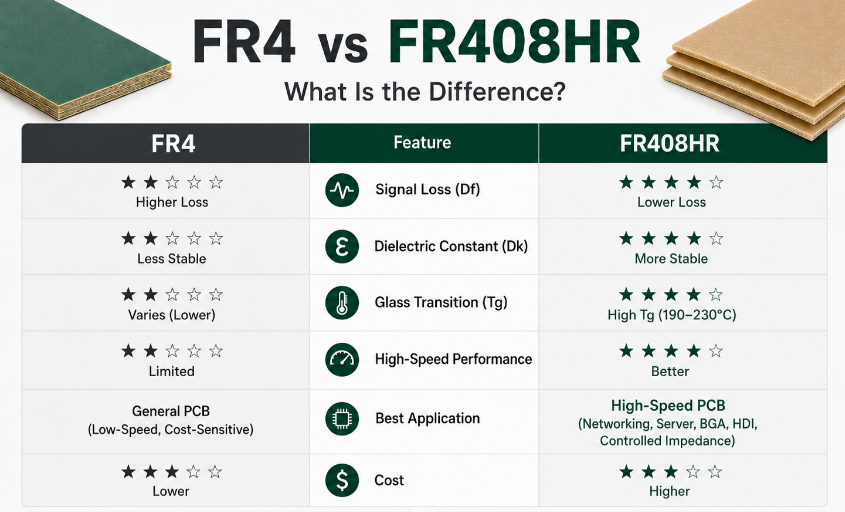
FR4 vs FR408HR is mainly a comparison between general-purpose PCB material and high-performance high-speed PCB material. Standard FR4 is lower cost and widely available, but its electrical performance is usually weaker at higher frequencies.
This Isola material provides lower loss, higher thermal reliability and better signal stability. It is more suitable for multilayer PCB, fast digital interfaces, BGA routing and controlled impedance designs.
| Item | FR4 | FR408HR |
|---|---|---|
| Material level | Standard FR4 | High-performance FR4 |
| Signal loss | Higher | Lower |
| Dk stability | Moderate | Better |
| Tg range | Varies by grade | High Tg |
| High-speed use | Limited | Better |
| Cost | Lower | Higher |
| Best fit | General PCB | High-speed PCB |
If a PCB has long high-speed traces, strict impedance control or repeated lead-free reflow stress, the upgraded laminate is usually the better option.
FR408 vs FR408HR vs FR408HRS: How Should You Choose?
FR408, FR408HR and FR408HRS are often searched together because the names look similar. However, they should not be treated as the same material in quotation, stackup design or procurement.
| Item | FR408 | FR408HR | FR408HRS |
|---|---|---|---|
| Material status | Earlier high-performance FR4 option | Current high-speed and high-reliability choice | Must verify exact material name |
| Main focus | Improved signal performance over standard FR4 | Lower loss, higher thermal reliability and lead-free support | Often appears as a search or supplier term |
| Typical use | Older high-speed PCB designs | New high-speed multilayer PCB projects | Only use after written confirmation |
| Tg reference | Lower than HR grade | High Tg grade | Depends on confirmed material |
| Loss performance | Good for its generation | Better balanced for modern high-speed PCB | Cannot assume without datasheet |
| Procurement risk | May be limited by availability | Easier to specify clearly | Higher risk of naming confusion |
| Best choice | Legacy designs or approved old stackups | New designs, controlled impedance and lead-free assembly | Not recommended without material approval |
For new projects, FR408HR is usually the safest choice because the material name is clear, the performance data is widely used, and the laminate is suitable for modern multilayer PCB manufacturing.
If “FR408HRS” appears in an old drawing, supplier quote or customer file, do not approve production by name alone. Confirm the exact laminate, datasheet, Dk, Df, Tg, copper type and approved equivalent list before ordering.
FR408HR vs 370HR: Which Material Is Better for Your PCB Project?
FR408HR vs 370HR depends on whether the project cares more about signal loss or general thermal reliability. Both are Isola high-reliability materials, but they serve different design priorities.
370HR is often selected for reliable multilayer PCB where thermal performance and CAF resistance matter. The high-speed laminate is better when the design also has lower-loss routing, controlled impedance sensitivity and fast digital signals.
| Item | 370HR | FR408HR |
|---|---|---|
| Main focus | Thermal reliability | High-speed performance |
| Dk | Higher | Lower |
| Df | Higher | Lower |
| Best use | Reliable FR4 multilayer PCB | High-speed multilayer PCB |
| Cost | Usually lower | Usually higher |
| Selection logic | Reliability first | Signal integrity first |
Choose 370HR for reliability-focused PCB. Choose the lower-loss option when signal integrity is a clear design priority.
FR408HR vs Rogers 4350B: Which One Is Suitable for High-Frequency PCB?
FR408HR vs Rogers 4350B should be decided by frequency, loss budget, RF performance and cost target. The Isola laminate is suitable for many high-speed digital PCB projects, while Rogers 4350B is better for RF, microwave and lower-loss high-frequency PCB.
The Isola laminate keeps FR4-like processing and lower cost. Rogers 4350B offers lower dielectric loss and stronger high-frequency performance, but it usually needs higher material cost and tighter process control.
| Item | FR408HR | Rogers 4350B |
|---|---|---|
| Material type | High-performance FR4 | RF laminate |
| Df level | Mid-loss | Lower loss |
| Best use | High-speed digital PCB | RF and microwave PCB |
| Manufacturing cost | Lower | Higher |
| Process compatibility | Easier | More controlled |
| Project fit | Networking, computing, industrial | Antenna, RF, microwave |
Use the Isola material for cost-effective high-speed PCB. Use Rogers 4350B when RF loss performance is the main requirement.
What Applications Commonly Use FR408HR PCB Material?
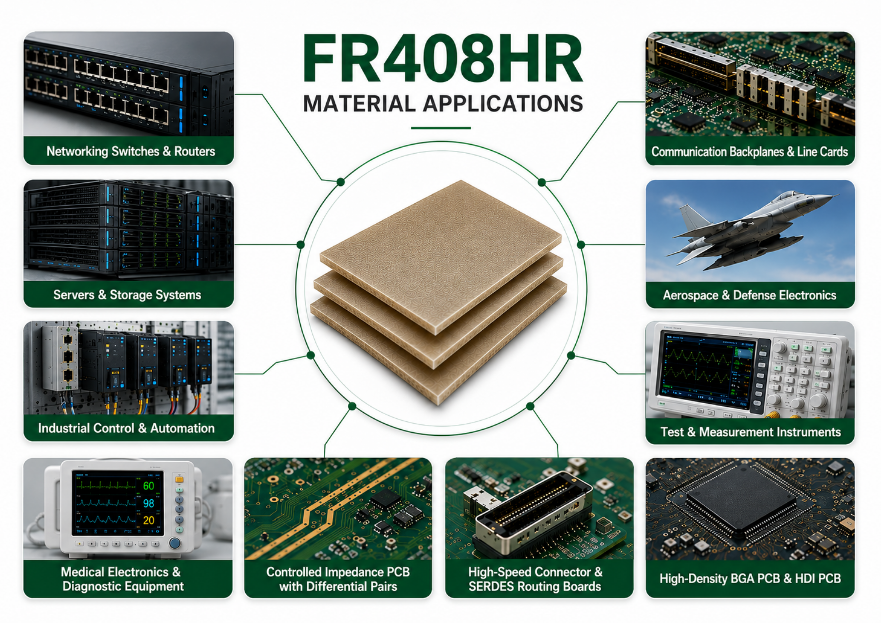
FR408HR PCB material is commonly used in products that need better signal integrity, stronger thermal reliability and stable multilayer PCB performance. It is especially useful when standard FR4 creates too much signal loss or reliability risk.
Common applications include:
- High-speed networking switches and routers.
- Communication backplanes and line cards.
- Servers, storage systems and computing hardware.
- Industrial control PCB and automation equipment.
- Medical electronics and diagnostic equipment.
- Aerospace and defense electronics.
- Test and measurement instruments.
- High-density BGA PCB and HDI PCB.
- Controlled impedance PCB with differential pairs.
- High-speed connector and SERDES routing boards.
What Affects FR408HR PCB Price?
FR408HR PCB price is affected by material cost, board structure, stackup complexity, production quantity, testing level and delivery schedule. The fr408hr laminate price per square foot also changes with copper foil, thickness, supplier stock and market availability.
Main cost factors include:
- Original Isola material or approved equivalent.
- PCB layer count and final thickness.
- Core, prepreg and copper weight selection.
- Controlled impedance tolerance.
- HDI, blind vias, buried vias or via filling.
- Back drilling for high-speed signal quality.
- ENIG, OSP, immersion silver or hard gold finish.
- IPC Class 2 or Class 3 inspection.
- Prototype quantity or batch production volume.
- Urgent delivery and material stock status.
For an accurate quotation, send Gerber files, stackup, quantity, surface finish, copper weight, impedance requirements and test standards. Complete files reduce engineering questions and avoid price changes after review.
What Are the Equivalent Materials to FR408HR?
FR408HR equivalent material should be selected by Dk, Df, Tg, Td, CTE, availability, processing behavior and project risk, not by price alone. A wrong replacement may change impedance, signal loss, lamination behavior or long-term reliability.
Possible comparison options include:
| Material | Best Fit |
|---|---|
| Isola 370HR | Reliability-focused FR4 multilayer PCB |
| Isola I-Speed | Lower-loss high-speed digital PCB |
| Isola I-Tera MT40 | Very low-loss high-speed PCB |
| Panasonic Megtron Series | High-speed and low-loss PCB |
| Rogers 4350B | RF and microwave PCB |
| Nelco N4000 Series | High-speed PCB alternatives |
Before replacing the material, confirm signal speed, trace length, RF requirement, thermal stress, budget and material availability. Stackup and impedance should also be reviewed again.
Why Choose EBest Circuit as Your FR408HR PCB Manufacturer?
EBest Circuit supports custom high-speed PCB projects from prototype to batch production. Our value is simple: stable material control, clear engineering review, reliable production and global delivery from a China-based direct PCB factory.
- Reduce material risk: We confirm material brand, stackup, copper weight and approved equivalent options before production.
- Improve signal reliability: Controlled impedance review, impedance coupon support and stackup checking help reduce signal deviation.
- Support complex PCB builds: We can support multilayer PCB, HDI PCB, BGA PCB, blind vias, buried vias, via filling and back drilling.
- Strengthen assembly quality: SMT assembly, BGA assembly, X-ray inspection and solderability checks support reliable PCBA delivery.
- Control batch consistency: AOI, electrical test, microsection, impedance testing and final inspection help reduce quality variation.
- Simplify global sourcing: Clear English communication, export-ready documents and RoHS-compliant packaging make overseas purchasing easier.
- Support OEM/ODM projects: Prototype, engineering verification and batch production can be matched to different project stages.
If your project requires reliable FR408HR PCB fabrication or PCBA assembly, EBest Circuit can review your files and provide a clear project-based quotation.
FAQs About FR408HR PCB Material
Q1. Does copper roughness affect signal loss on this laminate?
A1. Yes. Copper roughness can increase conductor loss, especially on high-speed traces. Even with a stable dielectric material, rough copper may reduce signal quality. For this reason, high-speed PCB projects should review copper foil type, trace length, impedance target and insertion loss budget before production.
Q2. What impedance tolerance is realistic for high-speed PCB?
A2. Common controlled impedance tolerance is often around ±10%, while tighter tolerance may be possible depending on design and factory capability. The final result depends on dielectric thickness, copper thickness, etching control, resin content and test coupon design. Confirm tolerance during stackup review, not after PCB fabrication.
Q3. Can this material support HDI PCB designs?
A3. Yes. The laminate can be used in HDI PCB projects when laser drilling, via filling and lamination are properly controlled. For dense BGA routing, the factory should review microvia structure, dielectric thickness, copper balance and lamination cycles before confirming production feasibility.
Q4. How can material authenticity be verified?
A4. Request material confirmation before production. For high-reliability projects, ask for material brand, laminate type, date code, certificate of conformity and traceability record. This reduces the risk of wrong substitutes, unstable Dk values and batch quality issues.
Q5. Is this laminate suitable for BGA assembly?
A5. Yes. It is suitable for BGA PCB when pad design, solder mask registration, board flatness and surface finish are controlled. ENIG is often selected for fine-pitch BGA because it provides flat pads and stable solderability. For reliable assembly, X-ray inspection is recommended after reflow.
Q6. Can this laminate be mixed with other materials in one stackup?
A6. Mixed-material stackups are possible, but they require careful engineering review. Different laminates may have different Dk, Df, CTE and lamination behavior. Before approval, check bonding compatibility, impedance shift, thermal stress, material availability and production repeatability.
Q7. What surface finish is commonly used for this type of PCB?
A7. ENIG is commonly used because it provides flat pads, good solderability and strong support for BGA assembly. OSP may be selected for cost-sensitive projects, while immersion silver can be used in some signal-sensitive applications. The best finish depends on assembly method, storage time, pad design and reliability target.
Q8. Does this laminate support lead-free assembly?
A8. Yes. It is designed for lead-free PCB assembly and can handle high-temperature reflow better than many common FR4 materials. However, reliable assembly still depends on correct baking, storage, soldering profile and process control. Moisture control is especially important for multilayer PCB and BGA assembly.
Q9. What files are required for an accurate quotation?
A9. Provide Gerber files, drill files, stackup, board thickness, copper weight, surface finish, impedance requirements, quantity and test requirements. For PCBA orders, also provide BOM, pick-and-place files and assembly drawings. Complete files help calculate cost accurately and reduce engineering delays.
Q10. How can wrong material substitution be avoided?
A10. Clearly state Isola FR408HR or approved equivalent in the PCB specification. Also request material confirmation and traceability records when needed. For high-reliability projects, material approval should happen before production, not after delivery. This helps avoid wrong laminate, wrong Dk and unstable PCB performance.
Q11. Is this material suitable for both prototype and mass production?
A11. Yes. It can be used for prototype and mass production. For prototypes, material stock and stackup confirmation are the main lead-time factors. For mass production, stable sourcing, impedance control, lamination consistency, electrical testing and inspection records become more important.
Q12. What inspection methods are useful for high-speed PCB?
A12. Useful inspection methods include AOI, electrical testing, impedance testing, microsection analysis, solderability inspection and final dimensional inspection. For assembled boards, BGA X-ray and functional testing may also be required. These checks help confirm circuit accuracy, plating quality, impedance control and assembly reliability.
Q13. When should a lower-loss material be selected instead?
A13. Choose a lower-loss laminate when the design has very long channels, strict insertion loss limits, RF circuits, microwave signals or high-frequency antenna sections. In these cases, Rogers, I-Tera, Megtron or other low-loss materials may provide better performance than a mid-loss high-speed FR4 laminate.
Q14. What should be checked before approving production?
A14. Before production, confirm material name, stackup, copper weight, board thickness, impedance tolerance, via structure, surface finish, IPC class, testing method and delivery schedule. This review helps avoid redesign, wrong material use, impedance failure, assembly risk and unexpected cost increases.
Conclusion
FR408HR is a strong option for high-speed multilayer PCB when standard FR4 cannot provide enough signal integrity, thermal stability or lead-free assembly reliability. Its key value is stable Dk, low Df, high Tg, controlled impedance support and FR4-compatible processing.
For selection, use this material for high-speed digital PCB, controlled impedance PCB, networking equipment, industrial control, medical electronics, dense BGA boards and reliable multilayer products. Choose 370HR when thermal reliability and cost are the main concerns. Choose Rogers 4350B or other low-loss laminates when RF, microwave or strict insertion loss performance is required.
For procurement, confirm the exact laminate, stackup, copper weight, surface finish, impedance tolerance, inspection standard and delivery schedule before production. EBest Circuit supports high speed PCB fabrication, PCBA assembly, stackup review, impedance control, prototype builds and batch production from our China-based direct PCB factory. Send your Gerber files and project requirements to sales@bestpcbs.com for a fast quotation.