





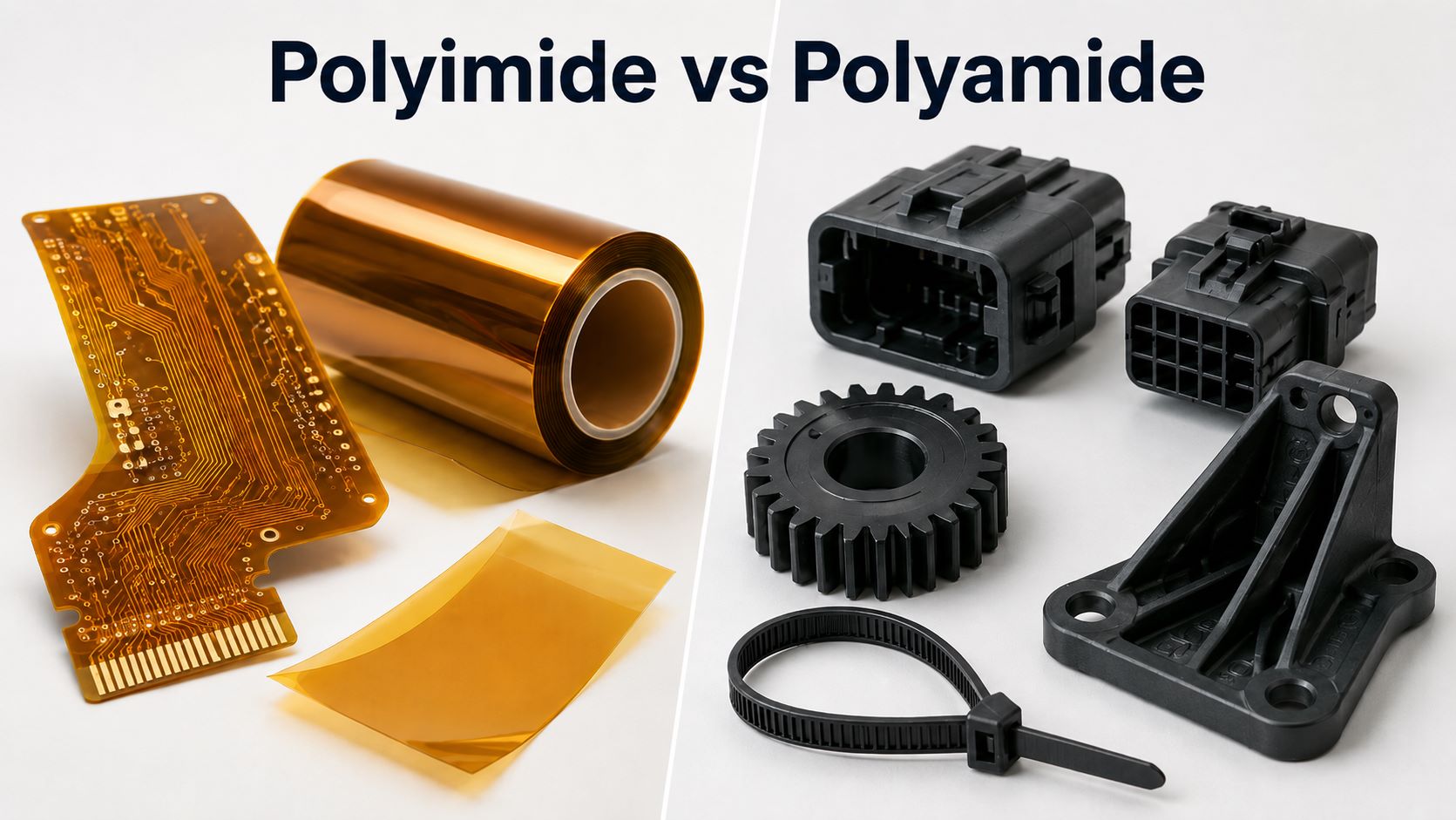
Polyimide vs polyamide is a material selection question. Polyimide is usually chosen for high-temperature insulation, flexible circuits, dimensional stability, and electronic reliability. Polyamide, commonly known as nylon, is usually chosen for molded mechanical parts, toughness, wear resistance, and cost-effective production.
The two names sound similar, but they are not the same material. If your project involves FPC, rigid-flex PCB, coverlay film, insulation tape, or high-temperature electronics, polyimide is usually more relevant. If your project involves connector housings, clips, gears, cable ties, or molded plastic parts, polyamide is usually more practical.
Typical values in this guide vary by grade, filler, thickness, processing method, and supplier datasheet.
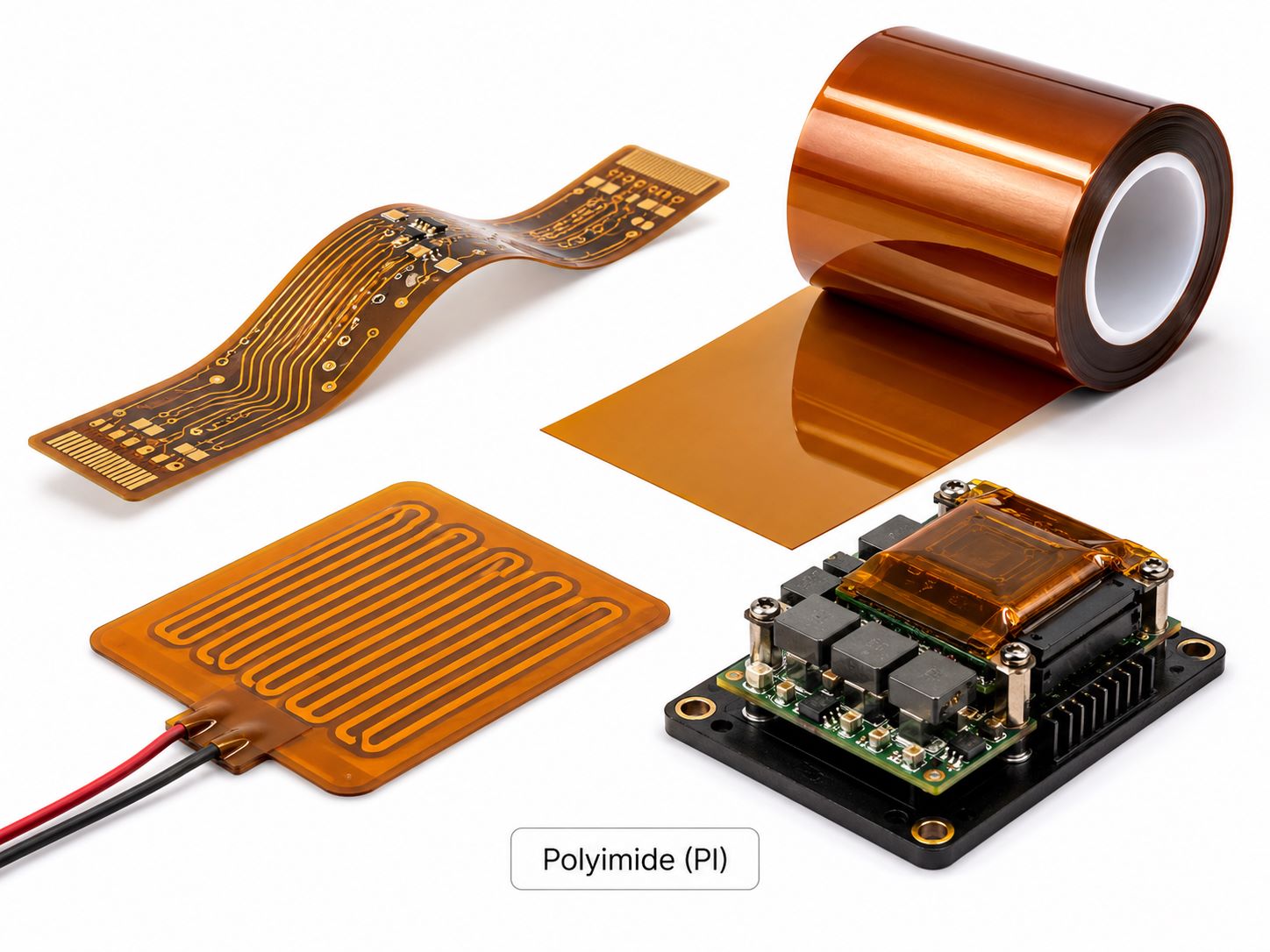
What Is Polyimide?
Polyimide is a high-performance polymer used when heat resistance, electrical insulation, dimensional stability, and thin-film reliability are important.
It is widely used in:
- Flexible printed circuits
- Rigid-flex PCBs
- Coverlay films
- High-temperature insulation tapes
- Flexible heaters
- Aerospace electronics
- Electronic insulation layers
Polyimide is important in PCB and FPC manufacturing because it can keep stable performance under heat, bending, and electrical stress.
| Polyimide Reference Data | Typical Value |
|---|---|
| Common abbreviation | PI |
| Common electronic form | Film / tape / insulation layer |
| Known film example | Kapton® HN |
| Application temperature range | -269°C to 400°C |
| Dielectric strength | about 154–315 kV/mm |
| Dielectric constant | about 3.4–3.5 |
| Volume resistivity | about 10¹⁷ Ω·cm |
| Long-term thermal stability | about 300°C for some PI materials |
| Short-term thermal stability | up to about 400°C for some PI materials |
Polyimide is usually not selected because it is cheap. It is selected because it can handle conditions where common engineering plastics may lose stability.
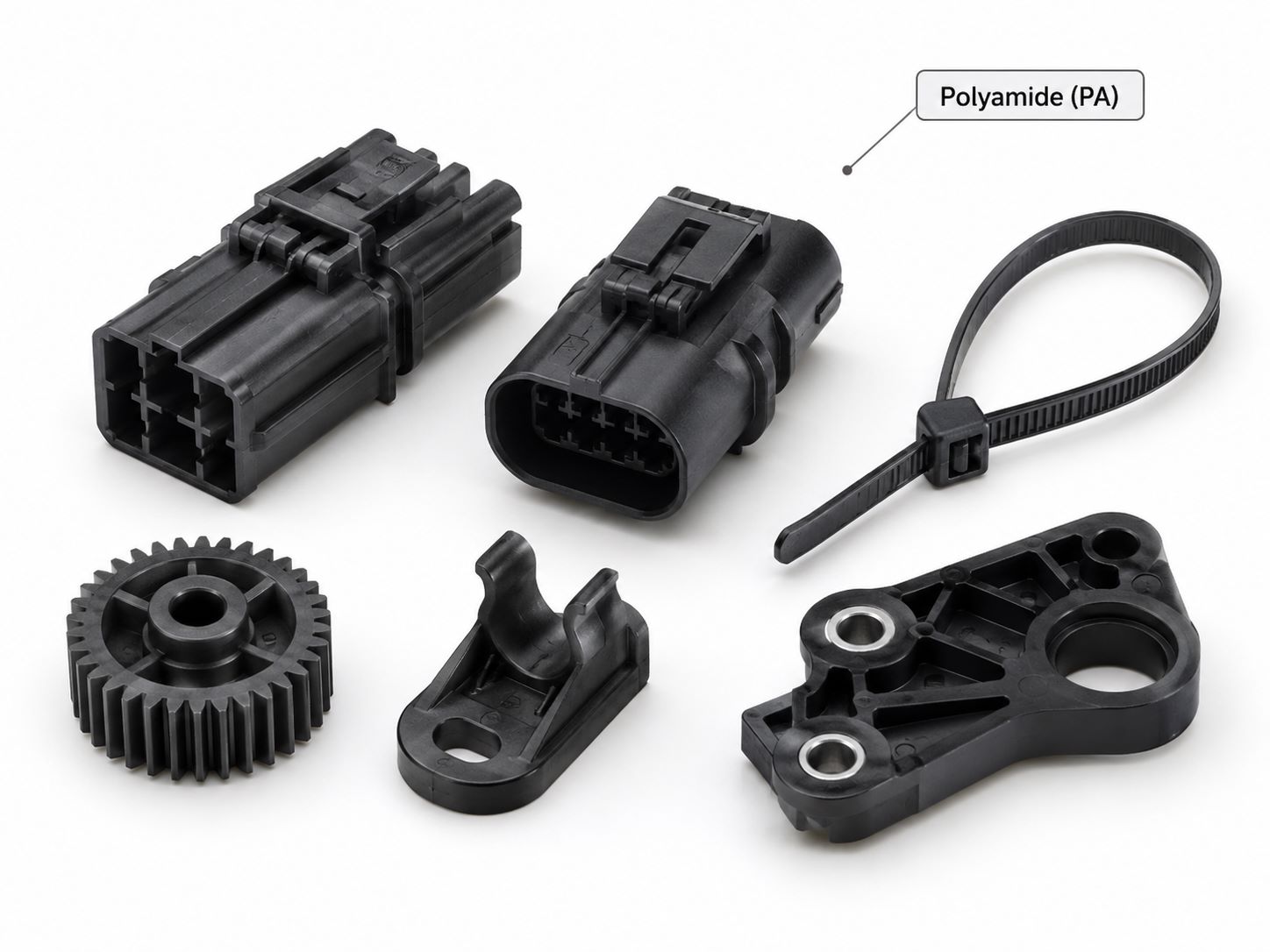
What Is Polyamide?
Polyamide is a nylon-type engineering thermoplastic used for tough, moldable, and wear-resistant mechanical parts.
Common polyamide types include PA6, PA66, PA11, PA12, and high-temperature polyamide grades. PA66 is one of the common examples used in engineering applications.
Polyamide is often used in:
- Connector housings
- Gears
- Bearings
- Bushings
- Cable ties
- Clips
- Brackets
- Covers
- Automotive plastic parts
- Industrial molded parts
Polyamide is usually easier to process than polyimide. It is widely used in injection molding and extrusion.
| Polyamide Reference Data | Typical PA66 Example |
|---|---|
| Common abbreviation | PA |
| Common name | Nylon |
| Typical grade example | PA66 |
| Melting temperature | about 255°C |
| Long-term service temperature | about 85°C |
| Short-term service temperature | about 149°C |
| Water absorption, 24 h | about 0.45% |
| Main processing method | Injection molding / extrusion |
| Typical use | Molded mechanical parts |
Polyamide is practical when the design needs toughness, wear resistance, and cost control. Its main limitation is that many grades absorb moisture, which can affect size and electrical behavior.
Polyimide vs Polyamide: What Is the Main Difference?
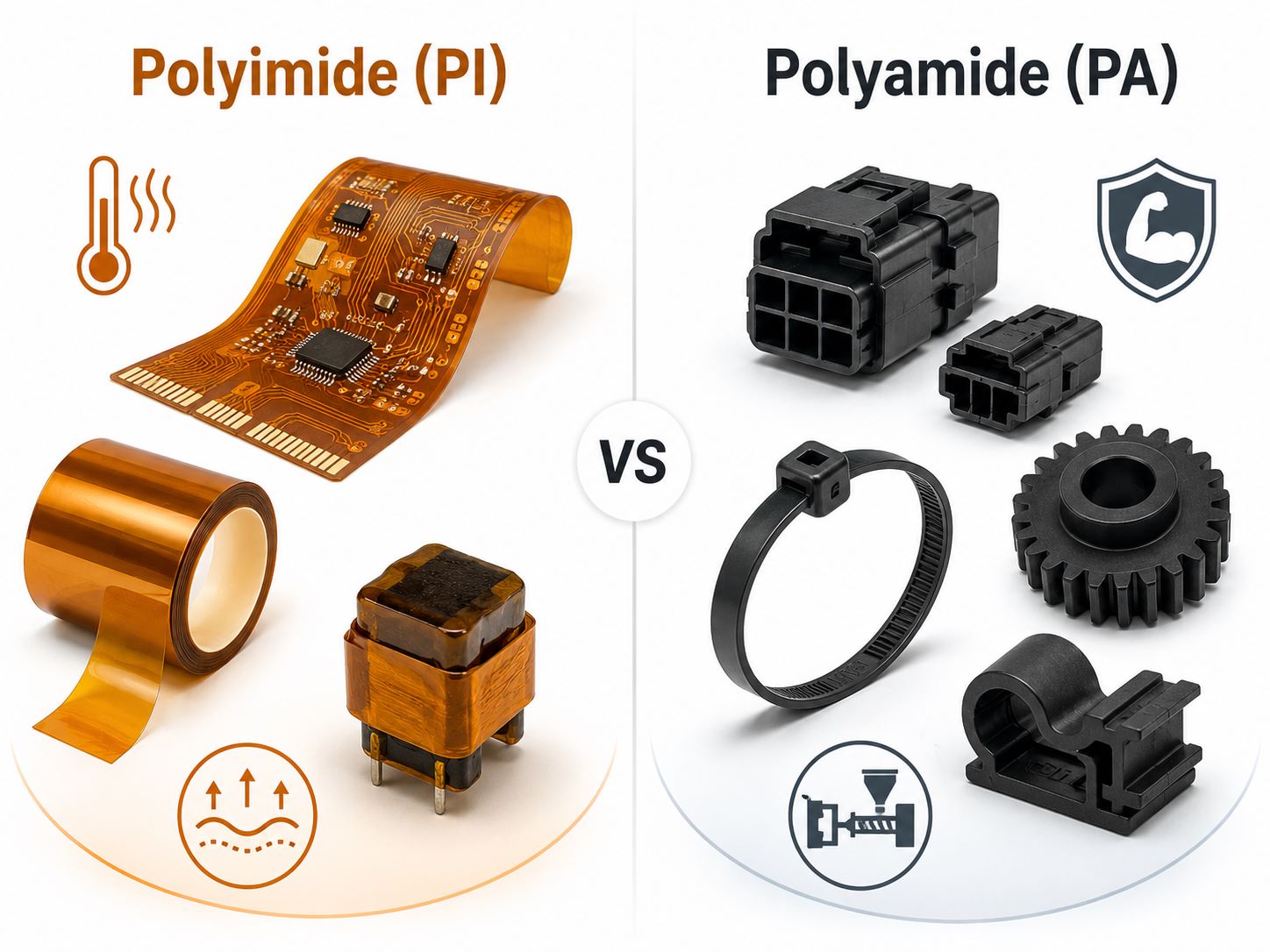
Polyimide is mainly used for high-temperature insulation and flexible circuits. Polyamide is mainly used for tough molded mechanical parts.
| Item | Polyimide | Polyamide |
|---|---|---|
| Common name | PI | Nylon / PA |
| Main role | Heat + insulation | Mechanical + molded parts |
| Heat resistance | Very high | Medium to good |
| FPC use | Common | Not typical |
| Molded parts | Limited | Common |
| Moisture concern | Lower in PI film use | Higher |
| Cost | Higher | Lower |
| Best fit | FPC, insulation film | Housings, gears, clips |
The easiest way to understand the difference:
- Polyimide is a performance material.
- It is used when heat, insulation, and dimensional stability are critical.
- It is common in FPC, rigid-flex PCB, insulation films, and high-temperature tapes.
- Polyamide is a practical engineering plastic.
- It is used when toughness, molding, wear resistance, and cost matter.
- It is common in housings, connectors, clips, gears, bearings, and cable ties.
- They are not normally interchangeable.
- A material for a flexible PCB substrate must meet different requirements from a molded connector housing.
- Choosing the wrong material can affect heat resistance, moisture stability, insulation, and long-term reliability.
Polyimide vs Polyamide Properties Comparison
Polyimide performs better in heat and electrical insulation. Polyamide performs better in moldability, toughness, and cost-effective mechanical use.
| Property | Polyimide | Polyamide |
|---|---|---|
| Heat resistance | Excellent | Medium to good |
| Electrical insulation | Excellent | Good |
| Moisture sensitivity | Lower in PI film use | Higher |
| Dimensional stability | Strong | Humidity dependent |
| Mechanical toughness | Good | Very good |
| Wear resistance | Good | Good |
| Thin film use | Common | Not typical |
| Injection molding | Limited / special grades | Common |
| FPC substrate use | Common | Not common |
| Cost | Higher | Lower |
The table gives the overview, but the application matters more than one single property.
For electronics and flexible circuits:
- Polyimide is usually stronger because it combines heat resistance, insulation, and stable thin-film behavior.
- It is suitable for FPC, rigid-flex PCB, coverlay, and insulation tape.
- It performs better where heat exposure and dimensional stability matter.
For molded mechanical parts:
- Polyamide is usually more practical.
- It is easier to process into housings, clips, connectors, brackets, and gears.
- It offers a good balance between strength, wear resistance, and cost.
The best material is not the one with the most impressive datasheet. It is the material whose strengths match the part function.
Which Has Better Heat Resistance: Polyimide or Polyamide?
Polyimide has better heat resistance than common polyamide materials.
This is one of the clearest differences between the two materials. Polyimide is widely used in high-temperature films and insulation applications. Common polyamide grades have lower service temperature limits and are usually selected for mechanical parts rather than extreme thermal environments.
| Heat Factor | Polyimide | Polyamide |
|---|---|---|
| High-temperature film use | Yes | Not typical |
| Typical PI film range | up to 400°C | Not typical |
| Long-term heat stability | Very high | Lower |
| Reflow / soldering environment | More suitable | Usually not substrate choice |
| Main heat risk | Grade-dependent shrinkage | Softening / dimensional change |
Choose polyimide when the project involves:
- Flexible PCB
- Rigid-flex PCB
- High-temperature insulation film
- Coverlay film
- Aerospace electronics
- Flexible heaters
- Soldering or reflow-related thermal exposure
Choose polyamide when the project involves:
- Molded plastic housing
- Clip or bracket
- Connector body
- Gear or bearing
- Moderate-temperature mechanical use
- Cost-sensitive plastic part
For PCB and FPC applications, heat resistance is one reason polyimide is much more common than polyamide.
Which Has Better Electrical Insulation: Polyimide or Polyamide?
Polyimide usually provides more stable electrical insulation in thin films, high-temperature environments, and flexible circuit applications.
Polyamide can also be used in electrical parts, especially molded connector housings and plastic covers. However, moisture absorption can affect its electrical behavior and dimensions.
| Electrical Factor | Polyimide | Polyamide |
|---|---|---|
| Thin-film insulation | Excellent | Not typical |
| Dielectric strength | High | Grade-dependent |
| Volume resistivity | Very high | Good |
| Moisture influence | Lower in PI film use | More important |
| FPC insulation use | Common | Not common |
| Connector housing use | Less common | Common |
Why polyimide is strong in electronic insulation:
- Thin-film reliability: it can provide insulation in very thin film form.
- Heat stability: it remains useful in higher-temperature environments.
- FPC compatibility: it supports bending, soldering, and long-term circuit reliability.
- Dimensional control: it helps maintain stable circuit geometry.
Where polyamide still works well:
- Connector housings
- Electrical enclosures
- Cable management parts
- Mechanical plastic parts near PCB assemblies
The practical rule is simple: polyimide is usually better for insulation inside the circuit structure; polyamide is usually better for molded parts around the circuit.
How Does Moisture Affect Polyimide and Polyamide?
Polyamide usually needs more attention to moisture absorption. Moisture can affect its size, stiffness, and electrical performance.
Many polyamide grades absorb moisture from the environment. This does not make polyamide a poor material, but humidity must be considered during design.
Moisture effects on polyamide:
- It may change part dimensions.
- It may reduce stiffness.
- It may affect electrical insulation behavior.
- It may affect tight-tolerance molded parts.
- It may require conditioning before final testing or assembly.
Moisture and polyimide:
- Polyimide film is usually more stable for FPC and insulation applications.
- Heat exposure, film thickness, and processing stress still matter.
- The final behavior depends on material grade and form.
What engineers should check:
- Water absorption
- Moisture absorption at saturation
- Dimensional change after conditioning
- Dielectric behavior after humidity exposure
- Mechanical strength after moisture exposure
Moisture is one reason polyamide is less suitable than polyimide for precision FPC substrate applications.
Polyimide vs Polyamide in PCB, FPC, and Electronics
Polyimide is much more important for PCB and FPC materials. Polyamide is more common in plastic parts around electronic assemblies.
| Application | Better Choice |
|---|---|
| Flexible PCB substrate | Polyimide |
| Rigid-flex PCB flexible layer | Polyimide |
| Coverlay film | Polyimide |
| High-temperature tape | Polyimide |
| Flexible heater | Polyimide |
| Electrical insulation film | Polyimide |
| Connector housing | Polyamide |
| Cable tie | Polyamide |
| Clip or bracket | Polyamide |
| Molded cover | Polyamide |
| Wear part under load | PAI or filled PA |
Why polyimide is used in FPC:
- Bending performance: flexible circuits need a stable film base.
- Heat resistance: FPC materials may experience soldering and operating heat.
- Electrical insulation: circuit layers need reliable dielectric separation.
- Dimensional stability: thin materials must remain stable during processing and use.
Why polyamide is used around electronics:
- Moldability: it is easy to mold into housings and connectors.
- Toughness: it can handle assembly and mechanical stress.
- Cost: it is economical for many plastic parts.
- Wear resistance: it works well in clips, gears, supports, and brackets.
For PCB-related buyers, the difference is clear: polyimide is usually part of the flexible circuit structure, while polyamide is usually part of the surrounding mechanical structure.
Polyamide-Imide vs Polyimide: Are They the Same?
Polyamide-imide, also called PAI, is not ordinary polyamide. It is a separate high-performance polymer used for hot, loaded, wear-resistant mechanical parts.
| Material | Best Known For | Typical Use |
|---|---|---|
| Polyimide | High-temperature insulation | FPC, insulation film |
| Polyamide | Tough molded parts | Housings, clips, gears |
| Polyamide-imide | Hot loaded wear parts | Bearings, bushings, seals |
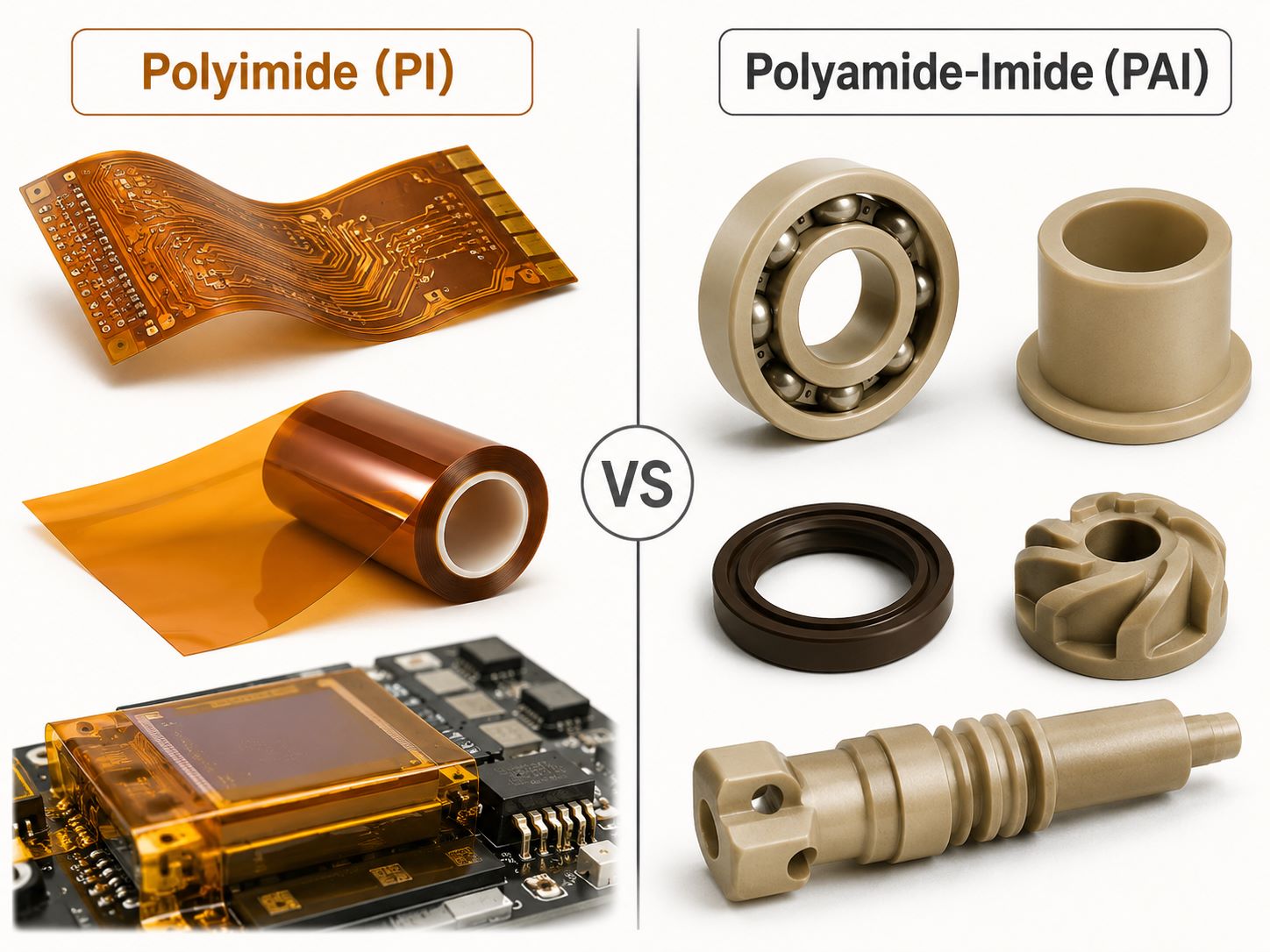
How to understand PAI:
- PAI combines amide and imide chemistry.
- It performs far above common nylon in high-temperature mechanical use.
- It is often used in bearings, bushings, seals, compressor parts, and precision components.
- It should not be treated as ordinary polyamide.
- It is stronger for hot mechanical parts, while polyimide is stronger for film insulation and flexible circuits.
When users search for polyamide-imide vs polyimide, they are usually comparing two high-performance materials. That is different from comparing ordinary polyamide vs polyimide.
FAQs About Polyimide vs Polyamide
What is the main difference between polyimide and polyamide?
Polyimide is mainly used for heat-resistant insulation, flexible circuits, and high-reliability electronics. Polyamide is mainly used for tough molded mechanical parts such as housings, gears, clips, and connectors.
Is polyimide the same as polyamide?
No. Polyimide and polyamide are different polymer families. Their names sound similar, but their heat resistance, moisture behavior, processing methods, and applications are different.
Which is better, polyimide or polyamide?
Polyimide is better for high temperature, electrical insulation, flexible circuits, and dimensional stability. Polyamide is better for molded parts, toughness, wear resistance, and cost-effective production.
Is polyimide used in PCB manufacturing?
Yes. Polyimide is widely used in flexible PCB and rigid-flex PCB manufacturing. It is commonly used as the flexible substrate and insulation layer.
Is polyamide used in PCB manufacturing?
Polyamide is not commonly used as the main PCB substrate. It is more often used for plastic parts around electronic assemblies, such as connector housings, cable ties, clips, and mechanical supports.
What is polyamide-imide?
Polyamide-imide, or PAI, is a high-performance polymer with both amide and imide chemistry. It is used for high-temperature, high-strength, wear-resistant mechanical parts.
Which material is better for flexible circuits?
Polyimide is better for flexible circuits because it offers heat resistance, electrical insulation, dimensional stability, and flexibility.
Which material absorbs more moisture?
Many polyamide grades need more attention to moisture absorption than polyimide film materials. Moisture can affect dimensional stability and electrical performance.
To conclude, polyimide vs polyamide is mainly a choice between high-temperature circuit insulation and practical molded mechanical performance.
Choose polyimide when the application needs heat resistance, electrical insulation, FPC reliability, rigid-flex PCB performance, or stable thin-film behavior. Choose polyamide when the application needs toughness, wear resistance, moldability, and cost control for mechanical parts.
Polyamide-imide should be treated as a separate high-performance material. It is useful when a part needs high mechanical strength, heat resistance, and wear resistance at the same time.
Need support with flexible PCB, rigid-flex PCB, PCB material selection, or PCBA manufacturing? Pls feel free to send your Gerber files, BOM, drawings, and project requirements to EBest Circuit at sales@bestpcbs.com.
You may also like
Tags: polyamide vs polyimide, Polyimide vs Polyamide, polyimide vs polyamide properties