The difference between offshore and domestic PCB manufacturers is the location of the factory that performs the released fabrication or assembly work. That location affects total delivered cost, receiving lead time, available processes and capacity, engineering access, quality oversight, and recovery after a delayed or rejected lot. Neither route is automatically cheaper, faster, or better.
OEMs, EMS providers, and product teams need more than a country label. They need to know which factory will build the boards, what the complete delivered cost will be, when usable boards will arrive, and how a failed lot will be recovered. Those answers make it possible to match the sourcing route to the design stage, volume, deadline, and business risk.
What Is the Difference Between Offshore and Domestic PCB Manufacturers?
The difference between offshore and domestic PCB manufacturers is the factory location—not the sales address. Domestic manufacturing keeps the quoted fabrication or assembly in the buyer’s home country. Offshore manufacturing assigns that work to a factory abroad. This distinction applies only to the production location; a domestic legal supplier may still use an offshore factory.
| Criteria | Domestic Manufacturing | Offshore Manufacturing |
|---|---|---|
| Manufacturing Site | Factory in the buyer’s home country | Factory outside the buyer’s home country |
| Order Profile | Prototypes, NPI, frequent ECOs, and urgent replenishment | Released designs, repeat volume, and planned releases |
| Cost Structure | Higher conversion cost may be offset by lower freight, duty, and buffer-inventory exposure | Lower conversion cost may be available at scale; freight, duty, and inventory remain part of delivered cost |
| Lead Time | Shorter transit and recovery cycle | Longer transit and customs path; better suited to planned releases |
| Engineering Interface | More working-hour overlap and easier site access | Scheduled cross-time-zone reviews and stronger written control |
| Supply-Chain Risk | Smaller qualified pool or constrained local capacity | Freight, customs, currency, and regional disruption |
How Do Offshore and Domestic PCB Manufacturing Costs Compare?
Offshore production can reduce the factory price on repeat orders, while domestic production can reduce freight, import charges, buffer stock, and urgent-recovery expense. Compare total landed cost per accepted board—not the quoted unit price.
Calculate both quotations on the same basis:
Total landed cost per accepted board = production price + tooling/NRE + freight + insurance + duty and brokerage + payment or currency cost + incoming inspection + expected scrap or rework + inventory carrying cost + recovery cost, divided by accepted quantity.
The result usually turns on three project conditions:
- Small or changing orders: Tooling, first-article review, engineering exchanges, expedited freight, and another revision can outweigh a modest unit-price saving.
- Stable repeat demand: Panel utilization, quantity breaks, planned material purchasing, scheduled freight, and controlled buffer stock can strengthen the offshore cost case.
- Expensive nonconformance: Sorting, rework, replacement production, return freight, and lost line time can erase an apparent saving from either route.
Put both offers on the same shipment size, freight mode, delivery term, importer responsibility, inspection scope, and recovery assumption. Only then can the buyer see whether an offshore factory-price advantage remains at the receiving dock.
How Does Lead Time Differ Between Domestic and Offshore PCB Manufacturers?
Domestic production usually reaches the buyer sooner for prototypes and emergency replacements. Offshore production can still meet a planned schedule when materials, capacity, approvals, and air freight are secured in advance. Measure lead time from the release of complete data to the receipt of usable boards.
For a U.S. buyer, the ranges below are practical RFQ estimates when the data package is complete, common materials are available, no major engineering hold occurs, and offshore shipments travel by express or air freight.
| Order Type | Domestic Lead Time | Offshore Lead Time | Main Variables |
|---|---|---|---|
| Simple prototype bare boards | 3–10 business days | 7–15 business days | Layer count, quick-turn capacity, DFM questions, material availability, and courier pickup |
| Standard multilayer, low-volume order | 10–20 business days | 15–30 business days | Lamination cycles, via filling, controlled impedance, surface finish, test records, and customs |
| Repeat production order | 3–5 weeks | 4–7 weeks by air | Forecast release, panel utilization, material allocation, production queue, inspection, and freight booking |
| PCB assembly after all parts are ready | About 2–4 weeks | About 3–5 weeks | Stencil preparation, placement complexity, BGA or bottom-terminated components, test scope, rework, and shipment release |
A committed delivery date must include material readiness, factory capacity, inspection, freight, customs, and final delivery. Domestic production has the clearer advantage when rapid recovery matters; a prepared offshore source can remain competitive for scheduled orders.
How Do Manufacturing Capabilities Compare Between Offshore and Domestic PCB Manufacturers?
Domestic factories often handle prototype feedback and engineering changes more quickly. Offshore factories may provide greater production scale or a broader integrated supply network. Neither location proves technical capability; the assigned factory must demonstrate that it can build the released design.
| Capability | Domestic | Offshore | Verification |
|---|---|---|---|
| Prototype and NPI | Often supports shorter DFM and revision loops for small builds | Works best with stable data and controlled approval windows | DFM response, prototype equipment, revision cutoff, and sample schedule |
| Advanced fabrication | Available through qualified specialist factories | Available through qualified factories and, in some cases, a wider production network | Exact site, process route, equipment, feature limits, and in-house or subcontracted scope |
| Materials | Local stock can shorten replenishment; specialist laminates may still be imported | Regional supply networks may broaden options but still face allocation and transit risk | Approved material, manufacturer, grade, stock status, alternate rules, and replenishment lead time |
| PCB assembly | Useful when hands-on debug, low-volume changes, or local validation is important | Can combine sourcing, assembly, inspection, and volume production in one route | Placement range, BGA capability, X-ray, programming, test scope, and rework control |
| Production volume | May suit low-volume or specialist work; available capacity must be confirmed | Can offer stronger panel utilization and repeat-volume capacity when reserved | Monthly capacity, bottleneck equipment, material allocation, ramp plan, and queue position |
| Backup production | Physical oversight can be easier, but the qualified local pool may be smaller | Additional sites may be available, although transfer control becomes more complex | Matched stackup, tooling, approved materials, test method, change control, and transfer validation |
Choose the route that fits the design stage and order scale, then qualify the factory against the released stackup, materials, vias, tolerances, assembly, testing, and capacity requirements. The factory record—not its country—establishes capability.
Does PCB Quality Differ Between Domestic and Offshore Manufacturers?
Neither geography has a built-in quality advantage. A domestic or offshore board is only as reliable as the factory’s control of materials, drilling, plating, imaging, inspection, testing, and corrective action. Use the same acceptance criteria for both routes, then compare the records from the actual production lot.
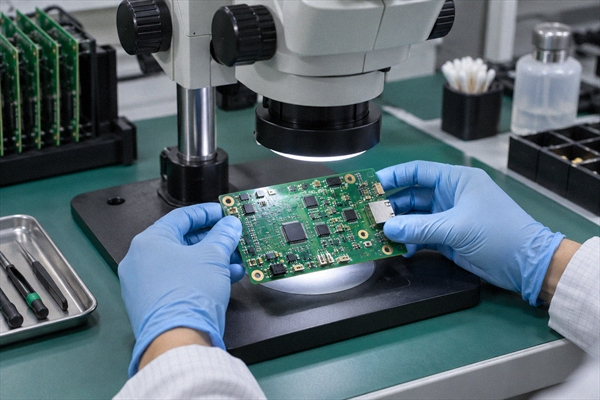
Look for the following controls before approving either source:
- Material and stackup control: The released material, copper, finished thickness, stackup, surface finish, tolerances, and approved substitutions match the production records.
- Drilling and plating control: Hole preparation, plating, filled-via processes, registration, and microsection evidence address the features that carry the greatest reliability risk.
- Inspection and test plan: Electrical test, impedance data, coupons, automated or visual inspection, X-ray where applicable, sample size, limits, units, and report format are agreed before production.
- Certificate scope: Any required certificate identifies the correct legal entity, manufacturing site, covered activity, and valid period.
- Lot traceability: Material lots, work orders, approved deviations, inspection records, and shipment records remain connected to the delivered lot.
- Change control: Site, material, stackup, finish, subcontractor, and controlled test-method changes require approval before use.
- Corrective action: Containment, root-cause analysis, replacement, effectiveness checks, and recurrence prevention have named owners and defined outputs.
Domestic sourcing can make an on-site audit or urgent physical review easier. An offshore source can deliver the same level of control when the order defines the required records, samples, approvals, and escalation path. Give preference to the factory that can trace how the lot was built, tested, released, and corrected when a result falls outside the agreed limit.
How Do Communication and Engineering Support Differ?
Domestic manufacturing generally offers more overlapping work hours and easier site access. Offshore manufacturing relies more heavily on complete written records and scheduled approval windows. What matters is whether questions reach the right engineer, decisions are recorded, and production waits for required approval.
Test that process with real project questions before placing the order:
- Named technical owner: Identify who receives DFM questions, who can answer process questions, and who owns escalation when the normal contact is unavailable.
- Written DFM record: Require stackup, impedance, material substitution, drill or via, panelization, assembly, and test questions to remain tied to the correct data revision.
- Approval authority: Record which changes require engineering approval and which manufacturing adjustments are already permitted by the released notes.
- Revision control: Use one controlled package for Gerber or ODB++, drill data, drawings, BOM, placement data, and approved responses so that fabrication and assembly do not work from different versions.
- Response expectations: Agree how urgent questions are flagged, when overlapping working hours are available, and how an unanswered issue affects the production schedule.
- ECO handoff: Confirm how an engineering change closes open work, identifies affected inventory, and authorizes the next build revision.
A domestic source may resolve an urgent question during the buyer’s working day and arrange a visit more easily. An offshore source can keep the project moving when ownership, revision history, approval authority, and escalation timing are explicit. Judge the communication process by how clearly questions are closed, not by time zone alone.
What Supply Chain and Logistics Risks Should You Compare?
Domestic and offshore routes fail in different ways. A domestic route may depend on a smaller qualified supplier pool or limited special-process capacity; an offshore route adds freight, customs, currency, and a longer replacement path. The better route is the one whose likely disruption the program can absorb and recover from.
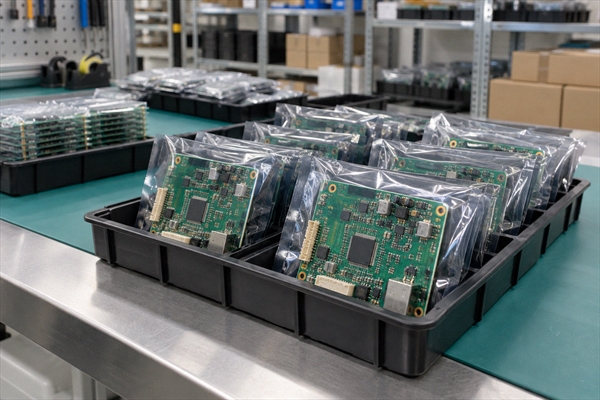
Domestic continuity checks should cover:
- Qualified capacity: Confirm material allocation, critical equipment, queue position, and the plan for an unexpected increase in demand.
- Special-process availability: Identify which required constructions, finishes, materials, and tests depend on a single local site or subcontractor.
- Single-source exposure: Determine whether another domestic or offshore factory could reproduce the released build without an uncontrolled transfer.
- Cost concentration: Review price breaks and capacity reservations across the forecast rather than treating a prototype quotation as production economics.
Offshore continuity checks should cover:
- Freight route: Set the shipment mode, handoff points, carrier buffer, insurance, and contingency for a missed booking or transport disruption.
- Customs responsibility: State the importer of record, classification owner, documentation, duty basis, brokerage, and delivery term in the quotation.
- Commercial exposure: State the quotation currency, validity, payment timing, and treatment of material commitments if demand changes.
- Regional concentration: Identify whether the factory, material source, port, and backup route depend on the same geographic event.
- Replacement route: Agree how a delayed or rejected lot will be contained, sorted, remade, and shipped without waiting for an undefined return process.
Before awarding the order, model three events: a factory stoppage, a missed receiving date, and a lot rejected at incoming inspection. Choose the route that keeps downtime, cash exposure, and recovery time within the program’s limits.
When Is a Domestic PCB Manufacturer the Better Choice?
Choose a domestic PCB manufacturer when proximity materially shortens engineering, validation, audit, or recovery work. Domestic production is usually the better fit for changing designs, small urgent builds, location-restricted programs, and demand that cannot support long transit or inventory buffers.
- Early prototypes: Engineers need quick feedback on stackup, tolerances, materials, assembly details, or test access before the design is frozen.
- Frequent revisions: Several ECOs are expected, and the cost of obsolete work or material exceeds the expected unit-price saving.
- Small urgent builds: Validation, repair, service, or replacement quantities must arrive quickly and cannot absorb a large minimum order.
- Fast failure recovery: A rejected lot could stop a launch or production line, making nearby sorting, rework, or replacement capacity valuable.
- Physical oversight: The buyer needs a short-notice audit, witness point, process review, or in-person corrective-action meeting.
- Location restrictions: Contract, customer, data, end-use, or site-access requirements limit where the board may be fabricated or assembled.
- Unstable demand: Release quantities and dates change often enough that excess inventory becomes a larger risk than unit price.
A domestic premium is justified when the shorter loop prevents a costly delay, obsolete revision, or compliance problem. The factory must still prove its process capability, capacity, quality records, and commercial terms; proximity alone is not a qualification.
When Is an Offshore PCB Manufacturer the Better Choice?
Choose an offshore PCB manufacturer when the design is stable, demand is forecastable, the proposed location is permitted, and the cost or capacity advantage remains after logistics and risk are included. Offshore production works best when materials, capacity, and shipments can be planned before the order becomes urgent.
- Stable production data: Stackup, materials, fabrication notes, BOM, placement data, inspection criteria, and approved substitutions are controlled under one revision.
- Repeat volume: Medium- or high-volume demand can benefit from panel utilization, material purchasing, scheduled production, and quantity pricing.
- Broader process access: The proposed site can show a suitable route for HDI, rigid-flex, high-frequency materials, heavy copper, metal-core, ceramic, or coordinated PCBA requirements.
- Predictable releases: Forecasts, material commitments, shipment windows, and inventory rules can absorb international transit.
- Available production capacity: The offshore candidate can reserve the equipment, material, and queue position needed for the planned ramp.
- Mature remote control: DFM approvals, revision control, lot records, nonconformance handling, and corrective action follow a documented process.
- Permitted manufacturing route: Customer, contract, file-control, end-use, production-country, and shipment-destination rules allow the assigned site.
An offshore advantage is real only when it survives a complete receiving-date and landed-cost comparison and the factory can provide the required technical and quality records. If freight, buffer stock, or recovery exposure removes the saving, the unit price does not justify the route.
How Should You Choose Between Offshore and Domestic PCB Manufacturers?
Eliminate unsuitable routes before comparing price. Start with non-negotiable location and capability requirements, then compare lead time, landed cost, quality evidence, and recovery among the factories that remain.
- Check manufacturing-location restrictions: Remove any fabrication or assembly site that conflicts with customer, contract, data, end-use, or site-access requirements.
- Match the required technologies: Confirm that the assigned factory can control the actual stackup, materials, vias, tolerances, finishes, electrical requirements, assembly, and tests.
- Assess design stability: Decide whether the next order is a changing prototype, a validation build, or released repeat production.
- Set the receiving date: Work backward through engineering release, materials, production, verification, transit, customs, and incoming acceptance.
- Use the real order profile: Compare the prototype quantity, production breaks, release pattern, ramp forecast, and likely material commitments.
- Normalize landed cost: Put production, tooling, freight, import charges, inspection, inventory, scrap, rework, and recovery on the same delivery basis.
- Set the release evidence: State the inspection reports, electrical or impedance results, traceability, certificates, deviations, and approvals needed for acceptance.
- Model a disruption: Calculate what happens if production stops, a shipment is delayed, or a lot is rejected at receiving.
- Compare recovery speed: Ask who contains the issue, what evidence arrives first, where replacement work is performed, and when conforming boards can be restored.
- Choose the source structure: Use one source when its continuity plan covers the risk; qualify a second source when the transfer cost is justified and both routes can build the same released design.
Changing prototypes and urgent deliveries often favor domestic production; stable repeat orders with planned demand can favor offshore production. For a complex PCB, qualify the factory’s process capability before using geography as a deciding factor.
Why Choose EBest Circuit for Offshore PCB Manufacturing?
When offshore production suits the project, EBest Circuit can quote PCB fabrication, component sourcing, assembly, agreed testing, and delivery as one scope. Engineering, quality, and purchasing can review the same technical assumptions, responsibilities, and delivery basis before releasing the order.
- Spend less time coordinating suppliers: One request can cover bare boards, components, assembly, testing, packaging, and delivery instead of requiring separate quotations.
- Resolve technical issues earlier: DFM review can close stackup, material, via, panelization, assembly, and test questions before material is committed.
- Match the factory to the design: HDI, rigid-flex, high-frequency, heavy-copper, metal-core, ceramic, volume, and assembly requirements can be screened before order placement.
- Compare the complete cost: Quantity breaks, tooling, included services, packaging, delivery terms, and buyer responsibilities can be shown in one commercial scope.
- Improve traceability and recovery: Revision status, inspection records, shipment milestones, escalation, and replacement expectations can be agreed before production begins.
This reduces supplier handoffs and makes the offshore quotation easier to compare with a domestic offer. Projects that require domestic manufacturing should remain with a qualified domestic source.
FAQs About Offshore and Domestic PCB Manufacturers
Q1: Is offshore PCB manufacturing the same as outsourcing?
A1: No. Outsourcing describes who performs the work; offshore describes where it is performed. A buyer can outsource fabrication or assembly to a domestic factory, an offshore factory, or separate factories in both locations. The distinction determines which location, trade, delivery, and recovery controls apply.
Q2: Is nearshore PCB manufacturing considered offshore?
A2: Yes, when the factory is outside the buyer’s home country. Nearshore production may reduce distance, time-zone difference, or freight exposure, but the manufacturing route is still cross-border. Price the border, transport, and recovery steps as a distinct route.
Q3: Are offshore PCB manufacturers always cheaper?
A3: No; the answer can change by order size and delivery method. Recalculate the comparison when quantity, freight mode, duty treatment, material commitment, inspection scope, or expected rework changes rather than carrying a savings percentage from one build to the next.
Q4: Are domestic PCB manufacturers always faster?
A4: No; factory capacity and material readiness can outweigh distance. Require both suppliers to state when the schedule starts, which customer approvals can stop it, and whether the quoted date is factory completion, shipment, or usable receipt.
Q5: Can offshore PCB manufacturers meet the same quality requirements as domestic suppliers?
A5: Yes, when the assigned site can meet the same specification and release evidence. Audit access may differ, so specify the lot records, test reports, traceability, deviation approval, and corrective-action outputs that must be available remotely.
Q6: Can bare PCBs be produced offshore and assembled domestically?
A6: Yes, but the two sites must be qualified separately. Set bare-board incoming inspection, packaging and moisture controls where applicable, ownership during transit, rejection handling, and the date accepted boards must reach the assembly line. Assign a named owner to every handoff.
Q7: How do Incoterms affect offshore PCB cost?
A7: They assign delivery tasks, cost, and risk between buyer and seller. Compare quotations at the same named place and version of the chosen term, then identify who books freight, carries insurance, clears customs, pays duties, and manages final delivery.
Q8: Should prototype and mass production use the same PCB supplier?
A8: Only when the supplier can control the transfer as well as both build stages. Compare prototype speed, volume equipment, panelization, approved materials, tooling, test coverage, revision history, and the evidence used to release the first production lot.
Q9: Can domestic and offshore PCB manufacturers be used as dual sources?
A9: Yes, if both sources build the same controlled product specification. Align stackup, approved materials, fabrication notes, test method, acceptance limits, revision control, and change approval; otherwise the backup may produce a materially different board when it is needed.
Q10: What documents should be requested from an offshore PCB manufacturer?
A10: Request the records that prove the assigned site, released construction, inspection result, and lot identity. Depending on the order, this may include site and process confirmation, stackup approval, material or conformity records, electrical and impedance results, microsection or inspection reports, approved deviations, packing details, and shipment traceability.
If you are comparing domestic and offshore options for an upcoming PCB build, send EBest Circuit your Gerber or ODB++ files, stackup, materials, quantity, destination, and required delivery date. For assembly, include the BOM and placement files. Email sales@bestpcbs.com, and we can prepare a project-specific PCB or PCBA quotation.