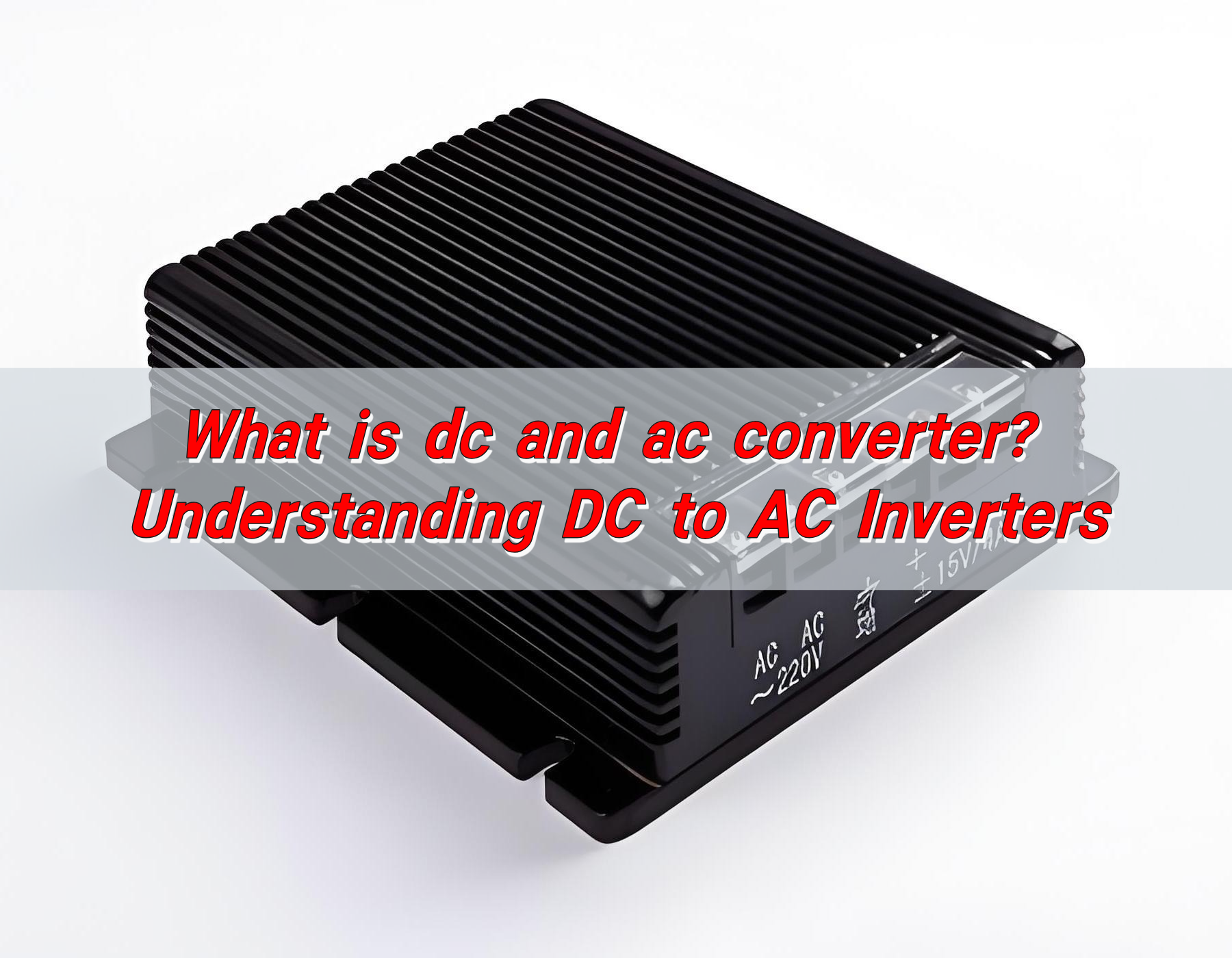
What does an inverter do? Its primary job is to convert direct current from a battery, solar array, fuel cell, or DC bus into alternating current with the voltage, frequency, and waveform required by the load. Modern inverters can also regulate motor speed, synchronize with the grid, manage battery power, monitor faults, and protect the connected system.
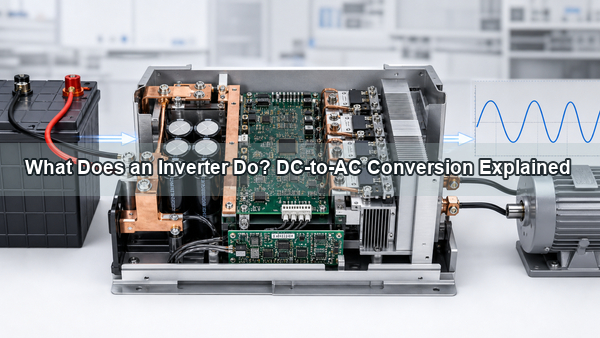
What Does an Inverter Do?
An inverter reverses the function associated with a rectifier. A rectifier changes AC into DC, while an inverter synthesizes AC from a DC source. The output may be fixed at 120 V/60 Hz or 230 V/50 Hz, synchronized to a utility grid, or continuously adjusted to control the speed and torque of an AC motor.
The conversion is electronic rather than mechanical. Semiconductor switches repeatedly connect the DC source to the output in opposite polarities. Control electronics determine the switching sequence, while filters and magnetics shape the pulses into a usable AC waveform.
How Does an Inverter Work?
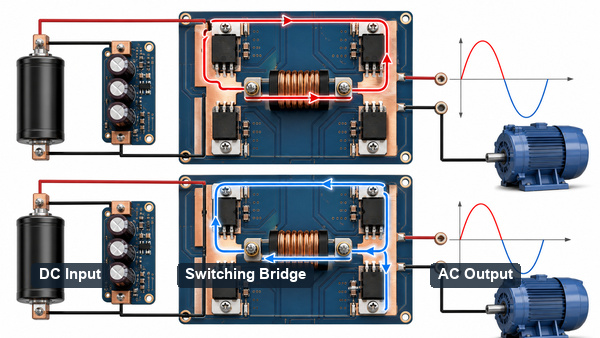
A basic full-bridge inverter uses four power switches arranged around the load. One diagonal pair conducts to apply positive voltage; the opposite pair conducts to apply negative voltage. Alternating between those states changes the direction of current and creates an AC output from a unidirectional DC input.
Practical units add a controller, gate drivers, current and voltage sensing, dead-time control, protection, and an output filter. The controller compares measured output with its target and changes the switching pattern to regulate amplitude, frequency, or motor torque.
What Parts Are Inside an Inverter?
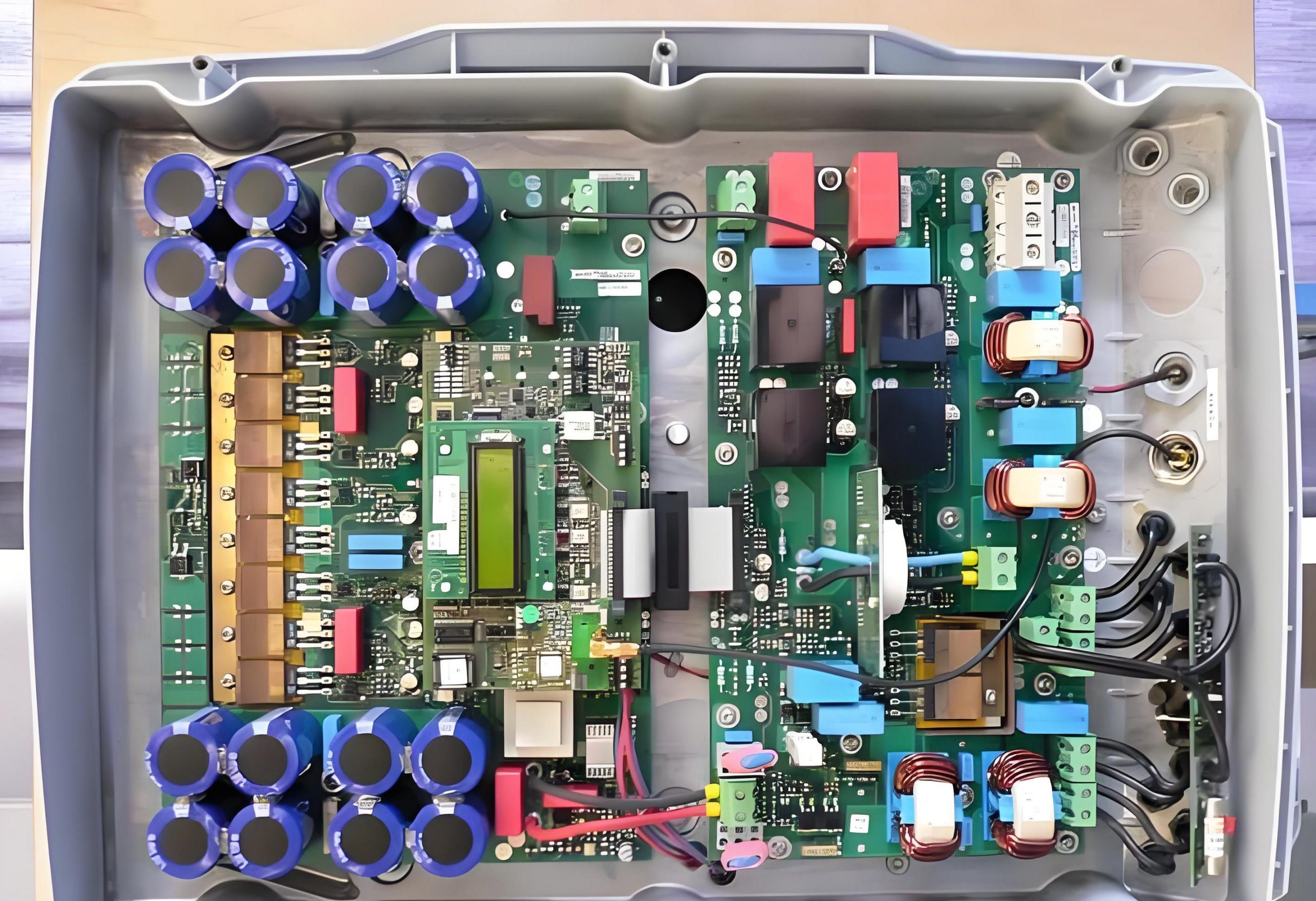
The power path and control path have different electrical and layout requirements. The main functional blocks are:
- DC input and protection: connectors, fuses, reverse-polarity control, surge suppression, and pre-charge circuitry.
- DC-link stage: capacitors that supply pulse current and limit bus ripple.
- Power bridge: MOSFETs, IGBTs, or SiC devices that switch the DC bus.
- Gate drivers: circuits that deliver controlled drive current and isolation to the power switches.
- Controller: MCU, DSP, or dedicated control IC that generates PWM and manages protection.
- Sensing: current, bus-voltage, output-voltage, and temperature feedback.
- Output network: inductors, capacitors, transformers, or motor windings that shape or use the switched waveform.
How Does PWM Create an AC Waveform?
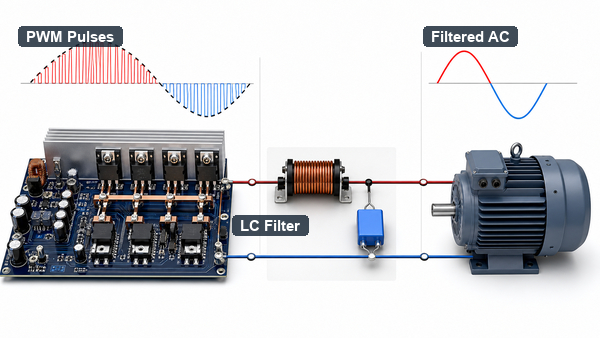
Pulse-width modulation changes how long each power switch remains on during every switching cycle. A sequence of narrow and wide pulses has an average value that follows a sine-wave reference. An LC filter or the inductance of a motor suppresses the high-frequency switching components, leaving the required low-frequency AC current.
Higher switching frequency can reduce filter size and improve waveform control, but it also increases switching loss, gate-drive demand, EMI, and PCB layout sensitivity. The final frequency is therefore a system trade-off involving semiconductor technology, power level, thermal limits, acoustic noise, and EMC targets.
What Output Waveforms Can an Inverter Produce?
| Waveform | Construction | Typical behavior | Design limitation |
|---|---|---|---|
| Square wave | Direct polarity reversal | Simple and inexpensive | High harmonic content; unsuitable for many loads |
| Modified sine wave | Stepped positive, zero, and negative levels | Acceptable for some resistive loads | Can increase motor heating, hum, and power-supply stress |
| Pure sine wave | High-frequency PWM plus filtering | Closest to utility AC and compatible with sensitive loads | More control, filtering, and thermal complexity |
Waveform labels alone do not define quality. Total harmonic distortion, regulation, transient response, common-mode noise, and load compatibility should also be checked.
What Types of Inverters Are Common?
Inverters can be classified by circuit topology or by system role. Voltage-source inverters operate from a relatively stiff DC-link voltage; current-source inverters control current through a DC-link inductor. Single-phase and three-phase bridges serve different loads, while isolated topologies add a transformer where safety, voltage conversion, or ground separation requires it.
System labels include string, central, micro, hybrid, grid-following, grid-forming, off-grid, motor-drive, and UPS inverters. These names describe installation and control behavior rather than one universal power stage.
Where Are Inverters Used?
Solar systems use inverters to convert panel DC into grid-compatible AC. Battery storage and UPS systems use them to supply AC during normal operation or an outage. EV traction inverters convert pack DC into controlled three-phase current for the motor and may reverse power flow during regenerative braking.
Motor drives vary output voltage and frequency to control pumps, fans, compressors, elevators, and factory equipment. Smaller inverter circuits appear in induction heating, microwave ovens, lighting ballasts, portable power stations, and other products that require controlled high-frequency or AC power.
For inverter, storage, and EV electronics, a new energy PCB must support the required current, isolation, thermal path, and control circuitry rather than being selected from application name alone.
How Efficient Is an Inverter?
Efficiency is output power divided by input power. Losses occur in semiconductor conduction, switching transitions, magnetics, capacitors, gate drivers, control circuits, and interconnects. Efficiency changes with input voltage, load, switching frequency, temperature, and power factor.
A unit rated at high peak efficiency may perform differently at light load or near its thermal limit. The loss calculation must use the intended operating point because every watt of loss becomes heat that the PCB, busbars, enclosure, and cooling system must remove.
What Is the Difference Between an Inverter and a Converter?
Inverter usually means DC-to-AC conversion. Converter is the broader term and may describe DC-to-DC, AC-to-DC, AC-to-AC, or DC-to-AC power conversion. A complete motor drive may contain an AC-to-DC rectifier, a DC link, and a DC-to-AC inverter in one enclosure.
A logic inverter is different again: it is a digital NOT gate that reverses a logic state, not a power stage designed to supply an AC load.
How Does PCB Design Affect Inverter Reliability?
High-current loops should be short and wide, and the DC-link capacitor must sit close to the switching bridge to reduce parasitic inductance. Gate-drive loops need controlled return paths and separation from high dv/dt nodes. Creepage, clearance, isolation slots, copper thickness, via arrays, current sensing, and thermal interfaces must match the voltage and fault environment.
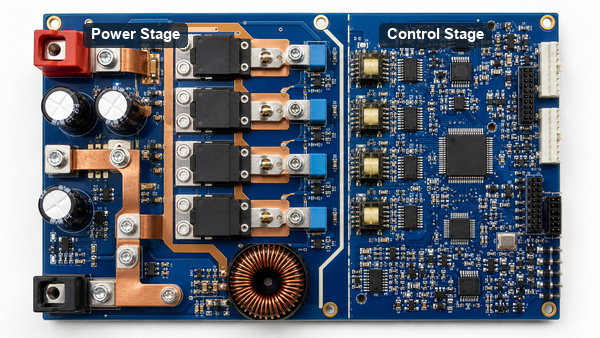
A heavy copper PCB for power electronics can reduce conductor loss where current and board geometry justify it. Assembly must also control solder voiding, thermal-pad coverage, device coplanarity, press-fit or bolted connections, and insulation cleanliness. EBest Circuit (Best Technology) supports PCB fabrication and PCB assembly for power-electronics projects, including engineering review of stack-up, copper, thermal features, and assembly constraints.
FAQ About What an Inverter Does
What does a power inverter do?
A power inverter converts DC into AC at the voltage and frequency required by the connected load. Depending on the design, it may also regulate power, charge a battery, control a motor, or synchronize with the grid.
Can an inverter work without a battery?
Yes. A grid-tied solar inverter can operate from a photovoltaic DC source, and an industrial drive can operate from a rectified AC supply. Off-grid systems need a sufficiently stable DC source, which is often a battery.
How long will a 12 V battery last with an inverter?
Runtime depends on battery watt-hours, allowable depth of discharge, inverter efficiency, and load power. A first estimate is usable battery watt-hours multiplied by inverter efficiency, divided by load watts.
Does an inverter increase voltage?
Some designs include a transformer or DC-to-DC stage that raises voltage before or during inversion. Voltage increase is not automatic; it depends on topology and the required output.
Does an inverter use power when no load is connected?
Yes. Control electronics, gate drivers, sensing, fans, and magnetics create standby loss. Low-power sleep modes reduce this consumption in battery-operated systems.
Conclusion
What does an inverter do? It switches a DC source into a controlled AC waveform and, in advanced systems, also manages motors, batteries, grid interaction, monitoring, and protection. Reliable performance depends on the switching topology, control method, waveform, operating point, thermal design, and physical PCB current paths.
For inverter PCB fabrication or assembly support, contact EBest Circuit (Best Technology) at sales@bestpcbs.com.