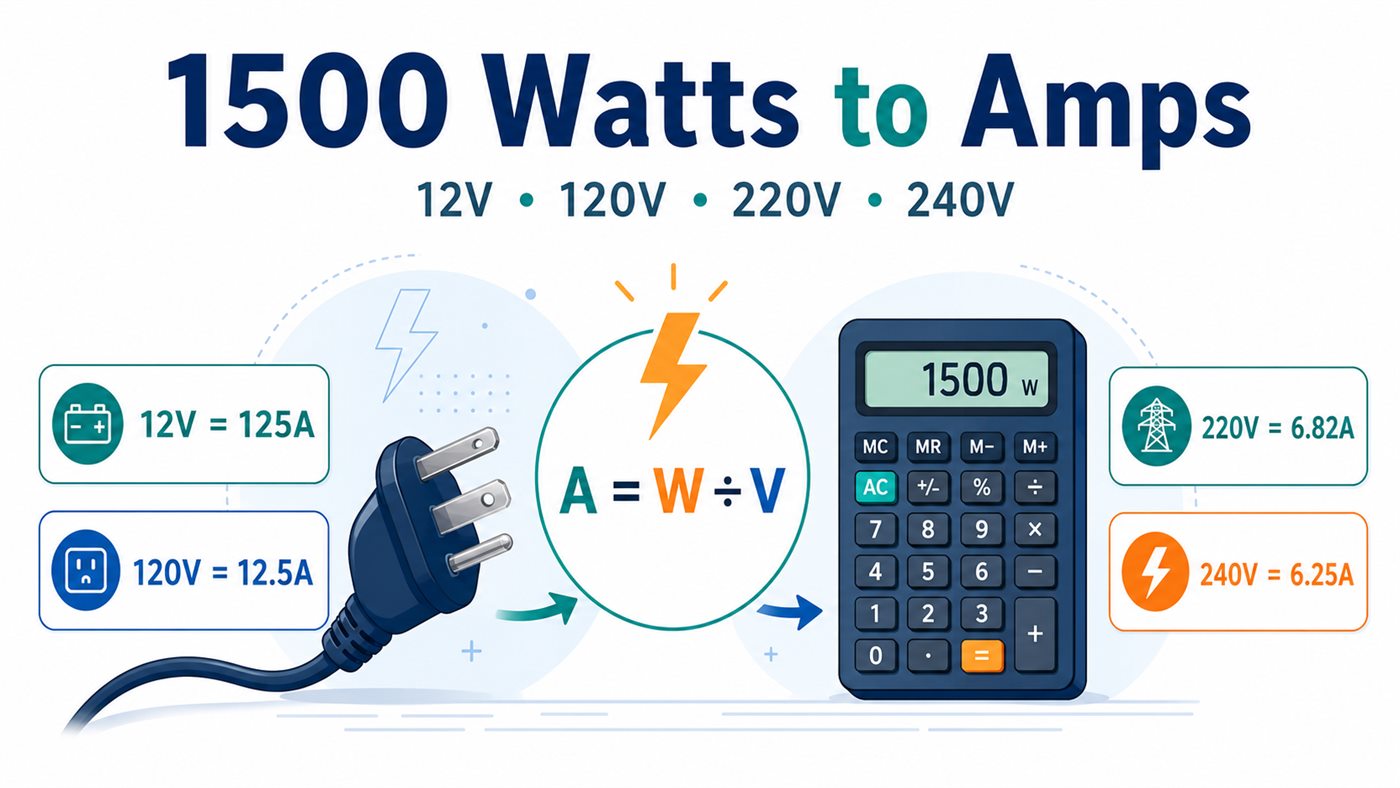
The 1500 watts to amps calculator gives 12.5A at 120V and 6.25A at 240V for an ideal resistive load. In a 12V battery system, the current rises to 125A before conversion losses are considered.
This guide explains how to convert 1500 watts to amps at common voltages, select the correct formula for DC and AC systems, and use the result when evaluating wiring, components, or high-current PCB designs.
How Many Amps Is 1500 Watts?
Under ideal conditions:
- 1500W at 12V = 125A
- 1500W at 120V = 12.5A
- 1500W at 220V = 6.82A
- 1500W at 230V = 6.52A
- 1500W at 240V = 6.25A
Amps = Watts ÷ Volts
This formula works directly for DC circuits and resistive AC loads with a power factor close to 1. Motors, transformers, compressors, switching power supplies, and inverter systems may draw more current.
1500 Watts to Amps Calculator
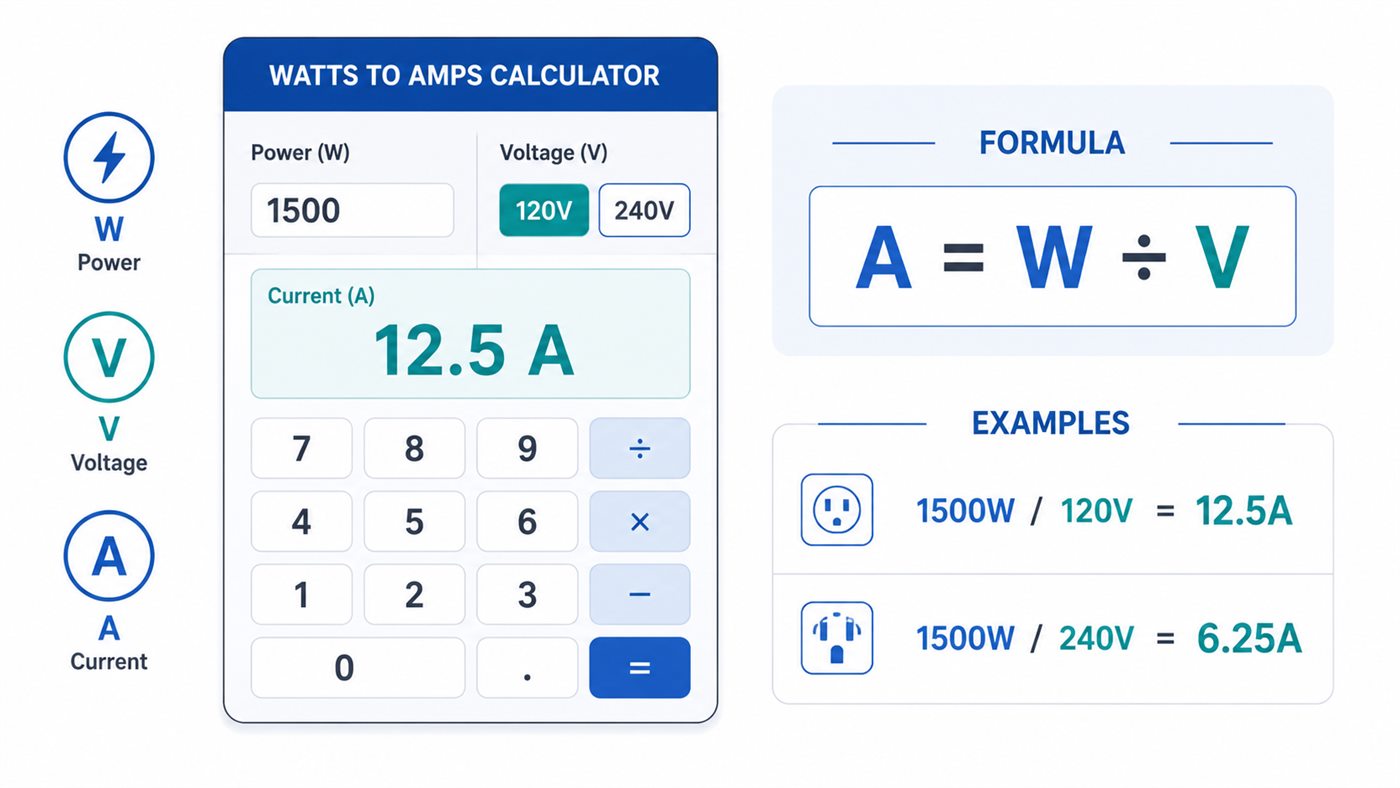
For a DC circuit or resistive single-phase AC load, divide 1500 watts by the supply voltage:
I = P ÷ V
Where:
I= current in ampsP= power in wattsV= voltage in volts
At 120V:
1500 ÷ 120 = 12.5A
At 240V:
1500 ÷ 240 = 6.25A
For other electrical systems, use the appropriate formula:
- Single-phase AC:
I = P ÷ (V × PF) - Three-phase AC:
I = P ÷ (√3 × V × PF) - Converter or inverter input:
I = P ÷ (V × efficiency)
For example, a 1500W AC load at 120V with a power factor of 0.9 draws:
1500 ÷ (120 × 0.9) = 13.89A
A 1500W inverter powered by a 12V battery at 90% efficiency needs approximately:
1500 ÷ (12 × 0.9) = 138.89A
The ideal calculation gives 125A, but conversion loss adds almost 14A. That difference matters when selecting cables, fuses, connectors, terminals, and PCB copper.
How Many Amps Is 1500 Watts at Common Voltages?
The following values assume DC power or a resistive single-phase AC load with a power factor of 1.
| Voltage | Current at 1500W | Typical Use |
|---|---|---|
| 12V | 125A | Batteries, automotive systems, inverters |
| 24V | 62.5A | Industrial controls and battery systems |
| 48V | 31.25A | Telecom and energy storage |
| 110V | 13.64A | 110V appliances and equipment |
| 120V | 12.5A | North American household circuits |
| 220V | 6.82A | Appliances and industrial equipment |
| 230V | 6.52A | Common nominal supply in many regions |
| 240V | 6.25A | High-power appliances and split-phase systems |
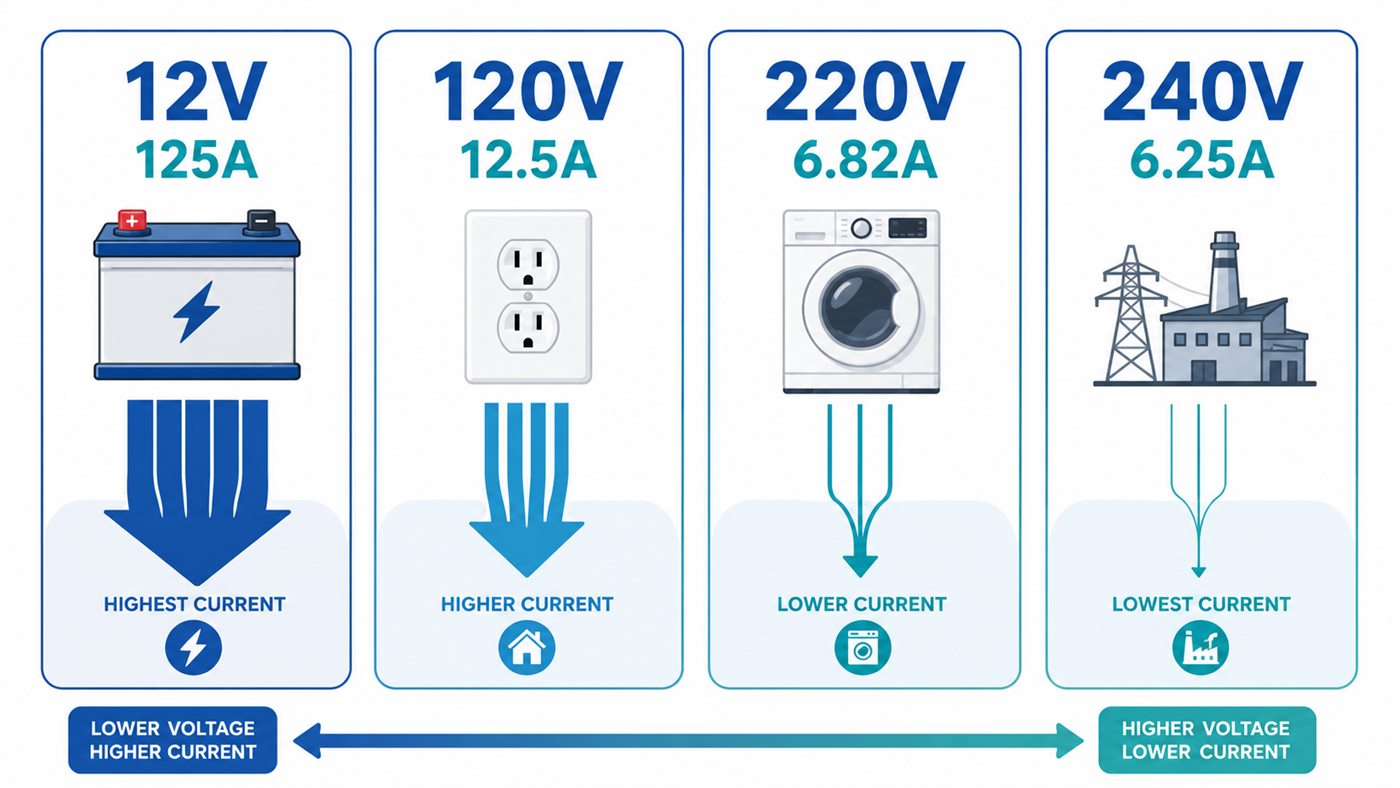
Lower voltage requires more current to deliver the same power. A 1500W load at 12V carries 20 times the current of a 1500W load at 240V.
This creates different design priorities:
- Low-voltage systems need heavier conductors, larger copper areas, low-resistance connectors, and careful voltage-drop control.
- Higher-voltage systems carry less current but require suitable insulation, creepage, clearance, and electrical isolation.
For PCB projects, low voltage does not automatically mean a simple design. A 12V, 125A current path can create more copper and thermal challenges than a higher-voltage circuit carrying only a few amps.
What Formula Converts 1500 Watts to Amps?
Watts and amps measure different electrical quantities, so voltage is required to calculate current.
The basic relationship is:
P = V × I
Rearranged:
I = P ÷ V
For 1500W at 120V:
1500 ÷ 120 = 12.5A
For 1500W at 240V:
1500 ÷ 240 = 6.25A
The reverse formula is:
Watts = Volts × Amps
This is why 1 amp does not represent a fixed number of watts:
- 1A at 12V = 12W
- 1A at 120V = 120W
- 1A at 240V = 240W
Do not reuse a current value taken from another voltage system. A 1500W product designed for 120V will not draw the same current as a 1500W product designed for 240V.
1500 Watts to Amps for DC and AC Circuits
The correct formula depends on the power system and load type.
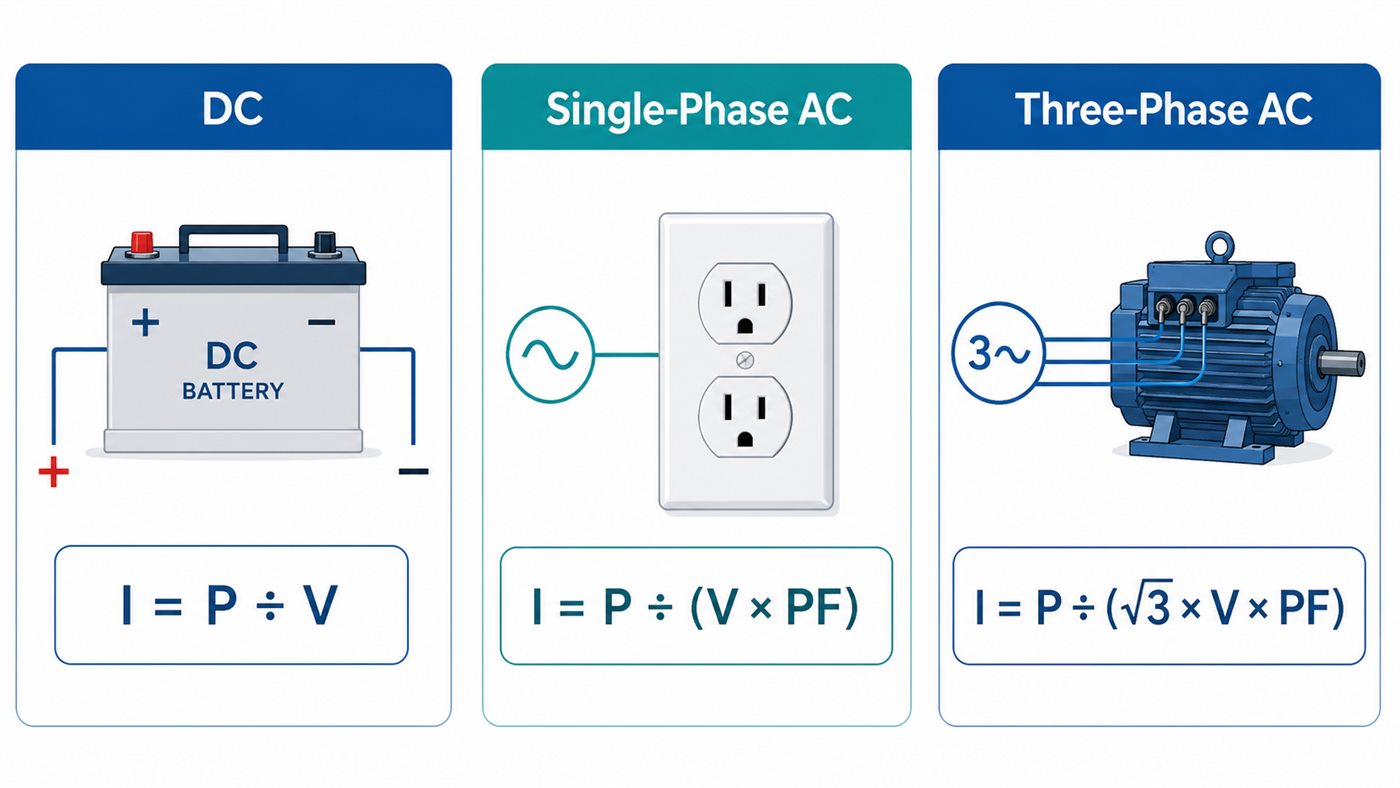
DC Circuits
For DC power:
I = P ÷ V
A 1500W load draws:
- 125A at 12V
- 62.5A at 24V
- 31.25A at 48V
In a battery system, the supply voltage is not perfectly constant. If voltage falls while the equipment continues delivering the same power, current rises.
This matters in:
- Battery packs
- Automotive electronics
- Energy storage systems
- DC motor drives
- Inverter input stages
Cable resistance and converter loss can increase the real current beyond the ideal result.
Single-Phase AC Circuits
For a resistive load:
I = P ÷ V
A 1500W heater at 120V draws approximately 12.5A.
For equipment with a power factor below 1:
I = P ÷ (V × PF)
At 230V with a power factor of 0.85:
1500 ÷ (230 × 0.85) = 7.67A
The simple calculation gives only 6.52A. Ignoring power factor would therefore understate the required current by more than 1A.
Power factor is especially relevant for:
- Motors
- Transformers
- Compressors
- LED drivers
- Industrial power supplies
- Electronic control equipment
Three-Phase AC Circuits
For a balanced three-phase load:
I = P ÷ (√3 × V × PF)
At 400V with a power factor of 0.9:
1500 ÷ (1.732 × 400 × 0.9) = 2.41A
For motors and drives, also check:
- Efficiency
- Startup current
- Overload characteristics
- Phase balance
- Duty cycle
Before calculating, confirm whether the 1500W rating refers to input power, output power, or maximum load capacity. These figures are often different.
How Do Power Factor and Efficiency Change the Current?
A 1500W label does not always reveal the actual input current. Power factor and efficiency can change the result significantly.
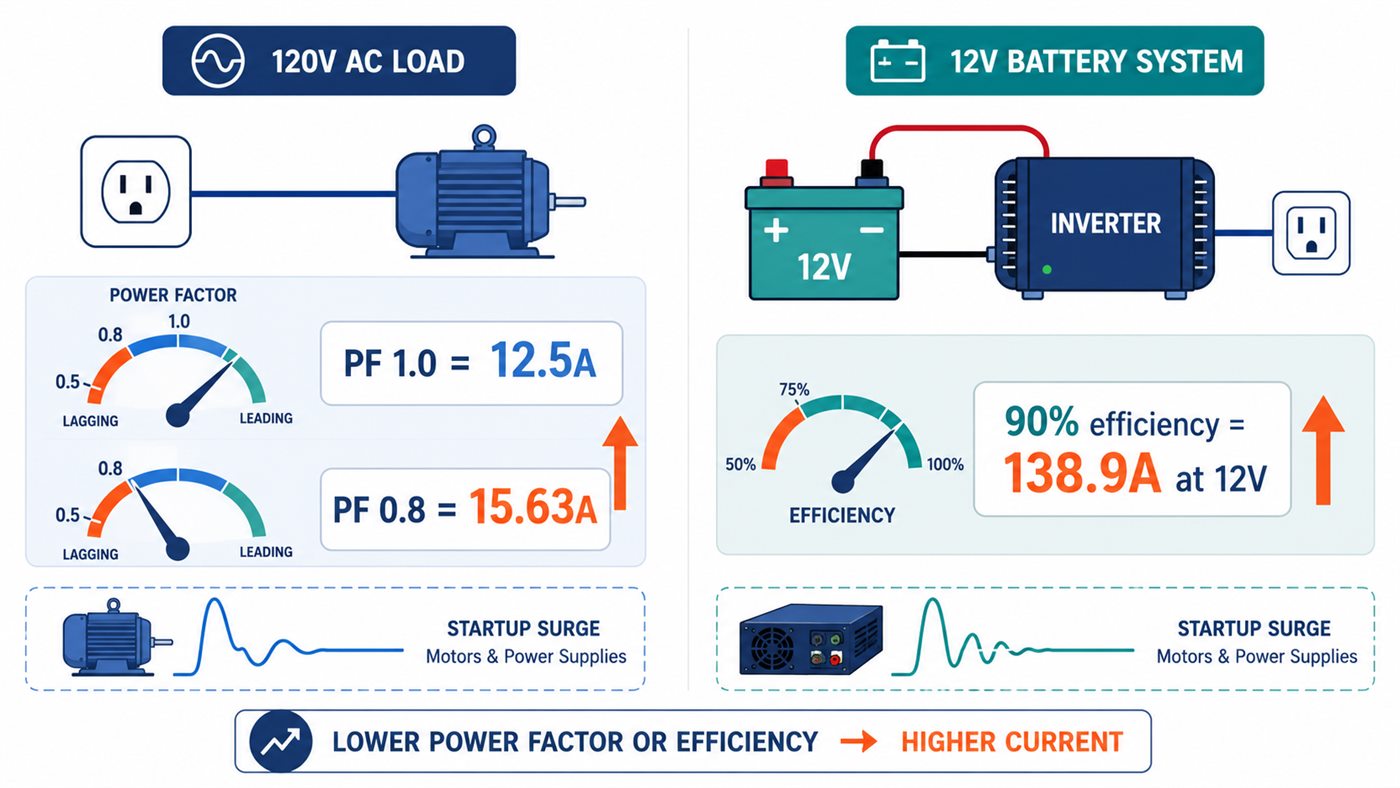
Power Factor
Power factor shows how effectively AC current is converted into useful power. Resistive heaters are usually close to 1. Motors, transformers, and some switching power supplies may operate at lower values.
| Power Factor | Current at 1500W and 120V |
|---|---|
| 1.00 | 12.50A |
| 0.95 | 13.16A |
| 0.90 | 13.89A |
| 0.85 | 14.71A |
| 0.80 | 15.63A |
At a power factor of 0.8, current is 25% higher than the ideal result.
Higher current affects:
- Cable and PCB copper loss
- Connector temperature
- Relay and switch ratings
- Fuse selection
- MOSFET and rectifier loading
- Voltage drop
Efficiency
If 1500W is the output power, the input power must be higher.
A 90%-efficient converter supplying 1500W requires:
1500 ÷ 0.9 = 1666.7W input
At 24V:
1666.7 ÷ 24 = 69.45A
The ideal calculation gives 62.5A. Designing around that lower value may leave insufficient margin for heat, voltage drop, or component tolerance.
Startup Current
Motors, compressors, large capacitors, and switching power supplies may draw a short surge when powered on. In some systems, this peak can be several times the normal running current.
For accurate design or purchasing decisions, collect:
- Rated input voltage
- Continuous current
- Peak or startup current
- Power factor
- Efficiency
- Duty cycle
- Ambient temperature
- Load waveform
A pulsed 60A load and a continuous 60A load should not be treated as the same thermal case.
Can a 15-Amp Circuit Handle a 1500-Watt Load?
At 120V, a 1500W resistive load draws 12.5A. This is below 15A, but it uses about 83% of the circuit rating.
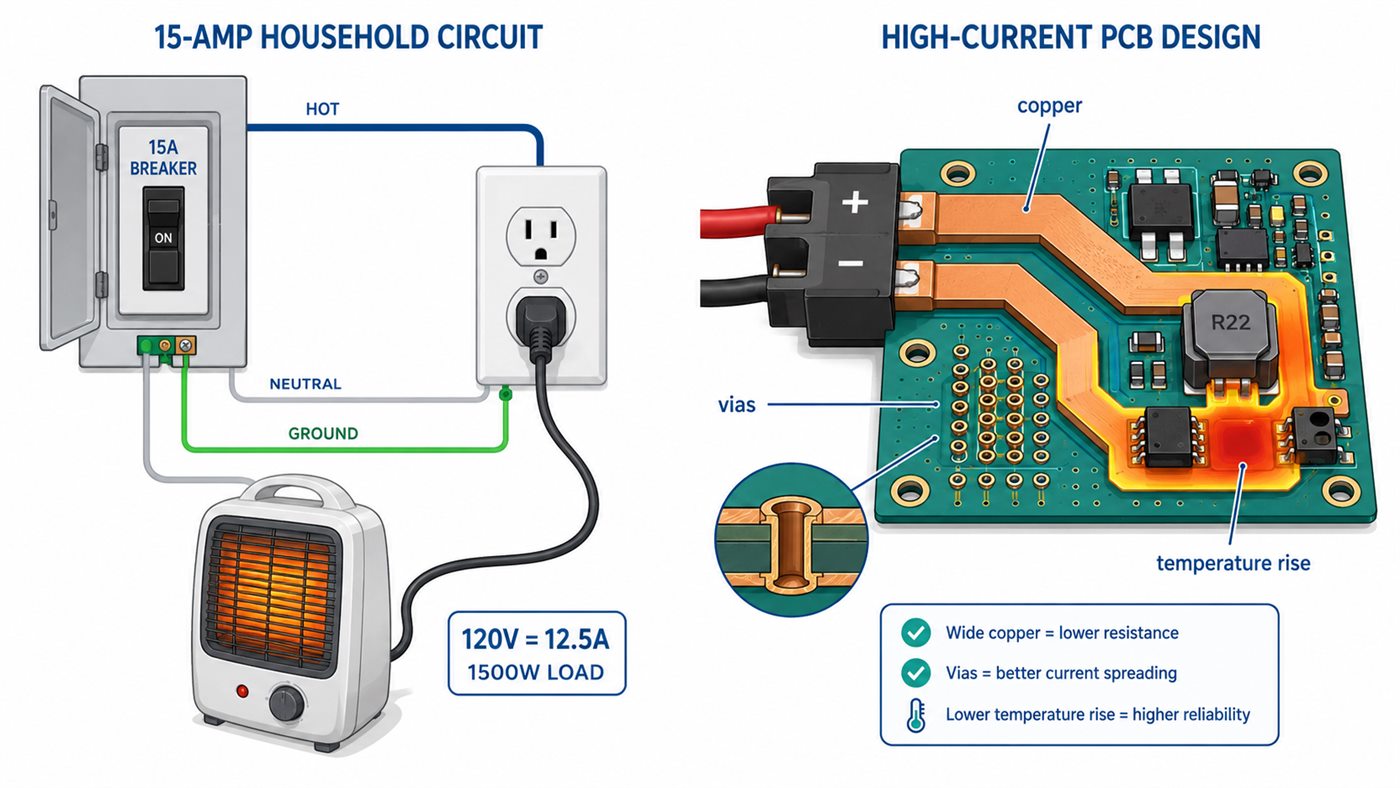
Before connecting the equipment, check:
- Whether the load runs continuously or intermittently
- Whether other devices share the circuit
- The actual supply voltage
- Power factor
- Startup current
- Extension cord gauge and length
- Plug and receptacle condition
- Local electrical requirements
- Manufacturer instructions
A 1500W heater and a 1500W motor-driven appliance may not place the same demand on a circuit. The heater is usually close to a resistive load, while the motor may have a lower power factor and much higher startup current.
Long or undersized extension cords increase voltage drop and heat. Loose or worn contacts can also overheat even when the calculated current appears acceptable.
The same principle applies to PCB design. A trace, connector, terminal block, or copper busbar should not run continuously at its absolute catalog limit without checking:
- Copper thickness
- Current-path width
- Via quantity and drill size
- Contact resistance
- Temperature rise
- Airflow
- Ambient temperature
- Nearby heat-sensitive components
Common Mistakes When Converting 1500 Watts to Amps
The calculation itself is simple. Most errors come from using the wrong assumptions or failing to verify the result with an appropriate electrical meter.
- Calculating without voltage: Watts alone cannot determine amps.
- Confusing 12V with 120V: The resulting current differs by a factor of 10.
- Ignoring power factor: This can underestimate AC current.
- Ignoring efficiency: Converter input current is higher than the ideal output calculation.
- Using nominal voltage as an exact value: Battery and utility voltage can vary.
- Confusing input and output power: Check which side of the system the 1500W rating describes.
- Selecting components at the calculated limit: Temperature, aging, and contact resistance reduce practical margin.
- Ignoring PCB bottlenecks: Narrow neck-downs, vias, pads, and copper transitions often heat before the main trace area.
- Treating surge current as running current: Both values matter, but they affect different design decisions.
For a high-current PCB quotation, “1500W” alone is not enough. The manufacturer also needs voltage, continuous current, peak current, duty cycle, copper weight, connector details, and the permitted temperature rise.
Frequently Asked Questions About 1500 Watts to Amps
1. How many amps is 1500 watts at 120V?
1500 watts equals 12.5 amps at 120V for DC or a resistive single-phase AC load.
1500 ÷ 120 = 12.5A
2. How many amps is 1500 watts at 240V?
1500 watts equals 6.25 amps at 240V under ideal resistive conditions.
1500 ÷ 240 = 6.25A
3. How many amps is 1500 watts at 220V?
1500 watts equals approximately 6.82 amps at 220V.
1500 ÷ 220 = 6.82A
4. How many amps is 1500 watts at 12V?
1500 watts equals 125 amps at 12V under ideal conditions.
1500 ÷ 12 = 125A
At 90% inverter efficiency, the input current rises to approximately 138.89A.
5. Can you convert 1500 watts to amps without voltage?
No. Voltage is required because current equals power divided by voltage.
6. Does a 1500-watt appliance use the same amps on 120V and 240V?
No. It draws about 12.5A at 120V and 6.25A at 240V, assuming the same real power and a power factor of 1.
7. Can a 15-amp circuit run a 1500-watt appliance?
A resistive 1500W load draws about 12.5A at 120V. Suitability also depends on operating duration, shared loads, wiring condition, startup current, and local electrical requirements.
8. Does power factor affect the result?
Yes. At 120V, 1500W draws 12.5A at a power factor of 1, but approximately 15.63A at a power factor of 0.8.
Need Support for High-Current PCB and Power Electronics Projects?
Converting 1500 watts to amps provides a useful starting point, but PCB and PCBA design requires more than a single current value. Copper geometry, connector resistance, operating duration, peak demand, and temperature rise all influence whether the finished assembly will operate reliably.
For quotation or engineering review, provide:
- Input and output voltage
- Continuous and peak current
- Duty cycle
- Board layer count and thickness
- Copper weight
- Connector and terminal specifications
- Maximum permitted temperature rise
- Operating environment
- Gerber files, schematic, BOM, and test requirements
EBest Circuit supports high-current PCB, heavy copper PCB, power supply, inverter, industrial control, and PCBA projects. An early engineering review can identify narrow copper sections, insufficient via capacity, connector bottlenecks, and unclear peak-current requirements before production.
For prototype review or quotation guidance, contact sales@bestpcbs.com or review our PCB manufacturing services.