CAN bus vs LIN bus comes down to how devices share information, how quickly they exchange it, and how much hardware each connection needs. CAN lets multiple electronic control units send messages using priority arbitration. LIN uses one coordinating node to schedule communication with simpler sensors and actuators. These differences explain why vehicles often use both networks.
EBest Circuit provides PCB fabrication, component sourcing, and PCB assembly for customer-designed control and interface boards. For CAN or LIN hardware, these services support the build from bare PCB to assembled board. Discuss your prototype or production needs with sales@bestpcbs.com.
What Is the Difference Between LIN and CAN Bus?
CAN allows nodes to compete for bus access; LIN gives one node control of the communication schedule. That distinction shapes their hardware, timing, and typical applications.
CAN stands for Controller Area Network. LIN stands for Local Interconnect Network. In LIN, the coordinating node is called the commander, or master in older documentation.
| Main difference | CAN bus | LIN bus |
|---|---|---|
| Who starts communication? | Multiple nodes can initiate messages when the bus is available | One commander sends scheduled frame headers |
| How is access organized? | Higher-priority messages win arbitration | Devices respond in the assigned frame slots |
| Where is it commonly used? | Communication between vehicle control units | Local connections to simpler sensors and actuators |
This article compares conventional two-wire high-speed CAN with automotive LIN. Specialized CAN physical layers are outside its scope.
How Does CAN/LIN Communication Work?
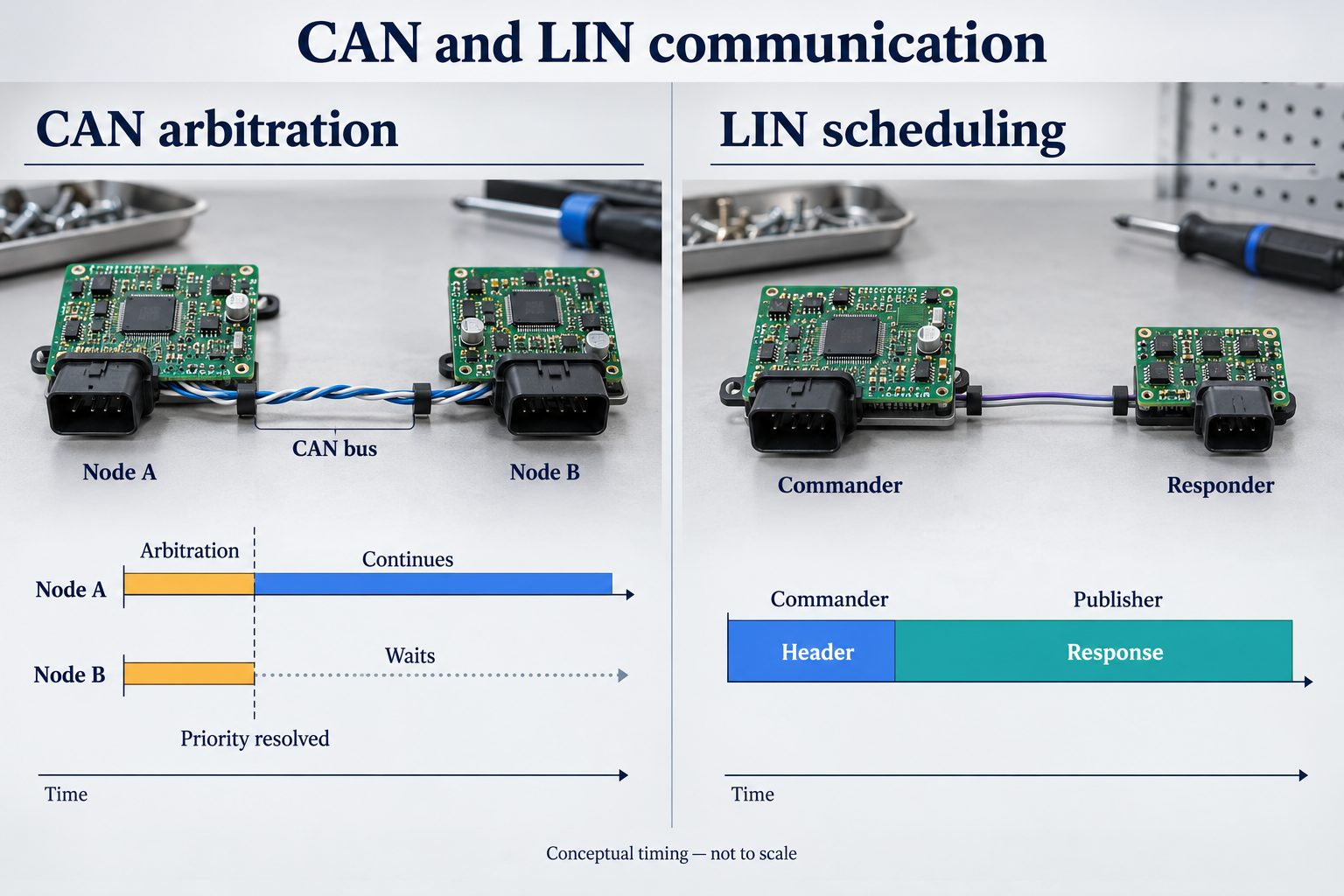
CAN determines which waiting message goes first. LIN determines when each scheduled exchange happens.
CAN: the higher-priority message continues.
- A node starts transmitting when the bus is available.
- If another node starts at the same time, both monitor the bus while sending their arbitration fields.
- The node that loses arbitration stops transmitting. The winning message continues, and the waiting node can try again later.
Arbitration works because a dominant bit overrides a recessive bit on the bus. A node that sends recessive but reads dominant knows it has lost. For otherwise comparable data frames with the same identifier format, a lower numerical identifier has higher priority.
LIN: the commander starts each exchange.
- The commander sends a header identifying the scheduled frame.
- The designated publisher sends the data and checksum in the response.
- Nodes that need those signals receive and use the response.
The publisher can be another node or the commander itself. A response can also be used by other devices in the same LIN cluster; it does not have to travel only back to the commander.
How Do CAN and LIN Bus Speeds Compare?
Classical CAN supports a much higher maximum bit rate than LIN. CAN FD can increase data transfer capacity further.
- LIN: up to 20 kbit/s, with 1–8 data bytes per frame.
- Classical CAN: up to 1 Mbit/s, with up to 8 data bytes per frame.
- CAN FD: up to 64 data bytes per frame, with the option to use a faster bit rate during the data phase. Arbitration still uses the nominal bit rate.
The maximum raw bit-rate ratio between Classical CAN and LIN is 50:1. However, bit rate is not the same as device update rate.
For example, an eight-data-byte LIN frame takes approximately 6.2 ms at 20 kbit/s before additional spacing. A sensor whose frame appears once in a longer repeating schedule must wait for its next slot. Its reading therefore does not necessarily update every 6.2 ms.
CAN messages can also wait while other traffic uses the bus. Actual response time depends on bus loading and message priority. For CAN FD, the usable data-phase rate additionally depends on the controllers, transceivers, wiring, and network configuration.
How Do CAN and LIN Electrical Interfaces Differ?
CAN uses two differential signal lines; LIN uses one signal line referenced to ground. Their transceivers and bus circuits are different, so the interfaces cannot be directly substituted.
| Electrical feature | High-speed CAN | LIN |
|---|---|---|
| Signal connection | CAN_H and CAN_L | One LIN signal line |
| How the signal is read | Voltage difference between the two lines | Signal-line voltage relative to ground |
| Bus resistors | Typically 120-ohm termination at each physical end of a linear bus | Pull-up network; the commander normally includes an external resistor and diode |
| Interface to the MCU | CAN controller functionality plus a CAN transceiver | LIN-capable communication, often using a UART, plus a LIN transceiver |
On CAN, differential reception helps reject interference that appears similarly on both lines. Ground differences still matter: the transceiver must stay within its allowed common-mode voltage range.
On LIN, the transmitter pulls the signal low for a dominant state. Pull-ups let it rise toward the bus supply for a recessive state. The transceiver connects this bus-side signaling to the MCU’s logic interface; a UART pin cannot connect directly to an automotive LIN wire.
For the circuit board, the difference extends beyond connector pins. Transceivers, resistor networks, and protection circuits must suit the bus. The signal-wire counts above also exclude power and ground connections.
Why Is LIN Usually Cheaper to Implement Than CAN?
LIN can reduce the cost of connecting devices that exchange only small amounts of data. The savings mainly come from the wiring and the communication hardware:
- Fewer signal connections: one LIN signal wire can reduce harness conductors and connector contacts compared with a two-wire CAN connection.
- Simple MCU communication hardware: a low-cost MCU’s UART can support LIN with suitable software and a LIN transceiver.
- Timing synchronization: the LIN header’s synchronization field lets compatible responder implementations align their communication timing with the commander.
The cost advantage varies with the existing hardware. If a control unit already has an MCU with an integrated CAN controller, using CAN may not require an additional controller chip.
Power regulation, transient protection, connectors, and testing still contribute to either board’s cost. A simple LIN actuator and a CAN-equipped control unit therefore cannot be compared using one universal savings percentage.
Why Do Vehicles Use Both CAN and LIN?
CAN can connect vehicle controllers while LIN handles smaller local groups of devices. This gives each part of the system communication capacity suited to its workload.
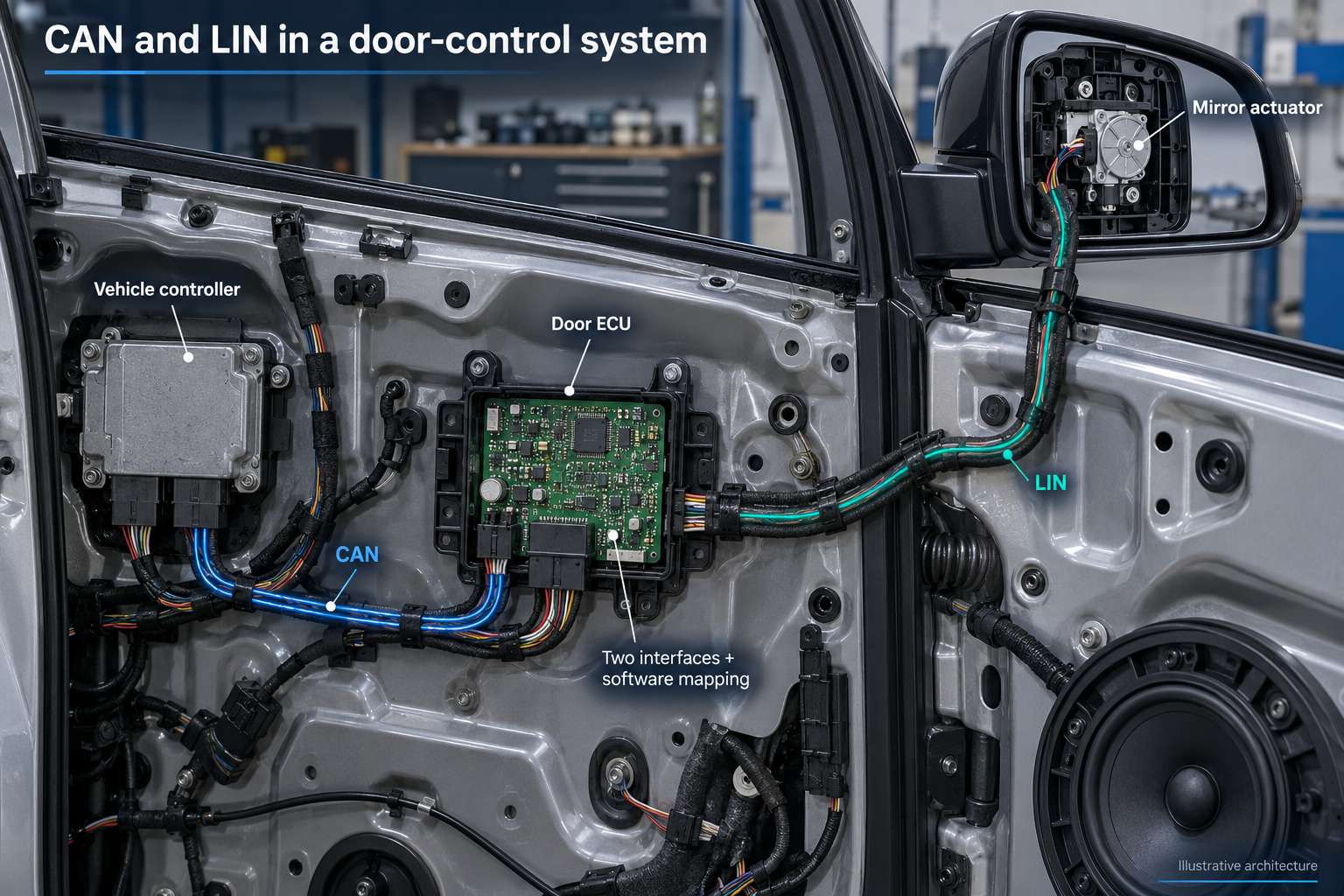
An illustrative door-control arrangement shows how they work together:
Vehicle controller → CAN → Door ECU → LIN → Mirror actuator
The door ECU receives a vehicle-level command over CAN. Its software maps the relevant information into a LIN signal, then sends it in the appropriate scheduled frame. Actuator status can return through the ECU in the opposite direction.
The ECU needs both physical interfaces and software that understands the messages on each network. Connecting CAN and LIN wires together cannot perform this translation; a gateway must handle signal mapping and timing as well.
Local actuator exchanges can stay within the LIN cluster, while relevant commands and status pass over CAN. This avoids requiring every small device to carry the same communication hardware as a vehicle control unit.
FAQs About CAN bus vs LIN bus
Can LIN replace CAN bus?
LIN can serve a low-bandwidth function whose timing fits a scheduled network. Replacing an existing CAN connection still requires changes to hardware, messages, software, and timing.
Can CAN and LIN communicate directly?
No. A controller or gateway needs both interfaces and software to translate the relevant application signals between the protocols.
Do CAN and LIN use the same transceiver?
No. Their electrical interfaces differ. Some integrated devices contain both types, but the CAN and LIN channels remain separate.
Does every CAN node need a 120-ohm resistor?
No. A conventional high-speed CAN bus is terminated at its two physical ends. Adding another 120-ohm termination at every intermediate node would excessively load the bus.
Can a LIN node wake up the network?
Yes. A suitably configured node can issue a wake-up signal. Normal frame communication resumes when the commander restarts its schedule.
For PCB fabrication and assembly of the interface boards discussed in this CAN bus vs LIN bus comparison, contact EBest Circuit at sales@bestpcbs.com to discuss support from prototype builds through production.