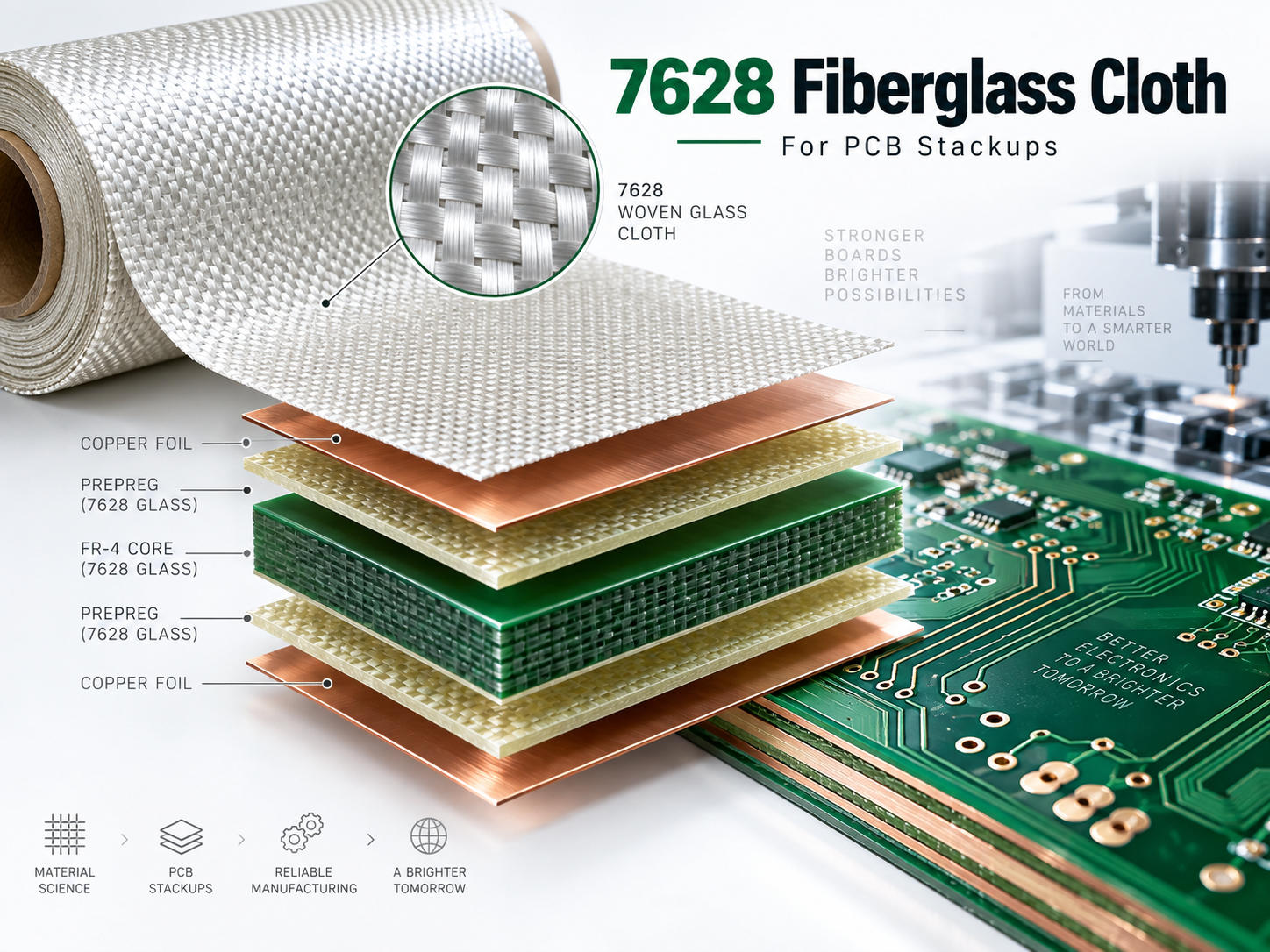
7628 fiberglass cloth is one of the heavier standard electronic glass fabrics used to reinforce FR-4 laminate and prepreg. It is not dedicated to one particular PCB category. Its main value is structural: compared with thinner glass styles such as 2116 or 1080, 7628 can establish a relatively thick dielectric section with fewer plies.
That makes 7628 especially relevant to conventional FR-4 boards where board thickness, mechanical rigidity, and larger layer-to-layer spacing matter more than extreme routing density. It may still appear in advanced multilayer boards, but high-speed, HDI, CAF-sensitive, and thin-dielectric regions often need closer material evaluation.
Key Takeaways
- 7628 fiberglass cloth is a relatively thick, heavy plain-weave E-glass fabric commonly used in FR-4 laminate and prepreg constructions.
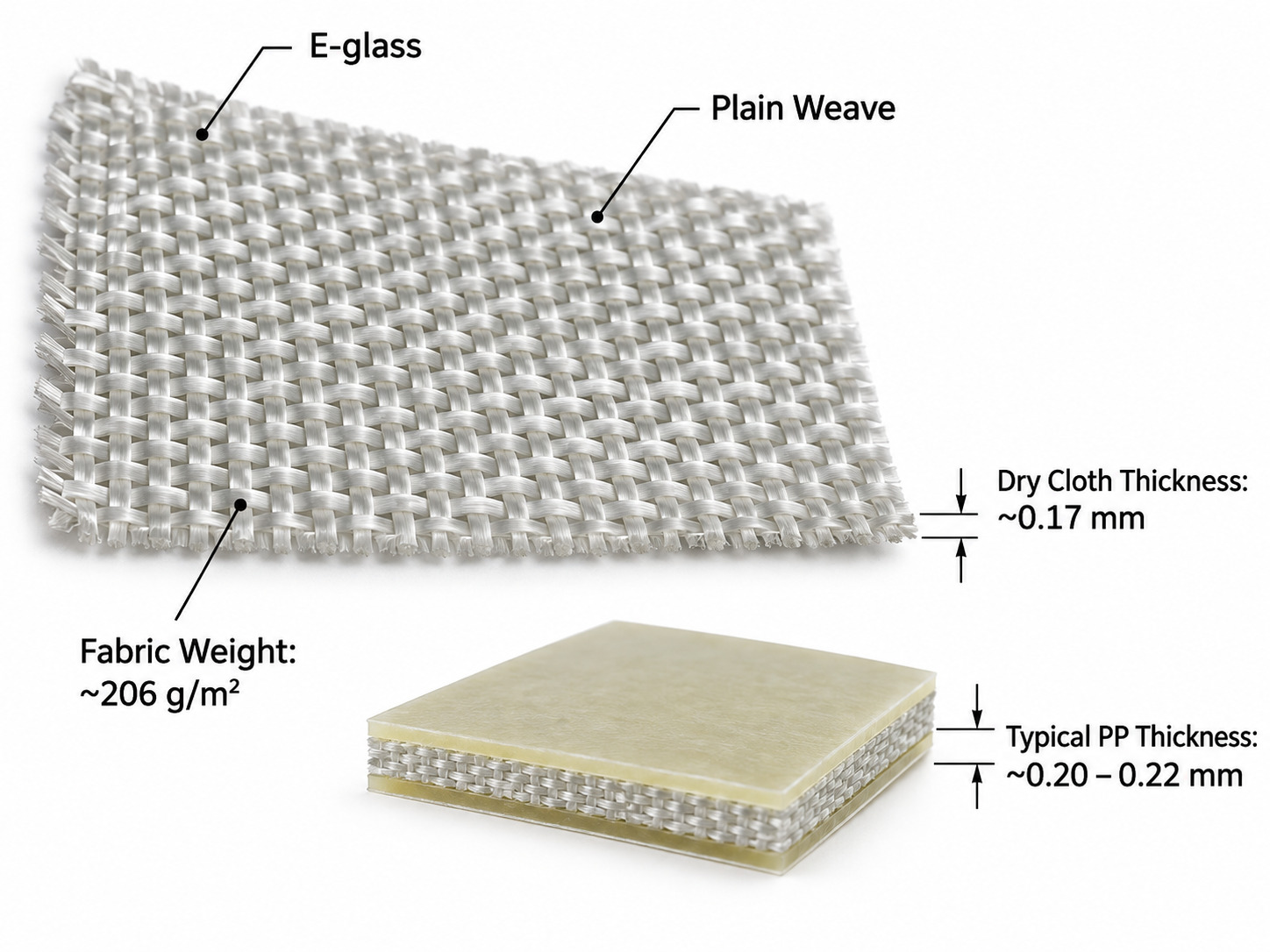
- Dry 7628 cloth is typically about 0.17 mm thick and 206 g/m², while common resin-impregnated 7628 prepregs can be around 0.20–0.22 mm thick.
- It is especially useful when a PCB stackup needs a larger dielectric thickness with fewer prepreg plies.
- Conventional FR-4 double-sided boards, industrial multilayers, power boards, automotive control boards, and other moderate-density PCBs are common application areas.
- Heavy use of 7628 is less attractive for ultra-thin HDI, very fine via pitch, high-CAF layouts, and high-speed differential routing sensitive to glass-weave effects.
- 7628 needs careful validation in lead-free and high-CAF designs, particularly where hole-wall spacing becomes tight.
- A rise in 7628 fiberglass cloth price does not increase every PCB price by the same percentage; the impact depends on how much 7628-based laminate or prepreg the stackup actually uses.
What Is 7628 Fiberglass Cloth?
7628 fiberglass cloth is a relatively thick electronic-grade E-glass fabric woven in a plain pattern and widely used as reinforcement in FR-4 PCB laminates and prepregs.
The dry fabric itself consists of glass yarn rather than resin. A typical construction uses ECG75 yarn with a nominal 44 warp × 31 fill count per inch. The dry cloth weighs about 206 g/m² and measures about 0.17 mm thick.
In PCB manufacturing, this dry glass fabric is impregnated with epoxy or another resin system before it becomes part of a usable laminate or prepreg construction. Terms such as resin content, prepreg thickness, and cured dielectric thickness describe the resin-impregnated material, not the dry 7628 cloth by itself.
What Are the Typical Specifications of 7628 Fiberglass Cloth?
Typical 7628 parameters are relatively stable at the dry-glass level, while resin content and final prepreg thickness vary by laminate supplier and resin system.
| Parameter | Typical Value |
|---|---|
| Glass type | E-glass |
| Weave | Plain weave |
| Dry cloth thickness | ~0.17 mm |
| Fabric weight | ~206 g/m² |
| Warp × fill count | ~44 × 31/in |
| Typical yarn | ECG75 1/0 |
| Typical prepreg resin content | ~46–51% in common constructions |
| Typical prepreg thickness | ~0.20–0.22 mm in common higher-RC constructions |
Resin content should therefore be treated as a prepreg parameter, not a fixed property of 7628 fiberglass cloth.
Where Is 7628 Used in a PCB Stackup?
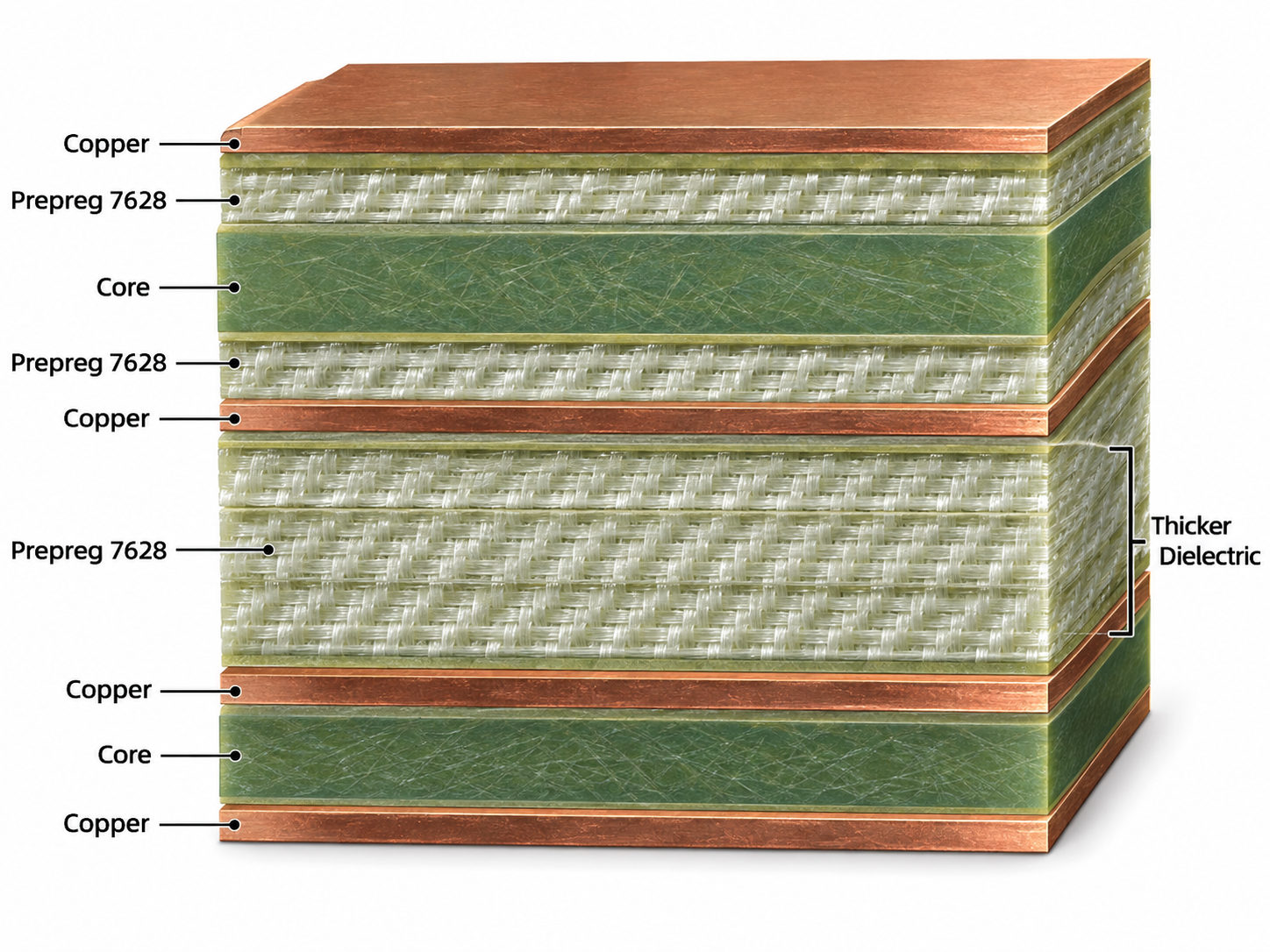
7628 is normally used inside FR-4 cores or prepregs where the stackup needs a relatively large dielectric build between copper layers.
Typical positions include:
- Between inner signal and plane layers
- Between two power or ground planes
- Inside thicker multilayer core constructions
- In FR-4 laminate used for conventional double-sided PCBs
- In multilayer stackups where one ply needs to add significant dielectric thickness
A simplified multilayer stackup might combine several glass styles rather than using 7628 everywhere. Thinner 1080 or 2116 prepreg may be placed close to dense signal layers, while 7628 is used deeper in the board where more separation is required.
In a 1.6 mm multilayer PCB, this mixed-glass approach can help the fabricator meet total thickness without stacking an excessive number of thin prepreg plies.
Which PCBs Commonly Use 7628 Fiberglass Cloth?
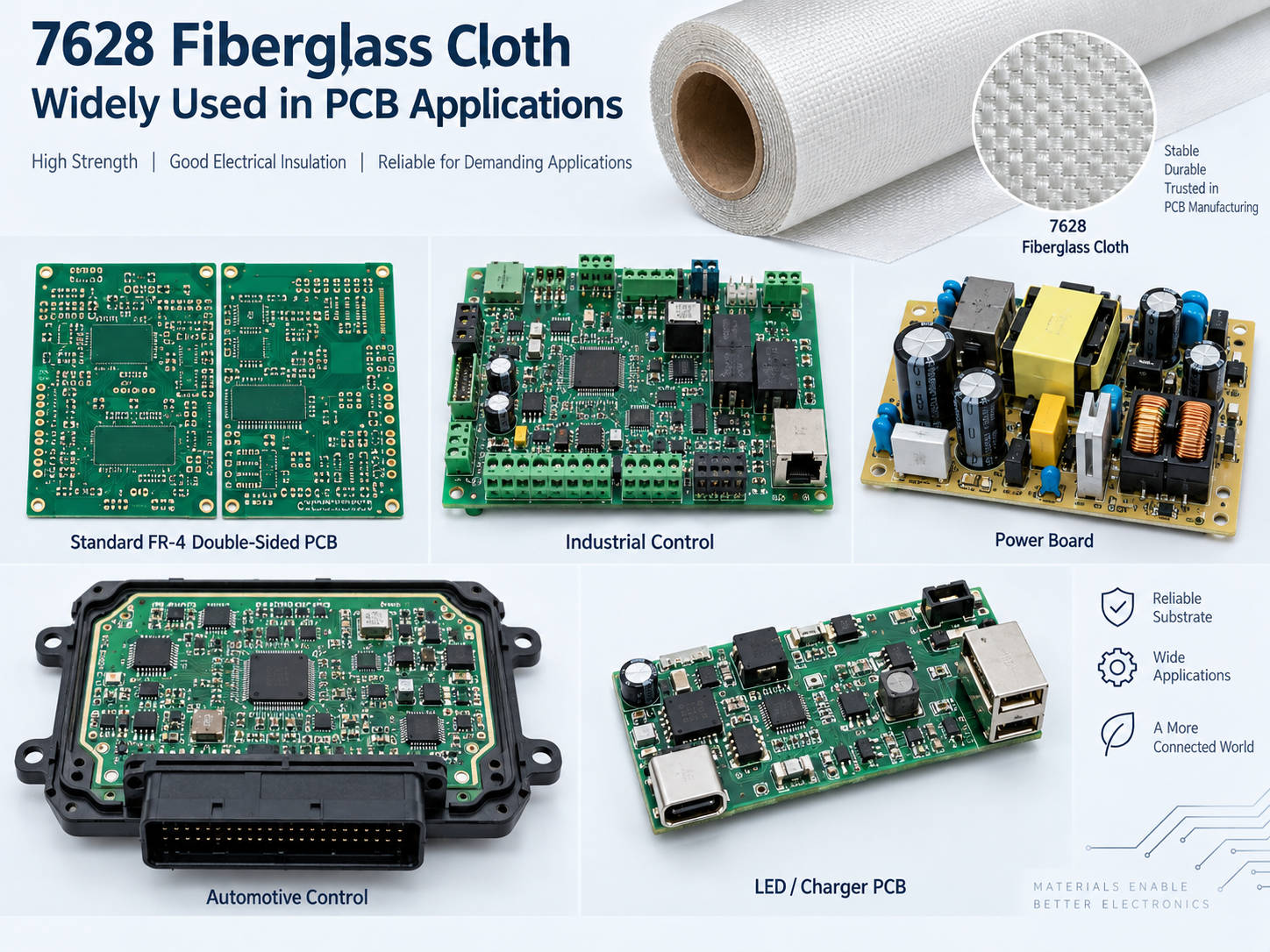
7628 is most relevant to conventional FR-4 PCBs that need relatively thick dielectric sections rather than extremely thin, high-density stackups.
Common applications include:
- Standard double-sided FR-4 PCBs
- 4-layer and general multilayer industrial boards
- Power supply boards
- Appliance control boards
- Automotive control electronics
- LED and charging equipment
- General communication control boards
- Multilayer PCBs requiring larger inner-layer spacing
- Designs where board rigidity and finished thickness matter
These applications often use moderate line widths, conventional through holes, and relatively generous dielectric spacing. 7628 is therefore less about the end product category and more about how the FR-4 stackup is built.
Why Is 7628 Useful for Thick PCB Dielectric Layers?
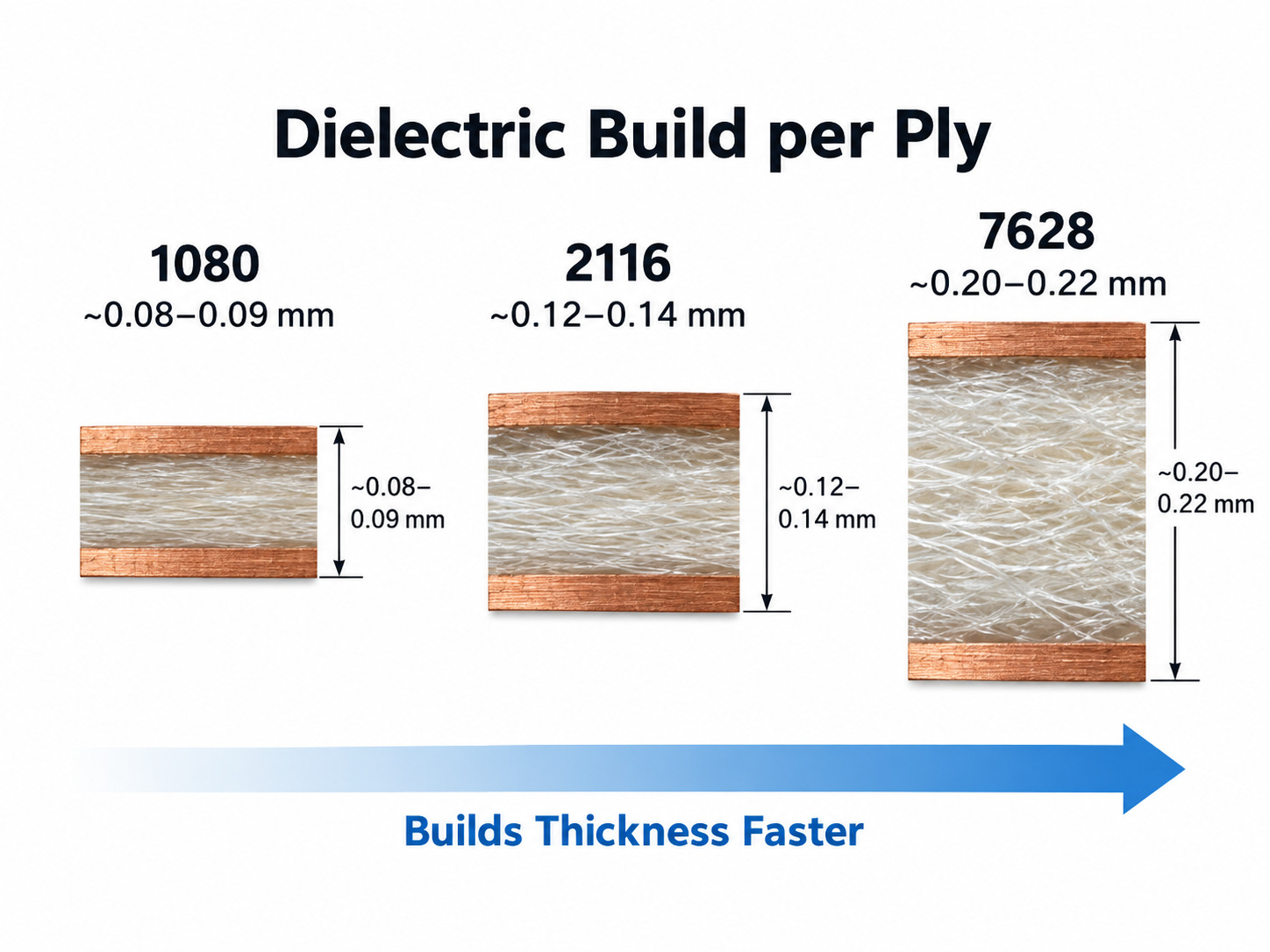
The main advantage of 7628 is that one ply can create substantially more dielectric thickness than thinner glass styles.
| Glass Style | Example Prepreg Thickness |
|---|---|
| 1080 | ~0.079–0.089 mm |
| 2116 | ~0.119–0.135 mm |
| 7628 | ~0.201–0.221 mm |
Using 7628 can help:
- Build larger layer-to-layer spacing with fewer plies
- Reach standard board thickness more efficiently
- Increase mechanical stiffness
- Simplify some conventional multilayer stackups
- Reduce the need to stack several thin prepregs in one dielectric section
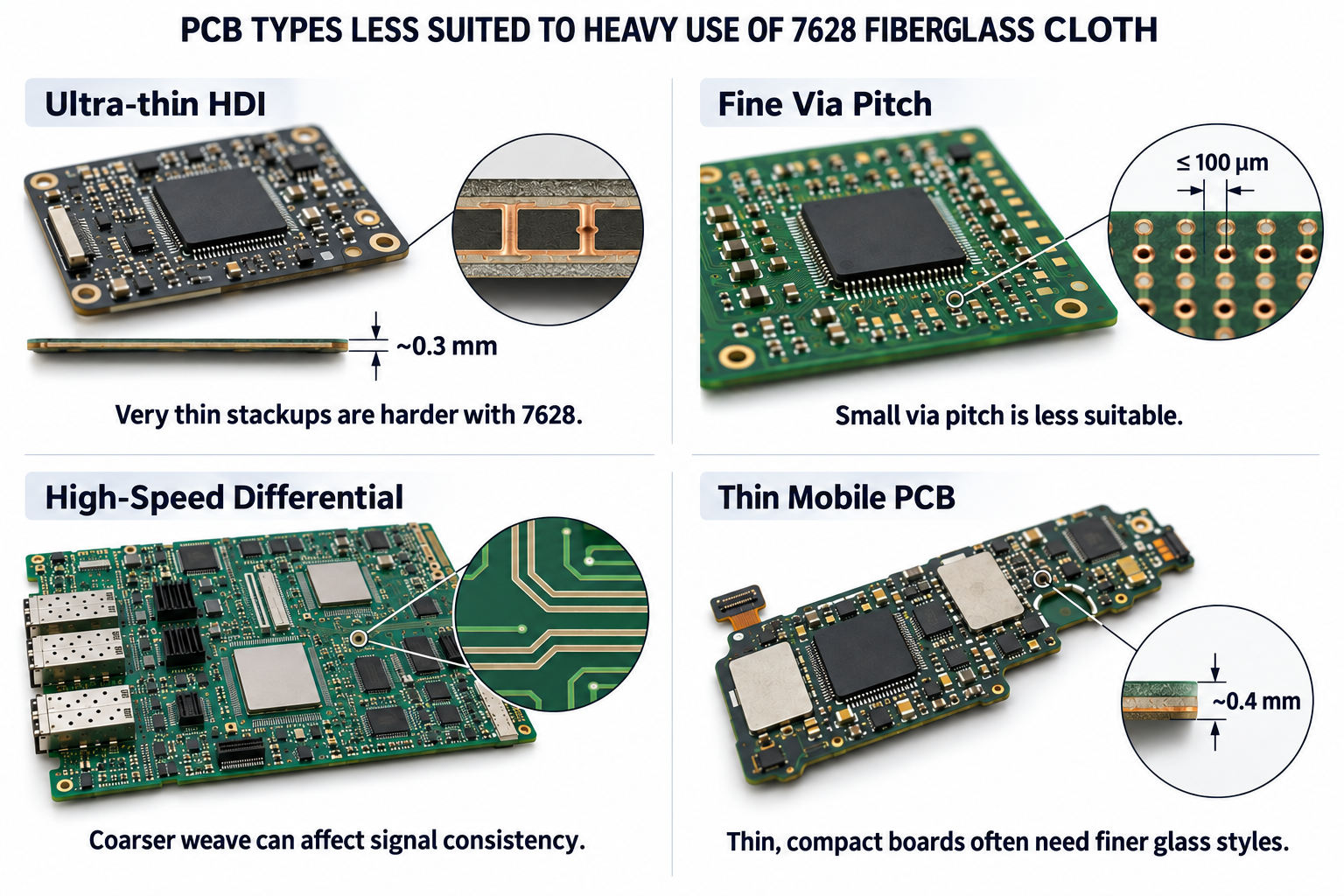
Which PCBs Are Less Suited to Heavy Use of 7628?
7628 is usually not the first choice near the most density-sensitive or signal-sensitive structures in an advanced PCB.
Designs that may favor thinner or more uniform glass styles include:
- Ultra-thin HDI boards
- Any-layer HDI
- Fine-pitch microvia structures
- Mobile and wearable products requiring very thin dielectrics
- Tight hole-to-hole or plane-to-hole spacing
- 112G/224G high-speed channels
- Millimeter-wave circuits
- Differential pairs with strict skew limits
- Stackups with demanding impedance uniformity
The reason is not that 7628 is unusable in an advanced PCB. A complex board may still use it in less critical internal regions. The concern is heavy use around the most sensitive layers, where its thicker weave, larger glass bundles, and greater dielectric build can make routing density, resin distribution, CAF margin, and high-speed performance harder to control.
What CAF, Wet-Out and Delamination Risks Should Be Checked with 7628?
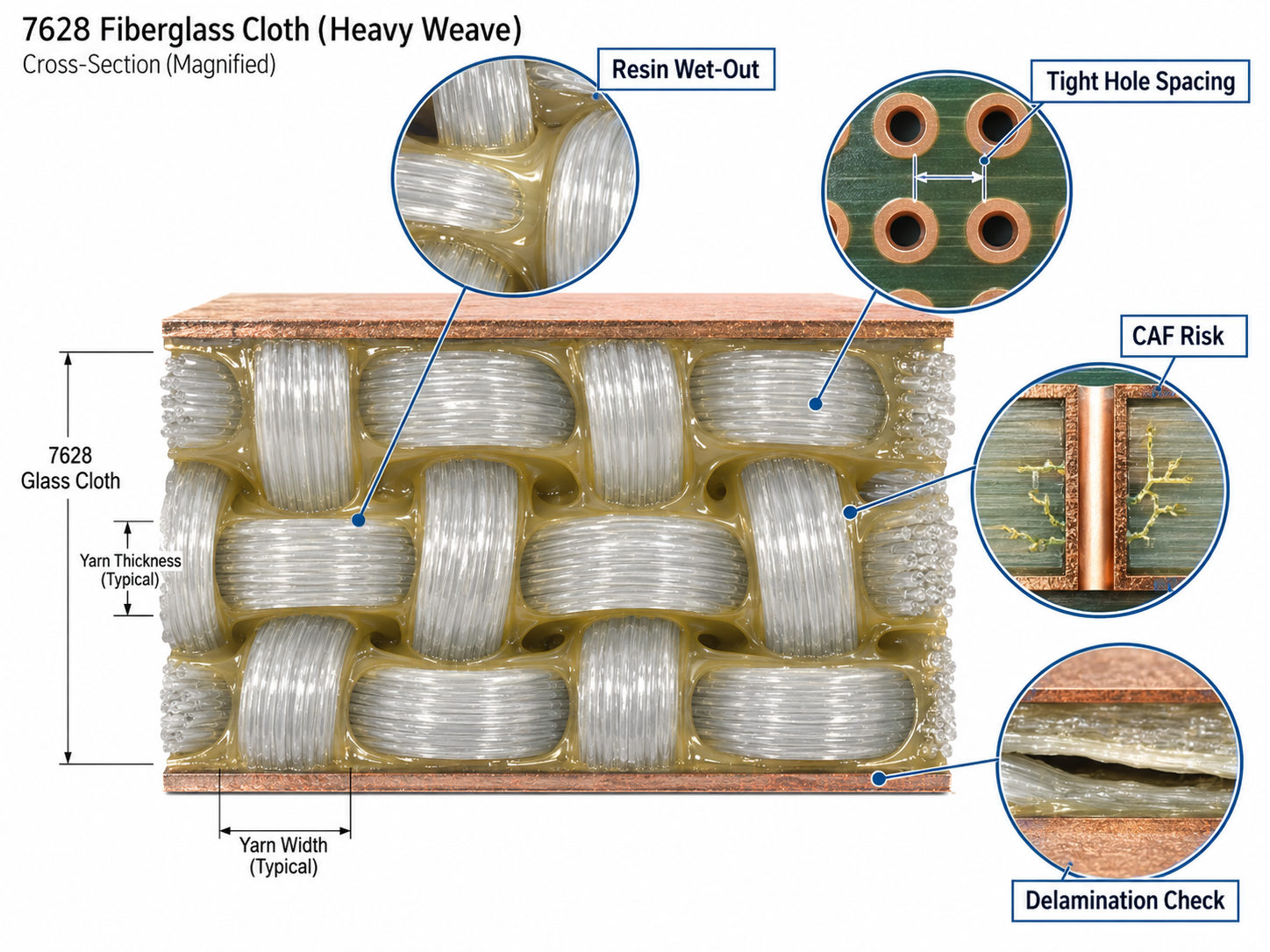
7628 requires careful validation in high-CAF, tight-hole-spacing, and high-temperature lead-free applications because its heavy glass weave is harder to fully wet with resin.
The main concerns are:
- Incomplete resin wet-out at yarn intersections
- Limited resin between tightly packed glass fibers
- Weak resin-to-glass bonding
- Measling
- Crazing
- Delamination
- CAF formation under moisture and electrical bias
Lead-free assembly can add additional thermal stress because the PCB experiences higher process temperatures. The actual risk depends on resin system, hole geometry, process quality, moisture exposure, voltage gradient, and stackup design.
How Does 7628 Affect High-Speed Signals and Fiber Weave Effect?
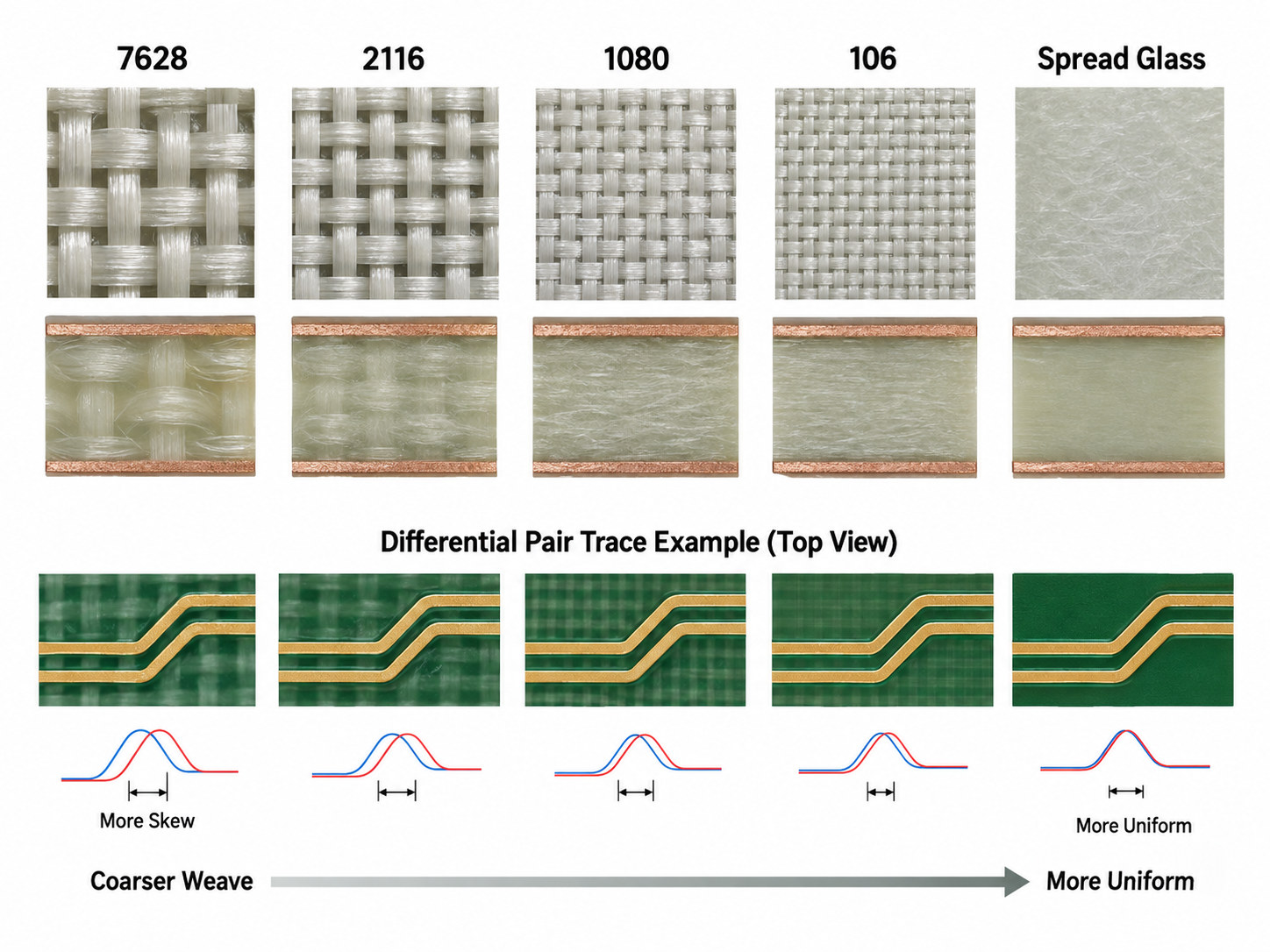
7628 has a relatively visible, coarse glass-weave structure, which can increase local dielectric variation around high-speed traces.
A PCB dielectric is not perfectly homogeneous. Glass-rich regions and resin-rich regions have different dielectric properties. When a trace passes over different portions of the weave, the effective local Dk can vary.
For a differential pair, possible effects include:
- Differential skew
- Phase-delay mismatch
- Local impedance variation
- Timing uncertainty
- Greater sensitivity at very high data rates
This is one reason high-speed designs may use spread glass, mechanically spread glass, thinner glass styles, or other more uniform constructions around critical channels. 7628 can still exist elsewhere in the same multilayer board where high-speed skew sensitivity is lower.
7628 vs 2116 vs 1080 vs 106: What Is the Difference?
The main difference between these PCB glass styles is their fabric thickness, yarn structure, resin capacity, and the dielectric thickness they help create after lamination.
| Glass Style | General Character | Typical PCB Use |
|---|---|---|
| 7628 | Thick, heavy weave | Standard FR-4, thicker dielectric sections |
| 2116 | Medium thickness | General multilayer PCB |
| 1080 | Thin, higher resin proportion | Thin multilayer and HDI structures |
| 106 / 1037 | Very thin | HDI and thin dielectric layers |
| Spread Glass | More uniform fiber distribution | High-speed, low-skew designs |
7628 is useful when the stackup needs thickness quickly, while 2116 provides a more moderate dielectric build. 1080 and 106-class fabrics are better suited to thinner layer spacing.
No single glass style is automatically better. A production stackup often combines several styles to balance total thickness, resin flow, impedance, mechanical strength, and manufacturing yield.
How Do 7628 Fiberglass Cloth Price Changes Affect PCB Cost?
A 7628 price increase does not translate into the same percentage increase for every PCB because glass cloth is only one part of the laminate, prepreg, and total PCB manufacturing cost.
The effect is more direct on products that use substantial amounts of conventional FR-4 and thick dielectric structures, including:
- Industrial multilayer PCBs
- Power supply boards
- Automotive control boards
- Appliance electronics
- LED and charging products
- Standard thick FR-4 assemblies
The final PCB cost also depends on the number of 7628 plies, board layer count, total FR-4 thickness, laminate and prepreg supplier, resin system, material inventory, panel utilization, and order volume.
Ultra-thin HDI or advanced high-speed boards may rely more heavily on other glass styles and specialized laminates, so their cost response to 7628 alone can be smaller.
How Should Engineers Decide Whether to Use 7628?
7628 is a good candidate when the PCB needs conventional FR-4 processing and relatively large dielectric thickness without excessive stackup complexity.
Consider 7628 when:
- A larger dielectric build is required
- Overall PCB thickness or stiffness matters
- Routing density is moderate
- Through-hole spacing is adequate
- Severe differential-skew control is not required
- The material has already been qualified by the fabricator
Consider thinner or more uniform glass constructions when:
- Very thin dielectric layers are required
- Microvia density is high
- Hole spacing creates CAF concerns
- High-speed differential skew is critical
- Millimeter-wave routing is present
- Impedance uniformity requires tighter material control
At EBest Circuit, glass style is reviewed together with resin content, finished dielectric thickness, copper weight, via geometry, impedance requirements, and PCB manufacturing capability during stackup and DFM review.
FAQ About 7628 Fiberglass Cloth
1. Is 7628 fiberglass cloth used in FR-4 PCB?
Yes. 7628 is a common E-glass reinforcement style used in FR-4 laminate and prepreg constructions.
2. How thick is 7628 fiberglass cloth?
Dry 7628 fabric is typically about 0.17 mm thick. A resin-impregnated 7628 prepreg may be around 0.20–0.22 mm, depending on resin content and material system.
3. Is 7628 thicker than 2116?
Yes. In common PCB prepreg constructions, 7628 produces significantly more dielectric thickness per ply than 2116.
4. Can 7628 be used in HDI PCB?
Yes, but it is usually not the preferred material for very thin HDI dielectric layers or fine-pitch microvia regions. It may still be used elsewhere in the same multilayer stackup.
5. Does 7628 increase CAF risk?
Not automatically. However, 7628 requires closer evaluation in high-CAF designs with tight hole spacing because its heavy weave is more difficult to fully wet with resin.
6. Does a rise in 7628 fiberglass cloth price increase all PCB prices?
No. The effect depends on how much 7628-based laminate or prepreg the PCB stackup uses, along with layer count, board thickness, resin system, supplier pricing, and order volume.
Need Help Reviewing a 7628-Based PCB Stackup?
Using 7628 is mainly a stackup decision. Its suitability depends on required dielectric thickness, via spacing, resin system, signal speed, total board thickness, and the location of critical routing layers.
EBest Circuit can review FR-4 stackups, prepreg selection, controlled impedance, via geometry, CAF-sensitive spacing, and manufacturing requirements before fabrication. For a new PCB project, send your Gerber files, stackup requirements, material specification, and target board thickness to sales@bestpcbs.com for DFM review.