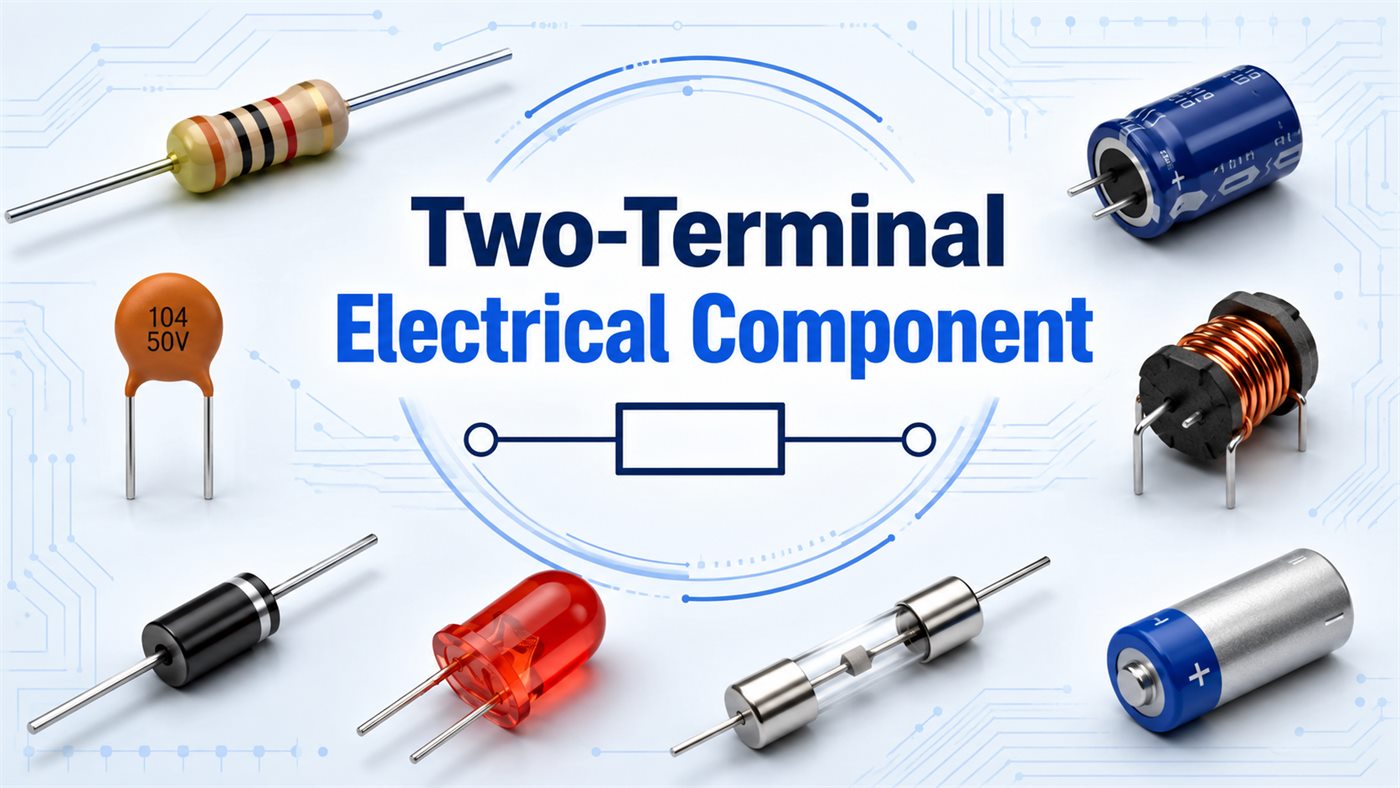
A two terminal electrical component connects to a circuit through two electrical points. Voltage is measured across those terminals, and current flows from one terminal to the other.
For the common two terminal electrical component crossword clue, especially when the answer has five letters or starts with “di,” the answer is usually diode.
| Search clue | Most likely answer |
|---|---|
| Two-terminal electrical component, 5 letters | Diode |
| Starts with “di” | Diode |
| Implements electrical resistance | Resistor |
| Stores energy in an electric field | Capacitor |
| Stores energy in a magnetic field | Inductor |
For the query two terminal electrical component 5 letters, the likely answer remains diode.
The crossword answer is straightforward. In engineering, however, “two-terminal component” is a broad category that also includes resistors, capacitors, inductors, fuses, switches, and battery cells.
What Is a Two-Terminal Electrical Component?
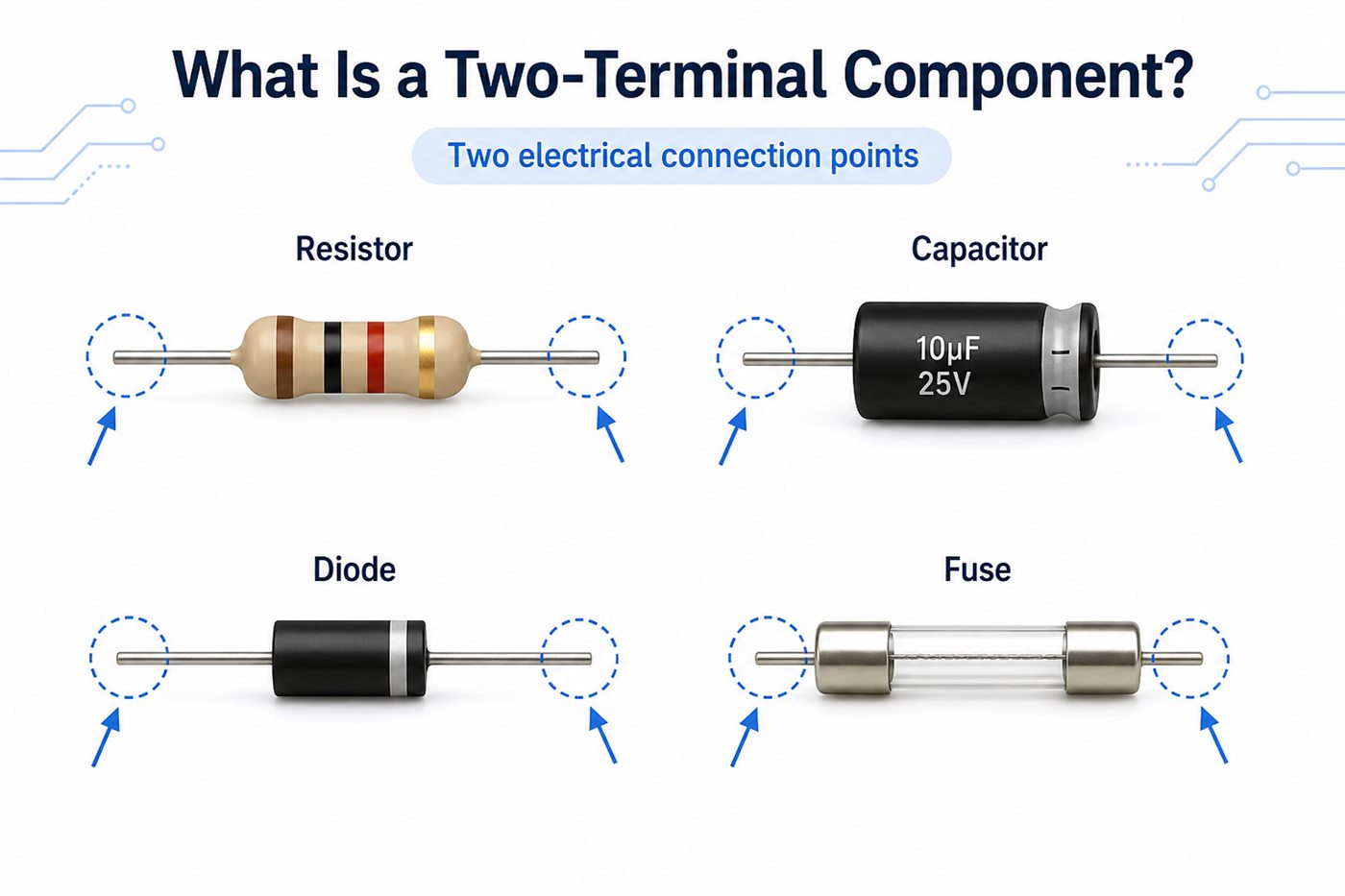
A two-terminal electrical component is a circuit element with two accessible electrical connections. Its operation can usually be described by the voltage across the terminals and the current passing through them.
Two terminals describe the connection structure, not the function. Depending on the device, a two-terminal component may:
- Limit current
- Store electrical or magnetic energy
- Conduct mainly in one direction
- Open a circuit during an overcurrent event
- Connect or disconnect a current path
- Supply power to a circuit
A resistor and a diode both have two terminals, but they are not electrically interchangeable. A resistor is generally non-polarized and approximately linear. A diode is polarized and nonlinear.
For PCB design and component selection, terminal count is only a starting point. The correct part must also match the value, package, polarity, voltage rating, current rating, tolerance, temperature range, and intended circuit function.
Two-Terminal Electrical Component Crossword Clue: What Is the Answer?
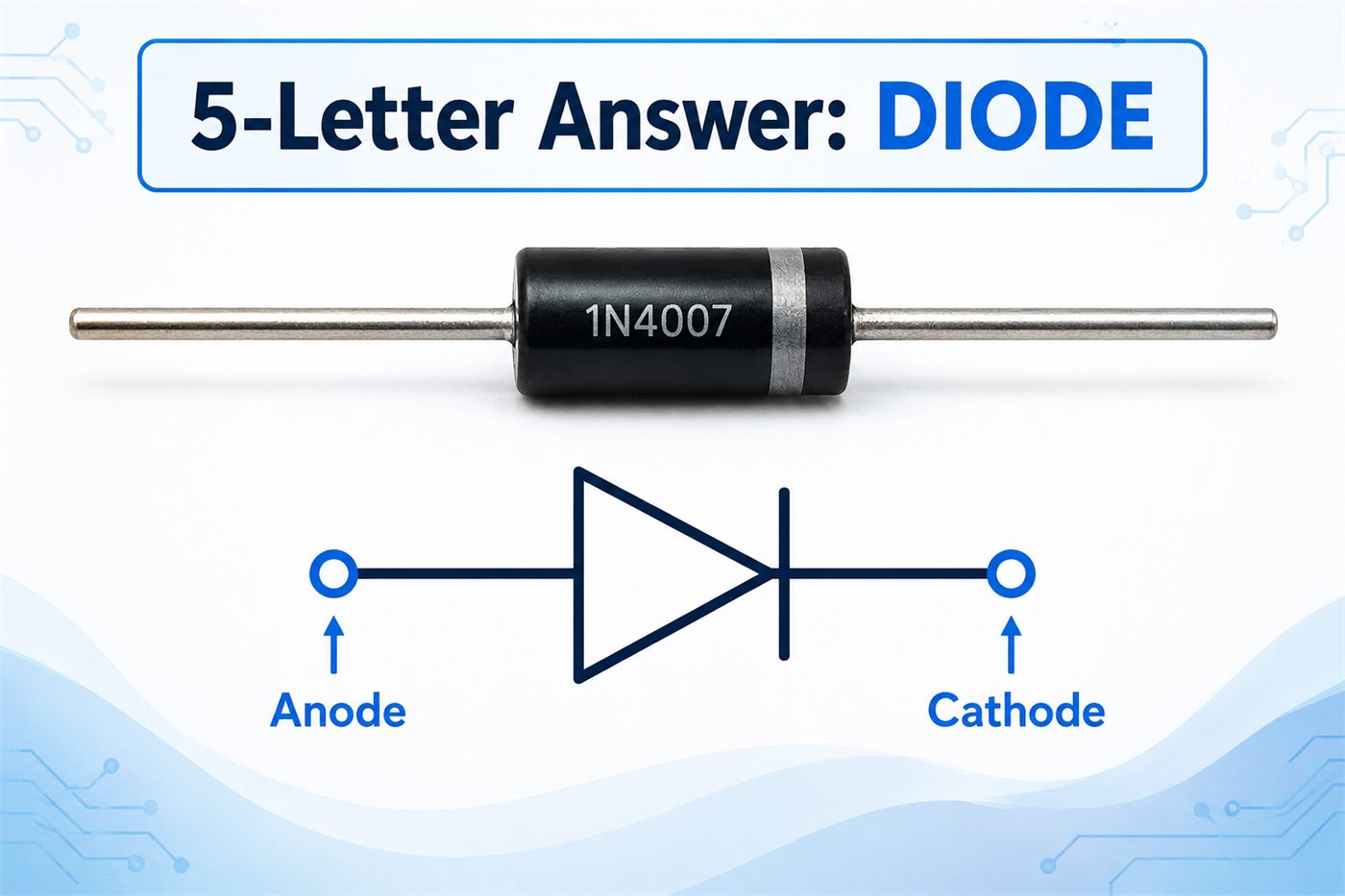
The answer is especially likely when the clue mentions:
- Five letters
- Starts with “di”
- Semiconductor device
- One-way current flow
- Rectification
Other clues point to different components:
| Additional clue | Likely answer |
|---|---|
| Implements resistance | Resistor |
| Stores energy in an electric field | Capacitor |
| Stores energy in a magnetic field | Inductor |
| Opens under excessive current | Fuse |
| Makes or breaks a circuit | Switch |
Therefore, “diode” is the best fit for the five-letter query, but it is not a universal synonym for every two-terminal component.
What Is Another Name for a Two-Terminal Electrical Component?
The clearest general two-terminal electrical component synonym is two-terminal device.
Other terms include:
- Two-terminal circuit element
- Two-terminal electronic component
- Electrical dipole
- Two-lead component
“Electrical dipole” appears in some physics textbooks, while “two-terminal device” is more common in engineering and component documentation.
“Two-pin component” is less accurate because not every terminal is a protruding pin. A component may use axial or radial leads, surface-mount end caps, flat solder pads, electrodes, or screw terminals.
An 0402 resistor, for example, has two metallized ends rather than two visible pins. It is still a two-terminal component.
What Does “Two-Terminal” Mean in a Circuit?
A terminal is an electrical connection point between a component and the rest of the circuit. In a two-terminal device, one connection is made at each end of the current path.
Related terms are often confused:
| Term | Meaning |
|---|---|
| Terminal | Electrical connection point |
| Pin | Rigid conductive contact on a package |
| Lead | Wire or formed conductor attached to a part |
| Pad | PCB copper area used for soldering |
| Electrode | Conductive region interacting with a material or field |
The physical form may change, but the electrical role remains the same.
Two terminals also do not mean that orientation is unimportant. Standard resistors are usually non-polarized, while diodes, LEDs, electrolytic capacitors, and batteries require correct polarity.
During PCB assembly, a polarized component may fit the footprint even when rotated incorrectly. The anode, cathode, positive terminal, or negative terminal must therefore be checked against the schematic, BOM, assembly drawing, and datasheet.
Common Two-Terminal Electrical Components and Their Functions
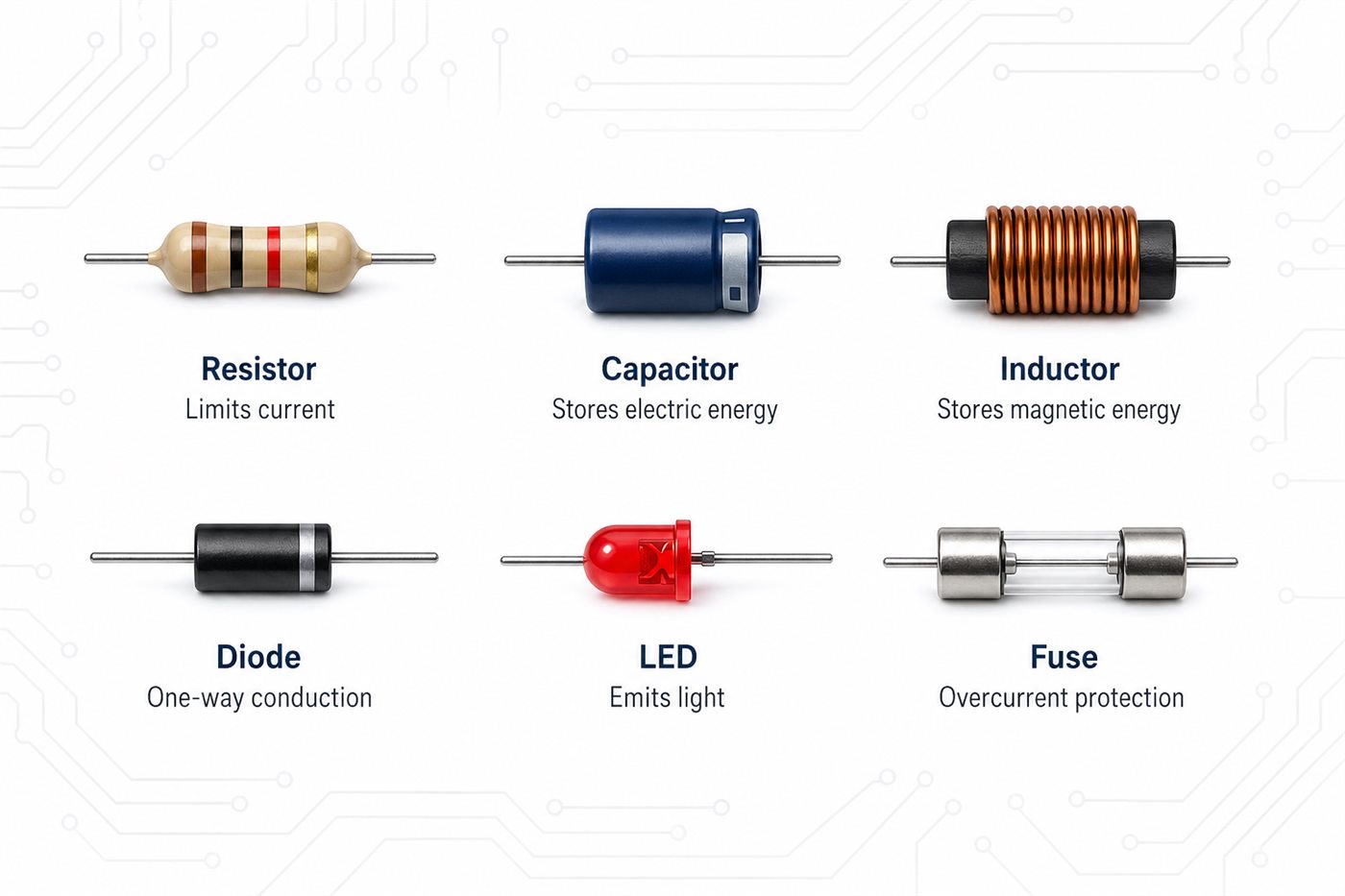
The most useful way to classify two terminal electrical components is by their electrical role.
| Component | Main function | Classification | Polarity |
|---|---|---|---|
| Resistor | Limits current or divides voltage | Passive | Usually non-polarized |
| Capacitor | Stores energy in an electric field | Passive | Depends on type |
| Inductor | Stores energy in a magnetic field | Passive | Usually non-polarized |
| Diode | Conducts mainly in one direction | Semiconductor | Polarized |
| LED | Converts electricity into light | Semiconductor | Polarized |
| Fuse | Opens during overcurrent | Protective | Usually non-polarized |
| Thermistor | Changes resistance with temperature | Passive sensor | Usually non-polarized |
| Varistor | Responds to excessive voltage | Protective | Usually non-polarized |
| Switch | Opens or closes a current path | Electromechanical | Usually non-polarized |
| Battery cell | Supplies electrical energy | Energy source | Polarized |
Two parts with the same terminal count should only be substituted when their function, ratings, package, and operating behavior also match. A footprint match is not enough. Buyers should also compare lifecycle status, approved manufacturers, operating temperature, and availability before accepting an alternate part.
Why Is a Resistor Called a Passive Two-Terminal Component?
A resistor is a passive two-terminal electrical component that implements resistance in a circuit. It does not create power gain or supply energy. Instead, it controls current and voltage.
Typical uses include:
- LED current limiting
- Voltage division
- Pull-up and pull-down networks
- Transistor biasing
- Signal termination
- Current sensing
- Feedback adjustment
- Discharge paths
Resistance value alone is not enough for selection. Engineers also check power rating, tolerance, temperature coefficient, maximum working voltage, pulse capability, package size, noise performance, and environmental requirements.
A 10 kΩ resistor in an 0402 package and one in a 2512 package may have the same resistance, but their power and voltage limits are very different.
For PCBA quotation, the BOM should include the resistance, tolerance, package or power rating, and preferred manufacturer part number. A description such as “10K resistor” leaves too much room for interpretation.
Current-sense resistors need extra detail. Their resistance may be only a few milliohms, so power dissipation, terminal construction, and PCB copper layout can affect measurement accuracy. Four-terminal Kelvin resistors are not basic two-terminal parts, even though they perform the same resistance function.
Why Is a Capacitor a Two-Terminal Energy-Storage Component?
A capacitor stores energy in an electric field between two conductive electrodes separated by a dielectric.
Its common functions include:
- Power-supply decoupling
- Noise filtering
- Signal coupling
- DC blocking
- Timing
- Snubber circuits
- Energy buffering
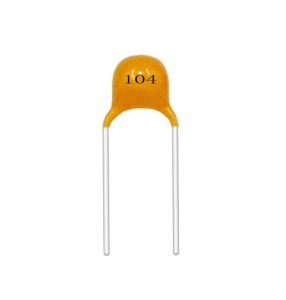
Capacitance is only one selection parameter. Practical capacitor choice also depends on rated voltage, dielectric type, tolerance, ESR, ripple-current capability, operating temperature, package size, and polarity.
Ceramic capacitors can lose effective capacitance under DC bias, especially in small high-capacitance X5R and X7R packages. Electrolytic and tantalum capacitors require closer attention to polarity, ripple current, and service life.
A 10 µF ceramic capacitor and a 10 µF electrolytic capacitor may share the same nominal value, but their frequency response, size, ESR, lifetime, and polarity are not the same. Voltage derating also matters: a capacitor rated only slightly above the operating voltage may have reduced margin during startup surges or transient events.
Is an Inductor a Passive Two-Terminal Component?
Yes. A standard inductor is a passive two-terminal component that stores energy in a magnetic field.
Common applications include:
- Switching converters
- LC filters
- EMI suppression
- RF matching
- Energy storage
- Current smoothing
Key selection parameters are inductance, rated current, saturation current, DC resistance, self-resonant frequency, core material, shielding, package size, and temperature range.
A power inductor may lose inductance as the core approaches saturation. High DC resistance also increases copper loss and temperature rise. When reviewing alternatives, compare the current-rating test conditions; manufacturers do not always define temperature-rise and saturation limits in the same way.
A transformer should not be treated as a basic two-terminal inductor. Most transformers use at least two windings and therefore have four or more external terminals.
Is a Diode a Two-Terminal Electrical Component?
Yes. A diode is a nonlinear two-terminal semiconductor component with an anode and cathode.
A conventional diode conducts strongly when forward-biased and blocks most reverse current within its rated limits.
Common diode types include:
- Rectifier diode
- Schottky diode
- Zener diode
- TVS diode
- LED
- Photodiode
The type matters because each serves a different role. A Schottky diode is often chosen for low forward voltage and fast switching. A TVS diode is designed to absorb short transient events. A Zener diode is used for voltage regulation or clamping.
Polarity must be checked carefully during assembly. A stripe often marks the cathode, but package markings vary. The schematic symbol, footprint orientation, assembly drawing, and manufacturer datasheet should agree.
For prototype or production quotations, provide the exact manufacturer part number when the diode has critical requirements such as breakdown voltage, surge current, reverse recovery time, or forward-voltage limit. Package thermal performance also matters in rectification and protection circuits, where short current peaks may be much higher than the normal operating current.
Passive and Semiconductor Two-Terminal Components: What Is the Difference?
The distinction comes from electrical behavior, not the number of terminals.
| Category | Examples | Typical behavior |
|---|---|---|
| Passive linear components | Resistor, ideal capacitor, ideal inductor | Dissipate or store energy |
| Semiconductor components | Diode, LED, Zener, TVS | Nonlinear and often polarity-dependent |
| Protective components | Fuse, MOV, thermistor | React to abnormal current, voltage, or temperature |
| Energy sources | Battery cell | Deliver electrical energy |
| Electromechanical components | Switch, reed switch | Mechanically open or close a path |
A resistor is approximately linear and usually bidirectional. A diode is nonlinear and directional. Both have two terminals, but their circuit behavior is fundamentally different.
How Do You Identify Two-Terminal Components on Schematics and PCBs?
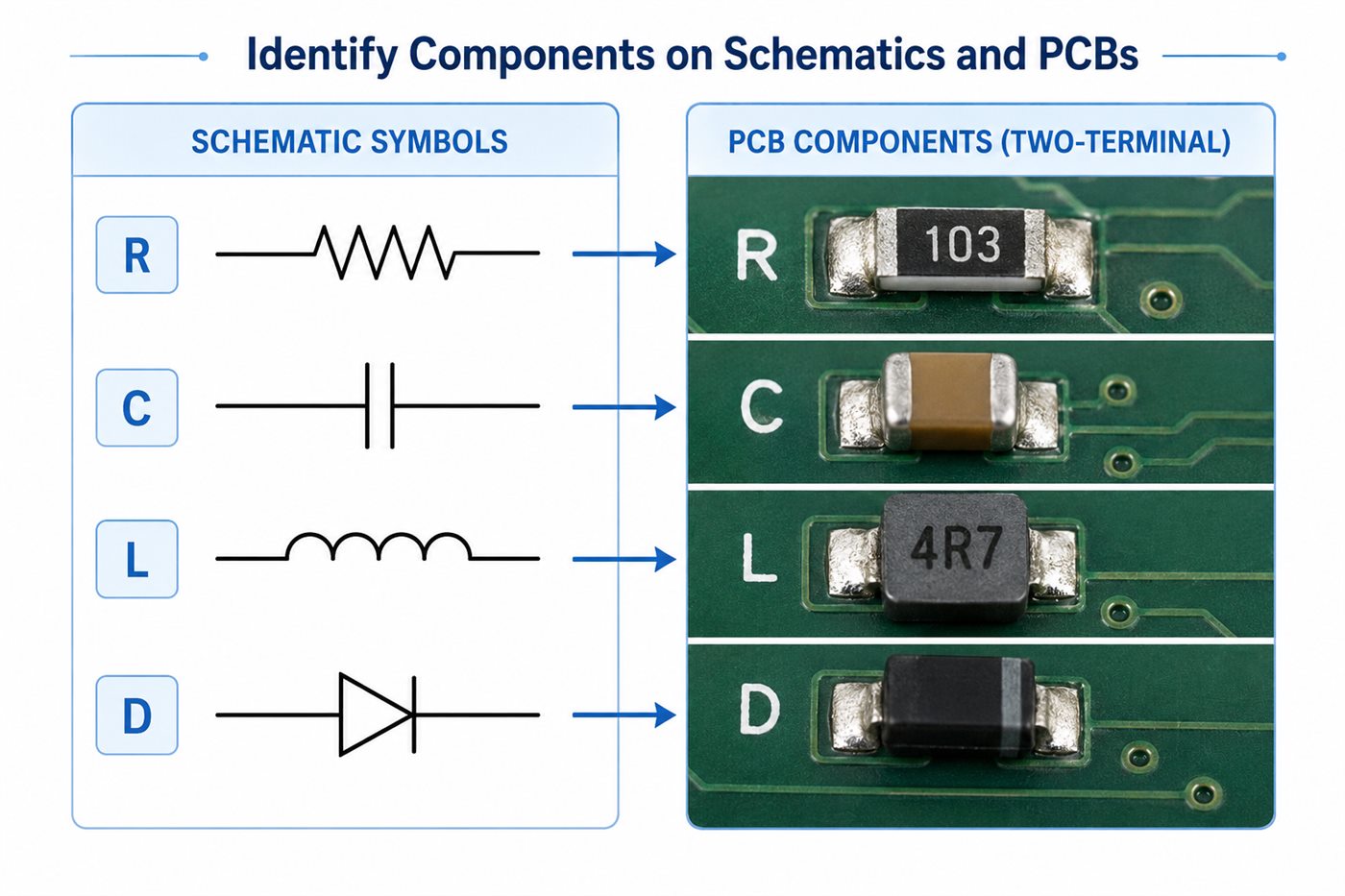
On a schematic, a two-terminal component normally has one connection at each side of its symbol. The reference designator is often the fastest identification clue:
- R: resistor
- C: capacitor
- L: inductor
- D: diode
- LED: light-emitting diode
- F: fuse
- TH or RT: thermistor
- MOV or RV: varistor
On a PCB, PCB component identification cannot rely on two solder pads alone. Similar packages may contain a resistor, capacitor, ferrite bead, inductor, diode, fuse, or zero-ohm jumper.
Use the following sources together:
- Reference designator
- Schematic symbol
- BOM description
- Manufacturer part number
- Package marking
- PCB polarity mark
- Datasheet pin definition
Small SMD components may have no readable marking. In that case, the BOM and placement data become especially important.
For PCBA review, EBest Circuit normally needs Gerber files, BOM data, and a pick-and-place file. An assembly drawing with polarity notes is useful when diode, LED, or capacitor orientation is not obvious.
Before requesting a quotation, check that the BOM contains:
- Exact manufacturer part numbers for critical components
- Package and value information
- Approved substitute rules
- DNP or do-not-fit positions
- Polarity and orientation notes
- Required testing or inspection steps
These details reduce clarification cycles and prevent technically unsuitable substitutions.
Two-Terminal vs Three-Terminal Electrical Components
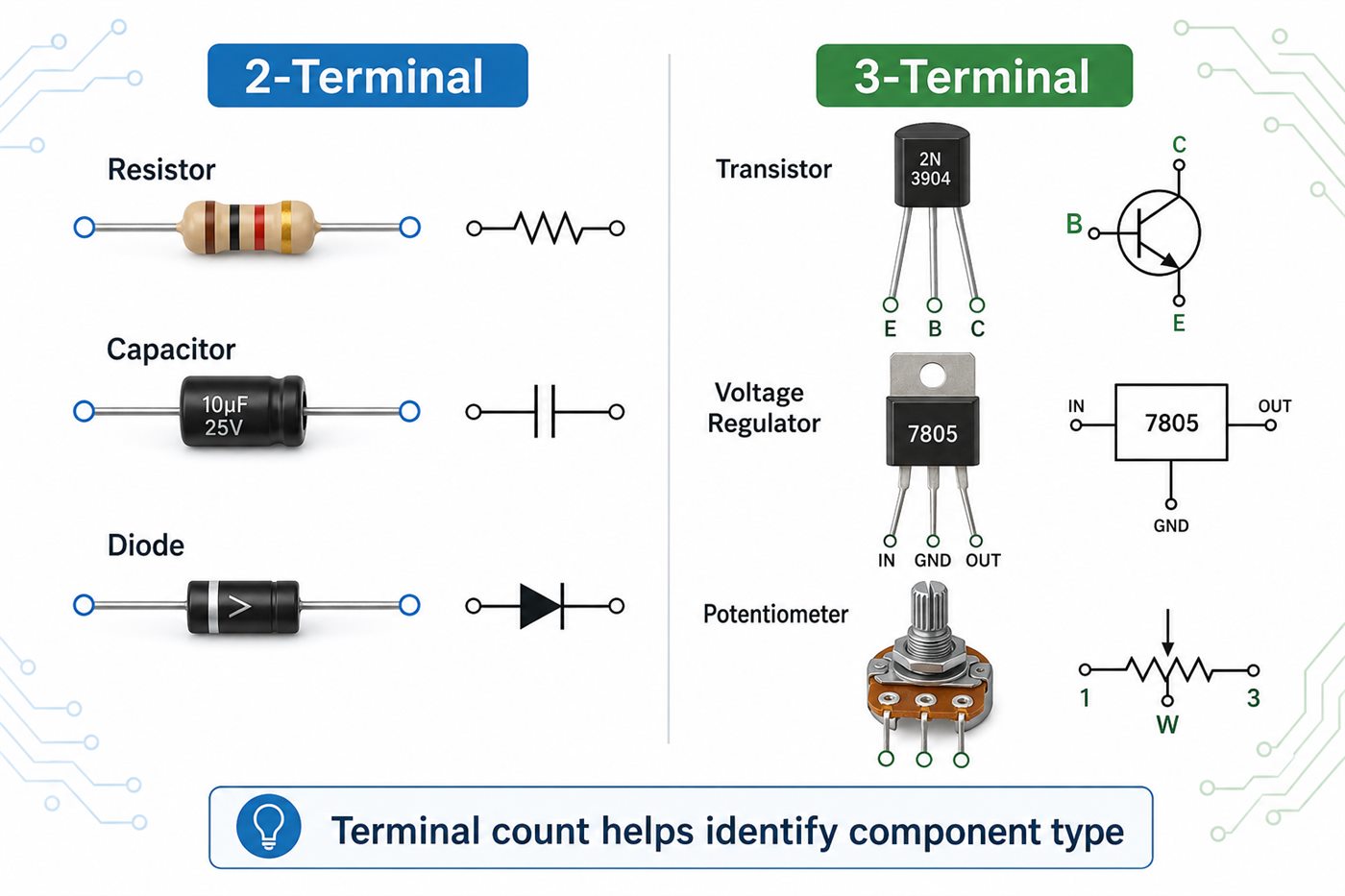
A three-terminal device usually adds a control, adjustment, or reference connection.
| Feature | Two-terminal component | Three-terminal component |
|---|---|---|
| Connections | Two | Three |
| Examples | Resistor, capacitor, diode, fuse | Transistor, potentiometer, regulator |
| Typical role | Limit, store, conduct, protect | Control, amplify, divide, regulate |
| Main selection focus | Value, rating, package, polarity | Pinout, control behavior, rating, package |
A fixed resistor has two terminals. A potentiometer normally has three: two ends of the resistive track and a movable wiper.
A diode has an anode and cathode. A bipolar transistor has a base, collector, and emitter. A MOSFET uses gate, drain, and source connections, although some packages also expose a body connection or thermal pad.
Terminal count helps narrow the possibilities, but the schematic and datasheet remain the final authority.
FAQs About Two-Terminal Electrical Components
What is the five-letter two-terminal electrical component?
The most common five-letter answer is diode. It has an anode and cathode and conducts primarily in one direction.
What two-terminal electrical component starts with “di”?
The answer is diode.
What passive two-terminal component implements electrical resistance?
A resistor is a passive two-terminal component that implements electrical resistance in a circuit.
What two-terminal component stores energy in an electric field?
A capacitor stores energy in an electric field between two conductive electrodes separated by a dielectric.
What two-terminal component stores energy in a magnetic field?
An inductor stores energy in a magnetic field created by current flowing through its winding or conductive structure.
Are all two-terminal electrical components passive?
No. “Two-terminal” describes the number of electrical connections. Diodes are semiconductor components, batteries are energy sources, and switches are electromechanical devices.
Is a battery a two-terminal electrical component?
A basic battery cell or battery pack commonly has a positive and negative terminal. More advanced battery packs may include additional connections for temperature sensing, communication, balancing, or protection.
Is a switch a two-terminal component?
A simple single-pole single-throw switch has two terminals. Changeover, multipole, illuminated, or electronically controlled switches may have more.
What is the difference between a terminal and a pin?
A terminal is an electrical connection point. A pin is one physical form of terminal. Terminals can also be leads, pads, electrodes, screws, or spring contacts.
Can two-terminal components be installed in either direction?
Only non-polarized components can generally be installed in either direction. Diodes, LEDs, electrolytic capacitors, and battery cells require the correct orientation.
Need Help With PCB Component Selection and Assembly?
A two-terminal electrical component is defined by its two connection points, but its function may be resistive, capacitive, inductive, protective, semiconductor-based, or power-supplying. For the five-letter crossword clue, the answer is usually diode.
For a PCB prototype or PCBA quotation, send your Gerber files, BOM, pick-and-place data, and assembly requirements to EBest Circuit at sales@bestpcbs.com.