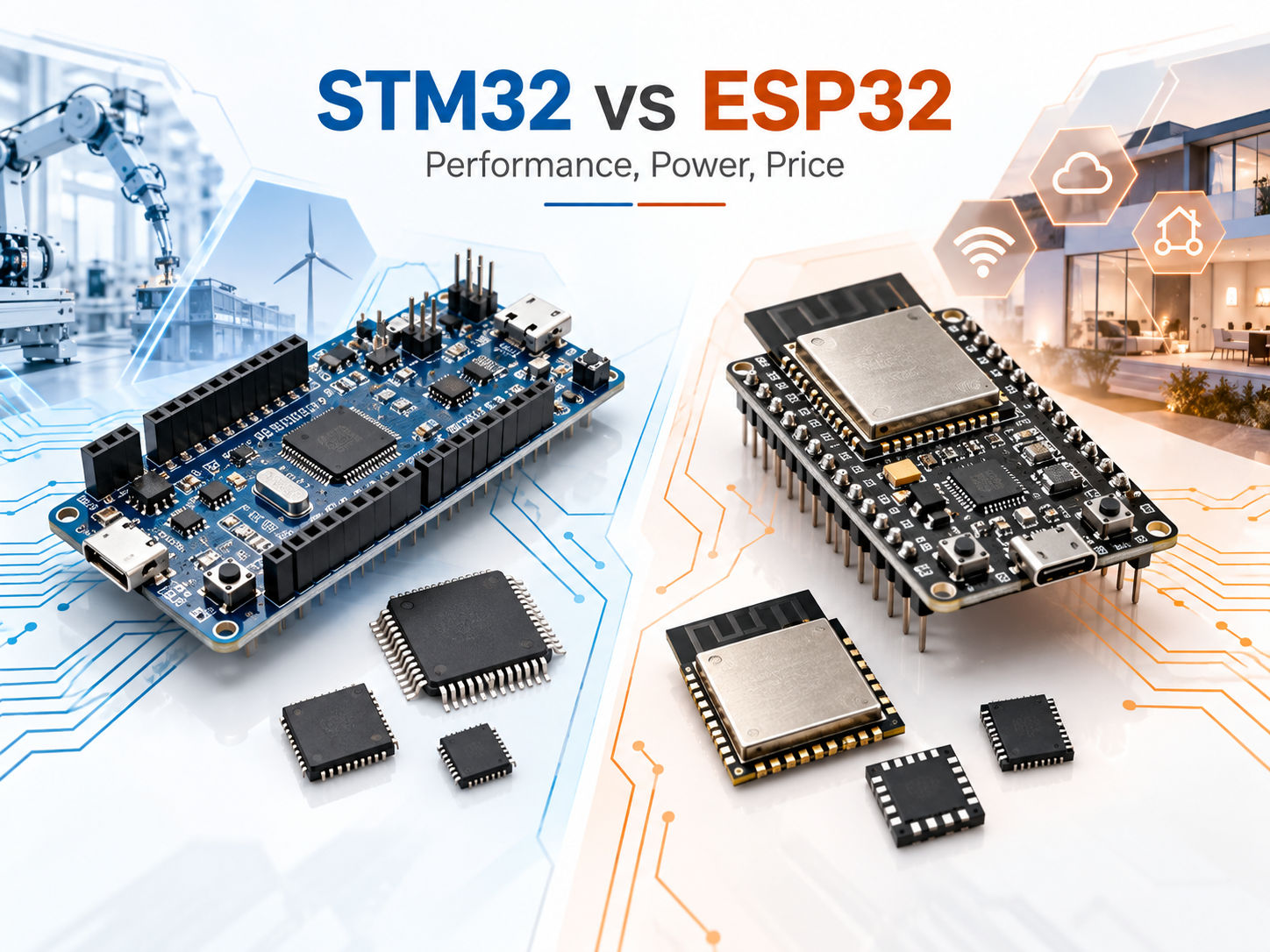
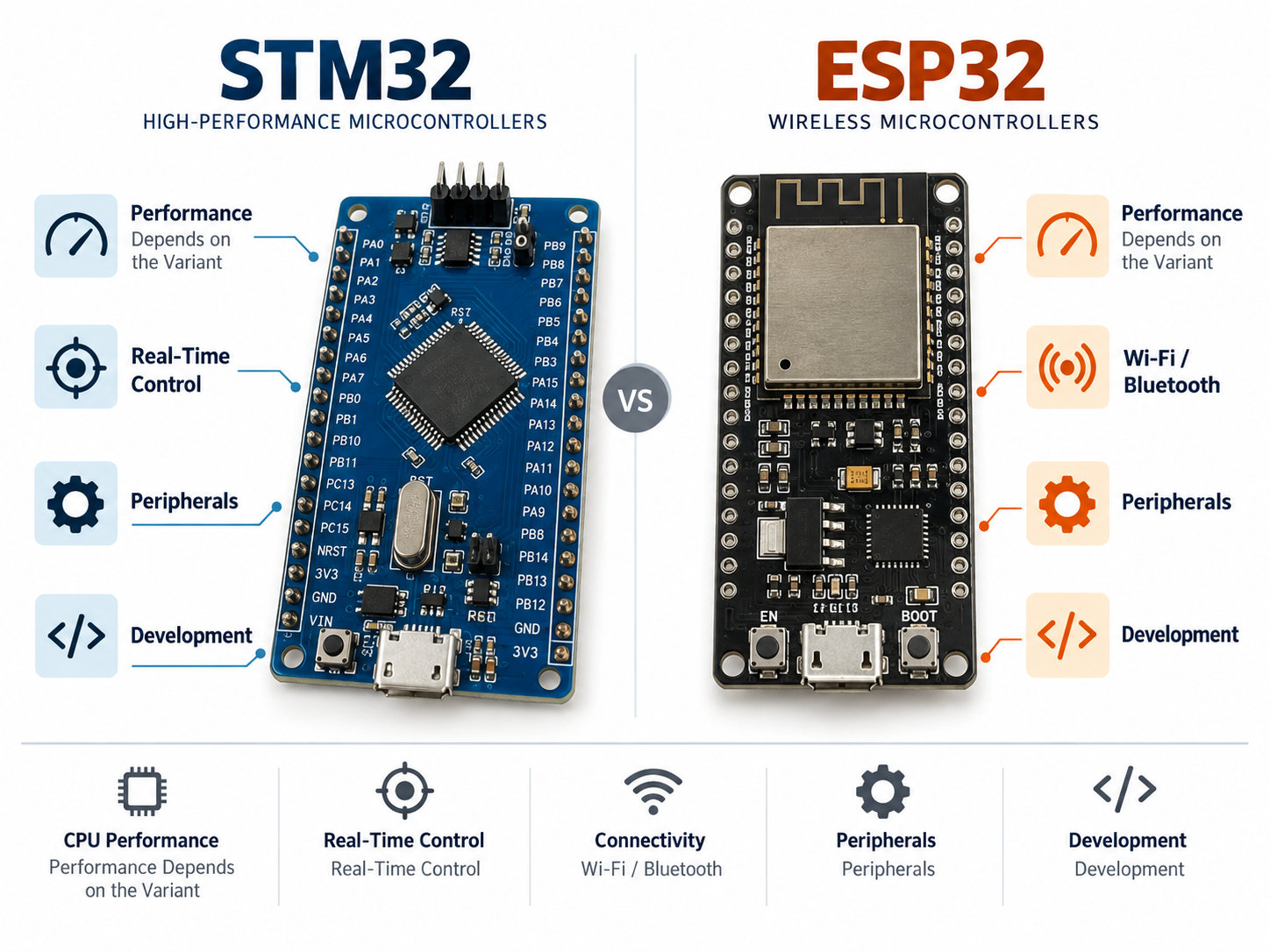
STM32 vs ESP32 is not a comparison between two individual chips. STM32 is a large Arm Cortex-M microcontroller family covering entry-level control through high-performance embedded processing, while ESP32 is a family of connected MCUs and SoCs designed around integrated wireless capability, general-purpose processing, and rapid IoT development.
This STM32 vs ESP32 microcontroller comparison focuses on production decisions rather than development-board popularity.
The better choice depends on the actual workload. CPU performance, peripherals, wireless requirements, power budget, unit cost, software ecosystem, PCB design, and production volume can all change the decision. Comparing representative devices such as STM32F103, STM32F4, STM32H7, classic ESP32, and ESP32-S3 gives a more useful picture than comparing the two brand families as if each contained only one MCU.
Key Takeaways
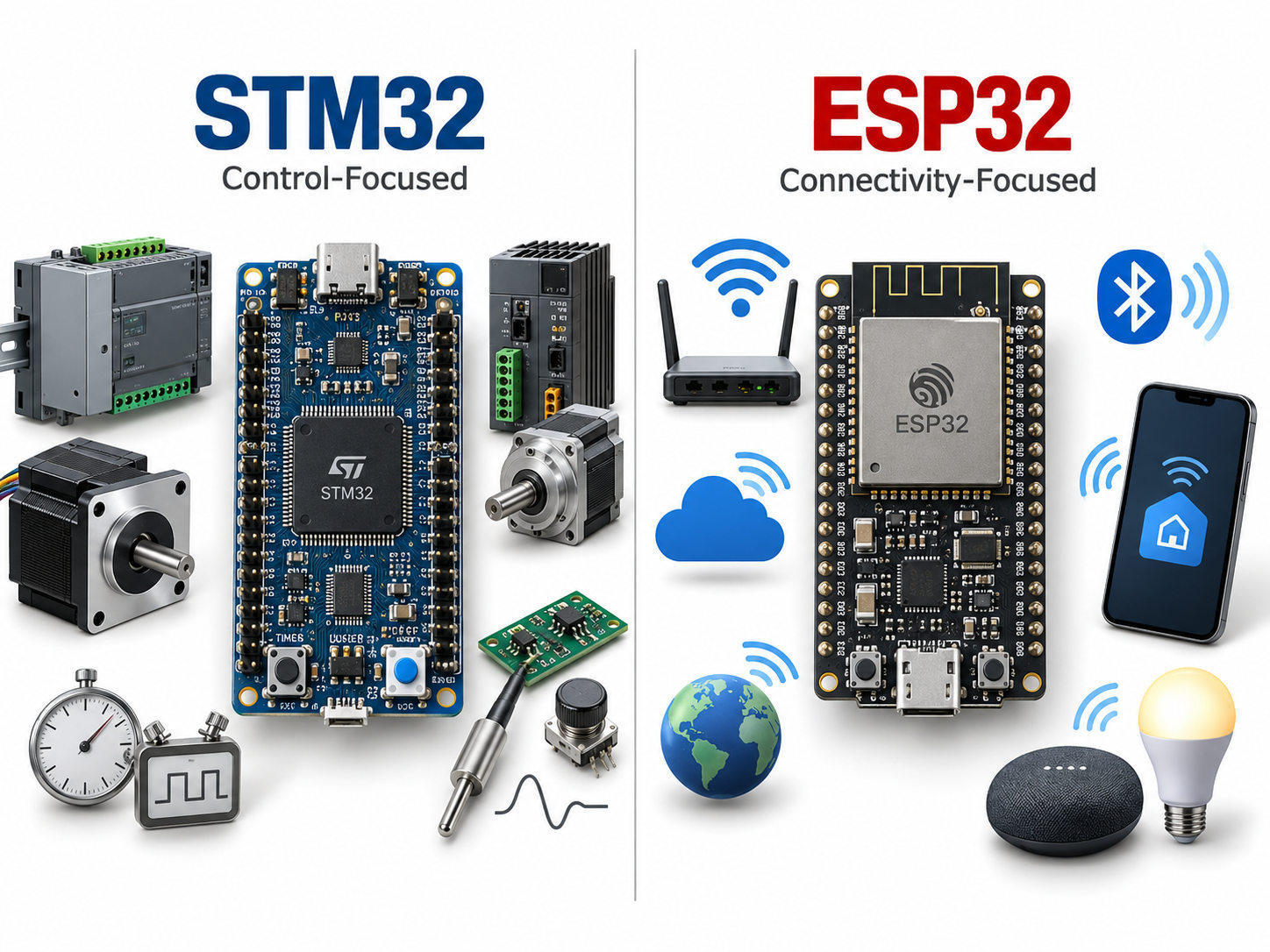
- STM32 is usually a stronger starting point for deterministic control, motor control, industrial interfaces, and applications that need a wide MCU selection.
- ESP32 is attractive for Wi-Fi, Bluetooth, IoT, and connected products because wireless connectivity is integrated into many ESP32 variants.
- Performance depends on the exact devices being compared. STM32F103, STM32F4, STM32H7, classic ESP32, and ESP32-S3 belong to very different performance levels.
- STM32 often fits low-power control applications well, while ESP32 power consumption depends heavily on radio activity, sleep strategy, and communication duty cycle.
- ESP32 can reduce total BOM cost in wireless products by eliminating a separate Wi-Fi or Bluetooth module.
- Robotics and drones do not have one universal winner. Real-time control and wireless communication place different demands on the MCU.
- STM32 and ESP32 can also work together, with one handling deterministic control and the other handling wireless connectivity.
STM32 vs ESP32: What Is the Main Difference?
The main difference is positioning: STM32 is primarily a broad embedded-control MCU family, while ESP32 is strongly oriented toward connected embedded systems with integrated Wi-Fi and Bluetooth on many variants.
STM32 devices span many performance and application classes. Depending on the series, designers can choose different CPU cores, clock speeds, memory sizes, timers, ADCs, communication peripherals, security features, and low-power modes.
ESP32 devices combine MCU processing with wireless functionality in a compact platform. Typical strengths include:
- Wi-Fi and Bluetooth integration
- Large developer ecosystem
- FreeRTOS support
- Flexible GPIO
- SPI, UART, I²C, ADC, PWM, and other common interfaces
- Module options with flash and antenna already integrated
For products centered on motor control, precise timing, industrial I/O, or tightly managed low-power operation, STM32 is often a natural starting point. For connected sensors, gateways, smart devices, and Wi-Fi/Bluetooth products, ESP32 can simplify the architecture.
Which STM32 and ESP32 Models Should You Actually Compare?
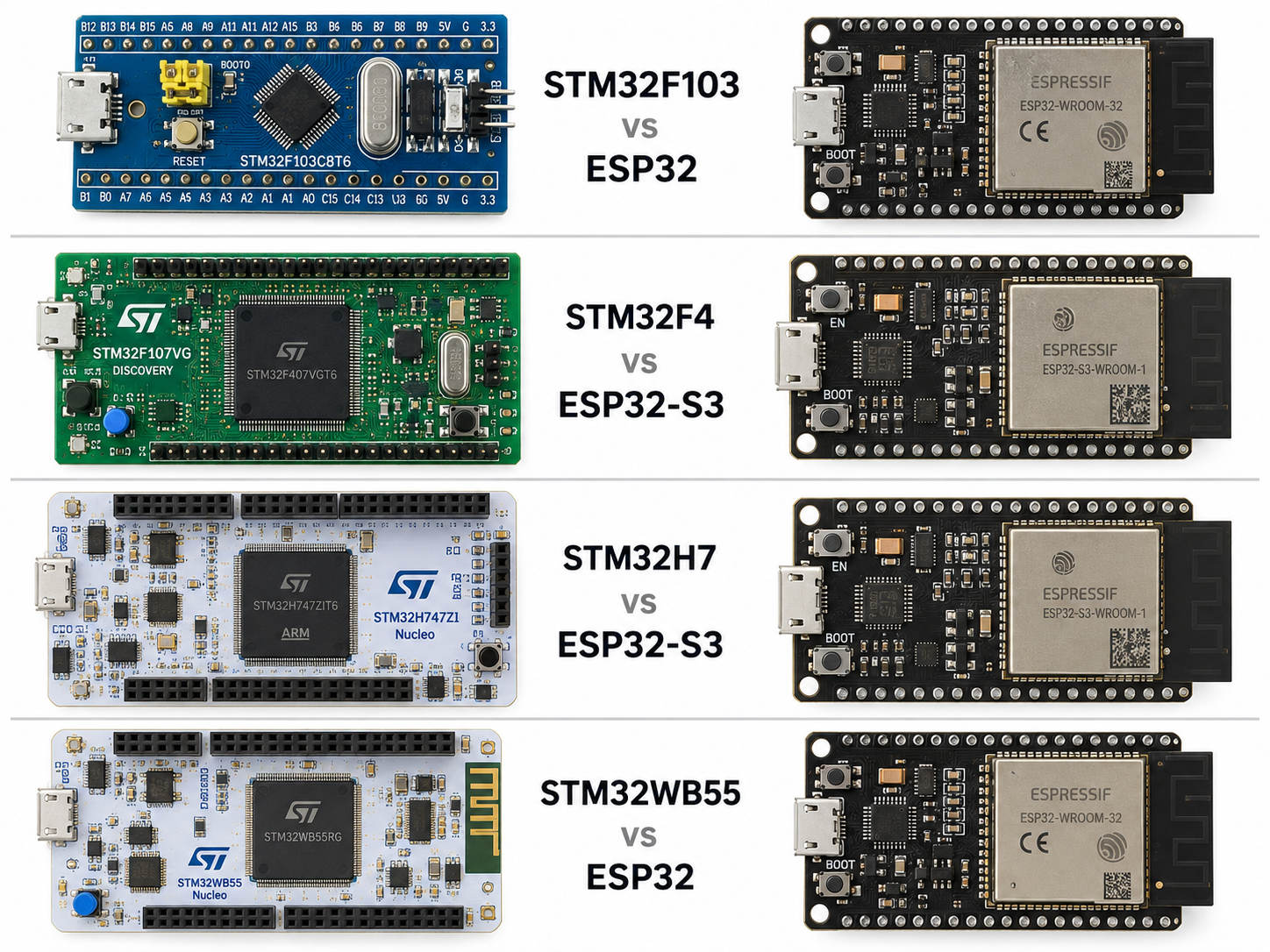
A useful STM32 vs ESP32 comparison needs representative devices from similar application levels. Comparing STM32H7 directly with an older ESP32 while ignoring the intended workload can create misleading conclusions.
| STM32 Family | ESP32 Family | Useful Comparison |
|---|---|---|
| STM32F103 | Classic ESP32 | Entry-level and older mainstream embedded designs |
| STM32F4 | ESP32 / ESP32-S3 | General embedded processing |
| STM32H7 | ESP32-S3 | Higher-performance applications |
| STM32WB55 | ESP32 family | Wireless embedded designs |
STM32F103 is widely associated with low-cost development boards such as the Blue Pill, while STM32F4 is a common step up for DSP, control, and higher-performance applications.
STM32H7 moves into a much higher performance class with faster Cortex-M7 devices and stronger memory and peripheral architectures. ESP32-S3, meanwhile, improves processing and AI-oriented instruction support while keeping Wi-Fi and Bluetooth integration.
The right comparison should therefore start from application requirements, not family names.
STM32 vs ESP32 Performance: Which Is Faster?
Neither platform is always faster because CPU performance depends on the exact STM32 and ESP32 devices being compared.
For an STM32 vs ESP32 speed comparison, benchmark the exact parts under the real workload. An STM32 vs ESP32 clock speed figure alone does not predict interrupt latency, peripheral throughput, or control-loop behavior.
Important factors include:
- CPU architecture
- Clock frequency
- Number of cores
- FPU and DSP support
- Cache architecture
- Internal RAM
- External-memory support
- DMA capability
- Hardware accelerators
- Interrupt and real-time behavior
An STM32F103 and STM32H7 are both STM32 devices, yet their performance levels are far apart. The same issue appears within the ESP32 family, where classic ESP32, ESP32-S3, C-series, and other variants use different architectures and peripheral sets.
ESP32 can perform well when parallel tasks, networking, or connected applications are important. Higher-end STM32 devices can offer stronger deterministic processing for control loops, signal processing, and demanding embedded workloads.
Clock speed alone should not decide the comparison. A 240 MHz processor does not automatically outperform a lower-clocked MCU in every real-time or peripheral-heavy application.
STM32 vs ESP32 Connectivity and Peripherals: What Changes the Design?
ESP32 generally offers an advantage when Wi-Fi or Bluetooth must be integrated directly into the product, while STM32 provides a broader range of specialized embedded-control peripherals across its product families.
| Feature | STM32 | ESP32 |
|---|---|---|
| Wi-Fi | Usually external | Integrated on many variants |
| Bluetooth | Available on selected wireless series | Integrated on many variants |
| CAN / FDCAN | Broad device support | Depends on variant |
| Motor-control timers | Strong on many series | Available, but product focus differs |
| ADC | Wide model-dependent range | Integrated, variant dependent |
| USB | Available on selected devices | Available on selected variants |
| Ethernet | Available on selected STM32 devices | Usually requires external PHY and suitable variant |
| Wireless networking | External or wireless STM32 family | Core strength |
STM32WB, STM32WL, and other wireless STM32 families mean it is inaccurate to say STM32 has no wireless capability. The difference is that wireless connectivity is central to the ESP32 ecosystem, while STM32 offers a broader family structure covering many embedded-control niches.
STM32 vs ESP32 Power Consumption: Which Uses Less Power?
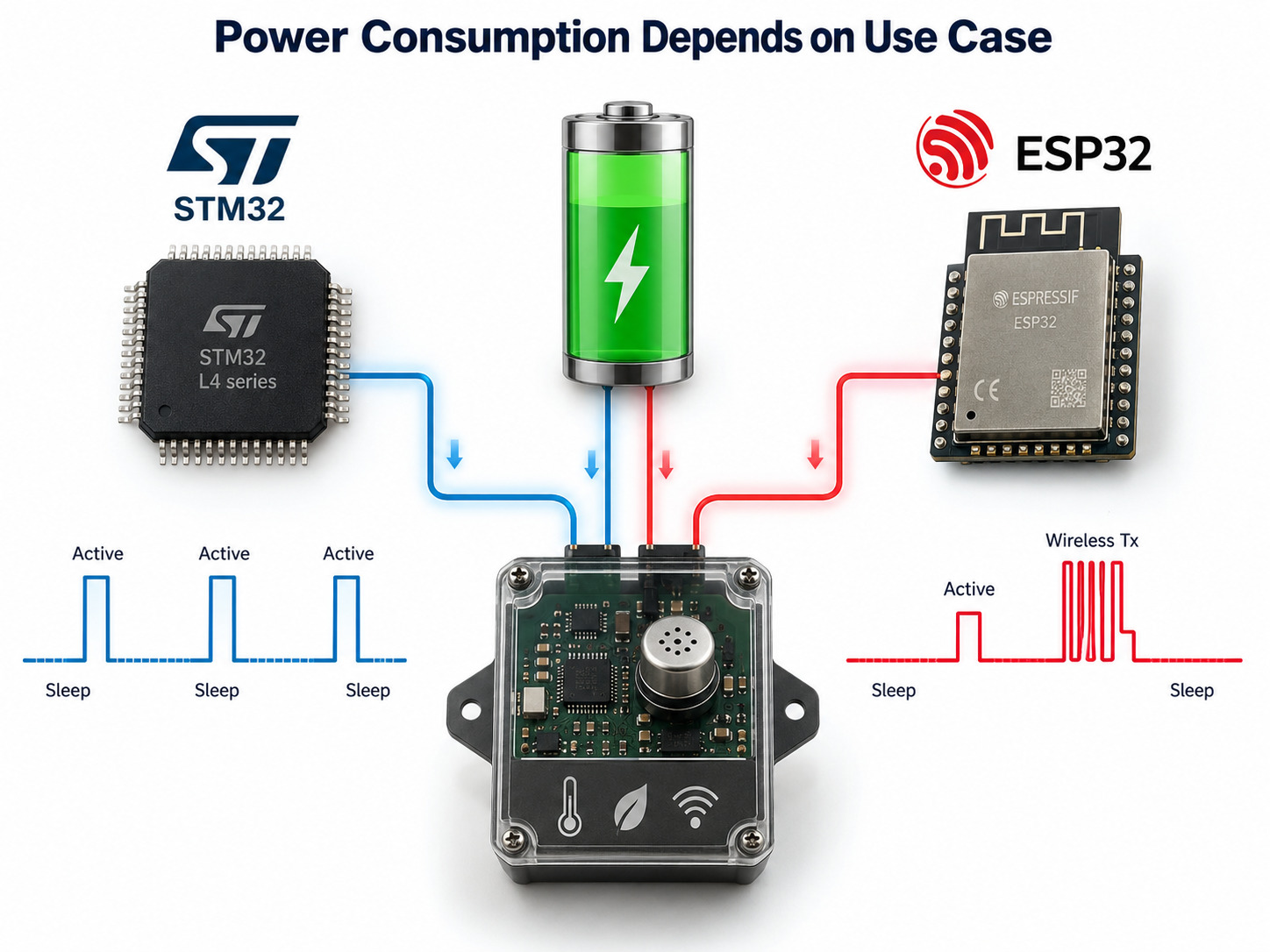
STM32 often provides more low-power choices for battery-operated control systems, but a fair comparison depends on the exact MCU, radio state, clock configuration, and duty cycle.
Power should be evaluated under several operating conditions:
- Active processing
- Idle mode
- Stop or light-sleep mode
- Deep sleep
- Wi-Fi active
- Bluetooth active
- Periodic radio wake-up
- Bare MCU versus development board
ESP32 designs can achieve low sleep current, but wireless transmission creates short periods of much higher consumption. A sensor that wakes every few minutes, transmits data, and returns to sleep may still have excellent battery life if the duty cycle is carefully controlled.
STM32 families include devices designed specifically for low-power operation, making them attractive for metering, battery instrumentation, remote sensing, and long-life embedded devices.
For production hardware, regulator quiescent current, LEDs, USB bridges, sensors, and external radios can matter as much as the MCU specification itself.
STM32 vs ESP32 Price: Which Costs Less in a Real Product?
ESP32 can have a lower total system cost when the product needs Wi-Fi or Bluetooth, while STM32 can be more economical when wireless connectivity is unnecessary.
The MCU price alone does not show the full cost. A production comparison should include:
- MCU or module cost
- External Wi-Fi/Bluetooth module
- Flash and external memory
- RF matching components
- Antenna
- Crystal and clock components
- PCB area
- Assembly cost
- Programming and testing
- Wireless certification requirements
An ESP32 module can combine the MCU, flash, RF circuitry, and antenna into one certified package. That can reduce design time and BOM complexity compared with adding an external wireless module to a conventional MCU.
A non-wireless STM32 design may require fewer RF-related parts and less PCB space reserved for antenna performance. The lower-cost architecture therefore depends on the final product, not the MCU unit price alone.
STM32 vs ESP32 Development: Which Is Easier to Program and Debug?
ESP32 often provides a faster learning path for connected prototypes, while STM32 offers a deeper professional embedded-development environment for projects that require detailed peripheral and hardware control.
Common STM32 tools include:
- STM32CubeIDE
- STM32CubeMX
- HAL and LL libraries
- ST-Link
- SWD debugging
- FreeRTOS
Common ESP32 tools include:
- ESP-IDF
- Arduino Core for ESP32
- PlatformIO
- FreeRTOS
- JTAG debugging
- Large open-source library ecosystem
ESP32 is popular among makers and IoT developers because Wi-Fi, Bluetooth, networking stacks, and Arduino-compatible libraries are easy to access.
STM32CubeMX can generate initialization code for clocks, GPIO, timers, ADCs, communication interfaces, and other peripherals. This can be especially useful when the application uses many hardware resources.
Arduino should not be treated as a third MCU family in this comparison. It is primarily a development platform and ecosystem that can run on different microcontroller architectures.
STM32 vs ESP32 for Robotics: Which Fits the Project Better?
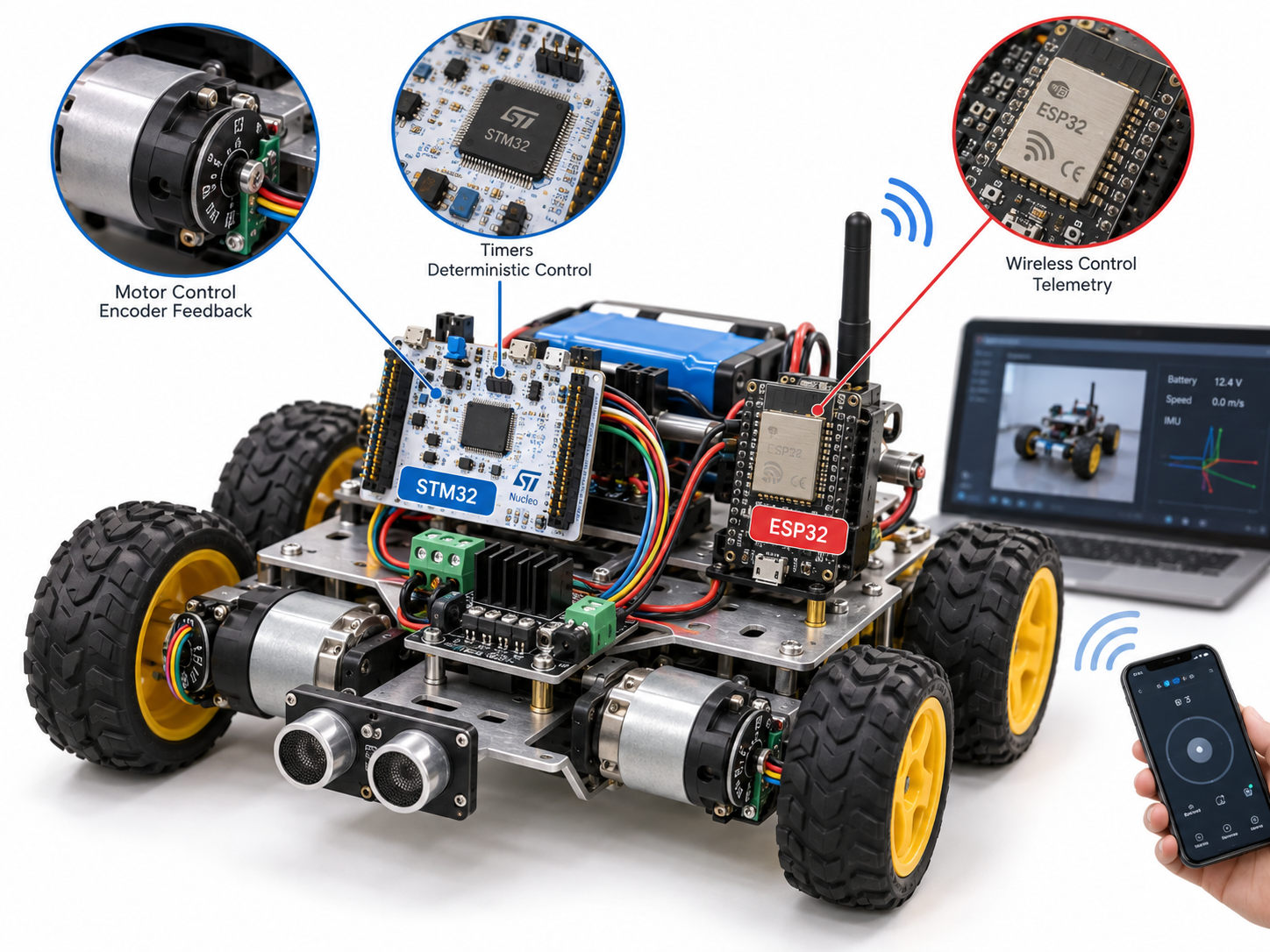
STM32 is often preferred for deterministic motor and motion control, while ESP32 is attractive when the robot needs wireless communication, remote control, telemetry, or cloud connectivity.
Robotics commonly involves:
- Motor PWM
- Encoders
- PID or FOC control
- IMUs
- Distance sensors
- Servo control
- Communication buses
- Wireless control
- Telemetry
A mobile robot with several motors and encoders may benefit from STM32 timer, DMA, ADC, and motor-control capabilities.
An ESP32 can work well for simpler robots where Wi-Fi or Bluetooth control is important. It can also manage sensors, web interfaces, telemetry, and communication with another controller.
For more demanding systems, separating responsibilities can improve architecture. One MCU can handle hard real-time control while another manages networking and user communication.
STM32 vs ESP32 for Drones: Which Fits Flight Control and Connectivity?
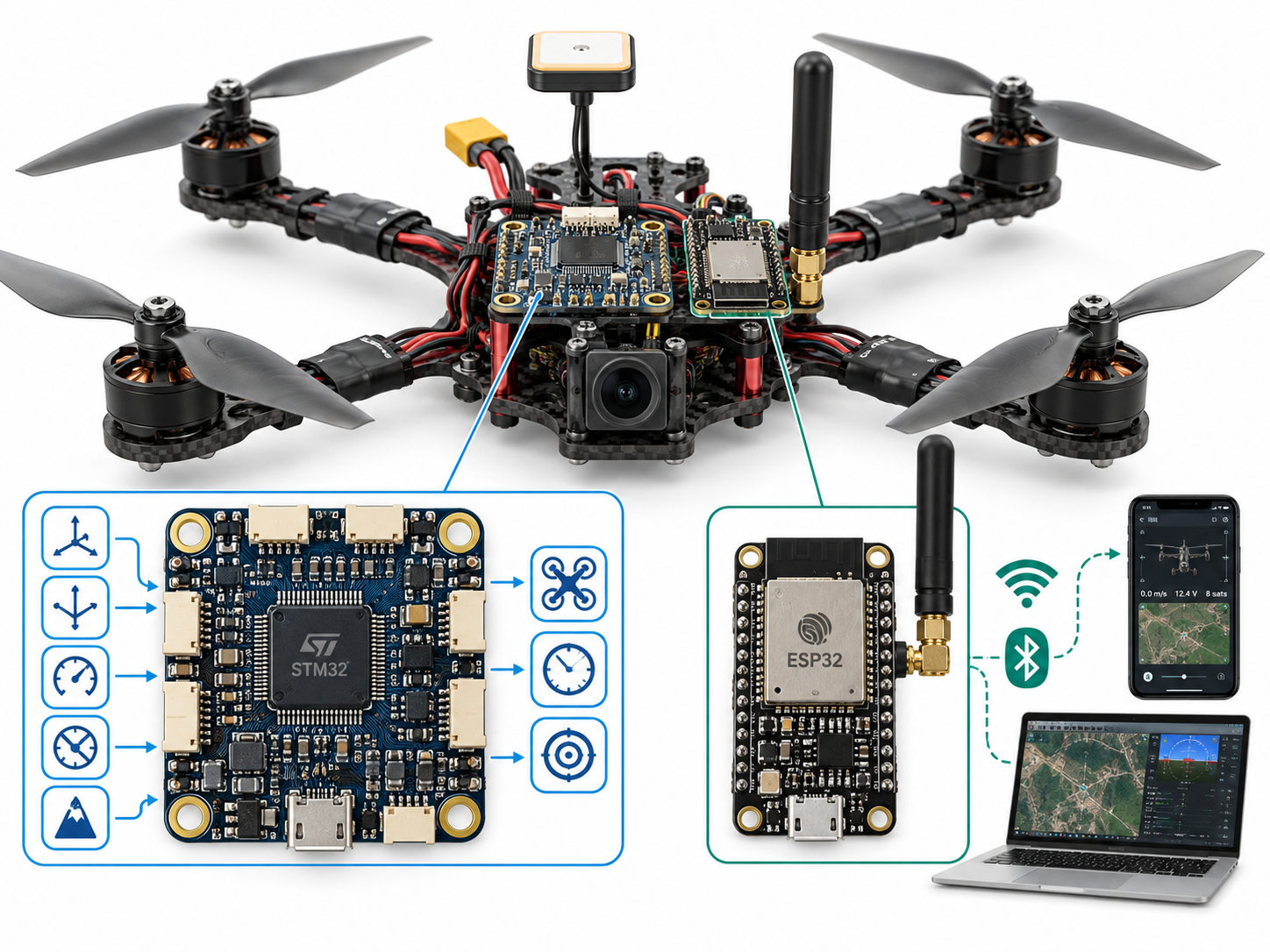
STM32 is commonly suited to the flight-control side of a drone, while ESP32 can be useful for wireless communication and secondary connected functions.
A flight controller needs predictable handling of:
- IMU sampling
- Sensor fusion
- PWM or DShot outputs
- Control loops
- DMA
- Interrupt timing
- Barometer and compass data
These requirements favor deterministic MCU behavior and strong timer/peripheral support.
ESP32 can fit other parts of the drone architecture, including Wi-Fi communication, Bluetooth setup, telemetry, configuration interfaces, and camera or peripheral control.
A simple experimental drone may run entirely on one MCU, but more advanced designs often divide time-critical control and communication functions.
STM32 vs ESP32 PCB Design: What Changes at Hardware Level?
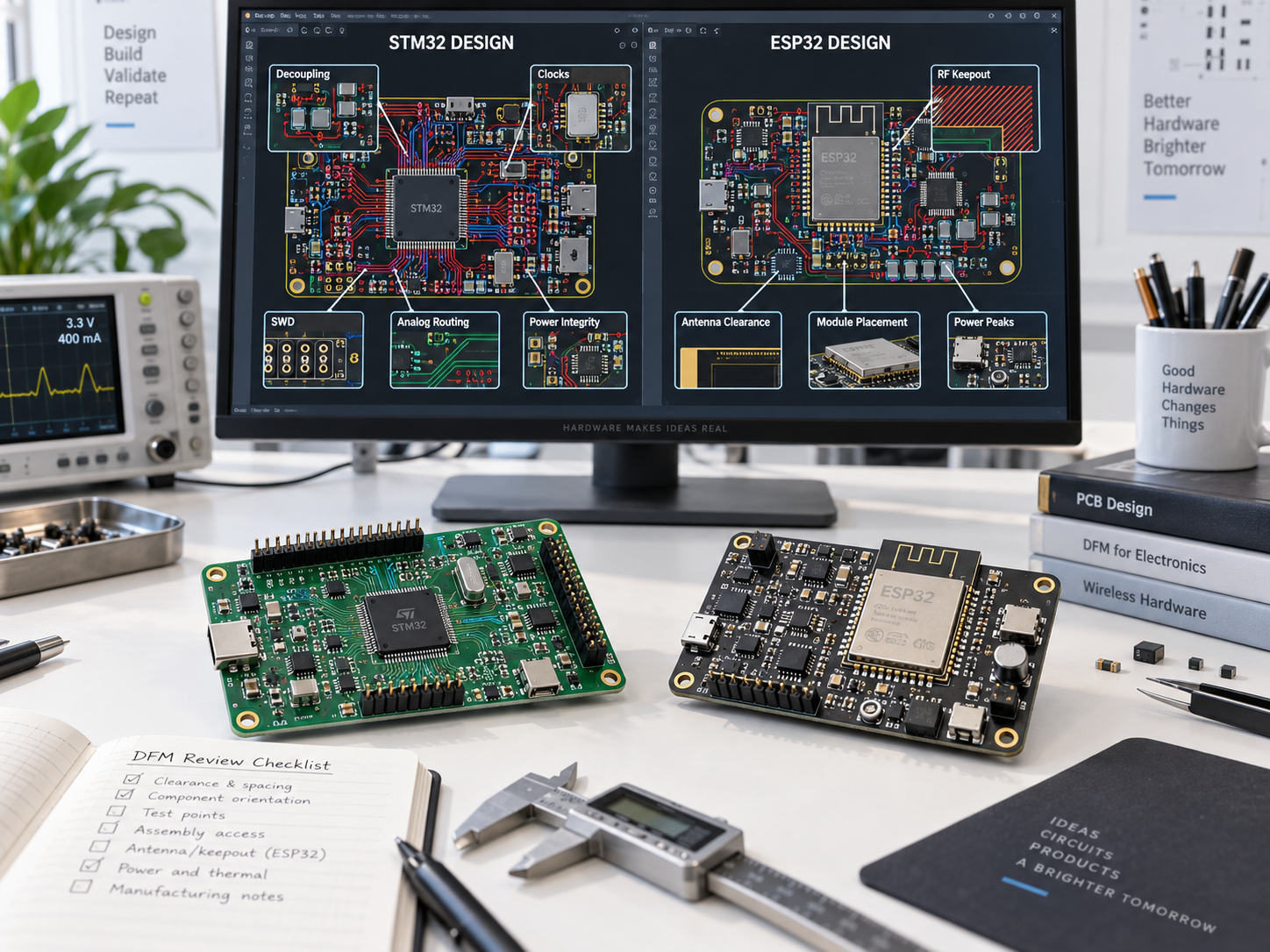
STM32 and ESP32 create different PCB design priorities. STM32 designs often focus on power integrity, clocks, analog performance, programming interfaces, and peripheral routing, while ESP32 designs also need careful RF and antenna planning.
For STM32 hardware, review:
- Decoupling capacitor placement
- VDDA and analog grounding
- Clock source and crystal layout
- BOOT configuration
- SWD programming interface
- USB or CAN transceivers
- External wireless modules where required
For ESP32 hardware, additional checks may include:
- Module versus bare SoC
- Antenna placement
- RF keepout
- Ground-plane geometry
- Flash and PSRAM configuration
- USB interface
- Power-supply peak-current capability
Using an ESP32 module can simplify RF design, but the antenna area still needs proper PCB clearance and enclosure consideration.
At EBest Circuit, MCU placement, power integrity, RF keepout, controlled-impedance interfaces, component footprints, and PCBA requirements can be reviewed during DFM before prototype fabrication.
Can STM32 and ESP32 Be Used Together?
Yes. STM32 and ESP32 are often complementary rather than direct competitors in systems that need both deterministic control and wireless connectivity.
A typical architecture might use:
STM32
- Motor control
- ADC sampling
- Real-time sensors
- Industrial communication
- Safety-related control
UART or SPI link
ESP32
- Wi-Fi
- Bluetooth
- Mobile-app communication
- MQTT or cloud connection
- Web configuration
This separation lets each controller handle the workload it is naturally suited to.
For example, an industrial robot may use STM32 for servo timing and encoder processing while ESP32 handles wireless diagnostics. A smart instrument can use STM32 for measurement accuracy and ESP32 for cloud connectivity.
The extra MCU adds BOM cost and firmware complexity, so this architecture is most useful when one device alone creates compromises in timing, connectivity, or certification.
STM32 vs ESP32: Which Should You Choose?
Choose according to the project requirement rather than the brand name. The most natural starting point changes with the workload.
| Requirement | More Natural Starting Point |
|---|---|
| Wi-Fi IoT device | ESP32 |
| Bluetooth-connected prototype | ESP32 |
| Motor control | STM32 |
| Industrial peripheral control | STM32 |
| Battery-powered control system | Selected STM32 series |
| Wireless sensor node | ESP32 or wireless STM32 |
| High-performance real-time processing | Higher-end STM32 |
| Low-cost connected product | ESP32 |
| Wireless + deterministic control | STM32 + ESP32 |
| General maker prototype | ESP32 |
| Industrial production platform | Compare exact STM32 and ESP32 variants |
The final decision should consider MCU availability, software maturity, peripheral requirements, power budget, wireless needs, PCB complexity, and long-term production requirements.
A project that needs integrated Wi-Fi and rapid development may favor ESP32, while precise motor control or demanding industrial interfaces may point toward STM32. For many commercial products, comparing exact part numbers is more useful than deciding between the two families in general.
FAQ About STM32 vs ESP32
1. Is STM32 more powerful than ESP32?
It depends on the exact variants. Entry-level STM32 devices can be less powerful than some ESP32 models, while STM32H7 devices occupy a much higher embedded-performance class.
2. Is ESP32 faster than STM32F103?
In raw CPU clock and many general processing workloads, ESP32 typically has more processing headroom than STM32F103. Real-time peripheral performance still depends on the application.
3. STM32F4 vs ESP32: which is better?
STM32F4 is often attractive for real-time control, DSP, timers, and industrial peripherals. ESP32 is usually more convenient when integrated Wi-Fi or Bluetooth is a major requirement.
4. STM32H7 vs ESP32-S3: what is the main difference?
STM32H7 focuses on high-performance embedded control and processing, while ESP32-S3 combines general-purpose processing with integrated Wi-Fi and Bluetooth connectivity.
5. STM32 Blue Pill or Black Pill vs ESP32: which should beginners use?
ESP32 is often easier for wireless and IoT projects. Blue Pill and Black Pill boards are useful for learning STM32 peripherals, embedded debugging, timers, and lower-level MCU development.
6. STM32 vs ESP32 vs Arduino vs RP2040 vs Raspberry Pi: are they direct alternatives?
Not exactly. STM32, ESP32, and RP2040 are MCU platforms, Arduino is primarily a development ecosystem and board family, while most Raspberry Pi products are Linux-capable single-board computers. Raspberry Pi Pico is an MCU board based on RP2040 or newer RP-series devices.
Planning an STM32 or ESP32 PCB?
MCU selection affects more than firmware. Power architecture, clocks, RF layout, antenna clearance, analog routing, programming interfaces, connectors, and assembly requirements can all change with the selected device.
EBest Circuit supports STM32 and ESP32 PCB fabrication, DFM review, fine-pitch SMT assembly, component sourcing, programming, and functional testing. For a new embedded project, send your Gerber files, BOM, schematic, and assembly requirements to sales@bestpcbs.com for engineering review.