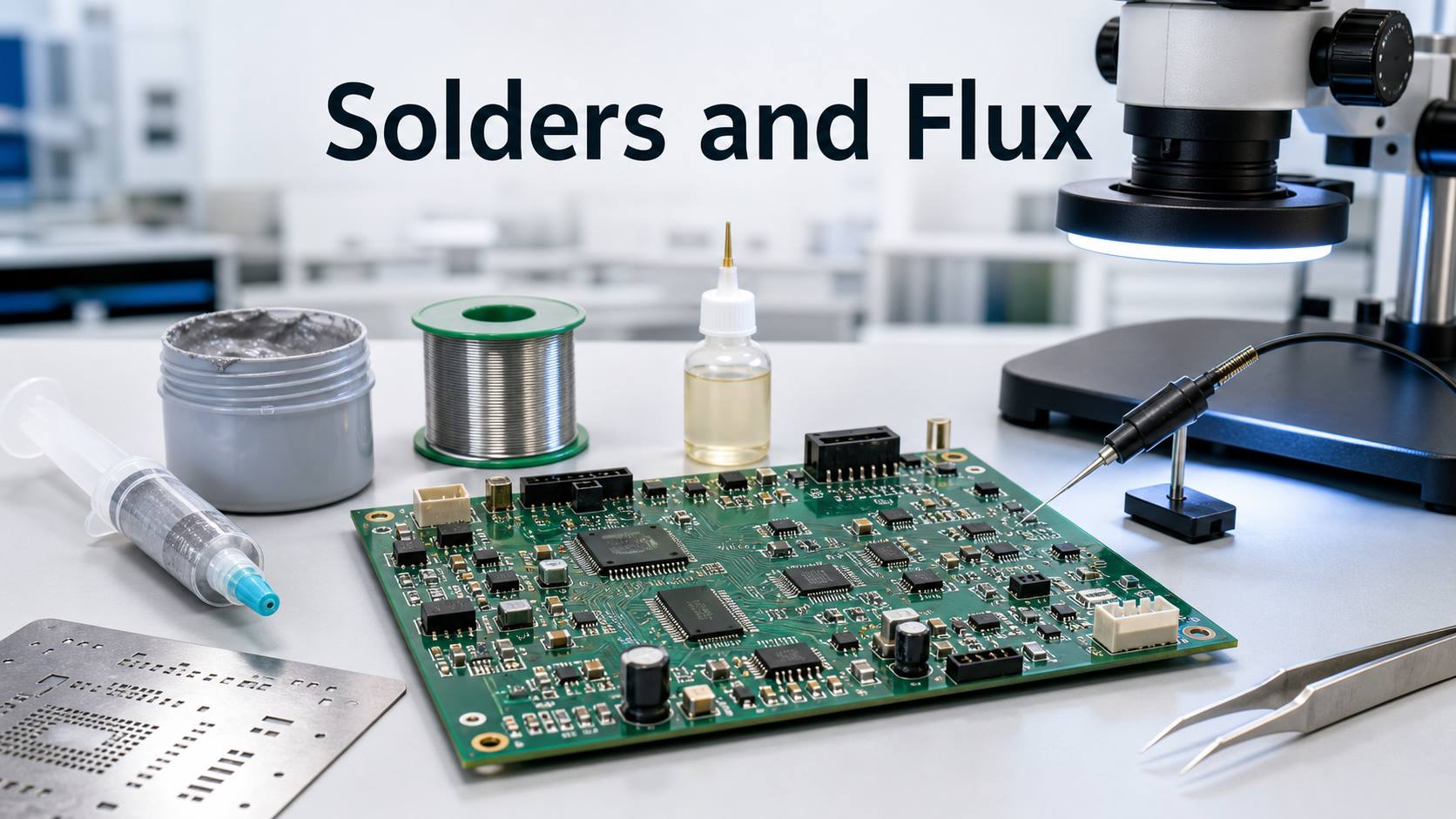
Solders and flux are basic materials in electronics soldering, but they directly affect PCB assembly quality, solder joint reliability, cleanliness, inspection results, and long-term product performance. Solder creates the metal connection. Flux prepares the metal surfaces so solder can wet the pads and component leads properly.
For PCB and PCBA projects, solders and flux are not just workshop supplies. They are part of the manufacturing process. The wrong solder alloy, flux type, solder paste condition, cleaning method, or residue control plan can lead to poor wetting, solder balls, bridges, corrosion risk, electrical leakage, weak joints, or failed inspection. EBest Circuit (Best Technology) supports PCB fabrication, component sourcing, SMT assembly, through-hole assembly, inspection, testing, cleaning, and packing for custom PCBA projects. If you are preparing a PCB assembly project, send your Gerber files, BOM, assembly drawing, soldering notes, or quality requirements to sales@bestpcbs.com for engineering review before production.
What Are Solders and Flux in PCB Assembly?
In PCB assembly, solder is the metal alloy used to join electronic components to PCB pads. Flux is the chemical material that removes surface oxides, improves wetting, and helps solder flow onto the metal surfaces.
They work together, but they are not the same.
| Material | Main Role |
|---|---|
| Solder | Forms the metal joint |
| Flux | Prepares surfaces for soldering |
| Solder paste | Solder powder mixed with flux |
| Flux residue | Material left after soldering |
In manual soldering, solder may come as solder wire, often with a flux core. In SMT assembly, solder is commonly applied as solder paste through a stencil. The paste already contains solder powder and flux, so storage, printing, reflow profile, and inspection all matter.
For PCB manufacturers and PCBA suppliers, the goal is not simply to “use solder and flux.” The goal is to choose and control them correctly for the board, components, assembly process, cleanliness requirement, and reliability target.
How Solders and Flux Work Together in Soldering
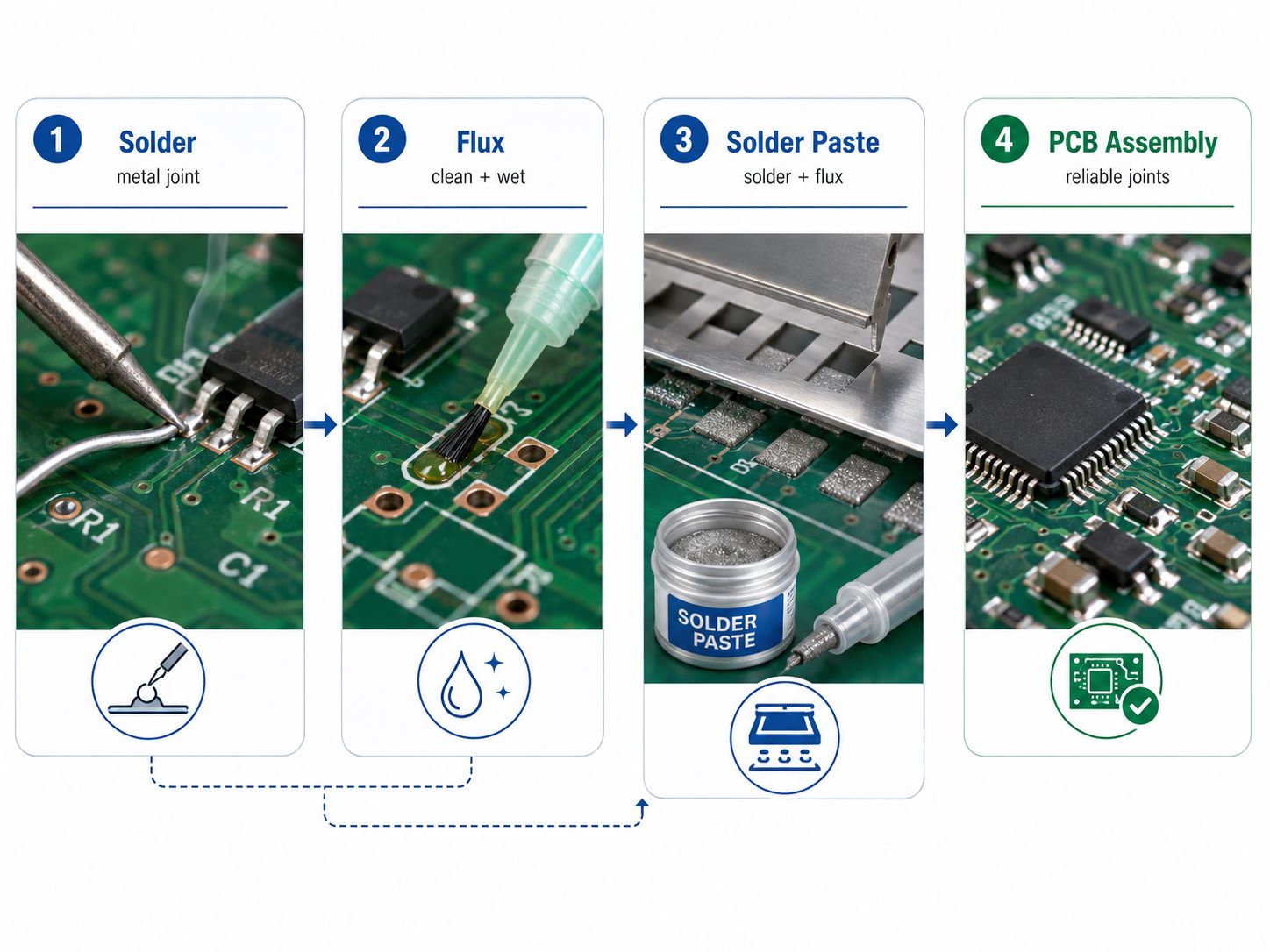
Solder does not bond well to oxidized metal. PCB pads, component leads, copper, tin, nickel, and other solderable surfaces can develop oxide layers before or during heating. Flux helps remove or reduce these oxides so molten solder can spread and form a stronger joint.
A good soldering result depends on three things working together:
- Clean solderable surfaces
- Correct heat transfer
- Suitable solder and flux chemistry
When flux activates under heat, it helps solder wet the pad and component termination. Good wetting usually creates a smooth, shiny, well-formed joint, depending on the solder alloy and process. Poor wetting may create dull, rough, incomplete, or weak solder joints.
In PCBA production, this is why soldering is controlled as a process, not treated as a manual habit. Solder paste condition, stencil printing, reflow curve, component finish, pad finish, flux activity, and cleaning requirements all affect final quality.
Soldering Wire and Flux for PCB Hand Soldering
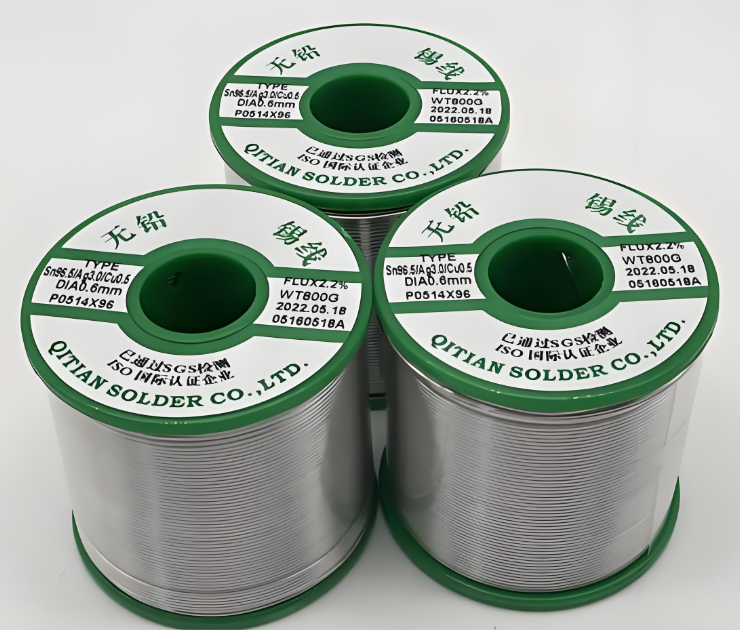
Soldering wire and flux are commonly used for hand soldering, repair, connector assembly, through-hole components, rework, and small production steps that cannot be completed only by SMT.
Solder wire may be:
- Lead-free solder wire
- Tin-lead solder wire where allowed
- Flux-core solder wire
- No-clean solder wire
- Rosin-core solder wire
For PCB assembly, hand soldering is often used for:
- Connectors
- Wires and cables
- Switches
- Large through-hole components
- Post-SMT repair
- Prototype modification
The key is process control. Too little flux can cause poor wetting. Too much flux can leave excessive residue. Too much heat can damage pads, components, or laminate. Too little heat can create cold solder joints.
At EBest Circuit, hand soldering is treated as part of the SMT PCB assembly process. It should follow assembly notes, component sensitivity, soldering temperature requirements, cleanliness requirements, and inspection standards.
Soldering Paste vs Flux in SMT Assembly
Soldering paste vs flux is a common question because both are used in electronics soldering, but they have different roles.
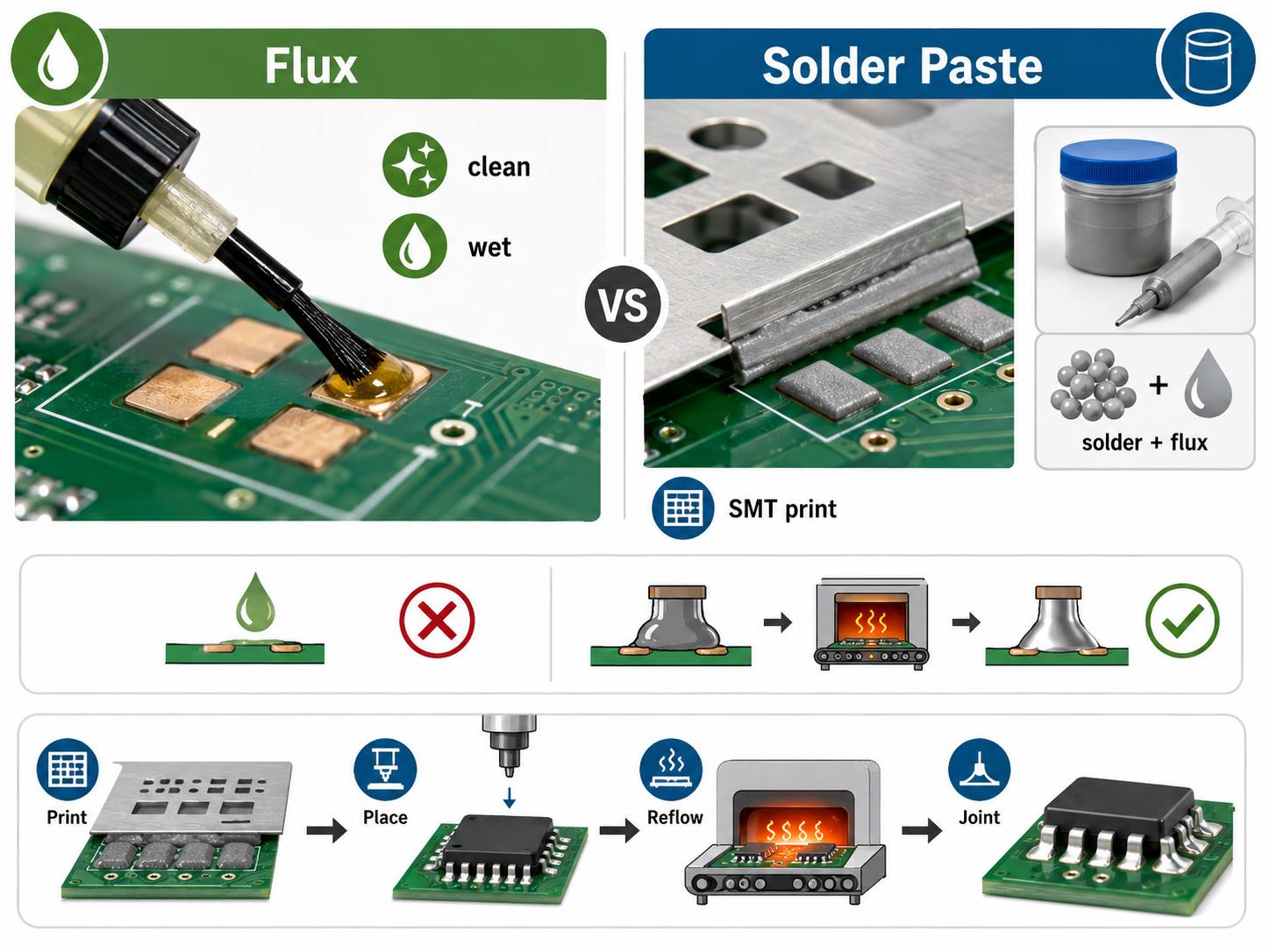
Solder paste is a mixture of solder powder and flux. Flux alone does not create a metal joint. It only supports the soldering process.
| Item | What It Contains | Main Use |
| Flux | Chemical activators | Helps solder wet surfaces |
| Solder wire | Solder alloy, often flux core | Hand soldering |
| Solder paste | Solder powder + flux | SMT reflow assembly |
In SMT assembly, solder paste is printed onto PCB pads through a stencil. Components are placed onto the paste, then the board passes through reflow soldering. During reflow, the flux activates, the solder powder melts, and solder joints form.
This is why solder paste handling is important. Paste storage, thawing time, stencil thickness, printing pressure, SPI inspection, placement accuracy, and reflow profile all affect PCBA quality.
So, is soldering paste and flux the same? No. Solder paste contains flux, but flux is only one part of solder paste.
Types of Soldering Flux for Electronics Manufacturing
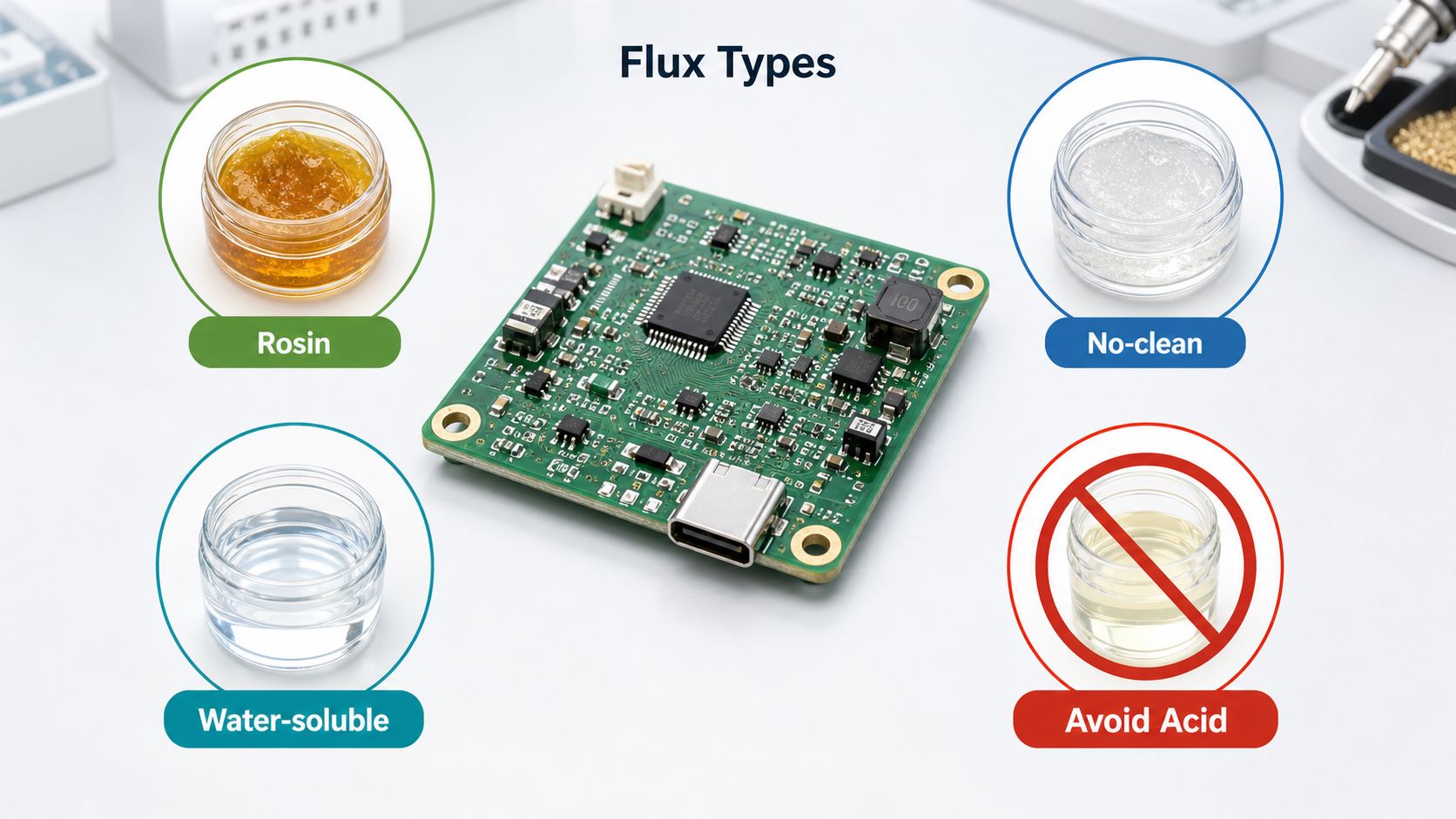
There are several types of soldering flux used in electronics. The right choice depends on the assembly process, components, board finish, cleaning requirement, and reliability level.
| Flux Type | Typical Use |
| Rosin flux | General electronics soldering |
| No-clean flux | Low-residue PCBA processes |
| Water-soluble flux | Stronger activity, requires cleaning |
| Organic acid flux | Selected electronics applications |
| Inorganic acid flux | Not suitable for normal PCB assembly |
For PCB assembly, aggressive acid fluxes used for plumbing or metalwork should not be used on electronic circuit boards. They may cause corrosion or reliability problems.
No-clean flux is common in electronics manufacturing, but “no-clean” does not always mean residue can be ignored. If the board has fine-pitch ICs, high impedance circuits, RF areas, conformal coating, connector areas, or customer cleanliness requirements, residue should still be reviewed.
For reliable PCBA, flux selection should match the product’s use environment and inspection requirements, not only the soldering convenience.
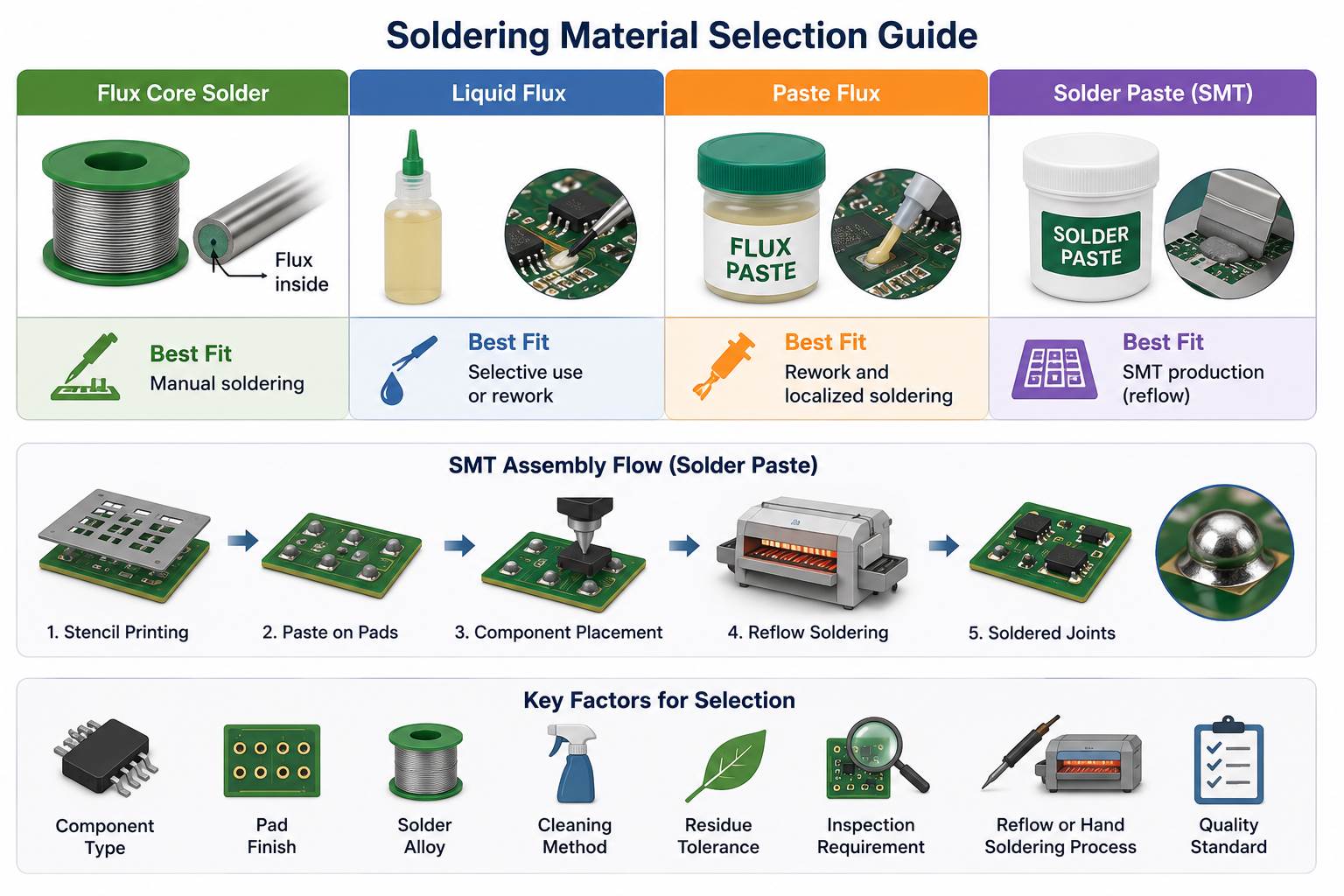
Flux Core Solder, Liquid Flux, and Paste Flux Selection
Flux core solder, liquid flux, and paste flux are different delivery forms. They are chosen based on how the soldering process is performed.
| Form | Best Fit |
| Flux core solder | Manual soldering |
| Liquid flux | Selective use or rework |
| Paste flux | Rework and localized soldering |
| Solder paste | SMT production |
Flux core solder is convenient for hand soldering because the flux is inside the wire. Liquid flux can be applied to improve solderability in specific areas. Paste flux is often used in rework or localized repair. SMT solder paste is used for stencil printing and reflow assembly.
For production, selection should consider:
- Component type
- Pad finish
- Solder alloy
- Cleaning method
- Residue tolerance
- Inspection requirement
- Reflow or hand soldering process
- Customer quality standard
In a PCBA factory, these materials should be controlled by process notes, not selected casually by operator preference.
PCB Flux and Circuit Board Flux Residue Risks
PCB flux and circuit board flux are useful during soldering, but flux residue can become a quality risk if it is not controlled.
Possible residue-related issues include:
- Sticky or visible contamination
- Poor appearance after assembly
- Connector contact concerns
- Difficulty with conformal coating
- Ionic contamination risk
- Electrical leakage in sensitive circuits
- Corrosion under certain conditions
- Customer inspection rejection
Not every residue causes failure, and many no-clean residues are acceptable under the right process. However, the decision depends on board application, cleanliness requirement, circuit sensitivity, and operating environment.
For example, a simple consumer board may tolerate more residue than a medical device, automotive module, sensor board, RF module, high-impedance circuit, or product used in humid environments.
This is where manufacturing review matters. The supplier should understand whether the board requires visual cleanliness, ionic cleanliness, conformal coating compatibility, or special post-assembly cleaning.
How to Clean Flux from PCB After Assembly
How to clean flux from PCB depends on the flux type, board design, components, and customer requirement. Some boards are cleaned after soldering, while some no-clean assemblies may not require full washing.
Common cleaning considerations include:
| Checkpoint | Why It Matters |
| Flux type | Determines cleaning method |
| Component sensitivity | Some parts cannot be washed |
| Connector areas | Residue can affect contact |
| Dense SMT zones | Residue can hide under parts |
| Coating requirement | Surface must be compatible |
| Customer standard | Defines acceptance level |
Cleaning may involve approved solvents, aqueous cleaning, manual cleaning, or controlled process cleaning. The cleaning method should not damage labels, components, connectors, switches, displays, sensors, or unsealed parts.
For PCBA projects, cleaning should be confirmed before production, especially when the customer says the board must have no solder balls, no residue, no visible contamination, or needs conformal coating after SMT.
A clean board is not only about appearance. It can affect inspection, reliability, packing, and customer confidence in the finished assembly.
How EBest Circuit Controls Solders and Flux in PCBA Quality
At EBest Circuit, solders and flux are controlled as part of the full PCB assembly process. The goal is to make the board manufacturable, solderable, inspectable, and reliable for the customer’s real application.
Our PCBA support may include:
- PCB fabrication and surface finish review
- BOM and component package review
- SMT assembly process planning
- Solder paste printing and SPI
- Reflow soldering control
- AOI inspection
- X-Ray inspection for BGA when required
- Through-hole and connector soldering
- Cleaning and visual inspection
- Functional testing coordination
- Packing based on customer requirements
For prototype and small-batch projects, EBest Circuit can also help engineers review assembly risks before production. This is especially useful when the board includes fine-pitch components, connectors, BGA, impedance-controlled circuits, high-power areas, or cleanliness requirements.
Solders and flux may look like small production materials, but in PCBA manufacturing they affect the final result. A good supplier should understand how material choice, soldering process, inspection, cleaning, and documentation work together.
FAQs about Solders and Flux in PCB Assembly
1. Are solders and flux the same?
No. Solder is the metal alloy that forms the joint. Flux is the chemical material that helps remove oxides and improve solder wetting.
2. Is soldering paste and flux the same thing?
No. Soldering paste contains solder powder and flux. Flux is one part of solder paste, but flux alone cannot create a solder joint.
3. What types of soldering flux are used in electronics?
Common electronics flux types include rosin flux, no-clean flux, water-soluble flux, and selected organic acid fluxes. Aggressive acid flux for plumbing is not suitable for normal PCB assembly.
4. Does no-clean flux need to be cleaned from PCB assemblies?
Not always. No-clean flux is designed to leave acceptable residue under the right process. However, cleaning may still be needed for fine-pitch boards, coating, high-reliability products, or customer cleanliness requirements.
5. How does flux residue affect PCB assembly quality?
Flux residue may affect appearance, connector contact, coating adhesion, electrical leakage, corrosion risk, or customer inspection. The real risk depends on flux type, residue amount, circuit sensitivity, and operating environment.
6. Can EBest Circuit help review solders and flux requirements for PCBA projects?
Yes. EBest Circuit can review PCB files, BOM, assembly notes, soldering requirements, cleaning requirements, and testing needs before production. For custom PCB and PCBA projects, you can send your files or questions to sales@bestpcbs.com.
If your PCB assembly project involves soldering, flux residue, PCB cleaning, SMT, through-hole assembly, BGA, connectors, or quality inspection requirements, please feel free to contact us at sales@bestpcbs.com. If you are still comparing soldering flux vs soldering paste for your assembly process, EBest Circuit’s engineering team can help review your manufacturing files and process notes before production, so your PCBA project can move from files to finished boards with fewer avoidable risks.