Serial number and part number identify different things on a PCB or PCBA. A part number identifies a board design, configuration, or purchasable item shared by equivalent units. A serial number identifies one physical board and connects it to its individual manufacturing, inspection, test, repair, or shipment history.
The practical serial number and part number difference is simple: use the part number to answer “what board is this?” and the serial number to answer “which exact board is this?” Reliable traceability usually needs both, plus controlled revision, lot, and date-code data.
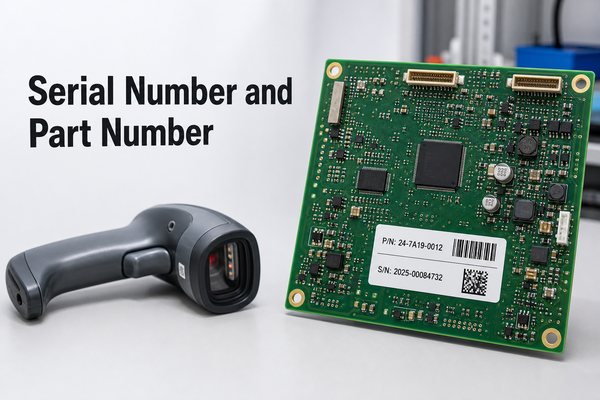
Difference Between Serial Number and Part Number
The difference between serial number and part number is the identification level. A part number applies to a defined design or item class, while a serial number applies to one manufactured instance of that design.
| Identifier | What It Identifies | Primary PCB Use |
| Part number | A defined PCB, PCBA, component, or configuration | BOM, purchasing, build selection, and replacement |
| Serial number | One physical PCB or PCBA | Unit history, testing, repair, warranty, and RMA |
| Revision | A controlled design change | Document and configuration control |
| Lot or batch number | A group made under common production conditions | Material and process containment |
| Model number | A product family or commercial model | Product identification above the board level |
A code becomes useful only when its meaning is controlled. Printing different values on boards does not create traceability unless the values link to accurate records and remain readable throughout assembly and service.
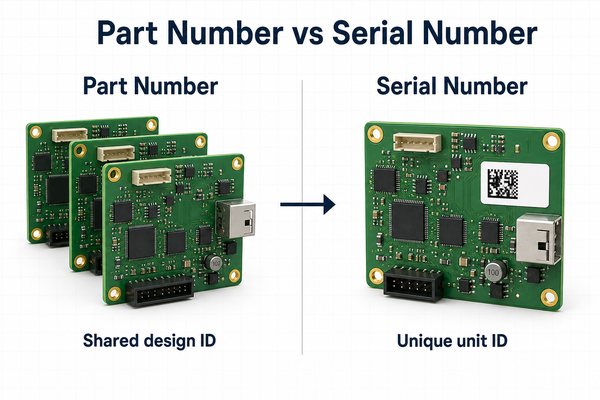
What Does a PCB Part Number Identify?
A PCB part number identifies the controlled item that engineering and purchasing expect to receive. Depending on the company’s system, it may represent a bare board, an assembled board, a programmed assembly, or a sellable product configuration.
The part-number record should point to the documents required to reproduce that item, such as:
- Approved Gerber or ODB++ data and drill files for the bare PCB.
- The fabrication drawing, stackup, material, finish, thickness, and controlled notes.
- The assembly drawing and the approved bill of materials.
- Pick-and-place data, polarity information, and special assembly instructions.
- Firmware, programming, calibration, and test requirements when they define the delivered PCBA.
Organizations often maintain customer part numbers, internal part numbers, and manufacturer part numbers at the same time. These fields should remain separate. One code should not be reused as if it had several meanings.
What Does a PCB Serial Number Identify?
A PCB serial number identifies one physical board and provides the key for retrieving its unit-level history. Two boards may share the same part number and revision but must have different serial numbers when individual traceability is required.
A useful serial-number record can connect the board to:
- Work order, panel, production date, and assembly line.
- Material or component lots required by the traceability plan.
- AOI, X-ray, ICT, flying-probe, or functional-test results.
- Programming and calibration records.
- Repair, rework, deviation, concession, and final-inspection status.
- Shipment, field return, warranty, or RMA history.
Not every project needs the same level of detail. IPC-1782 uses a risk-based approach in which the user and supplier agree on the required manufacturing and supply-chain traceability. A low-risk prototype and a safety-critical production assembly should not automatically use the same data plan.
How to Find Serial Number and Part Number on a PCB?
How to find serial number and part number depends on the marking method, but the first places to check are the PCB silkscreen, a permanent label, a laser mark, a barcode or Data Matrix, and the product enclosure label.
Use the following checks before accepting a value:
- Look for prefixes such as P/N, PN, Part No., S/N, or SN.
- Compare the value with the assembly drawing, BOM, purchase order, traveler, or product record.
- Check the revision separately; it may appear beside the part number but is not automatically part of it.
- Scan machine-readable codes only with the approved application, because a code may hold an internal record key rather than visible plain text.
- If several labels disagree, stop and resolve the configuration before assembly, shipment, or replacement.
For an unpopulated board, the silkscreen often carries the fixed board identifier and revision. For a PCBA, a variable-data label or laser mark is more suitable for the unique serial number. The detailed guide to printed circuit board labels explains common label content and placement considerations.
Serial Number and Model Number
Serial number and model number also identify different levels. A model number usually names a commercial product family or configuration, while a serial number separates one unit from every other unit of that model.
In electronics, the hierarchy may look like this:
- Model number: the finished product family sold or supported as one model.
- PCBA part number: the controlled assembly installed inside that product.
- Revision: the engineering version of that assembly.
- Serial number: the identity of one physical assembly or finished product.
A single product model can contain several PCB part numbers. It can also move to a newer PCBA revision without changing the public model number. Service teams therefore need an approved cross-reference rather than assuming these identifiers are interchangeable.
When Should a New PCB Part Number Be Assigned?
A new PCB part number should be assigned when a change creates a different item for ordering, manufacturing, fit, function, compliance, programming, or service. A revision update may be enough for a controlled change that remains interchangeable, but the decision must follow the organization’s configuration-control rules.
Changes that often justify a new part-number review include:
- Different board outline, connector location, mounting pattern, or mechanical interface.
- Different circuit function, component population, voltage rating, or approved application.
- Non-interchangeable stackup, material, thickness, copper weight, or surface finish.
- Firmware or programming that creates a distinct purchasable assembly.
- A BOM change that affects fit, form, function, qualification, or service replacement.
A typo correction or drawing clarification does not always require a new part number. The essential question is whether the change affects what must be built, bought, inspected, qualified, or serviced.
How Should PCB Serial Numbers Be Created?
PCB serial numbers should be unique within a defined system, stable for the life of the unit, and generated from a controlled source. The number may be sequential or non-sequential, numeric or alphanumeric, as long as the format prevents duplicates and supports reliable lookup.
A sound serial-number plan defines:
- The system that generates and reserves each serial number.
- The point in production when the number becomes attached to a physical board.
- Rules for scrapped boards, reworked boards, replacement boards, and duplicate labels.
- Whether a human-readable value must appear beside the machine-readable code.
- How long manufacturing and test records must remain accessible.
A serial number should not silently encode too much business logic. Date, site, line, or product information may change over time and can make formats brittle. A stable unique key linked to controlled records is often easier to maintain.
Which PCB Marking Method Fits Fixed and Variable Data?
Fixed data such as a board part number or reference designator often suits silkscreen, while variable data such as a unique serial number usually needs a printed label, laser mark, barcode, or Data Matrix. The method must survive the relevant process and remain readable in the finished assembly.
| Marking Method | Best Use | Main Limitation |
| Silkscreen | Fixed part number, revision, polarity, and assembly references | Not practical for unit-by-unit variable data |
| High-temperature label | Variable serial number, barcode, or Data Matrix | Material and adhesive must suit heat, cleaning, and service conditions |
| Laser marking | Permanent variable or fixed marking on a suitable surface | Contrast, substrate response, and scan quality require validation |
| Inkjet or direct print | Variable production data where the process is qualified | Durability and contrast depend on ink, surface, and downstream processes |
Placement matters as much as the code format. Keep the mark away from pads, test points, mounting holes, exposed conductors, high-heat areas, and locations covered by components or the enclosure. If scanning is required, validate the code after soldering, cleaning, coating, and final assembly—not only when the label is first printed.
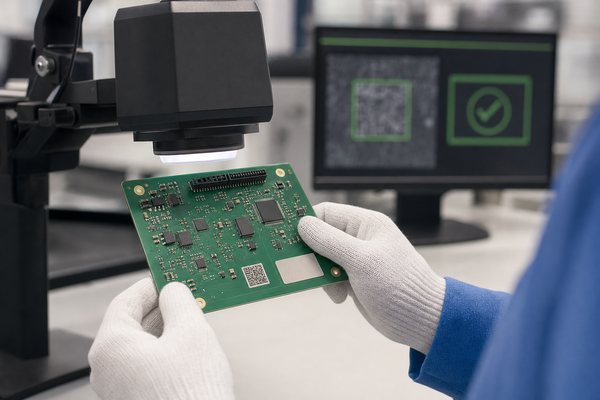
How Do Part and Serial Numbers Support PCB Traceability?
Part and serial numbers support PCB traceability by linking design identity to production identity. The part number selects the correct specification; the serial number records what happened to one actual unit built to that specification.
This connection supports several practical controls:
- Build verification: confirm that the traveler, BOM, program, and test plan match the intended board.
- Containment: identify affected units when a material, process, or test issue is discovered.
- Configuration history: determine which revision and approved substitutions were used.
- Failure analysis: compare one returned unit with its manufacturing and PCB testing records.
- Service control: select the correct replacement board, firmware, or repair instruction.
A PCB barcode or Data Matrix can speed up this linkage, but the symbol itself is only a carrier. The database structure, scan checkpoints, access control, backup, and record quality determine whether the traceability system works.
What Records Should Link to a PCB Serial Number?
A PCB serial number should link only to records needed by the project’s risk, quality, service, and customer requirements. More data is not automatically better; the goal is a reliable chain of evidence that can answer a real production or field question.
A practical record set may include:
- Customer order, internal work order, PCB part number, and revision.
- Panel or batch identifier and relevant material or component lot data.
- Assembly route, machine program version, and approved process status.
- Inspection and test result, including pass/fail status and re-test history.
- Nonconformance, repair, rework, or deviation record when applicable.
- Final release, packing, and shipment association.
Component records must keep the manufacturer part number, supplier or distributor number, and customer reference in separate fields. The component sourcing FAQ provides additional context for approved parts, substitutions, and sourcing documentation.
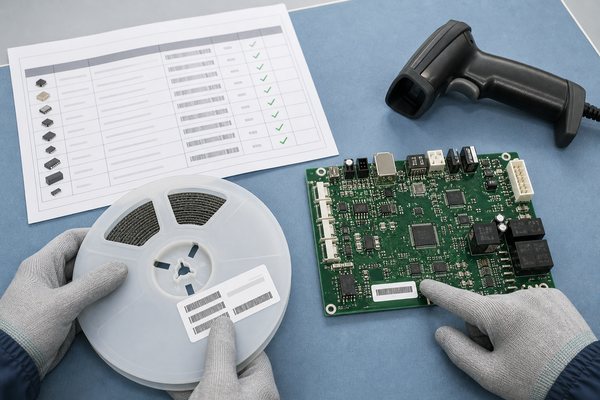
What Mistakes Break PCB Identification?
PCB identification fails when codes are ambiguous, duplicated, unreadable, or disconnected from controlled records. Most failures come from process gaps rather than from the barcode or label technology itself.
- Using the same field for part number, serial number, lot number, and revision.
- Changing a PCB design without updating its controlled revision or part-number decision.
- Generating serial numbers in several systems without duplicate prevention.
- Applying a label before the number is securely associated with the correct board.
- Placing a mark where soldering, cleaning, coating, components, or an enclosure will damage or hide it.
- Scanning a code but failing to verify the part number, revision, or expected production step.
- Keeping records that cannot be retrieved during an audit, failure analysis, or RMA.
Prevent these problems with one identifier owner, documented formats, controlled label templates, scan validation, duplicate checks, and a clear rule for handling scrap and rework.
FAQs About Serial Number and Part Number
Is a part number the same as a serial number?
No. A part number identifies a design, configuration, or purchasable item shared by equivalent units. A serial number identifies one physical unit. A production run can therefore contain many boards with the same part number but a different serial number on every board.
Can two PCBs have the same part number?
Yes. PCBs built to the same controlled design and configuration normally share a part number. Their serial numbers, when individual traceability is required, remain different.
Can two PCBs have the same serial number?
They should not share a serial number within the agreed identification scope. Duplicate serial numbers can merge test, repair, and shipment histories and make unit-level traceability unreliable.
Is a PCB revision part of the part number?
It depends on the organization’s configuration-control system. Some companies keep revision as a separate controlled field; others encode it in a broader item identifier. The format matters less than consistent control and unambiguous records.
Is a lot number the same as a serial number?
No. A lot number identifies a group of items made or handled under common conditions. A serial number identifies one item within or outside that lot. Lot-level tracking supports batch containment, while serial-level tracking supports individual-unit history.
Should a bare PCB and an assembled PCBA use the same part number?
Usually they should be treated as different controlled items because the bare board and assembled board have different specifications, purchasing states, and acceptance requirements. The exact numbering policy should follow the company’s configuration system.
Can a QR code contain both a part number and a serial number?
Yes, if the data structure, code size, readability, and system rules are validated. Another common method is to encode one unique record key and retrieve the part number, revision, and unit history from the database.
Where should a serial-number label be placed on a PCB?
Place it on a flat, accessible area that remains visible and scannable after assembly. Avoid pads, test points, mounting holes, exposed conductors, high-heat zones, and areas covered by components, shields, cables, or the enclosure.
Does every PCB need a unique serial number?
No. The required traceability level depends on product risk, customer requirements, service needs, and manufacturing controls. Some projects need only part, revision, and lot identification; others require a unique serial number and detailed unit history.
What should be provided to a PCB manufacturer for marking?
Provide the approved fixed text, variable-data format, label or marking method, code type, data source, location drawing, size and contrast requirements, scan checkpoints, record-retention needs, and acceptance criteria. Identify which information is customer-controlled and which the manufacturer may generate.
How Can EBest Circuit Support PCB Marking and Traceability?
Serial number and part number control works best when identification requirements are defined before fabrication and assembly. EBest Circuit can review PCB/PCBA marking content, label placement, variable-data needs, and traceability checkpoints against the supplied manufacturing package.
For a project review or quotation, send the Gerber files, BOM, quantities, marking drawing, required identifier format, and test or record requirements to sales@bestpcbs.com.