The PCB raw material price increase in 2026 is real, but it is not one continuous rise across every board type. Resonac and Panasonic announced large CCL and prepreg revisions during the year, while an August PCB-pricing update showed that temporary surcharges for some standard FR4 volume orders could also be removed when conditions eased.
For PCB buyers, the useful question is not “How much did all boards rise?” It is “Which material, supplier notice, effective date, stackup, copper weight, and order size apply to this quotation?” This timeline separates those factors and explains why raw-material percentages cannot be copied directly into a finished-board price.
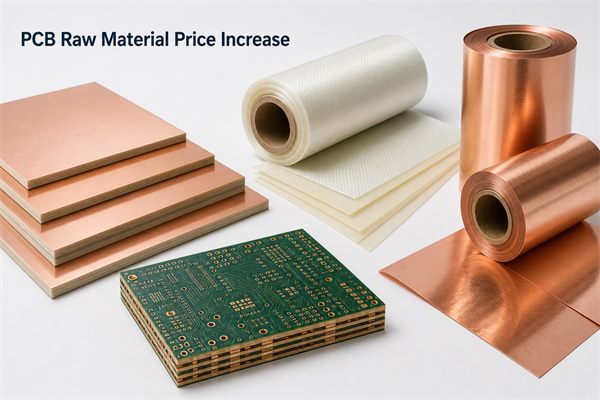
What Changed in the PCB Materials Market in 2026?
PCB material suppliers responded to higher copper foil, glass cloth, resin, solvent, energy, labor, and logistics costs with multiple product-specific price notices. The timing and scope differed by supplier: one notice covered all CCL and prepreg products, while others separated general glass-epoxy, low-loss, substrate, CEM-3, and flexible materials.
That distinction matters because a PCB quotation does not buy “raw material” as one commodity. It buys a defined construction using selected laminate and prepreg systems, copper weights, finished thickness, layer count, panel area, and process controls.
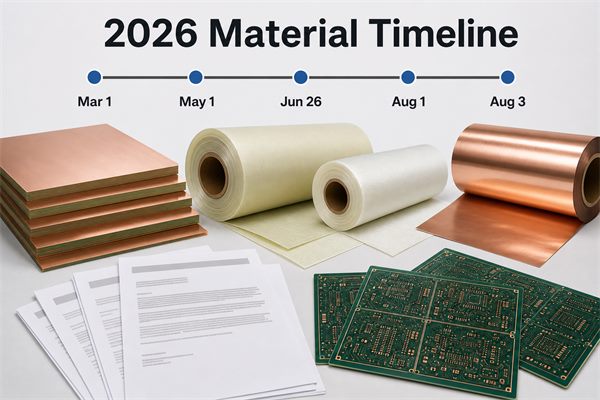
2026 Copper Clad Laminate Price Trend and Notice Timeline
The 2026 copper clad laminate price trend is best understood as a sequence of supplier notices followed by a partial easing signal in one standard-FR4 market segment. The percentages below are separate adjustments to different suppliers’ own products and base prices; they must not be added together.
| Notice / Effective Date | Product Scope | Reported Change |
| Resonac: Jan 16 / Mar 1 | All CCL and prepreg products | 30% or more |
| Panasonic: Apr 9 / May 1 | General CCL / prepreg | +30% / +20% |
| Panasonic: Apr 9 / May 1 | Low-loss CCL / prepreg | +20% / +15% |
| Panasonic: Apr 9 / May 1 | CEM-3 / FCCL | +30% / +15% |
| JLCPCB: Jun 13 / Jun 26 | FR4, FPC, aluminum, copper, Rogers and Teflon substrates | Dynamic pricing; no single percentage stated |
| Panasonic: Jun 26 / Aug 1 | General CCL / prepreg | +20% / +25% |
| Panasonic: Jun 26 / Aug 1 | Low-loss CCL / prepreg | +10% / +15% |
| Panasonic: Jun 26 / Aug 1 | LEXCM GX CCL / prepreg | +5% / +5% |
| Panasonic: Jun 26 / Aug 1 | CEM-3 / FCCL | +20% / +15% |
| JLCPCB: Aug 3 | Standard 1-, 2-, and 4-layer FR4 volume orders | Temporary tiered surcharges removed |
The earlier copper clad laminate price guide explains the material and board-cost relationship in general. This article focuses on the dated 2026 market events.
Why Are CCL and Prepreg Prices Rising?
CCL and prepreg prices are rising because several input costs increased at the same time and supply tightened for key materials. Resonac specifically cited copper foil and glass-cloth constraints plus higher labor and transportation costs. Panasonic’s April notice cited raw materials, energy, and logistics, while its June notice added pressure from petroleum-derived resins, solvents, related materials, and international logistics.
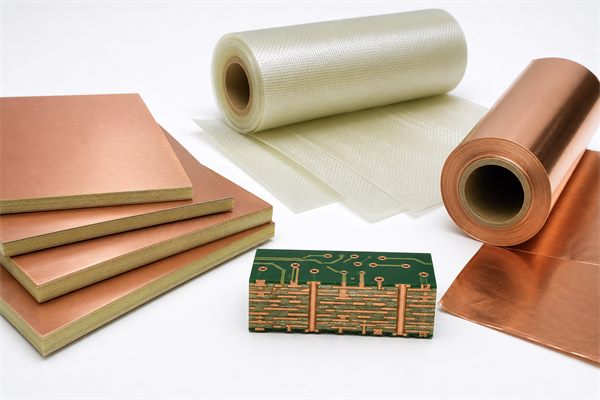
- Copper foil: affects every copper-clad sheet and becomes more important with heavier copper.
- Glass cloth: provides reinforcement and influences thickness, dimensional stability, and electrical performance.
- Resin and solvents: affect laminate and prepreg production, especially controlled resin-content systems.
- Energy and labor: influence material production, lamination, treatment, and handling.
- Logistics: affects both raw inputs and finished laminate movement across regions.
What Did Panasonic’s Two 2026 Price Revisions Show?
Panasonic’s April and June notices show that the cost pressure persisted but did not affect every material family equally. The May-effective notice applied a larger increase to general CCL than to general prepreg, while the August-effective notice reversed that relationship: general prepreg received the larger percentage adjustment.
Low-loss materials, substrate materials, CEM-3, and FCCL also had separate rates. This is why a buyer should provide the exact laminate system or electrical requirement instead of asking for a generic “FR4 price.” Our PCB material guide outlines the performance differences that drive material selection.
How Does a Copper Clad Laminate Price Increase Affect PCB Cost?
A copper clad laminate price increase affects the material portion of a PCB quotation, but the finished-board impact depends on how much laminate the design consumes and how efficiently it panels. Layer count, board area, core thickness, laminate grade, copper weight, stackup yield, and order quantity all change the result.
| Design Factor | Why Exposure Changes |
| Board area and panel utilization | More laminate area or poorer nesting increases material consumed per board |
| Layer count | More cores and prepreg interfaces increase laminate-system usage |
| Copper weight | Heavier copper raises copper content and may change process requirements |
| Material grade | Low-loss, high-Tg, halogen-free and high-frequency systems have different price bases |
| Finished thickness and stackup | Changes core/prepreg selection and the amount of resin and glass used |
| Inventory and quotation date | Existing stock may temporarily buffer a notice; replacement stock may use a new base price |
How Does a Prepreg Price Increase Affect PCB Stackups?
A prepreg price increase affects multilayer boards through bonding-layer count, glass style, resin content, pressed thickness, flow behavior, and the selected material family. For a prepreg price increase PCB cost review, the stackup and number of bonding interfaces matter more than the finished board outline alone.
Prepreg cannot be replaced solely on price. The change can affect dielectric thickness, impedance, resin fill around copper, lamination flow, thermal performance, and qualification status. See our guide to prepreg and core in PCB stackups for the structural difference.
What Does Copper Foil Price Pressure Mean for PCBs?
Copper foil price pressure matters because foil is both a CCL input and a direct cost driver for copper-intensive constructions. The verified Resonac notice identified tight copper-foil supply and higher prices as part of its CCL/prepreg revision background. It did not state one universal copper-foil percentage that could be applied to all boards.
A copper foil price increase usually matters more to heavy-copper boards, large panels, high-layer-count designs, and constructions with high copper utilization. Surface treatment, etching difficulty, plating requirements, and yield still affect the final quotation independently of commodity or foil input prices.
Why Did Standard FR4 Pricing Ease While Special Materials Stayed Exposed?
Standard FR4 pricing eased in one large-order channel because material and component conditions improved enough for temporary volume surcharges to be removed. JLCPCB’s August 3 notice applied specifically to standard 1-, 2-, and 4-layer FR4 volume orders; it did not state that all laminate suppliers reversed their notices or that every special material became cheaper.
Standard FR4 has a broader supplier base and more substitution flexibility than many controlled low-loss, high-frequency, FPC, metal-core, or customer-approved systems. Our FR4 PCB material guide explains why even the term FR4 covers multiple grades and performance levels.
Which PCB Designs Are Most Exposed to Material Volatility?
Designs are most exposed when they consume more material, require a narrow approved material set, or cannot switch suppliers without new electrical or reliability validation. The following projects deserve earlier material confirmation:
- high-layer-count multilayer boards with many prepreg interfaces;
- large panels or low panel-utilization designs;
- heavy-copper and metal-core constructions;
- low-loss, high-frequency, PTFE, Rogers, or controlled-Dk/Df designs;
- flex and rigid-flex boards using specified FCCL and coverlay systems;
- automotive, medical, aerospace, or other controlled builds with restricted substitutions;
- repeat orders whose old price was based on inventory purchased before a supplier notice.
For low-loss projects, supplier qualification must protect electrical performance as well as availability. Our low-loss PCB supplier guide lists practical checks for materials, stackups, impedance, and production control.
How Should PCB Buyers Plan Quotes and Orders in 2026?
PCB buyers should request construction-specific quotes, confirm material availability, and align quote validity with the planned purchase date. The goal is to reduce surprises without freezing an unverified design or over-ordering material.
- Provide Gerber or ODB++, stackup, finished thickness, copper weight, material grade, quantity, and delivery schedule.
- State whether an equivalent laminate system is allowed and who must approve it.
- Ask whether the quote uses current inventory, replacement-stock pricing, or a supplier allocation.
- Confirm quote validity and recheck long-lead or special materials before releasing the PO.
- Separate prototype pricing from volume pricing; their material utilization and surcharge rules may differ.
- Do not use one supplier notice as a blanket percentage for every line of a PCB or PCBA quote.
Because the PCB raw material price increase differs by material family and quotation date, repeat orders should be rechecked against the approved stackup rather than compared only with an old unit price.

FAQ About the 2026 PCB Material Price Increase
Did all PCB raw materials rise by 30% in 2026?
No. Some supplier notices used 30% or more for defined product groups, while others used lower rates or dynamic pricing. The rates apply to specified suppliers, products, dates, and base prices.
Can the supplier percentages be added together?
No. They are separate notices for different suppliers and effective dates. Even two notices from the same supplier may apply to different current price bases, so adding the percentages would misrepresent the published information.
Does a 30% CCL increase make the finished PCB 30% more expensive?
Not necessarily. CCL is one part of finished-board cost. The actual effect depends on laminate usage, panel efficiency, layers, copper, drilling, imaging, plating, testing, yield, quantity, and inventory.
Why can standard FR4 pricing fall while low-loss materials remain high?
Standard FR4 usually has broader supply and greater substitution flexibility. Low-loss and specialty systems may have fewer qualified sources, tighter specifications, and longer validation cycles.
Which date matters: the notice date or the effective date?
The effective date normally determines which shipments or orders use the revised supplier price. Existing inventory, contracts, and regional terms can still affect when a PCB quotation changes.
Why does prepreg pricing matter for multilayer boards?
Prepreg bonds layers and controls dielectric thickness and resin fill. Multilayer boards use multiple prepreg interfaces, so material choice and layer count can increase exposure.
Are copper prices and copper foil prices the same?
No. Copper foil includes conversion, treatment, thickness, quality, supply, and contract factors beyond the underlying metal price. A commodity move cannot be copied directly into a foil or PCB percentage.
Should buyers change laminate brands to save cost?
Only after confirming electrical, thermal, mechanical, regulatory, and customer requirements. A cheaper laminate is not equivalent if it changes impedance, loss, reliability, processing, or qualification status.
How long should a PCB price quote remain valid?
There is no universal period during volatile conditions. Buyers should use the validity printed on the current quotation and re-confirm material availability before a delayed purchase order.
What files help a manufacturer assess material cost accurately?
Provide fabrication data, stackup, board dimensions, finished thickness, copper weights, material grade, quantity, panel constraints, test requirements, and delivery schedule.
Market data note: this article uses issuer notices dated January 16, April 9, June 13, June 26, and August 3, 2026. A circulated July laminate notice was excluded from the quantified timeline because the original issuer document was not available for verification.
How Can EBest Circuit Review Your PCB Material and Quote Risk?
At EBest Circuit, we can review your Gerber files, stackup, material specification, copper weight, quantities, and delivery plan together before quoting. Send the project package to sales@bestpcbs.com for material-availability review and a current PCB or PCBA quotation.