


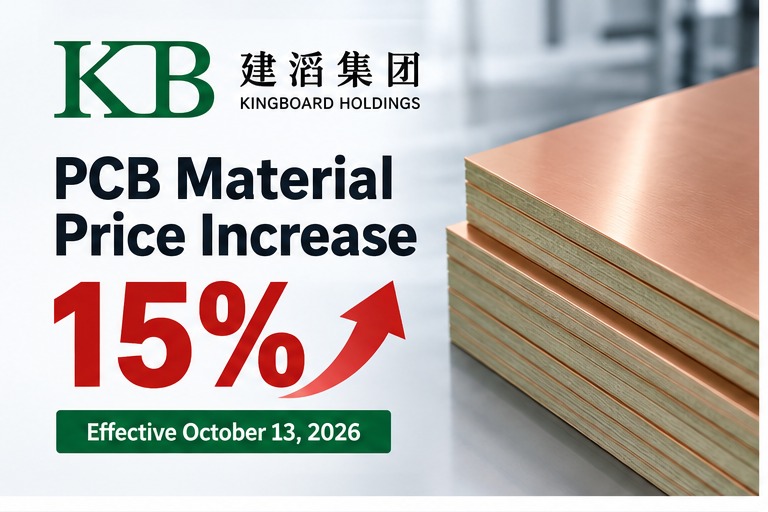
The PCB material price increase in October 2026 is adding new cost pressure to circuit board purchasing. On October 13, Kingboard Laminates announced a 15% price increase for copper-clad laminates (CCL) and prepreg (PP) manufactured using 2116 or thinner fiberglass fabrics. The adjustment took effect immediately, reflecting continued supply pressure on electronic glass fabric and other upstream materials.
For PCB buyers, the concern goes beyond higher material prices. Will your next PCB quotation change? Could material shortages extend production lead times? And how can you keep manufacturing costs under control without compromising board reliability?
At EBest Circuit, we provide PCB fabrication, component sourcing, and PCB assembly services. Our engineering team helps customers review material requirements, PCB stackups, manufacturing specifications, and production quantities to identify practical cost-saving opportunities before ordering.
Key Takeaways
- The October 2026 Kingboard laminates price increase affects CCL and prepreg using 2116 or thinner glass fabrics, with a 15% adjustment.
- A copper clad laminate price increase does not translate directly into the same increase in finished PCB prices.
- The copper clad laminate price trend reflects different material grades, glass fabric supplies, copper foil costs, and order conditions.
- Compare copper clad laminate price changes against the approved stackup, panel utilization, copper weight, and production quantity.
- Material alternatives require technical review and customer approval; forecasts and stable specifications can improve purchasing planning.
- At EBest Circuit, we support material selection, DFM, PCB fabrication, and assembly to help customers manage production costs.
What Is the Latest Kingboard PCB Material Price Increase in October 2026?
On October 13, 2026, Guangdong Kingboard Laminates Trading Co., Ltd. issued price adjustment notice No. 20261013, announcing an immediate 15% increase for selected PCB materials.
The adjustment covers copper-clad laminates and prepreg manufactured with 2116 or thinner electronic fiberglass fabrics. Kingboard attributed the increase to strong market demand, tight upstream supplies of electronic glass fabric and fiberglass yarn, and significant increases in associated material costs.
| Item | October 2026 adjustment |
| Manufacturer | Kingboard Laminates |
| Announcement date | October 13, 2026 |
| Effective date | Immediately |
| Affected materials | Copper-clad laminates and prepreg |
| Fiberglass fabric specification | 2116 and thinner styles |
| Announced price increase | 15% |
| Stated reasons | Strong demand, tight glass fabric and fiberglass yarn supply, rising material costs |
The latest adjustment follows a series of price increases across Kingboard’s laminate and prepreg product lines during 2025 and 2026. However, the 15% increase applies to the specified material categories, rather than every type of FR-4 laminate or finished PCB.
For companies purchasing multilayer PCBs, this distinction matters. A board’s cost exposure depends on its material construction, approved laminate specifications, and quantity of affected materials consumed during manufacturing.
Why Are PCB Raw Material Prices Rising in 2026?
PCB raw material prices are rising because demand for certain electronic materials is placing pressure on upstream manufacturing capacity and supply availability. Electronic glass fabric, copper foil, and resin systems are essential inputs for copper-clad laminates, and cost changes in these materials can affect PCB fabrication prices.
Electronic fiberglass fabric supply
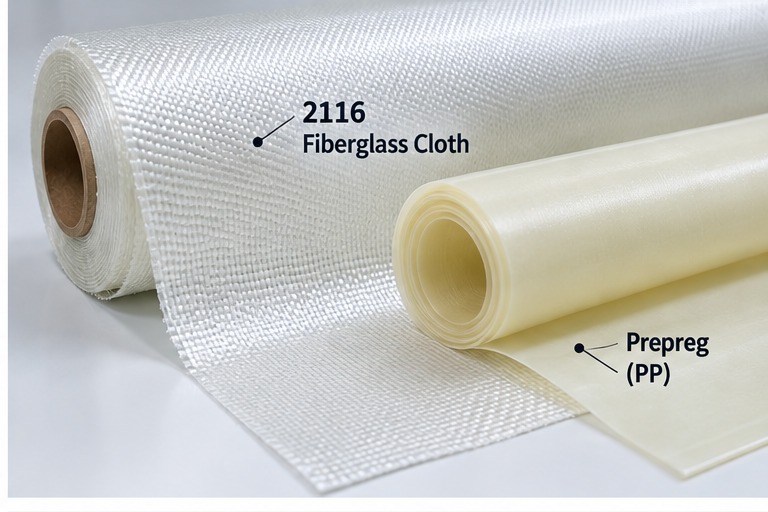
Fiberglass fabric provides reinforcement and dimensional stability within laminate and prepreg materials. Different glass cloth styles are selected according to thickness, resin content, electrical properties, and stackup requirements. Thin fiberglass fabrics, including 2116, 1080, and other fine styles, are commonly used in multilayer constructions that require controlled dielectric thickness. When these materials become more expensive or difficult to source, laminate manufacturers face higher production costs.
Copper foil cost pressure
Copper foil forms the conductive layers of a PCB. Its cost is affected by copper prices, foil processing requirements, thickness, and product specifications. Boards requiring heavier copper, additional copper layers, or larger panel areas can have greater exposure to copper-related material expenses.
Growing demand for advanced electronics
AI infrastructure, data centers, automotive electronics, communication equipment, and other electronic applications require substantial PCB manufacturing capacity. Some applications also depend on specialized laminate materials, high-layer-count stackups, and controlled electrical performance. These demand patterns can tighten supplies of particular material grades. The degree of impact varies by product category rather than affecting every PCB material equally.
For PCB buyers, the immediate concern is whether the materials specified in their current designs remain available at acceptable prices and lead times.
How Many Times Has Kingboard Raised Prices in 2026?
Kingboard Laminates has announced eight rounds of PCB material price increases in 2026 through October 13, bringing the reported total to 12 rounds since February 2025. These adjustments have affected FR-4 copper-clad laminates, CEM materials, prepreg, and certain copper foil processing charges, with different increases applied according to product type and specification.
The frequency of these increases illustrates the sustained pricing pressure facing PCB material buyers. The latest adjustment is particularly relevant to multilayer PCBs that use thin fiberglass fabrics in their laminate and prepreg constructions.
Kingboard PCB Material Price Increase History (2025–2026)
| Date | Affected PCB materials | Announced price increase |
| Feb 15, 2025 | FR-4 and CEM laminates | RMB 5 per sheet |
| Aug 15, 2025 | Copper-clad laminates | RMB 10 per sheet |
| Dec 1, 2025 | FR-4, CEM, prepreg | FR-4 and PP +10%; CEM +5% |
| Dec 26, 2025 | Laminate products | +10% |
| Mar 10, 2026 | Laminates, PP, copper foil processing | +10% for affected products |
| Apr 3, 2026 | Laminates and prepreg | +10% |
| Apr 28, 2026 | FR-4 laminates and prepreg | +10% |
| May 27, 2026 | Laminates and prepreg | Laminates +10%; PP +20% |
| Jun 16, 2026 | FR-4 laminates and prepreg | +15% |
| Jul 6, 2026 | FR-4, CEM-1/22F, prepreg | +10%–15%, depending on product |
| Aug 25, 2026 | FR-4 laminates and prepreg | FR-4 +10%; PP +10%–20% |
| Oct 13, 2026 | Laminates and PP using 2116 or thinner fiberglass fabrics | +15% |
According to industry reporting, prices for some conventional copper-clad laminates rose from approximately RMB 100 per sheet two years earlier to around RMB 400 per sheet. These figures describe particular market observations and should not be generalized to every material grade, thickness, or supplier.
Because the announcements involve different materials and specifications, their percentages cannot simply be added together to calculate one cumulative increase for all PCB raw materials.
For PCB buyers, the repeated adjustments introduce challenges in material budgeting, quotation validity, production planning, and long-term purchasing costs. Even when a PCB design remains unchanged, the material cost behind a repeat order may differ from that of a previous production batch.
How Does the 15% Laminate Price Increase Affect PCB Manufacturing Costs?
A 15% increase in selected laminate prices does not automatically translate into a 15% increase in finished PCB prices.
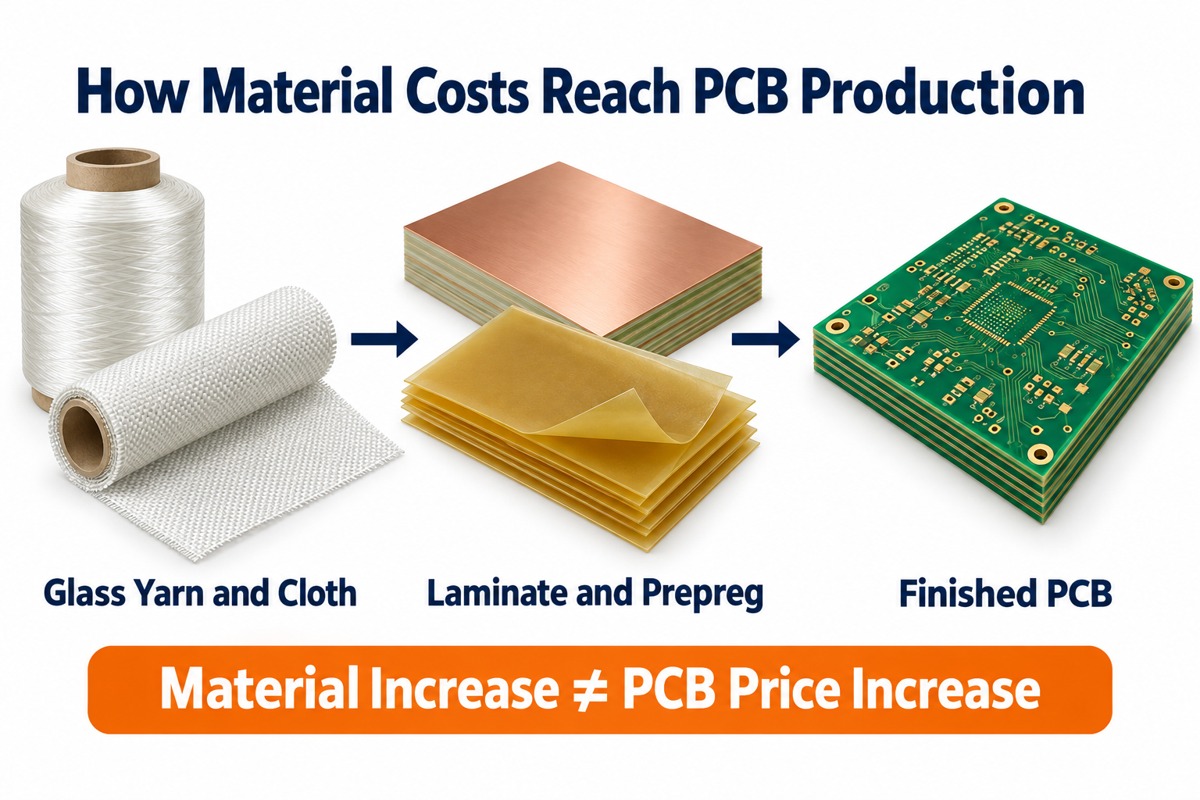
A PCB quotation includes raw materials, drilling, copper plating, imaging, etching, solder mask, surface finishing, inspection, electrical testing, and other manufacturing operations. The material portion varies depending on board construction and production quantity.
| PCB cost factor | Potential effect of rising material prices |
| Laminate and prepreg | Higher purchasing costs for affected grades |
| PCB layer count | More dielectric and copper layers increase material consumption |
| PCB dimensions | Larger boards generally consume more panel material |
| Copper thickness | Higher copper requirements can increase material and processing expenses |
| Stackup construction | Specific prepreg and core requirements may limit available alternatives |
| Production quantity | Purchasing quantities, panel utilization, and setup costs influence unit pricing |
| Material availability | Limited supply can affect procurement and manufacturing schedules |
Example: How a 15% material increase can affect a PCB quotation
Assume laminate and prepreg represent 30% of a finished PCB’s original manufacturing cost. If all of that material portion rises by 15%, while every other cost remains unchanged, the resulting cost increase would be 30% × 15% = 4.5% of the original PCB manufacturing cost.
This is an illustrative calculation, not an industry-wide PCB price forecast. Actual cost changes depend on material specifications, existing inventory, purchasing arrangements, and manufacturing efficiency. For buyers sourcing multilayer FR-4 PCBs, reviewing the material composition and stackup is often more useful than applying a uniform percentage increase to the entire PCB budget.
Which PCB Types Are More Sensitive to Rising CCL and Prepreg Prices?
Not every PCB design has the same exposure to changing laminate prices. Sensitivity depends on the amount and type of material used, construction complexity, and available approved alternatives.
| PCB type | Main cost considerations |
| Standard FR-4 PCB | Laminate grade, board thickness, copper weight, panel utilization |
| Multilayer PCB | Core and prepreg consumption, layer count, stackup structure |
| HDI PCB | Thin dielectric materials, buildup construction, lamination cycles |
| High-frequency PCB | Specialized dielectric materials and electrical performance requirements |
| High-speed PCB | Controlled impedance, dielectric properties, loss requirements |
| Heavy copper PCB | Copper thickness, plating requirements, etching complexity |
| Rigid-flex PCB | Rigid laminate, flexible materials, bonding structure, manufacturing complexity |
Multilayer FR-4 PCBs deserve particular attention. These boards typically use multiple core and prepreg layers to achieve their required thickness and electrical characteristics. When a design requires a specific glass fabric style or dielectric construction, a manufacturer must consider both material cost and technical compatibility.
HDI and high-speed boards may also have more restrictive material requirements, although their exposure to this particular announcement depends on the exact materials specified. For procurement teams, the best approach is to identify which current PCB part numbers use the affected material specifications before revising purchasing budgets.
How Can You Reduce PCB Manufacturing Costs During Material Price Increases?
The most effective way to control PCB costs is to review the design and manufacturing specifications before committing to production. Changes to panel utilization, material selection, stackup construction, and order planning may produce savings without changing the intended function of the board.
1. Review your PCB stackup and laminate requirements
Ask your PCB manufacturer to check whether the proposed stackup uses material grades that are necessary for the design. For standard FR-4 applications, there may be more than one suitable core and prepreg construction. However, any proposed substitution must preserve the required overall thickness, dielectric properties, electrical performance, thermal characteristics, and reliability. For impedance-controlled boards, a change in dielectric thickness or material properties may require trace geometry adjustments and renewed impedance verification.
2. Improve PCB panel utilization
Manufacturers process PCBs using production panels. The arrangement of individual boards on a panel directly affects material utilization. Optimizing board orientation, spacing, and manufacturing panel design can help reduce material waste. For projects with relatively large production quantities, even modest improvements in panel utilization can influence the total manufacturing cost.
3. Evaluate unnecessary design complexity
Additional layers, excessive copper thickness, specialized materials, and demanding manufacturing tolerances can increase fabrication costs. A design review should distinguish between requirements that are electrically or mechanically necessary and specifications that may be more restrictive than the application requires. For example, an unnecessarily tight dimensional tolerance can introduce manufacturing difficulty without improving product performance.
4. Plan production quantities more carefully
Small prototype batches and volume production have different cost structures. Combining planned demand into an appropriate production schedule may improve purchasing efficiency and reduce repeated setup expenses. The right order quantity should reflect actual demand, inventory carrying costs, approved design revisions, and production forecasts.
5. Request a DFM review before placing an order
A design for manufacturability (DFM) review can identify material constraints, fabrication risks, and cost-saving opportunities early. It is particularly useful when moving from prototype production to higher-volume manufacturing. An effective DFM review should cover material selection, stackup construction, drilling specifications, trace and spacing requirements, copper distribution, panel utilization, and test requirements.
6. Compare total manufacturing cost, not only board price
The lowest unit quotation does not always provide the lowest overall project cost. Rework, rejected boards, production delays, transportation expenses, and inconsistent quality can reduce apparent savings. Evaluate suppliers according to manufacturing capability, material compliance, quality control, lead-time commitments, and overall project cost.
Can You Use Alternative PCB Materials to Control Costs?
Alternative PCB materials may reduce manufacturing costs when they satisfy the original design’s electrical, mechanical, thermal, and regulatory requirements. For example, a standard industrial control board may have more material flexibility than a high-speed communication PCB requiring a specific dielectric constant and loss tangent. Material substitutions should therefore be evaluated against the application rather than price alone.
| Material property | Why it matters before substitution |
| Glass transition temperature (Tg) | Affects thermal performance and processing suitability |
| Decomposition temperature (Td) | Relevant to thermal exposure and material reliability |
| Dielectric constant (Dk) | Influences impedance and signal propagation |
| Dissipation factor (Df) | Contributes to dielectric signal loss |
| Coefficient of thermal expansion (CTE) | Affects dimensional stability and plated-hole reliability |
| Material thickness | Determines stackup geometry and mechanical dimensions |
| Flammability classification | Must satisfy applicable product safety requirements |
| Approved material specification | May restrict substitution in qualified products |
For medical, automotive, industrial, and other reliability-sensitive applications, material changes may require customer approval and additional qualification testing. A lower-cost material is useful only when the finished PCB continues to meet its required performance and reliability criteria. Buyers should request written confirmation of proposed substitutions and their technical implications before releasing a revised production order.
Will PCB Material Shortages Affect Manufacturing Lead Times?
PCB material shortages can extend production lead times when a manufacturer cannot obtain the approved core, prepreg, copper foil, or specialized laminate within the planned purchasing schedule. The impact depends on material availability, supplier stock, order quantity, and whether an approved alternative is available.
A PCB may have a relatively short fabrication cycle once materials are ready, but procurement delays can affect the overall delivery schedule. To reduce this risk, buyers should provide the following information when requesting a quotation:
- Approved material specifications: Identify mandatory material grades, brands, and permitted equivalents.
- PCB stackup: Supply layer structure, board thickness, copper weights, and impedance requirements.
- Production forecast: Indicate prototype quantities, expected repeat orders, and volume requirements.
- Required delivery schedule: Specify the target shipping or delivery date.
- Qualification restrictions: Identify applications requiring customer approval before material changes.
These details allow manufacturers to assess material availability and production feasibility before confirming a delivery commitment. For repeat production programs, early coordination between engineering, purchasing, and manufacturing can reduce the risk of unexpected material-related delays.
How Can You Secure More Stable PCB Pricing for Repeat Orders?
Stable PCB purchasing requires more than requesting a fixed unit price. Buyers should establish a clear understanding of material assumptions, quotation validity, production quantities, and the conditions under which prices may change. The following purchasing practices can improve cost visibility:
Confirm quotation validity
Ask how long the quoted price remains valid and whether it depends on current material availability. A quotation based on existing inventory may have different conditions from one requiring new material procurement.
Provide realistic volume forecasts
Expected monthly, quarterly, or annual quantities can help manufacturers evaluate purchasing requirements and capacity planning. Forecasts are particularly useful when a project has stable specifications and predictable demand.
Control PCB revisions
Frequent revisions can make long-term material purchasing more difficult. Maintaining clear revision control helps manufacturers distinguish approved production configurations from designs still undergoing development.
Discuss material purchasing arrangements
For stable production programs, buyers may discuss scheduled releases, reserved materials, or other purchasing arrangements with their manufacturing partners. Any such arrangement should define responsibilities, quantities, pricing conditions, and inventory commitments.
Review cost changes with technical context
When a PCB quotation increases, request clarification about the affected materials or manufacturing requirements. This provides a stronger basis for cost evaluation than comparing the percentage increase alone.
Why Choose EBest Circuit for PCB Manufacturing During Material Price Fluctuations?
Rising PCB material prices make supplier selection more important. You need a manufacturing partner that can help evaluate material requirements, identify avoidable costs, and support production without sacrificing product quality.
At EBest Circuit, we support customers from PCB prototyping to volume production, providing engineering review, fabrication, component sourcing, assembly, and project-defined testing. Our services are designed to help engineering and purchasing teams address both technical requirements and manufacturing costs.
- Engineering support before production: Our engineering team reviews PCB fabrication data, stackups, material requirements, and manufacturing specifications to identify potential production issues and cost optimization opportunities.
- Flexible PCB manufacturing capabilities: We support standard FR-4, multilayer PCB, HDI, rigid-flex PCB, metal core PCB, ceramic PCB, and other specialized board constructions for different applications.
- Material selection and DFM assistance: We help customers evaluate feasible material choices, stackup requirements, panel utilization, and fabrication specifications while preserving approved performance requirements.
- Prototype-to-volume production support: We coordinate manufacturing requirements as projects progress from early prototypes to repeat production, helping customers manage design revisions and production planning.
- PCB fabrication and assembly services: Customers can coordinate PCB manufacturing, component sourcing, SMT assembly, through-hole assembly, inspection, and applicable testing within one project.
- Quality management and inspection: Our manufacturing support includes process controls and inspection methods selected according to the product’s requirements. Our quality management certifications include ISO 9001, ISO 13485, and IATF 16949.
With material prices changing, our goal is to help customers achieve cost-effective PCB manufacturing, reliable product quality, and practical production planning.
What Should You Prepare to Get an Accurate PCB Manufacturing Quote?
An accurate PCB quotation begins with complete manufacturing information. The more clearly your technical requirements and order expectations are defined, the easier it is to evaluate materials, processes, and costs. For a PCB fabrication quotation, prepare:
- Gerber files and drill files showing the latest approved design.
- PCB stackup and material specifications, including layer count, finished thickness, and required laminate properties.
- Copper weight and surface finish requirements, such as ENIG, HASL, or other approved finishes.
- Board dimensions and manufacturing requirements, including controlled impedance, tolerances, and special processes where applicable.
- Order quantities, including prototypes, pilot production, or volume forecasts.
- Delivery requirements and any restrictions on material substitution.
For PCBA projects, please also include the BOM, pick-and-place file, assembly drawings, programming requirements, and test specifications.
Concerned about rising PCB material costs?
Send your PCB manufacturing files and purchasing requirements to sales@bestpcbs.com for a quotation. Our engineering team can review your design, evaluate manufacturing feasibility, and discuss suitable material and production options for your project.
Frequently Asked Questions About PCB Material Price Increases
Q1: Will PCB prices continue to rise throughout 2026?
A1: PCB prices may remain under pressure where laminate, fiberglass fabric, copper foil, or other material supply remains constrained, but future changes depend on market conditions and product specifications.
Q2: Does the Kingboard 15% increase apply to every FR-4 PCB?
A2: No. The October 13 announcement concerns CCL and prepreg manufactured using 2116 or thinner fiberglass fabrics, rather than every FR-4 PCB construction.
Q3: Is 2116 fiberglass fabric the same as a 2116 PCB laminate?
A3: No. 2116 identifies a fiberglass fabric style used within laminate or prepreg constructions; the finished laminate’s properties also depend on its resin system and other manufacturing specifications.
Q4: Can a PCB manufacturer change the laminate brand without customer approval?
A4: Material substitution depends on the customer’s specifications and approval requirements; controlled or qualified products may require formal approval before a change.
Q5: Are PCB prototype prices affected more than mass-production prices?
A5: The impact varies because prototypes and volume orders have different material consumption, purchasing arrangements, setup expenses, and unit cost structures.
Q6: Can ordering larger quantities reduce the effects of PCB material price increases?
A6: Larger production quantities may improve unit-cost efficiency, but actual savings depend on material prices, panel utilization, setup costs, and purchasing conditions.
Q7: What happens if the specified PCB laminate is unavailable?
A7: The manufacturer should identify the supply constraint and discuss approved alternatives or revised delivery arrangements before making changes to the released design.
Q8: Can PCB and PCBA manufacturing be quoted together?
A8: Yes. A combined quotation can cover bare-board fabrication, component sourcing, assembly, and required testing when the necessary production files are available.
You may also like


Tags: Copper Clad Laminate Price, copper clad laminate price increase, copper clad laminate price trend, kingboard laminates price increase, PCB material price increase