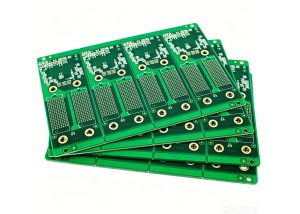
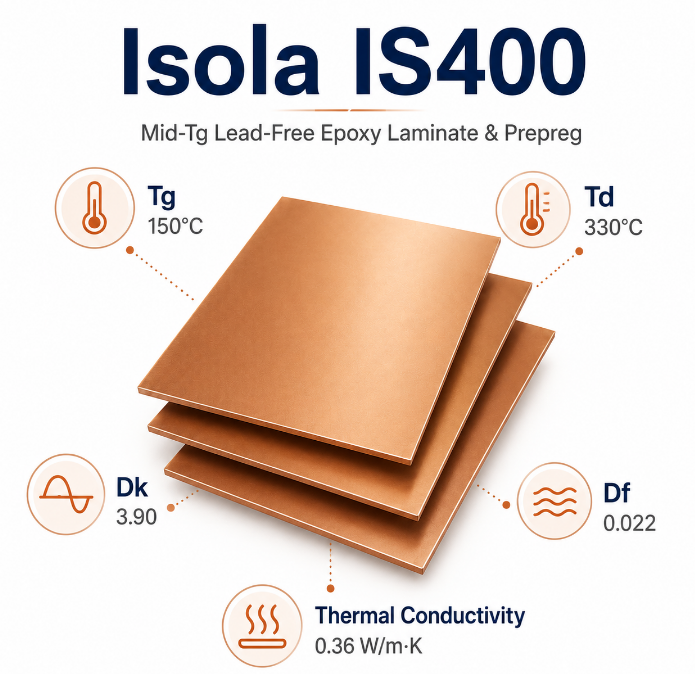
Isola IS400 is a mid-Tg, lead-free epoxy laminate and prepreg material for reliable multilayer PCB manufacturing. It is used when a PCB needs better thermal stability than basic FR4 while keeping normal FR-4 process compatibility.
This guide explains Isola IS400 material properties, datasheet values, Tg rating, Dk, Df, thermal conductivity, lead-free PCB use, applications, FR4 comparison, 370HR comparison, alternative material models and selection checks.
What Is Isola IS400?
Isola IS400 is a lead-free, mid-Tg epoxy laminate and prepreg system for multilayer PCB fabrication. It is built for PCB projects that need stronger heat resistance than many standard FR4 materials but do not require premium RF or microwave laminates.
The material uses an epoxy resin system reinforced with electrical-grade E-glass fabric. This structure gives the PCB mechanical strength, dielectric insulation and thermal stability during fabrication and lead-free assembly.
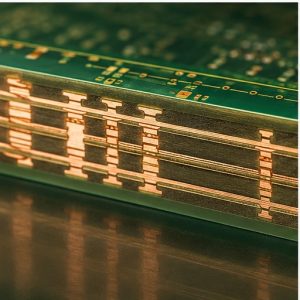
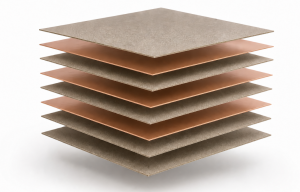
In PCB production, Isola IS400 is valued for balanced performance. The laminate works as the rigid copper-clad core, while the prepreg bonds layers during multilayer lamination. Together, they support stable stackup construction and practical cost control.
Why Is Isola IS400 Used for Lead-Free PCB Manufacturing?
Isola IS400 is used for lead-free PCB manufacturing because it offers better thermal stability than many basic FR4 materials. Lead-free soldering usually requires higher peak temperatures, which can stress the laminate, prepreg and plated through holes.
During lead-free reflow, the PCB must resist delamination, blistering, excessive expansion and resin breakdown. The Tg 150°C and Td 330°C values help the board tolerate these conditions more reliably.
The material is also FR-4 process compatible. A capable PCB factory can process it through controlled storage, lamination, drilling, desmear, plating, baking and final inspection.
For many multilayer PCB projects, Isola IS400 is a practical choice when the design needs lead-free reliability without moving to a costly specialty laminate.
Isola IS400 Material Properties and Datasheet Overview
Isola IS400 material properties include Tg 150°C, Td 330°C, Dk 3.90, Df 0.022 and thermal conductivity 0.36 W/m·K. These Isola IS400 technical specifications define thermal behavior, electrical performance, lead-free assembly resistance and multilayer PCB process stability.
| Property | Value | Unit |
|---|---|---|
| Tg | 150 | °C |
| Td | 330 | °C |
| Dk | 3.90 | — |
| Df | 0.022 | — |
| Thermal Conductivity | 0.36 | W/m·K |
| Z-Axis CTE Before Tg | 50 | ppm/°C |
| Z-Axis CTE After Tg | 250 | ppm/°C |
| T260 | >60 | min |
| T288 | >10 | min |
| Laminate Thickness | 0.05–2.4 | mm |
| Copper Weight | 18–70 | µm |
| Compliance | RoHS | — |
| UL File | E41625 | — |
| IPC Reference | 4101 /97 /98 /99 /101 | — |
The Isola IS400 datasheet shows that this material is not an ultra-low-loss laminate. Instead, it is a mid-Tg lead-free material for PCB projects that need stable thermal performance, defined dielectric values and reliable multilayer processing.
What Is the Tg Rating of Isola IS400?
The Tg rating of Isola IS400 is 150°C. Tg means glass transition temperature, which is the temperature range where the resin system changes from a rigid state to a softer state.
This value matters because PCB materials expand faster after reaching Tg. If the laminate has a low Tg, lead-free reflow and thermal cycling can increase the risk of delamination, hole wall stress, warpage and long-term failure.
An Isola IS400 Tg 150 material is usually stronger than many standard FR4 choices for lead-free PCB assembly. However, for harsh thermal cycling, thick copper, high layer counts or stricter reliability requirements, a high-Tg material such as Isola 370HR may be more suitable.
What Are the Dk, Df and Thermal Conductivity of Isola IS400?
The typical Dk is 3.90, the Df is 0.022 and the thermal conductivity is 0.36 W/m·K. These values affect signal behavior, dielectric loss and heat transfer in PCB design.
Dk, or dielectric constant, affects signal speed and controlled impedance. A Dk of 3.90 is suitable for many digital, industrial and control PCB designs, but final impedance still depends on dielectric thickness, copper thickness, resin content and glass style.
Df, or dissipation factor, affects signal loss. A Df of 0.022 is acceptable for general multilayer PCB designs, but it is not ideal for RF, microwave or very high-speed low-loss applications.
Isola IS400 thermal conductivity is typical for glass-reinforced epoxy material. Heat still needs to be managed with copper planes, thermal vias, balanced stackup design and proper component placement.
What Applications Commonly Use Isola IS400 PCB Material?
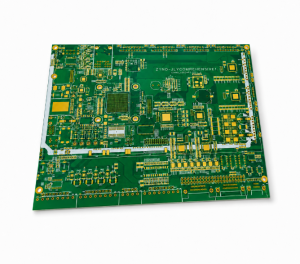
Isola IS400 PCB material is commonly used in products that need mid-level thermal reliability, multilayer stability and lead-free soldering compatibility. It fits reliability-focused PCB projects across industrial and commercial electronics.
Common applications include:
- Industrial control systems: PLC boards, automation control PCB and machine electronics.
- Automotive electronics: control modules, sensor support boards and power management PCB.
- Power supply electronics: control boards, converter support circuits and driver PCB.
- Commercial multilayer PCB: general electronics needing better heat resistance than basic FR4.
- LED control boards: driver control circuits and lighting-related electronics.
- Instrumentation PCB: monitoring, testing and measurement equipment.
- Communication support boards: non-RF multilayer PCB with stable dielectric requirements.
- Consumer and office electronics: reliable PCB designs using lead-free assembly.
For high-speed backplanes, RF circuits, microwave systems or ultra-low-loss signal paths, a lower-Df material should be reviewed before choosing this laminate.
Isola IS400 vs FR4: What Is the Difference?
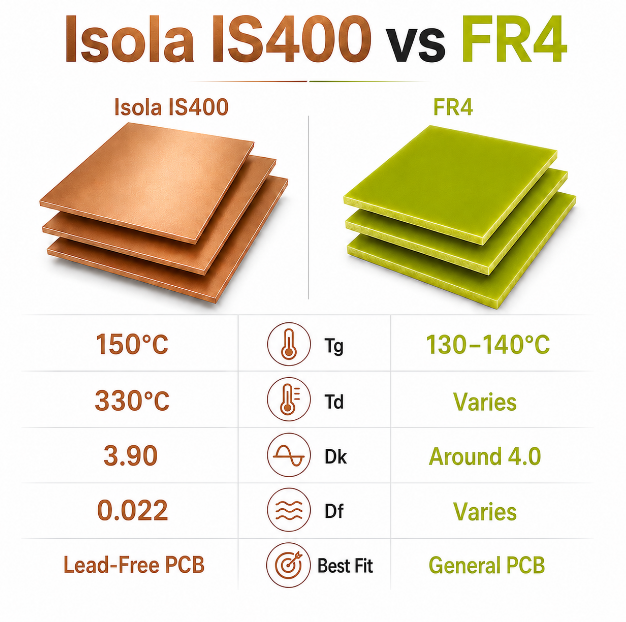
Isola IS400 is a defined mid-Tg lead-free material, while FR4 is a broad material category with many grades. Standard FR4 may have lower Tg, weaker thermal resistance or less predictable datasheet values.
| Item | Isola IS400 | Standard FR4 |
|---|---|---|
| Material Type | Mid-Tg epoxy laminate and prepreg | General glass-reinforced epoxy category |
| Tg | 150°C | Often 130–140°C, varies by grade |
| Td | 330°C | Varies by resin system |
| Dk | 3.90 | Usually around 4.0, varies by supplier |
| Df | 0.022 | Varies by grade and test frequency |
| Thermal Conductivity | 0.36 W/m·K | Usually similar range, varies by material |
| Lead-Free Assembly | Better fit than many low-Tg FR4 choices | Depends on Tg, Td and PCB thickness |
| Multilayer Reliability | More stable for demanding lead-free PCB use | Suitable for simple and standard multilayer PCB |
| Z-Axis Expansion | Defined CTE data | Depends on laminate grade |
| CAF Resistance | Designed for reliability-focused PCB use | Depends on material grade |
| Process Compatibility | FR-4 compatible | Standard FR4 process |
| Cost Level | Higher than basic FR4 | Lower in simple PCB projects |
| Best Use | Reliable multilayer PCB, industrial PCB, lead-free PCB | Low-cost general PCB |
Choose Isola IS400 when the PCB needs better lead-free reflow performance, defined material data and improved multilayer reliability. Choose standard FR4 when the design is simple, low-cost and not exposed to demanding thermal conditions.
Isola IS400 vs 370HR: Which Material Should You Choose?
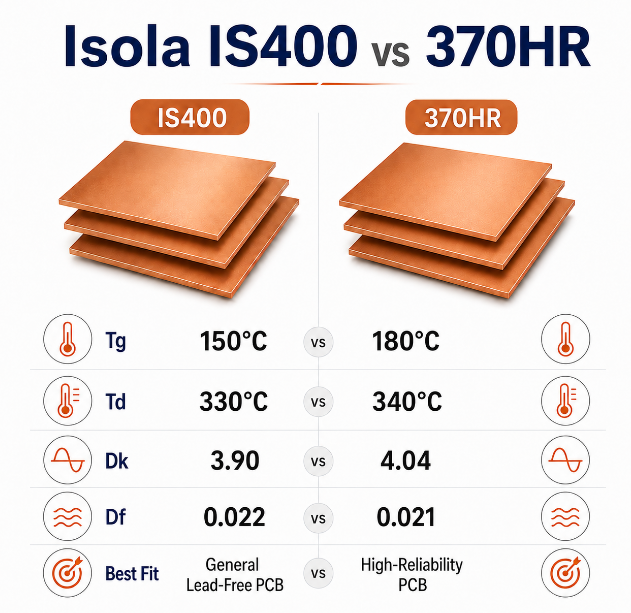
Choose Isola IS400 for balanced mid-Tg performance and choose 370HR for higher thermal reliability. Both materials are used in multilayer PCB fabrication, but they serve different reliability levels.
| Item | Isola IS400 | Isola 370HR |
|---|---|---|
| Material Class | Mid-Tg lead-free epoxy laminate | High-Tg FR-4 multifunctional epoxy laminate |
| Tg | 150°C | 180°C |
| Td | 330°C | 340°C |
| Dk | 3.90 | 4.04 |
| Df | 0.022 | 0.021 |
| Thermal Conductivity | 0.36 W/m·K | 0.4 W/m·K |
| Z-Axis CTE Before Tg | 50 ppm/°C | 45 ppm/°C |
| Z-Axis CTE After Tg | 250 ppm/°C | 230 ppm/°C |
| T260 | >60 min | 60 min |
| T288 | >10 min | 30 min |
| HDI Suitability | Suitable for standard multilayer PCB | Better fit for HDI and sequential lamination |
| Thermal Cycling | Good for mid-level reliability | Better for harsher reliability demands |
| Cost Level | Usually lower | Usually higher |
| Best Use | Industrial, commercial and lead-free multilayer PCB | High-reliability, high-layer-count and thermally demanding PCB |
Isola IS400 is a practical choice for industrial control, commercial electronics and mid-level lead-free applications. 370HR is better when the PCB faces higher thermal cycling, thicker copper, higher layer count, multiple reflow cycles or stricter long-term reliability requirements.
What Are the Alternative Materials to Isola IS400?
Alternative materials to Isola IS400 include specific mid-Tg, high-Tg and lower-loss laminate models. The right replacement depends on Tg, Df, lead-free assembly requirements, availability, cost target and PCB reliability level.
| Material Model | Supplier | Material Type | Best Fit |
|---|---|---|---|
| Isola 370HR | Isola | High-Tg FR-4 laminate and prepreg | Higher thermal reliability and high-layer-count PCB |
| Isola IS410 | Isola | High-Tg FR-4 epoxy laminate and prepreg | Multiple thermal excursions and reliable multilayer PCB |
| Isola FR408HR | Isola | Mid-loss FR-4 laminate and prepreg | Lower-loss digital PCB and higher-speed signal designs |
| Isola FR406 | Isola | FR-4 epoxy laminate and prepreg | General multilayer PCB where IS400 is not required |
| Shengyi S1000-2M | Shengyi | High-Tg lead-free FR-4 laminate | High-layer-count PCB and automotive electronics |
| Shengyi S1000-2 | Shengyi | High-Tg FR-4 laminate system | Industrial multilayer PCB and lead-free PCB production |
| ITEQ IT-180A | ITEQ | High-Tg low-CTE laminate and prepreg | High-layer PCB, lead-free assembly and CAF resistance |
| Panasonic R-1755V | Panasonic | High-Tg FR-4 laminate | Lead-free multilayer PCB with stable thermal reliability |
| Panasonic MEGTRON 6 | Panasonic | Low-loss laminate | High-speed PCB where signal loss is more important |
| Rogers RO4350B | Rogers | Hydrocarbon ceramic laminate | RF PCB, microwave PCB and antenna PCB |
Use Isola 370HR, IS410, S1000-2M or IT-180A when the design needs higher Tg and stronger thermal reliability. Use FR408HR or MEGTRON 6 when lower signal loss matters. Use Rogers RO4350B only when RF or microwave performance is the main requirement.
What Should You Check Before Choosing Isola IS400?
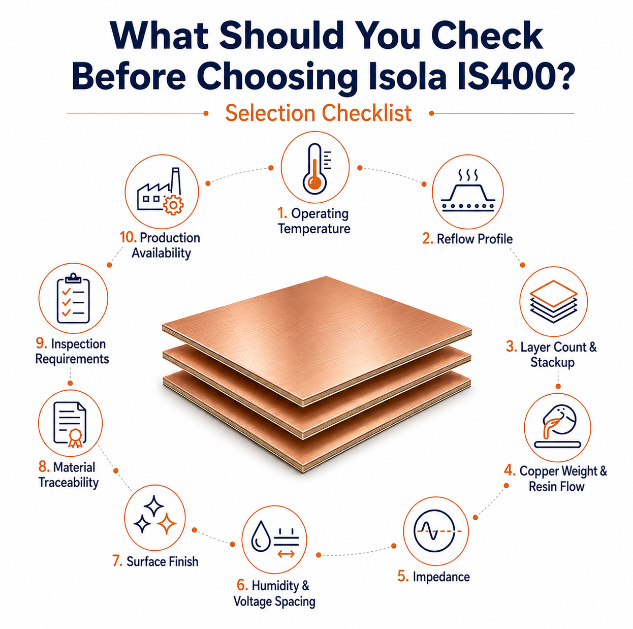
Before choosing Isola IS400, review the PCB design, assembly process, reliability target and supplier control ability. The material performs well only when it matches the actual stackup, operating environment and manufacturing process.
- Confirm the real operating temperature.
Check ambient temperature, component heat, enclosure temperature and thermal cycling. A Tg 150 material is suitable for many lead-free PCB projects, but higher-temperature environments may need a high-Tg laminate. - Review the reflow profile.
Confirm peak temperature, time above liquidus and the number of reflow cycles. Thick PCB, heavy copper PCB and double-sided assembly create more thermal stress. - Check layer count and stackup balance.
Higher layer counts require better registration, resin flow and lamination control. Unbalanced copper distribution can increase warpage risk. - Match copper weight with resin flow.
Heavy copper affects etching, spacing, prepreg filling and press cycle design. The factory should confirm whether the selected prepreg can fill copper areas without voids. - Verify impedance requirements.
Dk should be checked with the actual dielectric thickness, copper thickness and glass style. Controlled impedance PCB should not rely only on a catalog Dk value. - Evaluate humidity and voltage spacing.
Humid environments, narrow spacing and higher voltage can increase insulation risk. CAF resistance, cleanliness and spacing rules should be reviewed for reliability-focused designs. - Select the right surface finish.
ENIG, OSP, immersion silver and lead-free HASL can all be considered. The choice should match solderability, storage time, fine-pitch assembly, cost and inspection needs. - Confirm material traceability.
Ask the PCB factory to confirm material grade, laminate batch, prepreg type and stackup before production. This prevents unapproved material replacement. - Define inspection requirements.
For critical PCB orders, request electrical test, microsection, solderability check, impedance report and thermal stress review when needed. - Check production availability.
Material availability can affect lead time and cost. Confirm stock status before urgent PCB fabrication or batch production.
FAQs About Isola IS400 PCB Material
Q1: Why do some users search for “is400 isola”?
A1: “is400 isola” usually means the same material as Isola IS400. Some users type the material code before the brand name. In PCB fabrication notes, write the full material name clearly to avoid confusion with generic FR4 or unapproved substitutes.
Q2: How should Isola IS400 be listed in PCB fabrication notes?
A2: Use a clear note such as: “Base material: Isola IS400 laminate and prepreg, RoHS compliant, lead-free compatible.” For controlled projects, also include finished thickness, copper weight, layer count, surface finish, impedance requirements and IPC class.
Q3: Can Isola IS400 be used for controlled impedance PCB?
A3: Yes. Controlled impedance is possible when the stackup uses the correct dielectric thickness, copper thickness and glass style. The typical Dk is 3.90, but final impedance should be confirmed by the PCB manufacturer before production.
Q4: Does Isola IS400 PCB need baking before assembly?
A4: Baking depends on storage time, packaging, humidity exposure and PCB thickness. If boards are exposed to moisture or stored for a long time, baking helps reduce blistering, delamination and soldering defects during lead-free reflow.
Q5: What copper weights are commonly used with Isola IS400?
A5: Common copper weights are 18 µm, 35 µm and 70 µm, equal to about 1/2 oz, 1 oz and 2 oz. Heavy copper designs need extra review because resin flow, spacing and lamination pressure become more difficult.
Q6: Can Isola IS400 support HDI PCB?
A6: It can support some dense multilayer PCB designs, but it is not the first choice for complex HDI. Multiple microvia layers, sequential lamination and tight reliability targets may require 370HR, IS410 or another higher-reliability material.
Q7: How should Isola IS400 prepreg be stored?
A7: Store prepreg in a clean, dry and temperature-controlled area. After opening, reseal unused prepreg quickly. Moisture exposure can reduce resin flow quality and increase voids, weak bonding or lamination defects.
Q8: What failures can happen if the wrong PCB material is used?
A8: Common risks include delamination, blistering, warpage, hole wall cracks, insulation failure and unstable impedance. These failures are more likely under lead-free reflow, high humidity, thermal cycling or heavy copper stress.
Q9: Can Isola IS400 replace Rogers materials?
A9: Usually no. Rogers materials are used for RF, microwave and low-loss circuits. Isola IS400 is mainly used for reliable multilayer PCB fabrication. It can replace basic FR4 in some thermal projects, but not RF laminates.
Q10: What does RoHS compliance mean for buyers?
A10: RoHS compliance means the material meets restricted-substance requirements for many electronics markets. Buyers should still request material certificates, compliance documents and production records before mass production.
Q11: Which surface finishes work with Isola IS400 PCB?
A11: Common finishes include ENIG, OSP, immersion silver and lead-free HASL. ENIG suits fine-pitch SMT and better pad flatness. OSP suits cost-sensitive PCB projects with shorter storage time.
Q12: What files are needed for an Isola IS400 PCB quote?
A12: Send Gerber files, drill files, stackup, finished thickness, copper weight, surface finish, solder mask color, impedance requirements, IPC class, quantity and testing requirements. For PCBA, also send BOM and Pick and Place files.
Q13: Can Isola IS400 be used for thick copper PCB?
A13: Yes, but the PCB stackup must be reviewed carefully. Thick copper increases resin filling demand, etching difficulty, spacing limits and thermal stress. The manufacturer should confirm prepreg selection, copper balance and lamination control.
Q14: How can buyers avoid material substitution?
A14: Ask for material brand, grade, laminate certificate, stackup confirmation and production records. For critical PCB orders, do not allow material changes without written approval. This helps prevent generic FR4 from replacing the specified material.
Isola IS400 is a practical mid-Tg lead-free laminate and prepreg material for multilayer PCB projects that need better thermal reliability than standard FR4 without moving to a premium low-loss material. Its main technical points are Tg 150°C, Td 330°C, Dk 3.90, Df 0.022 and thermal conductivity 0.36 W/m·K.
For material selection, match the laminate with stackup, copper weight, reflow profile, impedance control, operating environment and inspection requirements. If your PCB project needs stable lead-free assembly, controlled production, reliable material traceability and global delivery, EBest Circuit can support custom PCB fabrication from prototype to batch production. Send your Gerber files, stackup and project requirements to sales@bestpcbs.com for a fast Isola IS400 PCB quotation.