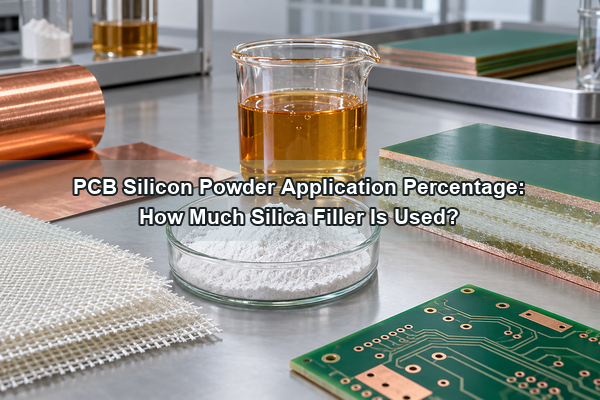
PCB silicon powder application percentage does not have one universal value. In PCB laminate discussions, “silicon powder” usually means electrically insulating silica powder (SiO2) used as a resin filler, not elemental silicon (Si). Published PCB material formulations range from low additions measured in parts per hundred resin to highly filled dielectric systems above 50 wt%, but those figures use different calculation bases and cannot be compared until the denominator is known.
What Does PCB Silicon Powder Mean?
In this context, PCB silicon powder is an imprecise trade expression. The functional filler in most copper-clad laminate and PCB insulation formulas is silica, silicon dioxide or SiO2. Suppliers may describe it as fused silica, spherical silica, crystalline silica, amorphous silica or surface-treated silica, depending on its structure and processing.
Silica powder is mixed into a thermosetting or thermoplastic resin system before the material becomes prepreg, a resin-coated film or another dielectric layer. It can change thermal expansion, stiffness, resin flow, moisture response, drilling behavior and electrical performance. The correct percentage therefore depends on the laminate family and the property balance required.
Is It Silicon or Silica in PCB Materials?
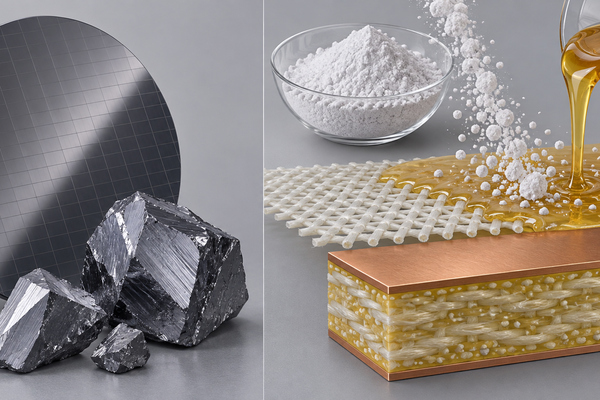
Elemental silicon and silica are not interchangeable. Elemental silicon is the semiconductor material used for integrated circuits, power devices and wafers. Silica is an electrical insulator and a common mineral filler. A document that says only “silicon powder” should be checked against the chemical name, formula and safety data sheet before it is used for material selection.
| Term | Chemical identity | Typical PCB-related role | Do not confuse it with |
|---|---|---|---|
| Silicon | Si | Semiconductor dies, wafers and selected electronic materials | White insulating filler in laminate resin |
| Silica | SiO2 | Inorganic filler in dielectric resin systems | Conductive or semiconducting silicon powder |
| Silicone | Siloxane polymer family | Coatings, adhesives, gels and encapsulants | Silica powder or silicon wafer material |
The long-tail expression PCB silica is also ambiguous. It may refer to silica-filled laminate resin, quartz-rich material, or simply a spelling shortcut. For a fabrication drawing or material approval, use the exact resin system and laminate grade rather than this shorthand alone.
What Is a Typical PCB Silicon Powder Application Percentage?
A defensible answer is a range tied to a formulation basis, not a single industry-wide target. Published PCB-related formulations show examples from roughly 5–70 wt% siliceous filler in a complete thermosetting resin composition, approximately 12.5–20 parts silica per 100 parts epoxy resin in another system, and about 50–70 mass% silica relative to the dielectric portion of certain silica-filled PTFE composites. Other insulating resin systems report inorganic filler ranges around 50–80 wt%.
These are formulation examples, not universal purchasing specifications. They may describe different resin chemistries, particle treatments, reinforcement contents and final products. A percentage that works for one low-loss PTFE dielectric cannot be copied directly into an FR-4 epoxy-glass laminate.
| Published expression | What the denominator may be | How it should be interpreted |
|---|---|---|
| 5–70 wt% siliceous filler | Complete thermosetting resin composition | Broad formulation window; not a finished-board standard |
| 12.5–20 parts per 100 parts epoxy | Epoxy resin only | A phr-style recipe cannot be read as final laminate wt% |
| 50–70 mass% silica | Dielectric portion of a filled PTFE system | Relevant to that dielectric architecture, not generic FR-4 |
| 50–80 wt% inorganic filler | Specified insulating resin composition | May include formulation-specific adhesion and flow limits |
Which Percentage Basis Is Being Reported?
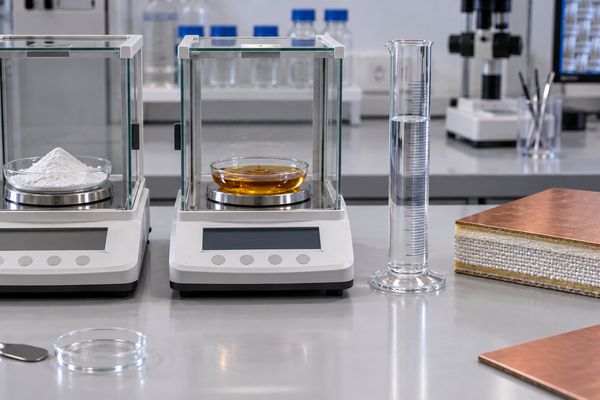
Before comparing two data sheets, identify the numerator and denominator. “30% silica” can mean 30 wt% of the mixed resin composition, 30 wt% of resin solids, 30 vol% of the dielectric, or 30 parts per 100 parts resin. Glass cloth, solvents, curing agents and copper may be included in one calculation and excluded from another.
- wt% of resin composition: filler mass divided by the mass of the specified mixed resin system.
- wt% of resin solids: volatile solvent is excluded, but curing agents and modifiers may be included.
- phr: filler parts by mass per 100 parts of a named resin component; it is not automatically a percentage.
- vol%: volume fraction; conversion from wt% requires material densities.
- final laminate wt%: may include glass reinforcement and sometimes other constituents, so it differs from the resin recipe.
If the basis is missing, the percentage is incomplete. Ask for the test or formulation definition before using it in a stack-up comparison.
Why Does the Silica Filler Percentage Vary?
Resin chemistry sets the first boundary. Epoxy, modified epoxy, cyanate ester, hydrocarbon and PTFE systems have different viscosities, cure mechanisms and filler compatibility. The same mass of silica can produce very different flow and adhesion behavior in those matrices.
Particle shape and size distribution also change the practical loading. Spherical particles can pack and flow differently from irregular ground particles. A blended particle-size distribution may reduce void space, while an unsuitable distribution can increase viscosity or leave poor surface quality. Surface treatment affects how the particles wet and bond to the resin.
The target dielectric constant, dissipation factor, thermal expansion, modulus, moisture absorption, bond strength and drillability must be balanced together. That is why the phrase silica filler should lead to a material-system review, not a percentage-only decision.
How Is Silica Used in FR-4 and Copper-Clad Laminates?
In an epoxy-glass copper-clad laminate, the dielectric is not simply resin plus powder. Woven glass cloth provides reinforcement, the resin fills the weave and bonds the structure, and copper foil forms the conductive layers. The PCB laminate silica filler content belongs to the resin formulation and influences how the prepreg flows, fills copper features and cures during lamination.
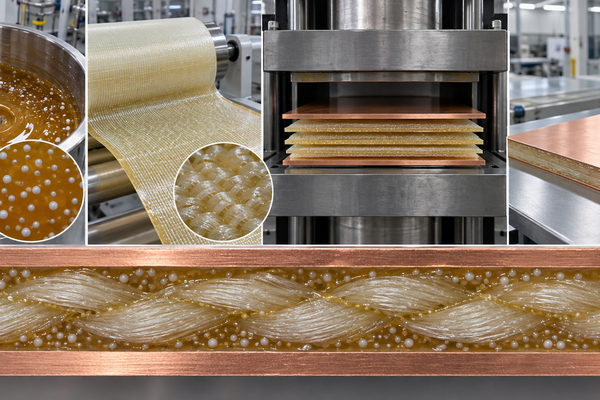
For conventional FR-4 PCB manufacturing, we select and process an approved laminate grade rather than inventing a silica ratio at the PCB fabrication stage. The laminate supplier controls the resin recipe; our job is to confirm the material designation, stack-up, thickness, copper weight, electrical requirements and process compatibility.
How Much Silica Is Used in High-Frequency PCB Laminates?
High-frequency materials may use substantial mineral loading to tune dielectric properties, dimensional stability and thermal expansion. Some silica-filled PTFE composites disclose silica contents around 50–70 mass% of the dielectric in specific formulations. Hydrocarbon or modified resin systems can use different filler packages and calculation bases.
Do not choose an RF PCB material from filler percentage alone. Dk, Df, frequency, test method, copper roughness, glass style, thickness tolerance and moisture behavior matter together. Two laminates with similar silica content can produce different insertion loss and fabrication behavior.
What Properties Change as Silica Content Increases?
More silica often lowers the effective thermal expansion of the resin-rich portion and increases stiffness. It can also reduce resin shrinkage and help dimensional stability. However, the outcome depends on silica type, particle geometry, treatment, dispersion and the base polymer.
| Property | Possible effect of higher silica loading | What must still be verified |
|---|---|---|
| CTE | Often decreases in the filled resin | Measured laminate-axis CTE and temperature range |
| Modulus | Often increases | Peel strength, brittleness and thermal-cycle reliability |
| Resin flow | Usually becomes more restricted as viscosity rises | Copper fill, glass wet-out and lamination window |
| Dielectric behavior | Dk and Df may shift | Frequency-specific data and actual construction |
| Drilling | Tool wear and hole-wall quality may change | Drill parameters, smear control and reliability |
| Moisture response | Can improve in a suitable formulation | Complete resin system and conditioning method |
These are tendencies, not guarantees. Filler percentage without the measured laminate data cannot establish finished-board performance.
How Do Particle Shape, Size and Surface Treatment Affect Loading?
Fine particles increase surface area and can raise viscosity quickly. Larger particles may reduce viscosity at the same mass loading but can create different surface and spacing constraints. Spherical silica is often selected when high loading and manageable flow are both important; irregular particles may interact differently with the resin and reinforcement.
Surface treatment improves compatibility between inorganic particles and the organic resin. Poor treatment or dispersion can cause agglomeration, voids, weak interfaces or inconsistent dielectric behavior. Therefore, “40% silica” is not a complete material description unless particle morphology, distribution and treatment are also controlled.
What Happens When the Filler Percentage Is Too High or Too Low?
If filler is too low for the intended system, thermal expansion and cure shrinkage may remain higher than desired, and the dielectric may miss its dimensional or electrical target. If filler is too high, viscosity can restrict resin flow and glass wet-out, reduce adhesion, increase brittleness, complicate drilling or make fine-feature filling less reliable.
The optimum level is therefore a processing window. It must support lamination and copper adhesion while delivering the required thermal and dielectric properties. This is especially important for dense multilayer constructions, heavy copper areas and small via structures where resin movement is limited.
Can PCB Buyers Specify a Silica Percentage?
A buyer can specify silica content when a controlled material specification, regulatory requirement or validated product design genuinely depends on it. For most PCB orders, however, the stronger approach is to specify the approved laminate grade and the performance requirements that the board must meet.
Useful procurement fields include laminate manufacturer and grade, Tg, decomposition temperature, z-axis CTE, Dk/Df test method and frequency, thickness tolerance, copper type, UL status, moisture performance and any material declaration. For thermal exposure, a suitable High-Tg PCB material should be selected from the full data set, not from the silica number alone.
If a custom resin formulation is mandatory, identify whether the requested value is wt%, vol% or phr and whether it applies to resin solids, dielectric or final laminate. Also define the verification document, because routine PCB incoming inspection normally confirms the laminate grade and certificate rather than reverse-engineering its proprietary filler recipe.
What Should You Confirm With a PCB Manufacturer?
Send the PCB manufacturer the laminate grade, stack-up, finished thickness, copper weights, impedance requirements, operating temperature, thermal cycles, frequency range and any restricted-material requirement. If silica content is a controlled characteristic, include the exact basis and acceptance document.
- Is “silicon powder” actually Si, SiO2 or a silicone-based material?
- Does the percentage use wt%, vol% or parts per hundred resin?
- Does the denominator include glass cloth, curing agents, solvent or the final laminate?
- Which laminate grade and revision provide the required property data?
- Are the Dk/Df values measured at the frequency and by the method used in the design?
- Will the chosen resin flow and filler system support the copper geometry and lamination stack?
At EBest Circuit (Best Technology), we review the material callout together with the stack-up and fabrication requirements. Email the controlled drawing and laminate specification to sales@bestpcbs.com. For a PCB silicon powder application percentage requirement, we will first confirm the material identity and calculation basis before assessing manufacturability.