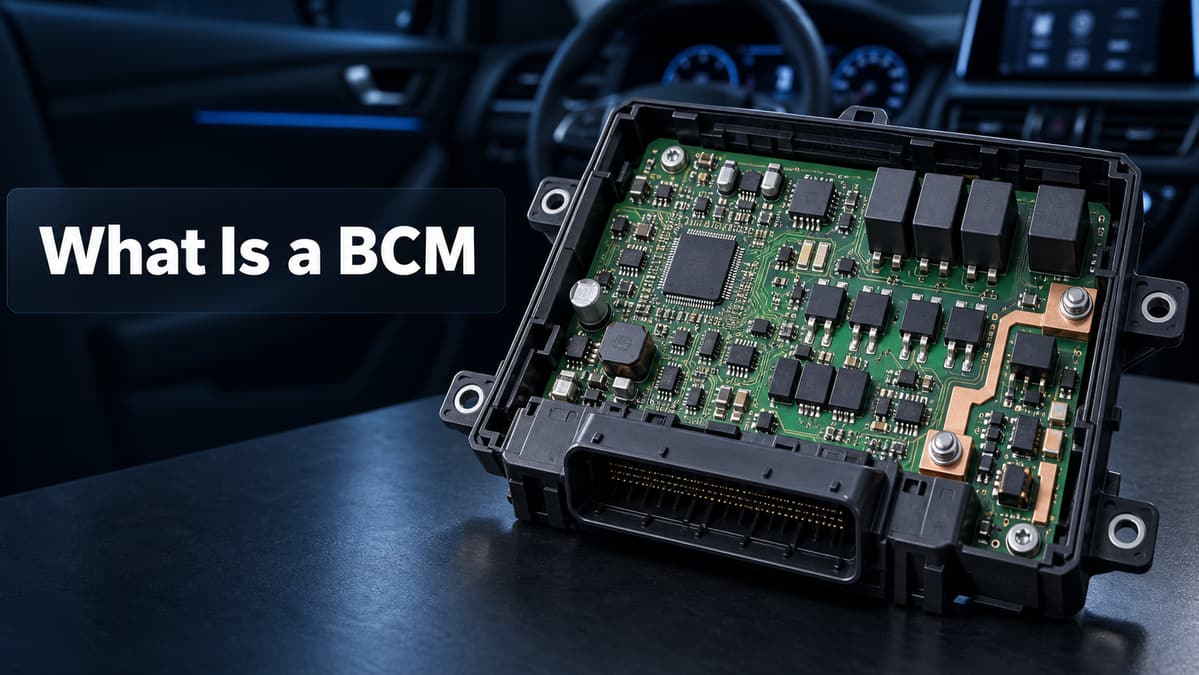


The data center server refresh cycle pcb demand 2026 outlook depends on three things: when operators replace equipment, how many new systems they deploy, and how much PCB content each system contains. A refresh creates new board demand when it requires new hardware, but consolidation can reduce server counts while increasing manufacturing complexity per board. In 2026, AI-related spending adds another driver alongside ordinary replacement. For PCB buyers, the useful question is not simply how old a server is; it is which motherboard, accelerator, networking, storage, and power designs are being released for production.

Key Takeaways
- A refresh cycle is a planning decision, not an automatic retirement date or an accounting depreciation period.
- PCB demand comes from replacement systems, new capacity, supporting network and power equipment, and service spares.
- TTM reported that Data Center and Networking represented 41% of its third-quarter 2026 net sales; that is a supplier sales mix, not global PCB market share.
- AI hardware can change laminate selection, routing density, power distribution, and assembly inspection requirements without imposing one universal layer count.
- Server consolidation can reduce board units even when each replacement system contains more expensive electronics.
- For manufacturing, approved stackups, controlled material substitutions, inspection coverage, and release schedules matter more than a headline market growth rate.
How Long Is a Data Center Server Refresh Cycle?
A data center refresh cycle is workload-dependent: a three-to-five-year replacement window can be a starting planning scenario, but it is not a rule for every fleet or every server component.
Operators replace equipment when performance, operating cost, support coverage, security requirements, or failure exposure justify the change. An underused server may remain useful after a newer generation arrives. A heavily loaded platform may become uneconomic sooner because it consumes too much power or rack space for the work it delivers.
Accounting life measures something different. Microsoft’s fiscal 2026 annual report lists estimated useful lives of two to six years for servers and network equipment. That range describes depreciation assumptions; it does not mean every Microsoft server is physically replaced at either endpoint. A data center replacement cycle should therefore be evaluated against the actual workload and support plan, not copied from an annual-report accounting policy.
At EBest Circuit, we support the manufacturing side of hardware changes through PCB fabrication, DFM review, component sourcing, and PCB assembly services. Our starting point is the released board design and its acceptance requirements—not an assumed replacement age.
Data Center Server Refresh Cycle: What Does the 2026 Evidence Show?
Public 2026 disclosures show strong data-center-related activity, but they do not establish a single global PCB growth rate caused by server refreshes.
| Source and period | Reported evidence | Demand signal |
|---|---|---|
| TTM, results released October 22, 2026; quarter ended September 28 | Data Center and Networking accounted for 41% of total net sales; TTM attributed strength to continued AI demand. | Observed exposure to an active electronics end market. |
| Dell Technologies, fiscal 2026 annual report filed March 16, 2026 | Modernization and consolidation contributed to demand and revenue growth in traditional servers and networking. | Replacement can accompany consolidation, not just fleet expansion. |
| Microsoft, fiscal 2026 annual report | Servers and network equipment have estimated accounting useful lives of two to six years. | Asset-life assumptions vary; they are not direct PCB purchase forecasts. |
These sources describe different things: supplier sales, server-market conditions, and accounting policy. Combining them into a precise PCB shipment forecast would require additional data on system shipments, board content, prices, inventory, and customer production schedules.
For planning as of November 6, 2026, our conclusion is narrower: refresh programs and AI infrastructure are both relevant demand drivers, while the timing and value of a specific PCB order remain design- and program-dependent. This is a manufacturing interpretation of the disclosures, not a full-year market forecast.
How Do Refresh, Expansion, and Redeployment Differ?
Refresh replaces installed equipment, expansion adds capacity, and redeployment moves existing equipment to another use; only the first two necessarily involve newly manufactured systems.

- Refresh: replacing an older compute platform can require a new motherboard, memory interface, risers, and compatible power hardware.
- Expansion: additional servers can also require more switches, storage connections, management electronics, and power distribution.
- Redeployment: moving a retired production server into a development environment reuses its existing boards unless repair or modification is needed.
A program can contain all three. Counting the same server first as a replacement and again as an expansion unit overstates demand. Procurement plans should separate newly built systems from reused hardware before estimating board quantities.
Which PCBs Change During a Server Refresh?
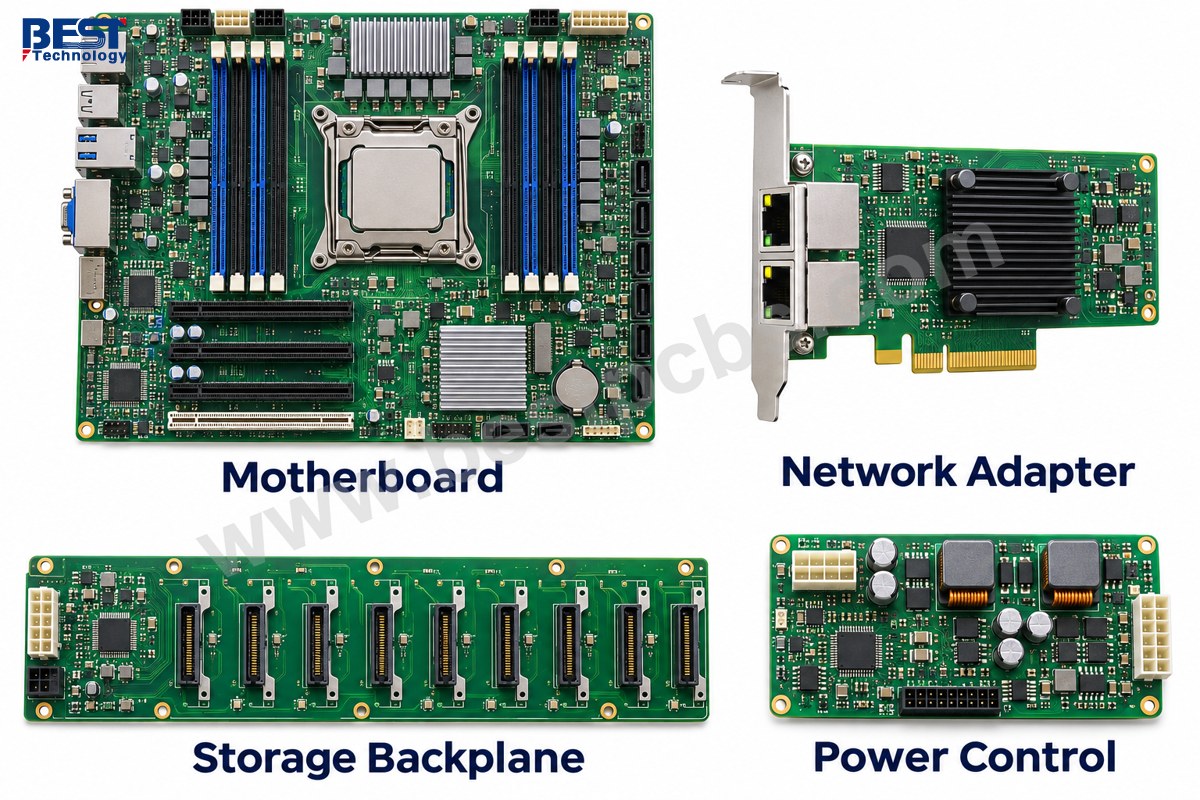
Motherboards, accelerator carriers, network adapters, storage backplanes, and power-control boards can change, depending on which interfaces and mechanical assemblies the new platform retains.
| Board type | Function | Typical redesign trigger |
|---|---|---|
| Server motherboard | Connects processors, memory, management and system interfaces | Processor socket, memory generation, power architecture |
| Accelerator carrier or baseboard | Connects accelerator modules, host interfaces and power | Module footprint, interconnect topology, current demand |
| Network adapter or switch PCB | Moves data within and between systems | Link speed, port density, connector changes |
| Storage backplane | Connects drive bays to data and power interfaces | Drive interface, connector geometry, hot-swap arrangement |
| Power-control or distribution PCB | Distributes, regulates or monitors electrical power | Load current, protection, connector and cooling changes |
Not every board changes in every refresh. A compatible storage backplane may remain in service while the compute board is replaced. Conversely, a new accelerator platform can force changes in the carrier, power connections, and cooling arrangement together. A data center PCB bill of materials should identify these retained and redesigned assemblies separately.
How Does AI Hardware Change PCB Requirements?
AI hardware changes PCB requirements when its interfaces, package density, power demand, or cooling arrangement exceed the existing board design’s margins.
Higher-speed channels require control of dielectric loss, copper roughness, via stubs, connectors, and reference-plane continuity. More routing layers can help distribute signals and power, but adding layers does not automatically solve channel loss. Our PCB design guidance supports the early discussion of stackup and manufacturability before fabrication data is frozen.
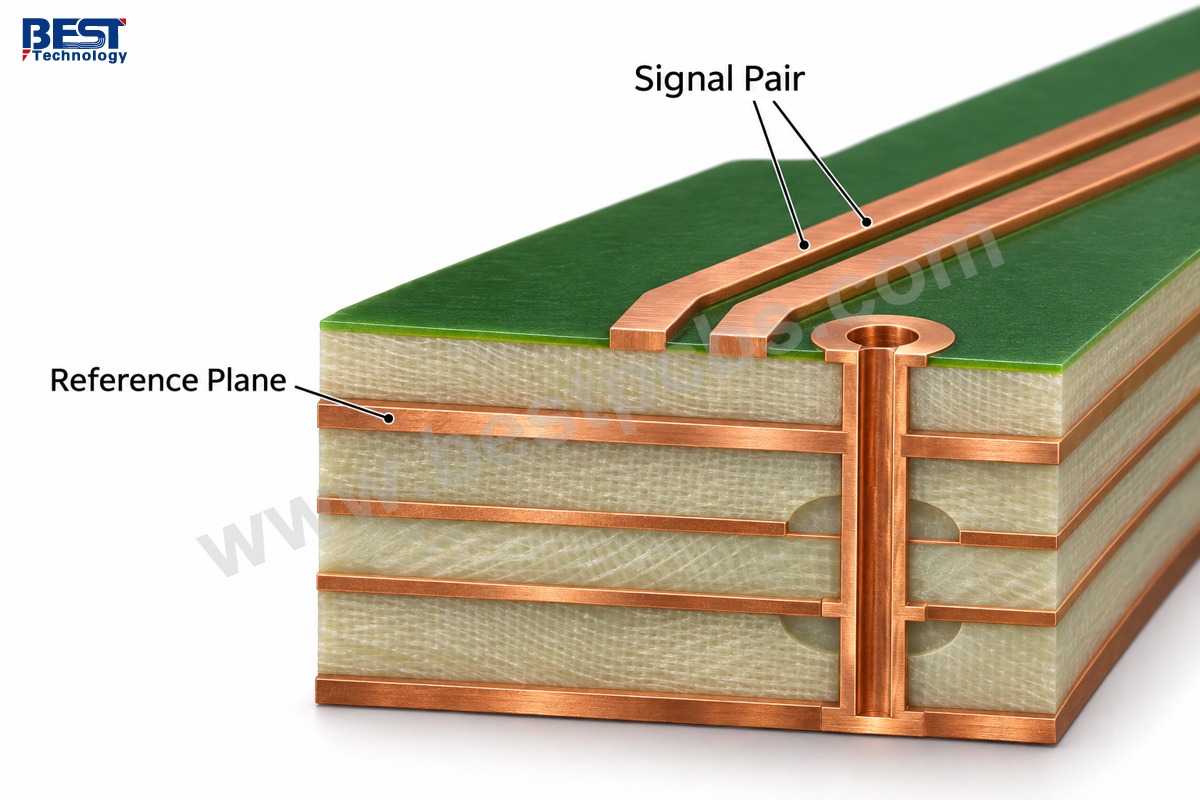
- Signal routing: specify the actual laminate grade, impedance targets, routing geometry, and any required test coupons.
- Power delivery: review copper distribution, current paths, connector interfaces, and heat concentration.
- Dense interconnects: check BGA escape routing, via structures, solder-mask geometry, and assembly access.
- Mechanical integration: confirm board thickness, mounting positions, stiffeners, and clearance to cooling hardware.
These are design inputs, not a claim that every AI board needs HDI, one particular low-loss material, or the same layer count. The appropriate construction follows the channel and mechanical requirements. High Tg alone is also not proof of low electrical loss.
Can Consolidation Reduce PCB Units While Increasing Board Value?
Yes. Replacing several older servers with fewer higher-capacity systems can reduce motherboard quantities while increasing PCB content or manufacturing cost per new system.
Consider an illustrative program replacing 1,000 older servers with 400 new systems after workload validation. If each system has one motherboard, the new purchase contains 400 motherboards—not 1,000. Additional accelerator, networking, and power boards may change the total, but they must be counted from the new architecture. This example is arithmetic, not a reported customer deployment or a market forecast.
Board units, fabricated area, and procurement value are separate measures. A larger board with more demanding materials, drilling, lamination, or inspection can carry a higher price without increasing unit shipments. Buyers and suppliers should state which measure they mean when discussing “PCB demand.”
Why Does Data Center Capital Spending Not Equal PCB Orders?
Data center capital spending includes buildings, power infrastructure, cooling, and other assets, so its growth cannot be converted directly into a PCB purchase-growth percentage.
Even hardware-related budgets pass through several gates before a board order is released: architecture selection, design qualification, component allocation, material approval, pilot builds, and production authorization. A site with unfinished power or cooling work may also defer installation despite an approved equipment budget.
For PCB scheduling, track the board revision, qualified stackup, pilot acceptance, firm release quantities, and material commitments. These project signals are closer to production demand than a broad infrastructure spending announcement. Separate confirmed orders from forecasts and optional releases rather than treating all three as committed factory loading.
What Should a Data Center Refresh Proposal Specify?
A data center refresh proposal should specify the workload being replaced, the retained hardware, the new board assemblies, and the qualification and rollout milestones.
- Define the replacement scope. Separate new systems, reused equipment, repair spares, and capacity expansion.
- Freeze interface and mechanical requirements. Identify connectors, power interfaces, cooling clearances, board outlines, and mounting points.
- Approve the manufacturing baseline. Align fabrication revision, stackup, BOM, permitted alternatives, assembly instructions, and test requirements.
- Qualify a pilot before volume release. Resolve board, assembly, firmware, and fixture issues against agreed acceptance criteria.
- Stage deliveries against deployment readiness. Match material purchases and production releases to the rollout rather than one assumed fleet replacement date.
This creates an actionable handover between system engineering and manufacturing. It also avoids comparing quotations that use different material grades, inspection coverage, or test scope.
How Can EBest Circuit Support Board Manufacturing?
We support reviewed PCB and PCBA projects through DFM, material selection discussions, fabrication, sourcing, assembly, and an agreed inspection and test plan.
For multilayer FR-4 PCB fabrication, we review the specified material system and construction rather than substituting a generic “equivalent” without approval. On assembled boards, the inspection plan can combine solder-paste inspection, AOI, BGA X-ray inspection, and functional testing according to the actual design and order scope.

Each method answers a different question. Bare-board electrical testing checks continuity and isolation; AOI checks visible assembly features; X-ray reveals selected hidden-joint conditions; functional testing checks defined behavior. No single inspection image proves system-level performance. We agree on the required coverage before the build so the delivered records match the project’s acceptance criteria.
FAQs About Server Refresh Cycles and PCB Demand
Does an expired server warranty mean the PCB must be replaced?
No. Warranty expiration changes support coverage, not the board’s physical condition. Replacement depends on service options, failure exposure, workload needs, and operating cost. A functioning board may remain usable, although the operator must decide whether continued service fits its reliability and security requirements.
Does a firmware upgrade create demand for new PCBs?
Not normally. Updating firmware reuses the installed hardware. New boards are needed only if the required function cannot be supported by the existing platform or if hardware modification or replacement is part of the upgrade.
Are refurbished servers the same demand source as new servers?
No. Refurbishment generally reuses existing boards, with replacement demand concentrated in failed assemblies, upgrades, or service parts. New-system manufacturing creates a different bill of materials. Combining refurbished and newly manufactured units without separating reused electronics can overstate new PCB demand.
Does every AI server require HDI PCBs?
No. HDI becomes relevant when package escape routing, interconnect density, and space constraints justify microvias or related structures. Some assemblies can use conventional multilayer construction. The board design and fabricator’s reviewed process capability determine the construction—not the AI label alone.
Should all spares be purchased with the first rollout?
Not necessarily. Spare quantities depend on service policy, repair turnaround, part availability, and the stability of the board revision. Purchasing too early can leave obsolete stock after a design change. Staged commitments can help, provided material availability and manufacturing lead times are reviewed before each release.
Plan Your Data Center Server Refresh Cycle with Manufacturing in Mind
The strongest PCB demand signal is a qualified design moving into an approved production release. If your refresh program includes custom boards, contact our engineering team at sales@bestpcbs.com. We can review the construction, sourcing, assembly, and test scope before you commit to the next build.