

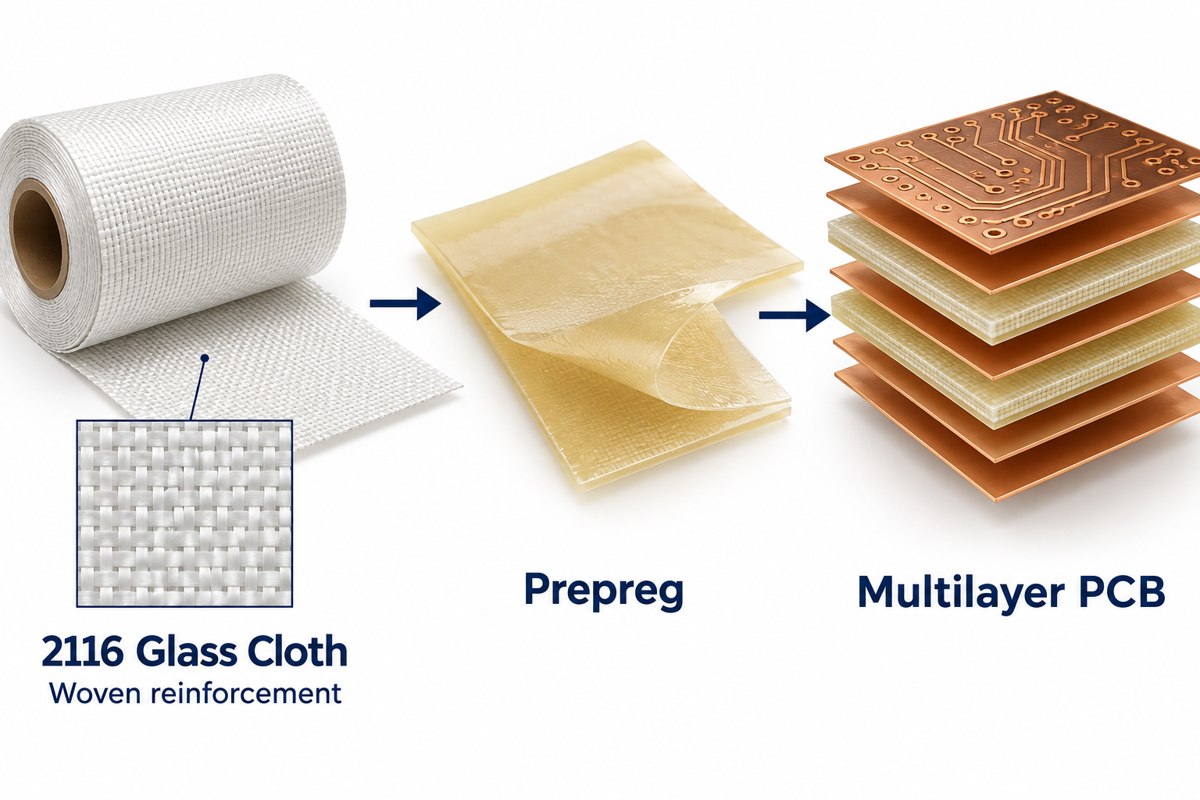
2116 Glass Cloth is a woven glass reinforcement used in PCB laminates and prepregs. Electronic-grade versions commonly use E-glass yarn in a plain weave, with fabric weights around 103–105 g/m² and a representative dry-cloth thickness of 0.094 mm. The number 2116 identifies the fabric construction—not a resin grade, dielectric constant, or finished PCB thickness.
For a PCB stackup, the useful specification combines the glass style with the laminate brand, resin system, resin content and finished dielectric thickness. Those choices determine whether the construction fits the board’s spacing, impedance and lamination requirements.
Key Takeaways
- 2116 is a woven reinforcement style used inside PCB materials, not a complete FR-4 material specification.
- Published electronic-grade examples list approximately 103–105 g/m² fabric weight; one supplier lists 0.094 mm nominal dry-cloth thickness.
- Dry glass-cloth thickness is not cured prepreg thickness. Resin content, copper coverage and lamination conditions affect the dielectric layer.
- Isola’s current 370HR table lists 2116 constructions at 0.119, 0.130 and 0.147 mm for different resin contents.
- 1080 is lighter and thinner; 7628 is heavier and thicker. They are not automatic drop-in substitutes for 2116.
- For controlled-impedance boards, confirm the actual material construction and validate thickness and impedance—not just the glass-style number.
What Is 2116 Glass Cloth?
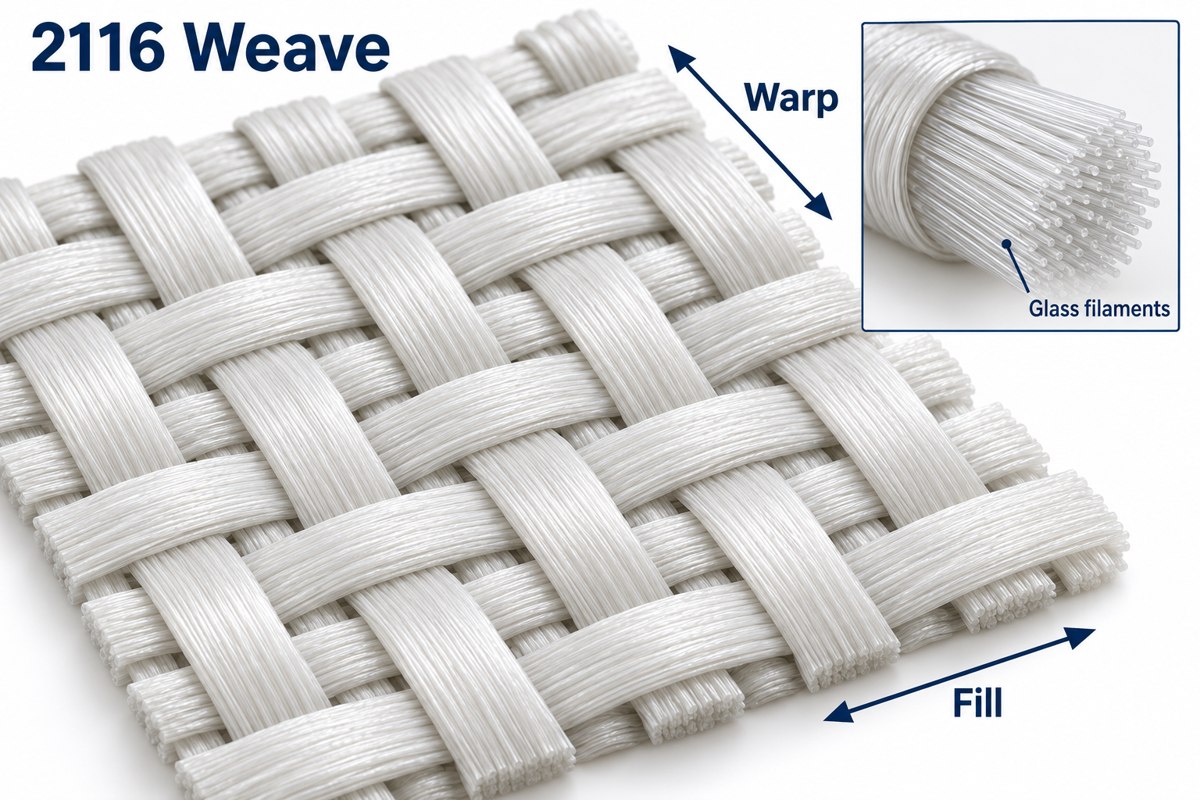
2116 glass cloth is a plain-woven reinforcement made from intersecting glass yarns, used to give resin-based PCB dielectric layers mechanical support and dimensional stability.
Suppliers also call it 2116 fiberglass cloth or 2116 glass fabric. In a plain weave, each yarn passes alternately over and under the yarns running across it. The lengthwise yarns are the warp; the crosswise yarns are the fill, also called the weft.
At EBest Circuit, we support FR-4 PCB manufacturing and engineering review. For a design using 2116, our focus is the complete laminate and prepreg construction: how it builds the specified dielectric spacing, supports copper features and fits the fabrication process.
What Are the Specifications of 2116 Glass Fabric?
Representative electronic-grade 2116 specifications are a plain weave, roughly 60 warp yarns and 57 fill yarns per inch, and about 103–105 g/m² fabric weight.
| Parameter | Published 2116 example |
|---|---|
| Weave | Plain |
| Warp density | 60 ± 2 ends/inch — Fulltech |
| Fill density | 57 ± 2 ends/inch — Fulltech |
| Fabric weight | 103 ± 2 g/m² — Fulltech |
| Alternative supplier weight | 105 ± 3 g/m² — Yaosheng |
| Nominal dry-fabric thickness | 0.094 mm — Yaosheng |
These are named supplier examples, not a single universal tolerance specification. Use the purchased fabric or laminate supplier’s current data when a drawing requires a controlled value.
How Does 2116 Glass Cloth Become PCB Prepreg?
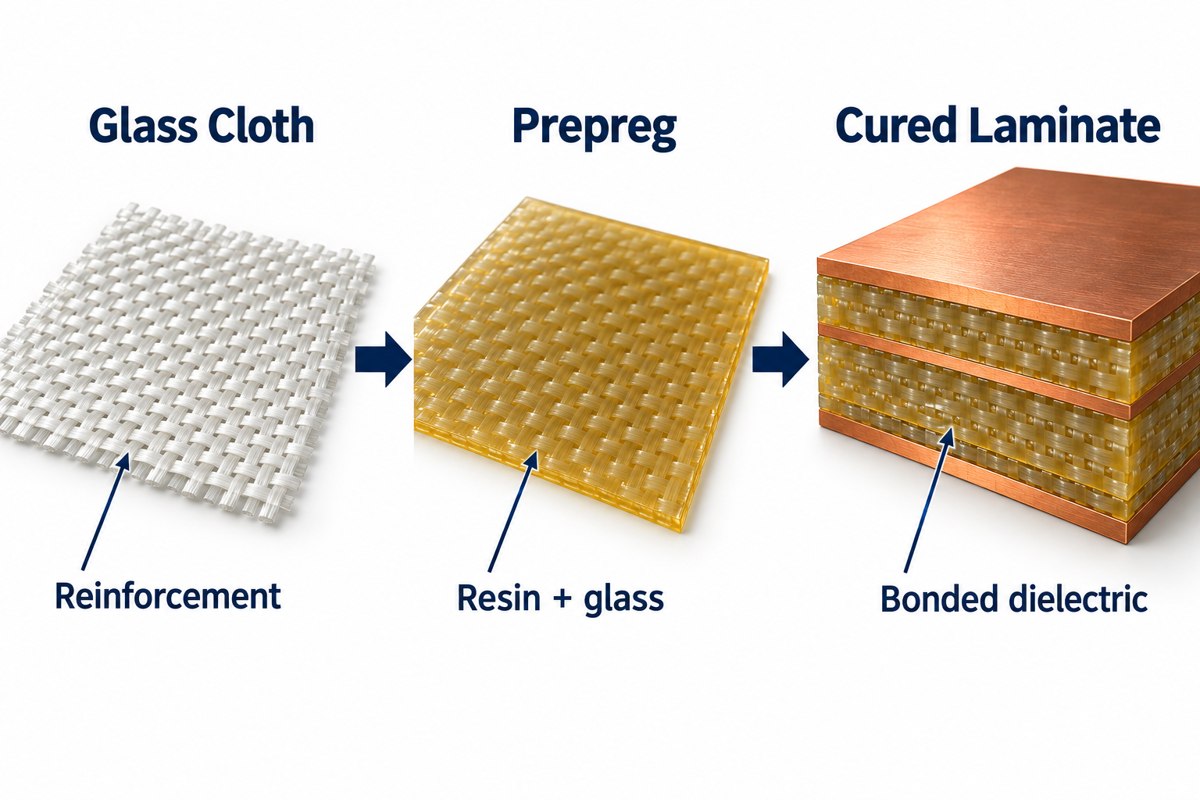
The fabric becomes prepreg when it is impregnated with resin and partially cured, leaving a sheet that can flow and bond during PCB lamination.
- The glass-fabric supplier weaves and finishes the reinforcement for compatibility with the intended resin.
- The laminate producer impregnates the fabric and controls resin pickup.
- Controlled drying and partial curing produce the B-stage prepreg sheet.
- The PCB fabricator places selected sheets between prepared layers and laminates them under a qualified temperature, pressure and vacuum cycle.
After curing, the resin and glass form the dielectric that separates copper layers. Bare fabric does not provide the bonding function of prepreg. A cured core is different again: it is already a rigid laminate, typically supplied with copper. Our PCB prepreg guide explains these material stages in more detail.
What Determines 2116 Prepreg Thickness?
2116 prepreg thickness depends on the resin system and resin content as well as the glass fabric; the final laminated spacing also depends on resin flow and the surrounding copper pattern.
For example, Isola’s current 370HR construction table gives the following values for 2116 prepreg. These are material-table values, not unconditional finished-board tolerances.
| 370HR glass style | Resin content | Listed thickness |
|---|---|---|
| 2116 | 52% | 0.119 mm |
| 2116 | 56% | 0.130 mm |
| 2116 | 60% | 0.147 mm |
The table’s February 2026 revision corrected the thickness entry for 2116 at 56% resin content. This is a practical reason to use the current construction sheet rather than copying a thickness from an older stackup.
In fabrication, resin must fill the spaces left by etched copper. A layer with wide copper-free areas does not have the same resin demand as a nearly solid plane. Adding nominal sheet thicknesses therefore provides a starting point, not proof of the final dielectric spacing.
How Does 2116 Compare with 1080 and 7628?
2116 sits between lighter 1080 and heavier 7628 in fabric weight and typical dry-cloth thickness, making it useful when the stackup needs more reinforcement per sheet than 1080 without the bulk of 7628.
| Glass style | Nominal dry-cloth thickness | Fabric weight |
|---|---|---|
| 1080 | 0.053 mm | 48 ± 3 g/m² |
| 2116 | 0.094 mm | 105 ± 3 g/m² |
| 7628 | 0.185 mm | 203.4 ± 5 g/m² |
The comparison uses Yaosheng’s electronic-grade fabric data so the values come from one supplier. It compares dry reinforcements, not finished prepreg layers.
- 1080: useful where thin dielectric constructions are needed.
- 2116: a candidate for intermediate dielectric builds in multilayer boards.
- 7628: useful for thicker builds where its larger reinforcement contribution fits the design.
Two sheets of 1080 are not automatically equivalent to one sheet of 2116. Resin mass, weave distribution, cured thickness and electrical properties can differ even when the overall thickness target looks similar.
Does the 2116 Weave Affect PCB Impedance?
Yes. The glass-and-resin distribution affects the dielectric environment around a trace, while the finished dielectric thickness directly affects its impedance.
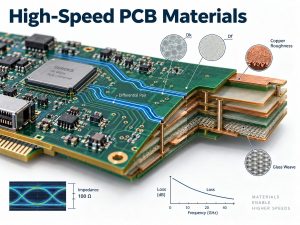
A differential pair can accumulate skew if its two traces encounter different proportions of glass and resin over a long distance. Spread-glass constructions reduce the size of resin-rich gaps; routing and stackup choices also affect the result. The style number alone does not tell you whether a fabric is spread. Isola states that 370HR glass is spread in both directions.
For an impedance calculation, use the selected laminate’s construction-specific dielectric data at relevant frequencies, along with the finished trace geometry and dielectric spacing. Do not assign one universal dielectric constant to every material containing 2116.
What Should Be Controlled During 2116 PCB Lamination?
Resin fill, dielectric spacing and layer alignment are the main lamination controls for a PCB stackup using 2116 prepreg.
- Resin fill: assess etched copper thickness and copper-free areas before selecting resin content and sheet count.
- Material condition: follow the prepreg supplier’s storage, handling and usable-life instructions.
- Press cycle: use the selected resin system’s processing window; “2116” does not specify a cure temperature.
- Stackup balance: review copper and material distribution across the board to reduce avoidable distortion.
- Layer registration: account for dimensional movement through lamination before drilling and imaging subsequent layers.
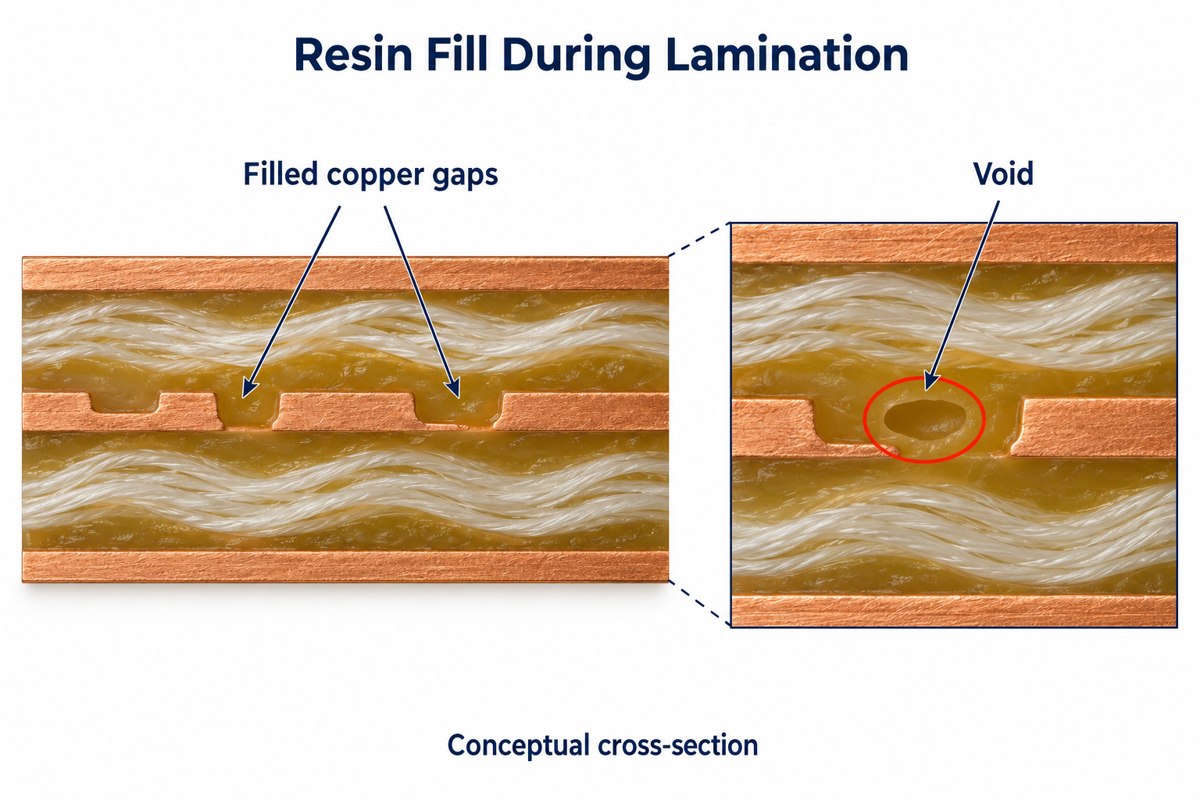
Insufficient resin can leave voids or inadequate coverage around copper features. Excessive flow can change the dielectric spacing. Neither condition can be judged from fabric weight alone.
How Is a 2116-Based PCB Stackup Verified?
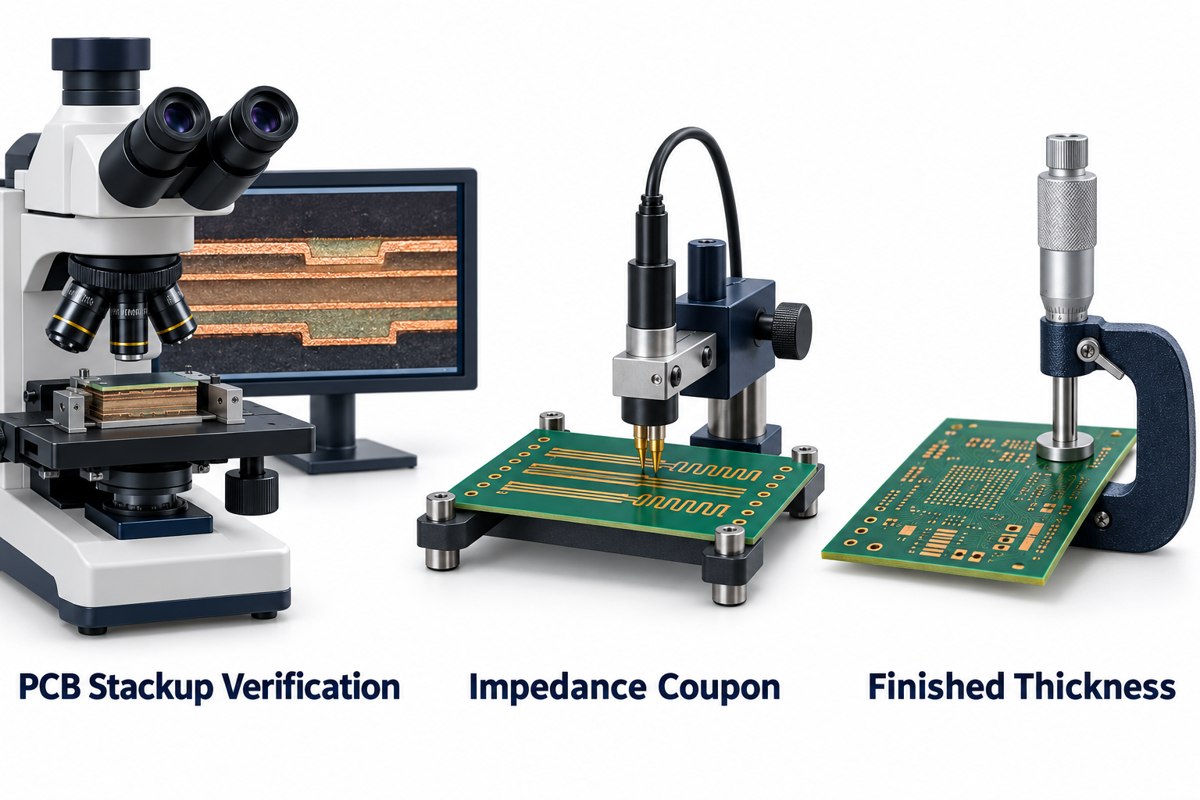
Verify a 2116-based stackup through material records, cross-section measurements and the electrical tests required by the board—not by measuring overall board thickness alone.
- Confirm the laminate grade, prepreg construction, resin content and material lot against the approved build.
- Use microsections to inspect dielectric spacing, resin fill and relevant interlayer features.
- Measure finished board thickness and flatness against the drawing.
- For controlled-impedance designs, test representative coupons using the agreed method and acceptance limits.
- Use electrical testing to check continuity and isolation; apply additional reliability testing when required by the project.
FAQ About 2116 Glass Cloth
Is 2116 glass cloth the same as FR-4?
No. 2116 identifies a reinforcement construction. FR-4 identifies a family of flame-retardant glass-reinforced epoxy laminates that can use different glass styles.
Does 2116 specify a PCB’s Tg?
No. Tg belongs to the cured resin system and laminate formulation. Two materials using 2116 can have different thermal ratings.
Can general-purpose 2116 composite fabric replace PCB-grade fabric?
Not solely because the style number matches. Electronic laminates require suitable fabric finish, cleanliness, resin compatibility and qualification by the laminate supplier.
Is 2116 prepreg always 0.13 mm thick?
No. 0.130 mm is one listed 370HR construction at 56% resin content. Other resin contents and material systems have different values.
Can 2116 be used in a high-speed PCB?
Yes, if the complete material construction meets the channel’s loss, impedance and skew requirements. The fabric style by itself does not establish a maximum data rate.
How Can EBest Circuit Support Your PCB Stackup?
We can review the material construction and dielectric spacing as part of PCB engineering support, then manufacture the board and provide PCB assembly when needed.
If your current drawing specifies only “2116,” send the stackup to sales@bestpcbs.com. We can help clarify the laminate grade, resin content and thickness requirements before the build moves into production.