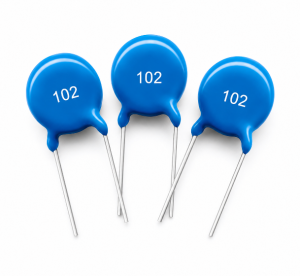
104J capacitor is a capacitor marked with the code “104J,” which usually means it has a capacitance value of 100,000 pF, or 100 nF, or 0.1 µF, with a J tolerance of ±5%. This guide explains the 104J capacitor value, code meaning, unit conversion, material types, voltage ratings, common uses, replacement rules, and testing methods in a clear and practical way.
If you are checking an old circuit board, reading a capacitor marking, repairing an electronic device, or choosing a replacement part, the marking “104J” can be confusing at first. The good news is that this code follows a simple rule. Once you understand how to read it, you can quickly identify what a 104J capacitor does and whether it fits your circuit.
Here is the quick answer before we go deeper:
| Marking | Capacitance | Tolerance | Common Unit |
|---|---|---|---|
| 104J | 100,000 pF | ±5% | 0.1 µF / 100 nF |
In short, a 104J capacitor is most commonly a 0.1 µF capacitor. The “104” tells you the capacitance value, while the “J” tells you the tolerance.
What Is a 104J Capacitor?
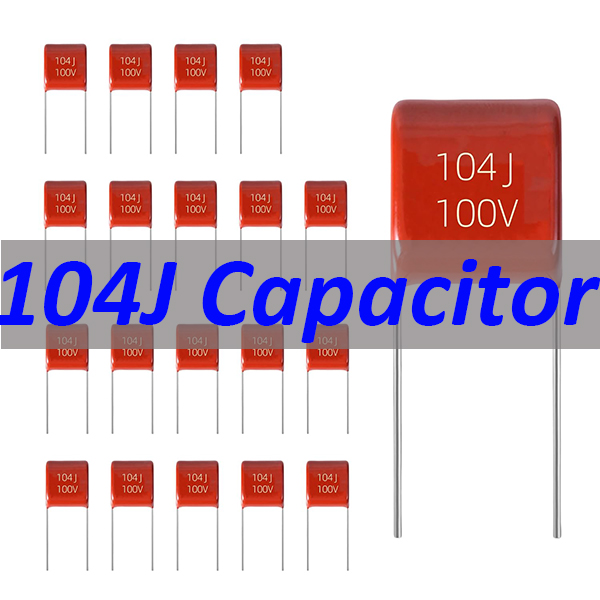
A 104J capacitor is an electronic component used to store and release electrical energy in a circuit. It is commonly used for decoupling, bypassing, filtering, noise suppression, coupling, timing, and general signal conditioning.
The marking “104J” appears on many capacitor types, especially ceramic capacitors and film capacitors. In many practical circuits, a 104J capacitor is selected because 0.1 µF is a very common capacitance value.
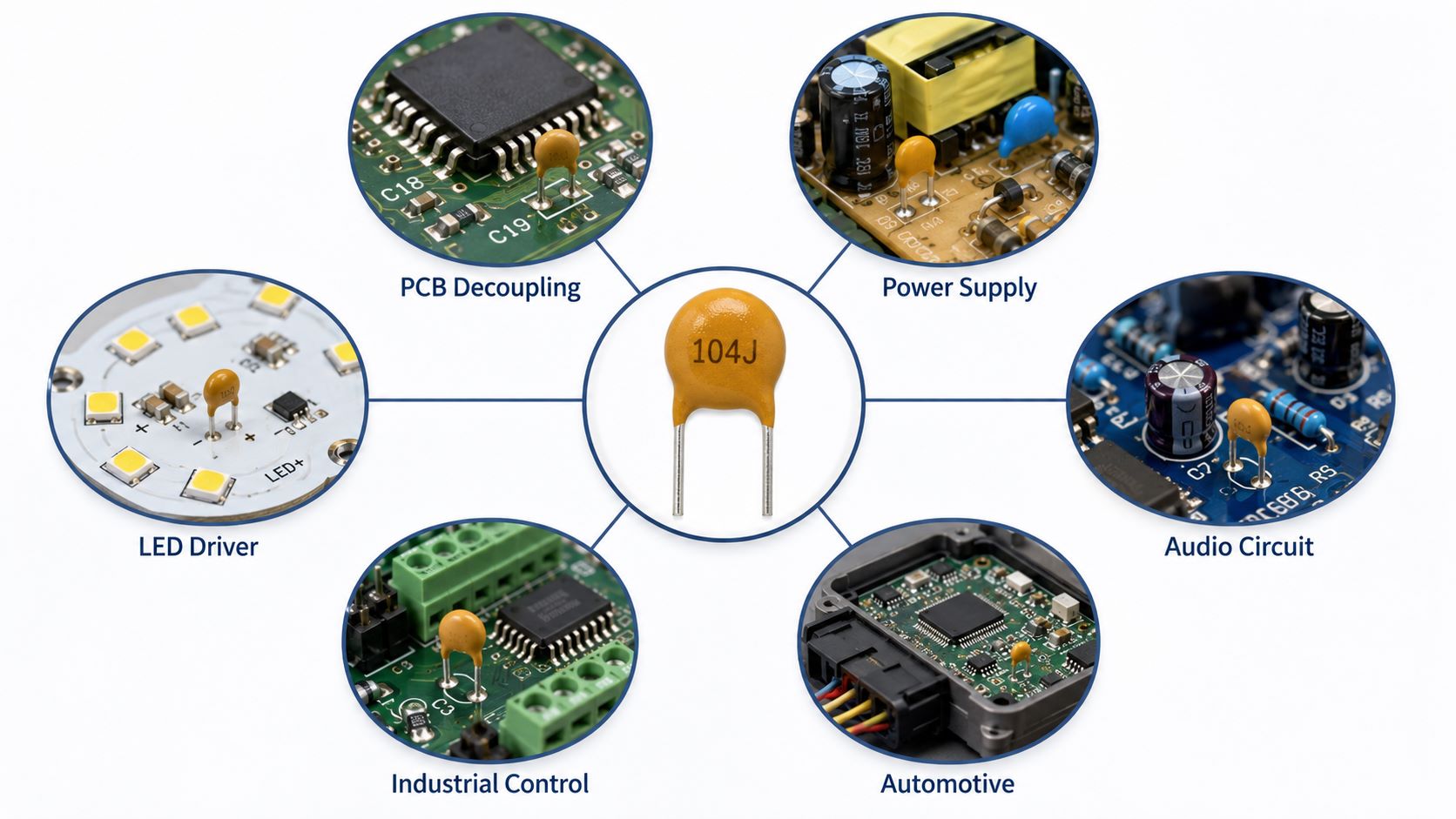
A 104J capacitor may appear in:
- Power supply filter circuits
- PCB decoupling networks
- Audio circuits
- Motor control circuits
- LED driver circuits
- Consumer electronics
- Industrial control PCB boards
- Automotive electronic modules
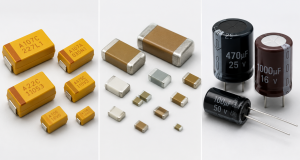
The capacitor may look different depending on its material and package. Some are small ceramic disc capacitors. Some are yellow or green polyester film capacitors. Some are box-type polypropylene capacitors. The appearance may change, but the value code follows the same basic reading method.
For example, a 104J capacitor marked on a small disc part and a 104J capacitor marked on a film capacitor may both have the same capacitance value of 0.1 µF. However, their voltage rating, temperature behavior, size, dielectric material, and application may not be the same.
That is why reading only “104J” is not enough for final replacement. You should also check the voltage rating, material type, package size, lead spacing, temperature rating, and circuit function.
What Is the Value of a 104J Capacitor?
The value of a 104J capacitor is 100,000 pF, which equals 100 nF or 0.1 µF. This is the most important point for anyone searching for 104J capacitor value.
The code “104” uses the standard three-digit capacitor code system:
- The first digit is 1.
- The second digit is 0.
- The third digit is 4.
- The third digit means “add four zeros.”
- So, 104 = 10 + four zeros = 100,000 pF.
So the capacitance is:
100,000 pF = 100 nF = 0.1 µF
This value is widely used because 0.1 µF capacitors are useful in many electronic circuits. They are especially common near IC power pins, where they help reduce noise and stabilize the local power supply.
A simple way to remember it is:
- 101 = 100 pF
- 102 = 1,000 pF
- 103 = 10,000 pF
- 104 = 100,000 pF
- 105 = 1,000,000 pF
So when you see “104,” you can read it as 100 nF or 0.1 µF.
If the capacitor is marked as 104J, the capacitance value is still 0.1 µF. The letter “J” does not change the capacitance value. It only describes the tolerance.
What Does 104J Mean on a Capacitor?
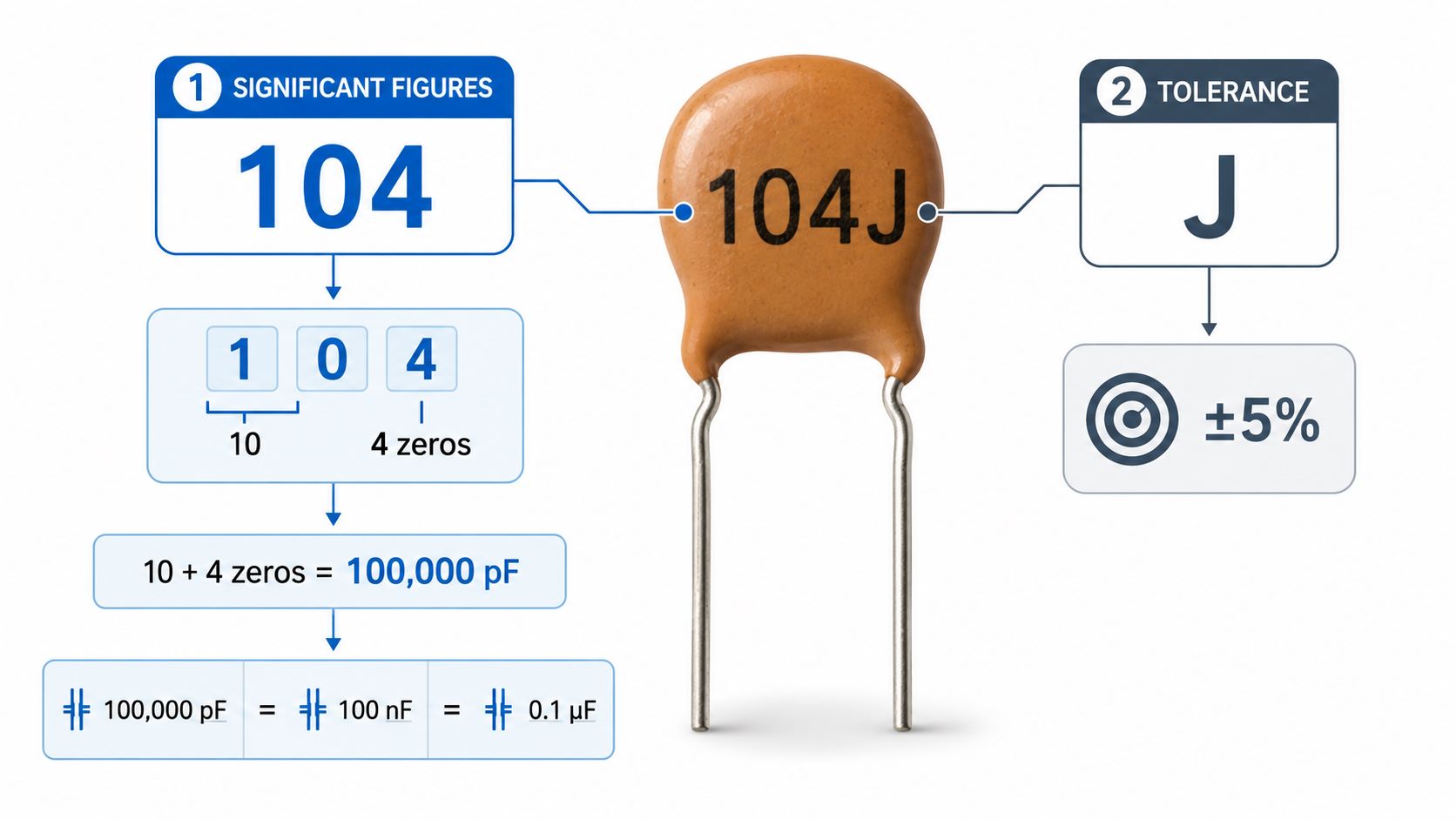
The marking 104J has two parts: “104” and “J.” Each part gives a different piece of information.
The meaning is:
- 104 = capacitance code
- J = tolerance code
The “104” means the capacitor value is 100,000 pF. The “J” means the capacitance tolerance is ±5%.
Tolerance tells you how much the actual capacitance may vary from the marked value. For a 104J capacitor, the ideal value is 0.1 µF, but the real measured value may be slightly higher or lower.
For example:
- Nominal value: 0.1 µF
- Tolerance: ±5%
- Acceptable range: about 0.095 µF to 0.105 µF
This means a 104J capacitor does not have to measure exactly 0.100 µF to be acceptable. If it is within the tolerance range, it is normally considered correct.
Common capacitor tolerance letters include:
| Letter | Tolerance |
|---|---|
| J | ±5% |
| K | ±10% |
| M | ±20% |
So, the difference between 104J and 104K is not the capacitance value. Both are usually 0.1 µF. The difference is tolerance. A 104J capacitor is more precise than a 104K capacitor.
This is important when choosing replacements. For general filtering, a 104K capacitor may sometimes work. For more sensitive timing, audio, or signal circuits, it is safer to keep the same tolerance or use a better one.
What Is the 104J Capacitor Value in pF, nF and µF?
The 104J capacitor value can be written in three common units: pF, nF, and µF. These units all describe the same capacitance, but they are used in different datasheets, drawings, and circuit diagrams.
The conversion is:
| Unit | 104J Capacitor Value |
|---|---|
| pF | 100,000 pF |
| nF | 100 nF |
| µF | 0.1 µF |
These three values are equal.
Many beginners become confused because one circuit diagram may show 0.1 µF, while another datasheet may show 100 nF, and the capacitor body may show 104J. In most cases, these are referring to the same capacitance value.
Here is a simple unit relationship:
- 1 nF = 1,000 pF
- 1 µF = 1,000 nF
- 0.1 µF = 100 nF
- 100 nF = 100,000 pF
So if you see “104J capacitor value in uF,” the answer is 0.1 µF. If you see “capacitor 104J 100n,” it means the same thing: 104J is a 100 nF capacitor.
For SEO and practical clarity, these expressions all point to the same value:
- 104J capacitor value = 0.1 µF
- capacitor 104J value = 100 nF
- 104J capacitor value in uF = 0.1 µF
- a 104J capacitor = 100,000 pF capacitor
This is why the 104J capacitor is often used as a quick reference example when learning capacitor codes.
How to Read a 104J Capacitor Code Correctly?
To read a 104J capacitor code correctly, separate the number code from the letter code. The number gives the capacitance value, and the letter gives the tolerance.
Use this method:
- Read the first two digits as the base number.
- Use the third digit as the number of zeros.
- Treat the final result as pF.
- Convert pF to nF or µF if needed.
- Read the letter as the tolerance code.
For 104J:
- First two digits: 10
- Third digit: 4 zeros
- Result: 100,000 pF
- Converted value: 100 nF or 0.1 µF
- Tolerance letter: J = ±5%
This method also works for many other capacitor markings.
Examples:
| Code | Value in pF | Value in nF | Value in µF |
|---|---|---|---|
| 101 | 100 pF | 0.1 nF | 0.0001 µF |
| 102 | 1,000 pF | 1 nF | 0.001 µF |
| 103 | 10,000 pF | 10 nF | 0.01 µF |
| 104 | 100,000 pF | 100 nF | 0.1 µF |
| 105 | 1,000,000 pF | 1,000 nF | 1 µF |
The same rule is often used on ceramic capacitors and film capacitors. However, larger capacitors may also print the capacitance directly, such as 0.1 µF, 100n, or 100nF.
One practical tip: if the capacitor has other markings, do not ignore them. Extra markings may show voltage, series, temperature grade, safety approval, or manufacturer code. For replacement, these details can matter as much as the capacitance value.
Is a 104J Capacitor Ceramic, Polyester or Polypropylene?
A 104J capacitor can be ceramic, polyester, polypropylene, or another dielectric type. The marking “104J” tells you capacitance and tolerance, but it does not always tell you the material.
This is a common misunderstanding. Some people think 104J always means ceramic. Others think it always means polyester film. In reality, 104J can appear on different capacitor families.
Common types include:
- Ceramic 104J capacitor
Often used for decoupling, bypassing, filtering, and general PCB circuits. - Polyester 104J capacitor
Often used in audio, coupling, filtering, and general-purpose film capacitor applications. - Polypropylene 104J capacitor
Often used where lower loss, better stability, or higher voltage performance is needed. - Safety-rated film capacitor
Used in AC line filtering or interference suppression, but only when properly rated as X or Y safety capacitors.
The material affects important performance factors:
- Temperature stability
- Voltage rating
- Size
- ESR
- Loss factor
- Frequency behavior
- Long-term reliability
- Suitable application area
For example, a ceramic 104J capacitor may be excellent for compact PCB decoupling. A polypropylene 104J capacitor may be better for pulse circuits, snubber circuits, or applications that need lower dielectric loss. A polyester 104J capacitor may be suitable for general signal coupling or filtering.
So, when replacing a 104J capacitor, do not choose only by the 104J marking. Try to match the original capacitor type, voltage rating, package style, and working position in the circuit.
104J Capacitor Datasheet Overview
A 104J capacitor datasheet usually gives more than just the capacitance value. It helps engineers confirm whether the capacitor is suitable for the real circuit.
The most important datasheet items include:
| Parameter | Typical Meaning |
|---|---|
| Capacitance | 0.1 µF / 100 nF / 100,000 pF |
| Tolerance | J = ±5% |
| Rated Voltage | 50V, 100V, 250V, 400V, 630V or higher |
| Dielectric | Ceramic, polyester, polypropylene, etc. |
| Temperature Range | Depends on series and material |
| Package | Disc, radial lead, box film, SMD, etc. |
| Lead Spacing | Important for through-hole replacement |
| Dissipation Factor | Lower is better for some AC or signal circuits |
| Insulation Resistance | Important for leakage-sensitive circuits |
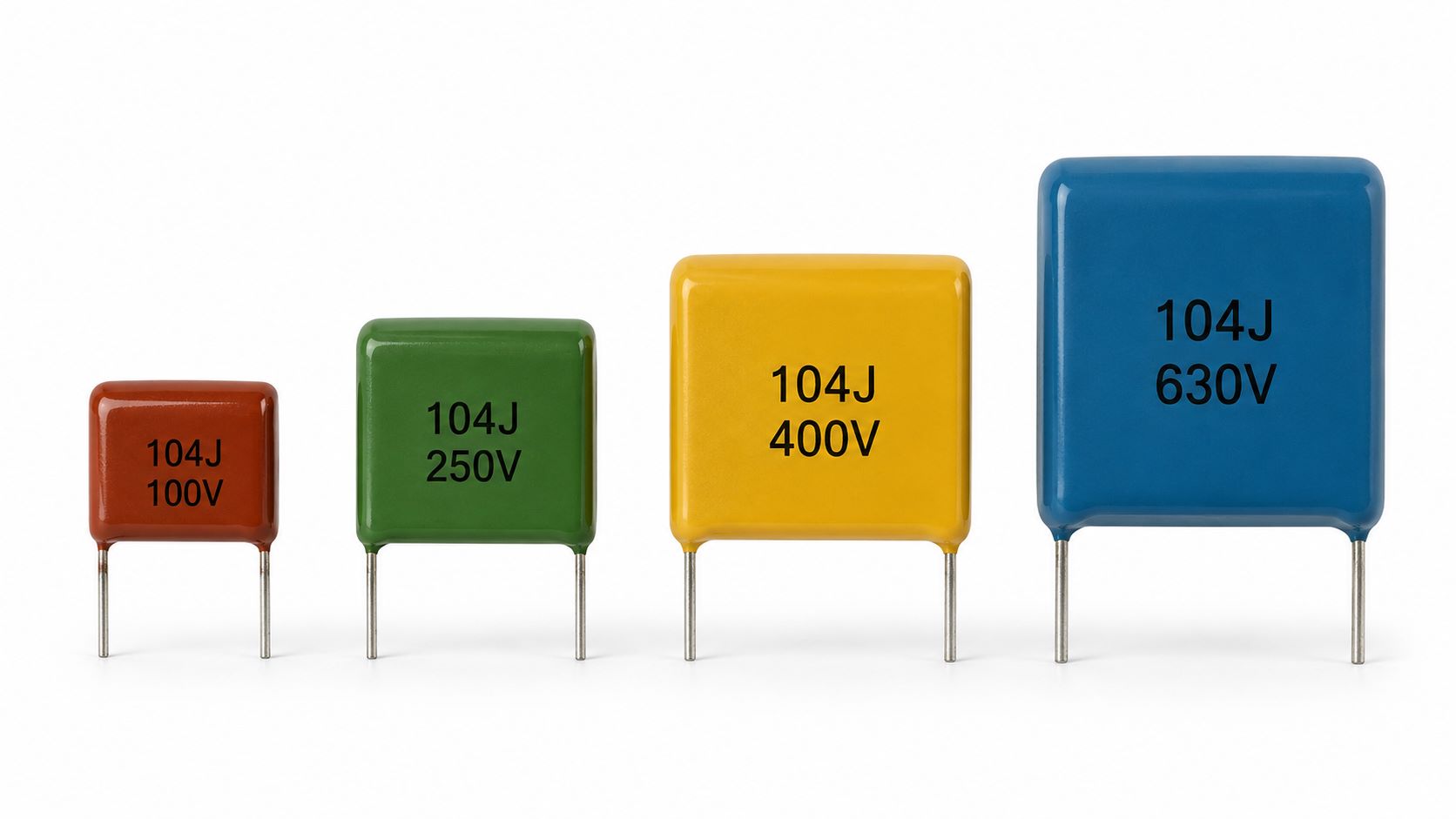
The voltage rating is one of the most important specifications. A 104J 100V capacitor and a 104J 400V capacitor may have the same capacitance, but they are not the same component. The 400V part can handle a higher working voltage, while the 100V part may be smaller and cheaper.
The dielectric material is also important. Ceramic capacitors can be small and economical, but their capacitance may change with voltage and temperature depending on the ceramic class. Film capacitors are often larger, but they can offer better stability in some applications.
A good 104J capacitor datasheet should help you answer these questions:
- Is the capacitance 0.1 µF?
- Is the tolerance ±5%?
- What is the rated voltage?
- What material is used?
- What is the operating temperature range?
- What is the package size?
- Is it suitable for the circuit environment?
For repair work, try to match the original specifications as closely as possible. For new design work, select the capacitor according to the actual circuit function, voltage margin, temperature range, and reliability target.
What Is the Voltage Rating of a 104J Capacitor?
The voltage rating of a 104J capacitor tells you the maximum voltage the capacitor is designed to handle under specified conditions. It does not change the capacitance value.
This point is very important:
- 104J 100V capacitor value = 0.1 µF
- 104J 250V capacitor value = 0.1 µF
- 104J 400V capacitor value = 0.1 µF
- 104J 630V capacitor value = 0.1 µF
The capacitance stays the same. The voltage rating changes.
Common 104J capacitor voltage ratings include:
- 50V
- 100V
- 250V
- 400V
- 630V
- 1kV
A low-voltage 104J capacitor may be used in signal circuits, low-voltage power rails, microcontroller boards, and small electronic products. A high-voltage 104J capacitor may be used in power supplies, motor circuits, lighting drivers, snubber circuits, and high-voltage filtering applications.
When choosing voltage rating, do not select a capacitor with a voltage rating lower than the circuit voltage. In many designs, engineers use voltage margin. For example, a 12V circuit may use a 25V or 50V capacitor. A 100V circuit may require a 250V or higher rated capacitor, depending on spikes, ripple, and safety margin.
A higher voltage rating usually means:
- Larger physical size
- Higher cost
- Better voltage margin
- Different dielectric or package options
It is usually acceptable to replace a capacitor with the same capacitance and a higher voltage rating, as long as the package size, lead spacing, material type, and circuit requirements are suitable. However, replacing a high-voltage capacitor with a lower-voltage part is risky and should be avoided.
What Is the Difference Between 104J 100V, 250V, 400V and 630V Capacitors?
The main difference between 104J 100V, 250V, 400V, and 630V capacitors is voltage rating. Their capacitance value is the same: 0.1 µF. Their ability to handle voltage is different.
Here is a simple comparison:
| Marking | Capacitance | Tolerance | Voltage Rating |
|---|---|---|---|
| 104J 100V | 0.1 µF | ±5% | 100V |
| 104J 250V | 0.1 µF | ±5% | 250V |
| 104J 400V | 0.1 µF | ±5% | 400V |
| 104J 630V | 0.1 µF | ±5% | 630V |
A 104J 100V capacitor is often used in low-voltage or moderate-voltage electronic circuits. A 104J 250V capacitor may be used in higher voltage signal or filtering circuits. A 104J 400V capacitor may appear in power supplies, lighting circuits, or industrial boards. A 104J 630V capacitor is often used when more voltage margin is needed.
The voltage choice depends on:
- Working voltage
- Peak voltage
- Ripple voltage
- Surge voltage
- Circuit location
- Safety requirement
- Temperature
- Reliability target
For example, if the original part is a 104J 400V capacitor, using a 104J 100V capacitor as a replacement is usually not safe. The capacitance may match, but the voltage rating does not.
On the other hand, replacing a 104J 250V capacitor with a 104J 400V capacitor may be acceptable in many cases if the size and material are suitable. Still, you should check the circuit function before making the change.
A practical rule is simple: match the capacitance, match the tolerance when possible, and never go lower on voltage rating unless the circuit has been reviewed by a qualified engineer.
Where Is a 104J Capacitor Commonly Used?
A 104J capacitor is commonly used in circuits that need 0.1 µF capacitance for noise reduction, filtering, bypassing, coupling, or timing. Because 0.1 µF is a very useful value, 104J capacitors appear in many electronic products.
Common uses include:
- Power supply decoupling
A 104J capacitor is often placed near IC power pins to reduce high-frequency noise. - Bypass circuits
It can provide a low-impedance path for unwanted AC noise. - Signal coupling
In some circuits, it can pass AC signals while blocking DC voltage. - Filter circuits
It can work with resistors or inductors to reduce noise or shape signals. - Audio circuits
Polyester or film 104J capacitors may be used for coupling or tone control. - Motor and power circuits
Higher-voltage film capacitors may be used for noise suppression or snubber functions. - LED drivers and lighting circuits
104J capacitors may support filtering, EMI reduction, or control circuit stability. - Industrial control boards
They can help stabilize control signals and reduce electrical noise.
In capacitor PCB design, 0.1 µF capacitors are often used as local decoupling capacitors. They are placed close to IC power pins to help reduce voltage disturbance. In this role, the physical placement of the capacitor can be as important as the capacitor value.
In repair work, you may find a 104J capacitor on power boards, control boards, amplifiers, adapters, LED lamps, small appliances, and automotive electronics. Before replacing it, check the voltage rating and material type carefully.
How to Choose the Right 104J Capacitor Replacement?
To choose the right 104J capacitor replacement, you need to match more than the printed code. The replacement should fit the circuit electrically, mechanically, and thermally.
Use this checklist:
- Match the capacitance
The replacement should be 0.1 µF, 100 nF, or 100,000 pF. - Match or improve the tolerance
Replace 104J with ±5% when possible. A tighter tolerance may be acceptable, but a looser tolerance may not be suitable for sensitive circuits. - Match or exceed the voltage rating
Do not replace a 400V part with a 100V part. Higher voltage may be acceptable if size and material fit. - Match the dielectric type
Replace ceramic with ceramic when the circuit needs that behavior. Replace film with film when stability, AC performance, or pulse handling matters. - Check the package style
Confirm through-hole, SMD, disc, box film, radial lead, or axial package. - Check lead spacing and body size
The part must physically fit the PCB. - Check the circuit function
Decoupling, coupling, filtering, timing, snubber, and safety circuits may require different capacitor types. - Check safety rating if used across AC lines
Do not replace a safety capacitor with a normal capacitor. Use proper X or Y safety-rated parts.
A 104J capacitor replacement may look correct by value, but still fail in the circuit if the voltage rating, material, or safety classification is wrong.
For example, a 104J 630V polypropylene film capacitor may be used in a power or pulse circuit. Replacing it with a small ceramic capacitor marked 104J may not provide the same performance. The capacitance value may match, but the electrical behavior may be different.
When in doubt, use the original datasheet, circuit diagram, or manufacturer specification as the main reference.
How to Test a 104J Capacitor With a Multimeter?
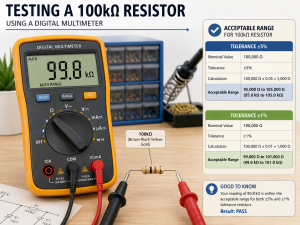
You can test a 104J capacitor with a digital multimeter if the meter has a capacitance measurement function. A basic resistance test can also help detect short circuits, but it cannot accurately measure capacitance.
Follow these steps:
- Turn off power completely
Never test a capacitor in a live circuit. - Discharge the capacitor safely
Use a suitable resistor to discharge it before handling. - Remove one leg if needed
In-circuit readings may be affected by other components. - Set the multimeter to capacitance mode
Choose the capacitor measurement function. - Connect the probes to the capacitor leads
Observe polarity only if the capacitor type is polarized. Most 104J ceramic or film capacitors are non-polarized. - Read the measured value
A 104J capacitor should measure near 0.1 µF. - Compare with tolerance
For 104J, a normal reading is usually around 0.095 µF to 0.105 µF, depending on meter accuracy and test conditions.
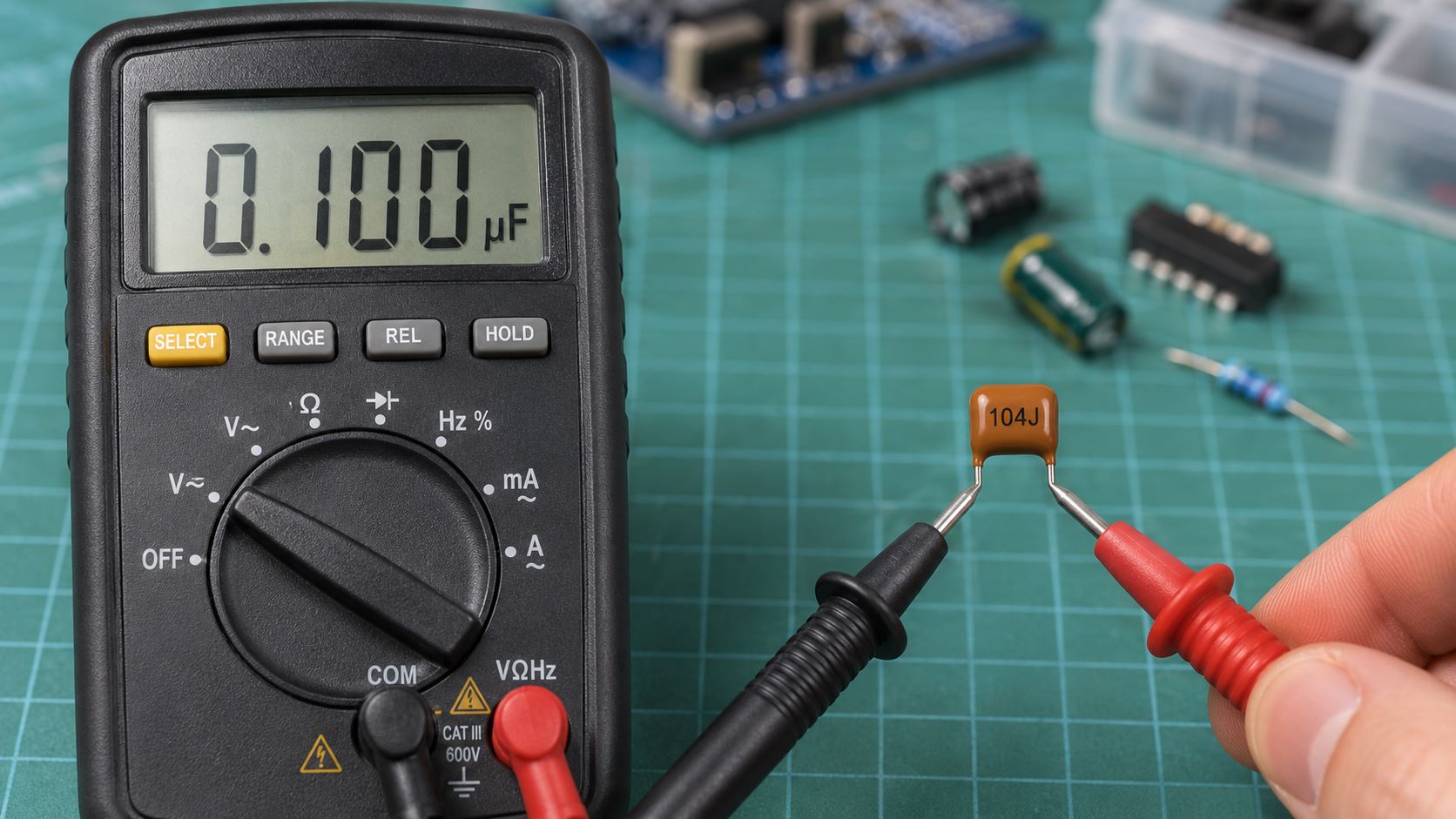
If the capacitor reads open, shorted, unstable, or far outside the expected value, it may be damaged. However, testing small capacitors can be affected by meter quality, lead contact, circuit connection, and dielectric behavior.
For more accurate testing, an LCR meter is better than a basic multimeter. An LCR meter can measure capacitance under more controlled test conditions and may also show ESR or loss factor.
For high-voltage capacitors, safety is critical. Some capacitors can hold charge after the circuit is turned off. Always discharge them properly before testing.
FAQs About 104J Capacitor
What Is a 104J Capacitor?
A 104J capacitor is usually a 0.1 µF capacitor with ±5% tolerance. The “104” means 100,000 pF, and the “J” means ±5%.
What Is the Value of a 104J Capacitor?
The value of a 104J capacitor is 100,000 pF, 100 nF, or 0.1 µF.
What Does 104J Mean on a Capacitor?
“104” is the capacitance code. It means 10 followed by four zeros in pF. “J” is the tolerance code, which means ±5%.
Is a 104J Capacitor the Same as 0.1 µF?
Yes. A 104J capacitor is normally the same capacitance value as 0.1 µF or 100 nF.
Is a 104J Capacitor Polarized?
Most 104J ceramic and film capacitors are non-polarized. However, always check the capacitor type and datasheet if you are not sure.
What Is the Difference Between 104J and 104K Capacitors?
Both are usually 0.1 µF capacitors. The difference is tolerance. 104J means ±5%, while 104K means ±10%.
Can I Replace a 104J Capacitor With a 104K Capacitor?
Sometimes, but not always. For general filtering, it may work. For precise timing, audio, or sensitive signal circuits, it is better to keep the same tolerance or use a tighter one.
Can I Use a Higher Voltage 104J Capacitor?
Yes, in many cases you can use a higher voltage 104J capacitor if the capacitance, package, material, and lead spacing are suitable. Do not use a lower voltage replacement unless the circuit has been reviewed.
What Is a 104J 100V Capacitor?
A 104J 100V capacitor is a 0.1 µF capacitor with ±5% tolerance and a 100V voltage rating.
What Is a 104J 400V Capacitor?
A 104J 400V capacitor is a 0.1 µF capacitor with ±5% tolerance and a 400V voltage rating. The higher voltage rating does not change the capacitance value.
Is a 104J Capacitor Ceramic or Film?
It can be ceramic or film. The marking “104J” tells the value and tolerance, but the capacitor material should be confirmed by appearance, datasheet, or part number.
Why Do 104J Capacitors Come in Different Colors?
104J capacitors may appear in different colors, such as red, green, yellow, blue, brown, or orange, because manufacturers use different coating materials, product series, voltage ratings, dielectric types, or visual designs. In most cases, the color itself does not directly define the capacitance value. A red 104J capacitor, a green 104J capacitor, and a yellow 104J capacitor can all have the same 0.1 µF value if they are marked “104J.” To identify the capacitor correctly, always check the printed code, voltage rating, dielectric material, package size, and datasheet instead of relying only on color.
Where Is a 104J Capacitor Used?
It is commonly used in decoupling, bypassing, filtering, coupling, audio circuits, power supplies, LED drivers, industrial boards, and control circuits.
How Do I Test a 104J Capacitor?
Use a multimeter with capacitance mode or an LCR meter. A good 104J capacitor should measure close to 0.1 µF, usually within the allowed tolerance range.
To summarize, 104J capacitor is a 0.1 µF capacitor, also written as 100 nF or 100,000 pF, and the “J” marking usually means ±5% tolerance. Understanding this code helps you read capacitor markings, compare voltage ratings, identify material types, choose replacements, and test parts more confidently.
For most users, the key is simple: “104” gives the value, “J” gives the tolerance, and the voltage rating must be checked separately. A 104J 100V capacitor, 104J 250V capacitor, 104J 400V capacitor, and 104J 630V capacitor may all share the same capacitance value, but they are not interchangeable in every circuit.
When replacing a 104J capacitor, match the capacitance, tolerance, voltage rating, dielectric type, package size, and circuit function. That is the safest way to avoid choosing a part that looks correct but performs poorly in the real application.