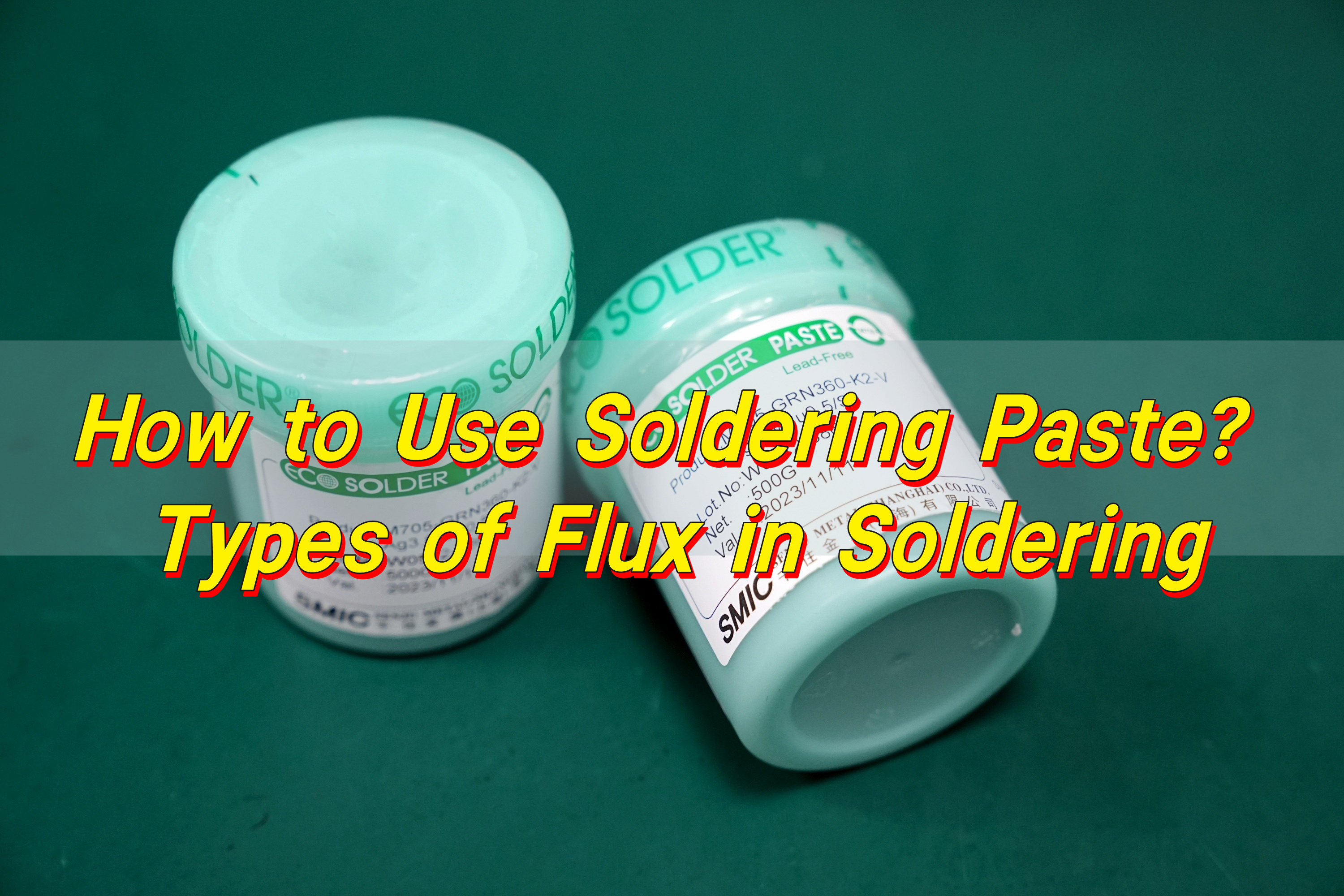
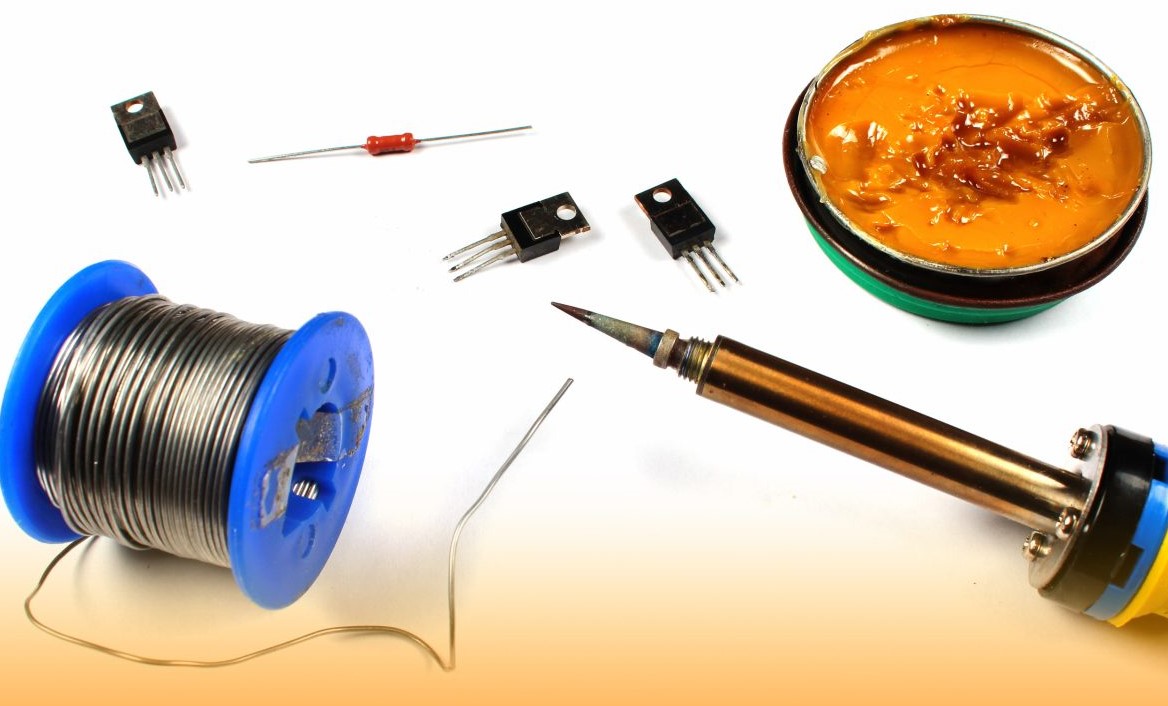
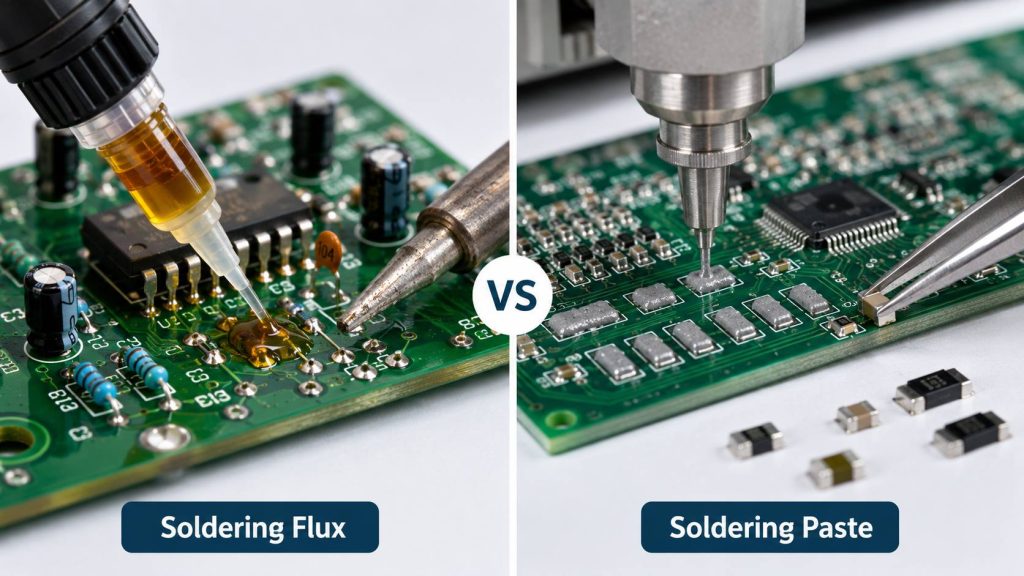
Soldering flux vs soldering paste comes down to one practical difference: flux prepares metal surfaces for soldering, while solder paste supplies both flux and solder metal. Use flux with solder wire, a solder bath, preforms, or existing solder. Use solder paste when the process requires a measured deposit of solder powder before heating, especially for surface-mount assembly.
The right choice depends on the assembly method, component footprint, alloy, and residue requirements. At EBest Circuit, we review these requirements alongside the BOM, stencil design, and inspection plan so material selection supports a repeatable production process.
What Is the Difference Between Soldering Flux and Solder Paste?
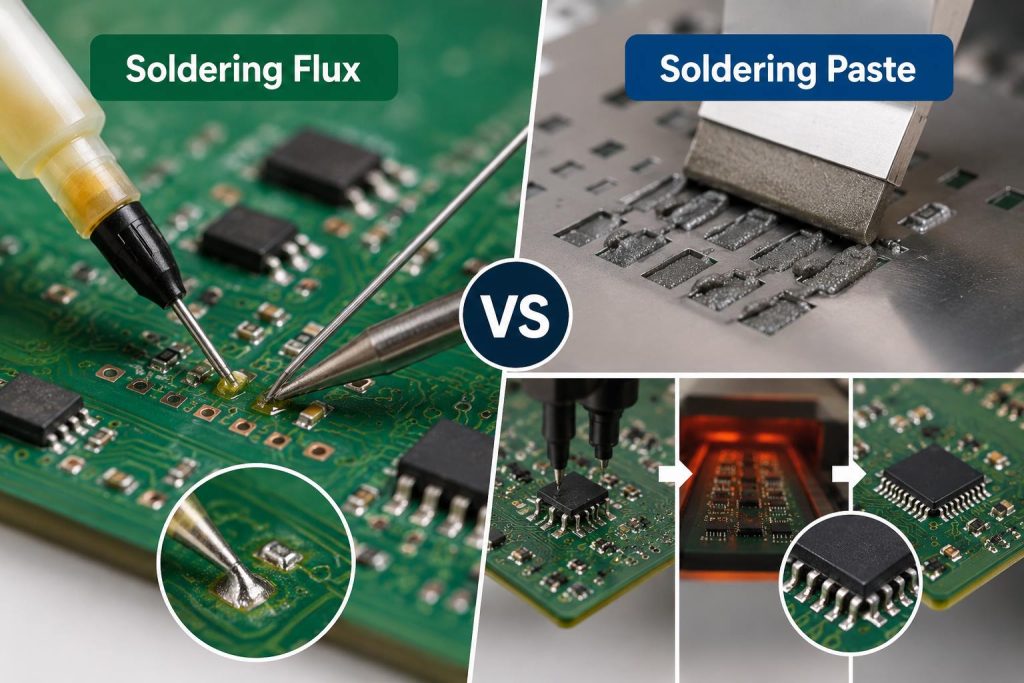
Soldering flux is a chemical preparation that removes surface oxides and supports solder wetting during heating. Solder paste combines a flux vehicle with fine metal powder; that powder melts and becomes the metallic connection.
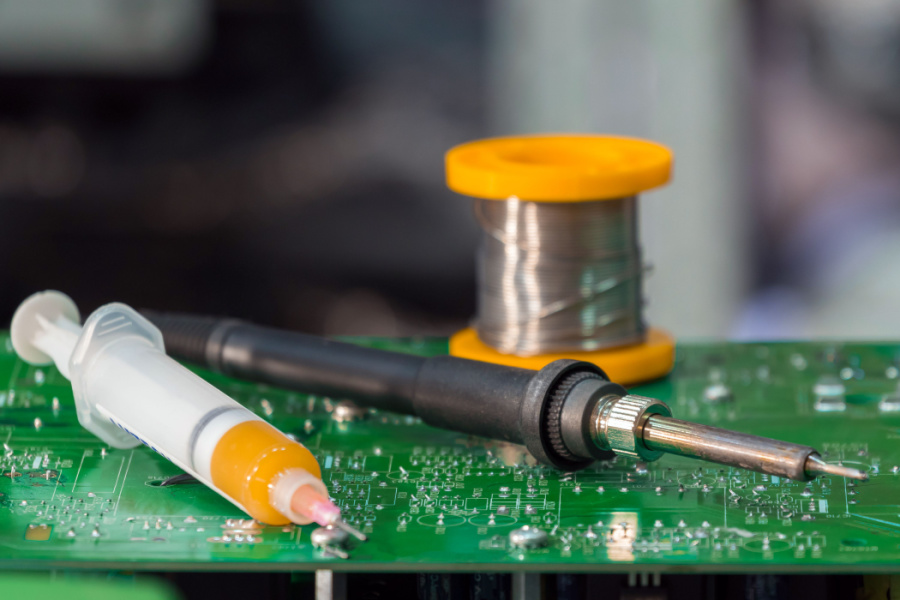
This distinction matters when buying materials. A syringe labeled “paste flux” may contain no solder powder. A similarly packaged solder paste should identify its alloy, powder type, and metal loading.
Check the technical data sheet rather than relying on the product name or appearance.
| Comparison point | Soldering flux | Solder paste |
|---|---|---|
| Main ingredients | Activators, carrier or solvent, and formulation-dependent resin or other ingredients | Solder alloy powder dispersed in a flux vehicle |
| Supplies solder metal? | No | Yes |
| Main function | Supports oxide removal and wetting | Deposits solder metal and supports wetting during reflow |
| Common physical forms | Liquid, pen, gel, or paste-like material | Metal-filled paste supplied in jars, cartridges, or syringes |
| Typical application | Pen, brush, spray, selective application, or dispensing | Stencil printing, jetting, or dispensing with a compatible formulation |
| Common processes | Hand soldering, wave soldering, selective soldering, and rework | SMT reflow and selected rework processes |
| Important specifications | Flux classification, solids content, activity, application amount, and residue behavior | Alloy, powder size, metal loading, rheology, working life, and reflow requirements |
| Source of the finished joint metal | Separate solder wire, bath, preform, or existing solder | Powder contained in the paste |
| Cleaning decision | Based on flux chemistry, processing, and assembly requirements | Based on the paste’s flux system, processing, and assembly requirements |
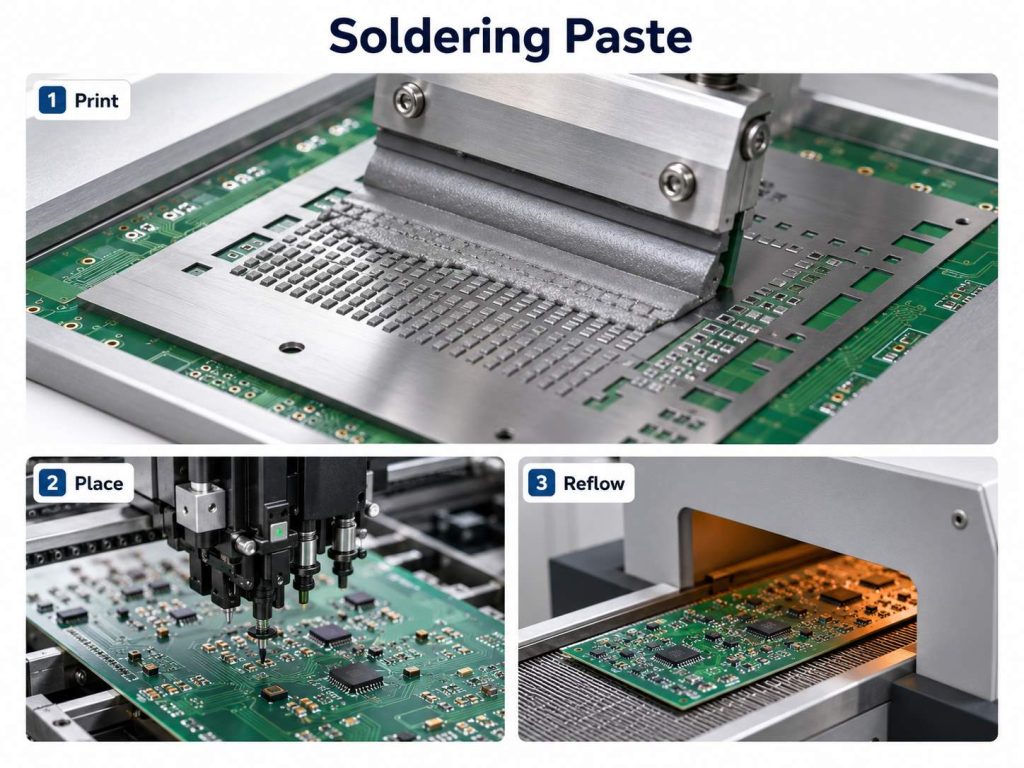
A solder paste deposit performs several jobs before it becomes a joint. It carries solder to the pad, maintains a printable or dispensable shape, and provides tack to help hold the component before reflow.
Flux applied separately has a different purpose. It assists a soldering operation in which the metal is supplied elsewhere.
What Does Flux Actually Do During Soldering?
Flux helps molten solder contact and spread across suitable metal surfaces. Its activators address oxides, while the formulation helps protect the heated interface during joint formation.
Good wetting produces contact between the solder and the pad or termination. Poor wetting may appear as solder pulling back, forming isolated beads, or leaving areas uncovered.
Ordinary flux does not change the melting point of the solder alloy. Its contribution is chemical surface preparation and support for wetting. If a joint receives insufficient heat, adding more flux alone will not solve the thermal problem.
Flux performance depends on several connected factors:
- Surface condition: Pad finishes and component terminations need to remain within acceptable solderability conditions.
- Activation window: The flux must remain effective during the relevant heating cycle.
- Application amount: The deposit must cover the work area without creating unnecessary residue.
- Thermal exposure: Heating must support solvent removal and activation while respecting assembly limits.
- Residue requirements: The processed material must suit the electrical and protective-coating requirements.
For example, a clean connector pin may need only the flux already present in cored solder wire. A reworked fine-pitch device may benefit from a controlled application of compatible external flux.
Treat heavy oxidation as a material-condition issue as well as a soldering issue. Check storage history, surface finish, and component condition before choosing a more active formulation.
What Is Inside Solder Paste, and Which Parameters Matter?
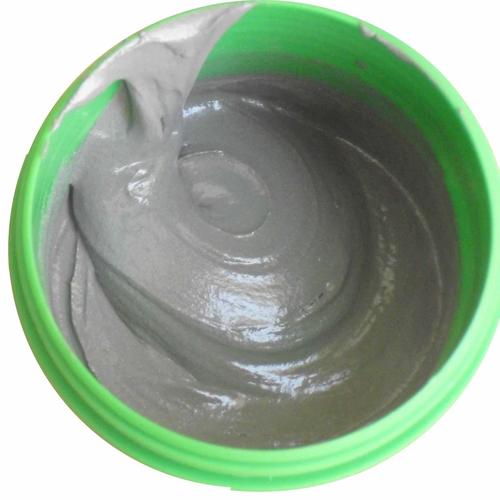
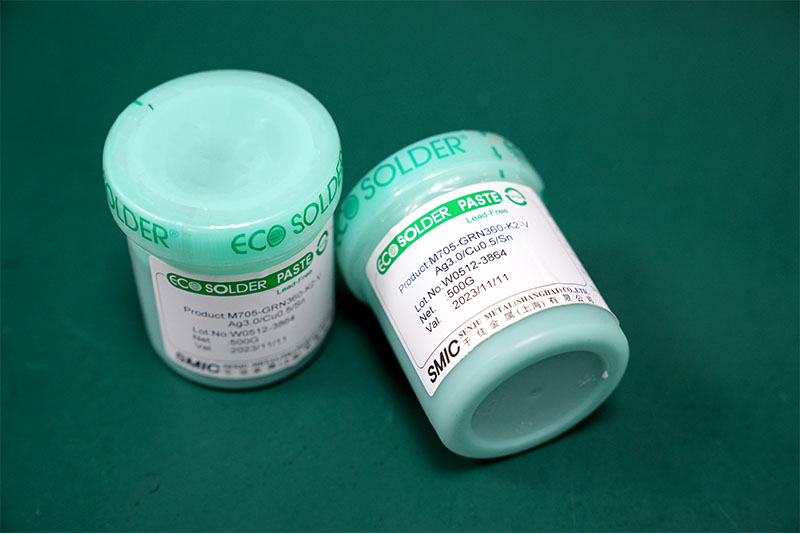
Solder paste contains alloy powder and a flux vehicle. The vehicle supports printing, tack, activation, and reflow behavior; the alloy determines the joint’s metallic composition.
- SAC305: Sn96.5%, Ag3.0%, Cu0.5% by weight.
- SAC0307-type: Sn99.0%, Ag0.3%, Cu0.7% by weight.
- Sn63Pb37: Sn63%, Pb37% by weight; a lead-containing alloy that needs application-specific compliance review.
Alloy, powder type, and metal loading describe different properties. SAC305 identifies an alloy composition. Type 4 identifies a powder-size category. A value such as 88.5% identifies the metal loading by weight for a particular formulation.
The following grades show how powder size, metal loading and cleaning route vary independently. Match the complete grade to the intended printing and cleaning process.
| Paste grade | Alloy composition by weight | Powder type | Metal loading by weight | Flux-system description |
|---|---|---|---|---|
| EM907 / T3 grade | Sn96.5Ag3.0Cu0.5, commonly called SAC305 | Type 3 | 88.5% | No-clean; contains halogen |
| EM907 / T4 grade | Sn96.5Ag3.0Cu0.5 | Type 4 | 88.5% | No-clean; contains halogen |
| WP616 / T4 grade | Sn96.5Ag3.0Cu0.5 | Type 4 | 88.8% | Water-soluble; zero-halogen |
| WP616 / T5 grade | Sn96.5Ag3.0Cu0.5 | Type 5 | 88.3% | Water-soluble; zero-halogen |
These settings apply only to the named grades. A matching alloy or metal percentage does not make two paste formulations interchangeable.
An 88.5% metal loading also means that a 100 g quantity contains approximately 88.5 g of alloy powder and 11.5 g of flux vehicle. That is a mass relationship. It does not mean the paste deposit retains 88.5% of its printed volume after reflow, because the metal and vehicle have different densities.
Other useful parameters include viscosity, slump, tack time, stencil life, and response to printing pauses. Compare viscosity values only when the instrument, temperature, and measurement conditions are compatible.
How Does Powder Size Affect Fine-Pitch Printing?
Powder size influences how readily solder paste passes through small stencil apertures. The relevant feature is the smallest aperture opening, together with stencil thickness and release behavior.
Common powder-size ranges are 25–45 µm for Type 3, 20–38 µm for Type 4, and 15–25 µm for Type 5. For initial aperture screening, allow five maximum-size particles across a rectangular opening and seven across a square opening or circular diameter.
| Powder type | Particle diameter range | Largest particle used in the screening calculation | Rectangular aperture width using five particles | Square or circular aperture width using seven particles |
|---|---|---|---|---|
| Type 3 | 25–45 µm | 45 µm | 225 µm | 315 µm |
| Type 4 | 20–38 µm | 38 µm | 190 µm | 266 µm |
| Type 5 | 15–25 µm | 25 µm | 125 µm | 175 µm |
Use these calculated widths as an initial screen, not a guaranteed printing limit. Check stencil area ratio as well; 0.66 is a common starting guideline. Aperture geometry, stencil finish, paste formulation and printing conditions determine actual transfer performance.
Consider a rectangular aperture that is 200 µm wide. Under the five-particle screening approach:
- Type 3 requires 225 µm, so the opening falls below that guideline.
- Type 4 requires 190 µm, so it passes that initial width screen.
- Type 5 requires 125 µm, providing more particle clearance.
The next check is stencil release. For an illustrative 200 × 400 µm rectangular opening in a 100 µm stencil, the area ratio is:
Area ratio = opening area ÷ aperture wall area
Area ratio = (200 × 400) ÷ [2 × (200 + 400) × 100] ≈ 0.67
That calculation describes the geometry only. It does not prove acceptable transfer efficiency or solder-joint quality.
Finer powder also creates more exposed powder surface area. Choose a powder grade that prints consistently through the required features while maintaining a workable handling and reflow process.
When Should You Use Flux Instead of Solder Paste?
Use separately applied flux when the process already has a source of solder metal. Typical examples include solder wire for manual work, molten solder for wave or selective soldering, and existing solder during controlled rework.
Hand soldering and connector installation
Flux-cored wire supplies solder and internal flux together. External flux can help with selected joints, especially where additional surface activation is useful. Apply it locally and confirm compatibility with the wire’s flux and the cleaning process.
Wave and selective soldering
The solder bath supplies metal, so the separately applied flux prepares the board and component leads. Important controls include deposited solids, preheat, contact conditions, and residue behavior.
For a 951 low-solids no-clean wave-soldering flux, the process values are approximately 2.0% solids, 120–240 µg of deposited flux solids per cm², and 93–115°C component-side board preheat. The deposition value refers to dry flux solids, not the total wet liquid. The preheat value is a board temperature, not the solder-pot temperature. Apply these values only to this formulation and a qualified wave-soldering process.
Touch-up and desoldering
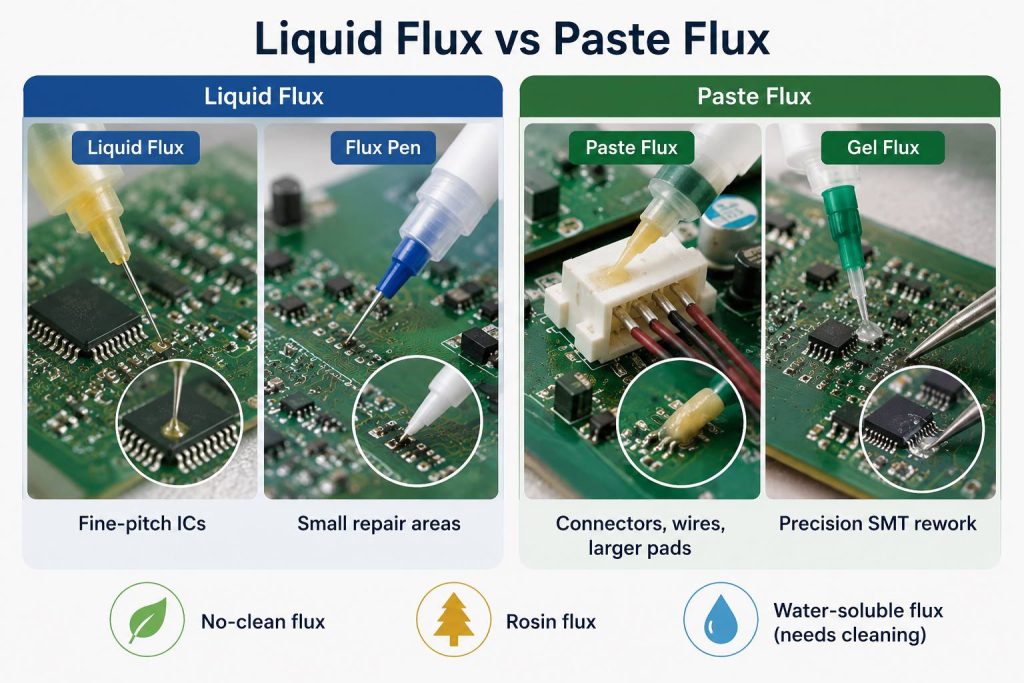
External flux can support wetting during bridge removal, solder-wick use, or joint touch-up. Select the form around access: a pen offers localized delivery, while a compatible tacky formulation stays near a rework area.
Liquid, gel, and paste-like flux describe delivery behavior. They do not establish activity level, residue acceptability, or cleaning requirements by themselves.
When Is Solder Paste the Better Choice?
Solder paste is the better choice when the assembly requires solder deposited onto pads before components pass through a reflow process.
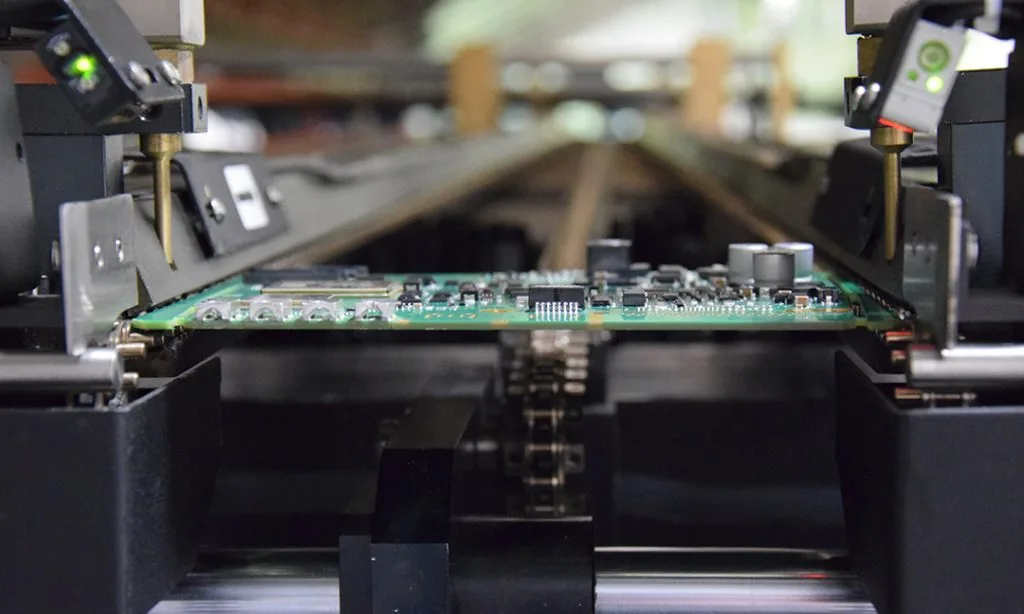
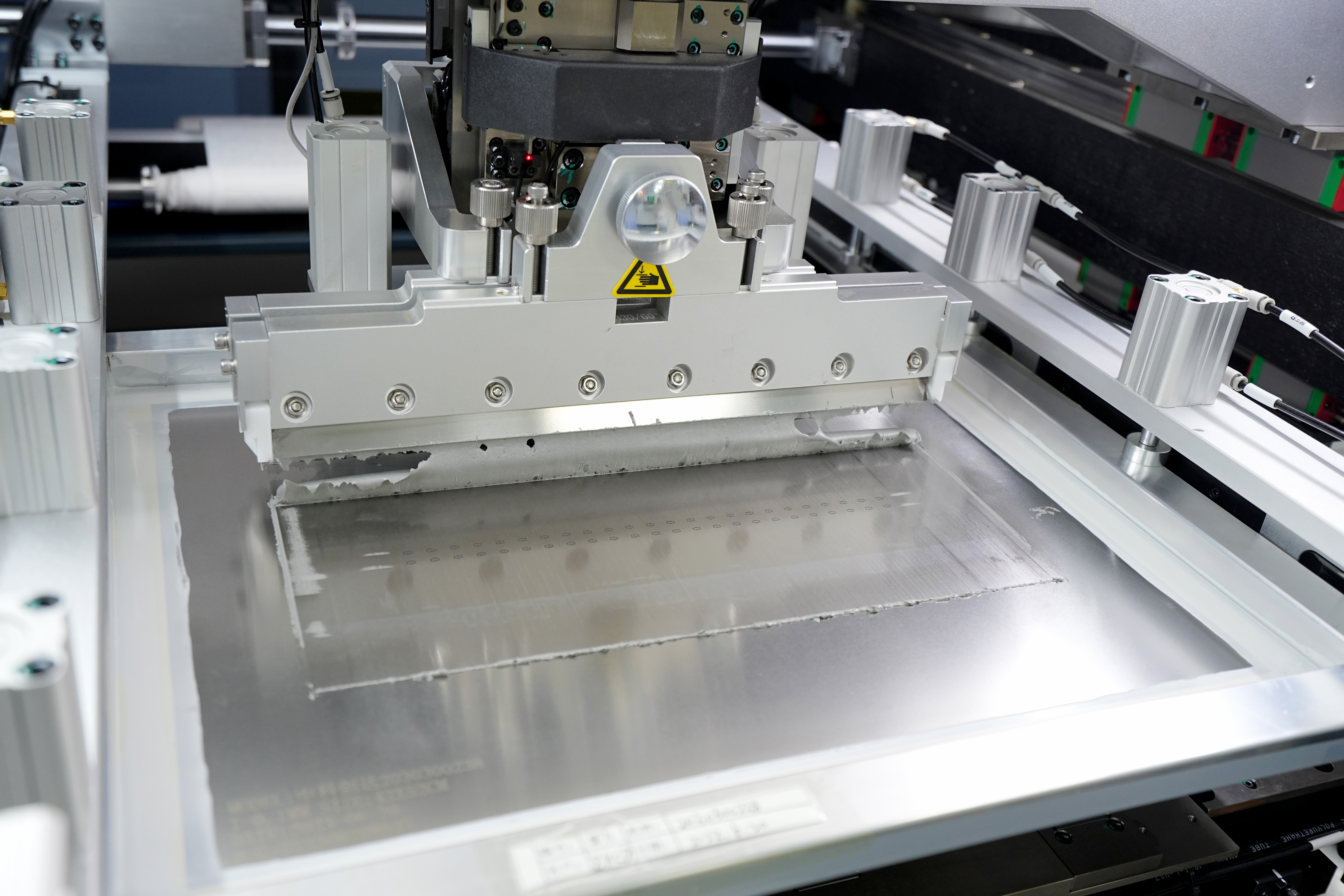
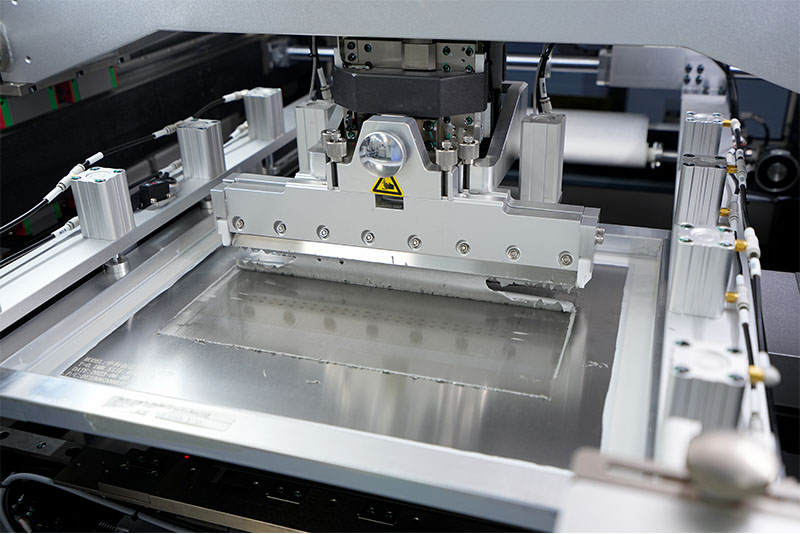
Stencil printing can apply many deposits in one operation. Placement equipment then positions the components, and the thermal cycle activates the flux, melts the alloy, and allows joints to form during cooling.
The material must suit the application method:
- Stencil-printing paste needs suitable aperture filling, release, and shape retention.
- Dispensing paste needs controlled flow through the specified delivery system.
- Jetting paste needs a formulation qualified for the particular jetting equipment.
A syringe package alone does not establish that a material will dispense through every needle.
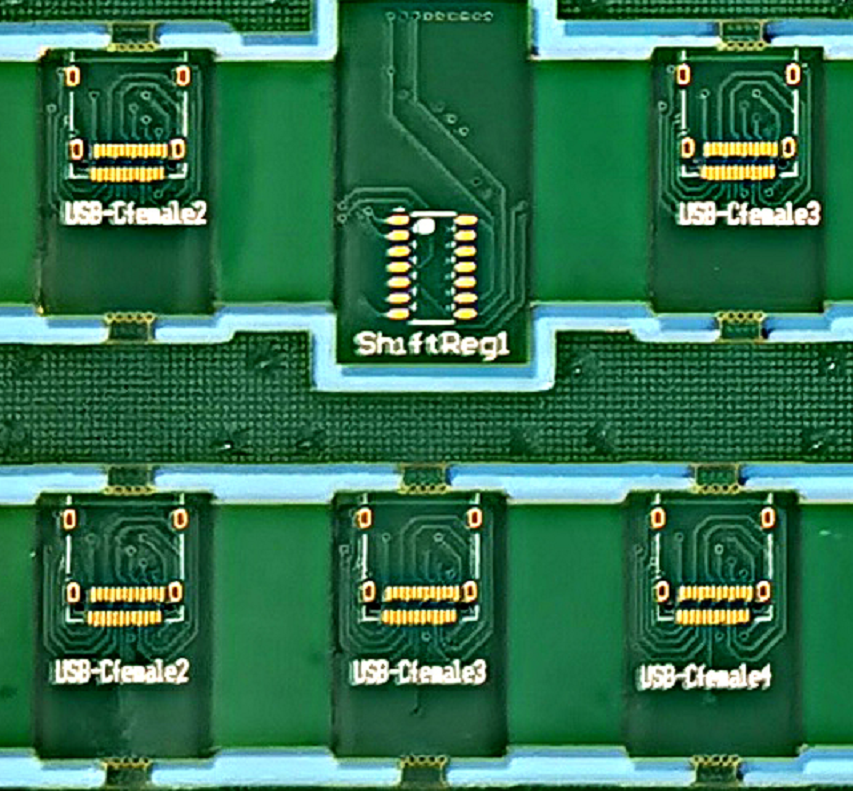
Solder volume deserves as much attention as paste chemistry. Excess deposit volume can contribute to bridging, while insufficient volume can contribute to weak or open connections. Stencil thickness, aperture dimensions, printing alignment, and transfer efficiency all affect the result.
Large thermal pads need particular care. Their aperture pattern should support suitable solder coverage and gas escape during reflow. Evaluate the component manufacturer’s footprint guidance alongside the printing and thermal process.
For prototypes, paste is useful when the build needs to represent the intended SMT process. Hand soldering may suit a simple test circuit, while printed paste and reflow provide more relevant information for a design moving toward automated assembly.
What should SPI check before component placement?
Solder paste inspection checks deposit volume, area, height and position. It helps detect missing paste, insufficient or excessive deposits and misalignment before reflow. Set acceptance limits from the approved stencil and assembly process; equipment resolution is not the same as measurement accuracy or a guaranteed detectable defect size.
Our SPI inspection accuracy can reach approximately 10 µm. Measurement accuracy is not a universal minimum detectable defect size; inspection limits still depend on the deposit geometry, inspection setup and assembly requirements.
How Should You Compare Processing and Storage Parameters?
Compare specifications at the exact product-and-grade level. Keep storage life, stencil life, tack time, and printing-pause performance separate because each describes a different condition.
How do we handle solder paste before printing?
At EBest Circuit, our typical solder paste handling controls are:
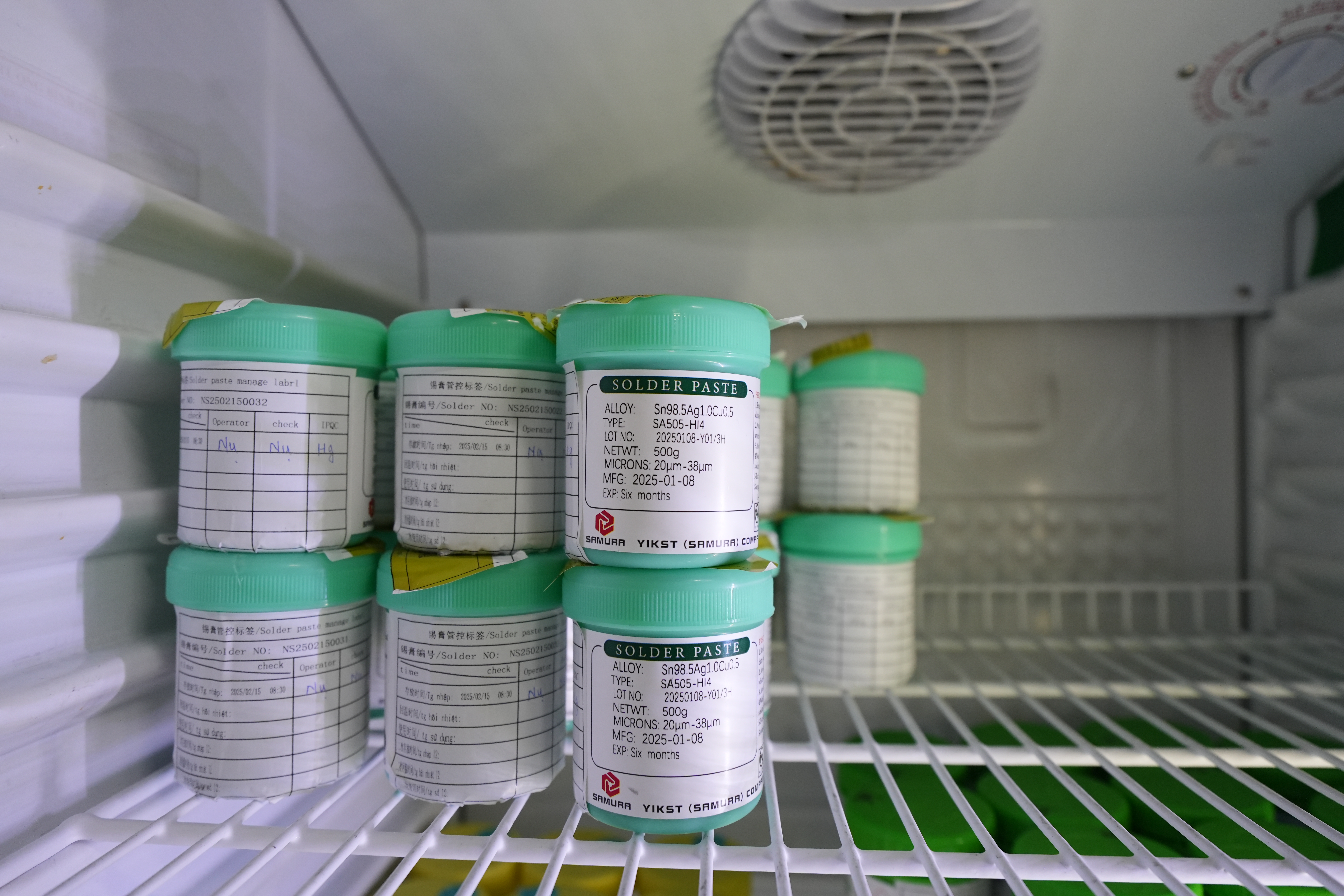
- Refrigerated storage: 2–10°C. Keep containers sealed and track the material lot and expiration date.
- Warm-up before use: about 4 hours. Keep the container sealed while the paste returns to its specified working temperature.
- Mixing before printing: about 3 minutes. Use the approved mixing method for the selected paste.
These are our typical production settings. Apply any material-specific handling requirements for the approved paste and packaging.
Typical shelf-life ranges are 3–6 months for solder paste and 6–24 months for flux. The exact expiration date and storage conditions depend on the formulation and packaging. Use the product label and material specification to release each lot; shelf life is separate from open-container working life and time on the stencil.
How do formulation-specific specifications differ?
For the EP256 Sn63Pb37, 90% metal formulation, the following parameters illustrate the separate controls needed for storage and printing. They are not universal settings for lead-free or other solder pastes.
| Parameter | Value and conditions |
|---|---|
| Reference formulation for physical data | Sn63Pb37, 90% metal |
| Typical viscosity | 1,400 poise (140 Pa·s) at 25°C; Malcom viscometer, 10 rpm |
| Optimal printing environment | 21–25°C and 35–65% RH |
| Stencil life | 8+ hours, process dependent |
| Printing-pause capability | Up to 90 minutes under stated conditions |
| Recommended refrigerated storage | 0–10°C |
| Shelf life | Six months from manufacture when properly handled at 0–10°C |
| Flux classification | ROL1 under the referenced J-STD-004B classification |
Keep the formulation, storage temperature and time limits together in the work instruction. Do not apply this six-month shelf life or 90-minute print pause to a different paste.
Keep refrigerated paste sealed while it reaches the specified working temperature, then open and mix it using the approved method. Container size, formulation and starting temperature affect warm-up time. Excessive or uncontrolled mixing can change paste temperature and rheology.
Record the material lot, expiration date, removal from storage, opening time, and permitted working exposure. This gives the production team a way to investigate printing changes without guessing about material history.
Does No-Clean Flux Mean the Board Never Needs Cleaning?
“No-clean” describes a formulation intended to leave residues suitable for specified applications when processed correctly. The final decision depends on the assembly’s electrical requirements, environment, and subsequent operations.
A board with sensitive analog inputs, close conductor spacing, protective coating, or demanding humidity exposure may require additional evaluation.
Review residue where it actually remains. Material trapped beneath low-standoff components can be harder to inspect and remove than exposed surface residue. Rework also introduces a separate application of flux, which may receive a different heating cycle from the original solder paste.
For water-soluble materials, establish the cleaning method, access, timing, rinsing, and drying requirements before production. “Water-soluble” identifies a cleaning characteristic; it does not define a complete cleaning procedure.
If cleaning is required, verify:
- Compatibility with components, markings, adhesives, and coatings.
- Access beneath the relevant packages.
- Removal of the particular flux residue.
- Suitable rinsing and complete drying.
- The inspection or testing needed for the application.
A visually clean board can still need further cleanliness assessment. Use the project’s requirements and appropriate validation method to decide acceptance rather than appearance alone.
How Do You Choose the Right Material for Your PCB Assembly?
Start with the operation that forms the joint, then narrow the material choice around the assembly.
First, identify the solder source. A reflow operation generally needs paste or another planned solder deposit. Manual soldering normally uses wire, while wave soldering uses a solder bath with separately applied flux.
Second, confirm the alloy requirements. Check compliance, component compatibility, thermal limits, and any approved material restrictions. A higher processing temperature does not automatically produce a stronger or more suitable joint.
Third, check the smallest printed feature. Review the stencil opening, thickness, area ratio, and paste grade together. Component pitch is useful context, but aperture dimensions provide a more direct printing check.
Fourth, agree on residue treatment. Select the no-clean or cleaning route before the first production build, including any coating or bonding operations that follow soldering.
Finally, validate the assembled result. Printing, placement, reflow, inspection, and electrical testing should confirm that the selected material works within the intended process.
A useful approval record includes the exact material code, alloy, powder grade, supplier documentation, storage controls, printing setup, measured thermal profile, and inspection results. Real records make repeat orders easier to control.
How Can You Tell Whether a Defect Comes from Flux or Solder Paste?
Investigate the point where the process first departs from its expected result. A visible soldering defect may have several causes, so changing the flux or paste should follow evidence.
For bridging, inspect the printed deposit first. Check alignment, volume, aperture condition, and slump. Then review component placement and behavior during reflow. Additional flux is not a substitute for correcting excessive solder volume.
For incomplete wetting, check surfaces and heating together. Review pad finish, component solderability, contamination, material age, and the measured thermal profile. The flux must remain active when the surfaces need it.
For inconsistent printing, review handling and equipment. Check paste temperature, exposure history, stencil cleanliness, support, squeegee settings, and replenishment practices.
For residue concerns, compare material and process records. Confirm which paste and rework flux were used, how they were heated, and whether the cleaning procedure addressed both materials.
A controlled investigation changes one relevant factor at a time and compares measurable results. Useful evidence includes paste deposit measurements, microscope images, temperature profiles, defect locations, and material-lot records.
FAQs About Soldering Flux vs Soldering Paste
Q1: Can plumbing flux be used on a PCB?
A1: Use electronics-grade flux specified for the assembly because plumbing formulations can leave residues unsuitable for electronic circuits.
Q2: Is flux-cored solder wire enough for hand soldering?
A2: Flux-cored wire can supply sufficient flux for suitable clean joints, while additional compatible flux may help with selected surfaces or rework operations.
Q3: Can dried solder paste be restored by adding liquid flux?
A3: Additives change the formulation, so use only a recovery method explicitly approved by the paste manufacturer.
Q4: Can two solder paste brands be mixed on the stencil?
A4: Keep materials separate unless the combination has been specifically approved and validated for the process.
Q5: Is lead-free solder paste automatically halogen-free?
A5: Lead content describes the alloy, while halogen content describes a separate material characteristic that requires its own declaration.
Q6: Is tacky flux suitable for BGA reballing?
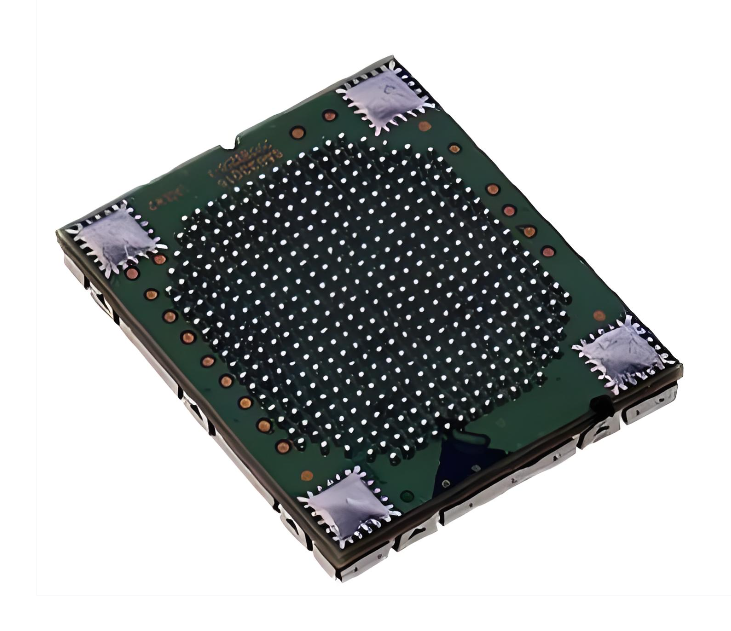
A6: A tacky flux may suit BGA reballing when its manufacturer specifies compatibility with the alloy, thermal cycle, and residue requirements.
Q7: Does a dull solder joint mean the flux failed?
A7: Joint appearance depends on alloy, finish, geometry, and processing, so dullness alone does not establish a flux failure.
How Can EBest Circuit Support Your Soldering Material Selection?
For a PCB assembly project, material selection works best when it is reviewed with the board layout, component packages, manufacturing sequence, and required inspection.
We review production files and discuss the soldering requirements alongside PCB fabrication, component sourcing, assembly, and project-defined testing. The review should identify material restrictions, fine-pitch features, heat-sensitive components, cleaning expectations, and any customer-approved process requirements.
Send your Gerber files, BOM, pick-and-place file, quantities, and testing requirements to sales@bestpcbs.com. Include any specified solder alloy, approved paste or flux, cleanliness requirements, and coating needs so these conditions can be considered before quotation and production planning.