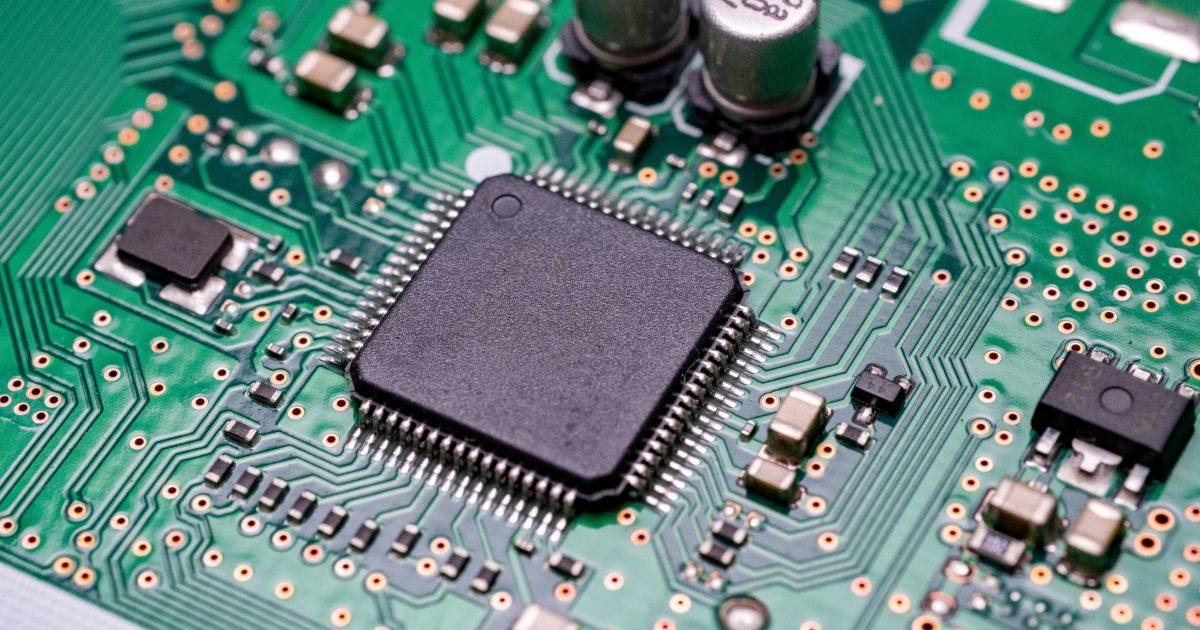
When engineers compare an aluminum vs copper heatsink, they are usually looking for a better way to move heat away from electronic components. In PCB and PCBA projects, the heatsink is only one part of the thermal path. Heat must pass through solder joints, copper pads, PCB materials, thermal vias, metal cores, and finally to the heatsink, enclosure, or air. If this path is not well designed, even a high-performance heatsink may not fully solve overheating.
EBest Circuit (Best Technology) supports thermal management PCB and PCBA solutions, including aluminum PCB, copper core PCB, ceramic PCB, heavy copper PCB, and full turnkey PCB assembly. Since copper thermal conductivity is much higher than many common PCB materials, copper-based structures can help spread heat faster in high-power and high-current applications. Our engineering team can help review your PCB structure, copper thickness, material selection, component layout, and assembly requirements before production. If your project involves LED PCB, power electronics, automotive PCBA, industrial control boards, or high-current circuits, you can send your Gerber files, BOM, or thermal requirements to sales@bestpcbs.com for a practical engineering review.
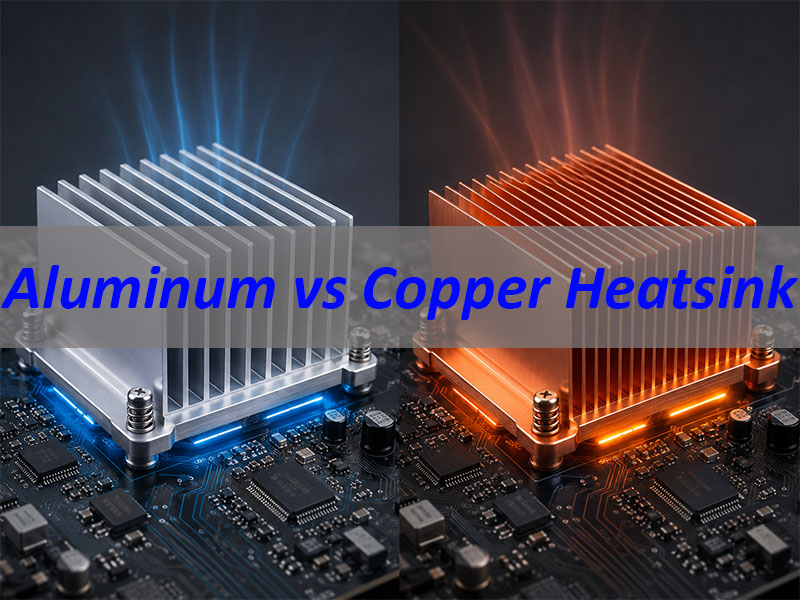
Aluminum vs Copper Heatsink: What Is the Main Difference?
The main difference is simple: copper conducts heat better, while aluminum offers a better balance of weight, cost, and manufacturability.
Copper is useful when heat is concentrated in a small area. It can move heat away from power components faster, which helps reduce local hotspots.
Aluminum is lighter and easier to form into fins. Since heatsinks need surface area to release heat into air, aluminum is widely used for large cooling structures.
| Factor | Copper | Aluminum |
|---|---|---|
| Thermal conductivity | Higher | Lower |
| Weight | Heavy | Light |
| Cost | Higher | Lower |
| Best use | Hotspots, compact high-power areas | Large fins, general cooling |
| PCB/PCBA role | Heat spreader, copper core, heavy copper | Aluminum PCB, MCPCB, external heatsink |
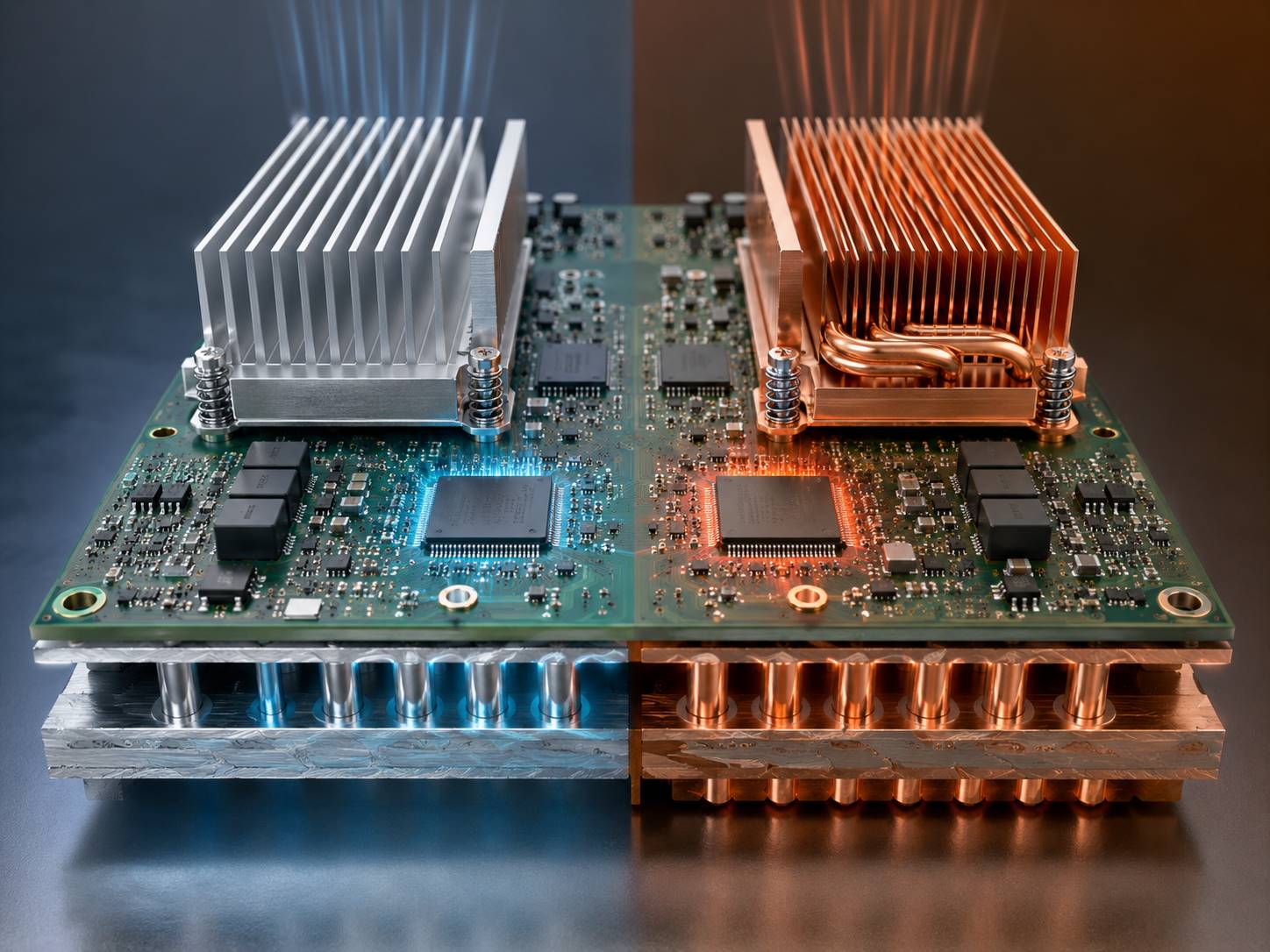
In real products, many designs use both materials. A copper base spreads heat quickly, while aluminum fins provide larger cooling area with lower weight and cost.
Why Does Heatsink Material Matter in PCB and PCBA Thermal Design?
Heatsink material matters because it affects how quickly heat leaves critical components. But in PCB and PCBA design, it should not be selected alone.
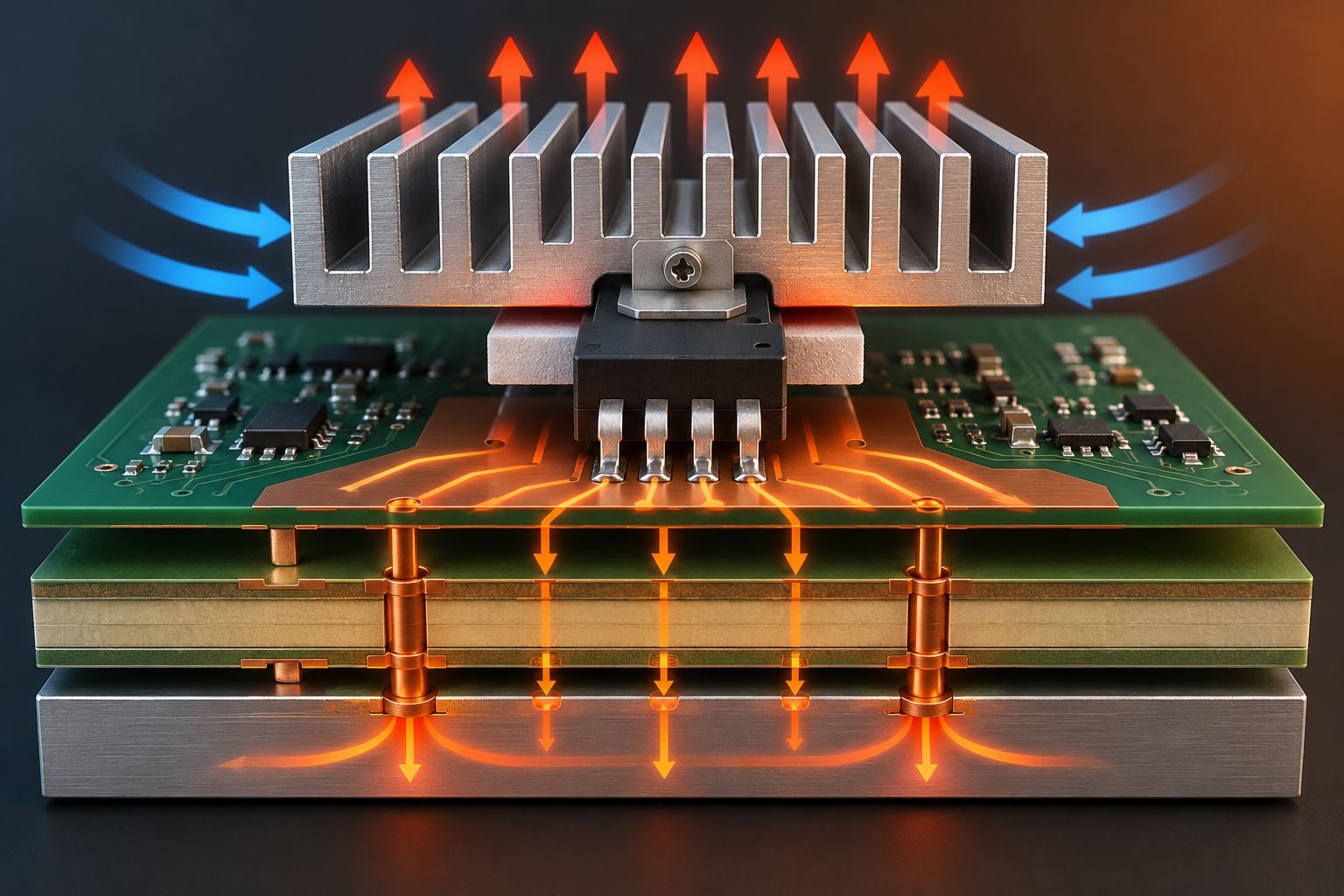
A typical thermal path looks like this:
Component → solder joint → copper pad → PCB structure → heatsink → air or enclosure
If the PCB structure blocks heat transfer, the heatsink cannot work efficiently. For example, standard FR4 may not be enough for high-power LEDs, MOSFETs, IGBTs, or dense power modules.
Before choosing a heatsink, engineers should check:
- Heat source position
- Power density
- Copper thickness
- Thermal vias
- Metal core material
- Dielectric thermal conductivity
- Component layout
- Mounting pressure
- Airflow and enclosure design
For low-power boards, FR4 with copper pours and thermal vias may be enough. For high-power products, aluminum PCB, copper core PCB, ceramic PCB, or heavy copper PCB may be more suitable.
Aluminum vs Copper Heatsink: Which Has Better Thermal Conductivity?
Copper has better thermal conductivity than aluminum.
Pure copper is usually around 385–401 W/m·K. Common aluminum materials are often around 205–237 W/m·K, depending on alloy grade and processing.
This means copper moves heat faster inside the material. When a component creates a small hotspot, copper can spread that heat more effectively.
However, heatsink performance also depends on surface area and airflow. Aluminum can be extruded into large fin structures, which helps release heat into the air at a lower cost and weight.
For PCB and PCBA cooling, the material choice often follows this logic:
| Need | Suitable Option |
|---|---|
| Faster heat spreading | Copper core PCB, copper base, heavy copper |
| Lightweight cooling | Aluminum PCB, aluminum heatsink |
| High insulation and heat transfer | Ceramic PCB |
| High current carrying | Heavy copper PCB |
| General LED cooling | Aluminum PCB |
Copper wins in conductivity. Aluminum often wins in cost, weight, and production practicality.
Why Are Most Heatsinks Made of Aluminum Instead of Copper?
Most heatsinks are made of aluminum because it is light, cost-effective, and easy to process.
Copper conducts heat better, but it is much heavier and more expensive. For the same size, copper is more than three times heavier than aluminum. In many PCBA products, that weight can create mechanical stress on the board or enclosure.
Aluminum can also be extruded into thin fins. This gives the heatsink more surface area, which is important for air cooling.
Aluminum is widely used in:
- LED lighting modules
- Power supply boards
- Automotive electronics
- Industrial control equipment
- Communication devices
- Consumer electronics
- Aluminum PCB assemblies
Copper is usually used where its higher thermal conductivity brings clear value, such as copper bases, heat spreaders, copper cores, or high-power zones.
That is why aluminum is more common, but copper remains important in demanding thermal designs.
Do Copper Heatsinks Cool Faster Than Aluminum Heatsinks?
Copper can absorb and spread heat faster than aluminum. This is useful when heat is concentrated in a small area.
Typical examples include MOSFETs, IGBTs, power ICs, LED chips, processors, and high-current components. These parts can create local hotspots if heat is not moved away quickly.
But cooling speed is not decided by material alone. It also depends on:
- Contact area
- Thermal interface material
- Mounting pressure
- Fin design
- Airflow
- PCB copper area
- Thermal via design
- Soldering quality
A full copper heatsink may perform well, but it can be too heavy or expensive. In many cases, a copper base with aluminum fins is more practical.
At the PCB level, copper core PCB or heavy copper PCB can also help spread heat before it reaches the external heatsink. This can be more effective than simply adding a larger heatsink later.
Is Aluminum or Copper Better for PCB and PCBA Cooling?
For PCB and PCBA cooling, aluminum and copper solve different problems.
Aluminum is better when the product needs a lightweight, cost-controlled, and manufacturable cooling structure. It is widely used in LED PCB, power supply PCB, and many metal core PCB applications.
Copper is better when the design has high heat density, high current, or limited space. It is often used in copper core PCB, heavy copper PCB, copper inlay PCB, copper heat spreaders, or high-power thermal zones.
A practical selection rule is:
| Application | Common Thermal Choice |
|---|---|
| LED lighting | Aluminum PCB + aluminum heatsink |
| High-power LED | Aluminum PCB, copper base, or ceramic PCB |
| Power supply | Heavy copper PCB + heatsink |
| Automotive power module | Copper core PCB or ceramic PCB |
| Industrial control PCBA | Heavy copper PCB or aluminum heatsink |
| High-current circuit | Heavy copper, copper bus bar, copper core |
| Compact high-power module | Copper spreader, ceramic PCB, copper core |
The best material is not always the most expensive one. The right choice is the structure that keeps component temperature within a safe range while meeting cost, size, and reliability targets.
What Are the Weight and Cost Differences Between Aluminum and Copper Heatsinks?
Weight and cost are two major reasons aluminum is more common.
Copper has a density of about 8.96 g/cm³, while aluminum is about 2.70 g/cm³. For the same volume, copper is more than three times heavier.
This matters because many heatsinks are mounted directly on or near the PCBA. Extra weight can increase mechanical stress, screw requirements, vibration risk, shipping cost, and assembly difficulty.
Copper also costs more. It may require more careful machining and assembly control.
Aluminum is easier to process and better for large fin structures. It provides useful cooling area without making the product too heavy.
Still, the cheapest option is not always the best option. If poor thermal design causes overheating, unstable performance, LED lumen decay, or early failure, the total cost becomes much higher.
A cost-effective thermal design should match the PCB structure, heatsink material, and assembly process from the beginning.
When Should You Choose Copper-Based Thermal Solutions?
Choose copper-based thermal solutions when heat must move quickly from a small or high-power area.
Copper is suitable when the design has:
- High heat density
- High current
- Limited board space
- Compact structure
- Strict temperature limits
- Poor airflow
- High reliability requirements
In PCB and PCBA manufacturing, copper-based solutions may include:
- Copper core PCB
- Heavy copper PCB
- Copper inlay PCB
- Copper coin PCB
- Copper heat spreader
- Copper base heatsink
- Copper bus bar assembly
These options are common in power electronics, automotive modules, LED power boards, motor control, communication amplifiers, charging equipment, and other high-power products.
Copper should be used where its performance brings clear value. For many projects, copper near the heat source plus aluminum for larger dissipation area is a more balanced solution.
When Should You Choose Aluminum-Based Thermal Solutions?
Choose aluminum-based thermal solutions when the product needs good heat dissipation, lower weight, easier production, and better cost control.
Aluminum is suitable when the design has:
- Moderate heat load
- Larger cooling area
- Cost-sensitive production
- Weight-sensitive structure
- LED lighting application
- Good airflow or enclosure cooling
- Mass production demand
In PCB and PCBA projects, aluminum is widely used in aluminum PCB, metal core PCB, LED PCB, power supply PCB, automotive lighting PCB, and industrial lighting modules.
Aluminum PCB is especially common in LED thermal management. It transfers heat from LED chips through the dielectric layer to the aluminum base, then to the heatsink or housing.
If the thermal requirement is not extreme, aluminum-based design is often the most practical choice. It offers a strong balance of performance, cost, weight, and manufacturability.
Why Choose EBest Circuit for PCB and PCBA Thermal Management Solutions?
Choosing between aluminum and copper heatsinks is only one part of thermal design. In many electronic products, the PCB and PCBA structure decide whether heat can move away from components efficiently.
EBest Circuit, also known as Best Technology, provides PCB and PCBA solutions for products that require stable heat dissipation. We support aluminum PCB, copper core PCB, ceramic PCB, heavy copper PCB, FR4 PCB, rigid-flex PCB, and turnkey PCB assembly.
We help customers select suitable thermal structures based on:
- Power density
- Current load
- Heat source position
- Product size
- Working environment
- Electrical insulation needs
- Prototype or mass production quantity
- Cost target
For LED lighting, automotive electronics, industrial control, power modules, communication equipment, medical electronics, and high-current PCBA projects, thermal performance is directly linked to reliability.
Our engineering team can help review Gerber files, stack-up, copper thickness, dielectric material, thermal vias, surface finish, BOM, component placement, and assembly requirements before production.
This helps identify thermal risks early, instead of discovering problems after PCBA testing or field use.
EBest Circuit supports both PCB fabrication and PCBA assembly, helping customers turn thermal design requirements into manufacturable products.
FAQs About Aluminum vs Copper Heatsink
1. Is copper better than aluminum for heatsinks?
Copper transfers heat faster, but aluminum is lighter, cheaper, and easier to form into large fin structures. Copper is better for high heat density. Aluminum is more practical for many general cooling designs.
2. Why are aluminum heatsinks more common than copper heatsinks?
Aluminum heatsinks are more common because they balance cooling performance, weight, cost, and manufacturability. Many products do not need full copper cooling.
3. Does copper dissipate heat better than aluminum?
Copper conducts heat better inside the material. But heat dissipation also depends on surface area, airflow, fin design, thermal interface material, and mounting quality.
4. Is a full copper heatsink worth it?
A full copper heatsink may be useful for compact, high-power products. For many designs, a copper base with aluminum fins gives a better balance.
5. Is aluminum or copper better for LED PCB cooling?
Aluminum PCB is commonly used for LED cooling because it is lightweight and cost-effective. Copper may be used for high-power LED modules that need faster heat spreading.
6. Is copper core PCB better than aluminum PCB?
Copper core PCB usually spreads heat better, but it costs more and is heavier. Aluminum PCB is suitable for many LED and power applications. Copper core PCB is better for higher heat density.
7. Can aluminum and copper be used together in one cooling design?
Yes. Many designs use copper near the heat source and aluminum for larger fin areas. This helps balance thermal performance, weight, and cost.
8. Can a heatsink solve all PCB overheating problems?
No. A heatsink works only when heat can reach it efficiently. If the PCB structure, solder pad, thermal vias, or dielectric material limit heat transfer, a larger heatsink may not fully solve the problem.
9. Which PCB material is best for thermal management?
There is no single best material for all products. Aluminum PCB suits many LED and power applications. Copper core PCB supports high heat density. Heavy copper PCB supports high current. Ceramic PCB is suitable for high thermal conductivity and insulation.
Choosing the right heatsink material is important, but reliable cooling depends on the full PCB and PCBA thermal path. If your project requires aluminum PCB, copper core PCB, ceramic PCB, heavy copper PCB, or turnkey PCBA with better heat dissipation, you can send your Gerber files, BOM, or thermal requirements to EBest Circuit at sales@bestpcbs.com for engineering review.